fuel pressure SKODA SUPERB 2005 1.G / (B5/3U) Owner's Manual
[x] Cancel search | Manufacturer: SKODA, Model Year: 2005, Model line: SUPERB, Model: SKODA SUPERB 2005 1.G / (B5/3U)Pages: 281
Page 27 of 281

Instruments and Indicator/Warning Lights
26
– Obtain professional assistance.
Meaning of the red symbols:
Three successive warning signals will sound if a red symbol appears. The
symbol continues flashing until the fault is rectified.
If several operational faults of priority 1 exist, the symbols appear one after
the other and are each illuminated for about 2 seconds.
Yellow symbols
A yellow symbol signals a warning.
The meaning of the yellow symbols:
Faults in the brake surface⇒ page 37
Coolant level too low/coolant tempera-
ture too high⇒page 32
Engine oil pressure too low⇒page 33
Fuel level low⇒page 33
Check engine oil level, engine oil sensor
faulty⇒page 33
Brake pad worn⇒page 33
Washer fluid level low⇒page 34
Light bulb defect⇒page 35
Light bulb in the brake light defect⇒page 35
Fig. 15 Information
display: Fuel level low
s3ec.book Seite 26 Montag, 2. Mai 2005 3:42 15
Page 34 of 281
Instruments and Indicator/Warning Lights33
Using the systemSafetyDriving TipsGeneral MaintenanceBreakdown assistanceTechnical Data
If the coolant is within the specified range, the increased temperature may
be caused by an operating problem at the coolant fan. Check the fuse for
the coolant fan, replace it if necessary
⇒page 260, “Replacing fuses”.
Do not continue driving if the warning light does not go off although the
fluid is at the correct level and also the fuse of the fan is in proper order.
Contact a specialist garage to obtain assistance.
Please also refer to the additional instructions ⇒page 226, “Replenishing
the coolant”.
The following text will be displayed in the information display*:
STOP CHECK COOLANT SERVICE MANUAL (STOP! CHECK
COOLANT! OWNER'S MANUAL)
WARNING
•If you must stop for technical reasons, then park the vehicle at
a safe distance from the traffic and switch off the engine and switch
on the hazard warning light system ⇒page 60.
•Take care when opening the co olant expansion bottle. If the
engine is hot, the cooling system is pressurized - risk of scalding!
It is best to allow the engine to cool down before removing the cap.
•Do not touch the coolant fan! The coolant fan may switch on
automatically even if the ignition is off.
Brake pad wear
If the warning light comes on, contact a specialist garage immediately
and have the brake pads on all of the wheels inspected.
A peep sounds as an additional warning signal. The following text will be displayed in the information display*:
CHECK BRAKE PADS
Bonnet
The warning light comes on when the ignition is switched on if the
bonnet is unlocked.
Fuel reserve
The warning light comes on, if the fuel level is still below 8 litres.
A peep sounds as an additional warning signal.
The following text will be displayed in the information display*: PLEASE REFUEL
Engine oil
The warning light lights up red (low oil pressure)
The warning light comes on for a few seconds 2) when the ignition is
switched on.
Stop the vehicle and switch the engine off if the warning light does not
go off after the engine has started or flashes while driving. Check the oil
level and top up with oil as necessary ⇒page 223.
2)The warning light on vehicles fitted with information display does not come on
after switching the ignition on, but only if a fault exists or the engine oil level is too
low.
s3ec.book Seite 33 Montag, 2. Mai 2005 3:42 15
Page 35 of 281
Instruments and Indicator/Warning Lights
34
3 peeps sound as an additional warning signal.
Do not continue your journey if for some reason it is not possible under
the conditions prevailing to top up with oil. Keep the engine switched off
and obtain professional assistance from a specialist garage, otherwise it
could lead to severe engine damage.
Do not drive any further if the warning light remains on even if the oil is
at the correct level. Do not run the engine not at idling speed either.
Contact the nearest specialist garage to obtain professional assistance.
The following text will be displayed in the information display*:
STOP! OIL PRESS. STOP MOTOR! SERVICE MANUAL (STOP! OIL
PRESSURE STOP ENGINE! OWNER'S MANUAL)
lights up yellow* (quantity of oil too low)
If the warning light lights up yellow, there is not the correct quantity of oil
in the engine. Check as soon as possible the oil level or top up
⇒ page 223 with engine oil.
A peep sounds as an additional warning signal.
The following text will be displayed in the information display*: CHECK OIL LEVEL
The warning light will go out if the bonnet is left open for more than 30
seconds. If no engine oil has been replenished, the warning light will come
on again after driving about 100 km.
The warning light
flashes yellow* (engine oil level sensor faulty)
A fault on the engine oil level sensor is indicated additionally by an audible
signal and the warning light coming on several times after the ignition has
been switched on.
In this case have the engine inspected without delay by a specialist
garage. The following text will be displayed in the information display*:
OIL SENSOR WORKSHOP! (OIL SENSOR WORKSHOP)
WARNING
•If you must stop for technical reasons, then park the vehicle at
a safe distance from the traffic and switch off the engine and switch
on the hazard warning light system ⇒page 60.
•The red oil pressure light is not an oil level indicator! One
should therefore check the oil level at regular intervals, preferably
after every refueling stop.
Open door
The warning light comes on if one or several doors are opened or if the
boot lid is opened.
The warning light on vehicles fitted with information display comes on
when switching the ignition off. The warning light goes out about 15
seconds after locking the vehicle.
The warning light on vehicles fitted with information display goes out after
switching the ignition off.
Windshield washer fluid level
The warning light comes on when the ignition is switched on if there is
insufficient fluid in the windshield washer system. Top up the fluid
⇒ page 233.
A peep sounds as an additional warning signal.
s3ec.book Seite 34 Montag, 2. Mai 2005 3:42 15
Page 68 of 281

Lights and Visibility67
Using the systemSafetyDriving TipsGeneral MaintenanceBreakdown assistanceTechnical Data
The rain sensor* automatically regulates the break between the individual
wiper strokes depending on the intensity of the rain.
Top up with wash liquid
⇒page 233.
WARNING
•Properly maintained windscreen wiper blades are essential for
clear visibility and safe driving ⇒page 68.
•Do not use the windscreen washer system at low temperatures,
without heating the windscreen beforehand. Otherwise the window
cleaner could freeze on the windscreen and restrict the view to the
front.
•The rain sensor only operates as a support. The driver is not
released from the responsibility to set the function of the wind-
screen wipers manually depending on the visibility conditions.
Caution
In frosty weather, please first of all check whether the windscreen wiper
blades are not frozen to the windscreen before switching them on.
Switching on windscreen wipers when the blades are frozen to the wind-
screen may result in damage both to the blades and the motor of the wind-
screen wipers!
Headlight cleaning system*
The headlight lenses are cleaned, when low beam or main beam are
switched on by holding ⇒page 66 the lever for about 2 seconds in the
position .
The headlight washer nozzles are moved forward out of the bumper by the
water pressure for cleaning the headlights.
You should remove stubborn dirt (such as insect residues) from the head-
light lenses at regular intervals, for example when refuelling. Please refer
to the following guidelines ⇒page 209, “The headlight lenses”.
You should remove any snow from the fixtures of the washer nozzles and
clear ice in winter with a de-icing spray in order to ensure proper operation
of the cleaning system.
Fig. 50 Headlight with
washer nozzle
extended
A5
s3ec.book Seite 67 Montag, 2. Mai 2005 3:42 15
Page 198 of 281

Driving and the Environment197
Using the systemSafetyDriving TipsGeneral MaintenanceBreakdown assistanceTechnical Data
Avoid driving short distances
Short distances result in an above-average high fuel
consumption.
– Avoid driving a distance of no more than 4 km if the engine is
cold.
The engine and catalytic converter must first have reached their optimal
operating temperature in order to effectively reduce fuel consumption
and pollutant emissions.
The cold engine vehicle consumes approx. 20 - 30 litres/100 km of fuel
immediately after starting. Fuel consumption drops to 15 litres/100 km
after just 1 kilometre. The engine reaches its operating temperature
(outside temperature and engine dependent) only after about 4 to 10 kilo-
metres and the fuel consumption then stabilizes. You should therefore
avoid driving short distances whenever possible. An important factor in this connection is also the
ambient temperature.
The ⇒fig. 164 shows the different fuel consumptions for the same
distance, on the one hand at +20°C and on the other hand at -10°C. Your
vehicle has a higher fuel consumption in winter than in summer.
Checking tyre inflation pressures
Tyres which are correctly inflated save fuel.
Always ensure that your tyres are inflated to the correct pressure at all
times. The rolling resistance will be increased if the tyre filling pressure is
too low. This will not only increase fuel consumption but also tyre wear
and the driving behaviour will worsen.
Always check the inflation pressure of the tyres when cold.
Do not drive with winter tyres all year round for this costs about 10 %
more fuel. Winter tyres are also louder.
No unnecessary ballast
Transporting ballast costs fuel.
The fact that every kilogram of extra weight increases your fuel consump-
tion means that it is worth taking a look in the luggage compartment to
avoid transporting any unnecessary ballast.
It is particularly in town traffic, when one is accelerating quite often, that
the vehicle weight will have a significant effect upon the fuel consumption.
A rule of thumb here is that an increase in weight of 100 kilograms will
cause an increase in fuel consumption of about 1 litre/100 kilometres.
You may frequently also leave a roof rack fitted on just out of conven-
ience, although you no longer need it. The increased aerodynamic drag of
Fig. 164 Fuel
consumption in
litres/100 km at
different temperatures
s3ec.book Seite 197 Montag, 2. Mai 2005 3:42 15
Page 218 of 281

Fuel217
Using the systemSafetyDriving TipsGeneral MaintenanceBreakdown assistanceTechnical Data
– Press the fuel tank flap closed.
The correct grade of fuel for your vehicle as well as the tyre size and infla-
tion pressures are stated on a sticker affixed to the inside of the fuel filler
flap. Further information on fuel ⇒page 214, “Fuel”.
The fuel tank has a capacity of about 62 litres.
WARNING
Pay attention to any legal requirements if you do carry a spare
canister in the vehicle. We do not recommend carrying any fuel
canisters in your vehicle for safety reasons. The canister can be
damaged in the event of an accident and fuel may leak out.
Caution
•Remove any fuel which has spilled onto the paintwork of your vehicle
immediately. This particularly applies to biodiesel - risk of paint damage!
•Vehicles fitted with catalytic converter should never be allowed to let
the fuel tank to run completely empty. An irregular supply of fuel to the
engine can result in misfiring and unburnt fuel may get into the exhaust
system, which may result in overheating and damage to the catalytic
converter.
For the sake of the environment
The fuel tank is full just as soon as the pump nozzle switches off for the
first time, provided the nozzle has been operated properly. You should not
continue refuelling - otherwise the expansion chamber in the fuel tank will
also be filled with fuel. Fuel might flow out of the tank when it heats up.
Emergency release of fuel filler flap
If the electric lock is faulty, you can also unlock the fuel filler flap
manually.
– Open the boot lid/luggage compartment door.
– Unscrew the clip attaching the right-hand side trim panel and
pull the trim panel off the body.
– Pull on the loop in direction of arrow in order to unlock the fuel filler flap ⇒fig. 167 .
WARNING
When unlocking the fuel filler flap manually, pay attention to sharp
edges of the body - risk of injury!
Fig. 167 Luggage
compartment: Emer-
gency release of fuel
filler flap
s3ec.book Seite 217 Montag, 2. Mai 2005 3:42 15
Page 237 of 281
Wheels and Tyres
236
Tyre life
The life of your tyres very much depends on the following points: Tyre pressure
The working life of tyres will be shortened considerably if the tyres are
insufficiently or over-inflated and this will have an adverse effect on the
handling of your vehicle.
Correctly inflated tyres are of particular importance when travelling at
high
speeds . It is therefore good to check the pressure at least once a month
and also before setting off on a long trip. Please do not forget the spare
wheel when checking the tyres.
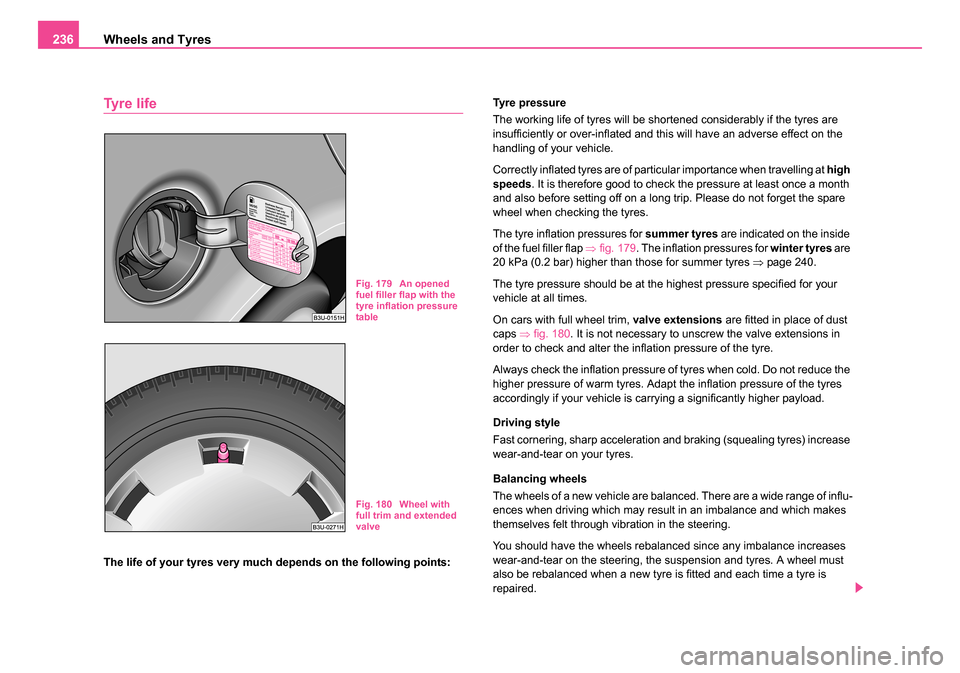
The tyre inflation pressures for summer tyres are indicated on the inside
of the fuel filler flap ⇒fig. 179 . The inflation pressures for winter tyres are
20 kPa (0.2 bar) higher than those for summer tyres ⇒page 240.
The tyre pressure should be at the highest pressure specified for your
vehicle at all times.
On cars with full wheel trim, valve extensions are fitted in place of dust
caps ⇒fig. 180 . It is not necessary to unscrew the valve extensions in
order to check and alter the inflation pressure of the tyre.
Always check the inflation pressure of tyres when cold. Do not reduce the
higher pressure of warm tyres. Adapt the inflation pressure of the tyres
accordingly if your vehicle is carrying a significantly higher payload.
Driving style
Fast cornering, sharp acceleration and braking (squealing tyres) increase
wear-and-tear on your tyres.
Balancing wheels
The wheels of a new vehicle are balanced. There are a wide range of influ-
ences when driving which may result in an imbalance and which makes
themselves felt through vibration in the steering.
You should have the wheels rebalanced since any imbalance increases
wear-and-tear on the steering, the suspension and tyres. A wheel must
also be rebalanced when a new tyre is fitted and each time a tyre is
repaired.
Fig. 179 An opened
fuel filler flap with the
tyre inflation pressure
table
Fig. 180 Wheel with
full trim and extended
valve
s3ec.book Seite 236 Montag, 2. Mai 2005 3:42 15
Page 238 of 281

Wheels and Tyres237
Using the systemSafetyDriving TipsGeneral MaintenanceBreakdown assistanceTechnical Data
Wheel alignment errors
Incorrect wheel alignment at the front and rear will not only increase wear-
and-tear on the tyres but will also has an adverse effect on vehicle safety.
Contact your specialist garage if you notice any unusual tyre wear.
WARNING
•If the inflation pressure is too low, the tyre must perform a
greater flexing work. At higher speeds the tyre will warm up as a
result of this. This can result in tread separation and even a tyre
blowout.
•Immediately replace the damaged rims or tyres.
For the sake of the environment
Tyres which are insufficiently inflated increase your fuel consumption.
Wear indicators
The base of the tread of the original tyres has wear indicators 1.6 mm
high, installed at right angles to the direction of travel. These wear indica-
tors are located at 6 - 8 points depending on the make and are evenly
spaced around the circumference of the tyre ⇒fig. 181 . Markings on the
walls of the tyres through the letters “TWI”, triangular symbols or other
symbols identify the position of the wear indicators.
A remaining tread of just 1.6 mm, measured in the grooves of the tread
next to the wear indicators, means that your tyres have reached their
legally permissible minimum tread depth.
WARNING
•You must have your tyres replaced with new ones at the latest
when the wear indicators have been worn down. The legally
permissible minimu m tread depth should be observed.
•Worn tyres do not provide the necessary adhesion to the road
surface at high speeds on wet roads. One could experience “aqua-
planing” (uncontrolled movements of the vehicle - “swimming” on
a wet road surface).
Fig. 181 Tyre tread
with wear indicators
s3ec.book Seite 237 Montag, 2. Mai 2005 3:42 15
Page 248 of 281

Breakdown assistance247
Using the systemSafetyDriving TipsGeneral MaintenanceBreakdown assistanceTechnical Data
•Hook for pulling off a full wheel trim,
•Plastic clip for a wheel bolt cover,
•Wheel wrench,
•Assembly pin for changing wheel,
•Screwdriver with reversible blade,
•Adapter for the wheel bolts lock.
After using the lifting jack, screw in the arm of the lifting jack fully before
placing it back in its stowage area.
WARNING
•The hexagon socket in the handle of the screwdriver should
only be used to fit on the wheel bolts. Never use the hexagon
socket of the screwdriver for tightening the wheel bolts because
you will not be able to achieve the necessary tightening torque with
the hexagon socket - risk of accident!
•The factory-supplied lifting jack is only intended for your model
of vehicle. On no account attempt to lift a heavier vehicle or other
loads - risk of injury!
•Ensure that the vehicle tool kit is safely attached in the luggage
compartment.
Spare wheel
The spare wheel is stowed in the spare wheel well in the
luggage compartment below the floor covering.
The spare wheel lies in a well in the luggage compartment under floor
covering and is fixed in place using special screws ⇒fig. 187 .
One should check the inflation pressure in the spare wheel (at best when
generally checking the tyre air pressures - see sign on the fuel filler flap
⇒ page 236) to ensure that the spare wheel is always ready to use.
Unidirectional tyres*
If you have such tyres on your vehicle, please refer to the notes below:
•The spare wheel provided with a car fitted with unidirectional tyres has
different dimensions. The wheel is provided with a warning sticker.
•After fitting on the wheel, the warning sticker must not be concealed
(e.g. by the wheel trim).
Fig. 187 Luggage
compartment: Spare
wheel
s3ec.book Seite 247 Montag, 2. Mai 2005 3:42 15
Page 270 of 281

General269
Using the systemSafetyDriving TipsGeneral MaintenanceBreakdown assistanceTechnical Data
Technical Data
General
Identification data
Vehicle data sticker
The vehicle data sticker ⇒fig. 207 is located on the floor of the luggage
compartment and is also stated in the Service schedule.
The vehicle data sticker contains the following data:
Vehicle identification number (VIN)
Vehicle type
Gearbox code, paint number, interior equipment number, engine
output, engine code
partial description of the vehicle Vehicle identification number (VIN)
The vehicle identification number - VIN (vehicle body number) is stamped
onto the partition between the engine compartment and the passenger
compartment and on a sign on the lower left hand edge below the wind-
screen.
Engine number
The engine number is stamped into the engine block.
Type plate (production plate)
The type plate is affixed to the rear cross panel in the engine compartment
on the right looking in the direction of travel.
Vehicles for certain export countries do not have a type plate.
Sticker on inside of fuel filler flap
The sticker is affixed to the inside of the fuel filler flap. The sticker contains
the following data:•The prescribed types of fuel,
•Tyre size,
•Tyre pressure.
Note
•You will find the technical data of your vehicle in the separate brochure
"Technical Data".
•Please note that the information stated in the official vehicle regis-
tration documents always takes priority.
Fig. 207 Vehicle data
sticker
A1
A2
A3
A4
s3ec.book Seite 269 Montag, 2. Mai 2005 3:42 15