child lock SKODA SUPERB 2008 2.G / (B6/3T) User Guide
[x] Cancel search | Manufacturer: SKODA, Model Year: 2008, Model line: SUPERB, Model: SKODA SUPERB 2008 2.G / (B6/3T)Pages: 272, PDF Size: 18.25 MB
Page 76 of 272
Seats and Stowage75
Using the systemSafetyDriving TipsGeneral MaintenanceBreakdown assistanceTechnical Data
Head restraints
Best protection is achieved if the top edge of the head restraint is at the
same level as the upper part of your head.
Adjusting the height of a head restraint
– Grasp the side of the head restraint with both hands and pull in
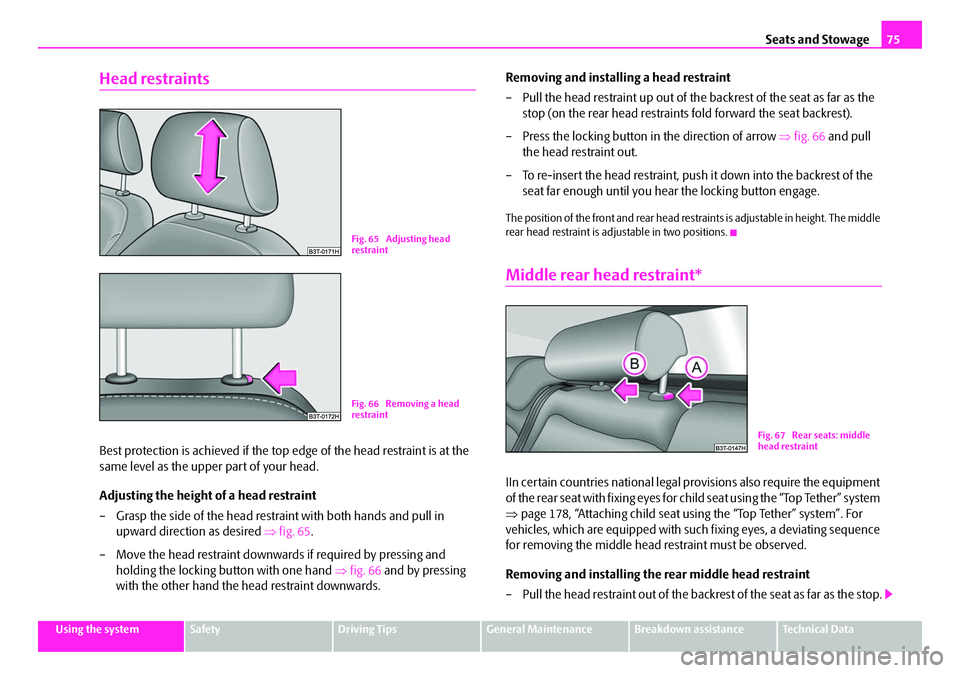
upward direction as desired ⇒fig. 65 .
– Move the head restraint downwards if required by pressing and holding the locking button with one hand ⇒fig. 66 and by pressing
with the other hand the head restraint downwards. Removing and installing a head restraint
– Pull the head restraint up out of the
backrest of the seat as far as the
stop (on the rear head restraints fold forward the seat backrest).
– Press the locking button in the direction of arrow ⇒fig. 66 and pull
the head restraint out.
– To re-insert the head restraint, push it down into the backrest of the
seat far enough until you hear the locking button engage.
The position of the front and rear head restraints is adjustable in height. The middle
rear head restraint is adjustable in two positions.
Middle rear head restraint*
IIn certain countries national legal pr ovisions also require the equipment
of the rear seat with fixing eyes for child seat using the “Top Tether” system
⇒ page 178, “Attaching child seat using the “Top Tether” system”. For
vehicles, which are equipped with such fixing eyes, a deviating sequence
for removing the middle head restraint must be observed.
Removing and installing the rear middle head restraint
– Pull the head restraint out of the backrest of the seat as far as the stop.
Fig. 65 Adjusting head
restraint
Fig. 66 Removing a head
restraint
Fig. 67 Rear seats: middle
head restraint
NKO B6 20.book Page 75 Wednesday, March 26, 2008 3:15 PM
Page 112 of 272

Starting-off and Driving111
Using the systemSafetyDriving TipsGeneral MaintenanceBreakdown assistanceTechnical Data
Ignition lock
Petrol engines
- ignition switched off, engine off, the steering can be locked
- ignition switched on
- start engine
Diesel engines - interruption of fuel supply, ignition switched off, engine off, the steering can
be locked.
- heating glow plugs on, ignition switched on
•You should not switch on any major elec trical components during the heating
period otherwise the vehicle batter y will be drained unnecessarily.
- start engine
Applies to all models:
Position
To lock the steering , with the ignition key withdrawn, turn the steering wheel until
the steering locking pin is heard to engage. You should always lock the steering as
a general rule if you leave your vehicle. This acts as a deterrent against possible theft
of your vehicle ⇒.
Position Move the steering wheel back and forward
a little if the ignition key cannot, or
cannot easily be turned into this position, in order to release the steering lock.
Position
The engine is started in this position. At the same time switched on low beam or
main beam or other electrical compon ents with major power consumption are
briefly switched off. The ignition key moves back into position when one
releases the key.
The ignition key must be turned back into position each time before starting the
engine again. The starter repeat lock in th e ignition lock prevents the starter being
engaged when the engine is ru nning and thus getting damaged.
Ignition key withdrawal lock (automatic gearbox)
You can only withdraw the ignition key after switching off the ignition if the selector
lever is in position P.
WARNING
•When driving, the ignition key must always be in the position (igni-
tion switched on) without the engine running. This position is indicated by
the warning lights coming on. If this is not the case, it could result in unex-
pected locking of the steering wheel - risk of accident!
•Only remove the ignition key from the ignition lock when the vehicle has
come to a standstill (put on the handbrake or select the selector lever posi-
tion P). The steering lock can enga ge immediately - risk of accident!
•Always withdraw the ignition key if you are going to leave the vehicle,
even for a short time. This is particularly important if children are left in the
vehicle. The children might otherwise star t the engine or switch on electrical
equipment (e.g. power windows) - risk of accident or injury!
Fig. 121 Ignition lock posi-
tions
A1
A2
A3
A1
A2
A3
A1
A2
A3
A2
A1
A2
NKO B6 20.book Page 111 Wednesday, March 26, 2008 3:15 PM
Page 115 of 272

Starting-off and Driving
114
WARNING
Never engage the reverse gear when driving - risk of accident!
Note
•One should not lay the hand on the shift lever while driving the vehicle. The
pressure of the hand will be transferred to the gearshift forks in the gearbox. This
can, over a period of time, lead to early wear of the gearshift forks.
•Depress the clutch pedal fully when chan ging gears, in order to avoid unneces-
sary wear and damage to the clutch and gearbox parts.
Handbrake
Applying the handbrake
– Pull the handbrake lever up fully.
Releasing the handbrake
– Pull the handbrake lever up slightly and at the same time press in the
locking button ⇒fig. 123 .
– Hold the button pressed and push the handbrake lever down fully ⇒ .
The handbrake warning light lights up when the handbrake is applied, provided
the ignition is on.
A warning signal sounds and the following text appears in the display* if you have
inadvertently driven off with the handbrake applied:
Release parking brake!
The handbrake warning is activated if you drive at a speed of more than 6 km/h for
more than 3 seconds.
WARNING
•Please note that the handbrake must be fully released. A handbrake
which is only partially released can re sult in the rear brakes overheating
which will have a negative effect on the operation of the brake system - risk
of accident! In addition this can result in premature wear of the rear brake
pads.
•Never leave children unattended in the vehicle. The children might, for
example, release the handbrake or take the vehicle out of gear. The vehicle
might then move off - risk of accident!
Caution
After the car has come to a stop, always firs t of all apply the handbrake firmly before
then additionally engaging a gear (manual gearbox) or moving the selector lever
into position P (automatic gearbox).
Fig. 123 Centre console:
Handbrake
NKO B6 20.book Page 114 Wednesday, March 26, 2008 3:15 PM
Page 155 of 272

Seat belts
156
•No two persons (also not children) should ever use a single seat belt
together.
•The maximum protection which seat belts can offer is only achieved if
you are correctly seated ⇒page 150, “Correct seated position”.
•The belt webbing must no t run across solid or fragile objects (e.g. spec-
tacles, ball-point pens, keys etc.) as this may be a cause of injuries.
•Bulky, loose clothing (e.g. a winter coat over a jacket) does not allow you
to be correctly seated and impairs proper operation of the seat belts.
•It is prohibited to use clamps or other objects to adjust seat belts (e.g. for
shortening the belts for smaller persons).
•The lock tongue should only be insert ed into the lock which is the correct
one for your seat. Wrong use of the safety belt will reduce its capacity to
protect and the risk of injury increases.
•The backrests of the front seats must not be tilted too far to the rear
otherwise the seatbelts can lose their effectiveness.
•The belt webbing must always be ke pt clean. Soiled belt webbing may
impair proper operation of the inertia reel ⇒page 203, “Seat belts”.
•The slot of the belt tongue must not be blocked by paper or similar
objects otherwise the belt tongue will not lock in place properly.
•Inspect the seat belts regularly to ensure they are in good condition. If
you find seat belts which have damage to the seat belt webbing, seat belt
connections, to the inertia reels or to the lock, the relevant safety belt must
be replaced by a specialist garage.
•The seat belts must not be removed or changed in any way. Do not make
an attempt to repair the seat belts yourself.
•Damaged seat belts which have been subjected to stress in an accident
and were therefore stretched, must be replaced - this is best done by a
specialist garage. The anchorage points of the belts must also be inspected.
The anchorage points for the be lts should also be checked.
•In certain countries it is possible to use seat belts which differ in terms of
their operation from the seat belts which are described on the pages which
follow.
How are seat belts correctly fastened?
Fastening three-point seat belts
Fasten your seat belt before starting!
– Correctly adjust the front seat and the head restraint before fastening
your seat belt ⇒page 75.
WARNING (continued)
Fig. 150 Routing of webbing
over the shoulders and the
lap belt
Fig. 151 Routing of belt
webbing for an expectant
mother
NKO B6 20.book Page 156 Wednesday, March 26, 2008 3:15 PM
Page 176 of 272

Transporting children safely177
Using the systemSafetyDriving TipsGeneral MaintenanceBreakdown assistanceTechnical Data
Children of more than 150 cm in height may use the seat belts fitted to the vehicle
without a seat bolster.
WARNING
•When transporting a child on the front passenger seat, please comply
with the appropriate national regulations regarding the use of child safety
seats. If required, the airb ag has to be deactivated,
− in a specialist garage
− or by using the switch for the front passenger airbag* ⇒page 169,
“Switch for the front passenger airbag*”.
•The shoulder part of the seat belt must run approximately across the
middle of the shoulder and fit snugly against the chest. It must on no account
run across the neck. The lap part of the seat belt must run across the pelvis
and fits snugly; it must not run over th e belly. Tighten the belt webbing over
your hip if necessary.
•Please comply with any differing nati onal legal regulations regarding the
use of child safety seats.
Attaching a child seat using the “ISOFIX” system
There are two fixing eyes* between the backrest and the seat of the front
passenger as well as on the rear exte rior seats for fixing the “ISOFIX”
system child seat in place. The places are marked with -ISOFIX-.
Install child seat
– Insert the mounting funnels onto the locking eyes between the backrest and seat cushion ⇒fig. 172 .
– Push the notched arms of the chil d seat over the mounting funnels
into the locking eyes, until it is heard to lock ⇒fig. 173 .
– Pull on both sides of the child seat!
One can mount a child safety seat using the “ISOFIX” system quickly, easily and reli-
ably. Please pay close attention to instru ctions from the manufacturer of the child
safety seat when installing and removing the seat.
Child seats fitted with the “ISOFIX” clampi ng system can only be mounted and fixed
in a vehicle fitted with an “ISOFIX system” when these child seats have been
released for this type of vehicle ac cording to the ECE-R 44 standard.
You can obtain child seats with the “ISOFIX” attachment system from specialist
garages who will also installed it as well.
Fig. 172 Locking eyes
(ISOFIX system)
Fig. 173 The ISOFIX child
seat is pushed into the
mounting funnels
AAAB
NKO B6 20.book Page 177 Wednesday, March 26, 2008 3:15 PM
Page 177 of 272

Transporting children safely
178
Complete installation instructions are enclosed with the child safety seat.
WARNING
•The locking eyes have just been developed for child safety seats which
use the “ISOFIX” system. You should therefore never attach other child
safety seats, seat belts or obje cts to the locking eyes - hazard!
•Ask a Škoda Service Partner whether a child seat which you bought for
another vehicle is recommended for use in a Škoda before using an “ISOFIX”
system.
•Certain child seats which use the “ISOFIX” system can be attached with
standard three-point seat belts. Please pay close attention to instructions
from the manufacturer of the child safety seat when installing and removing
the seat.
Note
•Child seats which use the “ISOFIX” system are currently available for children
weighing from 9 up to 18 kg. This correspo nds to an age range of from 9 months to
4 years.
•The child seats can also be fitted with the “Top Tether” system ⇒page 178.
Attaching child seat using the “Top Tether” system
IIn certain countries national legal provisions also require the equipment of the rear
seat with fixing eyes for child seat using the “Top Tether” system ⇒fig. 174 .
Always perform the installation and removal of the child seat using the “Top Tether”
system as stated in the instructions from the manufacturer of the child seat.
WARNING
•Attach the child seats with the “Top Tether” system only to the points
provided for this purpose ⇒fig. 174 .
•On no account should you equip your vehicle, e.g. mount screws or other
anchorage points.
•Pay attention to the important safety information regarding the use of
child seats.
Note
Store the remaining part of the belt for the “Top Tether” system in a textile pocket,
which is located at the child seat.
Fig. 174 Rear seat: Top
Te t h e r
NKO B6 20.book Page 178 Wednesday, March 26, 2008 3:15 PM
Page 208 of 272

Inspecting and Replenishing209
Using the systemSafetyDriving TipsGeneral MaintenanceBreakdown assistanceTechnical Data
WARNING
•Never open the bonnet if you see that steam or coolant is flowing out of
the engine compartment - risk of scaldi ng! Wait long enough until the steam
or coolant has stopped escaping.
•For safety reasons, the bonnet must always be properly closed when
driving. One should therefore check that the lock has in fact engaged prop-
erly after closing the bonnet.
•Stop your vehicle immediately while driv ing if you notice that the lock is
not properly engaged and close the bonne t properly - risk of an accident!
Caution
Ensure that the arms of the windscreen wipers are correctly in place against the
windscreen before opening the bonnet otherwise damage could occur to the
paintwork.
Working in the engine compartment
Particular care is required when carrying out any work in the engine
compartment!
There is a risk of injuries, scalding, accidents and fire when working in the
engine compartment, e.g. inspecting and replenishing oil and other fluids. For
this reason, it is essential to comply with the warning instructions stated
below and with the general applicable rules of safety. The engine compart-
ment of your car is a hazardous area ⇒ .
WARNING
•Never open the bonnet if you see that steam or coolant is flowing out of
the engine compartment - risk of scaldi ng! Wait long enough until the steam
or coolant has stopped escaping.
•Switch off the engine and pull out the ignition key.
•Apply the handbrake firmly.
•If your vehicle is fitted with a ma nual gearbox, move the gearshift lever
into Neutral, or if it is fitted with automatic gearbox, move the selector lever
into position P.
•Allow the engine to cool down.
•Keep children clear of the engine compartment.
•Never spill oil and other fluids over the hot engine. Such fluids (e.g. the
antifreeze contained in the coolant) may ignite!
•Avoid short circuits in the electrical system - particularly on the battery.
•Never place your hand into the radiator fan as long as the engine is still
warm. The fan might suddenly start running!
•Never open the cap of the coolant expa nsion bottle as long as the engine
is still warm. The cooling system is pressurized!
•Cover over the cap of the coolant expansion reservoir with a large cloth
when opening it as protection for your face, hands and arms from hot steam
or hot coolant.
•Do not let objects, such as e.g cleaning cloth or tools lie in the engine
compartment.
•If you wish to work under the vehicle, you must secure the vehicle from
rolling away and support it with suitable supporting blocks: the car jack is
not sufficient for this - risk of injury!
•In cases where it be necessary to carry out inspection work when the
engine is running there is an additional risk from rotating parts (e.g. the V-
ribbed belt, alternator, radiator fan) and from the high-voltage ignition
system. Please observe in addition the following.
−Never touch the electrical cabl es of the ignition system.
− Absolutely avoid any jewellery, loose items of clothing or long hair
from getting into the rotating parts of the engine - Hazard! Therefore
remove any jewellery beforehand, tie up your hair and wear tight fitting
clothing.
•Please also comply with the warnin g instructions stated below when
carrying out any essential work on the fuel system or on the electrical
system.
WARNING (continued)
NKO B6 20.book Page 209 Wednesday, March 26, 2008 3:15 PM
Page 216 of 272
Inspecting and Replenishing217
Using the systemSafetyDriving TipsGeneral MaintenanceBreakdown assistanceTechnical Data
The battery is located in a plastic ho using in the engine compartment or
in the left side of the luggage compartment.
Battery in the engine compartment
– Press the interlock on the side of the battery cover ⇒page 216,
fig. 191 , fold the battery cover out and pull it out.
– The installation of the battery cover takes place in the reverse order.
Battery in the luggage compartment
– You can open the compartment with the symbol
by turning the
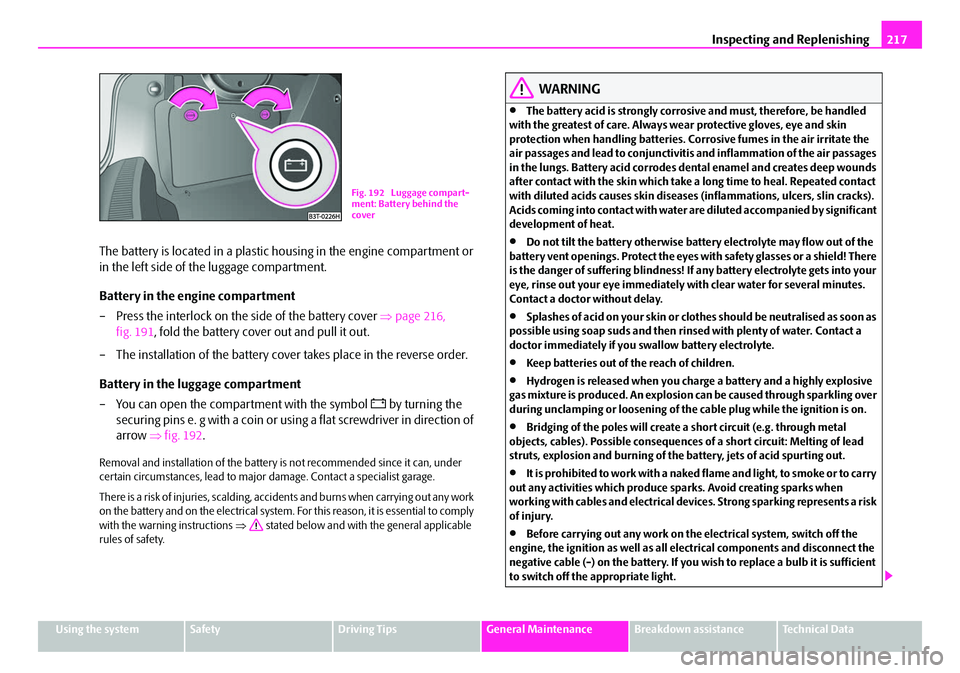
securing pins e. g with a coin or usin g a flat screwdriver in direction of
arrow ⇒fig. 192 .
Removal and installation of the battery is not recommended since it can, under
certain circumstances, lead to major damage. Contact a specialist garage.
There is a risk of injuries, scalding, acci dents and burns when carrying out any work
on the battery and on the electrical system. For this reason, it is essential to comply
with the warning instructions ⇒ stated below and with the general applicable
rules of safety.
WARNING
•The battery acid is strongly corrosive and must, therefore, be handled
with the greatest of care. Always we ar protective gloves, eye and skin
protection when handling batteries. Corrosive fumes in the air irritate the
air passages and lead to conjunctivitis and inflammation of the air passages
in the lungs. Battery acid corrodes de ntal enamel and creates deep wounds
after contact with the skin which take a long time to heal. Repeated contact
with diluted acids causes skin diseases (inflammations, ulcers, slin cracks).
Acids coming into contact with water are diluted accompanied by significant
development of heat.
•Do not tilt the battery otherwise battery electrolyte may flow out of the
battery vent openings. Protect the eyes with safety glasses or a shield! There
is the danger of suffering blindness! If any battery electrolyte gets into your
eye, rinse out your eye immediately with clear water for several minutes.
Contact a doctor without delay.
•Splashes of acid on your skin or clothes should be neutralised as soon as
possible using soap suds and then rinsed with plenty of water. Contact a
doctor immediately if you swallow battery electrolyte.
•Keep batteries out of the reach of children.
•Hydrogen is released when you char ge a battery and a highly explosive
gas mixture is produced. An explosion can be caused through sparkling over
during unclamping or loosening of the cable plug while the ignition is on.
•Bridging of the poles will create a short circuit (e.g. through metal
objects, cables). Possible consequences of a short circuit: Melting of lead
struts, explosion and burning of the battery, jets of acid spurting out.
•It is prohibited to work with a naked flame and light, to smoke or to carry
out any activities which produce sparks. Avoid creating sparks when
working with cables and electrical device s. Strong sparking represents a risk
of injury.
•Before carrying out any work on the electrical system, switch off the
engine, the ignition as well as all electrical components and disconnect the
negative cable (-) on the battery. If you wish to replace a bulb it is sufficient
to switch off the appropriate light.
Fig. 192 Luggage compart-
ment: Battery behind the
cover
NKO B6 20.book Page 217 Wednesday, March 26, 2008 3:15 PM
Page 265 of 272
Index
266
Changing bulbs . . . . . . . . . . . . . . . . . . . . . . . . . . . . . . 246
Changing the engine oil . . . . . . . . . . . . . . . . . . . . . . 212
Changing wheels around . . . . . . . . . . . . . . . . . . . . . 224
Charging the battery . . . . . . . . . . . . . . . . . . . . . . . . . 219
Warning light . . . . . . . . . . . . . . . . . . . . . . . . . . . . . 34
Check engine oil level . . . . . . . . . . . . . . . . . . . . . . . . 211
Child safety . . . . . . . . . . . . . . . . . . . . . . . . . . . . . . . . . 171 Side airbag . . . . . . . . . . . . . . . . . . . . . . . . . . . . . . 173
Child safety lock . . . . . . . . . . . . . . . . . . . . . . . . . . . . . . 37
Child safety seat on the front passenger seat . . . . . . . . . . . . . . . 172
Safety information . . . . . . . . . . . . . . . . . . . . . . . 171
Child seat . . . . . . . . . . . . . . . . . . . . . . . . . . . . . . . . . . . 174 Classification into groups . . . . . . . . . . . . . . . . . 174
ISOFIX system . . . . . . . . . . . . . . . . . . . . . . . . . . . . 177
Use of child safety seats . . . . . . . . . . . . . . . . . . 174
Children and safety . . . . . . . . . . . . . . . . . . . . . . . . . . 171
Chrome parts . . . . . . . . . . . . . . . . . . . . . . . . . . . . . . . 199
Cigarette lighter . . . . . . . . . . . . . . . . . . . . . . . . . . . . . . 86
Cleaning . . . . . . . . . . . . . . . . . . . . . . . . . . . . . . . . . . . . 197
Climatic Air outlet vents . . . . . . . . . . . . . . . . . . . . . . . . . . . . 99
Climatronic Air outlet vents . . . . . . . . . . . . . . . . . . . . . . . . . . . 105
Defrosting windows . . . . . . . . . . . . . . . . . . . . . . 105
Recirculated air mode . . . . . . . . . . . . . . . . . . . . 103
Climatronic (automatic air conditioning) . . . . . . 100
Clock . . . . . . . . . . . . . . . . . . . . . . . . . . . . . . . . . . . . . . . . 14
Clothes hooks . . . . . . . . . . . . . . . . . . . . . . . . . . . . . . . . 95
Cockpit General view . . . . . . . . . . . . . . . . . . . . . . . . . . . . . . . 8
Compartments . . . . . . . . . . . . . . . . . . . . . . . . . . . . . . . 87 Computer . . . . . . . . . . . . . . . . . . . . . . . . . . . . . . . . . . . . 14
Convenience operation . . . . . . . . . . . . . . . . . . . . . . . . 49
Converting/masking over headlights . . . . . . . . . . 192
Coolant . . . . . . . . . . . . . . . . . . . . . . . . . . . . . . . . . . . . 213
replenishing . . . . . . . . . . . . . . . . . . . . . . . . . . . . . 214
Warning light . . . . . . . . . . . . . . . . . . . . . . . . . . . . . . 31
Coolant level Warning light . . . . . . . . . . . . . . . . . . . . . . . . . . . . . . 31
Coolant quantity Warning light . . . . . . . . . . . . . . . . . . . . . . . . . . . . . . 31
Coolant temperature gauge . . . . . . . . . . . . . . . . . . . . 11
Coolant temperatur e/coolant level
Warning light . . . . . . . . . . . . . . . . . . . . . . . . . . . . . . 31
Correct seated position . . . . . . . . . . . . . . . . . . . . . . 150
Counter for distance driven . . . . . . . . . . . . . . . . . . . . 12
Cruise control system . . . . . . . . . . . . . . . . . . . . . . . . 120 Warning light . . . . . . . . . . . . . . . . . . . . . . . . . . . . . . 28
Cup holder front . . . . . . . . . . . . . . . . . . . . . . . . . . . . . . . . . . . . . . 84
rear . . . . . . . . . . . . . . . . . . . . . . . . . . . . . . . . . . . . . . . 84
D
Daylight driving lights . . . . . . . . . . . . . . . . . . . . . . . . . . 54
Deactivatingan airbag . . . . . . . . . . . . . . . . . . . . . . . . . . . . . . . . 168
Deactivating an airbag . . . . . . . . . . . . . . . . . . . . . . . 168
Defrosting rear window . . . . . . . . . . . . . . . . . . . . . . . . 63
De-icing the windows . . . . . . . . . . . . . . . . . . . . . . . 200
Detachable towing device . . . . . . . . . . . . . . . . . . . 196
Diesel . . . . . . . . . . . . . . . . . . . . . . . . . . . . . . . . . . . . . . 205 Diesel engines
Starting the engine . . . . . . . . . . . . . . . . . . . . . . . 112
Diesel particle filter . . . . . . . . . . . . . . . . . . . . . . . . . . 186 Warning light . . . . . . . . . . . . . . . . . . . . . . . . . . . . . 28
Digital clock . . . . . . . . . . . . . . . . . . . . . . . . . . . . . . . . . . 14
Direction indicators . . . . . . . . . . . . . . . . . . . . . . . . . . . 60 Warning light . . . . . . . . . . . . . . . . . . . . . . . . . . . . . 27
Display . . . . . . . . . . . . . . . . . . . . . . . . . . . . . . . . . . . . . . . 19
Distance driven . . . . . . . . . . . . . . . . . . . . . . . . . . . . . . . 12
Door Child safety lock . . . . . . . . . . . . . . . . . . . . . . . . . . . 37
Driver-steering recommendation . . . . . . . . . . . . . 181
Driving economically . . . . . . . . . . . . . . . . . . . . . . . . . 188
E
EDS . . . . . . . . . . . . . . . . . . . . . . . . . . . . . . . . . . . . . . . . . 180
Electric power-operated window Operational faults . . . . . . . . . . . . . . . . . . . . . . . . . 49
Electric sliding/tilting roof . . . . . . . . . . . . . . . . . . . . . 50
Electrically adjustable exterior mirror . . . . . . . . . . . 69
Electronic Differential Lock . . . . . . . . . . . . . . . . . . . 180
Electronic immobiliser . . . . . . . . . . . . . . . . . . . . . . . . 37
Electronic stability programme . . . . . . . . . . . . . . . . 179
Electronic stability programme (ESP) Warning light . . . . . . . . . . . . . . . . . . . . . . . . . . . . . 32
Engine starting . . . . . . . . . . . . . . . . . . . . . . . . . . . . . . . . . . 112
switching off . . . . . . . . . . . . . . . . . . . . . . . . . . . . . 113
Engine compartment Safety information . . . . . . . . . . . . . . . . . . . . . . . . 209
NKO B6 20.book Page 266 Wednesday, March 26, 2008 3:15 PM
Page 269 of 272

Index
270
Towing a trailer . . . . . . . . . . . . . . . . . . . . . . . . . . . . . . 194
Towing device . . . . . . . . . . . . . . . . . . . . . . . . . . . . . . . 196
Towing protection monitoring . . . . . . . . . . . . . . . . . 46
towing vehicle . . . . . . . . . . . . . . . . . . . . . . . . . . . . . . . 237
Tow-starting . . . . . . . . . . . . . . . . . . . . . . . . . . . . . . . . 237
Tow-starting and towing vehicle
Automatic gearbox . . . . . . . . . . . . . . . . . . . . . . . 128
Traction Control System . . . . . . . . . . . . . . . . . . . . . . 181
Traction control system (TCS) Warning light . . . . . . . . . . . . . . . . . . . . . . . . . . . . . 31
Trailer . . . . . . . . . . . . . . . . . . . . . . . . . . . . . . . . . . . . . . 194 General Maintenance . . . . . . . . . . . . . . . . . . . . 194
Transporting children safely . . . . . . . . . . . . . . . . . . 171
Tread depth . . . . . . . . . . . . . . . . . . . . . . . . . . . . . . . . . 223
Turn signal lights . . . . . . . . . . . . . . . . . . . . . . . . . . . . . 60 Warning light . . . . . . . . . . . . . . . . . . . . . . . . . . . . . 27
Twindoor . . . . . . . . . . . . . . . . . . . . . . . . . . . . . . . . . . . . 41
Two-way radio systems . . . . . . . . . . . . . . . . . . . . . . 145
Tyre . . . . . . . . . . . . . . . . . . . . . . . . . . . . . . . . . . . . . . . . 222
Tyre inflation pressure Warning light . . . . . . . . . . . . . . . . . . . . . . . . . . . . . 32
Tyres Winter tyres . . . . . . . . . . . . . . . . . . . . . . . . . . . . . 226
U
Underbody protection . . . . . . . . . . . . . . . . . . . . . . . 201
Unlocking . . . . . . . . . . . . . . . . . . . . . . . . . . . . . . . . . . . . 38Remote control . . . . . . . . . . . . . . . . . . . . . . . . . . . 44
Uphill-Start off-Assist . . . . . . . . . . . . . . . . . . . . . . . . 184
V
Vanity mirror . . . . . . . . . . . . . . . . . . . . . . . . . . . . . . . . . . 64
Vehicle tool kit . . . . . . . . . . . . . . . . . . . . . . . . . . . . . . 230
Ventilation Auxiliary ventilation . . . . . . . . . . . . . . . . . . . . . . 106
Visors . . . . . . . . . . . . . . . . . . . . . . . . . . . . . . . . . . . . . . . . 64
W
Warning lights . . . . . . . . . . . . . . . . . . . . . . . . . . . . . . . . 26
Warning symbols . . . . . . . . . . . . . . . . . . . . . . . . . . . . . . 26
Warning triangle . . . . . . . . . . . . . . . . . . . . . . . . . . . . 229
Washing . . . . . . . . . . . . . . . . . . . . . . . . . . . . . . . . . . . . 198 with a high-pressure cleaner . . . . . . . . . . . . . . 198
Washing the vehicle . . . . . . . . . . . . . . . . . . . . . . . . . 197
Washing vehicle by hand . . . . . . . . . . . . . . . . . . . . 198
Wax treatment . . . . . . . . . . . . . . . . . . . . . . . . . . . . . . 199
Wheel Changing . . . . . . . . . . . . . . . . . . . . . . . . . . . . . . . 231
Spare . . . . . . . . . . . . . . . . . . . . . . . . . . . . . . . . . . . 231
Wheel bolts . . . . . . . . . . . . . . . . . . . . . . . . . . . . . . . . . 225
Wheel trim . . . . . . . . . . . . . . . . . . . . . . . . . . . . . 222, 233
Wheels . . . . . . . . . . . . . . . . . . . . . . . . . . . . . . . . . . . . . 222
Window . . . . . . . . . . . . . . . . . . . . . . . . . . . . . . . . . . . . . . 47
Windows de-icing . . . . . . . . . . . . . . . . . . . . . . . . . . . . . . . . . 200
Windscreen washer nozzles . . . . . . . . . . . . . . . . . . . . 65
Windshield washer fluid reservoir . . . . . . . . . . . . 220 Warning light . . . . . . . . . . . . . . . . . . . . . . . . . . . . . . 34
Windshield washer system . . . . . . . . . . . . . . . . . . . 220
Windshield wiper . . . . . . . . . . . . . . . . . . . . . . . . . . . . . 65 Winter tyres . . . . . . . . . . . . . . . . . . . . . . . . . . . . . . . . . 226
Wiper blades
Replacing the wiper blades . . . . . . . . . . . . . . . . . 67
X
Xenon headlights . . . . . . . . . . . . . . . . . . . . . . . . . . . . 246
NKO B6 20.book Page 270 Wednesday, March 26, 2008 3:15 PM