fuel cap SKODA SUPERB 2009 2.G / (B6/3T) Owner's Manual
[x] Cancel search | Manufacturer: SKODA, Model Year: 2009, Model line: SUPERB, Model: SKODA SUPERB 2009 2.G / (B6/3T)Pages: 294, PDF Size: 21.33 MB
Page 16 of 294
The brief instruction
15
Using the system
Safety
Driving Tips
General Maintenance
Breakdown assistance
Technical Data
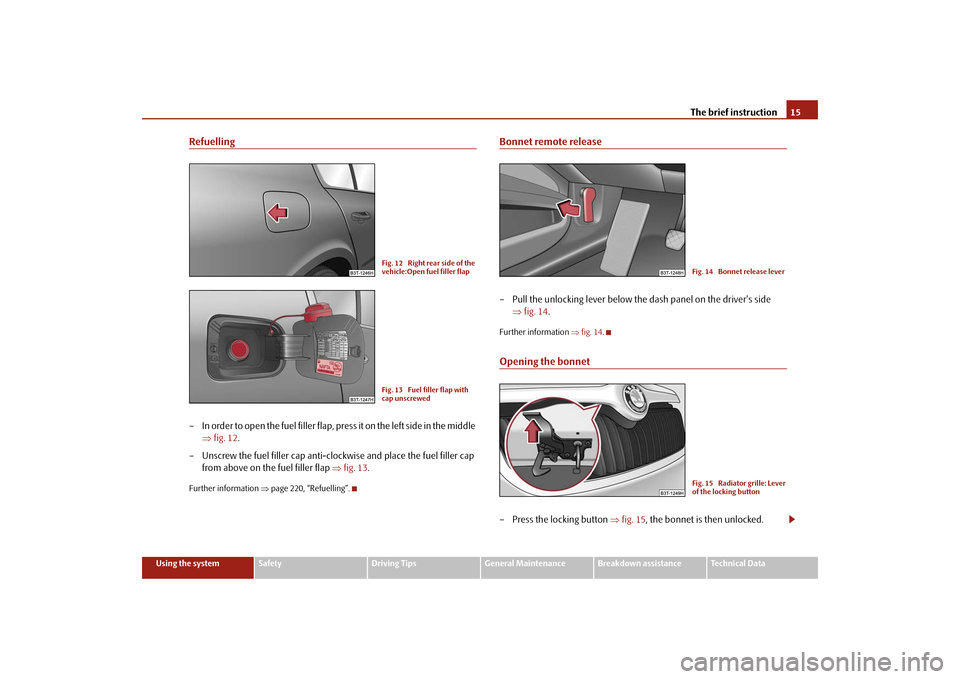
Refuelling– In order to open the fuel filler flap, press it on the left side in the middle
⇒
fig. 12
.
– Unscrew the fuel filler cap anti-cl
ockwise and place the fuel filler cap
from above on the fuel filler flap
⇒
fig. 13
.
Further information
⇒page 220, “Refuelling”.
Bonnet remote release– Pull the unlocking lever below the
dash panel on the driver's side
⇒
fig. 14
.
Further information
⇒fig. 14
.
Opening the bonnet– Press the locking button
⇒
fig. 15
, the bonnet is then unlocked.
Fig. 12 Right rear side of the vehicle:Open fuel filler flapFig. 13 Fuel filler flap with cap unscrewed
Fig. 14 Bonnet release leverFig. 15 Radiator grille: Lever of the locking button
s2dk.1.book Page 15 Wednesday, April 8, 2009 12:23 PM
Page 19 of 294
Instruments and Indicator/Warning Lights
18
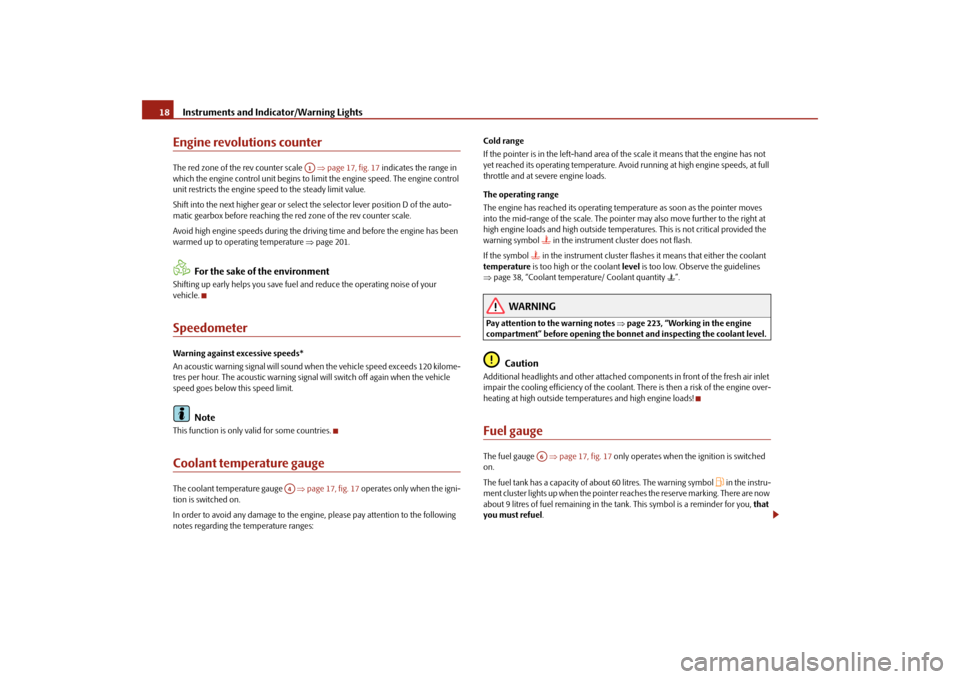
Engine revolutions counterThe red zone of the rev counter scale
⇒page 17, fig. 17
indicates the range in
which the engine control unit begins to li
mit the engine speed. The engine control
unit restricts the engine speed to the steady limit value. Shift into the next higher gear or select
the selector lever position D of the auto-
matic gearbox before reaching the red zone of the rev counter scale. Avoid high engine speeds during the driv
ing time and before the engine has been
warmed up to operating temperature
⇒page 201.
For the sake of the environment
Shifting up early helps you save fuel and reduce the operating noise of your vehicle.SpeedometerWarning against excessive speeds* An acoustic warning signal will sound when the vehicle speed exceeds 120 kilome- tres per hour. The acoustic warning signal
will switch off ag
ain when the vehicle
speed goes below this speed limit.
Note
This function is only valid for some countries.Coolant temperature gaugeThe coolant temperature gauge
⇒page 17, fig. 17
operates only when the igni-
tion is switched on. In order to avoid any damage to the engine
, please pay attentio
n to the following
notes regarding the temperature ranges:
Cold range If the pointer is in the left-hand area of the scale it means that the engine has not yet reached its operating temperature. Avoi
d running at high engine speeds, at full
throttle and at severe engine loads. The operating range The engine has reached its operating temperature as soon as the pointer moves into the mid-range of the scale. The pointe
r may also move further to the right at
high engine loads and high outside temper
atures. This is not critical provided the
warning symbol
in the instrument cluster does not flash.
If the symbol
in the instrument cluster flashes it means that either the coolant
temperature
is too high or the coolant
level
is too low. Observe the guidelines
⇒ page 38, “Coolant temperature/ Coolant quantity
”.
WARNING
Pay attention to the warning notes
⇒page 223, “Working in the engine
compartment” before opening the bonnet and inspecting the coolant level.
Caution
Additional headlights and other attached co
mponents in front of the fresh air inlet
impair the cooling efficiency of the coolant. There is then a risk of the engine over-heating at high outside temperatures and high engine loads!Fuel gaugeThe fuel gauge
⇒page 17, fig. 17
only operates when th
e ignition is switched
on. The fuel tank has a capacity of about 60 litres. The warning symbol
in the instru-
ment cluster lights up when the pointer reaches the reserve marking. There are now about 9 litres of fuel remaining in the tank. This symbol is a reminder for you,
that
you must refuel
.
A1
A4
A6
s2dk.1.book Page 18 Wednesday, April 8, 2009 12:23 PM
Page 92 of 294
Seats and Stowage
91
Using the system
Safety
Driving Tips
General Maintenance
Breakdown assistance
Technical Data
– Lift up the part with the holder and secure it by sliding it into the
grooves
⇒
page 90, fig. 98
.
The roof rack*DescriptionPay attention to the following points if you wish to transport luggage or other items on the roof of your vehicle:•
A special roof luggage rack system was
developed for the vehicle, that is why
you should only use a roof luggage rack which has been released for use by Škoda Auto.•
The base carrier is the basis for a comple
te roof luggage rack system. Separate
additional holders are required for safety reasons for transporting luggage, bikes, surfboards, skis and boats.•
The basic version of the roof luggage ra
ck system and further components are
obtainable as accessories from th
e authorised Škoda Service Partners.
Caution
•
If you use other roof rack systems or if the roof bars are not properly fitted, then
any damage which may result to your ca
r is not covered by the warranty agree-
ments. It is therefore essential to pay attention to the fitting instructions supplied with the roof luggage rack system.•
On models fitted with a power sliding/tilting roof, ensure that the opened
sliding/tilting roof does not strike any items of luggage transported on the roof.•
Ensure that the opened boot lid do
es not collide with the roof load.
For the sake of the environment
The increased aerodynamic drag results in a higher fuel consumption. One should therefore take off the roof bar system after use.
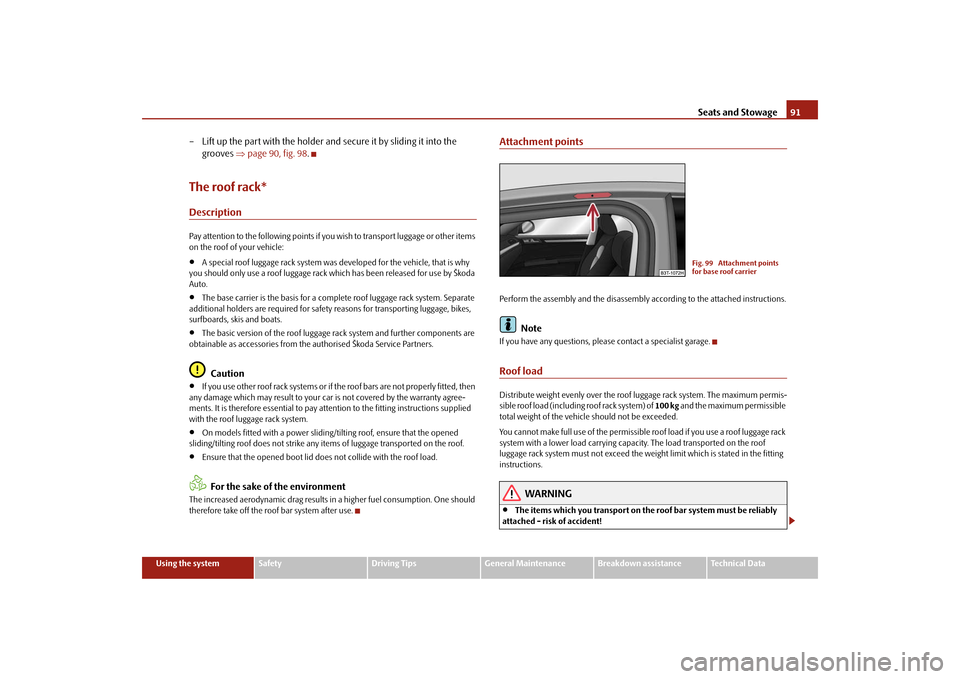
Attachment pointsPerform the assembly and the disassembly according to the attached instructions.
Note
If you have any questions, plea
se contact a specialist garage.
Roof loadDistribute weight evenly over the roof luggage rack system. The maximum permis- sible roof load (including roof rack system) of
100 kg
and the maximum permissible
total weight of the vehicl
e should not be exceeded.
You cannot make full use of th
e permissible roof load if you use a roof luggage rack
system with a lower load carrying capa
city. The load transported on the roof
luggage rack system must not exceed the weight limit which is stated in the fitting instructions.
WARNING
•
The items which you transport on the roof bar system must be reliably
attached - risk of accident!
Fig. 99 Attachment points for base roof carrier
s2dk.1.book Page 91 Wednesday, April 8, 2009 12:23 PM
Page 105 of 294
Air conditioning system
104
Air conditioning systemIntroductionDescription and informationIf the cooling system is switched on, the temperature and air humidity drops in the vehicle. The wellbeing of the occupants of
the car is enhanced as a result of this
particularly at high outside temperatures and a high air humidity. The system prevents the windows misting up during the cold season of the year. The heating effect is dependent upon th
e coolant temperature, thus full heat
output only occurs when the engine
has reached its operating temperature.
It is possible to briefly activate recirc
ulated air mode in order to enhance the
cooling effect - Climatic
⇒page 108, Climatronic
⇒page 111.
The air inlet in front of the windscreen must be free of ice, snow or leaves in order to ensure that the heating and cooling systems operate properly. After switching on the cooling
Condensation
from the evaporator of the air condi-
tioning may drip down and form a puddle
below the vehicle. This is quite normal
and not an indication of a leak!
WARNING
•
For your own safety and that of other road users, ensure that all the
windows are free of ice, snow and mistin
g. Please familiarize yourself about
how to correctly operate th
e heating and ventilation systems, how to demist
and defrost the windows, as well as with the cooling mode.•
You should not leave recirculated air mode on over a longer period of
time, as “stale” air may result in fatigue in the driver and occupants, divert your attention and also cause the windows to mist up. The risk of having an accident increases. Switch recirculated air mode off as soon as the windows begin misting up.
Note
•
The used air streams out through the air removal openings in the luggage
compartment.•
If the cooling system has not been switched on for a lengthy period, odours may
be produced at the evaporator because of
deposits. Switch the cooling system on
at least once a month for approximately 5 mi
nutes at the highest blower stage - also
during the cold season of the year - in order to avoid such odours. Also open a window for a short time.•
We recommend that you do not smoke in the vehicle when the recirculating air
mode is operating since the smoke which is drawn at the evaporator from the inte-rior of the vehicle forms deposits in the
evaporator of the air conditioning system.
This produces a permanent odour when th
e air conditioning system is operating
which can only be eliminated through co
nsiderable effort and expense (replace-
ment of compressor).•
Please refer to the information regarding the recirculated air mode for Climatic
⇒ page 108 or for Climatronic
⇒page 111.
Using the air conditioning system economicallyThe compressor on the air co
nditioning system uses po
wer from the engine when
in cooling mode which will effect the fuel consumption. It recommended to open the windows or the doors of a vehicle for which the inte- rior has been strongly heated through the ef
fect of direct sunlight in order to allow
the heated air to escape. The cooling system should not be switched on while travelling when the window is open. The desired interior temperature can also be achieved without switching in the cooling system just by switching to fresh air mode.
s2dk.1.book Page 104 Wednesday, April 8, 2009 12:23 PM
Page 106 of 294
Air conditioning system
105
Using the system
Safety
Driving Tips
General Maintenance
Breakdown assistance
Technical Data
For the sake of the environment
When you economize on fuel, you
also reduce pollutant emissions.
Operational problemsIf the cooling system does not operate at outside temperatures higher than +5 °C, there is a problem in the system. The reasons for this may be:•
The fuse on the air conditioning system
has blown. Check the fuse, replace it if
necessary
⇒page 256.
•
The cooling system has switched off automatically for a short time because the
coolant temperature of the engine is too hot
⇒page 18.
If you are not able to rectify the operat
ional problem yourself, or if the cooling
capacity decreases, switch the cooling sy
stem off. Contact a specialist garage.
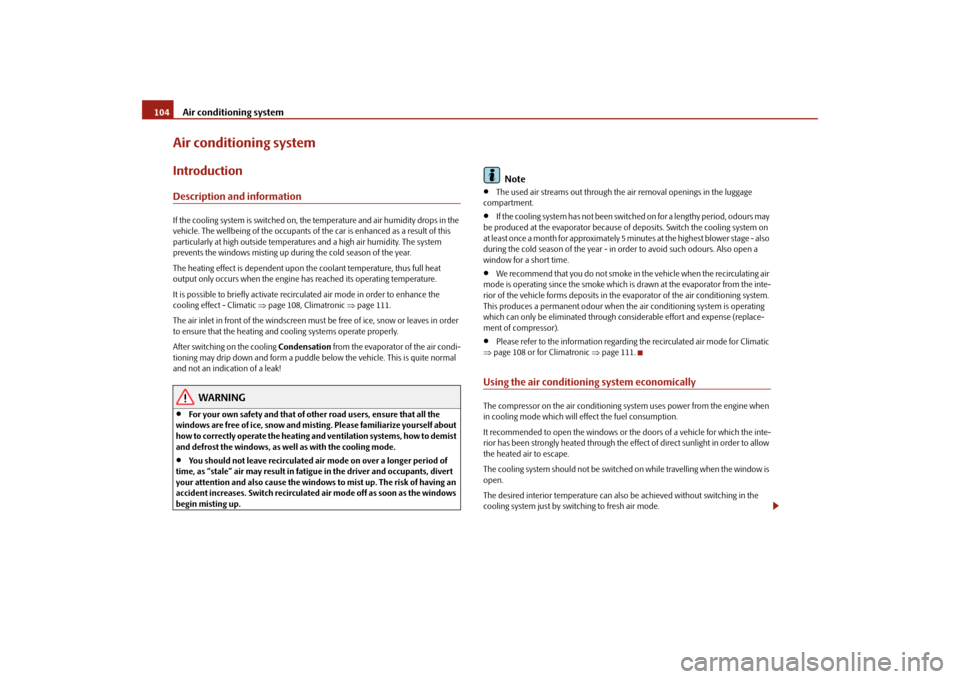
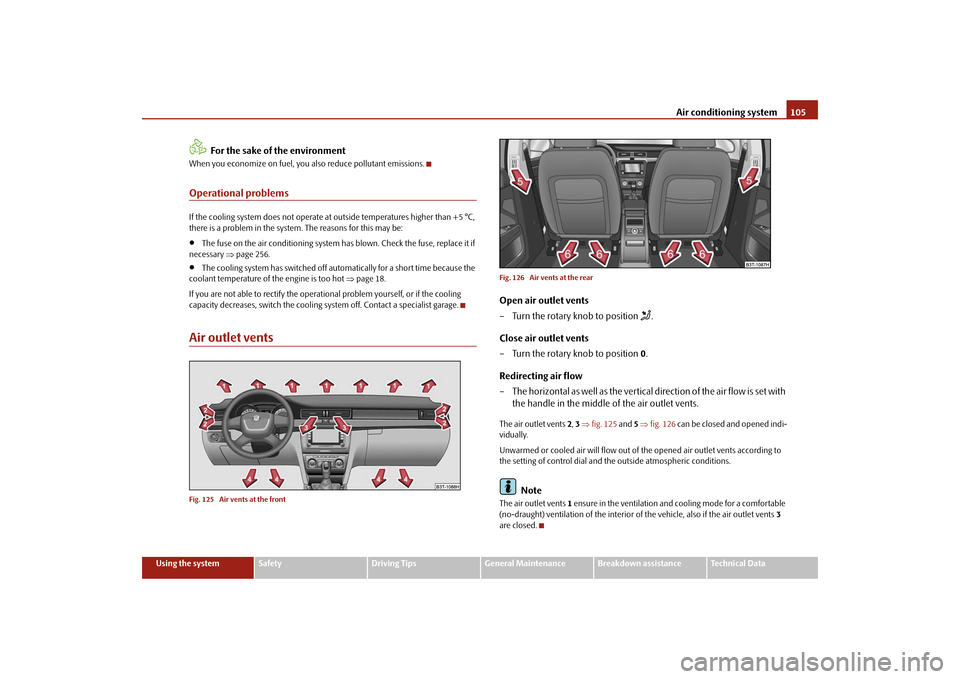
Air outlet ventsFig. 125 Air vents at the front
Fig. 126 Air vents at the rearOpen air outlet vents – Turn the rotary knob to position
.
Close air outlet vents – Turn the rotary knob to position
0.
Redirecting air flow – The horizontal as well as the vertical direction of the air flow is set with
the handle in the middle of the air outlet vents.
The air outlet vents
2, 3 ⇒fig. 125
and
5 ⇒fig. 126
can be closed and opened indi-
vidually. Unwarmed or cooled air will flow out of the opened air outlet vents according to the setting of control dial and the outside atmospheric conditions.
Note
The air outlet vents
1 ensure in the ventilation and cooling mode for a comfortable
(no-draught) ventilation of the interior of
the vehicle, also if the air outlet vents
3
are closed.
s2dk.1.book Page 105 Wednesday, April 8, 2009 12:23 PM
Page 221 of 294
Fuel
220
Operation in winterWinter-grade diesel fuel A different grade of diesel fuel is available at
filling stations in winter than during the
summer. Using “summer-grade diesel fuel” at
temperatures below 0°C can result in
operational problems because the diesel be
comes viscous as a result of paraffin
separation. It is therefore the case that DIN EN 590 prescribes diesel fuel class for certain periods of the year which can also be pu
rchased at the corresponding time during
the year. “Winter-grade diesel fuel” will still operate properly even at a temperature of -20°C. It is often the case in countries with diff
erent climatic conditions that diesel fuels
available have a different temperature char
acteristic. The authorised Škoda Service
Partners and filling stations in the country
concerned will be able to provide you
with information regarding the diesel fuels available. Prewarming fuel The vehicle is fitted with a fuel filter prewarming system. This secures operation of a vehicle using diesel fuel down to an environmental temperature of -25°C.
Caution
It is not permitted to add the various fuel
additives on the market, including petrol,
to diesel fuel in order to
improve its flow properties.
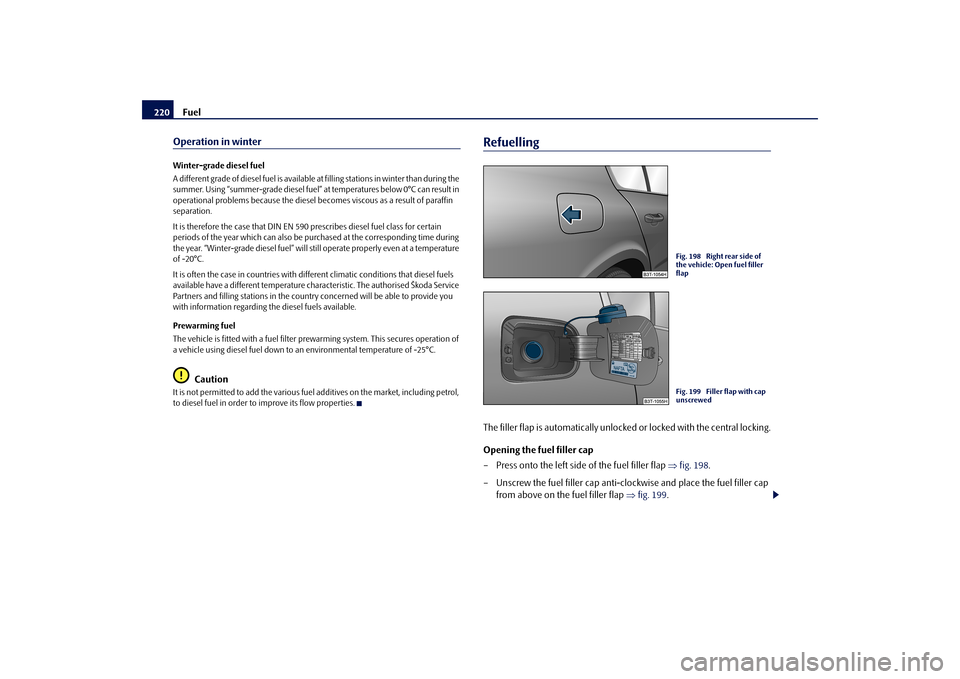
RefuellingThe filler flap is automatically unlocked or locked with the central locking. Opening the fuel filler cap – Press onto the left side of the fuel filler flap
⇒
fig. 198
.
– Unscrew the fuel filler cap anti-clo
ckwise and place the fuel filler cap
from above on the fuel filler flap
⇒
fig. 199
.Fig. 198 Right rear side of the vehicle: Open fuel filler flapFig. 199 Filler flap with cap unscrewed
s2dk.1.book Page 220 Wednesday, April 8, 2009 12:23 PM
Page 222 of 294
Fuel
221
Using the system
Safety
Driving Tips
General Maintenance
Breakdown assistance
Technical Data
Closing fuel filler cap – Screw on the fuel filler cap by turning it to the right until it is heard to
click.
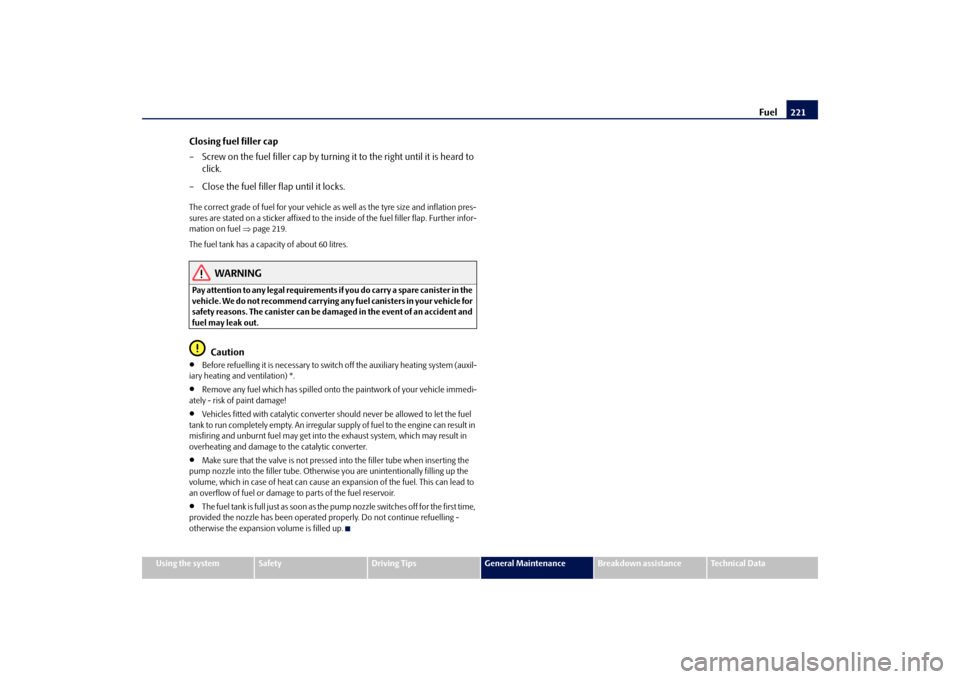
– Close the fuel filler flap until it locks.The correct grade of fuel for your vehicle as
well as the tyre size and inflation pres-
sures are stated on a sticker affixed to the
inside of the fuel filler flap. Further infor-
mation on fuel
⇒page 219.
The fuel tank has a capacity of about 60 litres.
WARNING
Pay attention to any legal requirements if
you do carry a spare canister in the
vehicle. We do not recommend carrying any fuel canisters in your vehicle for safety reasons. The canister can be da
maged in the event of an accident and
fuel may leak out.
Caution
•
Before refuelling it is necessary to switch off the auxiliary heating system (auxil-
iary heating and ventilation) *.•
Remove any fuel which has spilled onto the paintwork of your vehicle immedi-
ately - risk of paint damage!•
Vehicles fitted with catalytic converter sh
ould never be allowed to let the fuel
tank to run completely empty. An irregular
supply of fuel to the engine can result in
misfiring and unburnt fuel may get into the exhaust system, which may result in overheating and damage to the catalytic converter.•
Make sure that the valve is not pressed into the filler tube when inserting the
pump nozzle into the filler tube. Otherwis
e you are unintentionally filling up the
volume, which in case of heat can cause an
expansion of the fuel. This can lead to
an overflow of fuel or damage
to parts of the fuel reservoir.
•
T h e f u e l t a n k i s f u l l j u s t a s s o o n a s t h
e pump nozzle switches off for the first time,
provided the nozzle has been operated properly. Do not continue refuelling - otherwise the expansion volume is filled up.
s2dk.1.book Page 221 Wednesday, April 8, 2009 12:23 PM
Page 224 of 294
Inspecting and replenishing
223
Using the system
Safety
Driving Tips
General Maintenance
Breakdown assistance
Technical Data
WARNING
•
Never open the bonnet if you see that steam or coolant is flowing out of
the engine compartment - risk of scaldi
ng! Wait long enough until the steam
or coolant has stopped escaping.•
For safety reasons, the bonnet must always be properly closed when
driving. One should therefore check that
the lock has in fact engaged prop-
erly after closing the bonnet.•
Stop your vehicle immediately while driv
ing if you notice that the lock is
not properly engaged and close the bonne
t properly - risk of an accident!
Caution
Ensure that the arms of the windscreen
wipers are correctly
in place against the
windscreen before opening the bonnet otherwise damage could occur to the paintwork.Working in the engine compartment Particular care is required when carrying out any work in the engine compartment!There is a risk of injuries, scalding,
accidents and fire when working in the
engine compartment, e.g. inspecting and replenishing oil and other fluids. For this reason, it is essential to comply with the warning instructions stated below and with the general applicable
rules of safety. The engine compart-
ment of your car is a hazardous area
⇒
.
WARNING
•
Never open the bonnet if you see that steam or coolant is flowing out of
the engine compartment - risk of scaldi
ng! Wait long enough until the steam
or coolant has stopped escaping.•
Switch off the engine and pull out the ignition key.
•
Apply the handbrake firmly.
•
If your vehicle is fitted with a ma
nual gearbox, move the gearshift lever
into Neutral, or if it is fitted with
automatic gearbox, move the selector lever
into position P.•
Allow the engine to cool down.
•
Keep children clear of the engine compartment.
•
Never spill oil and other fluids over the hot engine. Such fluids (e.g. the
antifreeze contained in the coolant) may ignite!•
Avoid short circuits in the electrical system - particularly on the battery.
•
Never place your hand into the radiator fan as long as the engine is still
warm. The fan might suddenly start running!•
Never open the cap of the coolant expa
nsion bottle as long
as the engine
is still warm. The cooling system is pressurized!•
Cover over the cap of the coolant expansion reservoir with a large cloth
when opening it as protection for your
face, hands and arms from hot steam
or hot coolant.•
Do not let objects, such as e.g cleani
ng cloth or tools lie in the engine
compartment.•
If you wish to work under the vehicle, you must secure the vehicle from
rolling away and support it with suitable supporting blocks: the car jack is not sufficient for this - risk of injury!•
In cases where it be necessary to carry out inspection work when the
engine is running there is an additional risk from rotating parts (e.g. the V- ribbed belt, alternator, radiator fan) and from the high-voltage ignition system. Please observe in addition the following.
− Never touch the electrical cabl
es of the ignition system.
− Absolutely avoid any jewellery, loose items of clothing or long hair from getting into the rotating parts of the engine - Hazard! Therefore remove any jewellery beforehand, tie up your hair and wear tight fitting clothing.
•
Please also comply with the warnin
g instructions stated below when
carrying out any essential work on th
e fuel system or on the electrical
system.
WARNING (continued)
s2dk.1.book Page 223 Wednesday, April 8, 2009 12:23 PM
Page 226 of 294

Inspecting and replenishing
225
Using the system
Safety
Driving Tips
General Maintenance
Breakdown assistance
Technical Data
– Wait a few minutes and pull out the oil dipstick. – Wipe off the dipstick with a clea
n cloth and insert it again fully.
– Then withdraw the dipstick ag
ain and read off the oil level.
Oil level within range – You must
not
top up the oil.
Oil level within range – You
may
top up the oil. It is possible that the oil level may then be
within range after doing this.
Oil level within range – You
must
top up the oil
⇒
page 225. It is sufficient, once this is done,
to keep the oil level within range .
It is normal for the engine to consume oi
l. The oil consumption may be as much as
0.5 l/1 000 km depending on your style of
driving and the conditions under which
you operate your vehicle. Th
e oil consumption may be sl
ightly higher than this
during the first 5 000 kilometres. One should therefore check the oil level at regular intervals, preferably every time after the fuel tank is filled or after driving for long stretches. We recommend maintaining the oil level within the range -
but not above this
,
if the engine has been operating at high loads, for example during a lengthy motorway trip during the
summer months, towing a trai
ler or negotiating a high
mountain pass. The warning light in the instrument cluster* will indicate
⇒page 42, “Engine oil
level
” whether the oil level is too low. In this case, check the oil level as soon as
possible. Top up with an appropriate quantity of oil.
Caution
•
The oil level must on no account ex
tend beyond the ra
nge . Danger of
damaging the catalytic converter.
•
Do not continue your journey
if for some reason it is not possible under the
conditions prev
ailing to top up with oil.
Switch of the engine and contact
and
obtain professional assistance from a specialist garage.
Note
Engine oil specifications
⇒page 270.
Replenishing engine oil– Inspecting the engine oil level
⇒
page 224.
– Unscrew the cap of the engine oil filler opening.– Pour in a suitable grade of oil in portions of 0.5 litres
⇒
page 270.
– Inspect the oil level
⇒
page 224, “Check engine oil level”.
– Carefully screw on the cap of the filler opening and push the dipstick
in fully.
WARNING
•
Avoid dripping oil onto hot parts of the engine when topping up will oil -
a risk of fire!•
Read and observe the warning notes
⇒page 223, “Working in the engine
compartment” before working in the engine compartment.
For the sake of the environment
The oil level must on no account be above the range
⇒page 224. Oil will other-
wise be drawn in through the crankcas
e ventilation and may pass through the
exhaust system to atmosphere. The oil ma
y combust in the catalytic converter and
damage it.
AAAB
AA
AC
AB
AA
AA
Aa
s2dk.1.book Page 225 Wednesday, April 8, 2009 12:23 PM
Page 236 of 294
Wheels and Tyres
235
Using the system
Safety
Driving Tips
General Maintenance
Breakdown assistance
Technical Data
Wheels and TyresWheelsGeneral information•
New tyres do not offer optimal grip at first and should therefore be run in for
about 500 km at a moderate speed and an
appropriately cautious style of driving.
You will also profit from longer tyre life.•
The tread depth of new tyres may differ
because of design features and the
configuration of the tread (depending on
the type of tyre and the manufacturer).
•
Drive over curbs on the side of the road
and other such obstacles slowly and,
where possible, at a right angle in order to avoid damage to tyres and wheel trims.•
Inspect your tyres from time to time
for damage (punctures, cuts, splits and
bulges). Remove foreign bodies from the tyre profile.•
Damage to tyres and wheels is frequent
ly not visible. Unus
ual vibrations or
pulling of the vehicle to one side
could be a sign of tyre damage.
Please reduce
your speed immediately and stop if
you suspect that a wheel is damaged.
Inspect the tyres for signs of damage (bulges,
splits, etc.). If no
visible damage is
present, please drive at an appropriatel
y slow speed and carefully to the nearest
specialist garage in order to have your vehicle inspected.•
Also protect your tyres from contact with oil, grease and fuel.
•
Immediately replace any dust caps of the valves which have got lost.
•
Mark wheels before removing them so th
at their previous direction of running
can be maintained when mounted them again.•
Always store wheels or tyres which been removed in a cool, dry and, where
possible, dark place. Tyres which are not fixed to a wheel trim should be stored upright. Unidirectional tyres* The direction of rotation of the tyres is marked by arrows on the wall of the tyre. This indicates the direction of rotation of the tyre, and it is essential that the tyres are fitted on to run in this direction. Only then
are the tyres able to provide the optimal
properties in terms of grip, low noise, wear-and-tear and aquaplaning.
Further information concerning
the use of unidi
rectional tyres
⇒page 239.
WARNING
•
New tyres during the first 500 km do not offer optimal grip and should
therefore be run appropriately - risk of accident!•
Never drive with damaged tyres - risk of accident!Note
Please observe the various differing legal requirements regarding tyres.Tyre lifeThe life of your tyres very much depends on the following points: Tyre pressure The working life of tyres will be shortened considerably if the tyres are insufficiently or over-inflated and this will have an advers
e effect on the handli
ng of your vehicle.
Correctly inflated tyres are of partic
ular importance when travelling at
high speeds
.
It is therefore good to check the pressure at least once a month and also before
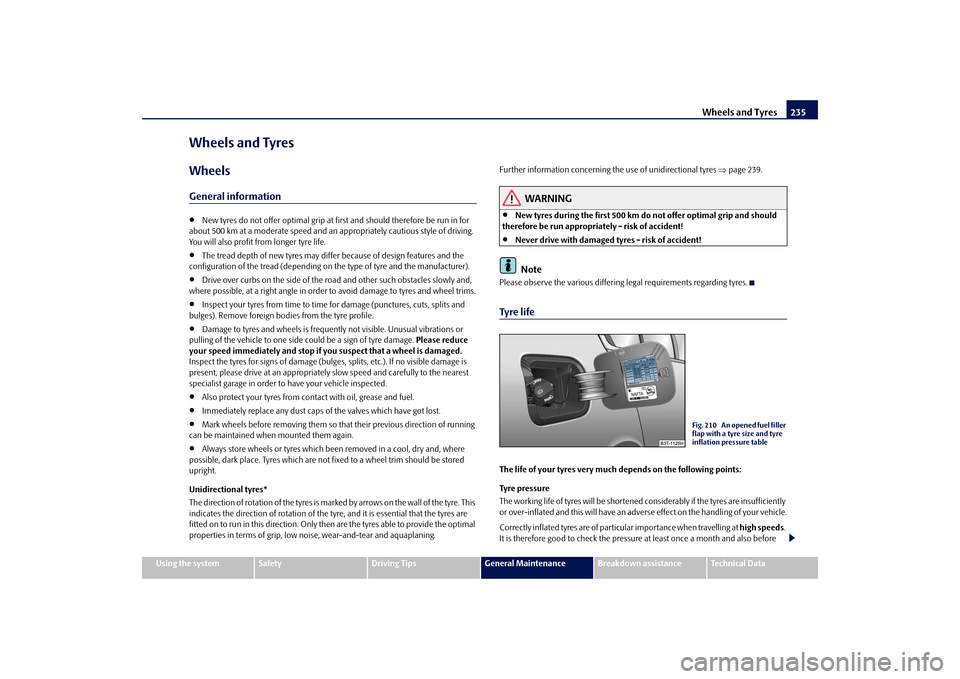
Fig. 210 An opened fuel filler flap with a tyre size and tyre inflation pressure table
s2dk.1.book Page 235 Wednesday, April 8, 2009 12:23 PM