boot SKODA SUPERB 2012 2.G / (B6/3T) Owner's Guide
[x] Cancel search | Manufacturer: SKODA, Model Year: 2012, Model line: SUPERB, Model: SKODA SUPERB 2012 2.G / (B6/3T)Pages: 235, PDF Size: 5.86 MB
Page 55 of 235
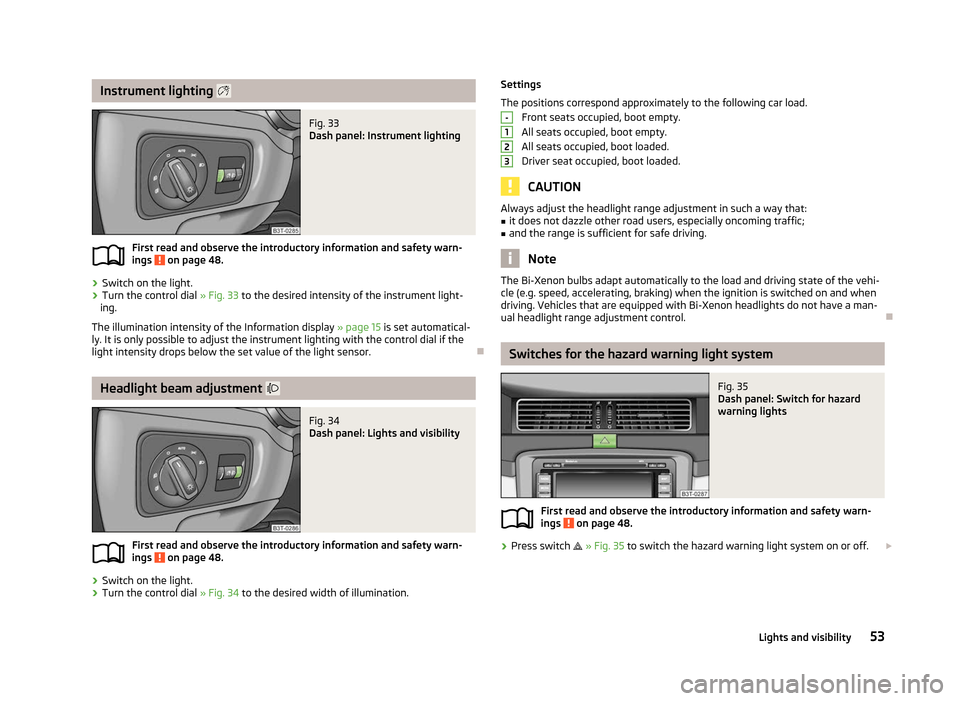
Instrument lighting
Fig. 33
Dash panel: Instrument lighting
First read and observe the introductory information and safety warn-
ings on page 48.
›
Switch on the light.
› Turn the control dial
» Fig. 33 to the desired intensity of the instrument light-
ing.
The illumination intensity of the Information display »
page 15 is set automatical-
ly. It is only possible to adjust the instrument lighting with the control dial if the
light intensity drops below the set value of the light sensor. ÐHeadlight beam adjustment
Fig. 34
Dash panel: Lights and visibility
First read and observe the introductory information and safety warn-
ings on page 48.
›
Switch on the light.
› Turn the control dial
» Fig. 34 to the desired width of illumination.
ä
ä Settings
The positions correspond approximately to the following car load.
Front seats occupied, boot empty.
All seats occupied, boot empty.
All seats occupied, boot loaded.
Driver seat occupied, boot loaded. CAUTION
Always adjust the headlight range adjustment in such a way that:
■ it does not dazzle other road users, especially oncoming traffic;
■ and the range is sufficient for safe driving. Note
The Bi-Xenon bulbs adapt automatically to the load and driving state of the vehi-
cle (e.g. speed, accelerating, braking) when the ignition is switched on and when
driving. Vehicles that are equipped with Bi-Xenon headlights do not have a man-
ual headlight range adjustment control. Ð Switches for the hazard warning light system
Fig. 35
Dash panel: Switch for hazard
warning lights
First read and observe the introductory information and safety warn-
ings on page 48.
›
Press switch
» Fig. 35 to switch the hazard warning light system on or off. £ -
1
2
3
ä
53
Lights and visibility
Page 58 of 235

Reading lights
›
Press switch
» Fig. 39 to switch the reading lights on or off. ÐRear interior light (Combi)
Fig. 40
Interior lights at the rear
Applies to vehicles with a panoramic sliding roof.
Switching on
› Press the cover glass in the area of the symbol
» Fig. 40.
Switching off
› Press the cover glass in the area of the symbol
O.
Operating with the door contact switch
› Place the cover glass in the middle position
. ÐFront door warning light
Fig. 41
Front door: Warning light
The warning light is located in the lower door trim panel » Fig. 41.The warning light goes on every time the door is opened. The light goes out
about 10 minutes after opening the door in order to avoid discharging the battery
of the vehicle.
There is a reflector installed on some vehicles instead of the warning light. Ð Entry lighting
The lighting is positioned on the bottom edge of the exterior mirror.
The light beam is directed towards the entry area of the front door.
The light comes on after the doors have been locked or on opening the boot lid.
The light goes out after switching on the ignition or within 30
seconds of closing
all of the doors and the boot lid.
If a door or the boot lid remains open, the light goes out within 2 minutes if the
ignition is switched off. WARNING
If the entry light is on, do not touch its cover - risk of burns! Ð Boot light
The light comes on automatically when the boot lid is opened. If the lid remains
open for more than about 10
minutes, the boot light switches off automatically. Ð
56 Using the system
Page 59 of 235

Boot light (Combi)
Removable lamp
Fig. 42
Removeable lamp
A removable lamp is fitted on the left side of the boot. This lamp has two func-
tions:
› lighting the boot - it illuminates part B
» Fig. 42 (the lamp is in the holder),
› portable lamp - it illuminates part C
(the lamp has been removed from the
holder).
If the lamp is in the holder, it is automatically switched on when the boot lid is
opened. If the boot lid remains open for more than 10 minutes, the light switches
off automatically.
The lamp is supplied by three rechargeable type AAA batteries. The rechargeable
batteries are constantly charged when the engine is running. It takes approx. 3
hours to fully charge the rechargeable batteries.
The lamp is fitted with magnets. Therefore it is possible to attach the lamp, for
example on the vehicle body, after removing it. ÐTaking out the lamp
Taking out the lamp › Grasp the lamp in the areas of the arrows D
» Fig. 42 on page 57
and swivel it
in the direction of the arrow E
. Reinserting the lamp the holder
›
First of all place the deactivated lamp in the holder on the side facing the boot
lid and then press on the lamp from the other side until it is clicks into place.
Operation of the lamp › If you press the button A
once, the lamp lights up with 100 % light intensity.
› If you press the button A
again, the lamp lights up with 50 % light intensity.
› If you press the button A
once again, the lamp goes out.
CAUTION
The removable lamp is not watertight and must therefore be protected against
moisture. Note
■ If the lamp is not correctly inserted into the holder, it does not light up when
the boot lid is opened and the rechargeable batteries are not charged. ■ If the lamp is not switched off and it is correctly inserted in the holder, the bulbs
in the front part C
» Fig. 42 on page 57 of the lamp are automatically switched
off.
■ The removed light can operate for a max. of 24 hours at an intensity of 100 %
and a max.of
48 hours at an intensity of 50 %. Ð Replacing the rechargeable batteries of the lamp
Proceed as follows if you wish to replace the faulty rechargeable batteries your-
self:
› Remove the lamp.
› Lever off the cover for the rechargeable batteries with a narrow and pointed
object from the location of the lock-off clips F
» Fig. 42 on page 57
.
› Remove the faulty rechargeable batteries from the lamp.
› Insert the new rechargeable batteries.
› Insert the cover for the rechargeable batteries and press it down until it clicks
into place. CAUTION
We recommend having the faulty rechargeable batteries replaced by a ŠKODA
specialist garage. If the lamp is not correctly opened, it can be damaged. £
57
Lights and visibility
Page 61 of 235

WARNING
The sun visors must not be swivelled towards the side windows in the deploy-
ment area of the head airbags if any objects, such as ball-point pens, etc. are
attached to them. This might result in injuries to the occupants if the head air-
bag is deployed. ÐSun screen
Fig. 45
Unroll the sun screen
The sun screen is located in the lower part of the boot cover.
Pulling out › Pull the sun screen on the handle A
» Fig. 45 and hang it in the magnetic
brackets B
.
Folding
› Remove the sun screen from the magnetic brackets B
and hold it on the han-
dle A
so that it can slowly roll up into the housing on the boot cover without
being damaged. Note
Do not place any objects that react sensitively to influences of magnetic fields
(watches, electronics, etc.) in the immediate vicinity of the magnetic brackets.
They can be damaged by the magnetic field. Ð Sun screen in the rear doors
Fig. 46
Rear door: Sun screen
Pulling out › Pull the sun screen on the handle A
» Fig. 46
and hang it in the bracket on the
top edge of the door.
Folding
› Remove the sun screen from the handle A
»
Fig. 46
and hold it in such a way
that it can roll up slowly without being damaged. Ð Windscreen wipers and washers
ä
Introduction
This chapter contains information on the following subjects:
Activating the windscreen wipers and washers 60
Automatic rear window wiper (Combi) 61
Alternative park position of the rear window wiper (Combi) 61
Headlight cleaning system 62
Replacing the windscreen wiper blades 62
Replacing the rear window wiper blade (Combi) 62
The windscreen wipers and the wash system only operate if the ignition is
switched on and the bonnet is closed.
The rear window wiper only operates if the boot lid is closed.
If the intermittent wipe is switched on, the intervals are also controlled depend-
ing on speed. £
59
Lights and visibility
Page 65 of 235

Attaching the wiper blade
›
Push the windscreen wiper blade until the stop and it locks in place.
› Check that the wiper blade is correctly attached.
› Fold the wiper arm back to the windscreen. ÐRear window
Manual dimming interior mirror
Basic setting
› Pull the lever on the bottom edge of the mirror forward.
Dimming mirror
› Push the lever on the bottom edge of the mirror backwards. ÐAutomatic dimming interior mirror
Fig. 50
Automatic dimming interior mir-
ror
Switching on automatic dimming › Press the button B
» Fig. 50, the indicator light A
lights up.
Switching off automatic dimming
› Press the button B
again, the indicator light A
goes out.
If the automatic dimming is switched on, the mirror dims automatically depend-
ing on the light striking the mirror from the rear. The mirror has no lever on the
bottom edge of the mirror. After the reverse gear is engaged, the mirror always
moves back into the normal position.
Do not attach external navigation devices on to the windscreen or in the vicinity
of the automatic dimming interior mirror » . WARNING
The display lighting on the external navigation device may cause the automat-
ic dimming interior mirror to malfunction – risk of accident. Note
■ Automatic mirror dimming operates only properly if the sun screen for the rear
window in the housing on the boot cover is not in use or the light striking the in-
terior rear-view mirror is not affected by other objects. ■ Do not affix any stickers in front of the light sensor, so that they do not impair
the automatic dimming function or put it out of operation. ■ If the automatic interior mirror dimming is switched off, the exterior mirror dim-
ming is also switched off. Ð Additional rear-view mirror
Fig. 51
Additional interior mirror
The additional interior mirror allows the driver a wider field of view of the rear
seats.
Adjusting the angle › Adjust the mirror in direction of arrow to the desired position. WARNING
Concentrate at all times fully on your driving! As the driver you are fully re-
sponsible for the operation of your vehicle. Use the additional interior mirror
only to such an extent that you are in full control of your vehicle at any time. Ð
63
Lights and visibility
Page 74 of 235

WARNING
■ The belts and the belt locks must be in their original position after folding
back the seat backrests - they must be ready to use.
■ The seat backrests must be securely interlocked in position so that no ob-
jects in the boot can slide into the passenger compartment if there is sudden
braking - risk of injury. ■ Ensure that the rear seat backrests are properly engaged. It is only then that
the three-point seat belt for the middle seat can reliably fulfil its function. CAUTION
Ensure that the seat belts are not damaged when operating the seat backrests.
Under no circumstances must the rear seat belts be jammed by the folded back
seat backrests. ÐFolding the seat cushions forwards (Combi)
Fig. 61
Folding the seat cushion for-
wards
› Pull up the seat cushion in the direction of the arrow 1
» Fig. 61 and fold for-
wards in the direction of the arrow 2
.
Note
To achieve a loading space that is as horizontal as possible, the rear head re-
straints can be removed before folding the seat backrests forwards. Store the re-
moved head restraints in such a way that they are not be damaged or soiled. Ð Rear armrest
Fig. 62
Rear seats: Armrest
› The armrest can be folded down to increase comfort
» Fig. 62.Ð Boot
ä
Introduction
This chapter contains information on the following subjects:
Class
N1 vehicles 73
Fastening elements 74
Folding hooks 74
Fixing nets 74
Fixing floor covering of the boot 75
Luggage net 75
Boot cover 75
Foldable boot cover (Combi) 76
Automatic foldable boot cover (Combi) 76
Please observe the following for the purpose of maintaining good handling char-
acteristics of your vehicle:
› Distribute loads as evenly as possible.
› Place heavy objects as far forward as possible.
› Attach the items of luggage to the lashing eyes or using the fixing
net »
page 74. £
72 Using the system
Page 75 of 235
In the event of an accident, there is such a high kinetic energy which is produced
by small and light objects that they can cause severe injuries. The magnitude of
the kinetic energy is dependent on the speed at which the vehicle is travelling
and the weight of the object. The speed at which the vehicle is travelling is in this
case the more significant factor.
Example: In the event of a frontal collision at a speed of 50 km/h, an unsecured
object with a weight of 4.5 kg produces an energy, which corresponds to 20 times
its own weight. This means that it results in a weight of approx. 90 kg
“ ”. You can
imagine the injuries that can occur, if this “object” flies through the interior com-
partment and hits an occupant. WARNING
■ Store the objects in the boot and attach them to the lashing eyes.
■ Loose objects in the passenger compartment can be thrown forward during
a sudden manoeuvre or in case of an accident and can injure the occupants or
other oncoming traffic. This risk is still increased, if the objects which are fly-
ing around are hit by a deployed airbag. In this case, the objects which are
thrown back can injure the occupants - hazard. ■ Please note that the handling properties of the vehicle may be affected
when transporting heavy objects as the centre of gravity can be displaced -
risk of accident! The speed and style of driving must be adjusted accordingly. ■ If the items of luggage or objects are attached to the lashing eyes with un-
suitable or damaged lashing straps, injuries can occur in the event of braking
manoeuvres or accidents. To prevent items of luggage from being thrown for-
ward, always use suitable lashing straps which must be firmly attached to the
lashing eyes. ■ The items carried in the boot must be stored in such a way that no objects
are able to slip forward if any sudden driving or braking manoeuvres are un-
dertaken - risk of injury!
■ When transporting fastened objects which are sharp and dangerous in the
boot that has been enlarged by folding the rear seats forward, ensure the
safety of the passengers transported on the other rear seats »
page 142.
■ If the rear seat next to the folded forward seat is occupied, ensure maxi-
mum safety, e.g. by placing the goods to be transported in such a way that the
seat is prevented from folding back in case of a rear collision.
■ Never drive with the boot lid fully opened or slightly ajar otherwise exhaust
gases may get into the interior of the vehicle - risk of poisoning!
■ Under no circumstances, should the permissible axle loads and permissible
gross weight of the vehicle be exceeded - risk of accident!
■ Never transport people in the boot! CAUTION
Make sure that transported objects with sharp edges do not damage the follow-
ing:
■ heating elements in the rear window;
■ elements of the aerial integrated in the rear window;
■ elements of the aerial integrated in the rear side windows (Estate car). Note
Tyre pressure must be adjusted to the load »
page 188. Ð Class N1 vehicles
First read and observe the introductory information and safety warn-
ings on page 72.
On class N1 vehicles, which are not fitted with a protective grille, a lashing set
which complies with the standard EN
12195 (1 - 4) must be used for fastening the
load. Ð
ä
73
Seats and Stowage
Page 76 of 235

Fastening elements
Fig. 63
Boot: Lashing eyes and fastening elements/Combi lashing eyes and
fastening elements
First read and observe the introductory information and safety warn-
ings on page 72.
The boot provides the following fastening elements
» Fig. 63.
Lashing eyes for fastening items of luggage and fixing nets.
Fastening elements for fastening fixing nets. CAUTION
The maximum permissible load of the lashing eyes is 3.5 kN (350 kg). ÐFolding hooks
Fig. 64
Boot: folding hook/Combi folding hooks
ä A
B First read and observe the introductory information and safety warn-
ings
on page 72.
Folding hooks for attaching small items of luggage, such as bags etc., are provi-
ded on both sides of the boot
» Fig. 64. CAUTION
The maximum permissible load of the hook is 7.5 kg. Ð Fixing nets
Fig. 65
Fixing nets
First read and observe the introductory information and safety warn-
ings on page 72.
Fixing examples for a fixing net as a vertical pocket
» Fig. 65 - , floor fixing net
and horizontal pocket » Fig. 65
- . WARNING
Do not exceed the maximum permissible load of the fixing nets. Heavy objects
are not secured sufficiently - risk of injury! CAUTION
■ The maximum permissible load of the fixing nets is 1.5
kg.
■ Do not place any sharp objects in the nets - risk of damaging the net. Ð
ä
ä
74 Using the system
Page 77 of 235

Fixing floor covering of the boot
Fig. 66
Boot: fixing the floor covering/fixing the Combi floor covering
First read and observe the introductory information and safety warn-
ings on page 72.
There is a loop or hook (Combi) located on the floor covering of the boot. If you
need to access the spare wheel, for example, the raised floor cover can be attach-
ed to a hook on the boot cover » Fig. 66 - or to the frame of the boot lid (Com-
bi) » Fig. 66 - . ÐLuggage net
Fig. 67
Boot: Luggage net
First read and observe the introductory information and safety warn-
ings on page 72.
The luggage net is designed for the transportation of lighter objects.ä
ä WARNING
Only store soft objects in the luggage net (up to a total weight of 1.5 kg).
Heavy objects are not secured sufficiently - risk of injury! CAUTION
No objects with sharp edges should be stored in the luggage net, as they can
damage the luggage net. Ð Boot cover
Fig. 68
Removing the boot cover
First read and observe the introductory information and safety warn-
ings on page 72.
The boot cover can be removed if you wish to transport bulky goods.
›
Unhook the support straps 1
» Fig. 68
.
› Place the cover in the horizontal position.
› Pull the cover out of the holders 2
horizontally towards the rear.
› To reinstall, first of all push the boot cover into the holders 2
and then hook
the support straps 1
on the boot lid.
The removed boot cover can be stowed behind the seat backrest. WARNING
No objects should be placed on the boot cover, the vehicle occupants could be
endangered if there is sudden braking or the vehicle collides with something. £
ä
75
Seats and Stowage
Page 78 of 235
CAUTION
Please ensure that the heating elements for the rear window heater are not dam-
aged as a result of objects placed in this area. Note
Opening the boot lid also lifts up the boot cover. ÐFoldable boot cover (Combi)
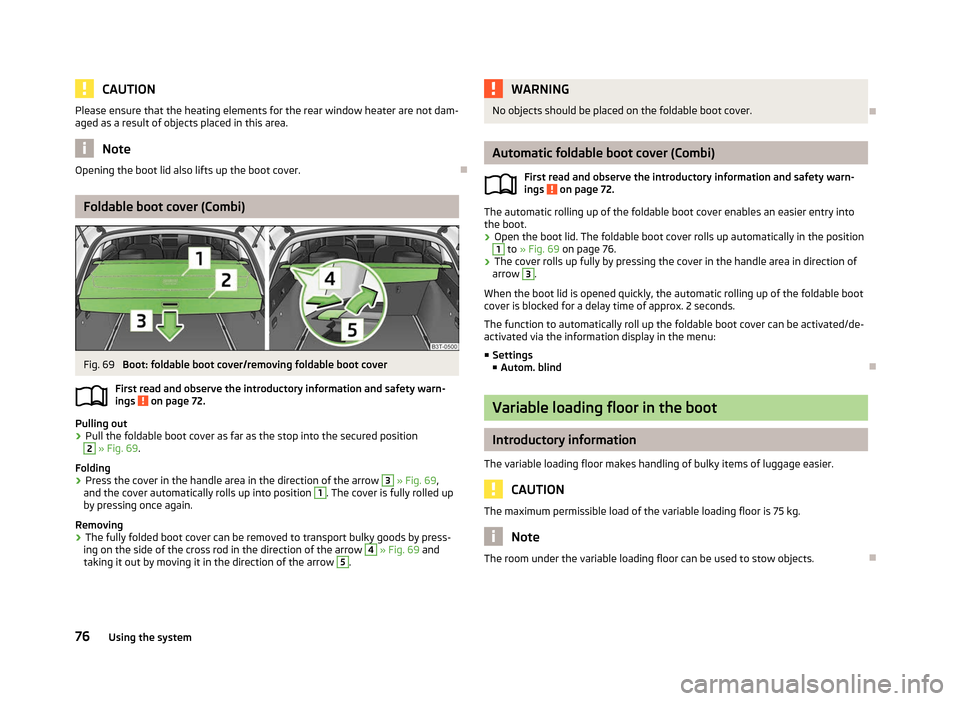
Fig. 69
Boot: foldable boot cover/removing foldable boot cover
First read and observe the introductory information and safety warn-
ings on page 72.
Pulling out
›
Pull the foldable boot cover as far as the stop into the secured position 2
» Fig. 69
.
Folding
› Press the cover in the handle area in the direction of the arrow 3
» Fig. 69
,
and the cover automatically rolls up into position 1
. The cover is fully rolled up
by pressing once again.
Removing
› The fully folded boot cover can be removed to transport bulky goods by press-
ing on the side of the cross rod in the direction of the arrow 4
» Fig. 69
and
taking it out by moving it in the direction of the arrow 5
.
ä WARNING
No objects should be placed on the foldable boot cover. Ð Automatic foldable boot cover (Combi)
First read and observe the introductory information and safety warn-
ings on page 72.
The automatic rolling up of the foldable boot cover enables an easier entry into
the boot.
›
Open the boot lid. The foldable boot cover rolls up automatically in the position 1
to » Fig. 69
on page 76.
› The cover rolls up fully by pressing the cover in the handle area in direction of
arrow 3
.
When the boot lid is opened quickly, the automatic rolling up of the foldable boot
cover is blocked for a delay time of approx. 2 seconds.
The function to automatically roll up the foldable boot cover can be activated/de-
activated via the information display in the menu:
■ Settings
■ Autom. blind Ð Variable loading floor in the boot
Introductory information
The variable loading floor makes handling of bulky items of luggage easier. CAUTION
The maximum permissible load of the variable loading floor is 75 kg. Note
The room under the variable loading floor can be used to stow objects. Ð
ä
76 Using the system