engine coolant SKODA YETI 2012 1.G / 5L User Guide
[x] Cancel search | Manufacturer: SKODA, Model Year: 2012, Model line: YETI, Model: SKODA YETI 2012 1.G / 5LPages: 225, PDF Size: 5.47 MB
Page 172 of 225
WARNING (Continued)
■ If you notice that the lock is not properly engaged while driving, stop the ve-
hicle immediately and close the bonnet - risk of an accident!
■ Keep children clear of the engine compartment.
■ Do not touch any hot engine parts - risk of burns!
■ Never spill fluids on the hot engine. Such fluids (e.g. the antifreeze con-
tained in the coolant) may ignite!
■ Avoid short circuits in the electrical system - particularly on the vehicle's
battery.
■ Never touch the radiator fan while the engine is still warm. The fan might
suddenly start running! ■ Never open the end cover of the coolant expansion reservoir while the en-
gine is still warm. The cooling system is pressurized!
■ When opening the end cover of the coolant expansion reservoir, cover it
with a cloth to protect your face, hands and arms from hot steam or hot cool-
ant.
■ Do not leave any items such as cloths or tools in the engine compartment.
■ If you wish to work under the vehicle, you must secure the vehicle from roll-
ing away and support it with suitable supporting blocks: the car jack is not
sufficient for this - risk of injury!
■ If any inspection work has to be carried out when the engine is running,
there is an additional risk from rotating parts (e.g. V-belt, alternator, radiator
fan) and the high-voltage ignition system. The following must also be ob-
served. ■Never touch the electric wiring on the ignition system.
■ Always make sure that no jewellery, loose clothing or long hair can get
caught in rotating engine parts - hazard! Always remove any jewellery, tie
back long hair and wear tight fitting clothing before completing any work.
■ Additionally, the following warning instructions must be observed if work
has to be carried out on the fuel or electrical system. ■Always disconnect the vehicle battery from the electrical system.
■ Do not smoke.
■ Never work near open flames.
■ Always have a functioning fire extinguisher nearby. CAUTION
■ Always top up using the correct specification of fluids. This may result in major
operating problems and also vehicle damage!
■ Never open the bonnet using the locking lever - danger of causing damage. For the sake of the environment
In view of the environmentally friendly disposal of fluids, the specials tools and
knowledge required for such work, we recommend that fluids are changed by a
Škoda
Service Partner as part of the inspection service. Note
■ If you have any questions regarding the fluids, visit a
ŠKODA Service Partner.
■ Fluids with the correct specifications can be purchased from ŠKODA Original Ac-
cessories. Ð
170 General Maintenance
Page 173 of 225
Opening and closing the bonnet
Fig. 139
Bonnet/radiator grille release lever: Release lever Fig. 140
Securing the bonnet with the
bonnet support
First read and observe the introductory information and safety warn-
ings on page 169.
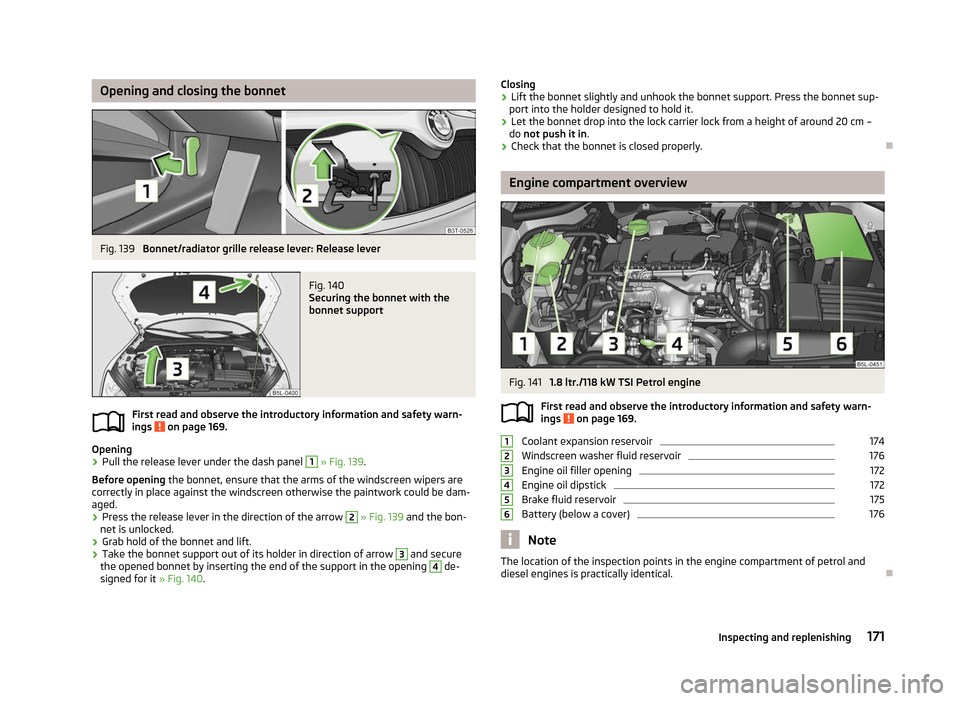
Opening
›
Pull the release lever under the dash panel 1
» Fig. 139.
Before opening the bonnet, ensure that the arms of the windscreen wipers are
correctly in place against the windscreen otherwise the paintwork could be dam-
aged.
› Press the release lever in the direction of the arrow 2
» Fig. 139 and the bon-
net is unlocked.
› Grab hold of the bonnet and lift.
› Take the bonnet support out of its holder in direction of arrow 3
and secure
the opened bonnet by inserting the end of the support in the opening 4
de-
signed for it » Fig. 140.
ä Closing
› Lift the bonnet slightly and unhook the bonnet support. Press the bonnet sup-
port into the holder designed to hold it.
› Let the bonnet drop into the lock carrier lock from a height of around 20 cm –
do not push it in .
› Check that the bonnet is closed properly. Ð Engine compartment overview
Fig. 141
1.8 ltr./118 kW TSI Petrol engine
First read and observe the introductory information and safety warn-
ings on page 169.
Coolant expansion reservoir 174
Windscreen washer fluid reservoir 176
Engine oil filler opening 172
Engine oil dipstick 172
Brake fluid reservoir 175
Battery (below a cover) 176
Note
The location of the inspection points in the engine compartment of petrol and
diesel engines is practically identical. Ð
ä 1
2
3
4
5
6
171
Inspecting and replenishing
Page 175 of 225
Changing engine oil
First read and observe the introductory information and safety warn-
ings on page 169.
The engine oil must be changed at the intervals stated in the Service schedule or
according to the service interval indicator
» page 10, Service Interval Display.CAUTION
Additives must not be added to the engine oil - risk of causing considerable dam-
age to parts of the engine! Damage, which results from such product, are exclu-
ded from the warranty. Note
If your skin has come into contact with oil, it must be washed thoroughly. ÐCoolant
First read and observe the introductory information and safety warn-
ings on page 169.
The cooling system is filled with a coolant in the factory.
The coolant consists of water with a concentration of coolant additive of 40 %.
This mixture provides antifreeze protection down to -25
°C and also protects the
cooling and heating system from corrosion. It also prevents the formation of scale
and significantly increases the boiling point of the coolant.
The concentration of coolant must therefore not be reduced by adding water dur-
ing the summer months or in countries with a warm climate. The concentration of
coolant additive in the coolant must be at least 40 %. 40 %.
If a higher concentration of antifreeze is required for climatic reasons, the amount
of coolant additive can only be increased up to 60 % (antifreeze protection down
to approx. -40 °C). The antifreeze protection tails off above that concentration.
Vehicles exported to countries with a cold climate are already factory-filled with a
coolant which offers antifreeze protection down to about -35 °C. In these coun-
tries the concentration of coolant additive should be at least 50 %.
When refilling, we only recommend you use the same antifreeze written on the
antifreeze expansion tank » Fig. 143 on page 174.
ä
ä
Coolant capacity
Petrol engines Capacities (in litres)
1.2 ltr./77 kW TSI 7.7
1.4 ltr./90 kW TSI 7.7
1.8 ltr./112 kW TSI 8.6
1.8 ltr./118 kW TSI 8.6 Diesel engines
Capacities (in litres)
1.6 ltr./77 kW TDI CR 8.4
2.0 ltr./81 kW TDI CR 8.4
2.0 ltr./103 kW TDI CR 8.4
2.0 ltr./125 kW TDI CR 8.4 CAUTION
■ Other coolant additives that do not comply with the correct specifications can
above all significantly reduce the anticorrosion effect.
■ Any faults resulting from corrosion may cause a loss of coolant and can conse-
quently result in major engine damage! Note
On vehicles that are fitted with an auxiliary heater (auxiliary heating and ventila-
tion), the coolant capacity is approx. 1 l larger. Ð
173
Inspecting and replenishing
Page 176 of 225
Checking the coolant level
Fig. 143
Engine compartment: Coolant
expansion reservoir
First read and observe the introductory information and safety warn-
ings on page 169.
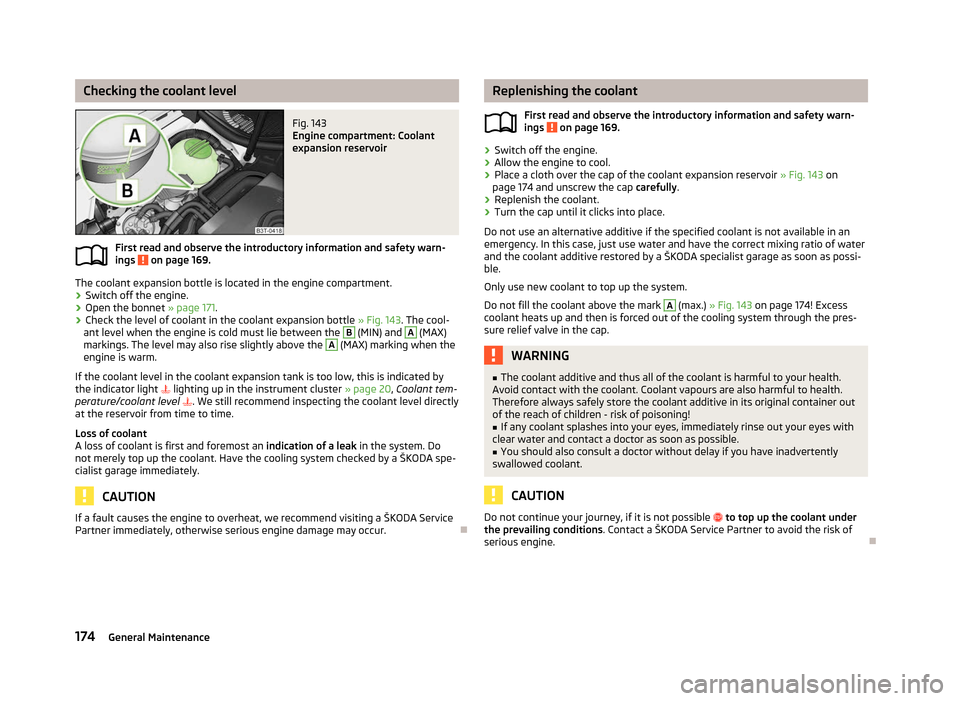
The coolant expansion bottle is located in the engine compartment.
›
Switch off the engine.
› Open the bonnet
» page 171.
› Check the level of coolant in the coolant expansion bottle
» Fig. 143. The cool-
ant level when the engine is cold must lie between the B
(MIN) and A
(MAX)
markings. The level may also rise slightly above the A
(MAX) marking when the
engine is warm.
If the coolant level in the coolant expansion tank is too low, this is indicated by
the indicator light lighting up in the instrument cluster » page 20, Coolant tem-
perature/coolant level . We still recommend inspecting the coolant level directly
at the reservoir from time to time.
Loss of coolant
A loss of coolant is first and foremost an indication of a leak in the system. Do
not merely top up the coolant. Have the cooling system checked by a
ŠKODA spe-
cialist garage immediately. CAUTION
If a fault causes the engine to overheat, we recommend visiting a ŠKODA Service
Partner immediately, otherwise serious engine damage may occur. Ð
ä Replenishing the coolant
First read and observe the introductory information and safety warn-
ings on page 169.
›
Switch off the engine.
› Allow the engine to cool.
› Place a cloth over the cap of the coolant expansion reservoir
» Fig. 143 on
page 174 and unscrew the cap carefully.
› Replenish the coolant.
› Turn the cap until it clicks into place.
Do not use an alternative additive if the specified coolant is not available in an
emergency. In this case, just use water and have the correct mixing ratio of water
and the coolant additive restored by a ŠKODA
specialist garage as soon as possi-
ble.
Only use new coolant to top up the system.
Do not fill the coolant above the mark A
(max.)
» Fig. 143 on page 174! Excess
coolant heats up and then is forced out of the cooling system through the pres-
sure relief valve in the cap. WARNING
■ The coolant additive and thus all of the coolant is harmful to your health.
Avoid contact with the coolant. Coolant vapours are also harmful to health.
Therefore always safely store the coolant additive in its original container out
of the reach of children - risk of poisoning!
■ If any coolant splashes into your eyes, immediately rinse out your eyes with
clear water and contact a doctor as soon as possible.
■ You should also consult a doctor without delay if you have inadvertently
swallowed coolant. CAUTION
Do not continue your journey, if it is not possible to top up the coolant under
the prevailing conditions . Contact a
ŠKODA Service Partner to avoid the risk of
serious engine. Ð
ä
174 General Maintenance
Page 177 of 225
Radiator fan
First read and observe the introductory information and safety warn-
ings on page 169.
The radiator fan is driven by an electric motor and controlled according to the
coolant temperature.
After switching off the ignition, the radiator fan can intermittently continue to op-
erate for approx. 10 minutes.
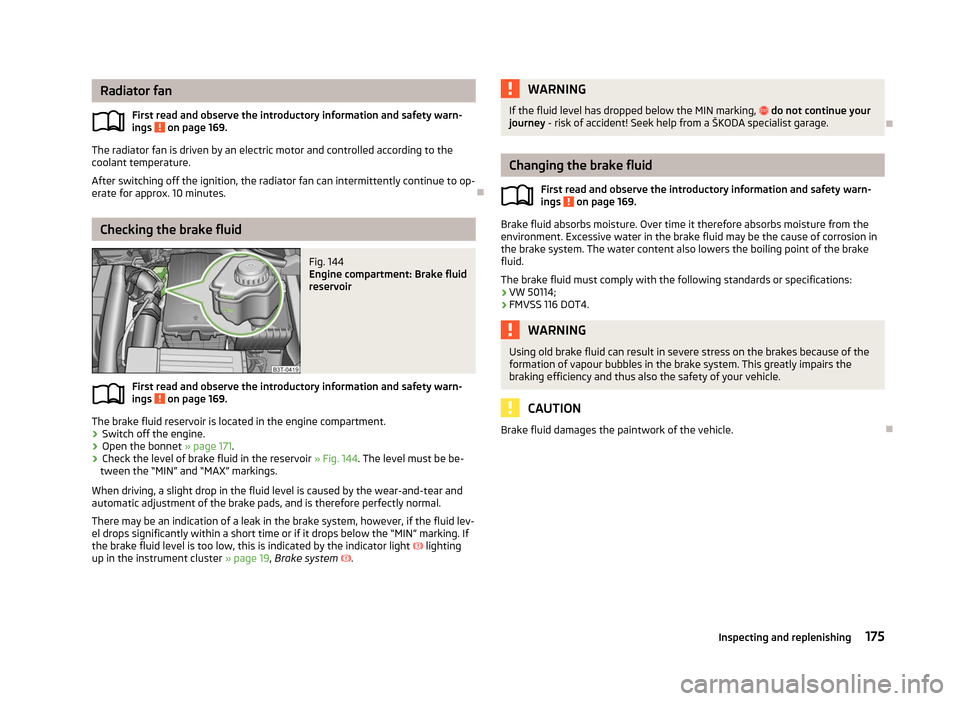
ÐChecking the brake fluid
Fig. 144
Engine compartment: Brake fluid
reservoir
First read and observe the introductory information and safety warn-
ings on page 169.
The brake fluid reservoir is located in the engine compartment.
›
Switch off the engine.
› Open the bonnet
» page 171.
› Check the level of brake fluid in the reservoir
» Fig. 144. The level must be be-
tween the “MIN” and “MAX” markings.
When driving, a slight drop in the fluid level is caused by the wear-and-tear and
automatic adjustment of the brake pads, and is therefore perfectly normal.
There may be an indication of a leak in the brake system, however, if the fluid lev-
el drops significantly within a short time or if it drops below the “MIN” marking. If
the brake fluid level is too low, this is indicated by the indicator light lighting
up in the instrument cluster » page 19, Brake system .
ä
ä WARNING
If the fluid level has dropped below the MIN marking, do not continue your
journey - risk of accident! Seek help from a
ŠKODA specialist garage.Ð Changing the brake fluid
First read and observe the introductory information and safety warn-
ings on page 169.
Brake fluid absorbs moisture. Over time it therefore absorbs moisture from the
environment. Excessive water in the brake fluid may be the cause of corrosion in
the brake system. The water content also lowers the boiling point of the brake
fluid.
The brake fluid must comply with the following standards or specifications:
› VW 50114;
› FMVSS 116 DOT4. WARNING
Using old brake fluid can result in severe stress on the brakes because of the
formation of vapour bubbles in the brake system. This greatly impairs the
braking efficiency and thus also the safety of your vehicle. CAUTION
Brake fluid damages the paintwork of the vehicle. Ð
ä
175
Inspecting and replenishing
Page 205 of 225
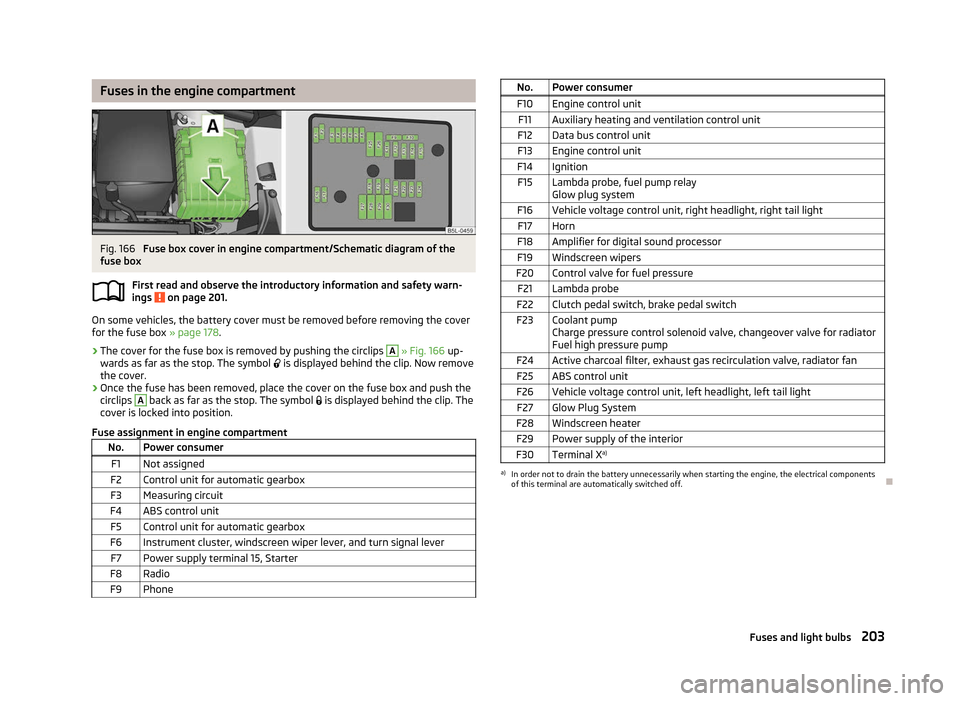
Fuses in the engine compartment
Fig. 166
Fuse box cover in engine compartment/Schematic diagram of the
fuse box
First read and observe the introductory information and safety warn-
ings on page 201.
On some vehicles, the battery cover must be removed before removing the cover
for the fuse box
» page 178.
› The cover for the fuse box is removed by pushing the circlips A
» Fig. 166
up-
wards as far as the stop. The symbol is displayed behind the clip. Now remove
the cover.
› Once the fuse has been removed, place the cover on the fuse box and push the
circlips A
back as far as the stop. The symbol
is displayed behind the clip. The
cover is locked into position.
Fuse assignment in engine compartment No. Power consumer
F1 Not assigned
F2 Control unit for automatic gearbox
F3 Measuring circuit
F4 ABS control unit F5 Control unit for automatic gearbox
F6 Instrument cluster, windscreen wiper lever, and turn signal lever F7 Power supply terminal 15, Starter
F8 Radio F9 Phone ä
No. Power consumer
F10 Engine control unit F11 Auxiliary heating and ventilation control unit
F12 Data bus control unit
F13 Engine control unit
F14 Ignition F15 Lambda probe, fuel pump relay Glow plug system
F16 Vehicle voltage control unit, right headlight, right tail light F17 Horn
F18 Amplifier for digital sound processor F19 Windscreen wipers
F20 Control valve for fuel pressure F21 Lambda probe
F22 Clutch pedal switch, brake pedal switch
F23 Coolant pump Charge pressure control solenoid valve, changeover valve for radiator
Fuel high pressure pump
F24 Active charcoal filter, exhaust gas recirculation valve, radiator fan F25 ABS control unit
F26 Vehicle voltage control unit, left headlight, left tail light F27 Glow Plug System
F28 Windscreen heater F29 Power supply of the interior
F30 Terminal X a) a)
In order not to drain the battery unnecessarily when starting the engine, the electrical components
of this terminal are automatically switched off. Ð
203
Fuses and light bulbs
Page 218 of 225
Charging a vehicle battery 179
Checking Battery electrolyte level 178
Brake fluid 175
Coolant level 174
Engine oil 172
Oil level 172
Windscreen washer fluid 176
Children and safety 143
Child safety Side airbag 144
Child safety lock 27
Child seat Classification 144
ISOFIX 145
on the front passenger seat 143
Suitability 144
TOP TETHER 145
Chrome parts refer to Taking care of your vehicle 162
Cigarette lighter 71
Cleaning 160
Artificial leather 165
Headlight lenses 163
Material coverings 165
Materials 165
Natural leather 165
Plastic parts 162
Wheels 164
Clock 11
Clothes hooks 78
Cockpit 12-volt power socket 71
Ashtray 70
Cigarette lighter 71
General view 7
Light 46
Storage compartments 72
Compartments 72
Computer see Multifunction display 12Coolant
Checking 174
Replenishing 174
Coolant temperature gauge display 9
Correct seated position 129
Counter for distance driven 10
Cruise control system (CCS) 104
Cup holder front 69
rear 70
D
Daytime running lights 40
De-icing the windscreen and rear window 47
Deactivating an airbag 141
Deactivating an airbag 141
Delayed locking of the boot lid see Boot lid 33
Diesel refer to Fuel 169
Diesel fuel Operation in winter 169
Diesel particulate filter 23
Digital clock 11
Dipstick 172
Display Service interval 10
Distance driven 10
Door Child safety lock 27
Indicator light for an open door 20
Doors Emergency locking 32
Driving Abroad 150
Driving through water on the street 151
Emissions 208Fuel consumption 208
Maximum speed 211
Driving off-road after driving off-road 156
Before driving 153
Changing gear when driving off-road 154
Explanation of technical terms 152
Ground clearance 152
Hillside angle 155
OFF ROAD mode 98
Overhang angle 152
Stuck vehicle 155
DVD-preinstallation 127
E
Economical and environmentally friendly driving 147
EDL Operating principle 98
Electrical power windows Button in the driver's door 34
Electric power windows Central locking system 36
Electronic differential lock (EDL) 98
Electronic immobiliser 93
Emergency Automatic gearbox 112
Changing a wheel 191
Hazard warning light system 44
Jump-starting 197
locking of the doors 32
panormaic sliding roof 38
Selector lever-unlocking 113
Towing the vehicle 198
Tyre repair 194
Unlocking the boot lid 34
Emissions 208
Engine Running in 146
Starting and stopping the engine 92
216 Index
Page 219 of 225
Engine compartment
Brake fluid 175
Coolant 173
Overview 171
Vehicle battery 176
Engine oil Capacity 210
Changing 173
Checking 172
Replenishing 172
Specification 210
Engine revolutions counter 9
Environment 147
Environmental compatibility 149
Environmentally friendly driving 147
ESC Function 96
Indicator light 22
F
Fire extinguisher 190
First-aid kit 190
Folding table 76
Footmats 100
Front airbag 138
Front seats 55
Fuel 167
Diesel 169
Fuel gauge 9
gauge 9
refer to Fuel 167
Refuelling 167
Unleaded petrol 168
Fuel consumption 147
Fuses Assignment 201
Replacing 201 G
Gear Recommended gear 11
General view Cockpit 7
Glow plug system Warning light 23
GSM 116, 119
H
Handbrake 96
Head airbag 141
Headlight cleaning system Headlight cleaning system 51
Headlights Driving abroad 150
Head restraint 59
Heating 82
Defrosting windows 82
Exterior mirror 53
Recirculated air mode 83
Seats 58
Windscreen and rear window 47
Horn 7
I
Ignition 94
Ignition lock 94
Immobiliser 93
Indicator lights 18
Information display see MAXI DOT 15
Instrument Cluster 8
See Instrument Cluster 8
Instrument lighting 43
Interior monitor 32
Internet connection 122ISOFIX 145
J
Jacking points Raise vehicle 193
Jump-starting 197
K
Knee airbag 139
L
Lever Main beam 45
Turn signal 45
Levers Windscreen wipers 49
Light Automatic driving lamp control 40
Cockpit 46
COMING HOME/LEAVING HOME function 41
Daytime running lights 40
Fog lights 42
Fog lights with the function CORNER 42
Hazard warning light system 44
Headlight beam adjustment 44
Headlight flasher 45
Low beam 40
Main beam 45
Parking light 40, 41
Rear fog light 43
Replacing bulbs 204
Tourist light 42
Turn signal 45
Lights Cornering lights 41
Indicator lights 18
switching lights on and off 40
Loads 208
217
Index
Page 220 of 225
Lock
Central locking system 29
Locking Emergency locking 32
Remote control 30
Locking and unlocking from the inside 29
M
MAXI DOT 15
Main menu 15
Settings 16
Maximum speed 211
Mirror Additional interior mirror 53
Automatic dimming interior mirror 52
Exterior mirror 53
Manual dimming interior mirror 52
Vanity 48
Mobile phone 114, 116, 119
Connecting to the hands-free system 117, 120
Multifunction display Functions 12
Memory 12
Operation 13
Multimedia 125
AUX-IN 126
MDI 126
N
Net partition 66
O
Off-road driving 151
Style of driving 154
OFF ROAD 98
Oil refer to Engine oil 172Onboard computer
see Multifunction display 12
Opening and closing the panoramic sliding roof 36
Opening and closing the sun screen 36
Operation in winter De-icing windows 163
Diesel fuel 169
Vehicle battery 178
Outside temperature 13
Overhang angle 153
Overview Engine compartment 171
Indicator lights 18
P
Paint see Paint damage 162
Paint damage 162
Panoramic sliding roof 36
Parking Park assist 101
Parking aid 100
Parking ticket holder 79
Passive Safety 128
Pedals 100
Periodic wiping 49
Petrol refer to Fuel 168
Polishing the paintwork refer to Taking care of your vehicle 162
Power steering 93
Power windows Button in the front passenger door 35
Button in the rear doors 35
Operational faults 36
Preservation refer to Taking care of your vehicle 162 R
Radiator fan 175
Radio reception Aerial 163
Functional fault 163
Raise vehicle 193
Rear mirror Automatic dimming interior mirror 52
Exterior mirror 53
Manual dimming interior mirror 52
Rear window - heating 47
Recirculated air mode Climatronic 87
Manual air conditioning system 85
Recommended gear 11
Refuelling 167
Fuel 167
Regulation Headlight beam 44
Remote control 30
Synchronisation process 31
Remote control key Replacing the battery 26
Replacement of parts 189
Replacing Bulbs 204
Fuses 201
Vehicle battery 179
Windscreen wiper blade 51
Replenishing Coolant 174
Engine oil 172
Windscreen washer fluid 176
Roof rack system Roof load 69
Running in Brake pads 146
Engine 146
218 Index