power steering SKODA YETI 2012 1.G / 5L User Guide
[x] Cancel search | Manufacturer: SKODA, Model Year: 2012, Model line: YETI, Model: SKODA YETI 2012 1.G / 5LPages: 225, PDF Size: 5.47 MB
Page 111 of 225

Automatic gearbox
Automatic gearbox
ä
Introduction
This chapter contains information on the following subjects:
Introductory information 109
Starting-off and driving 110
Selector lever positions 110
Manual shifting of gears (Tiptronic) 111
Selector lever lock 111
Kickdown function 112
Dynamic shift programme 112
Emergency programme 112
Selector lever-emergency unlocking 113
WARNING
■ Do not depress the accelerator if changing the position of the selector lever
when the vehicle is stationary and the engine is running - risk of accident!
■ Never move the selector lever into position R or P when driving - risk of an
accident!
■ When the engine is running and the vehicle is stationary, it is necessary to
hold the car with the brake pedal in all the positions of the selector lever (ex-
cept P and N) since the power transmission is never completely interrupted,
also not when the engine is idling - the vehicle creeps.
■ The selector lever must be placed into position P and the handbrake firmly
applied before the bonnet can be opened and work on the running engine can
be completed - risk of accident! The safety guidelines must always be ob-
served » page 169 , Engine compartment .
■ If stopping on a hill (downhill gradient), never try to maintain the vehicle sta-
tionary with the gear engaged by means of the “accelerator pedal”, i.e. by let-
ting the clutch slip. This can lead to overheating of the clutch. If there is a risk
of overheating of the clutch due to overload, the clutch is opened automati-
cally and the vehicle rolls backward - risk of accident! WARNING (Continued)
■ If you have to stop on a slope, depress and hold the brake pedal to prevent
the vehicle from rolling back.
■ On a smooth or slippery road surface using the kickdown function can cause
the driven wheels to spin - risk of skidding! CAUTION
■ The double clutch on the automatic gearbox DSG is equipped with an overload
protection. If the uphill function is used when the vehicle is stationary or driving
slowly uphill, the thermal stress on the clutches is increased. ■ If the clutch system overheats, the symbol is shown in the information dis-
play along with the message Gearbox overheated. Stop! Owner's man.! appears.
An audible signal sounds as a warning signal. Stop the vehicle, switch off the en-
gine, and wait until the symbol disappears - risk of gearbox damage! You can
continue your journey as soon as the symbol disappears. Ð Introductory information
First read and observe the introductory information and safety warn-
ings on page 109.
Shifting up and down through the gears is performed automatically. The gearbox
can also be switched to
Tiptronic mode. This mode makes it possible for you to
also shift gears manually » page 111.
The engine can only be started when the selector lever is in position P or N . If
the selector lever is not in the P or N positions when locking the steering, switch-
ing the ignition on or off or when leaving the engine on, the following message
will appear in the Information display Move selector lever to position P/N! or, in
the instrument cluster display: P/N .
At temperatures below -10 °C the engine can only be started in the selector lever
position P.
When parking on a level road surface, it suffices to engage selector lever position
P. When parking on a slope, the handbrake should be applied firmly before the
park position is selected. This ensures that there is no excessive pressure on the
lock mechanism and that it is subsequently easier to move the selector lever out
of position P. £
ä
109
Automatic gearbox
Page 156 of 225

Off-road driving
First read and observe the introductory information and safety warn-
ings on page 151.
Important information
› Switch on the
OFF ROADmode » page 98 , OFF ROAD mode.
› Drive slowly through tricky route sections. Shift up when driving up on slippery
surfaces, make sure the vehicle always remains in motion. Do not drive too fast
otherwise you may lose control over the vehicle.
› Drive slowly over hilltops. Make sure that the wheels of the vehicle do not lift
off the ground, as this could severely damage the vehicle and it may become
disabled.
› If your vehicle got stuck in sand, snow or sludge, it may be more effective to re-
verse the vehicle than trying to drive forwards.
› Place stones, footmats or pieces of wood under the spinning wheels in order to
achieve traction on a sandy or slippery ground.
› Read the instructions before driving through water
» page 151.
› Keep sufficient distance from other vehicles even at low speeds. When the first
vehicle suddenly gets stuck, the following vehicle can still stop in time without
getting stuck itself.
Driving uphill
› Drive slowly and steadily straight uphill.
› Do not shift gears or press the clutch pedal while climbing.
› Only press the accelerator enough to move up the hill.
› Do not stop or turn the vehicle around on the hillside.
› Prevent the engine from cutting out.
If you can go no further on a slope
› Never attempt to make a turn with the vehicle on a hillside.
› If the engine cuts out, stop and restart the engine.
› Shift into reverse gear and carefully move backwards in your own lane.
Downhill
› Shift into first gear or select the first driving stage, while in Tiptronic mode, to
drive downhill on steep hillsides. The Downhill Drive Support is optimally utilis-
ed in this way.
› Use the foot break carefully otherwise you may lose control over the vehicle.
› If it is feasible and safe, drive straight down.
› Do not press down on the clutch or shift into Neutral.
ä
Driving over rutted roads and troughs
› Only drive over rutted roads and troughs when they do not exceed your vehi-
cle's ground clearance. Your vehicle may
“sink” and get stuck in soft ground.
› Never drive over rutted roads and troughs which are too deep. If you cannot
avoid this, it is better that you turn back.
Crossing a trench › If possible, drive through the trench at an acute angle. Make sure when driving
through the trench that the tilt angle is not too steep.
Driving in sand and mud
› You should always drive at a constant speed through sand or mud whenever
possible and at the same time do not shift gears.
› Never drive too fast, otherwise the wheels may spin and the vehicle can get
stuck. If you feel that the tyres are losing grip, turn the steering wheel quickly
back and forth. This leads to an improved grip on the front tyres for a short peri-
od of time. Ð Changing gear when driving off-road
First read and observe the introductory information and safety warn-
ings on page 151.
The gear you must shift into depends on the terrain. Choosing the correct gear
contributes to safe driving.
Important information
› When the gear or the driving stage has been properly selected, it is unnecessary
to slow down the vehicle on a downhill section using the footbrake as in most
cases the engine braking power is sufficient.
› Depress the accelerator only as much as is necessary. A too great acceleration
may lead to the wheels spinning and thus results in the loss over the control of
the vehicle. £
ä
154 Driving Tips
Page 200 of 225
›
Attach the other end 4
to a solid metal part which is connected firmly to the
engine block, or to the engine block itself.
Starting engine
› Start the engine on the vehicle providing the power and allow it to idle.
› Now start the engine of the vehicle with the discharged battery.
› If the engine does not start, terminate the attempt to start the engine after
10 seconds and wait for about 30 seconds before repeating the process.
› Disconnect the cables in exactly the
reverse order to the one described above. ÐJump-starting in vehicles with the START-STOP system
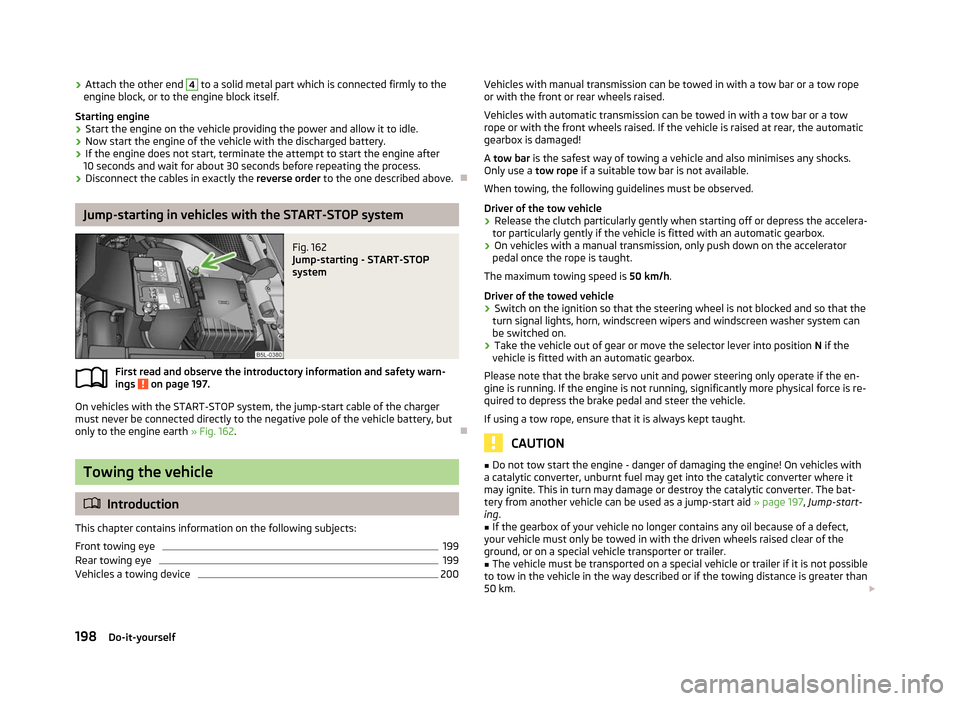
Fig. 162
Jump-starting - START-STOP
system
First read and observe the introductory information and safety warn-
ings on page 197.
On vehicles with the START-STOP system, the jump-start cable of the charger
must never be connected directly to the negative pole of the vehicle battery, but
only to the engine earth » Fig. 162. ÐTowing the vehicle
ä
Introduction
This chapter contains information on the following subjects:
Front towing eye 199
Rear towing eye 199
Vehicles a towing device 200
ä Vehicles with manual transmission can be towed in with a tow bar or a tow rope
or with the front or rear wheels raised.
Vehicles with automatic transmission can be towed in with a tow bar or a tow
rope or with the front wheels raised. If the vehicle is raised at rear, the automatic
gearbox is damaged!
A tow bar is the safest way of towing a vehicle and also minimises any shocks.
Only use a tow rope if a suitable tow bar is not available.
When towing, the following guidelines must be observed.
Driver of the tow vehicle › Release the clutch particularly gently when starting off or depress the accelera-
tor particularly gently if the vehicle is fitted with an automatic gearbox.
› On vehicles with a manual transmission, only push down on the accelerator
pedal once the rope is taught.
The maximum towing speed is 50 km/h.
Driver of the towed vehicle
› Switch on the ignition so that the steering wheel is not blocked and so that the
turn signal lights, horn, windscreen wipers and windscreen washer system can
be switched on.
› Take the vehicle out of gear or move the selector lever into position
N if the
vehicle is fitted with an automatic gearbox.
Please note that the brake servo unit and power steering only operate if the en-
gine is running. If the engine is not running, significantly more physical force is re-
quired to depress the brake pedal and steer the vehicle.
If using a tow rope, ensure that it is always kept taught. CAUTION
■ Do not tow start the engine - danger of damaging the engine! On vehicles with
a catalytic converter, unburnt fuel may get into the catalytic converter where it
may ignite. This in turn may damage or destroy the catalytic converter. The bat-
tery from another vehicle can be used as a jump-start aid » page 197, Jump-start-
ing .
■ If the gearbox of your vehicle no longer contains any oil because of a defect,
your vehicle must only be towed in with the driven wheels raised clear of the
ground, or on a special vehicle transporter or trailer.
■ The vehicle must be transported on a special vehicle or trailer if it is not possible
to tow in the vehicle in the way described or if the towing distance is greater than
50 km. £
198 Do-it-yourself
Page 204 of 225
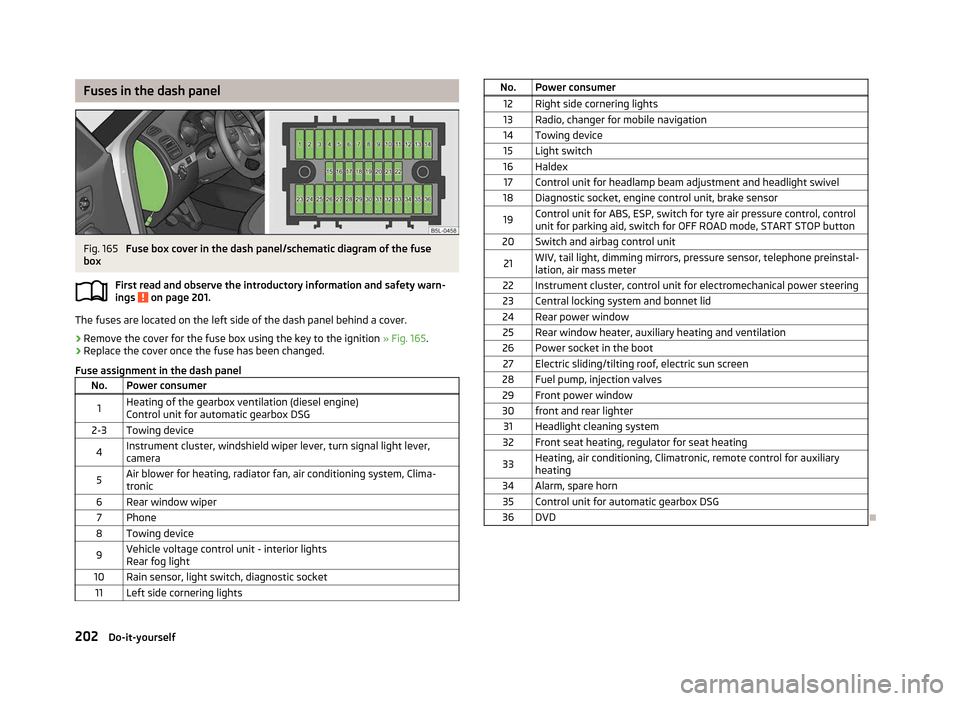
Fuses in the dash panel
Fig. 165
Fuse box cover in the dash panel/schematic diagram of the fuse
box
First read and observe the introductory information and safety warn-
ings on page 201.
The fuses are located on the left side of the dash panel behind a cover.
›
Remove the cover for the fuse box using the key to the ignition
» Fig. 165.
› Replace the cover once the fuse has been changed.
Fuse assignment in the dash panel No. Power consumer
1 Heating of the gearbox ventilation (diesel engine)
Control unit for automatic gearbox DSG
2-3 Towing device
4 Instrument cluster, windshield wiper lever, turn signal light lever,
camera
5 Air blower for heating, radiator fan, air conditioning system, Clima-
tronic
6 Rear window wiper 7 Phone
8 Towing device
9 Vehicle voltage control unit - interior lights
Rear fog light
10 Rain sensor, light switch, diagnostic socket 11 Left side cornering lights ä
No. Power consumer
12 Right side cornering lights
13 Radio, changer for mobile navigation
14 Towing device 15 Light switch
16 Haldex 17 Control unit for headlamp beam adjustment and headlight swivel
18 Diagnostic socket, engine control unit, brake sensor
19 Control unit for ABS, ESP, switch for tyre air pressure control, control
unit for parking aid, switch for
OFF ROAD mode, START STOP button
20 Switch and airbag control unit
21 WIV, tail light, dimming mirrors, pressure sensor, telephone preinstal-
lation, air mass meter
22 Instrument cluster, control unit for electromechanical power steering
23 Central locking system and bonnet lid
24 Rear power window 25 Rear window heater, auxiliary heating and ventilation
26 Power socket in the boot 27 Electric sliding/tilting roof, electric sun screen
28 Fuel pump, injection valves 29 Front power window
30 front and rear lighter 31 Headlight cleaning system
32 Front seat heating, regulator for seat heating
33 Heating, air conditioning, Climatronic, remote control for auxiliary
heating
34 Alarm, spare horn 35 Control unit for automatic gearbox DSG
36 DVD Ð
202 Do-it-yourself
Page 217 of 225
Index
A
Ability to climb see Slope angle 153
ABS Function 97
Warning light 22
Accessories 189
Active driver-steering recommendation (DSR) 96
Adjusting Exterior mirror 53
Adjusting seats 129
Adjustment Seat 56
Aerial 161
see Radio reception 163
Airbag 137
Deployment 137
Front airbag 138
Head airbag 141
Knee airbag 139
Side airbag 140
Airbag system 137
Air conditioning system Air outlet vents 81
Climatronic 86
Manual air conditioning system 83
Alarm 31
Anti-theft alarm system 31
Antilock brake system 97
Armrest 75
Ashtray 70
Assistance systems OFF ROAD 98
Assist systems ABS 22, 97
Cruise control systems (CCS) 104EDL 98
ESC 22, 96
Park assist 101
Parking aid 100
START/STOP 106
TCS 22, 97
Auto Check Control 17
Automatic driving lamp control 40
Automatic gearbox 109
Dynamic shift programme 112
Emergency programme 112
Information for driving 109
Kickdown 112
Manual shifting of gears 111
Parking 110
Selector lever-emergency unlocking 113
Selector lever lock 111
Selector lever positions 110
Starting off 110
Stopping 110
Tiptronic 111
Automatic load deactivation 180
Auxiliary heating (auxiliary heating and ventila- tion) 88
Avoiding damage to your vehicle 150
B
Before setting off 128
Belts 132
Belt tensioners 135
Bonnet Closing 171
Opening 171
Boot Class
N1 vehicles 63
Cover 65
Emergency unlocking 34
Fastening elements 64
Fixing nets 65
Folding hooks 64Light 47
see Boot lid 33
Unlocking the boot lid 34
Variable loading floor 66
Boot lid 33
Automatic locking 33
Warning light 21
Brake assist 96
Brake booster 96
Brake fluid Checking 175
Brakes Brake assist systems 94
Handbrake 96
Indicator light 19
Running in 146
Braking Brake fluid 175
Breakdown kit 194
Bulbs Replacing 204
Button in the driver's door Electric power windows 34
C
Car computer see Multifunction display 12
Car jack 190
Carrier 68
Catalytic converter 146
CD changer 126
Central locking button 29
Central locking system 27
lock 29
unlock 28
Changes 189
Changing Engine oil 173
Wheel 191
215
Index
Page 220 of 225
Lock
Central locking system 29
Locking Emergency locking 32
Remote control 30
Locking and unlocking from the inside 29
M
MAXI DOT 15
Main menu 15
Settings 16
Maximum speed 211
Mirror Additional interior mirror 53
Automatic dimming interior mirror 52
Exterior mirror 53
Manual dimming interior mirror 52
Vanity 48
Mobile phone 114, 116, 119
Connecting to the hands-free system 117, 120
Multifunction display Functions 12
Memory 12
Operation 13
Multimedia 125
AUX-IN 126
MDI 126
N
Net partition 66
O
Off-road driving 151
Style of driving 154
OFF ROAD 98
Oil refer to Engine oil 172Onboard computer
see Multifunction display 12
Opening and closing the panoramic sliding roof 36
Opening and closing the sun screen 36
Operation in winter De-icing windows 163
Diesel fuel 169
Vehicle battery 178
Outside temperature 13
Overhang angle 153
Overview Engine compartment 171
Indicator lights 18
P
Paint see Paint damage 162
Paint damage 162
Panoramic sliding roof 36
Parking Park assist 101
Parking aid 100
Parking ticket holder 79
Passive Safety 128
Pedals 100
Periodic wiping 49
Petrol refer to Fuel 168
Polishing the paintwork refer to Taking care of your vehicle 162
Power steering 93
Power windows Button in the front passenger door 35
Button in the rear doors 35
Operational faults 36
Preservation refer to Taking care of your vehicle 162 R
Radiator fan 175
Radio reception Aerial 163
Functional fault 163
Raise vehicle 193
Rear mirror Automatic dimming interior mirror 52
Exterior mirror 53
Manual dimming interior mirror 52
Rear window - heating 47
Recirculated air mode Climatronic 87
Manual air conditioning system 85
Recommended gear 11
Refuelling 167
Fuel 167
Regulation Headlight beam 44
Remote control 30
Synchronisation process 31
Remote control key Replacing the battery 26
Replacement of parts 189
Replacing Bulbs 204
Fuses 201
Vehicle battery 179
Windscreen wiper blade 51
Replenishing Coolant 174
Engine oil 172
Windscreen washer fluid 176
Roof rack system Roof load 69
Running in Brake pads 146
Engine 146
218 Index