service SKODA YETI 2013 1.G / 5L Owner's Guide
[x] Cancel search | Manufacturer: SKODA, Model Year: 2013, Model line: YETI, Model: SKODA YETI 2013 1.G / 5LPages: 266, PDF Size: 26.71 MB
Page 206 of 266
Specifications and capacityFirst read and observe the introductory information and safety warn-
ings
on page 202.
Specifications and capacity (in l) for vehicles with flexible service intervals
Petrol enginesSpecificationFilling level1.2 ltr/77 kW TSIVW 504 003.91.4 ltr/90 kW TSIVW 504 003.61.8 l/112, 118 kW TSIVW 504 004.6Diesel engines a)SpecificationFilling
level1.6 ltr/77 kW TDI CRVW 507 004.32.0 l/81, 103, 125 kW TDI CRVW 507 004.3a)
Engine oil VW 505 01 can optionally be used in diesel engines without a DPF.
Specifications and capacity (in l) for vehicles with fixed service intervals
Petrol enginesSpecificationFilling level1.2 ltr/77 kW TSIVW 502 003.91.4 ltr/90 kW TSIVW 502 003.61.8 l/112, 118 kW TSIVW 502 004.6applies to Russia
SAE 0W-30 VW 502 00/505 00Diesel engines a)SpecificationFilling
level1.6 ltr/77 kW TDI CRVW 507 004.32.0 l/81, 103, 125 kW TDI CRVW 507 004.3a)
Engine oil VW 505 01 can optionally be used in diesel engines without a DPF.
CAUTION■
If the above engine oils are not available, a different engine oil can be used in
an emergency. To prevent damage to the engine, a maximum of 0.5 litres only of
the following engine oils may be used until the next oil change: ■ For petrol engine models: ACEA A3/ACEA B4 or API SN/API SM;
■ For diesel engine models: ACEA C3 or API CJ-4.
Checking the oil level
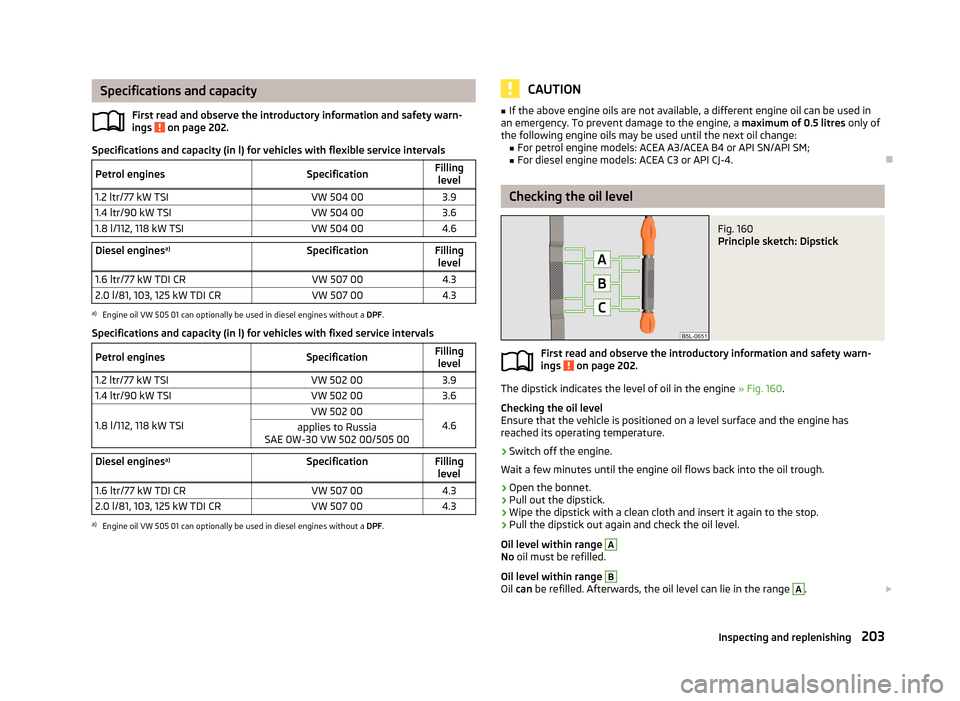
Fig. 160
Principle sketch: Dipstick
First read and observe the introductory information and safety warn-
ings on page 202.
The dipstick indicates the level of oil in the engine » Fig. 160.
Checking the oil level
Ensure that the vehicle is positioned on a level surface and the engine has reached its operating temperature.
›
Switch off the engine.
Wait a few minutes until the engine oil flows back into the oil trough.
›
Open the bonnet.
›
Pull out the dipstick.
›
Wipe the dipstick with a clean cloth and insert it again to the stop.
›
Pull the dipstick out again and check the oil level.
Oil level within range
A
No oil must be refilled.
Oil level within range
B
Oil can be refilled. Afterwards, the oil level can lie in the range
A
.
203Inspecting and replenishing
Page 207 of 266
Oil level within range CThe engine must be topped up with oil so that the oil level at least reaches the
range B
.
The engine consumes a little oil. The oil consumption may be as much as 0.5 l/
1 000 km depending on your style of driving and the conditions under which you operate your vehicle. Consumption may be slightly higher than this during thefirst 5 000 kilometres.
The oil level must be checked at regular intervals. We recommend after each time
you refuel or prior to making a long journey.
We recommend maintaining the oil level within the range
A
, but not above , if
the engine has been operating at high loads, for example, during a lengthy motor-
way trip during the summer months, towing a trailer or negotiating a high moun- tain pass.
The indicator light in the instrument cluster will indicate whether the oil level is
too low » page 17 ,
Engine oil . Check the oil level using the dipstick as soon
as possible. Add oil accordingly.
CAUTION
The oil level must not exceed the range A » Fig. 160 – there is a risk of damaging
the exhaust system.
Replenishing
First read and observe the introductory information and safety warn-
ings
on page 202.
›
Check the oil level » page 203.
›
Unscrew the cap of the engine oil filler opening » Fig. 158
on page 201.
›
Replenish the oil in portions of 0.5 litres in accordance with the correct specifi-
cations » page 203 .
›
Check the oil level » page 203.
›
Carefully screw on the oil filler opening cap and push the dipstick in fully.
Changing
First read and observe the introductory information and safety warn-ings
on page 202.
The engine oil must be changed according to prescribed service inter-vals » page 182 or according to the service interval display » page 30.
Coolant
Introduction
This chapter contains information on the following subjects:
Capacity
205
Checking the coolant level
205
Replenishing
206
The coolant consists of water with coolant additive. This mixture guarantees anti- freeze protection, protects the cooling/heater system against corrosion and pre-
vents lime formation.
Vehicles exported to countries with a mild climate are already factory-filled with
a coolant which offers antifreeze protection down to about -25 ℃. In these coun-
tries, the concentration of coolant additive should be at least 40%.
Vehicles exported to countries with a cold climate are already factory-filled with a
coolant which offers antifreeze protection down to about -35 °C. In these coun-
tries, the concentration of coolant additive should be at least 50%.
If a higher concentration of antifreeze is required for climatic reasons, the con-centration of coolant additive can be increased up to a maximum of 60% (anti-
freeze protection down to approx. -40 °C).
When refilling, only use the same antifreeze written on the antifreeze expansion tank » Fig. 161 on page 205.
204General Maintenance
Page 209 of 266
If the coolant level in the coolant expansion tank is too low, this is indicated by
the warning light lighting up in the instrument cluster » page 16, Coolant .
We still recommend inspecting the coolant level directly at the reservoir from
time to time.
Loss of coolant
A loss of coolant is first and foremost an indication of a leak in the system. Do
not merely top up the coolant. Have the cooling system checked by a specialist
garage.
Replenishing
First read and observe the introductory information and safety warn-
ings
on page 204.
Only top up with new coolant.
›
Switch off the engine.
›
Allow the engine to cool.
›
Place a cloth over the cap of the coolant expansion tank and unscrew the cap carefully .
›
Replenish the coolant.
›
Turn the cap until it clicks into place.
Do not use an alternative additive if the specified coolant is not available in an emergency. In this case, use just water and have the correct mixing ratio of waterand coolant additive restored by a specialist garage as soon as possible.
Brake fluid
Introduction
This chapter contains information on the following subjects:
Checking the brake fluid level
206
Changing
207WARNING■ The engine compartment of your car is a hazardous area. The following
warning instructions must be followed at all times when working in the en-
gine compartment » page 199.■
If the fluid level has dropped below the MIN marking » Fig. 162 on page 206,
do not continue your journey - risk of accident! Seek help from a specialist
garage.
■
Do not use used brake fluid - the function of the brake system may be im-
paired – risk of accident!
CAUTION
Brake fluid damages the paintwork of the vehicle.
Note
■ The brake fluid is changed as part of a compulsory inspection service.■We recommend using oils from the ŠKODA Original Accessories range.
Checking the brake fluid level
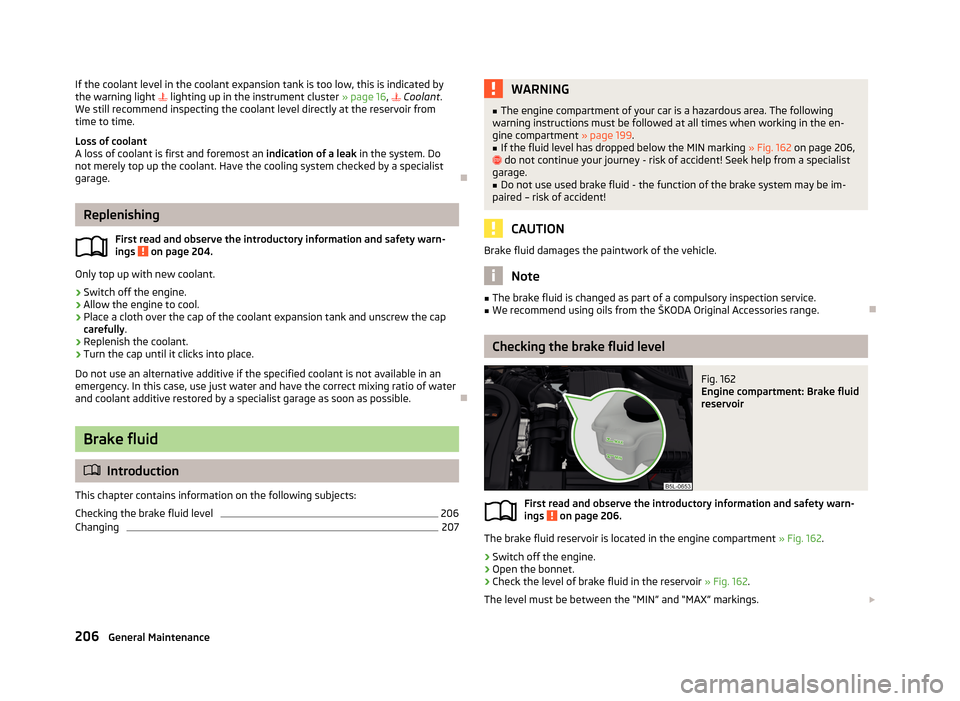
Fig. 162
Engine compartment: Brake fluid
reservoir
First read and observe the introductory information and safety warn-
ings on page 206.
The brake fluid reservoir is located in the engine compartment » Fig. 162.
›
Switch off the engine.
›
Open the bonnet.
›
Check the level of brake fluid in the reservoir » Fig. 162.
The level must be between the “MIN” and “MAX” markings.
206General Maintenance
Page 212 of 266

›Open the battery cover in the direction of the arrow 1 or press the interlock on
the side of the battery cover in the direction of the arrow 2 » Fig. 163 , fold the
cover up and remove.
The battery cover is installed in reverse order.
The edge of the polyester battery cover is inserted between the battery and theside wall of the battery cover when working on the battery.
Checking the battery electrolyte level
Fig. 164
Vehicle battery: Electrolyte level
indicator
First read and observe the introductory information and safety warn-
ings on page 207.
On vehicles with a vehicle battery fitted with a colour indicator » Fig. 164 , the
electrolyte level can be determined by looking at the change in colour.
Air bubbles can influence the colour of the indicator. For this reason carefullyknock on the indicator before carrying out the check.
› Black colour - electrolyte level is correct.
› Colourless or light yellow colour - electrolyte level too low, the battery must be
replaced.
Vehicles with a START-STOP system are fitted with a battery control unit for checking the energy level for recurring engine start.
We recommend that you have the acid level checked regularly by a specialist ga-
rage, especially in the following cases.
› High external temperatures.
› Longer day trips.
› After each charge.
Winter time
The vehicle battery only has a proportion of the starting power in lower tempera- tures. A discharged vehicle battery may already freeze at temperatures just be-
low 0 °C .
We therefore recommend that you have the battery checked and, if necessary, re-
charged by a specialist garage before the start of the winter.
CAUTION
For technical reasons, on vehicles with the description “AGM”, the electrolyte lev- el cannot be checked.
Note
The battery acid level is also checked regularly by a specialist garage as part of
the inspection service.
Charging
First read and observe the introductory information and safety warn-ings
on page 207.
A properly charged vehicle battery is essential for reliably starting the engine.
›
Switch off the ignition and all of the electrical components.
›
Only when performing a “quick-charge”, disconnect both battery cables (first
“negative”, then “positive”).
›
Attach the terminal clamps of the charger to the battery terminals (red = “posi- tive”, black = “negative”).
›
Plug the mains cable of the charger into the power socket and switch on thedevice.
›
After charging has been successful: Switch off the charger and remove the
mains cable from the power socket.
›
Only then disconnect the charger's terminal clamps.
›
Reconnect the cables to the battery (first “positive”, then “negative”).
It is not necessary to disconnect the cables of the battery if you recharge the ve-
hicle battery using low amperages (for example from a mini-charger). Refer to the
instructions of the charger manufacturer .
A charging current of 0.1 multiple of the total vehicle battery capacity (or lower) must be used until full charging is achieved.
209Inspecting and replenishing
Page 215 of 266

Wheels
Tyres and wheel rims
Introduction
This chapter contains information on the following subjects:
Service life of tyres
213
New tyres
214
Unidirectional tyres
215
Tyre pressure monitor
215
Spare wheel
216
Full wheel trim
217
Wheel bolts
217
Wheel bolts
217WARNINGThe national legal regulations must be observed for the use of tyres.WARNINGInstructions for the use of tyres■For the first 500 km, new tyres do not yet provide optimum grip, and appro-
priate care should therefore be taken when driving – risk of accident!■
Only use radial tyres of the same type, size (rolling circumference) and tread
pattern on all four wheels.
■
For reasons of driving safety, do not replace tyres individually.
■
Never exceed the maximum permissible load bearing capacity for fitted
tyres – risk of accident!
■
Never exceed the maximum permissible speed for fitted tyres – risk of acci-
dent!
■
Incorrect wheel alignment at the front or rear impairs handling – risk of acci-
dent!
WARNING (Continued)■ Unusual vibrations or pulling of the vehicle to one side could be a sign of
tyre damage. If there is any doubt that a wheel is damaged, immediately re-
duce your speed and stop! If no external damage is evident, drive slowly and
carefully to the nearest specialist garage to have the vehicle checked.■
Only use tyres or wheel rims that have been approved by ŠKODA for your
model of vehicle. Failure to observe this instruction may impair the road safety
of your vehicle – risk of accident!
WARNINGInformation regarding tyre damage or wear■Never use tyres if you do not know anything about the condition and age.■
Never drive with damaged tyres – risk of accident!
■
Immediately replace damaged wheel rims or tyres.
■
You must have your tyres replaced with new ones at the latest when the
wear indicators have been worn down.
■
Worn tyres impair necessary adhesion to the road surface, particularly at
high speeds on wet roads. This could lead to “aquaplaning” (uncontrolled ve- hicle movement – “swimming” on a wet road surface).
WARNINGInformation on tyre pressure■The tyre control display does not absolve the driver of the responsibility to
ensure the correct tyre inflation pressure. Check the tyre inflation pressure at
regular intervals.■
Insufficient or excessive inflation pressure impairs handling – risk of acci-
dent!
■
If the inflation pressure is too low, the tyre will have to overcome a higher
rolling resistance. This will cause a significant increase in the temperature of
the tyre, especially at higher speeds. This can result in tread separation and a
tyre blowout.
212General Maintenance
Page 216 of 266
WARNINGInformation on the wheel bolts■The wheel bolts must be clean and must turn easily. Never treat them with
grease or oil.■
The prescribed tightening torque of the wheel bolts for steel and light alloy
wheels is 120 Nm.
■
If the wheel bolts are tightened to a too low tightening torque, the rim can
come loose when the car is moving – risk of accident! A tightening torque
which is too high can damage the bolts and threads and this can result in per-
manent deformation of the contact surfaces on the rim.
■
In case of incorrect treatment of the wheel bolts, the wheel can loosen
when the car is moving – risk of accident!
WARNINGInformation on the spare wheel■Only use the spare wheel while absolutely necessary.■
Never drive with more than one spare wheel mounted.
■
The snow chains cannot be used on the spare wheel.
CAUTION
■ If a spare wheel is used that is not identical to the fitted tyres, the following
must be observed » page 216, Spare wheel .■
Protect the tyres from contact with oil, grease and fuel.
■
Replace lost valve caps.
■
If, in the event of a puncture, it is necessary to fit a spare wheel with a tyre
without a dedicated running direction or with the opposite direction of rotation, drive carefully as the optimal characteristics of the tyre are no longer applicable in
this situation.
For the sake of the environment
Tyres that are insufficiently inflated increase your fuel consumption.
Note
■ We recommend that any work on the wheels or tyres be carried out by a spe-
cialist garage.■
We recommend that you use wheel rims, tyres, full wheel trims and snow chains
from ŠKODA Original Accessories.
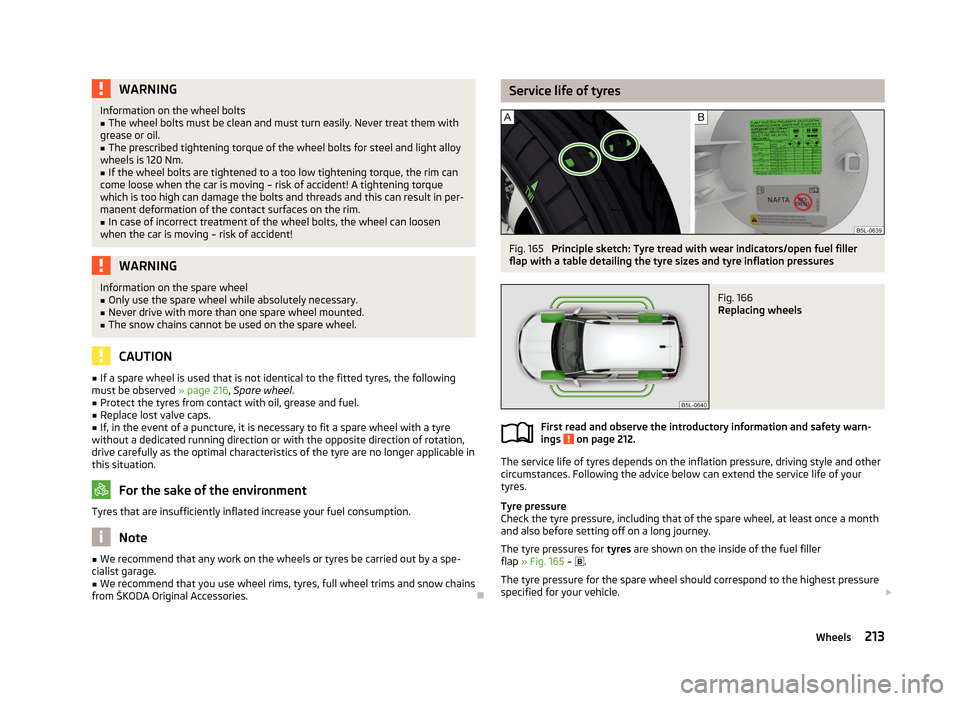
Service life of tyresFig. 165
Principle sketch: Tyre tread with wear indicators/open fuel filler
flap with a table detailing the tyre sizes and tyre inflation pressures
Fig. 166
Replacing wheels
First read and observe the introductory information and safety warn-
ings on page 212.
The service life of tyres depends on the inflation pressure, driving style and other
circumstances. Following the advice below can extend the service life of your
tyres.
Tyre pressure
Check the tyre pressure, including that of the spare wheel, at least once a month and also before setting off on a long journey.
The tyre pressures for tyres are shown on the inside of the fuel filler
flap » Fig. 165 –
.
The tyre pressure for the spare wheel should correspond to the highest pressure
specified for your vehicle.
213Wheels
Page 217 of 266
Always check the inflation pressure when the tyres are cold. Do not reduce the
higher pressure of warm tyres.
With greater additional load, adjust the tyre inflation pressure accordingly.
Driving style
Fast cornering, sharp acceleration and braking increase the wear of your tyres.
Balancing wheels
The wheels of a new vehicle are balanced. When driving, however, there are a
range of factors that may result in an imbalance. This may become apparent by a
“vibration” in the steering.
Have the wheels rebalanced after replacing the tyres.
Wheel alignment errors
Incorrect wheel alignment at the front or rear leads to excess wear of the tyres.
Tyre damage
Drive over kerbs and other such obstacles slowly and perpendicularly wherever
possible in order to avoid damage to tyres and wheel trims.
We recommend checking your tyres and wheel rims for damage (punctures, cuts,
splits and bulges, etc.) on a regular basis. Remove foreign bodies (e.g. small
stones) from the tyre tread immediately.
Replacing wheels
If significantly greater wear is present on the front tyres, we recommend replac-
ing the front wheels with the rear wheels as shown in the diagram » Fig. 166. You
will then obtain approximately the same life for all the tyres.
We recommend that you swap the tyres every 10,000 km in order to achieve even
wear on all tyres and to ensure optimal service life for the tyres.
Storing tyres
Identify disassembled tyres so that the previous direction of rotation can be
maintained if the tyres are reassembled.
Always store wheels or tyres in a cool, dry place that is as dark as possible. Tyres
which are not fixed to a wheel trim should be stored upright.
Wear indicators
The base of the tread of the tyres has 1.6 mm high wear indicators installed. These wear indicators are located multiple times depending on the make and are evenly spaced around the circumference of the tyre » Fig. 165 -
. Markings on
the walls of the tyres through the letters “TWI”, triangular symbols or other sym- bols identify the position of the wear indicators.Tyre age
Tyres age and lose their original characteristics, even if they are not being used.
Therefore, we recommend not using summer or winter tyres older than 6 or 4 years old respectively.
New tyres
First read and observe the introductory information and safety warn-
ings
on page 212.
Only use radial tyres of the same type, size (rolling circumference) and tread pat-
tern on one axle on all four wheels.
The tyre/wheel combinations which are approved for your vehicle are indicated in
your vehicle documents.
Where possible, replace tyres by axle. Always fit the tyres with the deeper tread
depth to the front wheels.
Explanation of tyre markings
225/50R 17 91 T
What this means is:
CaptionMeaning225Tyre width in mm » Fig. 165 on page 213 - 50Height/width ratio in % » Fig. 165 on page 213 - RCode letter for the type of tyre – Radial » Fig. 165 on page 213 - 17Diameter of wheel in inches » Fig. 165 on page 213 - 91Load index » TSpeed symbol »
The date of manufacture is stated on the tyre wall (possibly on the inside). e.g.
DOT ... 10 13...
means, for example, that the tyre was manufactured in the 10th week of 2013.
Load index
This indicates the maximum permissible load for each individual tyre. 580 kg
615 kg
630 kg
899192214General Maintenance
Page 238 of 266
CAUTIONIf the windscreen wipers are handled carelessly, there is a risk of damage to the
windscreen.
Replacing front windscreen wipers
Fig. 191
Windscreen wiper blade
First read and observe the introductory information and safety warn-
ings on page 234.
When in the rest position, the wiper arms cannot be fold down from the wind- screen. Before replacing the windscreen wiper blade, put the windscreen wiper
arms into the service position.
Service position for changing wiper blades
›
Closing the bonnet.
›
Switch the ignition off and on again.
›
Then press the windscreen wiper lever into position
4
» Fig. 36 on page 57
within 10 seconds – the wiper arms move into the service position.
Removing the wiper blade
›
Lift the windscreen wiper arm away from the windscreen.
›
Press the locking button
1
» Fig. 191 to unlock the wiper blade and pull off in
the direction of the arrow
2
.
Attaching the wiper blade
›
Push the windscreen wiper blade until the stop and it locks in place.
›
Check that the wiper blade is correctly attached.
›
Fold the wiper arms back to the windscreen.
The windscreen wiper arms move back into the rest position - after switching on
the ignition and changing the position of the window wiper lever or when driving
at a speed of more than 6°km/h.
Windshield wiper blades in proper condition are essential to obtain good visibility.
Wiper blades should not be allowed to become dirtied by dust, insect remains and
preserving wax.
Juddering or smearing of the wiper blades could then be due to wax residues left
on the windshield by vehicle washing in automatic vehicle wash systems. It is
therefore important to degrease the lips of the windshield wiper blades after ev-
ery pass through an automatic vehicle wash system .
Replacing the rear window wiper blade
Fig. 192
Rear window wiper blade
First read and observe the introductory information and safety warn-
ings on page 234.
Removing the wiper blade
›
Lift the wiper arm away from the window » Fig. 192.
›
Tilt the wiper blade to the stop in the direction of the wiper arm.
›
Hold the upper part of the wiper arm and unlock the securing mechanism
1
.
›
Remove the wiper blade in the direction of the arrow
2
.
Attaching the wiper blade
›
Push the windscreen wiper blade until the stop and it locks in place.
›
Check that the wiper blade is correctly attached.
›
Fold the wiper arm back to the windscreen.
235Emergency equipment and self-help
Page 256 of 266
Counter for distance driven13
Cruise control system Activating/deactivating
148
Changing the stored speed148
Storing and maintaining speed148
Switching off temporarily148
Warning light22
Cruise Control System147
Cupholders73
D
DAY LIGHT see Daylight running lights
48
Daylight running lights48
De-icing the windscreen and rear window55
Deactivating an airbag175
Decorative films190
Delayed locking of the boot lid see Boot lid
41
Diesel refer to Fuel
198
diesel - particulate filter
20
Diesel fuel Operation in winter
198
Diesel particulate filter warning light
20
Digital Clock Time
13
Dipstick203
Disconnecting and reconnecting vehicle battery
210
Display12
Compass points25
Coolant temperature11
Correct gear changes24
Fuel supply12
Service intervals30
Display of the second speed13
Distance driven13
Door Child safety lock
37
Closing37
Emergency locking233
Emergency locking the driver's door232
Opening37
warning light door open16
Door open warning light
16
Driver Steering Recommendation (DSR)137
Driving Abroad
135
Emissions244
Fording water on roads134
Fuel consumption244
Maximum speed247
on unpaved roads135
driving away from paved roads135
Driving economically Economical gear changing
131
Driving with a trailer157
DSR137
DVD-preinstallation116
E
Economical driving
130
Ballast132
Driving at full throttle131
Idling131
Looking ahead130
Regular maintenance132
Saving energy133
Short distances132
Tyre inflation pressure132
EDL Operation
137
Electrical power windows43
Button in the driver's door41, 42
Button in the rear doors43
Operational faults44
Electronic Differential Lock (EDL)137
Electronic immobiliser119
Electronic Stability Control (ESC)136
emergency replace battery in the remote control
231
Emergency Activation of the sliding/tilting roof
234
Changing a wheel221
Hazard warning light system52
Jump-starting226, 227
Locking the door without a locking cylinder233
Locking the driver's door232
Selector lever-unlocking233
Sliding/tilting roof234
Start engine - KESSY123
Switching off the ignition –KESSY123
Towing the using the tow hitch230
Towing the vehicle228
Tyre repair224
Unlocking the driver's door232
Unlocking the tailgate233
emergency equipment reflective vest
219
Emergency equipment First aid kit
219
Jack220
Vehicle tool kit220
Warning triangle219
Emissions244
Engine Running in
129
Engine compartment199
Brake fluid206
Coolant205
Overview201
Vehicle battery207
engine oil information messages
17
warning light17
253Index
Page 258 of 266
I
Ice warning
24
Ignition119
Immobiliser119
Individual settings Locking
36
Unlocking36
Inertia reel167
Information messages see KESSY
38
Information system23
Compass point display25
Door warning25
Gear recommendation24
Ice warning24
MAXI DOT display28
Multifunction display25
Operation23
Service interval display30
Inserting the variable loading floor
88
Instrument cluster10
Counter for distance driven13
Display12
Fuel gauge12
Lighting53
Overview10
Revolutions counter11
Speedometer11
Temperature gauge11
Warning lights14
Instrument lighting53
Interior monitor40
Internet connection108
ISOFIX180
J
Jack
220
Jacking points Raise vehicle223
Jump-starting226, 227
K
KESSY Information messages
38
lock38
Lock / unlock the steering121
Starting the engine122
Switching off the engine123
Switching off the ignition123
Switching on the ignition122
unlock38
Key Locking
33
Starting the engine119
Stopping the engine120
Unlocking33
Knee airbag172
L
LEAVING HOME
51
Lever Main beam
49
Turn signal49
Levers Windscreen wipers
57
Licht COMING HOME / LEAVING HOME
51
Light Cockpit
53
Fog lights with CORNER function51
Instruments53
Replacing bulbs238
Travel mode50
Lights47
Adaptive headlights (AFS)50
Automatic driving lamp control49
Daylight running48
Fog lights51
Hazard warning light system52
Headlight beam adjustment47
Headlight flasher49
Low beam47
Main beam49
Parking lights53
Rear fog light51
Side lights47
Switching on/off47
Tourist lights50
Turn signal49
Warning lights14
Lights on/off47
Loads244
Locking Individual settings
36
KESSY35
Key33
Remote control34
Vehicle key33
Locking and unlocking the vehicle from the inside 36
Locking the door without a locking cylinder Emergency
233
Low beam47
Luggage compartment81
Cover85
Emergency unlocking233
Fastening elements82
Fastening with sliding hook84
Fixing nets83
Flexible storage compartment84
floor covering on both sides85
foldable hook83
Net partition86
removable light87
Storage compartments86
Unlocking the tailgate233
Variable loading floor88
Luggage compartment cover85
255Index