belt SKODA YETI 2013 1.G / 5L Owner's Manual
[x] Cancel search | Manufacturer: SKODA, Model Year: 2013, Model line: YETI, Model: SKODA YETI 2013 1.G / 5LPages: 266, PDF Size: 26.71 MB
Page 6 of 266
Table of Contents
Materials defect liability and ŠKODA warranty for
new cars5
Mobility warranty and ŠKODA extended
warranty
6
Abbreviations
Using the system
Cockpit
9
Overview
8
Instruments and Indicator Lights
10
Instrument cluster
10
Warning lights
14
Information system
23
Driver information system
23
Multifunction display (MFD)
25
MAXI DOT display
28
Service interval display
30
Unlocking and opening
32
Unlocking and locking
32
KESSY
38
Anti-theft alarm system
39
Luggage compartment lid
40
Electric power windows
41
Panorama sliding/tilting roof
44
Lights and visibility
47
Lights
47
Interior lights
53
Visibility
55
Windscreen wipers and washers
56
Rear mirror
58Seats and useful equipment61Front seats61
Front seat functions
64
Head restraints
66
Rear seats
67
Practical equipment
70
Luggage compartment
81
Variable loading floor in the luggage
compartment (Estate)
88
Roof rack system
90
Heating and air-conditioning
91
Heating, ventilation, cooling
91
Auxiliary heating (auxiliary heating and ventilation)
97
Communication and multimedia
100
General information
100
Universal telephone preinstallation GSM II
103
Universal telephone preinstallation GSM IIl
105
Wi-Fi
109
Voice control
110
Multimedia
113
Driving
Starting-off and Driving
117
Steering
117
Starting and stopping the engine using the
key
118
Starting and stopping the engine - KESSY
120
Brakes
124
Manual gear changing and pedals
125
Automatic transmission
126
Running in
129
Economical driving and environmental
sustainability
130
Water crossing and drive outside paved roads
134
Driving abroad
135Assist systems136Brake assist systems136
OFF ROAD-mode
138
Parking aid
140
Optical Parking Assist (Rear view camera)
141
Park assist
143
Cruise Control System
147
START-STOP
149
Fatigue detection (break recommendation)
151
Towing a trailer
152
Towing device
152
Trailer
156
Safety
Passive Safety
160
General information
160
Correct seated position
161
Seat belts
164
Using seat belts
164
Inertia reels and belt tensioners
167
Airbag system
169
Description of the airbag system
169
Airbag overview
170
Deactivating airbags
175
Transporting children safely
177
Child seat
177
Fastening systems
180
General Maintenance
Vehicle care
182
Service intervals
182
Service work, adjustments and technical alterations
184
Washing your car
1873Table of Contents
Page 17 of 266
The menu item Vehicle status is shown in the main menu of the MAXI DOT dis-
play whenever at least one fault message exists. After selecting this menu, the
first of the error messages is displayed. Several error messages are shown on the
display under the message e.g. 1/3. This indicates that the first of a total of three
error messages is being displayed.
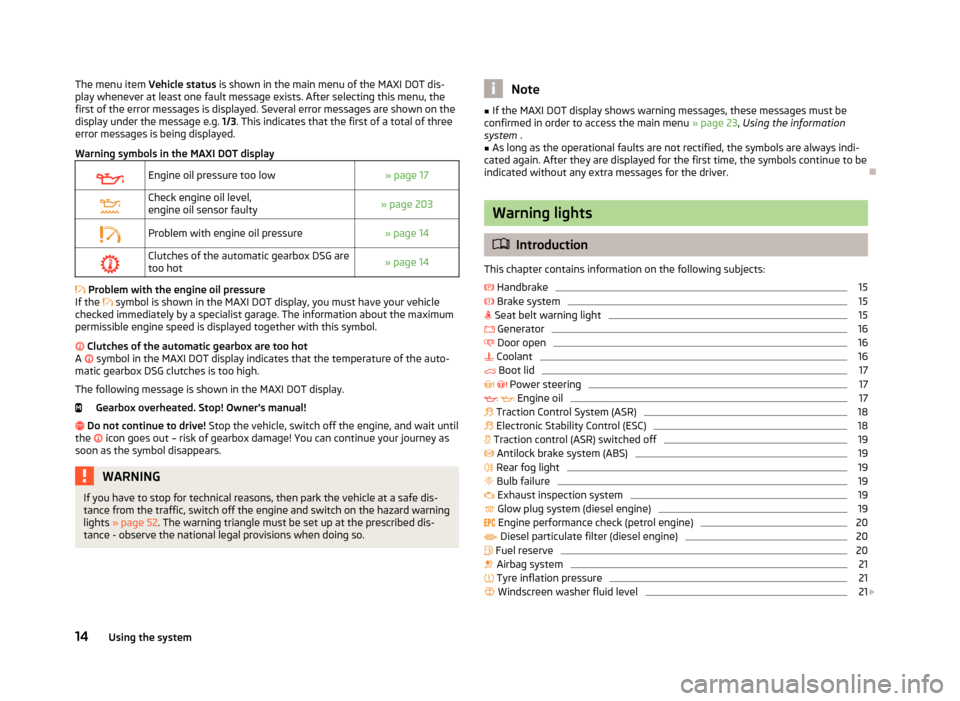
Warning symbols in the MAXI DOT displayEngine oil pressure too low» page 17Check engine oil level,
engine oil sensor faulty» page 203Problem with engine oil pressure» page 14Clutches of the automatic gearbox DSG are too hot» page 14
Problem with the engine oil pressure
If the
symbol is shown in the MAXI DOT display, you must have your vehicle
checked immediately by a specialist garage. The information about the maximum
permissible engine speed is displayed together with this symbol.
Clutches of the automatic gearbox are too hot
A
symbol in the MAXI DOT display indicates that the temperature of the auto-
matic gearbox DSG clutches is too high.
The following message is shown in the MAXI DOT display. Gearbox overheated. Stop! Owner's manual!
Do not continue to drive! Stop the vehicle, switch off the engine, and wait until
the
icon goes out – risk of gearbox damage! You can continue your journey as
soon as the symbol disappears.
WARNINGIf you have to stop for technical reasons, then park the vehicle at a safe dis- tance from the traffic, switch off the engine and switch on the hazard warning
lights » page 52 . The warning triangle must be set up at the prescribed dis-
tance - observe the national legal provisions when doing so.Note■ If the MAXI DOT display shows warning messages, these messages must be
confirmed in order to access the main menu » page 23, Using the information
system .■
As long as the operational faults are not rectified, the symbols are always indi-
cated again. After they are displayed for the first time, the symbols continue to be
indicated without any extra messages for the driver.
Warning lights
Introduction
This chapter contains information on the following subjects:
Handbrake
15
Brake system
15
Seat belt warning light
15
Generator
16
Door open
16
Coolant
16
Boot lid
17
Power steering
17
Engine oil
17
Traction Control System (ASR)
18
Electronic Stability Control (ESC)
18
Traction control (ASR) switched off
19
Antilock brake system (ABS)
19
Rear fog light
19
Bulb failure
19
Exhaust inspection system
19
Glow plug system (diesel engine)
19
Engine performance check (petrol engine)
20
Diesel particulate filter (diesel engine)
20
Fuel reserve
20
Airbag system
21
Tyre inflation pressure
21
Windscreen washer fluid level
21
14Using the system
Page 18 of 266
Turn signal system21 Fog lights22
Cruise control system
22
Selector lever lock
22
OFF ROADmode
22
Main beam
22
The warning lights indicate certain functions or faults.
Some warning lights can be accompanied by acoustic signals and messages in the
display of the instrument cluster.
After switching on the ignition, some warning lights illuminate briefly as a func-
tion test.
If the tested systems are OK, the corresponding warning lights go out a few sec-
onds after switching on the ignition.
WARNING■ Ignoring illuminated warning lights and related messages or instructions in
the display of the instrument cluster may lead to serious personal injury or
damage to the vehicle.■
If you have to stop for technical reasons, then park the vehicle at a safe dis-
tance from the traffic, switch off the engine and switch on the hazard warning lights » page 52 . The warning triangle must be set up at the prescribed dis-
tance - observe the national legal provisions when doing so.
■
The engine compartment of your car is a hazardous area. The following
warning instructions must be followed at all times when working in the en-
gine compartment » page 199, Engine compartment .
Handbrake
First read and observe the introductory information and safety warn-
ings
on page 14.
The indicator light
comes on if the handbrake is applied.
An acoustic signal will sound if you drive the vehicle above 6 km/h for at least 3
seconds while the handbrake is applied.
The following message is shown in the MAXI DOT display. Release parking brake!
Brake system
First read and observe the introductory information and safety warn-
ings
on page 14.
If the warning light lights up, the brake fluid level in the brake system is too
low.
The following message is shown in the MAXI DOT display. Brake fluid: Owner's manual!
Stop the vehicle, switch off the engine, and check the level of the brake flu-
id » page 206 .
If the warning light
lights up together with the warning light
, there is a
problem with the ABS.
WARNING■ If you have to stop for technical reasons, then park the vehicle at a safe dis-
tance from the traffic, switch off the engine and activate the hazard warning
light system » page 52. The warning triangle must be set up at the prescri-
bed distance - observe the national legal provisions when doing so.■
The following guidelines should be observed when opening the bonnet and
checking the brake fluid level » page 199, Engine compartment .
■
If the warning light is displayed simultaneously with warning light
» page 19 , Antilock brake system (ABS) , do not continue your jour-
ney! Seek help from a specialist garage.
■
A fault to the braking system can increase the vehicle's braking distance -
risk of accident!
Seat belt warning light
First read and observe the introductory information and safety warn-ings
on page 14.
The warning light
comes on after the ignition is switched on as a reminder for
the driver and front passenger to fasten the seat belt.
The warning light
goes out once the driver or front passenger has fastened
their seat belt.
15Instruments and Indicator Lights
Page 19 of 266
If the driver or front passenger has not fastened their seat belt and the vehicle
speed is more than 20 km/h, the warning light flashes and you will hear an
acoustic signal.
If the seat belt is not fastened by the driver or front passenger during the next
90 seconds, the warning signal is deactivated and the indicator light lights up
permanently.
Further information » page 164, Seat belts .
Generator
First read and observe the introductory information and safety warn-ings
on page 14.
If the indicator light lights up
when the engine is running, the vehicle battery is
not being charged.
Seek assistance from a specialist garage immediately. The electrical system re-
quires checking.
WARNINGIf you have to stop for technical reasons, then park the vehicle at a safe dis-
tance from the traffic, switch off the engine and switch on the hazard warning
lights » page 52 . The warning triangle must be set up at the prescribed dis-
tance - observe the national legal provisions when doing so.
CAUTION
If the indicator light (cooling system fault) lights up in addition to the indica-
tor light while driving, do not continue driving! Stop the engine - there is a risk
of engine damage! Seek help from a specialist garage.
Door open
First read and observe the introductory information and safety warn-
ings
on page 14.
The indicator light
comes on, if one or several doors are opened.
The warning light comes on even when the ignition is switched off. The warning
light lights up for a maximum of 5 minutes.
On vehicles with MAXI DOT display, this indicator is replaced by a vehicle icon on
the display » page 25 .WARNINGIf you have to stop for technical reasons, then park the vehicle at a safe dis-
tance from the traffic, switch off the engine and switch on the hazard warning
lights » page 52 . The warning triangle must be set up at the prescribed dis-
tance - observe the national legal provisions when doing so.
Coolant
First read and observe the introductory information and safety warn-ings
on page 14.
If the warning light
lights up or flashes , either the coolant temperature is too
high or the coolant level is too low.
The following message is shown in the MAXI DOT display. Check coolant! Owner's manual!
› Stop the vehicle, switch off the engine, and check the coolant level
» page 205.
› If the coolant level is too low, add coolant to the reservoir
» page 206.
› If the indicator light
disappears after adding coolant and switching on the ig-
nition, you may continue your journey.
› If the coolant level is within the specified range, but the indicator light
is still
illuminated , check the fuse for the radiator fan and replace it if necessa-
ry » page 237 , Fuses in the engine compartment .
› If the coolant level and fan fuse are both OK but the indicator light
is still illu-
minated ,
do not continue your journey!
› Seek help from a specialist garage.
16Using the system
Page 24 of 266
Airbag systemFirst read and observe the introductory information and safety warn-ings
on page 14.
If the warning light lights up , there is a fault in the airbag system.
The following message is shown in the MAXI DOT display. Error: Airbag
The operational capability of the airbag system is monitored electronically, includ-
ing when one of the airbags is switched off.
If a front, side or head airbag or belt tensioner has been switched off using thevehicle system tester:
› The warning
lights up for approx. 4 seconds after switching on the ignition
and then flashes again for approx. 12 seconds.
The following message is shown in the MAXI DOT display. Airbag / belt tensioner deactivated.
If the air bag was switched off using the key-operated switch on the side of the
dash panel on the passenger side:
› The indicator light
comes on for around 4 seconds after the ignition has been
switched on;
› Switched off airbags are indicated in the middle of the dash panel by the indica-
tor light
in the display
coming on » page 176.
WARNINGIf there is a fault in the airbag system, have it checked immediately by a spe-
cialist garage. Otherwise, there is a risk of the system not being activated in
the event of an accident.
Tyre inflation pressure
First read and observe the introductory information and safety warn-
ings
on page 14.
The warning light
lights up , if there is a substantial drop in inflation pressure in
one of the tyres. Check and adjust the pressure in all tyres » page 213.
An audible signal sounds as a warning signal.
If the warning light flashes , there is a fault in the system.
Seek assistance from a specialist garage immediately.
Further information » page 215, Tyre pressure monitor .
Note
If the vehicle's battery has been disconnected and reconnected, the warning light
comes on after switching on the ignition. If the warning light does not go
out after moving a short distance, this means there is an error in the system. Seek
assistance from a specialist garage immediately.
Windscreen washer fluid level
First read and observe the introductory information and safety warn-ings
on page 14.
If the windscreen washer fluid level is too low, the indicator light
comes on.
The following message is shown in the MAXI DOT display. Top up wash fluid!
Top up with liquid » page 205.
Turn signal system
First read and observe the introductory information and safety warn-ings
on page 14.
Either the left
or right
indicator light flashes depending on the position of
the control lever.
If there is a fault in the turn signal system, the warning light flashes at twice its
normal rate. This does not apply when towing a trailer.
Switching off the hazard indicator light system is switched on will cause all of the
turn signal lights as well as both indicator lights to flash.
Further information » page 49.
21Instruments and Indicator Lights
Page 64 of 266
Seats and useful equipment
Front seats
Introduction
This chapter contains information on the following subjects:
Manually adjusting the front seats
62
Electric front seat adjustment
62
Memory Function of the electrically adjustable seat
63
Memory function of the remote control key
63
The driver's seat should be adjusted in such a way that the pedals can be fully
pressed to the floor with slightly bent legs.
The seat backrest on the driver's seat should be adjusted in such a way that the
upper point of the steering wheel can be easily reached with slightly bent arms.
Correct adjustment of the seats is particularly important for the following: › Reaching the controls safely and quickly.
› A relaxed and fatigue-free body position.
› Achieving the maximum protection offered by the seat belts and the airbag
system.
WARNINGGeneral information■Caution when adjusting the seat! You may suffer injuries or bruises as a re-
sult of adjusting the seat without paying proper attention.■
The electric front seat adjustment is also functional when the ignition is
turned off (even with the ignition key removed). Therefore children should
never be left unattended in the vehicle.
■
The seat backrests must not be tilted too far back when driving, as this will
impair the function of the seat belts and of the airbag system – risk of injury!
■
Never carry more people than there are number of seats in the vehicle.
■
Each occupant must correctly fasten the seat belt belonging to the seat.
Children must be fastened » page 177, Transporting children safely with a
suitable restraint system.
WARNING (Continued)■ The front seats and head restraints must be adjusted to match the body
size at all times and the seat belt must always be fastened properly to provide
the most effective levels of protection to the passengers.■
Do not carry any objects on the front passenger seat except objects de-
signed for this purpose (e.g. child seats) – risk of accident!
WARNINGInformation for the driver■Only adjust the driver's seat when the vehicle is stationary – risk of accident!■
Maintain a distance of at least 25 cm from the steering wheel, and a dis-
tance of at least 10 cm between the legs and the dash panel at the height of
the knee airbag. Not maintaining this minimum distance will mean that the
airbag system will not be able to properly protect you – hazard!
■
Ensure that there are no objects in the driver's footwell, as these may get
caught in the pedal apparatus when driving or braking » page 126. You would
then no longer be able to operate the clutch, brake or acceleration pedals.
WARNINGInformation for the front passenger■Maintain a distance of at least 25 cm to the dash panel. Not maintaining this
minimum distance will mean that the airbag system will not be able to proper-
ly protect you – hazard!■
Always keep your feet in the footwell when the car is being driven – never
place your feet on the instrument panel, out of the window or on the surfaces of the seats. You will be exposed to increased risk of injury if it becomes nec-
essary to apply the brake or in the event of an accident. If an airbag is de-
ployed, you may suffer fatal injuries when adopting an incorrect seated posi- tion!
Note
■ After a certain time, play can develop within the adjustment mechanism of the
backrest angle.■
For safety reasons, it is not possible to store the seat position in the electric
seat memory and remote control key memory if the inclination angle of the seat
backrest is more than 102° in relation to the seat cushion.
■
Each time you store the position of the electrically adjustable driver's seat and
exterior mirrors, the existing setting is deleted.
61Seats and useful equipment
Page 69 of 266
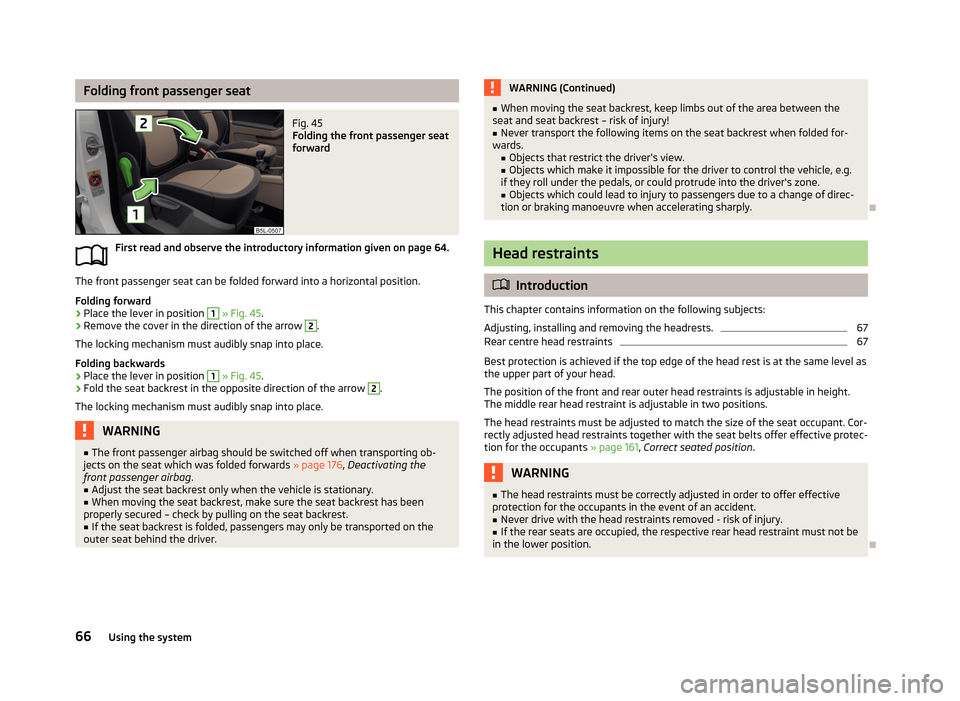
Folding front passenger seatFig. 45
Folding the front passenger seat
forward
First read and observe the introductory information given on page 64.
The front passenger seat can be folded forward into a horizontal position.
Folding forward
›
Place the lever in position
1
» Fig. 45 .
›
Remove the cover in the direction of the arrow
2
.
The locking mechanism must audibly snap into place.
Folding backwards
›
Place the lever in position
1
» Fig. 45 .
›
Fold the seat backrest in the opposite direction of the arrow
2
.
The locking mechanism must audibly snap into place.
WARNING■ The front passenger airbag should be switched off when transporting ob-
jects on the seat which was folded forwards » page 176, Deactivating the
front passenger airbag .■
Adjust the seat backrest only when the vehicle is stationary.
■
When moving the seat backrest, make sure the seat backrest has been
properly secured – check by pulling on the seat backrest.
■
If the seat backrest is folded, passengers may only be transported on the
outer seat behind the driver.
WARNING (Continued)■ When moving the seat backrest, keep limbs out of the area between the
seat and seat backrest – risk of injury!■
Never transport the following items on the seat backrest when folded for-
wards. ■Objects that restrict the driver's view.
■ Objects which make it impossible for the driver to control the vehicle, e.g.
if they roll under the pedals, or could protrude into the driver's zone.
■ Objects which could lead to injury to passengers due to a change of direc-
tion or braking manoeuvre when accelerating sharply.
Head restraints
Introduction
This chapter contains information on the following subjects:
Adjusting, installing and removing the headrests.
67
Rear centre head restraints
67
Best protection is achieved if the top edge of the head rest is at the same level as the upper part of your head.
The position of the front and rear outer head restraints is adjustable in height. The middle rear head restraint is adjustable in two positions.
The head restraints must be adjusted to match the size of the seat occupant. Cor-rectly adjusted head restraints together with the seat belts offer effective protec-
tion for the occupants » page 161, Correct seated position .
WARNING■
The head restraints must be correctly adjusted in order to offer effective
protection for the occupants in the event of an accident.■
Never drive with the head restraints removed - risk of injury.
■
If the rear seats are occupied, the respective rear head restraint must not be
in the lower position.
66Using the system
Page 71 of 266
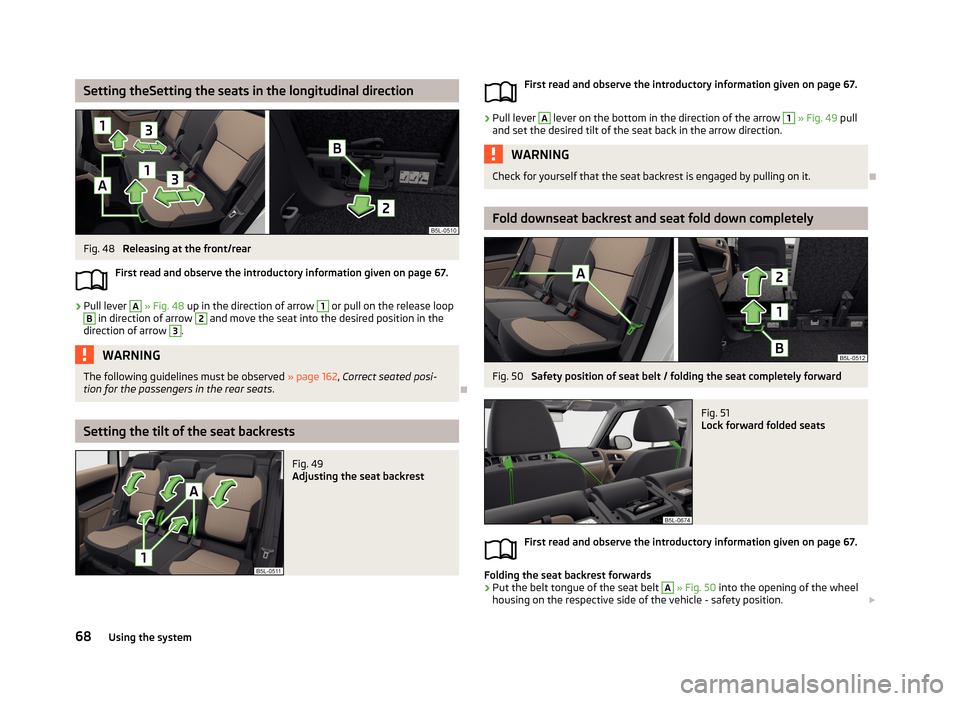
Setting theSetting the seats in the longitudinal directionFig. 48
Releasing at the front/rear
First read and observe the introductory information given on page 67.
›
Pull lever
A
» Fig. 48 up in the direction of arrow
1
or pull on the release loop
B
in direction of arrow
2
and move the seat into the desired position in the
direction of arrow
3
.
WARNINGThe following guidelines must be observed » page 162, Correct seated posi-
tion for the passengers in the rear seats .
Setting the tilt of the seat backrests
Fig. 49
Adjusting the seat backrestFirst read and observe the introductory information given on page 67.›
Pull lever
A
lever on the bottom in the direction of the arrow
1
» Fig. 49 pull
and set the desired tilt of the seat back in the arrow direction.
WARNINGCheck for yourself that the seat backrest is engaged by pulling on it.
Fold downseat backrest and seat fold down completely
Fig. 50
Safety position of seat belt / folding the seat completely forward
Fig. 51
Lock forward folded seats
First read and observe the introductory information given on page 67.
Folding the seat backrest forwards
›
Put the belt tongue of the seat belt
A
» Fig. 50 into the opening of the wheel
housing on the respective side of the vehicle - safety position.
68Using the system
Page 72 of 266
›Remove the head restraint from the rear middle seat
» page 67.›Push the outer rear seats towards the rear as far as they will go » page 68, Set-
ting theSetting the seats in the longitudinal direction .›
Pull the lever
A
» Fig. 49 on page 68 and fold the seat backrests of the outer
rear seats onto the seat cushion as far as the stop.
›
Fold the middle rear seat backrest forwards in the same way, then pull once more on the lever
A
» Fig. 49 on page 68 and press the seat backrest down-
wards until it is heard to lock into a lower position.
Folding seats fully forwards and locking them
›
If the outer rear seat is fully folded forward, push it towards the rear as far as it
can go.
›
Pull the lever
B
» Fig. 50 in the direction of the arrow
1
and push the seat
completely forward in the direction of arrow
2
.
›
Secure the folded forward seat with the aid of the fixing belt B to a guide rod of
the head restraint in the front seat » Fig. 51.
WARNING■
Immediately lock the folded forward seat to a guide rod on the front head
restraint using the fixing belt - risk of injury.■
The following guidelines must be observed » page 162, Correct seated posi-
tion for the driver .
CAUTION
■
Before folding the rear middle seat forward, make sure that the storage com-
partment, the ashtray and the cup holder in the rear part of the centre console
are closed - risk of damage.■
Only keep the seats in the folded forward position for as long as necessary to
transport cargo - there is a risk of damaging the front seat backrests. The seats must be folded back once the cargo has been transported.
■
If the outer seat is not in the rear end position when folding forward, damage
can occur to the locking bolts when unlocking the seat.
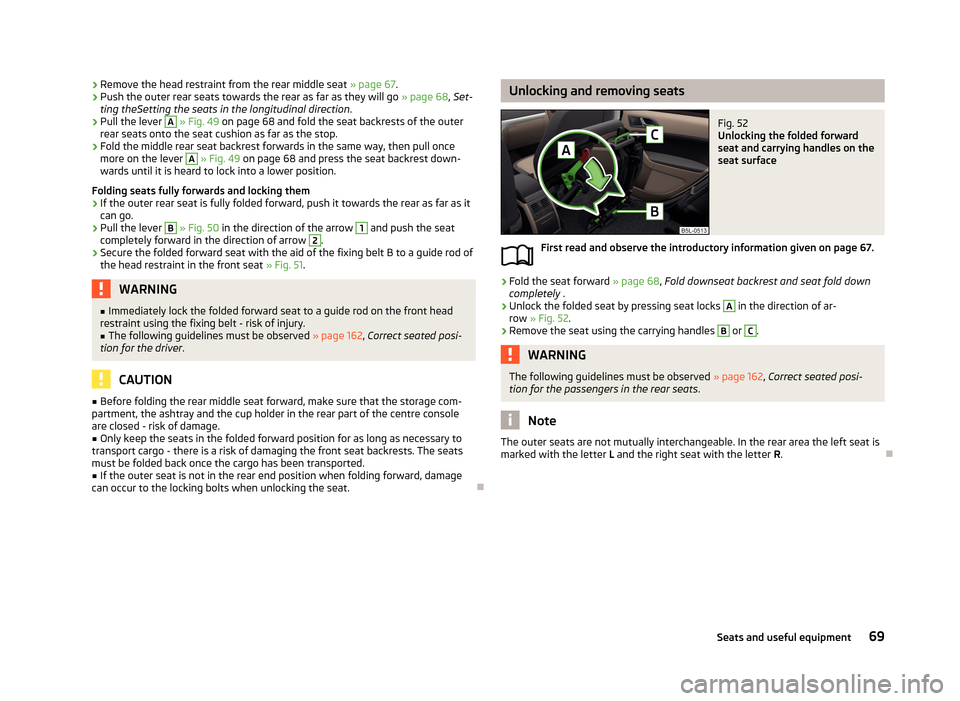
Unlocking and removing seatsFig. 52
Unlocking the folded forward
seat and carrying handles on the
seat surface
First read and observe the introductory information given on page 67.
›
Fold the seat forward » page 68, Fold downseat backrest and seat fold down
completely .
›
Unlock the folded seat by pressing seat locks
A
in the direction of ar-
row » Fig. 52 .
›
Remove the seat using the carrying handles
B
or
C
.
WARNINGThe following guidelines must be observed » page 162, Correct seated posi-
tion for the passengers in the rear seats .
Note
The outer seats are not mutually interchangeable. In the rear area the left seat is
marked with the letter L and the right seat with the letter R.
69Seats and useful equipment
Page 73 of 266
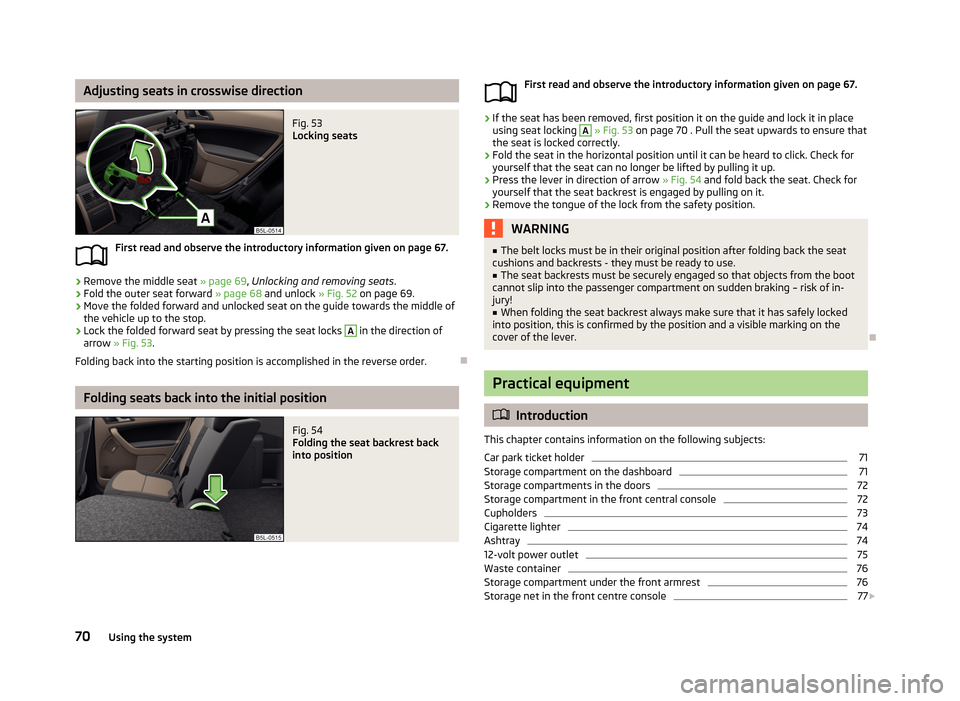
Adjusting seats in crosswise directionFig. 53
Locking seats
First read and observe the introductory information given on page 67.
›
Remove the middle seat » page 69, Unlocking and removing seats .
›
Fold the outer seat forward » page 68 and unlock » Fig. 52 on page 69.
›
Move the folded forward and unlocked seat on the guide towards the middle of
the vehicle up to the stop.
›
Lock the folded forward seat by pressing the seat locks
A
in the direction of
arrow » Fig. 53 .
Folding back into the starting position is accomplished in the reverse order.
Folding seats back into the initial position
Fig. 54
Folding the seat backrest back
into positionFirst read and observe the introductory information given on page 67.›
If the seat has been removed, first position it on the guide and lock it in place using seat locking
A
» Fig. 53 on page 70 . Pull the seat upwards to ensure that
the seat is locked correctly.
›
Fold the seat in the horizontal position until it can be heard to click. Check for yourself that the seat can no longer be lifted by pulling it up.
›
Press the lever in direction of arrow » Fig. 54 and fold back the seat. Check for
yourself that the seat backrest is engaged by pulling on it.
›
Remove the tongue of the lock from the safety position.
WARNING■ The belt locks must be in their original position after folding back the seat
cushions and backrests - they must be ready to use.■
The seat backrests must be securely engaged so that objects from the boot
cannot slip into the passenger compartment on sudden braking – risk of in- jury!
■
When folding the seat backrest always make sure that it has safely locked
into position, this is confirmed by the position and a visible marking on the cover of the lever.
Practical equipment
Introduction
This chapter contains information on the following subjects:
Car park ticket holder
71
Storage compartment on the dashboard
71
Storage compartments in the doors
72
Storage compartment in the front central console
72
Cupholders
73
Cigarette lighter
74
Ashtray
74
12-volt power outlet
75
Waste container
76
Storage compartment under the front armrest
76
Storage net in the front centre console
77
70Using the system