belt SKODA YETI 2013 1.G / 5L Owner's Guide
[x] Cancel search | Manufacturer: SKODA, Model Year: 2013, Model line: YETI, Model: SKODA YETI 2013 1.G / 5LPages: 266, PDF Size: 26.71 MB
Page 183 of 266
Fastening systems
Introduction
This chapter contains information on the following subjects:
eyes belonging to the lISOFIX system
180
Use of child seats with the ISOFIX system
180
Locking eyes of the TOP TETHER system
181
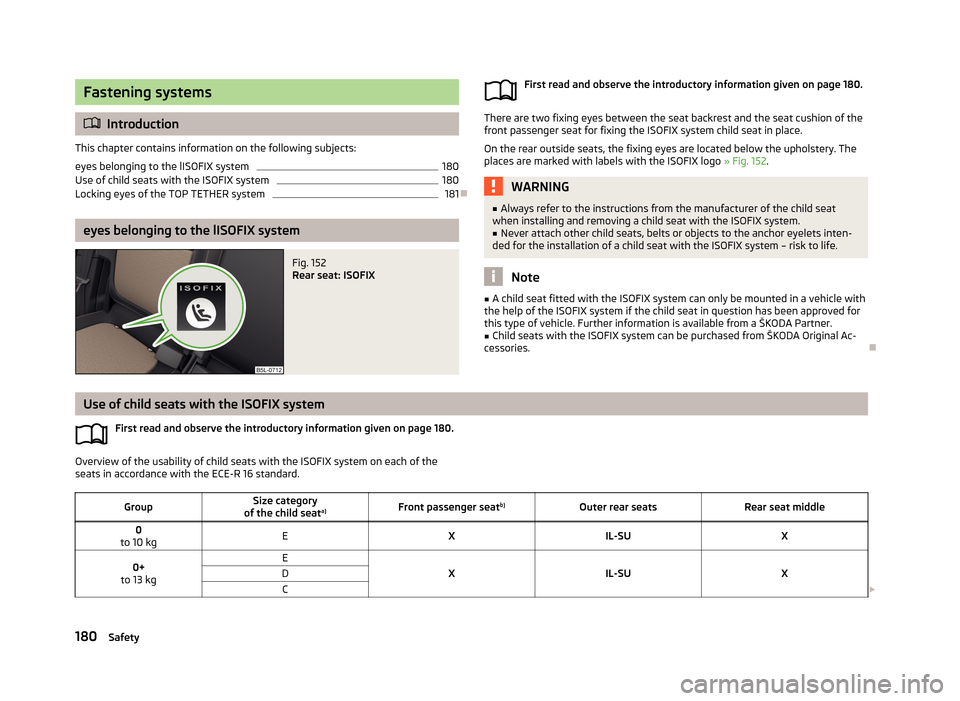
eyes belonging to the lISOFIX system
Fig. 152
Rear seat: ISOFIX
First read and observe the introductory information given on page 180.
There are two fixing eyes between the seat backrest and the seat cushion of the front passenger seat for fixing the ISOFIX system child seat in place.
On the rear outside seats, the fixing eyes are located below the upholstery. The
places are marked with labels with the ISOFIX logo » Fig. 152.
WARNING■
Always refer to the instructions from the manufacturer of the child seat
when installing and removing a child seat with the ISOFIX system.■
Never attach other child seats, belts or objects to the anchor eyelets inten-
ded for the installation of a child seat with the ISOFIX system – risk to life.
Note
■ A child seat fitted with the ISOFIX system can only be mounted in a vehicle with
the help of the ISOFIX system if the child seat in question has been approved for this type of vehicle. Further information is available from a ŠKODA Partner.■
Child seats with the ISOFIX system can be purchased from ŠKODA Original Ac-
cessories.
Use of child seats with the ISOFIX system
First read and observe the introductory information given on page 180.
Overview of the usability of child seats with the ISOFIX system on each of the
seats in accordance with the ECE-R 16 standard.
GroupSize category
of the child seat a)Front passenger seat b)Outer rear seatsRear seat middle0
to 10 kgEXIL-SUX0+
to 13 kgE
XIL-SUX
DC 180Safety
Page 184 of 266
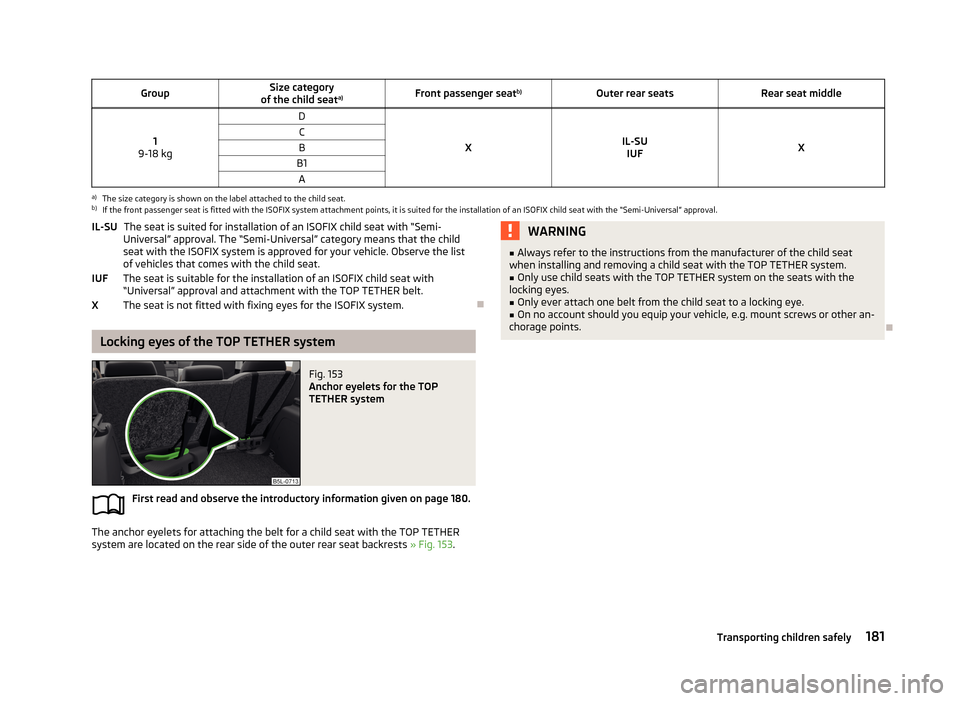
GroupSize category
of the child seat a)Front passenger seat b)Outer rear seatsRear seat middle
1
9-18 kg
D
XIL-SU IUFX
CBB1Aa)
The size category is shown on the label attached to the child seat.
b)
If the front passenger seat is fitted with the ISOFIX system attachment points, it is suited for the installation of an ISOFIX child seat with the “Semi-Universal” approval.
The seat is suited for installation of an ISOFIX child seat with “Semi-
Universal” approval. The “Semi-Universal” category means that the child
seat with the ISOFIX system is approved for your vehicle. Observe the list of vehicles that comes with the child seat.
The seat is suitable for the installation of an ISOFIX child seat with
“Universal” approval and attachment with the TOP TETHER belt.
The seat is not fitted with fixing eyes for the ISOFIX system.
Locking eyes of the TOP TETHER system
Fig. 153
Anchor eyelets for the TOP
TETHER system
First read and observe the introductory information given on page 180.
The anchor eyelets for attaching the belt for a child seat with the TOP TETHER
system are located on the rear side of the outer rear seat backrests » Fig. 153.
IL-SU
IUFXWARNING■
Always refer to the instructions from the manufacturer of the child seat
when installing and removing a child seat with the TOP TETHER system.■
Only use child seats with the TOP TETHER system on the seats with the
locking eyes.
■
Only ever attach one belt from the child seat to a locking eye.
■
On no account should you equip your vehicle, e.g. mount screws or other an-
chorage points.
181Transporting children safely
Page 185 of 266
General Maintenance
Vehicle care
Service intervals
Introduction
This chapter contains information on the following subjects:
Overview of service intervals
182
Fixed service intervals QI1 - QI4
183
Variable service interval QI6
183
Information about the ŠKODA service
183
The service interval display in the instrument cluster will remind you to carry out
every service stipulated by the manufacturer at the right time in order to prevent you from forgetting any.
Timely and proper performance of servicing works is one of the requirements for the settlement of potential warranty claims.
The completion of services can be verified by the validated service certificate andthe corresponding receipts.
The specified service intervals are tailored to normal operating conditions.
In the case of difficult operating conditions, it is necessary to have some service
work performed before the date of the next service or between the specified
service intervals. This applies mainly to the cleaning or the replacement of the air
filter insert in regions with heavy dust pollution as well as checking and replacing
the toothed belt, but also to vehicles with diesel particle filters, which can put
greater strain on the engine oil.
Difficult operating conditions
› Sulphur-containing diesel fuel.
› Frequent short trips.
› Longer periods of engine idling (e.g. taxis).
› Operation in areas with heavy dust pollution.
› Frequent trailer operation.
›
Predominantly stop-and-go traffic as is often the case in city driving, for exam-
ple.
› Operation predominantly during winter.
A service consultant at the specialist garage will tell you whether the operating conditions of your vehicle may make it necessary for service work to be carried
out between the normal service intervals.
Different service charges may apply from the particular scope of work required,
depending on the vehicle type and equipment and the status of your vehicle.
Note
■ The customer is responsible for covering the cost of all services including
changing or replenishing the oil, even during the warranty period, unless stated otherwise in the ŠKODA AUTO a.s. warranty terms or other agreements.■
You will be informed about the current service scopes for the particular service
work by the specialist garage.
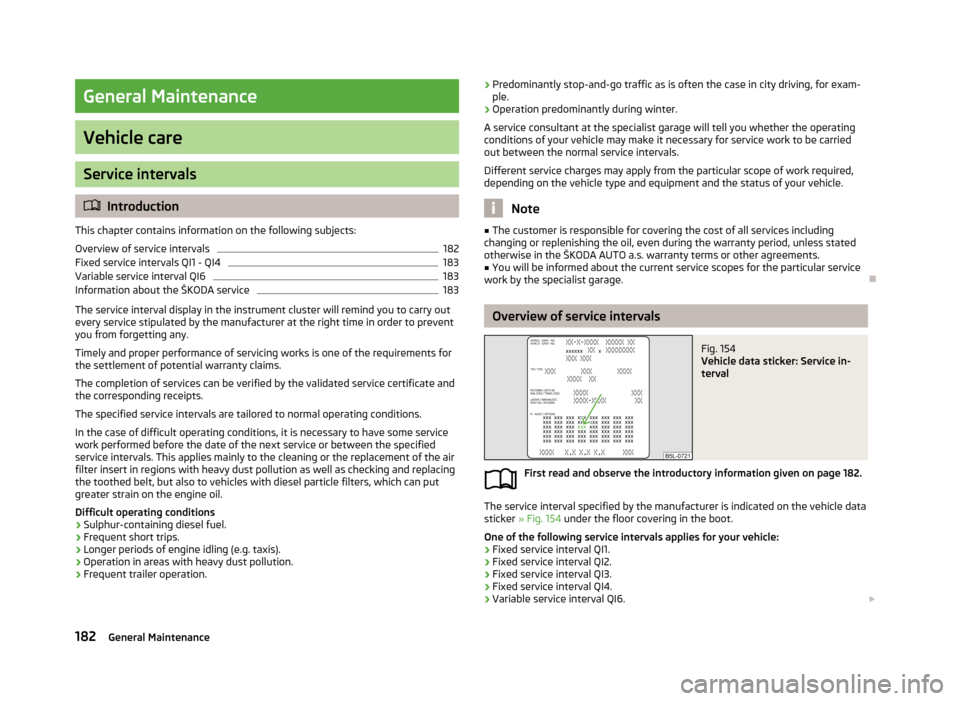
Overview of service intervals
Fig. 154
Vehicle data sticker: Service in-
terval
First read and observe the introductory information given on page 182.
The service interval specified by the manufacturer is indicated on the vehicle data
sticker » Fig. 154 under the floor covering in the boot.
One of the following service intervals applies for your vehicle:
› Fixed service interval QI1.
› Fixed service interval QI2.
› Fixed service interval QI3.
› Fixed service interval QI4.
› Variable service interval QI6.
182General Maintenance
Page 195 of 266
Cavity protectionFirst read and observe the introductory information and safety warn-
ings
on page 189.
All the cavities of your vehicle which are at risk from corrosion are protected for life by a layer of protective wax applied in the factory.
This wax protection does not need to be inspected or re-applied. If any small amount of wax flow out of the cavities at high temperatures, thesemust be removed with a plastic scraper and the stains cleaned using a petroleum cleaner.
WARNINGSafety regulations should be observed when using petroleum cleaner to re-
move wax – risk of fire!
Wheels
First read and observe the introductory information and safety warn-
ings
on page 189.
Wheel rims
Also thoroughly wash the wheel rims when washing the vehicle on a regular ba-
sis.
Regularly remove salt and brake abrasion, otherwise the rim material will be cor-
roded.
Damage to the paint layer on the wheel rims must be touched up immediately.
Light alloy wheels
After washing thoroughly and treat the wheel rims with a protective product for
light alloy wheels. Products which cause abrasion must not be used to treat the
wheel rims.
CAUTION
Severe layers of dirt on the wheels can also result in wheel imbalance. This may
show itself in the form of a wheel vibration which is transmitted to the steering
wheel which, in certain circumstances, can cause premature wear of the steering.
This means it is necessary to remove the dirt.
Underbody protection
First read and observe the introductory information and safety warn-ings
on page 189.
The underside of your vehicle is protected for life against chemical and mechani-
cal influences.
It is not possible to guarantee that the protective coating will not suffer any
damage as the vehicle is driven.
We recommend having the protective coating underneath the vehicle and the
chassis checked — preferably before the beginning of winter and at the end of
winter.
WARNINGNever use additional underbody protection or anti-corrosion agents for ex-
haust pipes, catalytic converters, diesel particle filters or heat shields. When
the engine reaches its operating temperature, these substances may ignite - risk of fire!
Taking care of the interior
Introduction
This chapter contains information on the following subjects:
Natural leather
193
Artificial leather, cloths and Alcantara ®
194
Seat covers
194
Seat belts
195
Regular and proper care helps to ensure efficiency and to
maintain the value of
your vehicle.
We recommend using vehicle care products from ŠKODA Original Accessories. These are available from ŠKODA Partners. The usage instructions on the package
must be observed.
192General Maintenance
Page 196 of 266
WARNING■Vehicle care products may be harmful to your health if not used according to
the instructions.■
Always store vehicle care products safely, in particular out of the reach of
children – risk of poisoning!
CAUTION
■ Be sure to check clothing for colourfastness to avoid any damage or visible
stains on the material (leather), panels and textiles.■
Remove fresh stains such as those from ball-point pens, ink, lipstick, shoe pol-
ish, etc., from the material (leather), panels and textiles as quickly as possible.
■
Air fresheners and scents can be hazardous to heath when the temperature in-
side the vehicle is high.
■
Do not attach scents or air fresheners to the dash panel – there is a risk of dam-
age to the dash panel.
■
Do not stick any stickers on the inside of the rear windows, the rear side win-
dows and in the vicinity of the heating elements on the windscreen or near the
window aerial. These may get damaged.
■
Do not clean the roof panelling with a brush – there is a risk of damage to the
surface of the panelling.
■
Cleaner that contain solvents can damage the material being cleaned.
■
Apply only a small amount of the cleaning and care product.
For the sake of the environment
Used vehicle care product cans represent hazardous waste that is harmful to the
environment. These must be disposed of in accordance with national legal regula- tions.
Note
Due to the special tools and knowledge required, and to avoid any potential prob-
lems with the cleaning and care of the interior of your vehicle, we recommend
that cleaning and care of the interior of your vehicle be carried out by a ŠKODA service partner.
Natural leather
First read and observe the introductory information and safety warn-
ings
on page 192.
Leather is a natural material with specific properties, and requires regular clean-
ing and maintenance.
The leather should be cleaned on a regular basis depending on the amount of
wear-and-tear.
Dust and dirt in the pores and folds act as abrasive materials. This leads to severe corrosion and the premature brittleness of the leather surface.
We recommend that you remove dust regularly and at short intervals using a
cloth or vacuum cleaner.
Clean soiled leather surfaces with a water-dampened cotton or woollen cloth and
then dry with a clean, dry cloth »
.
Clean severely soiled areas with a cloth soaked in a mild soap solution (2 table-
spoons of neutral soap to 1 litre of water).
To remove stains , use a cleaning agent specially designed for this purpose.
Treat the leather regularly and at suitable intervals using a suitable leather care
product.
CAUTION
■ Ensure that no part of the leather is soaked through during cleaning and that
no water gets into the seams. Otherwise, the leather could become brittle or
cracked.■
Avoid leaving the vehicle for lengthy periods in bright sunlight to avoid the
leather from bleaching. If the vehicle is parked in the open for lengthy periods, protect the leather from direct sunlight by covering it.
■
Sharp-edged objects on items of clothing such as zip fasteners, rivets, sharp-
edged belts, jewellery and pendants may leave permanent scratches or signs of
rubbing on the surface. Such damage cannot be subsequently recognised as a
justified complaint.
■
The use of a mechanical steering wheel lock may damage the leather surface of
the steering wheel.
193Vehicle care
Page 198 of 266
■Do not sit on wet seats - risk of seat deformation.■Always clean the seats from “seam to seam”.
Seat belts
First read and observe the introductory information and safety warn-
ings
on page 192.
The belt webbing must always be kept clean.
Wash dirty seat belts with mild soapy water.
Remove coarse dirt with a soft brush.
Dirty belt webbing may impair the correct functioning of the inertia reel.
WARNING■ The seat belts must not be removed for cleaning.■Never clean the seat belts chemically as chemical cleaning products could
destroy the fabric.■
The seat belts must not be allowed to come into contact with corrosive liq-
uids (e.g. acids).
■
Check the condition of all the seat belts on a regular basis. If any damage to
the belt webbing, seat belt connections, inertia reel or lock is detected, the
seat belt must be replaced by a specialist garage.
■
The seat belts must be fully dried before being rolled up.
195Vehicle care
Page 202 of 266
Engine compartment
Introduction
This chapter contains information on the following subjects:
Opening and closing the bonnet
200
Engine compartment overview
201
Radiator fan
201
Windscreen washer system
201WARNINGInjuries or scolding or risks of accident or fire may occur when working in the
engine compartment. For this reason, it is essential to comply with the warn- ing instructions outlined below and with the general applicable safety rules.
The engine compartment of your car is a hazardous area!WARNINGInstructions before beginning work in the engine compartment■Turn off the engine and withdraw the ignition key.■
Firmly apply the handbrake.
■
If the vehicle is fitted with a manual gearbox, move the gearshift lever into
Neutral, or if the vehicle is fitted with an automatic gearbox, move the selec-
tor lever into position P.
■
Allow the engine to cool.
■
Never open the bonnet if you can see steam or coolant escaping from the
engine compartment – risk of scalding! Wait until no more steam or coolant is escaping.
WARNINGInformation for working in the engine room■Keep children clear of the engine compartment.■
Never touch the radiator fan while the engine is still warm. The fan might
suddenly start running!
■
Do not touch any hot engine parts – risk of burns!
■
The coolant is harmful to health.
WARNING (Continued)■ Avoid contact with the coolant.■Coolant vapours are harmful to health.■
Never open the end cover of the coolant expansion reservoir while the en-
gine is still warm. The cooling system is pressurized!
■
When opening the end cover of the coolant expansion reservoir, cover it
with a cloth to protect your face, hands and arms from hot steam or hot cool-
ant.
■
If any coolant splashes into your eyes, immediately rinse out your eyes with
clear water and contact a doctor as soon as possible.
■
Always store the coolant additive securely in its original container, and in
particular out of the reach of children – risk of poisoning!
■
If coolant is swallowed, consult a doctor immediately.
■
Do not leave any items (e.g. cloths or tools) in the engine compartment.
■
Never spill fluids on the hot engine. Such fluids (e.g. the antifreeze con-
tained in the coolant) may ignite!
WARNINGInformation for working in the engine compartment with the engine running■Pay particular attention to rotating engine parts (e.g. V-ribbed belt, genera-
tor, radiator fan) and the high-voltage ignition system – risk to life!■
Never touch the electric wiring on the ignition system.
■
Avoid short circuits in the electrical system - particularly on the vehicle's
battery.
■
Always make sure that no jewellery, loose clothing or long hair can get
caught in rotating engine parts – risk to life! Always remove any jewellery, tie
back long hair and wear tight fitting clothing before completing any work.
WARNINGInformation for working on the fuel system or the electrical system■Always disconnect the vehicle battery from the electrical system.■
Do not smoke.
■
Never work near open flames.
■
Always have a functioning fire extinguisher nearby.
199Inspecting and replenishing
Page 254 of 266
Index
A
Abroad Driving abroad
135
Unleaded petrol135
ABS Operation
137
Warning light19
Accessories184
Adaptive headlights (AFS)50
Adjusting Belt height
167
Exterior mirrors59
Head restraints66
Interior mirror59
Seats62
Steering wheel117
Adjusting the headrests
67
Adjusting the seats161
Adjustment Headlight beam
47
Aerial188
See windows191
AFS50
Airbag169
Deactivating175
Deactivating the front passenger airbag176
Deployment169
Front airbag171
Head airbag174
Indicator light21
Knee airbag172
Modifications and damage to the airbag system 186
Side airbag
173
Airbag system169
Air conditioning Climatronic95
manual air conditioning94
Recirculation93
Air conditioning system Air outlets
92
Air outlets92
Alarm Switching off
39
Triggering39
Anti-theft alarm system Activating/deactivating
39
Trailer159
Antilock brake system (ABS)137
Armrest Front
65
Artificial leather194
Ashtray74
ASR warning light
18
Assistence systems OFF ROAD-mode
138
Assist systems136
ABS19, 137
ASR18
Cruise Control System147
DSR137
EDL137
ESC18, 136
HBA137
HHC138
Park assist143
Parking aid140
START-STOP149
TCS137
Auto Check Control13
Automatic driving lamp control49
Automatic gearbox Manual shifting of gears
127
Selector lever-emergency unlocking233
Starting-off and driving128
Tiptronic127
Automatic load deactivation210
Automatic transmission126
Kickdown128
Malfunction128
Selector lever lock127
Using the selector lever127
Auxiliary heating and ventilation System settings
98
auxiliary heating and ventilations Switching on and off directly
98
Auxiliary heating (auxiliary heating and ventila- tion)
97
Radio remote control99
B
Ball head Check fitting
155
Ball rod installing
154
Ready position153
removing155
Bar with sliding hook84
Battery In the remote control key
231
Belts164
Belt tensioners168
Bonnet Closing
200
Opening200
Boot Class N1 vehicles
88
see Boot lid41
Boot lid41
Automatic locking41
Warning light17
Brake information messages
15
warning light15
251Index
Page 260 of 266
Practical features70
Compartment for glasses77
Folding table in the middle seat backrest80
Folding table on front seat backrest80
Storage compartment in the front central con- sole
72
Storage compartments in the doors72
Storage net in the front centre console77
Waste container76
Practical Features Storage compartment on the dashboard
71
R
Radiator fan
201
Radio reception See windows
191
Radio remote control Auxiliary heating
99
Raise vehicle223
Rear-view mirror Exterior mirrors
59
Fold in passenger mirror60
Rear-view mirrors Synchronous adjustment of the rear-view mirrors 59
Rear fog light
51
Warning light19
Rear head restraints in the centre
67
Rear interior light54
Rear mirror58
Interior mirror59
rear seats in the longitudinal direction
68
Rear seats67
Setting the tilt of the seat backrests68
Rear window - heater55
Recirculation93
Refuelling196
Fuel196
Remote control Locking34
Replacing the battery231
Synchronisation process34
Unlocking34
Remote control key Replacing the battery
231
Removable light Removing light
87
replace batteries of the lights232
Removable ski bag81
Removing the variable loading floor
88
Repairs and technical alterations184
Replace the battery in the auxiliary heating (auxiliary
heating) in the remote control
231
replace - batteries of the lights232
Replacing bulb for fog lights
241
Bulb for the licence plate light242
Bulb in rear light243
Fuses236
Fuses in the dash panel236
Fuses in the engine compartment237
Vehicle battery210
windscreen wiper blades235
Replacing windscreen wiper blades234
Replenishing Coolant
206
Engine oil204
Windscreen washer fluid201
reversing assistant orientation lines and monitored area
142
Revolutions counter11
Roof rack system90
Roof load90
Running-in the first 1500 km
129
Running inBrake pads130
Engine129
Tyres129
S
SAFE See Safe securing system
35
SAFELOCK See Safe securing system
35
Safe securing system35
Safety160
Child safety177
Child safety seats177
Correct seated position161
Head restraints66
ISOFIX180
TOP TETHER181
Safety belts rear middle seat
167
Saving electrical energy130
Seals Taking care of your vehicle
190
Seat belt warning light
15
Seat belts164
Belt tensioners168
Cleaning195
fastening and unfastening166
Height adjustment167
Seatbelts Inertia reels
167
Seat belts The physical principle of a head-on collision
165
Seat functions64
Seats Electric adjustment
62
Folding front passenger seat66
Front armrest65
Head restraints66
257Index
Page 261 of 266
Heating64
Manually adjusting62
Memory Function of the electrically adjustable seat
63
Removing seats69
Storing in memory of remote control key63
Seats and practical equipment Setting front seats
61
Seats and useful equipment61
Securing the variable load floor in the raised position
89
Selector lever see Using the selector lever
127
Selector lever lock Warning light
22
Service185
Service interval display30
Service intervals182
Setting13
Setting the13
Shelves70
Shifting gears Driving and saving energy
131
Side airbag173
Side lights47
ski bag81
Sliding/tilting roof Closing
45
Closing the sun screen45
Emergency operation234
Opening/closing the sun screen45
Opening and tilting45
Operation45
Snow chains218
Spare wheel216
Speedometer11
see speedometer11
Speed symbol see Wheels
215
Spoiler186
START-STOP149
Manually activating/deactivating the system150
Operating conditions of the system150
Starting/shutting down the engine149
Starting and stopping the engine - KESSY120
Starting and stopping the engine using the key118
Starting engine Jump-starting
226
Starting the engine Jump-starting
227
Key119
see KESSY122
START STOP Information messages
151
Jump-starting228
Steering force assistance118
Steering lock / unlock see KESSY
121
Steering wheel117
Stopping the engine Key
120
Storage box87
Storage compartment in the rear central console79
Storage compartment on the passenger side78
Storage compartments70
Compartment for glasses77
Storage compartment in the front central con- sole
72
Storage compartment in the rear central console 79
Storage compartment on the dashboard
71
Storage compartment on the passenger side78
Storage compartments in the doors72
Storage compartment under the passenger seat78
Storage pockets on the front seats79
Storage compartment under the pasenger seat78
Storage pockets on the front seats79
Storing seats
63
Sun visors55
Switch See Ignition119
Switching off the engine see KESSY
123
Switching off the ignition see KESSY
123
Switching on the ignition see KESSY
122
Switch off ASR warning light
19
Synchronous adjustment of the rear-view mirrors 59
T
Taking care of the vehicle Natural leather
193
Seat belts195
Taking care of your vehicle Automatic car wash system
188
Cavity protection192
Chrome parts190
Cleaning the wheels192
Decorative films190
Door lock cylinders191
Headlight lenses191
High-pressure cleaner188
Plastic parts190
Polishing the paintwork189
Rubber seals190
Taking care of the interior192
Taking care of your vehicle exterior189
Washing187
Washing by hand188
Wash system188
Wax treatment189
Taking care of your vehicles Fabric covers
194
TCS Operation
137
Technical data244
Telephone103, 105
258Index