bonnet SKODA YETI 2014 1.G / 5L User Guide
[x] Cancel search | Manufacturer: SKODA, Model Year: 2014, Model line: YETI, Model: SKODA YETI 2014 1.G / 5LPages: 248, PDF Size: 29.49 MB
Page 187 of 248
CAUTION■If the above engine oils are not available, a different engine oil can be used in
an emergency. To prevent damage to the engine, a maximum of 0.5 litres only
of the following engine oils may be used: ■ For petrol engine models: ACEA A3/ACEA B4 or API SN, (API SM);
■ For diesel engine models: ACEA C3 or API CJ-4.
Checking the oil level
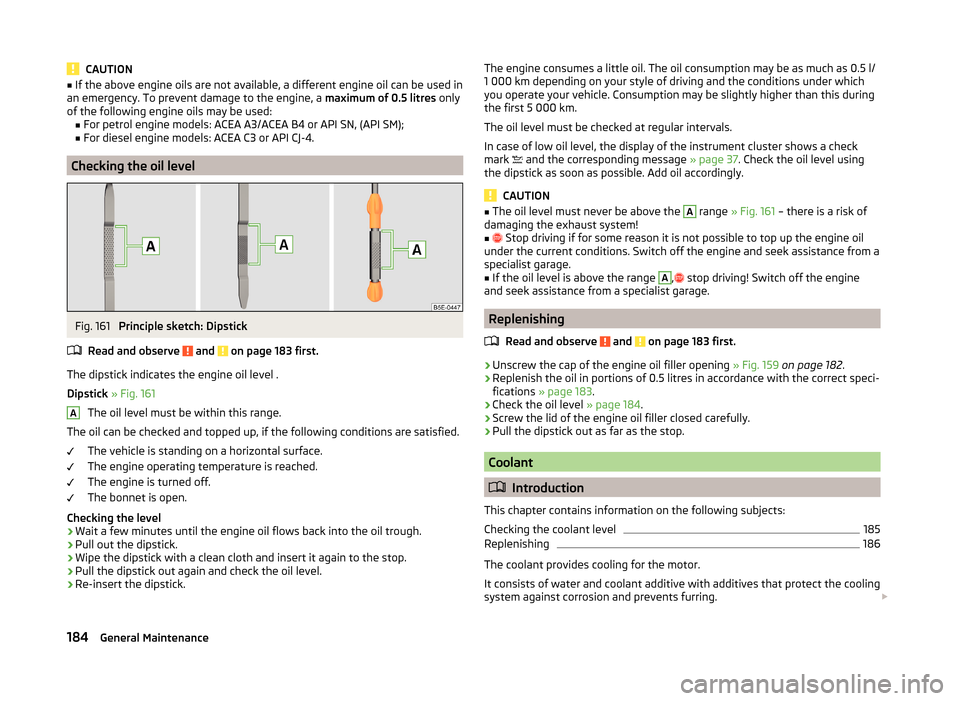
Fig. 161
Principle sketch: Dipstick
Read and observe
and on page 183 first.
The dipstick indicates the engine oil level .
Dipstick » Fig. 161
The oil level must be within this range.
The oil can be checked and topped up, if the following conditions are satisfied. The vehicle is standing on a horizontal surface.
The engine operating temperature is reached.
The engine is turned off.
The bonnet is open.
Checking the level
›
Wait a few minutes until the engine oil flows back into the oil trough.
›
Pull out the dipstick.
›
Wipe the dipstick with a clean cloth and insert it again to the stop.
›
Pull the dipstick out again and check the oil level.
›
Re-insert the dipstick.
AThe engine consumes a little oil. The oil consumption may be as much as 0.5 l/
1 000 km depending on your style of driving and the conditions under which
you operate your vehicle. Consumption may be slightly higher than this during
the first 5 000 km.
The oil level must be checked at regular intervals.
In case of low oil level, the display of the instrument cluster shows a check
mark
and the corresponding message » page 37. Check the oil level using
the dipstick as soon as possible. Add oil accordingly.
CAUTION
■ The oil level must never be above the A range » Fig. 161 – there is a risk of
damaging the exhaust system!■
Stop driving if for some reason it is not possible to top up the engine oil
under the current conditions. Switch off the engine and seek assistance from a
specialist garage.
■
If the oil level is above the range
A
,
stop driving! Switch off the engine
and seek assistance from a specialist garage.
Replenishing
Read and observe
and on page 183 first.
›
Unscrew the cap of the engine oil filler opening » Fig. 159 on page 182 .
›
Replenish the oil in portions of 0.5 litres in accordance with the correct speci-
fications » page 183 .
›
Check the oil level » page 184.
›
Screw the lid of the engine oil filler closed carefully.
›
Pull the dipstick out as far as the stop.
Coolant
Introduction
This chapter contains information on the following subjects:
Checking the coolant level
185
Replenishing
186
The coolant provides cooling for the motor.
It consists of water and coolant additive with additives that protect the cooling
system against corrosion and prevents furring.
184General Maintenance
Page 188 of 248
The coolant additive content in the coolant must be at least 40%.
The coolant additive may be increased to a maximum of 60%.
The correct mixing ratio of water and coolant additive is to be checked if nec- essary by a specialist garage or is to be restored if necessary.
The description of the coolant is shown in the coolant expansion reser-
voir » Fig. 162 on page 185 .WARNINGThe engine compartment of your car is a hazardous area. The following
warning instructions must be followed at all times when working in the en-
gine compartment » page 180.■
The coolant is harmful to health.
■
Avoid contact with the coolant.
■
Coolant vapours are harmful to health.
■
Never open the end cover of the coolant expansion reservoir while the
engine is still warm. The cooling system is pressurized!
■
When opening the end cover of the coolant expansion reservoir, cover it
with a cloth to protect your face, hands and arms from hot steam or hot
coolant.
■
If any coolant splashes into your eyes, immediately rinse out your eyes
with clear water and contact a doctor as soon as possible.
■
Always keep the coolant in the original container, safe from people who
are not completely independent, especially children - there is a danger of
poisoning!
■
If coolant is swallowed, consult a doctor immediately.
■
Never spill operating fluids over the hot engine - risk of fire.
CAUTION
■ Do not continue if for some reason it is not possible to fill with coolant un-
der the current circumstances! Switch off the engine and seek assistance from
a specialist garage.■
If the expansion tank is empty, do not top up with coolant. The system could
fill with air - risk of engine damage,
stop driving! Switch off the engine and
seek assistance from a specialist garage.
■
The concentration of coolant additive in the coolant must never be under
40%.
■
Over 60% of coolant additive in the coolant reduces the antifreeze protec-
tion and cooling effect.
■
A coolant additive that does not comply with the correct specification can
significantly reduce the corrosion protection of the cooling system.
■ Any faults resulting from corrosion may cause a loss of coolant and can con-
sequently result in major engine damage!■
Do not fill the coolant above the mark
A
» Fig. 162 on page 185 .
■
If an error occurs, leading to the engine overheating, the help of a professio-
nal garage is to be sought - there is a risk of serious engine damage occurring.
■
Additional headlights and other attached components in front of the air inlet
impair the cooling efficiency of the coolant.
■
Never cover the radiator - there is a risk of the engine overheating.
Note
The coolant capacity is approximately 1 l greater on vehicles that are fitted
with an auxiliary heater (auxiliary heating and ventilation).
Checking the coolant level
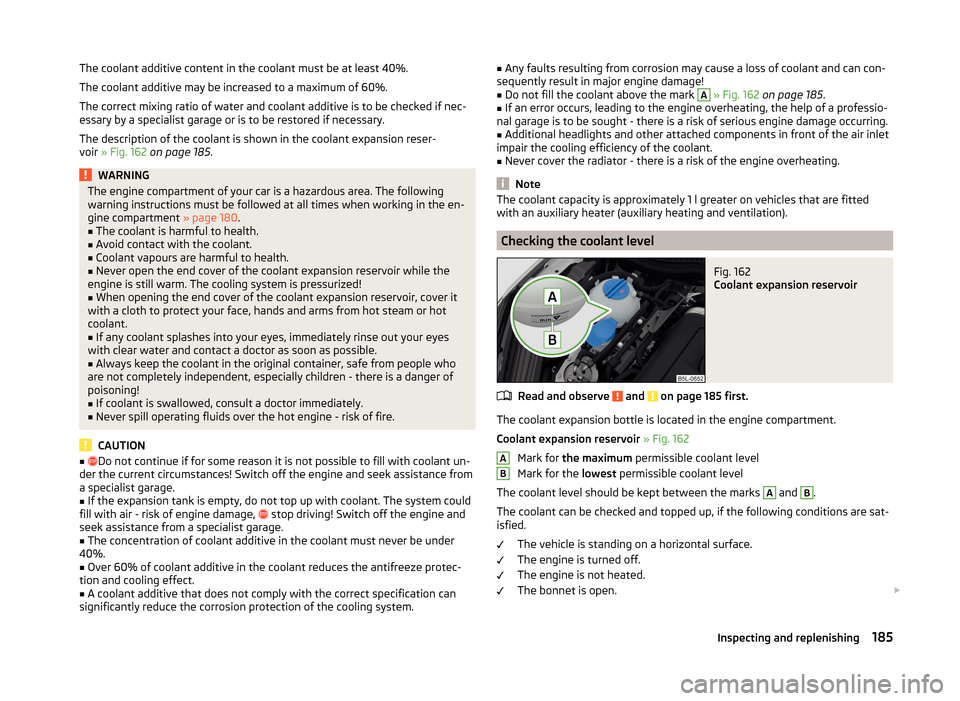
Fig. 162
Coolant expansion reservoir
Read and observe and on page 185 first.
The coolant expansion bottle is located in the engine compartment.
Coolant expansion reservoir » Fig. 162
Mark for the maximum permissible coolant level
Mark for the lowest permissible coolant level
The coolant level should be kept between the marks
A
and
B
.
The coolant can be checked and topped up, if the following conditions are sat-
isfied.
The vehicle is standing on a horizontal surface.
The engine is turned off.
The engine is not heated.
The bonnet is open.
AB185Inspecting and replenishing
Page 189 of 248
Checking the level›Check the coolant level in the coolant expansion tank » Fig. 162.
If the engine is warm, the test result may be inaccurate. The level can also be
above the mark A
» Fig. 162 .
In case of low coolant level, the indicator symbol
is displayed in the instru-
ment cluster along with the relevant message » page 36. We still recommend
inspecting the coolant level directly at the reservoir from time to time.
Loss of coolant
A loss of coolant is first and foremost an indication of a leak in the cooling sys-
tem. Do not merely top up the coolant. Have the cooling system checked by a
specialist garage.
Replenishing
Read and observe
and on page 185 first.
The coolant expansion tank must always contain a small amount of cool-
ant » page 185, in section Introduction .
›
Place a cloth over the cap of the coolant expansion tank and unscrew the
cap carefully .
›
Replenish the coolant.
›
Turn the cap until it clicks into place.
CAUTION
■
Only top up with new coolant.■Do not use an alternative additive if the specified coolant is not available. In
this case, use just water and have the correct mixing ratio of water and cool-
ant additive restored by a specialist garage as soon as possible.
Brake fluid
Introduction
This chapter contains information on the following subjects:
Checking the brake fluid level
186
Specification
187
The brake fluid reservoir is located in the engine compartment » Fig. 163 on
page 186 .
WARNING■
The engine compartment of your car is a hazardous area. The following
warning instructions must be followed at all times when working in the en-
gine compartment » page 180.■
Do not use used brake fluid - the function of the brake system may be im-
paired – risk of accident!
CAUTION
■ Do not continue your journey if the fluid level has dropped below the “MIN”
marking » Fig. 163 on page 186 , do not continue driving - there is a risk of
an accident! Seek help from a specialist garage.■
Brake fluid damages the paintwork of the vehicle.
Note
■ The brake fluid is changed as part of a compulsory inspection service.■We recommend using oils from the ŠKODA Original Accessories range.
Checking the brake fluid level
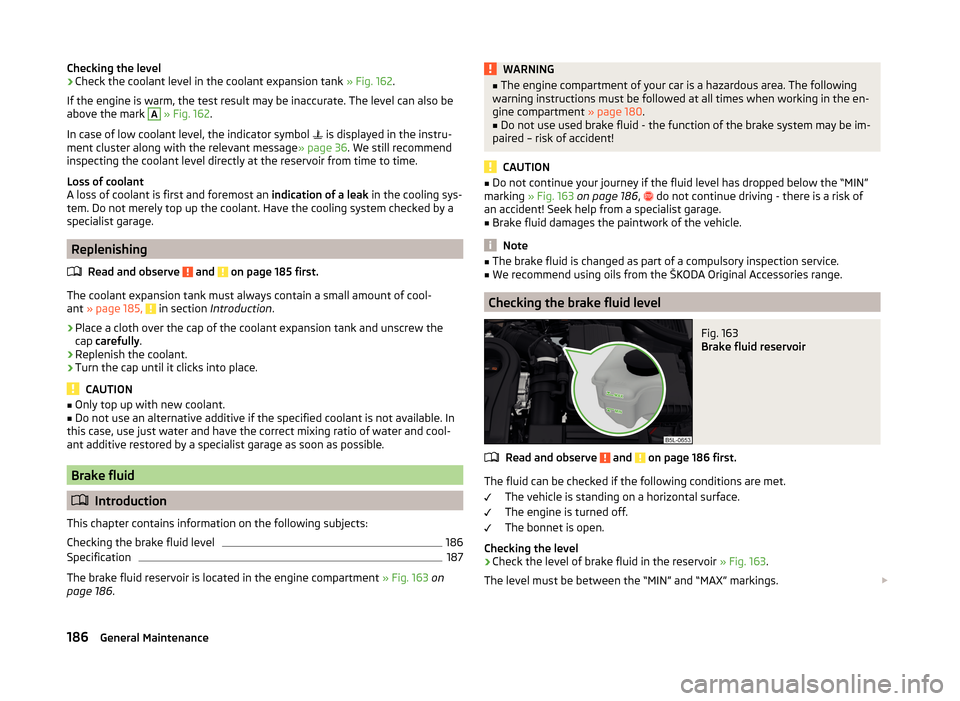
Fig. 163
Brake fluid reservoir
Read and observe and on page 186 first.
The fluid can be checked if the following conditions are met.
The vehicle is standing on a horizontal surface.
The engine is turned off.
The bonnet is open.
Checking the level
›
Check the level of brake fluid in the reservoir » Fig. 163.
The level must be between the “MIN” and “MAX” markings.
186General Maintenance
Page 192 of 248
Air bubbles can influence the colour of the indicator. For this reason carefully
knock on the indicator before carrying out the check.
› Black colour - electrolyte level is correct.
› Colourless or light yellow colour - electrolyte level too low, the battery must
be replaced.
Vehicles with a START-STOP system are fitted with a battery control unit for
checking the energy level for recurring engine start.
We recommend that you have the acid level checked regularly by a specialist garage, especially in the following cases.
› High external temperatures.
› Longer day trips.
› After each charge.
Winter time
The vehicle battery only has a proportion of the starting power in lower tem-
peratures. A discharged vehicle battery may already freeze at temperatures
just below 0 °C .
We therefore recommend that you have the battery checked and, if necessary,
recharged by a specialist garage before the start of the winter.
Note
■ The battery acid level is also checked regularly by a specialist garage as part
of the inspection service.■
For technical reasons, on vehicles with the description “AGM”, the electrolyte
level cannot be checked.
Charging
Read and observe
and on page 187 first.
A properly charged vehicle battery is essential for reliably starting the engine.A charging operation can be performed if the following conditions are satis-
fied.
The engine is turned off.
The ignition is switched off.
All consumers are turned off.
The bonnet is open.
“Fast charging” with high currents
›
Disconnect both battery cables (first of all “negative”, then “positive”).
› Attach the terminal clamps of the charger to the battery terminals (red =
“positive”, black = “negative”).›
Plug the mains cable of the charger into the power socket and switch on the
device.
›
After charging has been successful: Switch off the charger and remove the
mains cable from the power socket.
›
Only then disconnect the charger's terminal clamps.
›
Reconnect the cables to the battery (first “positive”, then “negative”).
Charging with low voltages
It is not necessary to disconnect the cables from the battery if you recharge
the vehicle battery, for example from a mini-charger.
Refer to the instructions of the charger manufacturer .
A charging current of 0.1 multiple of the total vehicle battery capacity (or low-
er) must be used until full charging is achieved.
The vent plugs of the vehicle battery should not be opened for charging.
WARNING■ When you charge a battery, hydrogen is released, and a highly explosive
gas mixture is also produced. An explosion can be caused through sparkling
over during unclamping or loosening of the cable plug while the ignition is
on.■
Creating a bridge between the poles on the battery (e.g. with metal ob-
jects - cables) creates a short circuit - risk of damage to the battery, explo-
sion and burning of the battery, jets of acid spurting out.
■
Avoid creating sparks when working with cables and electrical devices.
Strong sparking represents a risk of injury.
■
Before carrying out any work on the electrical system, switch off the en-
gine, the ignition and all electrical consumers and disconnect the negative
terminal
.
■
“Quick-charging” the vehicle battery is dangerous and requires a special
charger and specialist knowledge.
■
We therefore recommend that vehicle batteries be “rapidly charged” by a
specialist garage.
CAUTION
On vehicles with the START / STOP system or additional heating (auxiliary
heating), do not connect the pole terminal of the charger directly to the nega-
tive terminal of the vehicle battery but only to the engine earth » page 206.189Inspecting and replenishing
Page 216 of 248
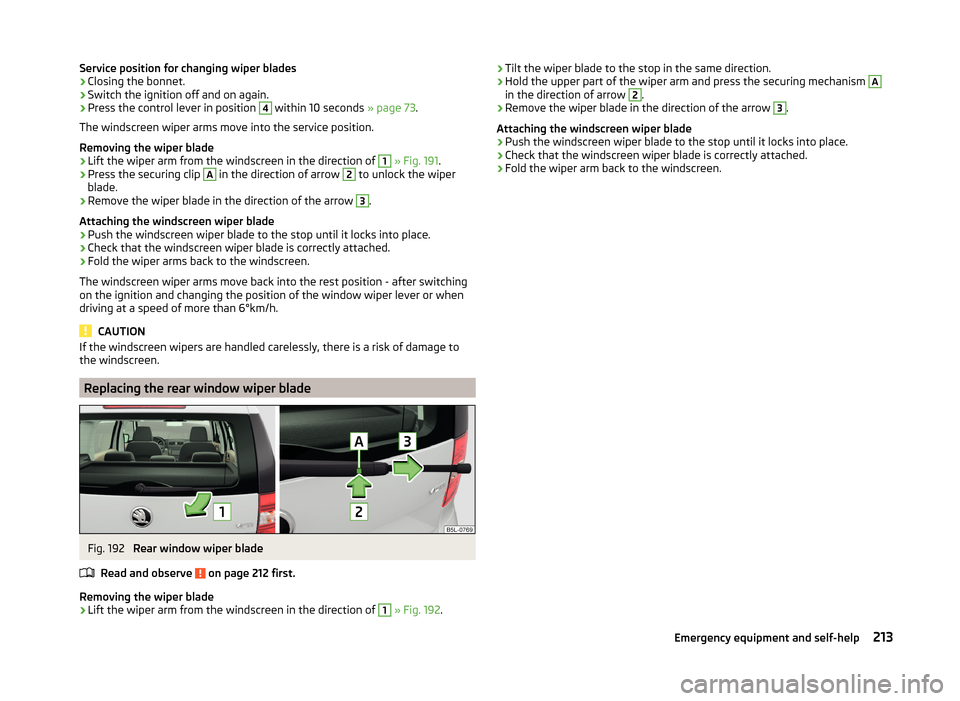
Service position for changing wiper blades›Closing the bonnet.›
Switch the ignition off and on again.
›
Press the control lever in position
4
within 10 seconds » page 73.
The windscreen wiper arms move into the service position.
Removing the wiper blade
›
Lift the wiper arm from the windscreen in the direction of
1
» Fig. 191 .
›
Press the securing clip
A
in the direction of arrow
2
to unlock the wiper
blade.
›
Remove the wiper blade in the direction of the arrow
3
.
Attaching the windscreen wiper blade
›
Push the windscreen wiper blade to the stop until it locks into place.
›
Check that the windscreen wiper blade is correctly attached.
›
Fold the wiper arms back to the windscreen.
The windscreen wiper arms move back into the rest position - after switching
on the ignition and changing the position of the window wiper lever or when
driving at a speed of more than 6°km/h.
CAUTION
If the windscreen wipers are handled carelessly, there is a risk of damage to
the windscreen.
Replacing the rear window wiper blade
Fig. 192
Rear window wiper blade
Read and observe
on page 212 first.
Removing the wiper blade
›
Lift the wiper arm from the windscreen in the direction of
1
» Fig. 192 .
›Tilt the wiper blade to the stop in the same direction.›Hold the upper part of the wiper arm and press the securing mechanism A
in the direction of arrow
2
.
›
Remove the wiper blade in the direction of the arrow
3
.
Attaching the windscreen wiper blade
›
Push the windscreen wiper blade to the stop until it locks into place.
›
Check that the windscreen wiper blade is correctly attached.
›
Fold the wiper arm back to the windscreen.
213Emergency equipment and self-help
Page 218 of 248
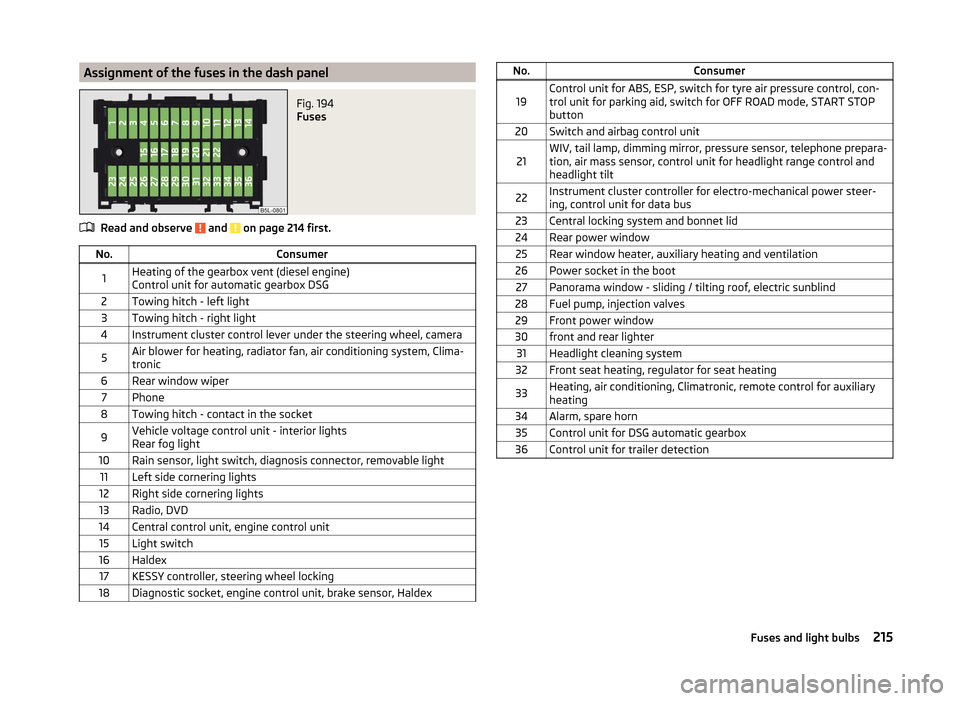
Assignment of the fuses in the dash panelFig. 194
Fuses
Read and observe and on page 214 first.
No.Consumer1Heating of the gearbox vent (diesel engine)
Control unit for automatic gearbox DSG2Towing hitch - left light3Towing hitch - right light4Instrument cluster control lever under the steering wheel, camera5Air blower for heating, radiator fan, air conditioning system, Clima-
tronic6Rear window wiper7Phone8Towing hitch - contact in the socket9Vehicle voltage control unit - interior lights
Rear fog light10Rain sensor, light switch, diagnosis connector, removable light11Left side cornering lights12Right side cornering lights13Radio, DVD14Central control unit, engine control unit15Light switch16Haldex17KESSY controller, steering wheel locking18Diagnostic socket, engine control unit, brake sensor, HaldexNo.Consumer19Control unit for ABS, ESP, switch for tyre air pressure control, con-
trol unit for parking aid, switch for OFF ROAD mode, START STOP button20Switch and airbag control unit21WIV, tail lamp, dimming mirror, pressure sensor, telephone prepara-
tion, air mass sensor, control unit for headlight range control and
headlight tilt22Instrument cluster controller for electro-mechanical power steer-
ing, control unit for data bus23Central locking system and bonnet lid24Rear power window25Rear window heater, auxiliary heating and ventilation26Power socket in the boot27Panorama window - sliding / tilting roof, electric sunblind28Fuel pump, injection valves29Front power window30front and rear lighter31Headlight cleaning system32Front seat heating, regulator for seat heating33Heating, air conditioning, Climatronic, remote control for auxiliary
heating34Alarm, spare horn35Control unit for DSG automatic gearbox36Control unit for trailer detection215Fuses and light bulbs
Page 235 of 248
Ball rodinstalling161
removing162
Bar with sliding hook98
Battery In the remote control key
210
Belts12
Belt tensioners15
Bonnet Closing
181
Opening181
Boot Class N1 vehicles
102
See Boot lid57
Boot lid automatic locking
58
Closing57
Opening57
Warning light36
Brake information messages
35
warning light35
Brake booster136
brake fluid specification
187
Brake fluid186
Checking186
information messages35
Brake pedal (automatic gearbox) warning light
41
brakes Driving in
140
Brakes Brake booster
136
Brake fluid186
Braking and stabilisation systems142
Handbrake136
Brakes and parking135
Braking Information on braking
135
Break recommendationSee Fatigue detection157
C
Camera Lens care
173
Camera lens care
173
Car care Jack
173
Car computer See multifunction display
44
Care and maintenance166
Car park ticket holder86
Carrier Roof rack
103
Cavity protection173
CD changer128
Central locking51
Problems55
Central locking button54
Change bulb for high beam
218
bulb for low beam218
engine oil183
light bulb in tail light220
Change engine oil
183
Changing Wheels
200
Changing a wheel Follow-up tasks
201
Preparation200
Removing and refitting a wheel201
Charging a vehicle battery189
Check Fit ball head properly
161
CheckingBattery electrolyte level188
Brake fluid186
Coolant185
Engine oil184
Oil level184
Windscreen washer fluid182
Checks Statutory checks
166
Children and safety23
Child safety Side airbag
25
Child safety lock55
Child safety seat Use of child safety seats
25
Child seat Classification
25
ISOFIX26
on the front passenger seat24
TOP TETHER27
Use of ISOFIX child seats26
Chrome parts see vehicle care
172
Cigarette lighter89
cleaning chrome parts
172
Cleaning Alcantara
175
and maintaining belts176
artificial leather175
headlight glasses172
materials175
natural leather175
plastic parts171
seats covers of the electrically heated seats176
wheels173
Cleaning safety belt
176
Cleaning seat covers
176
232Index