trailer SKODA YETI 2014 1.G / 5L Owner's Guide
[x] Cancel search | Manufacturer: SKODA, Model Year: 2014, Model line: YETI, Model: SKODA YETI 2014 1.G / 5LPages: 248, PDF Size: 29.49 MB
Page 208 of 248

Preparations for using the breakdown kitRead and observe
on page 204 first.
The following preparatory work must be carried out before using the puncture
repair kit.
›
Switch off the engine.
›
Engage 1st gear or place the selector lever of the automatic transmission in
the P-position .
›
Firmly apply the handbrake.
›
Check that you can carry out the repairs with the breakdown kit » page 203.
›
Uncouple any trailers.
›
Remove the breakdown kit from the boot.
›
Stick the sticker
1
» Fig. 178 on page 204 on the dashboard in the driver's
field of view.
›
Unscrew the valve cap.
›
Use the valve remover
2
to unscrew the valve core and place it on a clean
surface (rag, paper, etc.).
Sealing and inflating the tyre
Read and observe
on page 204 first.
Sealing
›
Forcefully shake the tyre inflater bottle
10
» Fig. 178 on page 204 back and
forth several times.
›
Firmly screw the inflation hose
3
onto the tyre inflator bottle
10
in a clock-
wise direction. The film on the cap is pierced automatically.
›
Remove the plug from the inflation hose
3
and plug the open end fully onto
the tyre valve.
›
Hold the bottle
10
with the bottom facing upwards and fill all of the sealing
agent from the tyre inflator bottle into the tyre.
›
Remove the empty tyre inflator bottle from the valve.
›
Screw the valve core back into the tyre valve using the valve remover
2
.
Inflating
›
Screw the air compressor tyre inflation hose
8
» Fig. 178 on page 204 firmly
onto the tyre valve.
›
Check that the air release valve
6
is closed.
›
Start the engine and run it in idle.
›
Plug the connector
4
into 12 Volt socket » page 90.
›
Switch on the air compressor with the ON and OFF switch
9
.
›Allow the air compressor to run until a pressure of 2.0 - 2.5 bar is achieved.
Maximum run time of 8 minutes » .›
Switch off the air compressor.
›
If you cannot reach an air pressure of 2.0 – 2.5 bar, unscrew the tyre inflation
hose
8
from the tyre valve.
›
Drive the vehicle 10 metres forwards or backwards to allow the sealing agent
to “distribute” in the tyre.
›
Firmly screw the tyre inflation hose
8
back onto the tyre valve and repeat
the inflation process.
›
If you cannot reach the required tyre inflation pressure here either, this
means the tyre has sustained too much damage. You cannot seal with tyre with the breakdown kit »
.
›
Switch off the air compressor.
›
Remove the tyre inflation hose
8
from the tyre valve.
Once a tyre inflation pressure of 2.0 – 2.5 bar is achieved, continue the journey
at a maximum speed of 80 km/h (50 mph).
WARNING■ If you cannot inflate the tyre to at least 2.0 bar, this means the damage
sustained was too serious. The sealing agent cannot be used to seal the
tyre.
Do not drive the vehicle. Seek help from a specialist garage.■
The tyre inflation hose and air compressor may get hot as the tyre is be-
ing inflated – risk of burning.
CAUTION
Switch off the air compressor after running 8 minutes at the latest – risk of
overheating! Allow the air compressor to cool a few minutes before switching
it on again.
Notes for driving with repaired tyres
Read and observe
on page 204 first.
The inflation pressure of the repaired tyre must be checked after driving for 10
minutes.
If the tyre inflation pressure is 1.3 bar or less
›
Do not drive the vehicle! You cannot properly seal with tyre with the
breakdown kit.
If the tyre inflation pressure is 1.3 bar or more
›
Set the tyre pressure to the correct value.
205Emergency equipment and self-help
Page 211 of 248
›Take the vehicle out of gear or move the selector lever into position
N if the
vehicle is fitted with an automatic gearbox.
Please note that the brake servo unit and power steering only operate if the
engine is running. If the engine is not running, significantly more physical force
is required to depress the brake pedal and steer the vehicle.
If using a tow rope, ensure that it is always kept taught.
Both drivers should be familiar with the problems which might occur while a vehicle is being towed. Unskilled drivers should not attempt to tow in another
vehicle or to be towed in.
The vehicle must be transported on a special breakdown vehicle or trailer if it
is not possible to tow in the vehicle in the way described or if the towing dis-
tance is greater than 50 km.WARNING■ When towing, respect the national legal provisions, especially those
which relate to the identification of the towing vehicle and the vehicle be-
ing towed.■
When towing, exercise increased caution.
■
Do not use spiral rope for towing » Fig. 181-
, the towing eye may un-
screw from the vehicle - risk of accident.
■
Ensure tow rope is not twisted - risk of accident.
CAUTION
■ Do not tow start the engine – there is a risk of damaging the engine and the
catalytic converter. The battery from another vehicle can be used as a jump-
start aid » page 206 , Jump-starting .■
If the gearbox has no oil, your vehicle must be towed with the front axle
raised clear of the ground or on a breakdown vehicle or trailer.
■
To protect both vehicles when tow-starting or towing, the tow rope should
be elastic. Thus one should only use plastic fibre rope or a rope made out of a
similarly elastic material.
■
There is always a risk of excessive stresses and damage resulting at the
points to which you attach the tow rope or tow bar when you attempt to tow a
vehicle which is not standing on a paved road.
■
Attach the tow rope or the tow bar to the towing eyes » page 208
or » page 209 to the detachable ball head of the towing device » page 159 .
NoteWe recommend using a tow rope from ŠKODA Original Accessories, which is
available from a ŠKODA Partner.
Front towing eye
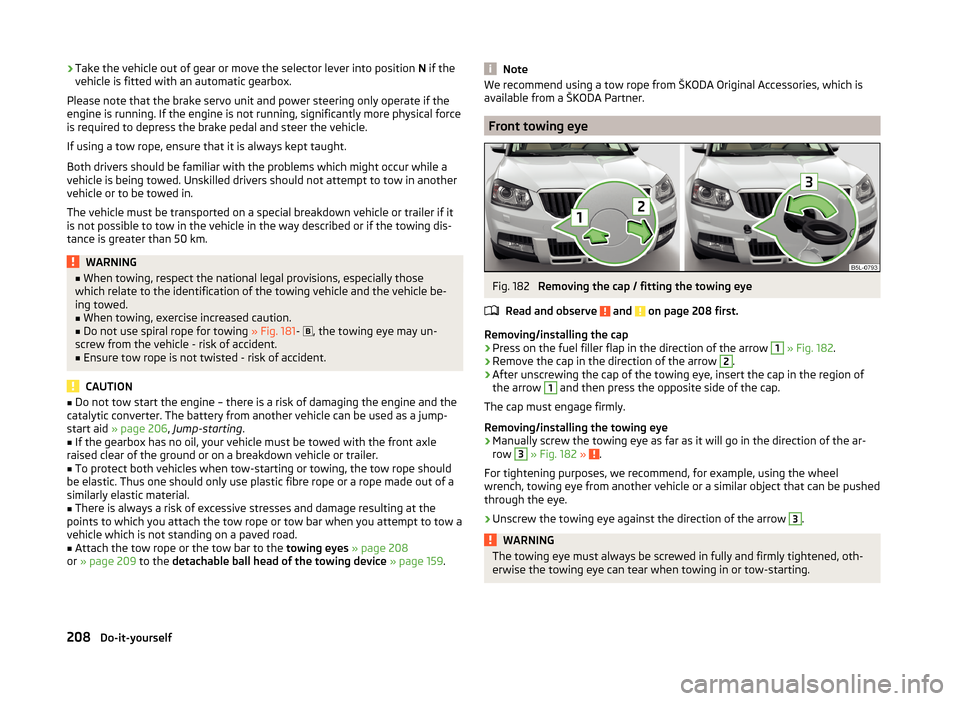
Fig. 182
Removing the cap / fitting the towing eye
Read and observe
and on page 208 first.
Removing/installing the cap
›
Press on the fuel filler flap in the direction of the arrow
1
» Fig. 182 .
›
Remove the cap in the direction of the arrow
2
.
›
After unscrewing the cap of the towing eye, insert the cap in the region of
the arrow
1
and then press the opposite side of the cap.
The cap must engage firmly.
Removing/installing the towing eye
›
Manually screw the towing eye as far as it will go in the direction of the ar-
row
3
» Fig. 182 » .
For tightening purposes, we recommend, for example, using the wheel
wrench, towing eye from another vehicle or a similar object that can be pushed through the eye.
›
Unscrew the towing eye against the direction of the arrow
3
.
WARNINGThe towing eye must always be screwed in fully and firmly tightened, oth-
erwise the towing eye can tear when towing in or tow-starting.208Do-it-yourself
Page 218 of 248
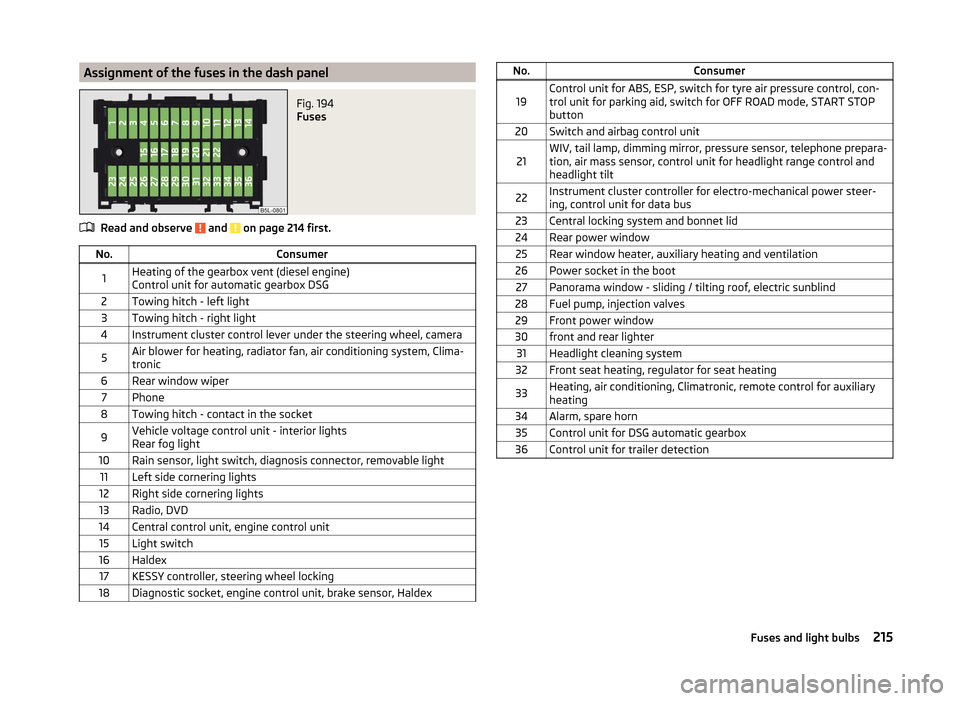
Assignment of the fuses in the dash panelFig. 194
Fuses
Read and observe and on page 214 first.
No.Consumer1Heating of the gearbox vent (diesel engine)
Control unit for automatic gearbox DSG2Towing hitch - left light3Towing hitch - right light4Instrument cluster control lever under the steering wheel, camera5Air blower for heating, radiator fan, air conditioning system, Clima-
tronic6Rear window wiper7Phone8Towing hitch - contact in the socket9Vehicle voltage control unit - interior lights
Rear fog light10Rain sensor, light switch, diagnosis connector, removable light11Left side cornering lights12Right side cornering lights13Radio, DVD14Central control unit, engine control unit15Light switch16Haldex17KESSY controller, steering wheel locking18Diagnostic socket, engine control unit, brake sensor, HaldexNo.Consumer19Control unit for ABS, ESP, switch for tyre air pressure control, con-
trol unit for parking aid, switch for OFF ROAD mode, START STOP button20Switch and airbag control unit21WIV, tail lamp, dimming mirror, pressure sensor, telephone prepara-
tion, air mass sensor, control unit for headlight range control and
headlight tilt22Instrument cluster controller for electro-mechanical power steer-
ing, control unit for data bus23Central locking system and bonnet lid24Rear power window25Rear window heater, auxiliary heating and ventilation26Power socket in the boot27Panorama window - sliding / tilting roof, electric sunblind28Fuel pump, injection valves29Front power window30front and rear lighter31Headlight cleaning system32Front seat heating, regulator for seat heating33Heating, air conditioning, Climatronic, remote control for auxiliary
heating34Alarm, spare horn35Control unit for DSG automatic gearbox36Control unit for trailer detection215Fuses and light bulbs
Page 225 of 248
Technical data
Technical data
Vehicle data
Introduction
This chapter contains information on the following subjects:
Vehicle characteristics
222
Operating weight and payload
223
Measurement of fuel consumption and CO 2 emissions according to ECE
Regulations and EU Directives
223
Dimensions
224
angle and gradeability
225
Vehicle-specific details per engine type
226
The details given in the vehicle's technical documentation always take prece-
dence over the details in the Owner's Manual.
The listed performance values were determined without performance-reduc- ing equipment, e.g. air conditioning system.
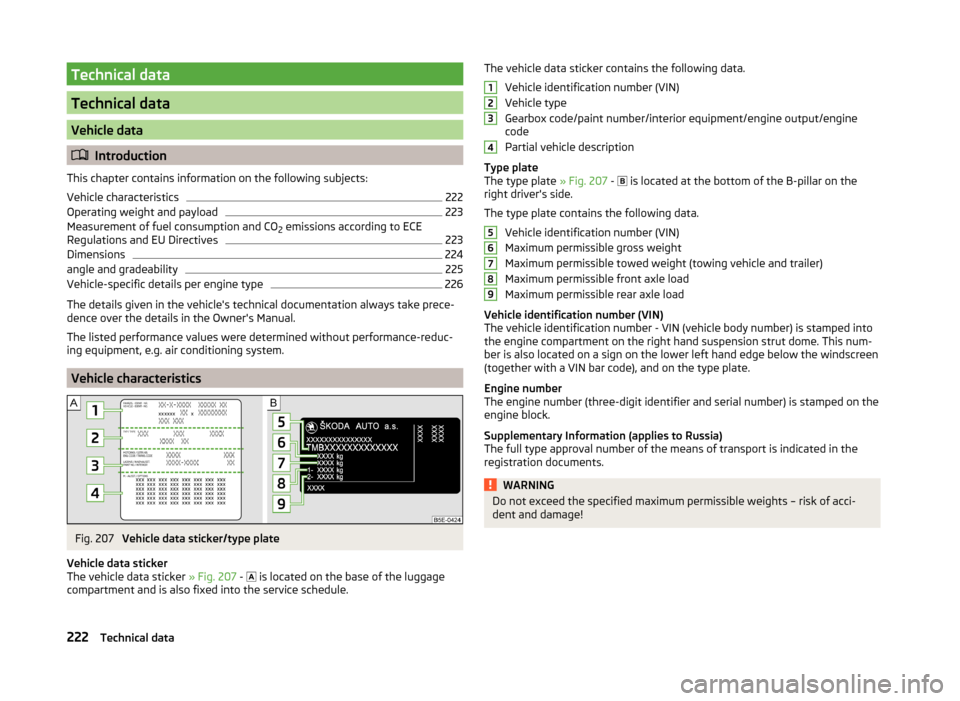
Vehicle characteristics
Fig. 207
Vehicle data sticker/type plate
Vehicle data sticker
The vehicle data sticker » Fig. 207 -
is located on the base of the luggage
compartment and is also fixed into the service schedule.
The vehicle data sticker contains the following data.
Vehicle identification number (VIN)
Vehicle type
Gearbox code/paint number/interior equipment/engine output/engine
code
Partial vehicle description
Type plate
The type plate » Fig. 207 -
is located at the bottom of the B-pillar on the
right driver's side.
The type plate contains the following data. Vehicle identification number (VIN)
Maximum permissible gross weight
Maximum permissible towed weight (towing vehicle and trailer)
Maximum permissible front axle load
Maximum permissible rear axle load
Vehicle identification number (VIN)
The vehicle identification number - VIN (vehicle body number) is stamped into
the engine compartment on the right hand suspension strut dome. This num-
ber is also located on a sign on the lower left hand edge below the windscreen
(together with a VIN bar code), and on the type plate.
Engine number
The engine number (three-digit identifier and serial number) is stamped on the engine block.
Supplementary Information (applies to Russia)
The full type approval number of the means of transport is indicated in the
registration documents.WARNINGDo not exceed the specified maximum permissible weights – risk of acci-
dent and damage!123456789222Technical data
Page 226 of 248

Operating weight and payload
Operating weight
This value represents the minimum operating weight without additional
weight-increasing equipment such as air conditioning system, spare wheel, or
trailer hitch.
The specified operating weight is for orientation purposes only.
The operating weight also contains the weight of the driver (75 kg), the weight
of the operating fluids, the tool kit, and a fuel tank filled to 90 % capacity.
Operating weight of the vehicle » page 226.
Payload
It is possible to calculate the approximate maximum payload from the differ-
ence between the permissible total weight and the operating weight.
The payload consists of the following weights.
› The weight of the passengers.
› The weight of all items of luggage and other loads.
› The weight of the roof, including the roof rack system.
› The weight of the equipment that is excluded from the operating weight.
› The trailer nose weight with trailer (max. 80 kg and 85 kg 1)
).
Note
If required, you can find out the precise weight of your vehicle at a specialist
garage.
Measurement of fuel consumption and CO 2 emissions according to
ECE Regulations and EU Directives
The data on fuel consumption and CO 2 emissions were not available at the
time of going to press.
The data on fuel consumption and CO 2 emissions are given on the ŠKODA
websites or in the sales and technical vehicle documentation.
The measurement of the intra-urban cycle begins with a cold start of the en-
gine. Afterwards urban driving is simulated.
In the extra-urban driving cycle, the vehicle is accelerated and decelerated in
all gears, corresponding to daily routine driving conditions. The driving speed
varies between 0 and 120 km/h.
The calculation of the combined fuel consumption considers a weighting of
about 37 % for the intra-urban cycle and 63 % for the extra-urban cycle.
Note
■ The fuel consumption and emission levels given on the ŠKODA websites or in
the commercial and technical vehicle documentation have been established in
accordance with rules and under conditions that are set out by legal or techni-
cal rules for the determination of operational and technical data of motor vehi-
cles.■
Depending on the extent of the equipment, the driving style, traffic condi-
tions, weather influences and vehicle condition, consumption values can in
practice result in fuel economy figures in the use of the vehicle that differ from
the fuel consumption values listed on the ŠKODA websites or in the commer-
cial and technical vehicle documentation.
1)
Applies to vehicles 4x4 with the 2.0 l/103 kW TDI CR and 2.0 L/125 kW TDI CR engine.
223Technical data
Page 229 of 248
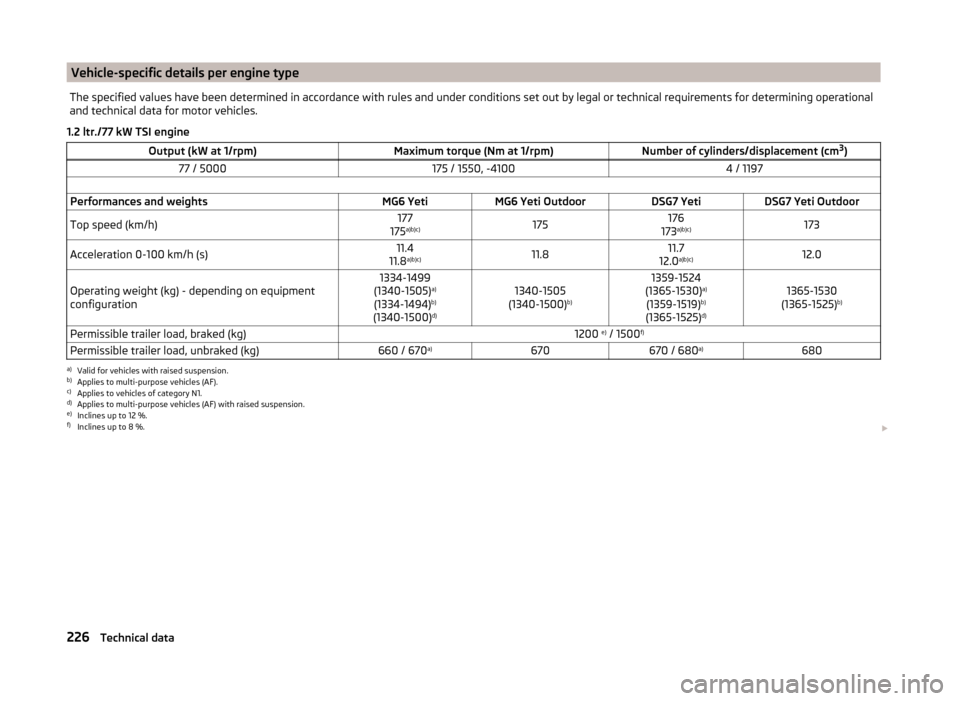
Vehicle-specific details per engine typeThe specified values have been determined in accordance with rules and under conditions set out by legal or technical requirements for determining operational
and technical data for motor vehicles.
1.2 ltr./77 kW TSI engine
Output (kW at 1/rpm)Maximum torque (Nm at 1/rpm)Number of cylinders/displacement (cm 3
)77 / 5000175 / 1550, -41004 / 1197 Performances and weightsMG6 YetiMG6 Yeti OutdoorDSG7 YetiDSG7 Yeti OutdoorTop speed (km/h)177
175 a)b)c)175176
173 a)b)c)173Acceleration 0-100 km/h (s)11.4
11.8 a)b)c)11.811.7
12.0 a)b)c)12.0Operating weight (kg) - depending on equipment
configuration1334-1499
(1340-1505) a)
(1334-1494) b)
(1340-1500) d)1340-1505
(1340-1500) b)1359-1524
(1365-1530) a)
(1359-1519) b)
(1365-1525) d)1365-1530
(1365-1525) b)Permissible trailer load, braked (kg)1200
e)
/ 1500 f)Permissible trailer load, unbraked (kg)660 / 670 a)670670 / 680 a)680a)
Valid for vehicles with raised suspension.
b)
Applies to multi-purpose vehicles (AF).
c)
Applies to vehicles of category N1.
d)
Applies to multi-purpose vehicles (AF) with raised suspension.
e)
Inclines up to 12 %.
f)
Inclines up to 8 %.
226Technical data
Page 230 of 248
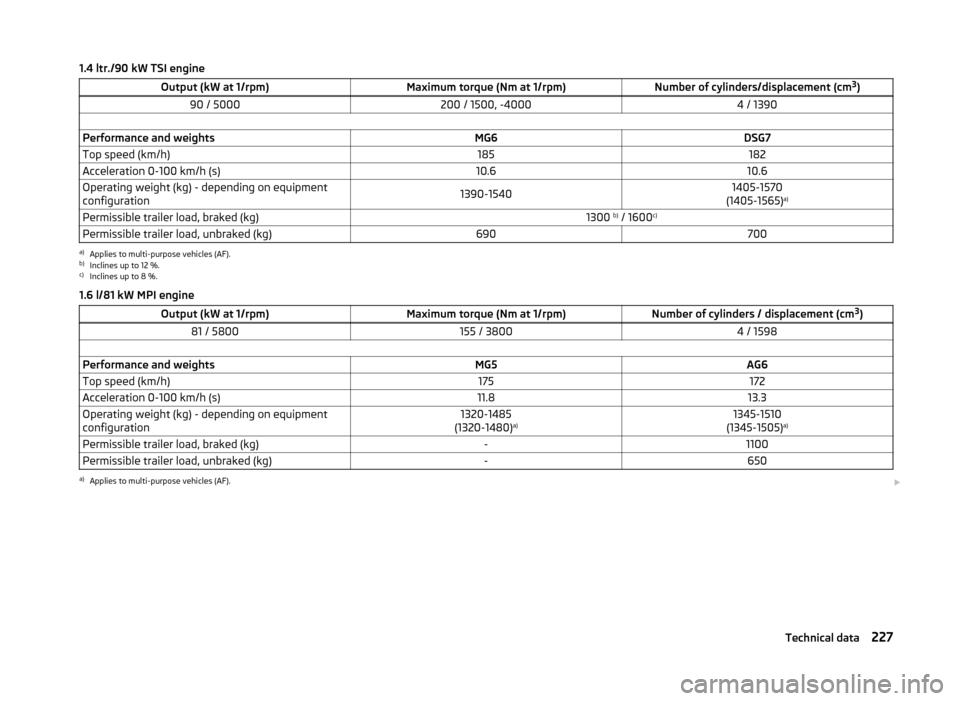
1.4 ltr./90 kW TSI engineOutput (kW at 1/rpm)Maximum torque (Nm at 1/rpm)Number of cylinders/displacement (cm3
)90 / 5000200 / 1500, -40004 / 1390 Performance and weightsMG6DSG7Top speed (km/h)185182Acceleration 0-100 km/h (s)10.610.6Operating weight (kg) - depending on equipment
configuration1390-15401405-1570
(1405-1565) a)Permissible trailer load, braked (kg)1300
b)
/ 1600 c)Permissible trailer load, unbraked (kg)690700a)
Applies to multi-purpose vehicles (AF).
b)
Inclines up to 12 %.
c)
Inclines up to 8 %.
1.6 l/81 kW MPI engine
Output (kW at 1/rpm)Maximum torque (Nm at 1/rpm)Number of cylinders / displacement (cm 3
)81 / 5800155 / 38004 / 1598 Performance and weightsMG5AG6Top speed (km/h)175172Acceleration 0-100 km/h (s)11.813.3Operating weight (kg) - depending on equipment
configuration1320-1485
(1320-1480) a)1345-1510
(1345-1505) a)Permissible trailer load, braked (kg)-1100Permissible trailer load, unbraked (kg)-650a)
Applies to multi-purpose vehicles (AF).
227Technical data
Page 231 of 248
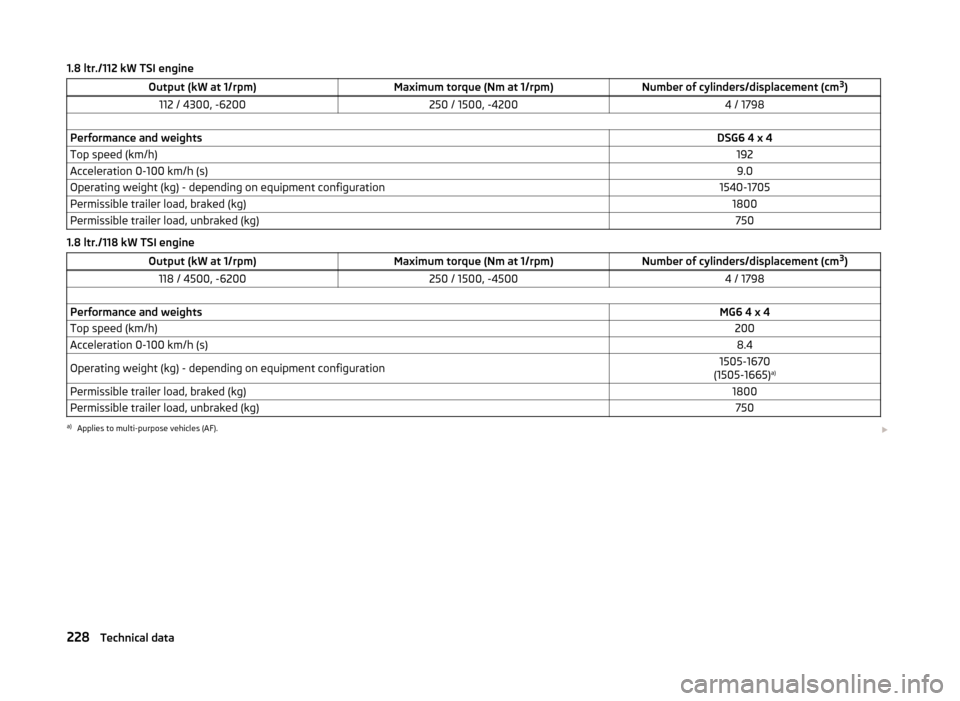
1.8 ltr./112 kW TSI engineOutput (kW at 1/rpm)Maximum torque (Nm at 1/rpm)Number of cylinders/displacement (cm3
)112 / 4300, -6200250 / 1500, -42004 / 1798 Performance and weightsDSG6 4 x 4Top speed (km/h)192Acceleration 0-100 km/h (s)9.0Operating weight (kg) - depending on equipment configuration1540-1705Permissible trailer load, braked (kg)1800Permissible trailer load, unbraked (kg)750
1.8 ltr./118 kW TSI engine
Output (kW at 1/rpm)Maximum torque (Nm at 1/rpm)Number of cylinders/displacement (cm 3
)118 / 4500, -6200250 / 1500, -45004 / 1798 Performance and weightsMG6 4 x 4Top speed (km/h)200Acceleration 0-100 km/h (s)8.4Operating weight (kg) - depending on equipment configuration1505-1670
(1505-1665) a)Permissible trailer load, braked (kg)1800Permissible trailer load, unbraked (kg)750a)
Applies to multi-purpose vehicles (AF).
228Technical data
Page 232 of 248
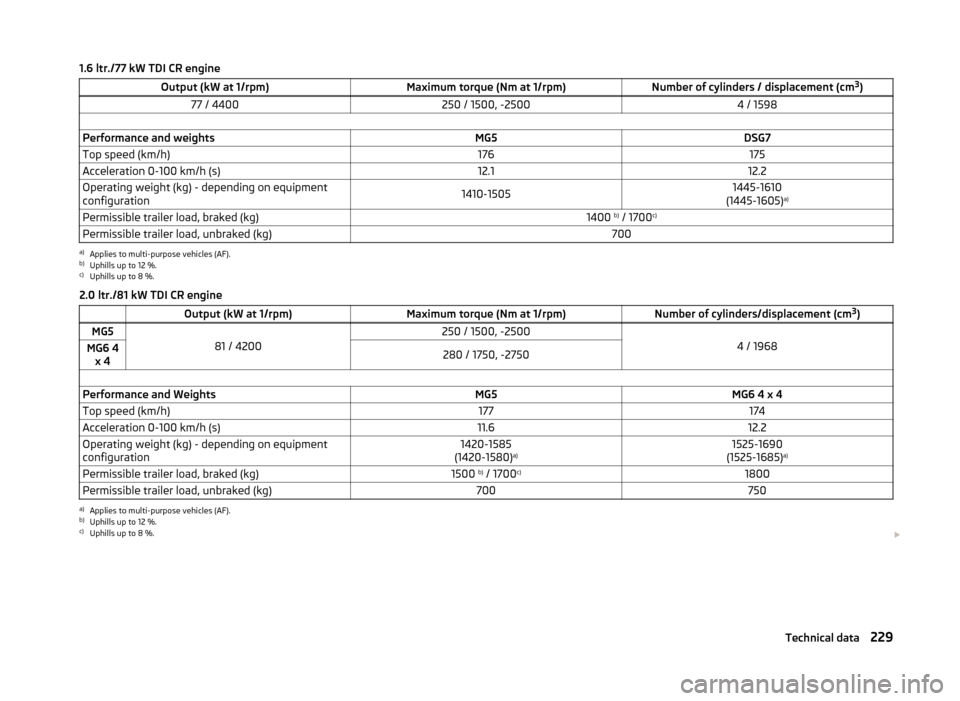
1.6 ltr./77 kW TDI CR engineOutput (kW at 1/rpm)Maximum torque (Nm at 1/rpm)Number of cylinders / displacement (cm3
)77 / 4400250 / 1500, -25004 / 1598 Performance and weightsMG5DSG7Top speed (km/h)176175Acceleration 0-100 km/h (s)12.112.2Operating weight (kg) - depending on equipment
configuration1410-15051445-1610
(1445-1605) a)Permissible trailer load, braked (kg)1400
b)
/ 1700 c)Permissible trailer load, unbraked (kg)700a)
Applies to multi-purpose vehicles (AF).
b)
Uphills up to 12 %.
c)
Uphills up to 8 %.
2.0 ltr./81 kW TDI CR engine
Output (kW at 1/rpm)Maximum torque (Nm at 1/rpm)Number of cylinders/displacement (cm 3
)MG5
81 / 4200
250 / 1500, -2500
4 / 1968
MG6 4
x 4280 / 1750, -2750 Performance and WeightsMG5MG6 4 x 4Top speed (km/h)177174Acceleration 0-100 km/h (s)11.612.2Operating weight (kg) - depending on equipment
configuration1420-1585
(1420-1580) a)1525-1690
(1525-1685) a)Permissible trailer load, braked (kg)1500
b)
/ 1700 c)1800Permissible trailer load, unbraked (kg)700750a)
Applies to multi-purpose vehicles (AF).
b)
Uphills up to 12 %.
c)
Uphills up to 8 %.
229Technical data
Page 233 of 248
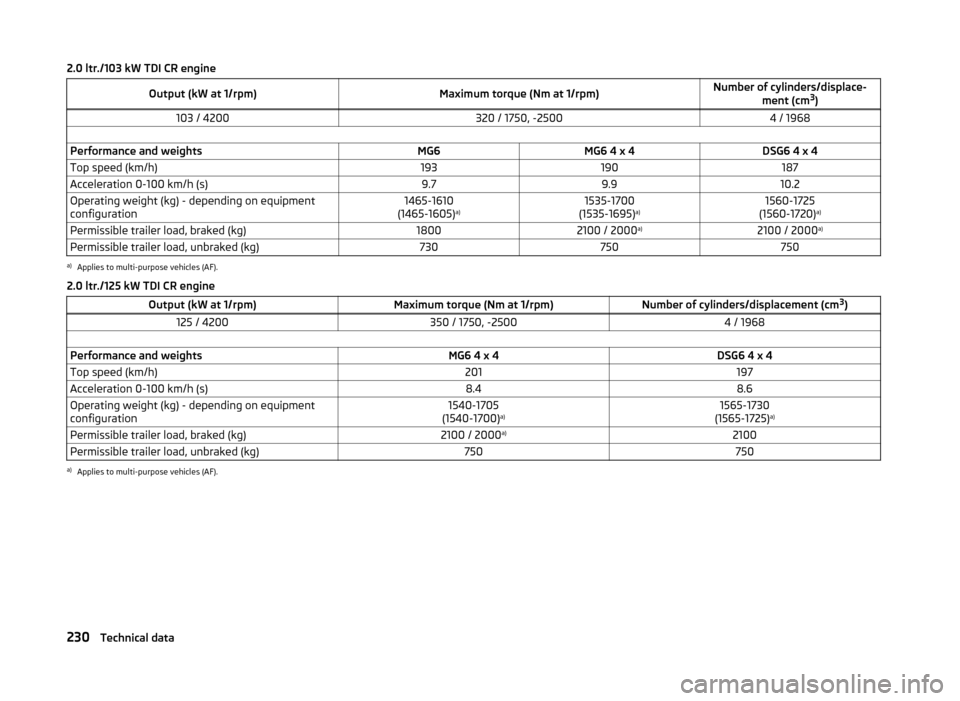
2.0 ltr./103 kW TDI CR engineOutput (kW at 1/rpm)Maximum torque (Nm at 1/rpm)Number of cylinders/displace-ment (cm3
)103 / 4200320 / 1750, -25004 / 1968 Performance and weightsMG6MG6 4 x 4DSG6 4 x 4Top speed (km/h)193190187Acceleration 0-100 km/h (s)9.79.910.2Operating weight (kg) - depending on equipment
configuration1465-1610
(1465-1605) a)1535-1700
(1535-1695) a)1560-1725
(1560-1720) a)Permissible trailer load, braked (kg)18002100 / 2000
a)2100 / 2000 a)Permissible trailer load, unbraked (kg)730750750a)
Applies to multi-purpose vehicles (AF).
2.0 ltr./125 kW TDI CR engine
Output (kW at 1/rpm)Maximum torque (Nm at 1/rpm)Number of cylinders/displacement (cm 3
)125 / 4200350 / 1750, -25004 / 1968 Performance and weightsMG6 4 x 4DSG6 4 x 4Top speed (km/h)201197Acceleration 0-100 km/h (s)8.48.6Operating weight (kg) - depending on equipment
configuration1540-1705
(1540-1700) a)1565-1730
(1565-1725) a)Permissible trailer load, braked (kg)2100 / 2000
a)2100Permissible trailer load, unbraked (kg)750750a)
Applies to multi-purpose vehicles (AF).
230Technical data