seats SKODA YETI 2017 Owner´s Manual
[x] Cancel search | Manufacturer: SKODA, Model Year: 2017, Model line: YETI, Model: SKODA YETI 2017Pages: 200, PDF Size: 28.93 MB
Page 25 of 200

Child safety and the side airbagFig. 13
Incorrect seated position of a
child who is not properly secured
– risk from the side airbag/Child
properly protected by safety seat
Read and observe on page 21 first.
The child must not be positioned in the deployment area of the side airbag
» Fig. 13 -
.
There must be sufficient room between the child and the deployment area of
the side airbag that the airbag can provide as much protection as possible
» Fig. 13 –
.
Classification of child seats
Read and observe
on page 21 first.
Classification of child seats according to the ECE-R 44 standard.
GroupWeight of the child0up to 10 kg0up to 13 kg19-18 kg215-25 kg322-36 kg
Use of child safety seats which are secured using a seat belt
Never use a rear-facing child seat on the front passenger seat if the front passenger airbag is activated. This child safety seat is positioned in the deployment
area of the front passenger airbag. The airbag may cause the child severe, or even fatal injuries, in the event of it being deployed.
Read and observe
on page 21 first.
Overview of the usability of child seats fastened with a seat belt on each of the seats in accordance with the ECE-R 16 standard.GroupFront passenger seatRear seatsExternalRear seat Centre0
up to 10 kgUUU0
up to 13 kgUUU1
9-18 kgUUUGroupFront passenger seatRear seatsExternalRear seat Centre2
15-25 kgUUU a)3
22-36 kgUUU a)a)
If the middle rear seat is not provided with a headrest, then a child seat of Group 2 or 3 is only to be used
if this has its own built-in headrest. If the child seat of Group 2 or 3 does not have its own built-in head-
rest, the child seat must be attached to the outer rear seat.
“Universal” child seat category - a child seat designed to be attached to
the seat using the seat belt.
U23Transporting children safely
Page 26 of 200

Fastening systems
Introduction
This chapter contains information on the following subjects:
attachment points of the
system
24
Use of child safety seats with the
system
24
Attachment points of the
system
25
attachment points of the system
Fig. 14
Labels of the system
is a system for securing child seats quickly and safely.
There are two fixing eyes between the seat backrest and the seat cushion of
the front passenger seat for fixing a child seat with the
system.
On the rear outside seats, the fixing eyes are located below the upholstery.
The places are marked with labels with the
logo » Fig. 14 .WARNING■
Always refer to the instructions of the manufacturer of the child seat
when installing and removing a child seat with the system.■
Never attach other child seats, belts or objects to the attachment points
intended for the installation of a child seat with the
system – risk of
death!
Note
■ A child seat fitted with the system can only be mounted in a vehicle fit-
ted with a system if the child seat has been approved for this type of ve-
hicle. Further information is available from a ŠKODA Partner.■
Child seats with the
system can be purchased from ŠKODA Original Ac-
cessories.
Use of child safety seats with the system
Never use a rear-facing child seat on the front passenger seat if the front passenger airbag is activated. This child safety seat is positioned in the deployment
area of the front passenger airbag. The airbag may cause the child severe, or even fatal injuries, in the event of it being deployed.Overview of the use-ability of the child seats fastened with the system on each of the seats in accordance with the ECE-R 16 standard.GroupSize class of
the child seat a)Front passenger seat
b)Outer rear seatsRear seat middle0
up to 10 kgEXIL-SUX0
up to 13 kgE
XIL-SUX
DC 24Safety
Page 27 of 200
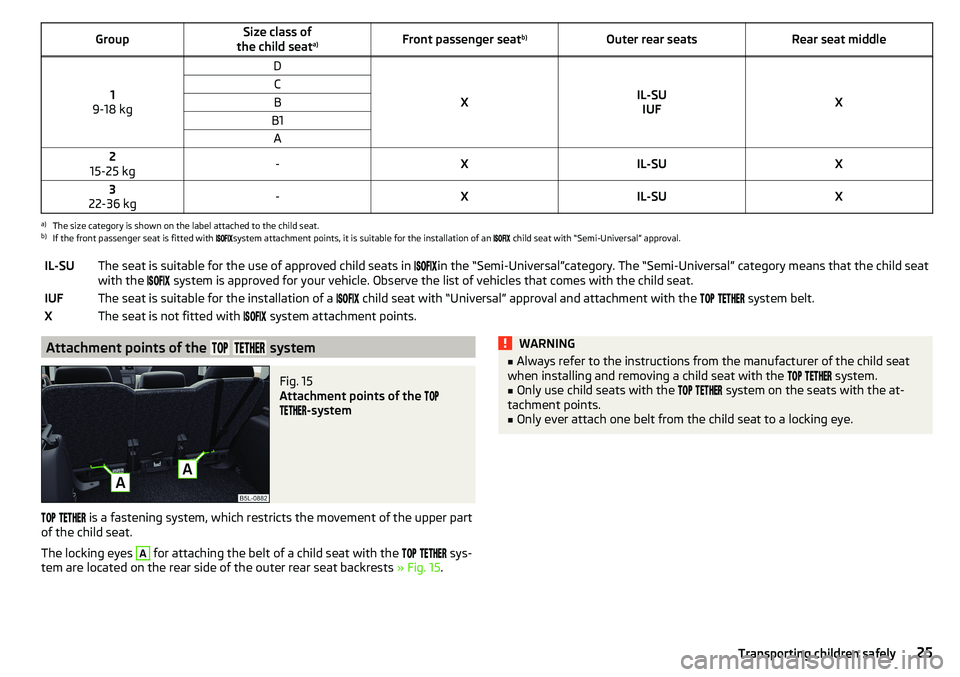
GroupSize class of
the child seat a)Front passenger seat
b)Outer rear seatsRear seat middle
1
9-18 kg
D
XIL-SU IUFX
CBB1A2
15-25 kg-XIL-SUX3
22-36 kg-XIL-SUXa)
The size category is shown on the label attached to the child seat.
b)
If the front passenger seat is fitted with system attachment points, it is suitable for the installation of an
child seat with “Semi-Universal” approval.
IL-SUThe seat is suitable for the use of approved child seats in
in the “Semi-Universal”category. The “Semi-Universal” category means that the child seat
with the
system is approved for your vehicle. Observe the list of vehicles that comes with the child seat.IUFThe seat is suitable for the installation of a child seat with “Universal” approval and attachment with the system belt.XThe seat is not fitted with system attachment points.Attachment points of the systemFig. 15
Attachment points of the
-system
is a fastening system, which restricts the movement of the upper part
of the child seat.
The locking eyes
A
for attaching the belt of a child seat with the
sys-
tem are located on the rear side of the outer rear seat backrests » Fig. 15.
WARNING■
Always refer to the instructions from the manufacturer of the child seat
when installing and removing a child seat with the system.■
Only use child seats with the
system on the seats with the at-
tachment points.
■
Only ever attach one belt from the child seat to a locking eye.
25Transporting children safely
Page 56 of 200
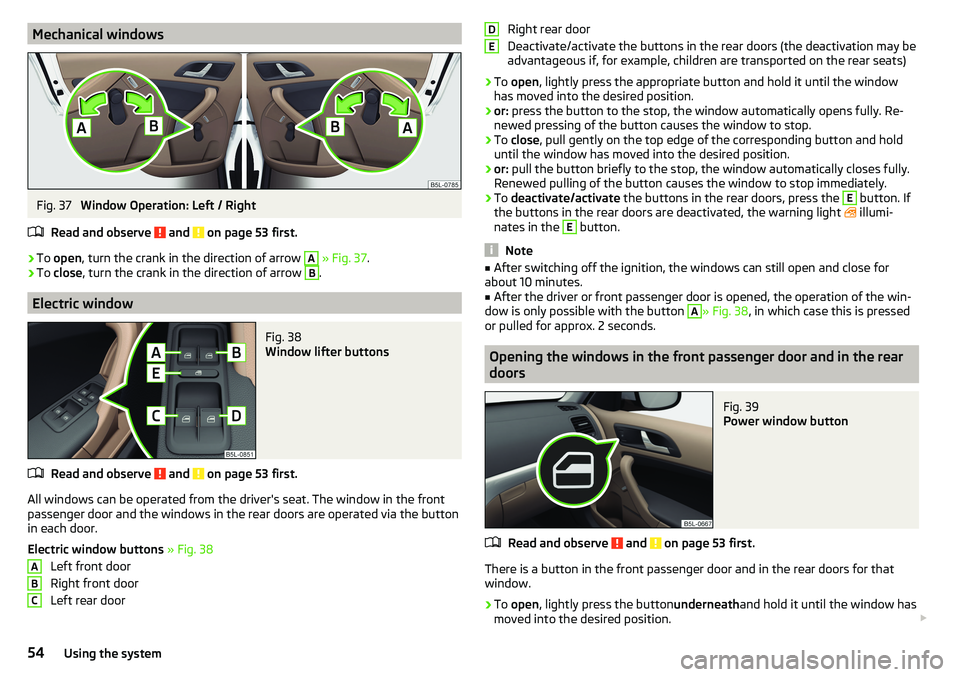
Mechanical windowsFig. 37
Window Operation: Left / Right
Read and observe
and on page 53 first.
›
To open , turn the crank in the direction of arrow
A
» Fig. 37 .
›
To close , turn the crank in the direction of arrow
B
.
Electric window
Fig. 38
Window lifter buttons
Read and observe and on page 53 first.
All windows can be operated from the driver's seat. The window in the front
passenger door and the windows in the rear doors are operated via the button
in each door.
Electric window buttons » Fig. 38
Left front door
Right front door
Left rear door
ABCRight rear door
Deactivate/activate the buttons in the rear doors (the deactivation may be
advantageous if, for example, children are transported on the rear seats)›
To open , lightly press the appropriate button and hold it until the window
has moved into the desired position.
›
or: press the button to the stop, the window automatically opens fully. Re-
newed pressing of the button causes the window to stop.
›
To close , pull gently on the top edge of the corresponding button and hold
until the window has moved into the desired position.
›
or: pull the button briefly to the stop, the window automatically closes fully.
Renewed pulling of the button causes the window to stop immediately.
›
To deactivate/activate the buttons in the rear doors, press the
E
button. If
the buttons in the rear doors are deactivated, the warning light illumi-
nates in the
E
button.
Note
■ After switching off the ignition, the windows can still open and close for
about 10 minutes.■
After the driver or front passenger door is opened, the operation of the win-
dow is only possible with the button
A
» Fig. 38 , in which case this is pressed
or pulled for approx. 2 seconds.
Opening the windows in the front passenger door and in the rear
doors
Fig. 39
Power window button
Read and observe and on page 53 first.
There is a button in the front passenger door and in the rear doors for that
window.
›
To open , lightly press the button underneathand hold it until the window has
moved into the desired position.
DE54Using the system
Page 60 of 200
Lights and visibility
Lights
Introduction
This chapter contains information on the following subjects:
Operating the lights
58
Daylight running lights (DAY LIGHT)
59
Turn signal and main beam
59
Automatic driving light control
60
Xenon headlight
60
Fog lights/rear fog light
60
Fog lights with the CORNER function
61
COMING HOME / LEAVING HOME
61
Hazard warning light system
61
Parking lights
61
Driving abroad
62
Unless otherwise stated, the lights only work when the ignition is switched on.
The layout of the controls on right-hand drive vehicles differs partially from
that shown in this layout » Fig. 42 on page 58 .
WARNINGThe automatic driving lamp control only operates as a support and
does not release the driver from his responsibility to check the lights and, if
necessary, to switch on the light depending on the prevailing light condi-
tions.
Note
The headlights may mist up temporarily. When the light is on, the light-emit-
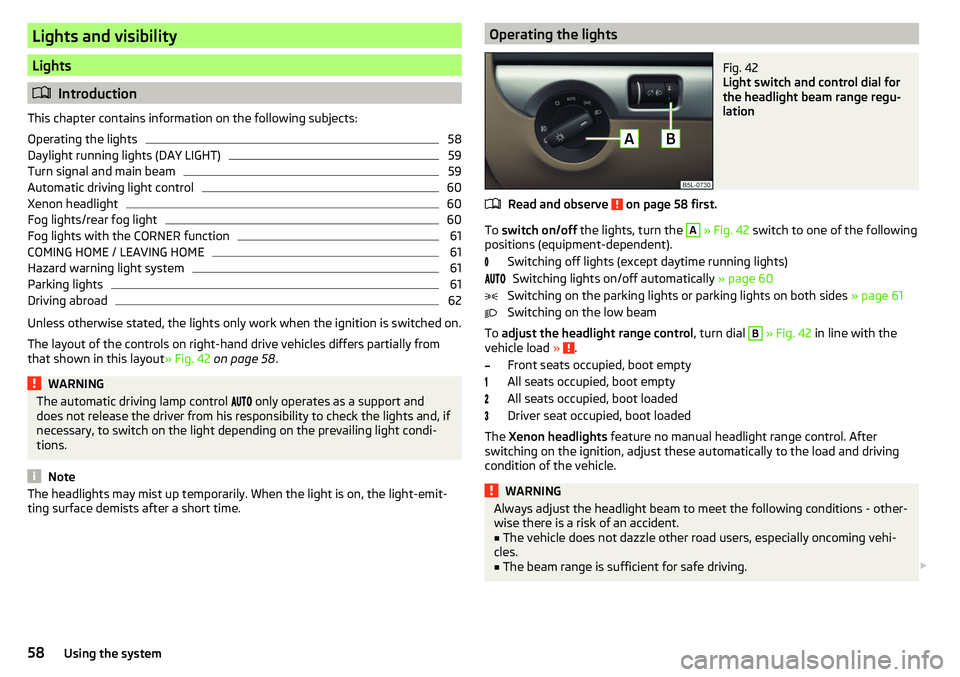
ting surface demists after a short time.Operating the lightsFig. 42
Light switch and control dial for
the headlight beam range regu-
lation
Read and observe on page 58 first.
To switch on/off the lights, turn the
A
» Fig. 42 switch to one of the following
positions (equipment-dependent).
Switching off lights (except daytime running lights)Switching lights on/off automatically » page 60
Switching on the parking lights or parking lights on both sides » page 61
Switching on the low beam
To adjust the headlight range control , turn dial
B
» Fig. 42 in line with the
vehicle load » .
Front seats occupied, boot empty
All seats occupied, boot empty
All seats occupied, boot loaded
Driver seat occupied, boot loaded
The Xenon headlights feature no manual headlight range control. After
switching on the ignition, adjust these automatically to the load and driving
condition of the vehicle.
WARNINGAlways adjust the headlight beam to meet the following conditions - other-
wise there is a risk of an accident.■
The vehicle does not dazzle other road users, especially oncoming vehi-
cles.
■
The beam range is sufficient for safe driving.
58Using the system
Page 70 of 200
CAUTION■Never manually fold in/out the electrically folding exterior mirrors - there is a
risk of damage to the mirror!■
When the mirror is swung by external influences (due to impact during ma-
noeuvring, for example), then first fold-in the mirror by turning the knob and
wait for a loud clapping noise.
Seats and head restraints
Front seats
Introduction
This chapter contains information on the following subjects:
Manual adjustment
68
Electrical adjustment
69
Memory Function of the electrically adjustable seat
69
Memory function of the remote control key
70
Folding front passenger seat
70
Armrest setting
71WARNING■ Only adjust the driver's seat when the vehicle is stationary – otherwise
there is a risk of accident!■
Caution when adjusting the seat! You may suffer injuries or bruises as a
result of adjusting the seat without paying proper attention.
Manual adjustment
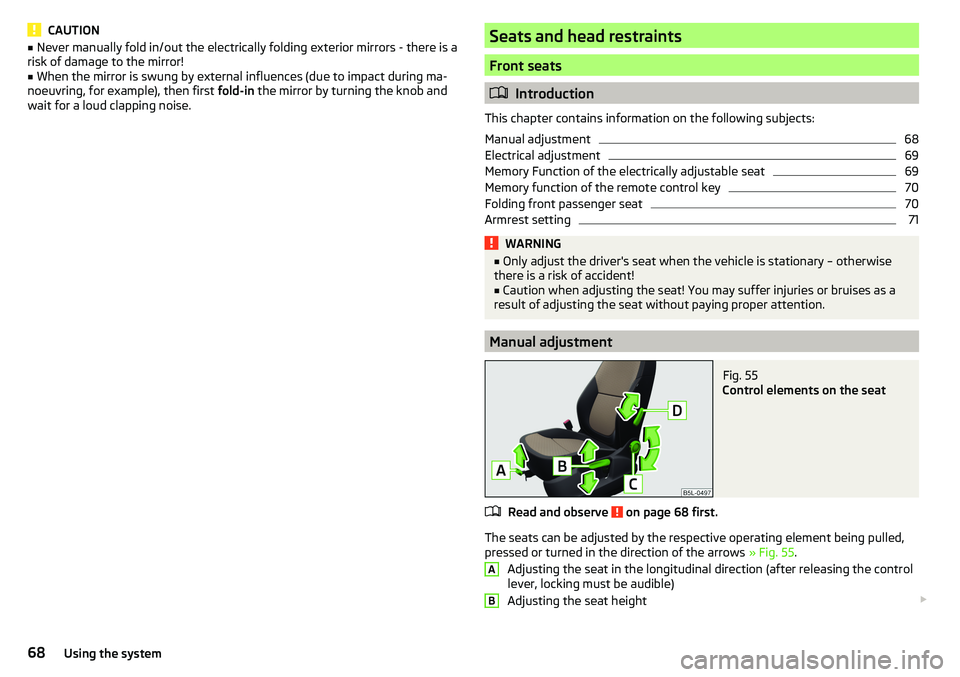
Fig. 55
Control elements on the seat
Read and observe on page 68 first.
The seats can be adjusted by the respective operating element being pulled,
pressed or turned in the direction of the arrows » Fig. 55.
Adjusting the seat in the longitudinal direction (after releasing the control
lever, locking must be audible)
Adjusting the seat height
AB68Using the system
Page 71 of 200
Adjusting the tilt of the backrest (do not lean on the backrest when ad-
justing)
Setting the extent of the curvature of the lumbar support
Note
After a certain time, play can develop within the adjustment mechanism of the
backrest angle.
Electrical adjustment
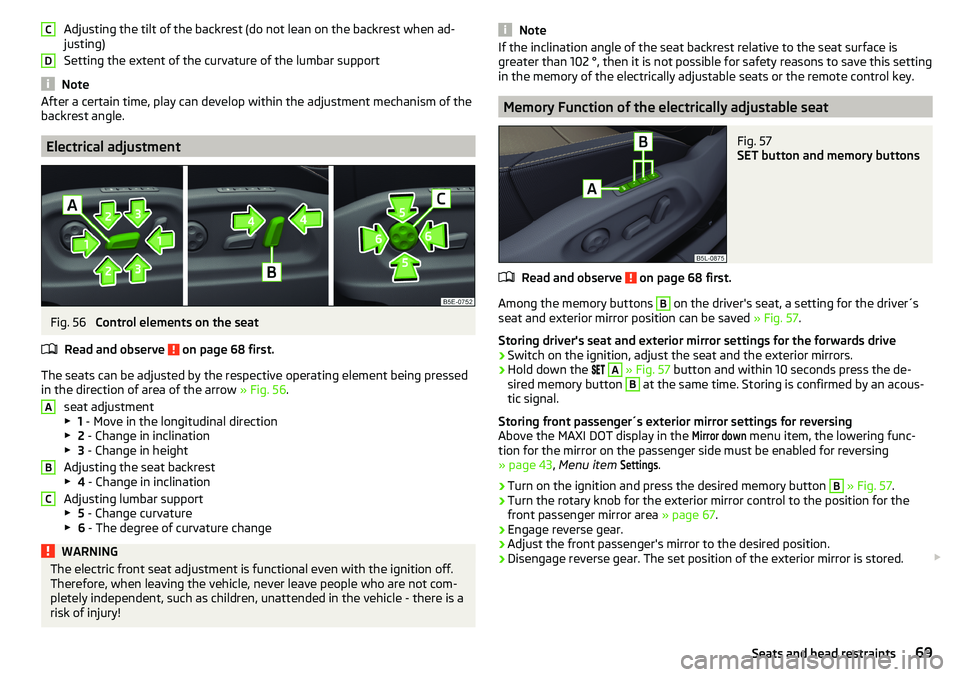
Fig. 56
Control elements on the seat
Read and observe
on page 68 first.
The seats can be adjusted by the respective operating element being pressed in the direction of area of the arrow » Fig. 56.
seat adjustment
▶ 1 - Move in the longitudinal direction
▶ 2 - Change in inclination
▶ 3 - Change in height
Adjusting the seat backrest
▶ 4 - Change in inclination
Adjusting lumbar support
▶ 5 - Change curvature
▶ 6 - The degree of curvature change
WARNINGThe electric front seat adjustment is functional even with the ignition off.
Therefore, when leaving the vehicle, never leave people who are not com-
pletely independent, such as children, unattended in the vehicle - there is a
risk of injury!CDABCNoteIf the inclination angle of the seat backrest relative to the seat surface is
greater than 102 °, then it is not possible for safety reasons to save this setting
in the memory of the electrically adjustable seats or the remote control key.
Memory Function of the electrically adjustable seat
Fig. 57
SET button and memory buttons
Read and observe on page 68 first.
Among the memory buttons
B
on the driver's seat, a setting for the driver´s
seat and exterior mirror position can be saved » Fig. 57.
Storing driver's seat and exterior mirror settings for the forwards drive
›
Switch on the ignition, adjust the seat and the exterior mirrors.
›
Hold down the
A
» Fig. 57 button and within 10 seconds press the de-
sired memory button
B
at the same time. Storing is confirmed by an acous-
tic signal.
Storing front passenger´s exterior mirror settings for reversing
Above the MAXI DOT display in the
Mirror down
menu item, the lowering func-
tion for the mirror on the passenger side must be enabled for reversing
» page 43 , Menu item
Settings
.
›
Turn on the ignition and press the desired memory button
B
» Fig. 57 .
›
Turn the rotary knob for the exterior mirror control to the position for the
front passenger mirror area » page 67.
›
Engage reverse gear.
›
Adjust the front passenger's mirror to the desired position.
›
Disengage reverse gear. The set position of the exterior mirror is stored.
69Seats and head restraints
Page 73 of 200
WARNING (Continued)■Do not adjust the seat back while driving - There is a risk of injury and ac-
cidents!■
When moving the seat backrest, keep limbs out of the area between the
seat and seat backrest – risk of injury!
■
Never transport the following items on the seat backrest when folded
forwards. ■ Objects that could restrict the driver's view.
■ Objects which make it impossible for the driver to control the vehicle
(e.g. if they roll under the pedals, or protrude into the driver's zone).
■ Objects which could lead to injury to passengers (e.g. if accelerating
sharply, braking or changing direction).
Armrest setting
Fig. 59
Adjust armrest
Read and observe on page 68 first.
›
To adjust the height , lift the armrest in the direction of the arrow
A
into one
of the six locking positions » Fig. 59.
›
To close , lift the armrest in the direction of arrow
A
until the stop and then
fold down again.
›
To longitudinally adjust move the armrest in the direction of arrow
B
to the
desired position.
Rear seats
Introduction
This chapter contains information on the following subjects:
Adjusting seats in forward/back direction
71
Adjusting the angle of the seat backrest
71Folding the seat backrest forwards and folding the seat fully forwards72Unlock and removing the seat72
Adjusting seats in crosswise direction
73
Folding back seats
73
Adjusting seats in forward/back direction
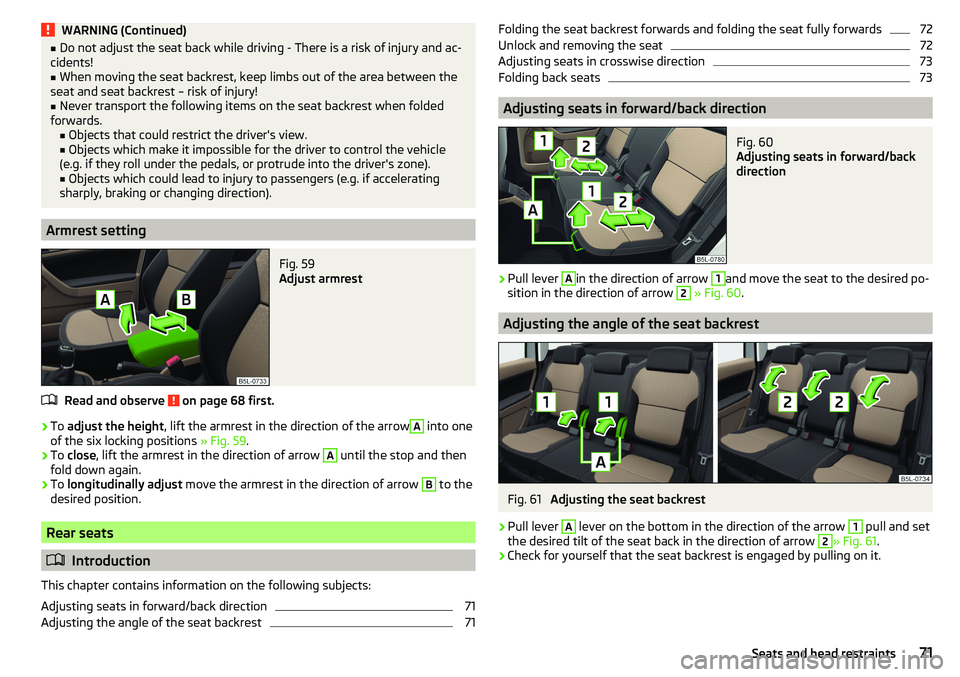
Fig. 60
Adjusting seats in forward/back
direction
›
Pull lever
A
in the direction of arrow
1
and move the seat to the desired po-
sition in the direction of arrow
2
» Fig. 60 .
Adjusting the angle of the seat backrest
Fig. 61
Adjusting the seat backrest
›
Pull lever
A
lever on the bottom in the direction of the arrow
1
pull and set
the desired tilt of the seat back in the direction of arrow
2
» Fig. 61 .
›
Check for yourself that the seat backrest is engaged by pulling on it.
71Seats and head restraints
Page 74 of 200
Folding the seat backrest forwards and folding the seat fullyforwardsFig. 62
Safety position of seat belt / folding the seat completely forward
Fig. 63
Lock forward folded seats
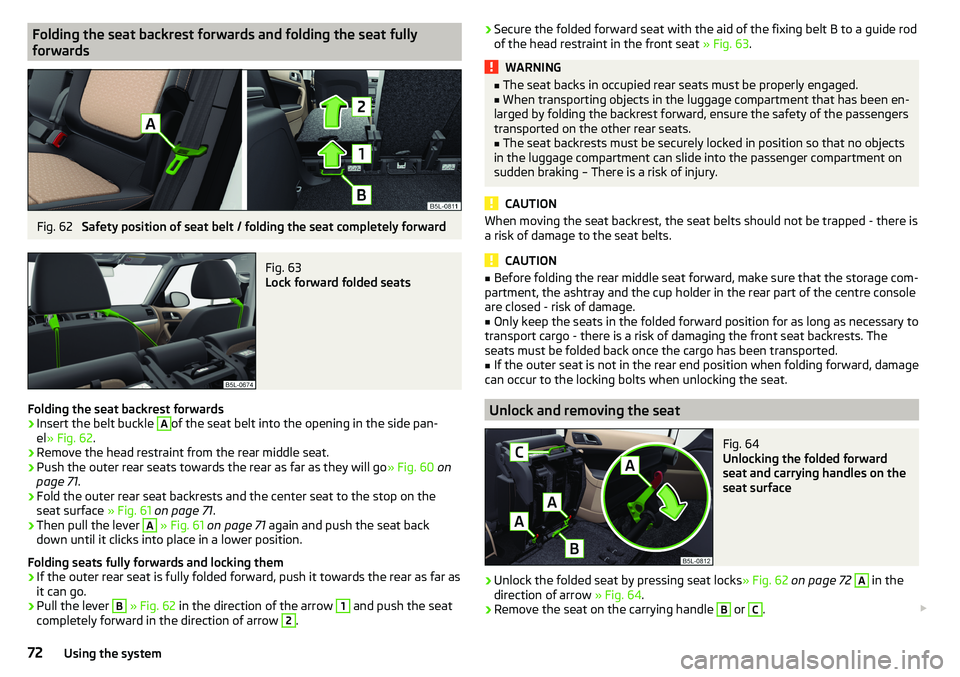
Folding the seat backrest forwards
›
Insert the belt buckle
A
of the seat belt into the opening in the side pan-
el » Fig. 62 .
›
Remove the head restraint from the rear middle seat.
›
Push the outer rear seats towards the rear as far as they will go » Fig. 60 on
page 71 .
›
Fold the outer rear seat backrests and the center seat to the stop on the
seat surface » Fig. 61 on page 71 .
›
Then pull the lever
A
» Fig. 61 on page 71 again and push the seat back
down until it clicks into place in a lower position.
Folding seats fully forwards and locking them
›
If the outer rear seat is fully folded forward, push it towards the rear as far as
it can go.
›
Pull the lever
B
» Fig. 62 in the direction of the arrow
1
and push the seat
completely forward in the direction of arrow
2
.
› Secure the folded forward seat with the aid of the fixing belt B to a guide rod
of the head restraint in the front seat » Fig. 63.WARNING■
The seat backs in occupied rear seats must be properly engaged.■When transporting objects in the luggage compartment that has been en-
larged by folding the backrest forward, ensure the safety of the passengers
transported on the other rear seats.■
The seat backrests must be securely locked in position so that no objects
in the luggage compartment can slide into the passenger compartment on
sudden braking – There is a risk of injury.
CAUTION
When moving the seat backrest, the seat belts should not be trapped - there is
a risk of damage to the seat belts.
CAUTION
■ Before folding the rear middle seat forward, make sure that the storage com-
partment, the ashtray and the cup holder in the rear part of the centre console
are closed - risk of damage.■
Only keep the seats in the folded forward position for as long as necessary to
transport cargo - there is a risk of damaging the front seat backrests. The
seats must be folded back once the cargo has been transported.
■
If the outer seat is not in the rear end position when folding forward, damage
can occur to the locking bolts when unlocking the seat.
Unlock and removing the seat
Fig. 64
Unlocking the folded forward
seat and carrying handles on the
seat surface
›
Unlock the folded seat by pressing seat locks » Fig. 62 on page 72
A
in the
direction of arrow » Fig. 64.
›
Remove the seat on the carrying handle
B
or
C
.
72Using the system
Page 75 of 200

NoteThe outer seats are not mutually interchangeable. In the rear area the left seat
is marked with the letter L and the right seat with the letter R.
Adjusting seats in crosswise direction
Fig. 65
Locking seats
›
Remove the middle seat » Fig. 64 on page 72 .
›
Fold the outer seat forwards and unlock » Fig. 64 on page 72 .
›
Move outer seat on the guide towards the middle of the vehicle up to the
stop.
›
Lock the folded forward seat by pressing the seat locks
A
in the direction of
arrow » Fig. 65 .
Folding back into the starting position is accomplished in the reverse order.
Folding back seats
Fig. 66
Folding the seat backrest back
into position
›
If the seat has been removed, first position it on the guide and lock it in place
using seat locking
A
» Fig. 65 on page 73 . Pull the seat upwards to ensure
that the seat is locked correctly.
›
Fold the seat in the horizontal position until it audibly click in place. Check
that the seat can no longer be lifted by pulling it up.
› Press the lever in direction of arrow 1
» Fig. 66 and fold back the seat back-
rest in the direction of arrow 2. Check this by pulling on the seat backrest.
Headrests
Introduction
This chapter contains information on the following subjects:
Setting the height
73
Removing/installing
74
Note
The middle rear head restraint is only adjustable in two positions.
Setting the height
Fig. 67
Setting the height of the headrest
›
Grasp the restraint and move upwards in the direction of
1
» Fig. 67 .
›
To move the headrest down, press the securing button
A
in the direction of
arrow
2
and hold it down while pressing the headrest in the direction of ar-
row
3
.
73Seats and head restraints