towing SKODA YETI 2017 Owner´s Manual
[x] Cancel search | Manufacturer: SKODA, Model Year: 2017, Model line: YETI, Model: SKODA YETI 2017Pages: 200, PDF Size: 28.93 MB
Page 114 of 200
The HHC is active on gradients upwards up 5% if the driver door is closed. HHC
is only ever active on slopes when in forward or reverse start off.
Trailer stabilization system (TSA)
Read and observe
on page 110 first.
The TSA helps the combination stable in situations where the trailer sways
and then the whole trailer combination.
TSA brakes the individual wheels of the towing vehicle in order to damp the rocking motion of the entire vehicle combination.
The following conditions are required for the correct TSA function. The trailer was shipped from the factory or purchased from the ŠKODA
genuine accessories.
The trailer is electrically connected to the towing vehicle via the trailer
socket.
The TCS is activated.
The speed is greater than 60 km/h.
Further information » page 124, Towing device and trailer .
OFF ROAD Mode
Introduction
This chapter contains information on the following subjects:
Operation
112
Hill Descent Assistant
113
TCSOFF ROAD
113
EDS OFF ROAD
113
ABS OFF ROAD
113
Start-Off Assistant
114
The OFF ROAD mode includes several features that help to overcome difficult
navigable routes when travelling on non-paved roads.
But even with OFF ROAD mode activated, your vehicle is never a true SUV.
WARNING■ The general information relating to the use of assistance systems must
be observed » page 110, in section General information .■
A lack of fuel can cause irregular engine running or cause the engine to
shut down. This would lead the OFF ROAD mode to lose its effectiveness -
risk of accident!
CAUTION
■ The OFF ROAD mode is not designed for the use on common roads.■All four wheels must be fitted with the same tyres approved by the
ŠKODA AUTO to ensure theOFF ROAD mode operates correctly.
Operation
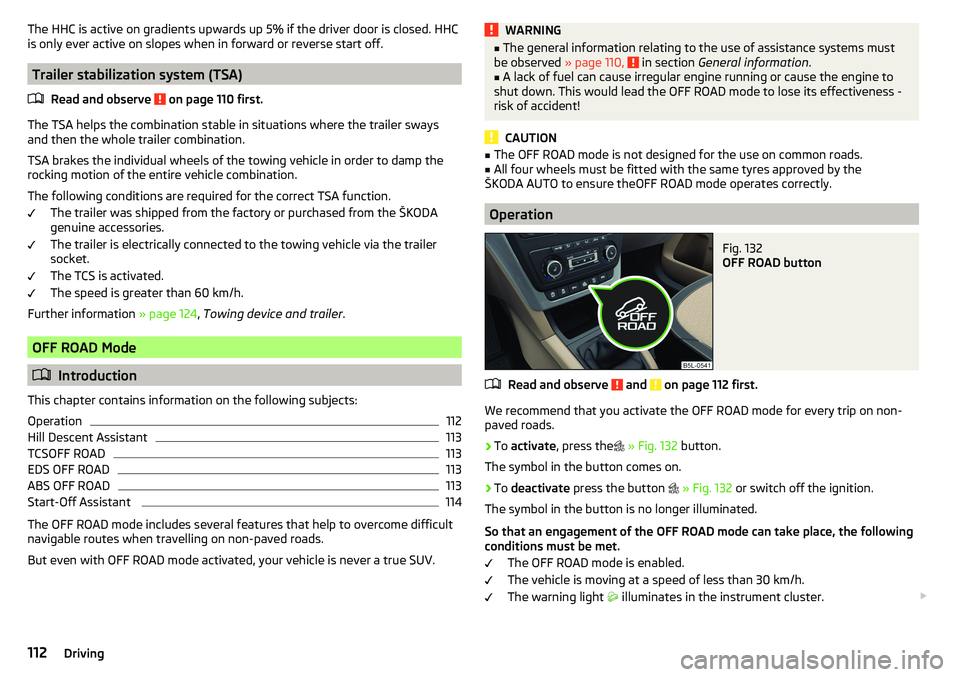
Fig. 132
OFF ROAD button
Read and observe and on page 112 first.
We recommend that you activate the OFF ROAD mode for every trip on non- paved roads.
›
To activate , press the
» Fig. 132 button.
The symbol in the button comes on.
›
To deactivate press the button
» Fig. 132 or switch off the ignition.
The symbol in the button is no longer illuminated.
So that an engagement of the OFF ROAD mode can take place, the following conditions must be met.
The OFF ROAD mode is enabled.
The vehicle is moving at a speed of less than 30 km/h. The warning light
illuminates in the instrument cluster.
112Driving
Page 117 of 200

Fig. 134
Sampled areas and range of the
sensors
Read and observe and on page 114 first.
The system uses ultrasound waves to calculate the distance between the
bumper and an obstacle. The ultrasonic sensors are, depending on vehicle
equipment, located in the back or in the front bumper » Fig. 133.
Depending on the equipment, the following system variants are possible
» Fig. 134 .
▶ Variant 1: warns of obstacles in the areas
C
,
D
.
▶ Variant 2: warns of obstacles in the areas
A
,
B
,
C
,
D
.
▶ Variant 3: warns of obstacles in the areas
A
,
B
,
C
,
D
,
E
.
Approximate range of sensors (in cm)
Area » Fig. 134Variant 1
(4 sensors)Variant 2
(8 sensors)Variant 3
(12 sensors)A-120120B-6060C160160160D606060E--60
Audible signals
The interval between the acoustic signals becomes shorter as the clearance is
reduced. At a distance of approx. 30 cm, a continuous tone starts to sound -
danger zone. From this moment do not continue to move towards the obsta-
cle!
Towing a trailer
When towing, or when another accessory is connected to the trailer socket on-
ly the areas
A
and
B
» Fig. 134 are active in the system.
Note■
If with Version 3 vehicles not all fields around the vehicle are active after ac-
tivation the vehicle should be moved forwards or backwards.■
The signal tones for front obstacle recognition are factory-set to be higher
than for rear obstacle recognition.
■
The sound of the park-assist can be adjusted via the MAXI DOT display in the
Assistants
menu option » page 43.
Display in the Infotainment display
Fig. 135
Display
Read and observe and on page 114 first.
Functional interfaces and obstacle warning » Fig. 135
Change to rear-view camera display .
Switching off park assistant display. Switching audible parking signals on/off.
Message:
Look! Safe to move?
An area without detected obstacles is shown as a transparent segment.
An obstacle which is currently outside of the collision area is shown by the
yellow segment.
An obstacle in the collision zone is shown as an orange-coloured segment.
Stop moving in the direction of the obstacle!
ABC115Assist systems
Page 126 of 200

Towing device and trailer
Hitch
Introduction
This chapter contains information on the following subjects:
Description
124
Setting the ready position
125
Check the setting of the standby position
125
Assemble the ball rod
125
Check proper mounting
126
Removing ball rod - Step 1
126
Removing ball rod - Step 2
127
Vertical load with mounted accessories
127
The maximum trailer nose weight when towing a trailer is 80 kg, for vehicles
with four-wheel drive and the 2.0 l / 103 kW TDI CR or 2.0 l / 110 kW TDI CR
engine, it is 85 kg. Other information (e.g. on the nameplate of the trailer de-
vice) provide only about the test values of the device information.
WARNING■ Check that the tow bar is seated correctly and is secured in the mounting
recess before the start of every journey.■
When the ball rod is not used and properly secured in the receiving shaft,
this could be damaged or incomplete and must not be used -There is a risk
of an accident.
■
Do not modify or adapt the towing device in any way.
■
Keep the mounting recess of the towing equipment clean at all times.
Such dirt prevents the ball head from being attached securely.
DescriptionFig. 143
Carrier for the towing device/tow bar
Read and observe
on page 124 first.
The ball rod is detachable and is located in the stowage compartment for the
spare / emergency wheel.
Support for the towing device and tow bar » Fig. 143
13-pin power socket
Mounting recess
Safety eyelet
Cover for the mounting recess
Dust cap
Locking ball
Green marking on the handwheel
Handwheel
Key
Lock cap
Red marking on the handwheel
Green box on the tow bar
Tow ball
12345678910111213124Driving
Page 127 of 200

Setting the ready positionFig. 144
Lock unlock / pull out hand wheel and turn
Read and observe
on page 124 first.
The tow bar must be set to the ready position prior to installation » page 125,
Check the setting of the standby position .
›
Grip the tow bar below the protective cap.
›
Remove the cap from the lock.
›
Insert the key into the hand wheel lock.
›
Turn the key
A
in direction of the arrow
1
to the stop » Fig. 144.
›
Pull the handwheel
B
in the direction of the arrow
2
and drag in the direc-
tion of the arrow
3
to the stop. The hand wheel
B
remains locked in this
position.
Check the setting of the standby position
Fig. 145
Ready position
Read and observe on page 124 first.
Correctly adjusted standby position » Fig. 145
The locking balls
A
can be pushed fully into the tow bar.
The red marking
B
on the hand wheel is located in the green box on the
tow bar.
The key
C
is in the unlocked position and cannot be removed.
There is a clear gap of approx. 5 mm
D
between the hand wheel and the
tow bar.
When in the ready position, the key cannot be removed from the lock. The ball
bar is thus set ready for installation.
Assemble the ball rod
Fig. 146
Removing the cap on the rear bumper/inserting the tow bar
125Towing device and trailer
Page 129 of 200

›Remover the cover A from the handwheel lock in the direction of the arrow1
» Fig. 149 .›
Insert the key into the handwheel lock.
›
Turn the key
B
2
in the direction of the arrow as far as the stop.
Removing ball rod - Step 2
Fig. 150
Removing the two bar/placing the cover on the rear bumper
Read and observe
on page 124 first.
Removing
›
Grip the tow bar from below and with the other hand pull the handwheel
C
in the direction of the arrow
3
» Fig. 150 .
›
Turn the handwheel in the direction of the arrow
4
to the stop , and hold in
this position.
›
Remove the tow bar from the mounting recess downwards and in the direc-
tion of the arrow
5
. At the same time, the ball rod latches into the ready po-
sition and is therefore ready to be re-fitted.
After removing the ball rod
›
Attach the cover for the mounting recess
4
» Fig. 143 on page 124 .
›
Grip the cover on the rear bumper
E
» Fig. 150 at the handle
D
and position
in the direction of the arrow
6
on the checkmark underneath the upper
edge of the bumper.
›
Push this cover onto the lower edge and onto the two sides in the direction
of the arrow
7
.
If the hand wheel
C
is not turned all the way to the stop, then it will return to
its initial position when the tow bar is removed and will rest on the tow bar
and not engage into the ready position. The ball head then needs to be
brought into this position before the next time it is fitted » page 125.
The ball rod must be cleaned before storing in the box with the vehicle tool
always.WARNINGNever allow the tow bar to remain unsecured in the boot. This could cause
damage to the boot upon sudden braking, and could put the safety of the
occupants at risk!
Vertical load with mounted accessories
Fig. 151
Representation of the maximum
length of the mounted accesso-
ries and the permissible total
weight of the accessory depend-
ing on the load centre of gravity
Read and observe on page 124 first.
When using the accessories (e.g. bicycle carrier), the maximum length and the
permissible total weight including load must be considered.
The maximum length of the mounted accessories (from the ball of the towing
device) is 70 cm » Fig. 151 .
The total permitted weight of the accessories including load changes with in-
creasing distance of the load centre of gravity from the ball head of the towing
device.
Distance of the centre of gravity of the load from the ball headPermissible total weight of the ac- cessories, including load0 cm75 kg30 cm75 kg60 cm35 kg70 cm0 kg
CAUTION
Never exceed the permissible total weight of the accessories incl. load and
maximum length of the accessories - risk of damage to the towing device. 127Towing device and trailer
Page 130 of 200
NoteWe recommend that you use accessories from ŠKODA Original Accessories.
Using the towing device
Trailer (accessory) connect and disconnect
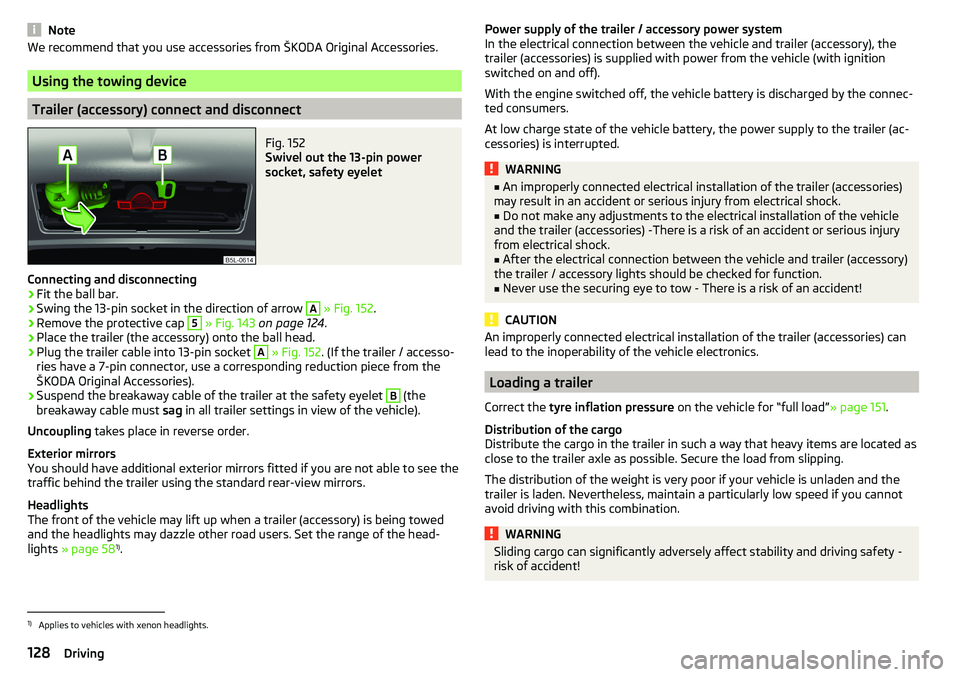
Fig. 152
Swivel out the 13-pin power
socket, safety eyelet
Connecting and disconnecting
›
Fit the ball bar.
›
Swing the 13-pin socket in the direction of arrow
A
» Fig. 152 .
›
Remove the protective cap
5
» Fig. 143 on page 124 .
›
Place the trailer (the accessory) onto the ball head.
›
Plug the trailer cable into 13-pin socket
A
» Fig. 152 . (If the trailer / accesso-
ries have a 7-pin connector, use a corresponding reduction piece from the
ŠKODA Original Accessories).
›
Suspend the breakaway cable of the trailer at the safety eyelet
B
(the
breakaway cable must sag in all trailer settings in view of the vehicle).
Uncoupling takes place in reverse order.
Exterior mirrors
You should have additional exterior mirrors fitted if you are not able to see the
traffic behind the trailer using the standard rear-view mirrors.
Headlights
The front of the vehicle may lift up when a trailer (accessory) is being towed
and the headlights may dazzle other road users. Set the range of the head-
lights » page 58 1)
.
Power supply of the trailer / accessory power system
In the electrical connection between the vehicle and trailer (accessory), the
trailer (accessories) is supplied with power from the vehicle (with ignition
switched on and off).
With the engine switched off, the vehicle battery is discharged by the connec-
ted consumers.
At low charge state of the vehicle battery, the power supply to the trailer (ac-
cessories) is interrupted.WARNING■ An improperly connected electrical installation of the trailer (accessories)
may result in an accident or serious injury from electrical shock.■
Do not make any adjustments to the electrical installation of the vehicle
and the trailer (accessories) -There is a risk of an accident or serious injury
from electrical shock.
■
After the electrical connection between the vehicle and trailer (accessory)
the trailer / accessory lights should be checked for function.
■
Never use the securing eye to tow - There is a risk of an accident!
CAUTION
An improperly connected electrical installation of the trailer (accessories) can
lead to the inoperability of the vehicle electronics.
Loading a trailer
Correct the tyre inflation pressure on the vehicle for “full load” » page 151.
Distribution of the cargo
Distribute the cargo in the trailer in such a way that heavy items are located as
close to the trailer axle as possible. Secure the load from slipping.
The distribution of the weight is very poor if your vehicle is unladen and the
trailer is laden. Nevertheless, maintain a particularly low speed if you cannot
avoid driving with this combination.
WARNINGSliding cargo can significantly adversely affect stability and driving safety -
risk of accident!1)
Applies to vehicles with xenon headlights.
128Driving
Page 131 of 200
TrailerThe permissible trailer load must not be exceeded under any circumstances.Permissible trailer loadEngineTransmissionPermissible trailer load, braked (kg)Permissible trailer load, unbraked (kg)Gradients of up to 12%Gradients of up to 8%a)1.2 ltr./81 kW TSIMG12001500670DSG120015006801.4 ltr./92 kW TSIMG13001600670DSG130016006901.4 ltr./110 kW TSIMG 4x418001800730DSG 4x4180018007401.6 l./81 kW MPIMG-b)-b)- b)AG110011006501.8 ltr./112 kW TSIDSG 4x4180018007502.0 ltr./81 kW TDI
CRMG (EU4, EU5)15001500700MG (EU6)15001500720MG 4x4180018007502.0 ltr./103 kW TDI
CRMG 4x42100/2000 c)2100/2000c)750DSG 4x42100/2000c)2100/2000 c)7502.0 ltr./110 kW TDI
CRMG18001800740MG 4x42100/2000 c)2100/2000 c)750DSG 4x42100/2000c)2100/2000 c)750a)
Only valid for some countries.
b)
The vehicle is not equipped with a towing device.
c)
Applies to vehicles of category AF.
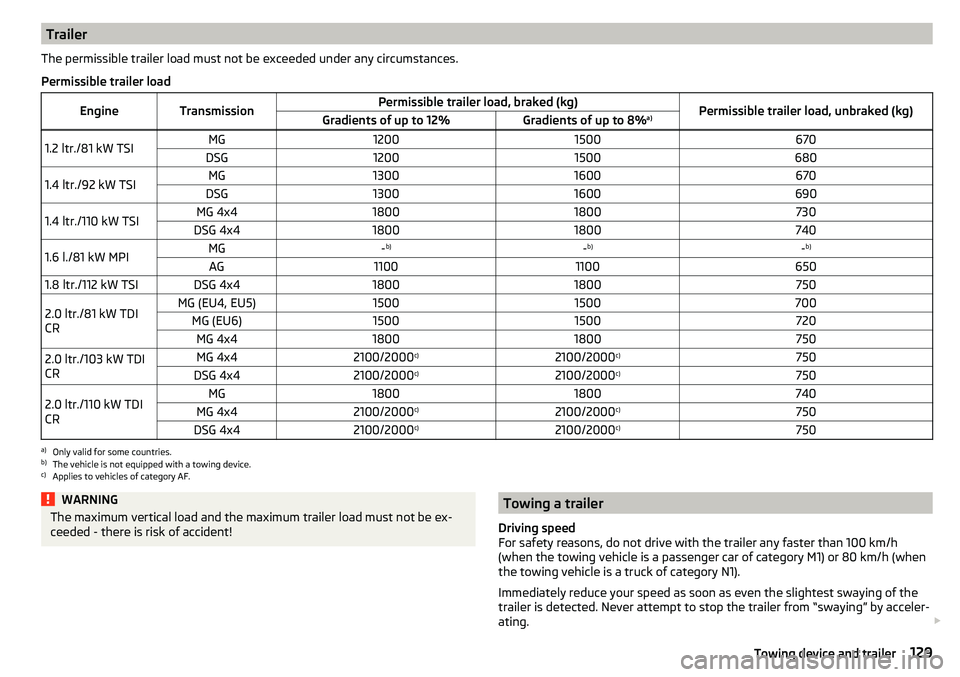
WARNINGThe maximum vertical load and the maximum trailer load must not be ex-
ceeded - there is risk of accident!Towing a trailer
Driving speed
For safety reasons, do not drive with the trailer any faster than 100 km/h
(when the towing vehicle is a passenger car of category M1) or 80 km/h (when
the towing vehicle is a truck of category N1).
Immediately reduce your speed as soon as even the slightest swaying of the
trailer is detected. Never attempt to stop the trailer from “swaying” by acceler-
ating. 129Towing device and trailer
Page 132 of 200

Brakes
Apply the brakes in good time! If the trailer is fitted with a trailer brake, apply
the brakes gently at first, then brake firmly. This will avoid brake jolts resulting
from the trailer wheels locking.
On downhill sections shift down a gear in good time to also use the engine as
a brake.WARNINGAlways drive particularly carefully with the trailer.
CAUTION
With frequent towing, the vehicle is excessively loaded so this must also be
checked between service intervals.
Anti-theft alarm system
The alarm is triggered if, with a vehicle with activated anti-theft alarm (here-
after only warning system), the electrical connection to the trailer (accessory)
is interrupted.
Always switch off the anti-theft alarm system before a trailer (accessory) is
coupled or uncoupled » page 51.
Conditions for including a trailer (accessory) in the anti-theft alarm system. The vehicle is factory-fitted with an anti-theft alarm system and a towing
device.
The trailer (accessory) is electrically connected to the towing vehicle by
means of the trailer socket.
The electrical system of the vehicle and trailer (accessory) is functional.
The vehicle is locked and the anti-theft alarm system is activated.
The trailer (accessory) is not equipped with LED taillights.
130Driving
Page 139 of 200
The towing device is maintenance-free. Coat the ball head of the towing de-
vice with a suitable grease whenever necessary.
Protection of cavities
All the cavities of your vehicle which are at risk from corrosion are protected by
a layer of long-lasting protective wax applied in the factory.
If any small amount of wax flow out of the cavities at high temperatures, these
must be removed with a plastic scraper and the stains cleaned using a petrole-
um cleaner.
Underbody
The underside of your vehicle is already permanently protected by the factory
against chemical and mechanical influences.
We recommend having the protective coating checked — preferably before the
beginning of winter and at the end of winter.
Product life of the films
Environmental influences (e.g. sunlight, humidity, air pollution, rockfall) affect
the life of the films. Films will age and become brittle – this is entirely normal;
this is not a fault.
Sunlight may also affect the strength of the film colour.
When transporting a load on the roof rack (e.g. roof box or similar), there is an
increased risk of film damage (e.g. of chipping from the secured load).
CAUTION
■ Vehicle paint
■ Repair damaged areas as soon as possible.
■ Matt-painted parts should not be treated with polishes or hard waxes.
■ Do not polish in a dusty environment - risk of paint scratches.
■ Do not apply any paint care products to door seals or window guides.■
Plastic parts
■ Do not use paint polish.
■
Chromed and anodised parts
■ Do not polish in a dusty environment - There is a risk of surface scratches.
■
Films
The following instructions must be observed, otherwise there is a risk of film
damage. ■ Do not use dirty cloths or sponges for cleaning.
■ Do not use a scraper or other means to remove ice and snow.
■ Do not polish the films.
■ Do not use a high pressure cleaner on the films.
■
Rubber seals
■ Do not treat the door seals and window guides deal with anything - the
protective varnish coating could be damaged.■
Windows and door mirrors ■ Do not clean the insides of the windows/mirrors with sharp objects - risk of
damage to the filaments or the antenna. ■ Do not use a cloth which has been used to polish the body - this could dirty
the window and impair visibility.
■
Head / taillights
■ Do not wipe head/taillights dry, do not use any sharp objects - There is a
risk of damage to the protective coating and of cracks forming on the head-
light glass covers.
■
Reversing camera
The following instructions must be observed, otherwise there is a risk of camera damage. ■ Do not remove snow / ice with warm / hot water.
■ To wash, never use a pressure washer or steam jet.
■ For cleaning, do not use abrasive cleaners.
■
Door lock cylinders
■ Make sure that as little water as possible gets into the locking cylinder
when washing the vehicle - there is a risk of freezing the lock cylinder!
■
Wheels ■ Heavy soiling of the wheels can affect the balance of the wheels - the re-
sult can be a vibration, which can cause premature wear of the steering.
137Care and maintenance
Page 157 of 200
WARNINGAlways properly secure the fire extinguisher - there is a risk of injury in the
event of sudden braking or a vehicle collision.
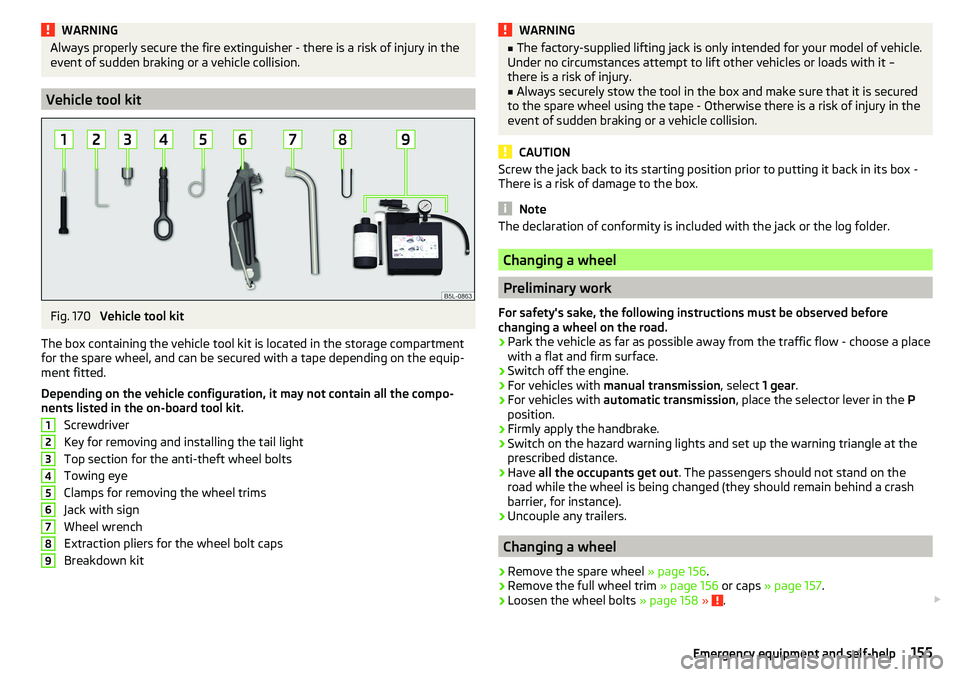
Vehicle tool kit
Fig. 170
Vehicle tool kit
The box containing the vehicle tool kit is located in the storage compartment
for the spare wheel, and can be secured with a tape depending on the equip-
ment fitted.
Depending on the vehicle configuration, it may not contain all the compo-
nents listed in the on-board tool kit.
Screwdriver
Key for removing and installing the tail light
Top section for the anti-theft wheel bolts
Towing eye
Clamps for removing the wheel trims
Jack with sign
Wheel wrench
Extraction pliers for the wheel bolt caps
Breakdown kit
123456789WARNING■ The factory-supplied lifting jack is only intended for your model of vehicle.
Under no circumstances attempt to lift other vehicles or loads with it –
there is a risk of injury.■
Always securely stow the tool in the box and make sure that it is secured
to the spare wheel using the tape - Otherwise there is a risk of injury in the
event of sudden braking or a vehicle collision.
CAUTION
Screw the jack back to its starting position prior to putting it back in its box -
There is a risk of damage to the box.
Note
The declaration of conformity is included with the jack or the log folder.
Changing a wheel
Preliminary work
For safety's sake, the following instructions must be observed before
changing a wheel on the road.
›
Park the vehicle as far as possible away from the traffic flow - choose a place
with a flat and firm surface.
›
Switch off the engine.
›
For vehicles with manual transmission , select 1 gear.
›
For vehicles with automatic transmission , place the selector lever in the P
position.
›
Firmly apply the handbrake.
›
Switch on the hazard warning lights and set up the warning triangle at the
prescribed distance.
›
Have all the occupants get out . The passengers should not stand on the
road while the wheel is being changed (they should remain behind a crash
barrier, for instance).
›
Uncouple any trailers.
Changing a wheel
›
Remove the spare wheel » page 156.
›
Remove the full wheel trim » page 156 or caps » page 157 .
›
Loosen the wheel bolts » page 158 » .
155Emergency equipment and self-help