towing SKODA YETI 2017 Owner´s Manual
[x] Cancel search | Manufacturer: SKODA, Model Year: 2017, Model line: YETI, Model: SKODA YETI 2017Pages: 200, PDF Size: 28.93 MB
Page 158 of 200
›Jack up the vehicle
» page 158 until the wheel that needs changing is clear of
the ground.›
Unscrew the wheel bolts and place them on a clean surface (cloth, paper,
etc.).
›
Remove the wheel carefully.
›
Attach the spare wheel and slightly screw on the wheel bolts.
›
Lower the vehicle.
›
Tighten the wheel bolts opposite each other using the wheel wrench (“pull- ing crossways”) » page 158.
›
Replace the wheel trim » page 156 and caps » page 157 .
When fitting unidirectional tyres, ensure that the direction of rotation is cor-
rect » page 150 .
All bolts must be clean and must turn easily. If screws are corroded and diffi-
cult to move, these must be replaced.
WARNING■ Undo the wheel bolts just a little (about one turn), provided the vehicle
has not yet been jacked up. Otherwise the wheel could come loose and fall
off – risk of injury.■
Under no circumstances must the bolts be greased or oiled - cause an ac-
cident.
Subsequent steps
After changing the wheel, the following work must be carried out.
›
Stow the replaced wheel in the well under the floor covering of the luggage
compartment and secure with a locking screw.
›
Stow the vehicle tool kit in the space provided.
›
Check tyre pressure on the mounted wheel and adjust if necessary and, with
vehicles with tyre pressure monitoring, save the tyre pressure values in the
system » page 123 .
›
Have the tightening torque of the wheel bolts checked as soon as possible.
The prescribed tightening torque is 120 Nm.
Replace the damaged wheel or consult a specialist garage about repair op-
tions.
WARNINGTightening torque which is too high can damage the threads and this can
result in permanent deformation of the contact surfaces on the rim. Where
tightening torque is too low, the wheels may become loose while driving -
There is a risk of an accident. Therefore drive cautiously and only at a mod-
erate speed until the tightening torque has been checked.
Removing /stowing the spare wheel
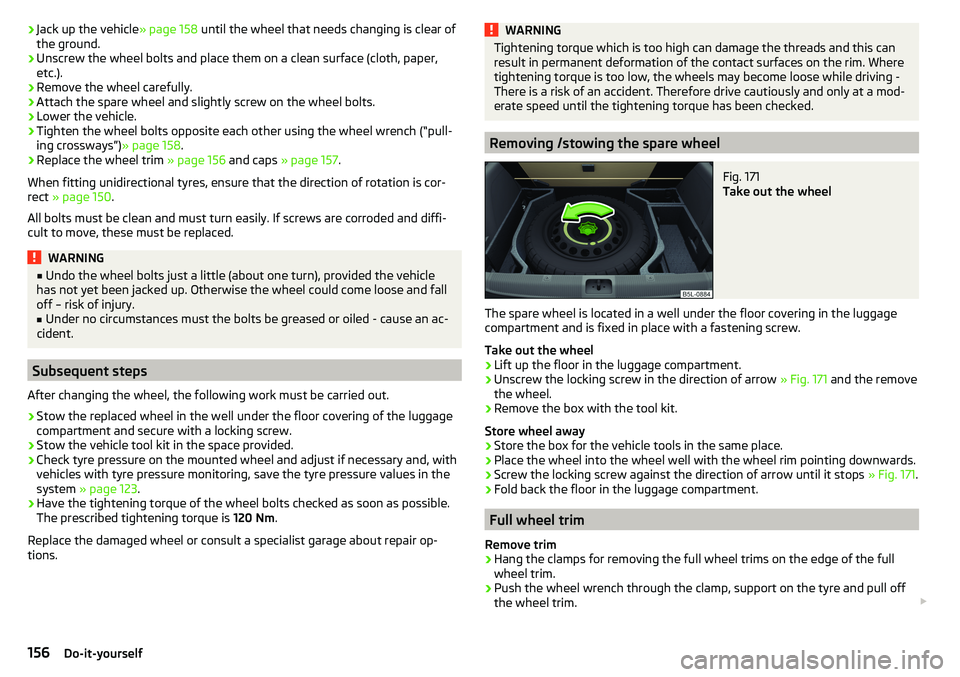
Fig. 171
Take out the wheel
The spare wheel is located in a well under the floor covering in the luggage
compartment and is fixed in place with a fastening screw.
Take out the wheel
›
Lift up the floor in the luggage compartment.
›
Unscrew the locking screw in the direction of arrow » Fig. 171 and the remove
the wheel.
›
Remove the box with the tool kit.
Store wheel away
›
Store the box for the vehicle tools in the same place.
›
Place the wheel into the wheel well with the wheel rim pointing downwards.
›
Screw the locking screw against the direction of arrow until it stops » Fig. 171.
›
Fold back the floor in the luggage compartment.
Full wheel trim
Remove trim
›
Hang the clamps for removing the full wheel trims on the edge of the full
wheel trim.
›
Push the wheel wrench through the clamp, support on the tyre and pull off
the wheel trim.
156Do-it-yourself
Page 164 of 200

WARNING■Never clamp the jump cable to the negative terminal of the discharged
battery -There is a risk of an explosion.■
The non-insulated parts of the terminal clamps must never touch each
other – risk of short circuit!
■
The jump-start cable connected to the positive terminal of the battery
must not come into contact with electrically conducting parts of the vehicle
– risk of short circuit!
■
Position the jump cables so that they cannot be caught in rotating parts
in the engine compartment - danger of injuries and the risk of vehicle dam-
age.
Towing the vehicle
Information about the towing process
Fig. 179
Braided tow rope / Spiral tow rope
To tow with a tow rope, only use a braided synthetic fibre rope » Fig. 179 -
»
.
Attach the tow rope or the tow bar to the towing eyes at the front
» page 163 , towing eyes at the rear » page 163 or to the towing device of
the trailer device » page 124 .
Conditions for towing. Cars with automatic gearboxes must not be towed with the rear wheels
raised - there is a risk of gearbox damage!
If the gearbox has no oil, your vehicle must be towed with the front axle
raised clear of the ground or on a breakdown vehicle or trailer.
The maximum towing speed is 50 km/h.
The vehicle must be transported on a special breakdown vehicle or trailer
if it is not possible to tow in the vehicle in the way described or if the tow-
ing distance is greater than 50 km.
Driver of the tow vehicle›
On vehicles with manual transmission , engage gear slowly when starting.
›
On vehicles with automatic transmission , accelerate with particular care.
›
Only then approach correctly when the rope is taut.
Driver of the towed vehicle
›
If possible, the vehicle should be towed with the engine running. The brake
booster and power steering only operate if the engine is running, otherwise
much greater force has to be applied to the brake pedal and more power has
to be expended for steering.
›
If it is not possible to start the engine, switch on the ignition so that the
steering wheel does not lock and so that the turn signal lights, windscreen
wipers and windscreen washer system can be used.
›
Take the vehicle out of gear or move the selector lever into position N if the
vehicle is fitted with an automatic gearbox.
›
Keep the tow rope taut at all times during the towing procedure.
WARNING■ Spiral tow ropes must not be used for towing » Fig. 179- , the towing
eye may unscrew out of the vehicle - There is a risk of an accident.■
Ensure tow rope is not twisted - risk of accident.
CAUTION
■ Do not tow-start the engine – There is a risk of damaging the engine. The
battery from another vehicle can be used as a jump-start aid » page 161, Jump-
starting .■
For off-road towing manoeuvres, there is a risk to both vehicles that the fas-
teners may become overloaded and damaged.
Note
We recommend that you use a tow rope from ŠKODA Original Accessories.162Do-it-yourself
Page 165 of 200
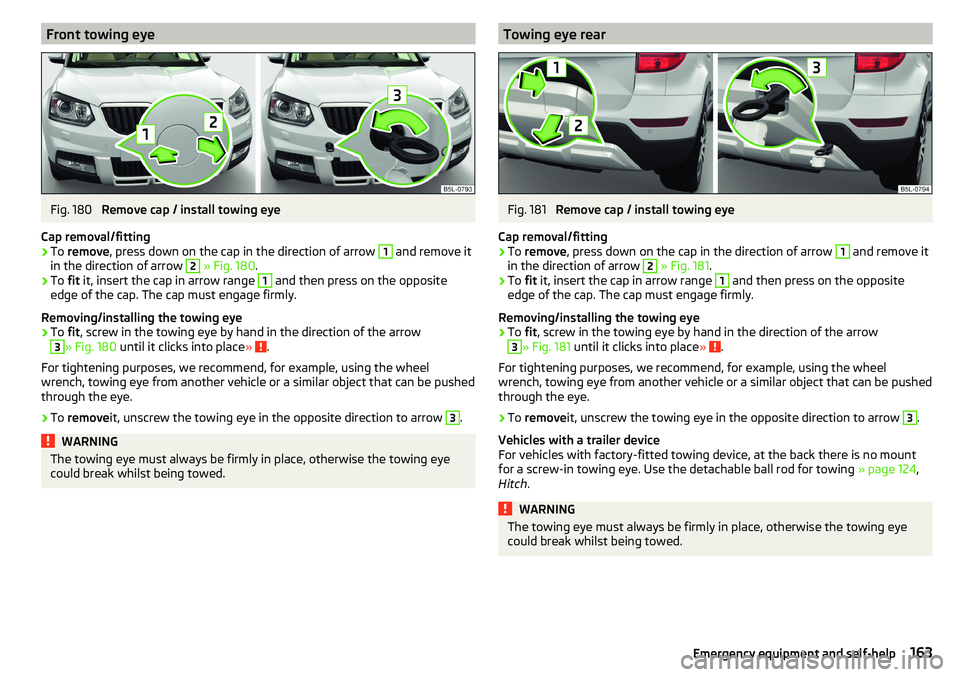
Front towing eyeFig. 180
Remove cap / install towing eye
Cap removal/fitting
›
To remove , press down on the cap in the direction of arrow
1
and remove it
in the direction of arrow
2
» Fig. 180 .
›
To fit it, insert the cap in arrow range
1
and then press on the opposite
edge of the cap. The cap must engage firmly.
Removing/installing the towing eye
›
To fit, screw in the towing eye by hand in the direction of the arrow
3
» Fig. 180 until it clicks into place » .
For tightening purposes, we recommend, for example, using the wheel
wrench, towing eye from another vehicle or a similar object that can be pushed through the eye.
›
To remove it, unscrew the towing eye in the opposite direction to arrow
3
.
WARNINGThe towing eye must always be firmly in place, otherwise the towing eye
could break whilst being towed.Towing eye rearFig. 181
Remove cap / install towing eye
Cap removal/fitting
›
To remove , press down on the cap in the direction of arrow
1
and remove it
in the direction of arrow
2
» Fig. 181 .
›
To fit it, insert the cap in arrow range
1
and then press on the opposite
edge of the cap. The cap must engage firmly.
Removing/installing the towing eye
›
To fit, screw in the towing eye by hand in the direction of the arrow
3
» Fig. 181 until it clicks into place » .
For tightening purposes, we recommend, for example, using the wheel
wrench, towing eye from another vehicle or a similar object that can be pushed
through the eye.
›
To remove it, unscrew the towing eye in the opposite direction to arrow
3
.
Vehicles with a trailer device
For vehicles with factory-fitted towing device, at the back there is no mount
for a screw-in towing eye. Use the detachable ball rod for towing » page 124,
Hitch .
WARNINGThe towing eye must always be firmly in place, otherwise the towing eye
could break whilst being towed.163Emergency equipment and self-help
Page 170 of 200

Fuses in the dashboardFig. 193
Distribution board cover.
Read and observe and on page 167 first.
The fuses are located on the left side of the dash panel behind a cover.
Replacing fuses
›
Remove the ignition key, turn off the lights and all electrical consumers.
›
Insert a screwdriver into the opening in the cover in the direction of the ar-
row » Fig. 193 .
›
Remove the cover of the fuse box and remove.
›
Remove the plastic clip from the holder in the fuse box cover in the dash
panel.
›
Use the clip to pull the fuse out, then insert a new fuse.
›
Re-insert the cover of the fuse box .
›
Replace the bracket at the original position.
Fuse arrangement in the dashboard
Fig. 194
Fuses
Read and observe and on page 167 first.No.Consumer1Heating of the gearbox vent (diesel engine)
Automatic gearbox2Towing hitch - left light3Trailer device - electrical outlet4Instrument cluster control lever under the steering wheel, camera5Air blower for heating, radiator fan, air conditioning system, Clima-
tronic6Rear window wiper7emergency call8Towing hitch - right light9Interior lighting, rear fog light10Rain sensor, light switch, diagnostic socket11Left side front headlight12Right side front headlight13Radio14Central control system, engine management system15Light switch16All-wheel drive17KESSY, steering lock18Diagnostic connector, engine control system, brake sensor, four-
wheel drive, START-STOP19ABS, ESP, switch for tyre air pressure control, parking aid, switch for
OFF ROAD mode, START STOP button20Airbag21Variable Service Interval - WIV, reversing lamps, dimmable mirrors,
pressure sensor, telephone preparation, air mass meter, headlamp
levelling and swivelling headlights22Instrument cluster, electromechanical power steering, databus23Central locking, boot lid24Electric windows - Rear25Rear window heater, auxiliary heating and ventilation26Power socket in the boot 168Do-it-yourself
Page 177 of 200

Technical data
Technical data
Basic vehicle data
Introduction
This chapter contains information on the following subjects:
Vehicle data
175
Operating weight
176
Payload
176
Measurement of fuel consumption and CO 2 emissions according to ECE
Regulations and EU Directives
177
Dimensions
178
Angle and gradeability
179
The details given in the vehicle's technical documentation always take prece-
dence over the details in the Owner's Manual.
The performance values listed were determined without performance-reduc- ing equipment, e.g. air conditioning system.
The values given have been determined in accordance with regulations and in
conditions prescribed by legal or technical provisions for determining the oper-
ating and technical data of vehicles.
The values listed are for the basic model without optional equipment.
Vehicle dataFig. 207
Vehicle data sticker/type plate
Vehicle data sticker
The vehicle data sticker » Fig. 207 -
is located on the base of the luggage
compartment and is also stuck into the Owner's Manual.
The vehicle data sticker contains the following data. Vehicle identification number (VIN)
Vehicle type
Gearbox code/paint number/interior equipment/engine output/engine code
Partial vehicle description
Approved tyre diameter in inches 1)
The approved tyres and rim sizes for your vehicle are listed in the vehicle's
technical documentation (the so called COC document) and this also states the
declaration of conformity.
Type plate
The type plate » Fig. 207 -
is located at the bottom of the B-pillar on the
right driver's side.
The type plate contains the following data. Vehicle manufacturers
Vehicle identification number (VIN)
Maximum permissible gross weight
Maximum permissible towed weight (towing vehicle and trailer)
1234567891)
Only valid for some countries.
175Technical data
Page 178 of 200
Maximum permissible front axle load
Maximum permissible rear axle load
Vehicle identification number (VIN)
The vehicle identification number - VIN (vehicle body number) is stamped into
the engine compartment on the right hand suspension strut dome. This num-
ber is also located on a sign on the lower left hand edge below the windscreen
(together with a VIN bar code), and on the type plate.
Engine number
The engine number (three-digit identifier and serial number) is stamped on the
engine block.
Supplementary Information (applies to Russia)
The full type approval number of the means of transport is indicated in the
registration documents, field 17.
Maximum permissible trailer weight
The listed maximum permissible trailer weight is only valid for altitudes up to 1000 m above sea level.
The engine output falls as altitude increases, as does the vehicle's climbing
power. Therefore, for every additional 1000 m in height (or part), the maximum
permissible towed weight must be reduced by 10%.
The towed weight is made up of the actual weights of the loaded towing vehi-
cle and the loaded trailer.WARNINGDo not exceed the specified maximum permissible weights – risk of acci-
dent and damage!
Operating weight
This value is only a guide value and corresponds to the lowest possible operat-
ing weight without further weight-reducing equipment (e.g. air conditioning,
spare wheel etc.). It also includes a weight allowance for the driver (75 kg), the
weight of the operating fluids, the tool kit and a fuel tank filled to 90 % ca-
pacity.
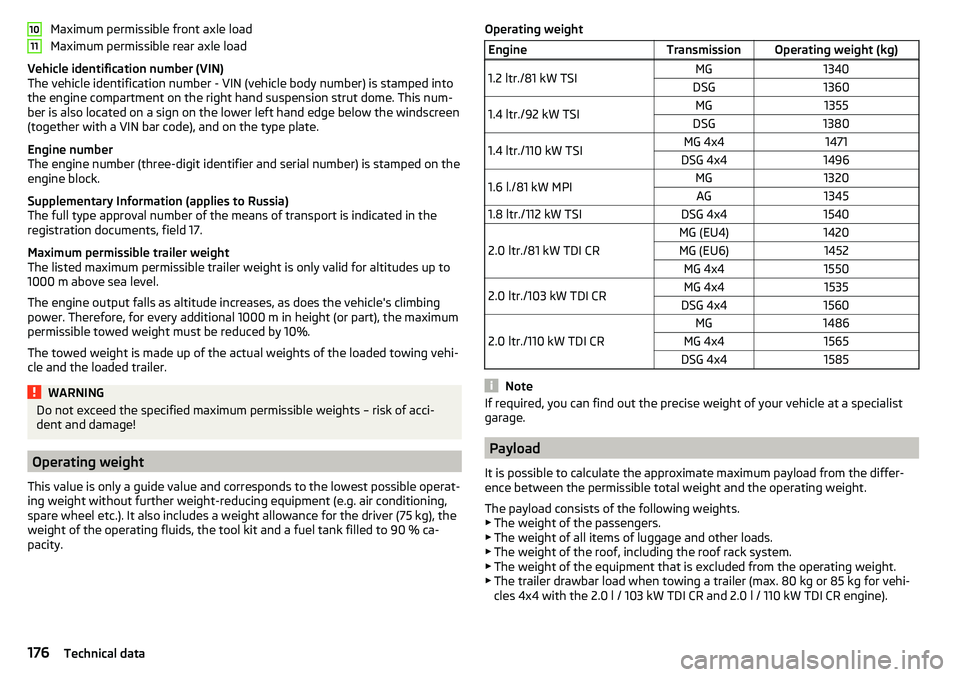
1011Operating weightEngineTransmissionOperating weight (kg)1.2 ltr./81 kW TSIMG1340DSG13601.4 ltr./92 kW TSIMG1355DSG13801.4 ltr./110 kW TSIMG 4x41471DSG 4x414961.6 l./81 kW MPIMG1320AG13451.8 ltr./112 kW TSIDSG 4x41540
2.0 ltr./81 kW TDI CR
MG (EU4)1420MG (EU6)1452MG 4x415502.0 ltr./103 kW TDI CRMG 4x41535DSG 4x41560
2.0 ltr./110 kW TDI CR
MG1486MG 4x41565DSG 4x41585
Note
If required, you can find out the precise weight of your vehicle at a specialist
garage.
Payload
It is possible to calculate the approximate maximum payload from the differ-
ence between the permissible total weight and the operating weight.
The payload consists of the following weights.
▶ The weight of the passengers.
▶ The weight of all items of luggage and other loads.
▶ The weight of the roof, including the roof rack system.
▶ The weight of the equipment that is excluded from the operating weight.
▶ The trailer drawbar load when towing a trailer (max. 80 kg or 85 kg for vehi-
cles 4x4 with the 2.0 l / 103 kW TDI CR and 2.0 l / 110 kW TDI CR engine).
176Technical data
Page 188 of 200
DoorChild safety lock51
Emergency locking165
Emergency locking of the driver's door165
Opening/Closing50
warning light door open32
Door alarm38
Door open warning light
32
Drive Driving through water
109
Driver Steering Recommendation (DSR)111
Driving Emissions
177
Fuel consumption177
through water109
Top speed181
DSR111
E
Economical driving
108
EDL111
Electrical power windows55
Button in the rear doors54
Electric power windows53
Electric window Buttons in the driver´s door
54
Electric windows Operational faults
55
Electronic Differential Lock (EDL)111
Electronic immobiliser100
Emergency Hazard warning light system
61
Jump-starting161
Selector lever-unlocking166
Starting / stopping the engine with the push of a button
101
Starting the engine / stopping with the push of a button
102
Towing the vehicle162
Towing the vehicle using the trailer device163
Tyre repair159
Unlocking/locking the door165
Unlocking / locking the door165
Emergency equipment Fire extinguisher
154
First aid kit154
Jack155
Reflective vest154
Vehicle tool kit155
Warning triangle154
Emission control system35
Emissions177
Engine Running in
108
Engine compartment142
Brake fluid147
Coolant146
Engine oil144
Overview144
Vehicle battery147
Windscreen washer fluid144
Engine drag torque control (MSR)110
Engine number175
engine oil specification
145
Engine oil144
Check145
Oil changing144
Refilling145
Warning light33
EPC35
ESC Operation
110
Warning light34
Extended warranty5
Exterior temperature41
F
Fastening elements
87
Fatigue detection122
Films136
Fire extinguisher154
First aid kit154
Flashing59
Flexible storage compartment88
Floor covering in the luggage compartment88
Fog lights Warning light
37
Fog lights/rear fog light60
Fog lights with the CORNER function61
folding table on the rear seat backrest
84
Folding table on the front seat backrest
83
Footmats106
see footmats106
Force limiter Sliding/tilting roof
56
Window55
Front seats68
Fuel139
Diesel140
Fuel gauge29
refer to Fuel139
Refuelling139
Unleaded petrol140
Warning light36
Fuel consumption177
Fuel filter information messages
30
Fuel reserve36
Fuses167
in the dashboard168
in the engine compartment169
186Index
Page 189 of 200
G
Gear change Gear recommendation
39
Information on the selected gear39
Gear changing Gear stick
105
Genuine parts132
Glasses compartment81
GPS See Owner's Manual Infotainment
6
gradeability179
H
Handbrake
104
Warning light32
Hazard warning light system61
HBA111
Headrests73
Heating93
Air distribution control96
Controls94
Mirrors67
Seats74
Windscreen and rear window63
Help in an emergency8
HHC111
Hill Start Assist (HHC)111
Hitch124
Horn27
I
Ignition lock
101
Images See Owner's Manual Infotainment
6
Immobiliser100
In an emergency Changing a wheel
155
incline179
Inertia reel15
Information about the towing process162
Information system38
Door alarm38
Gear recommendation39
MAXI DOT display42
Multifunction display41
Service interval display44
Infotainment6
Instrument cluster28
Auto Check Control30
Display of the second speedometer39
see instrument cluster28
Warning lights31
instrument lighting29
interior light62
Interior lighting63
Interior monitor52
iPad holder84
ISOFIX24
J
Jack
155
- fit158
Jump-starting161
K
KESSY Unlocking/locking
49
key Switch on/off ignition
101
Key Changing battery
164
Lock48
Starting / stopping the engine101
Unlock48
L
Lamp failure Warning light
34
Lamps Warning light
34
LEAVING HOME61
lever Turn signal/main beam
59
Lever Cruise control
122
Operation of the information system40
Windscreen wipers65
light Flash
59
instruments29
Light Automatic driving light control
60
COMING HOME / LEAVING HOME61
Driving abroad62
Fog lights/rear fog light60
Fog lights with the CORNER function61
Headlight cleaning system66
Replacing bulbs170
Turn signal/main beam59
Xenon headlight60
lighting Luggage Storage
90
Lighting Interior lighting
62
Lights58
Cockpit62
Daylight running59
Dipped beam58
Hazard warning light system61
Headlight range control58
Parking lights58, 61
Switching on and off58
Warning lights31
Load176
187Index
Page 192 of 200
SeatbeltsInertia reels15
Seat belts Warning light
32
Seat electrical adjustment69
Seats Electrical adjustment
69
Folding front passenger seat70
front68
Front armrest71
Headrests73
Heating74
Manually adjusting68
Memory Function of the electrically adjustable seat
69
Rear71
Setting68
Storing in memory of remote control key70
Seats and head restraint68
Selector lever106
Selector lever control106
Selector lever lock Warning light
37
Service131
Service interval display44
Service intervals133, 134
Service Plan135
Setting Aux. heating (aux. heating and ventilation)
98
Headrests73
Mirror66, 67
Seat belt height14
Seats68
Setting the Clock
39
Shifting Tiptronic
107
Sliding/tilting roof Activating operation of the sunshade
57
Sunshade57
SmartGate Connection via Wi-Fi46
introductory information45
Password/PIN code change47
Setting47
Wi-Fi direct connection46
SmartLink See Owner's Manual Infotainment
6
SMS See Owner's Manual Infotainment
6
Snow chains153
Sockets 12-volt socket in the interior
79
12-volt socket in the luggage compartment79
Sound See Owner's Manual Infotainment
6
Spare wheel152
Removing / stowing156
Speed symbol152
Spoiler132
Stabilisation system110
Stability Control (ESC)110
START-STOP102
Jump-starting161
Manually deactivating/activating the system103
operation102
START-STOP system102
Start engine immobiliser
100
Starter button Lock / unlock the steering lock
100
Problems with the engine start102
Starting / stopping the engine101
Switch on/off ignition101
Starting engine Jump-starting
161
Starting the engine Jump-starting
161
Key101
Starter button101
Steering lock (KESSY system) Warning light33
Steering wheel Buttons
40
Correct posture11
setting11
Stopping See Parking
105
Stopping the engine Key
101
Starter button101
Storage75
Storage box90
Storage compartment Glasses compartment
81
in the front centre console76
in the rear centre console83
on the dash panel76
on the front passenger side82
under the front arm rest81
Storage compartments75
storage net in the front centre console81
Storing seats
69
Stowage compartments in the doors
76
Sunshade of the sliding/tilting roof57
Sun visors64
Switch Car battery
149
Switching the lights on and off58
Switch off Alarm
52
Switch off ignition101
Key101
Switch off TCS Warning light
34
Switch on ignition101
Key101
190Index
Page 193 of 200
T
Table on the front seat backrest
83
on the middle rear seat backrest84
Tablet holder84
TCS Deactivate/activate
111
Function111
Warning light34
Technical data175
Through-loading bag84
Ticket holder75
Tilt / slide sunroof Activate operation
57
Operation56
Time39
Tiptronic107
Tools155
Top speed181
TOP TETHER25
Towing163
Towing a trailer129
Towing away162
Towing device128
Accessories127
Description124
Vertical load124
Towing eye163
Towing protection52
Towing the vehicle162
Traction control (TCS)34, 111
Trailer Connect and disconnect
128
Load129
loading128
Towing a trailer129
Trailer stabilization system (TSA)112
Trailer towing124
Transmission Warning messages30
transport Luggage Storage
86
Transport Roof rack
93
Towing device and trailer124
Transporting children21
Triangle154
TSA112
Turn signal59
Turn signal system Warning light
37
Tyre load capacity152
Tyre pressure151
Warning light36
Tyre pressure monitoring123
Warning light36
Tyre repair159
Tyres150
damage150
Explanation of the label152
new150
Tyre pressure151
Wear indicator151
Tyre size152
U
Umbrella Tray
82
Unlock Individual settings
50
Key48
Unlocking Central locking button
49
In case of emergency165
KESSY49
Remote control48
Unlocking and locking47
Unlock steering lock100
USB77
Used vehicles Acceptance and recycling
133
Useful equipment Clothes hook
82
Cup holders77
Glasses compartment81
Multimedia holder80
Removable through-loading bag84
Useful features 12-volt socket in the interior
79
12-volt socket in the luggage compartment79
Ashtray78
Cigarette lighter78
Reflective vest154
Storage compartment75
Ticket holder75
Using the variable loading floor with a spare wheel
92
V
Variable loading floor
91
Variable loading floor with spare wheel Removable storage box
90
Vehicle battery Automatic shutdown of consumers
147
charging149
Safety instructions147
Vehicle care135
Vehicle cleaning135
Vehicle condition See Auto-Check Control
30
Vehicle data sticker175
Vehicle data sticker and nameplate Vehicle data sticker and nameplate
175
Vehicle dimensions178
Vehicle height178
Vehicle Identification Number (VIN)175
191Index