warning SMART FORTWO 2016 Owners Manual
[x] Cancel search | Manufacturer: SMART, Model Year: 2016, Model line: FORTWO, Model: SMART FORTWO 2016Pages: 214, PDF Size: 4.93 MB
Page 184 of 214
Use a suitable pressure gauge to check the
tire pressure. The outer appearance of a tire
does not permit any reliable conclusion
about the tire pressure. On vehicles equip-
ped with the electronic tire pressure moni-
tor, the tire pressure can be checked in the
on-board computer.
The tire temperature and pressure increase
when the vehicle is in motion. This is
dependent on the driving speed and the load.
Therefore, you should only correct tire pres-
sures when the tires are cold.
The tires are cold:
Rif the vehicle has been parked with the
tires out of direct sunlight for at least
three hours and
Rif the vehicle has not been driven further
than 1 mile (1.6 km)
The tire temperature changes depending on
the outside temperature, the vehicle speed
and the tire load. If the tire temperature
changes by 18 ‡(10 †), the tire pressure
changes by approximately 10 kPa (0.1 bar/
1.5 psi). Take this into account when checking
the pressure of warm tires. Only correct the
tire pressure if it is too low for the current
operating conditions. If you check the tire
pressure when the tires are warm, the result-
ing value will be higher than if the tires were
cold. This is normal. Do not reduce the tire
pressure to the value specified for cold
tires. The tire pressure would otherwise be
too low.
Observe the recommended tire pressures for
cold tires:
Ron the Tire and Loading Information plac-
ard on the B-pillar on the driver's side
Rin the tire pressure table in the fuel filler
flap (Ypage 98).
Underinflated or overinflated tires
GWARNING
Tires with pressure that is too low can
overheat and burst as a consequence. In
addition, they also suffer from excessive
and/or irregular wear, which can severely
impair the braking properties and the
driving characteristics. There is a risk of an accident.
Avoid tire pressures that are too low in all
the tires, including the spare wheel.
Underinflated tires
Underinflated tires may:
Roverheat, leading to tire defects
Radversely affect handling
Rwear excessively and/or unevenly
Rhave an adverse effect on fuel consumption
GWARNING
Tires with excessively high pressure can
burst because they are damaged more easily by road debris, potholes etc. In addition,
they also suffer from irregular wear, which
can severely impair the braking properties
and the driving characteristics. There is a
risk of an accident.
Avoid tire pressures that are too high in all
the tires, including the spare wheel.
Overinflated tires
Overinflated tires may:
Rincrease the braking distance
Radversely affect handling
Rwear excessively and/or unevenly
Rhave an adverse effect on ride comfort
Rbe more susceptible to damage
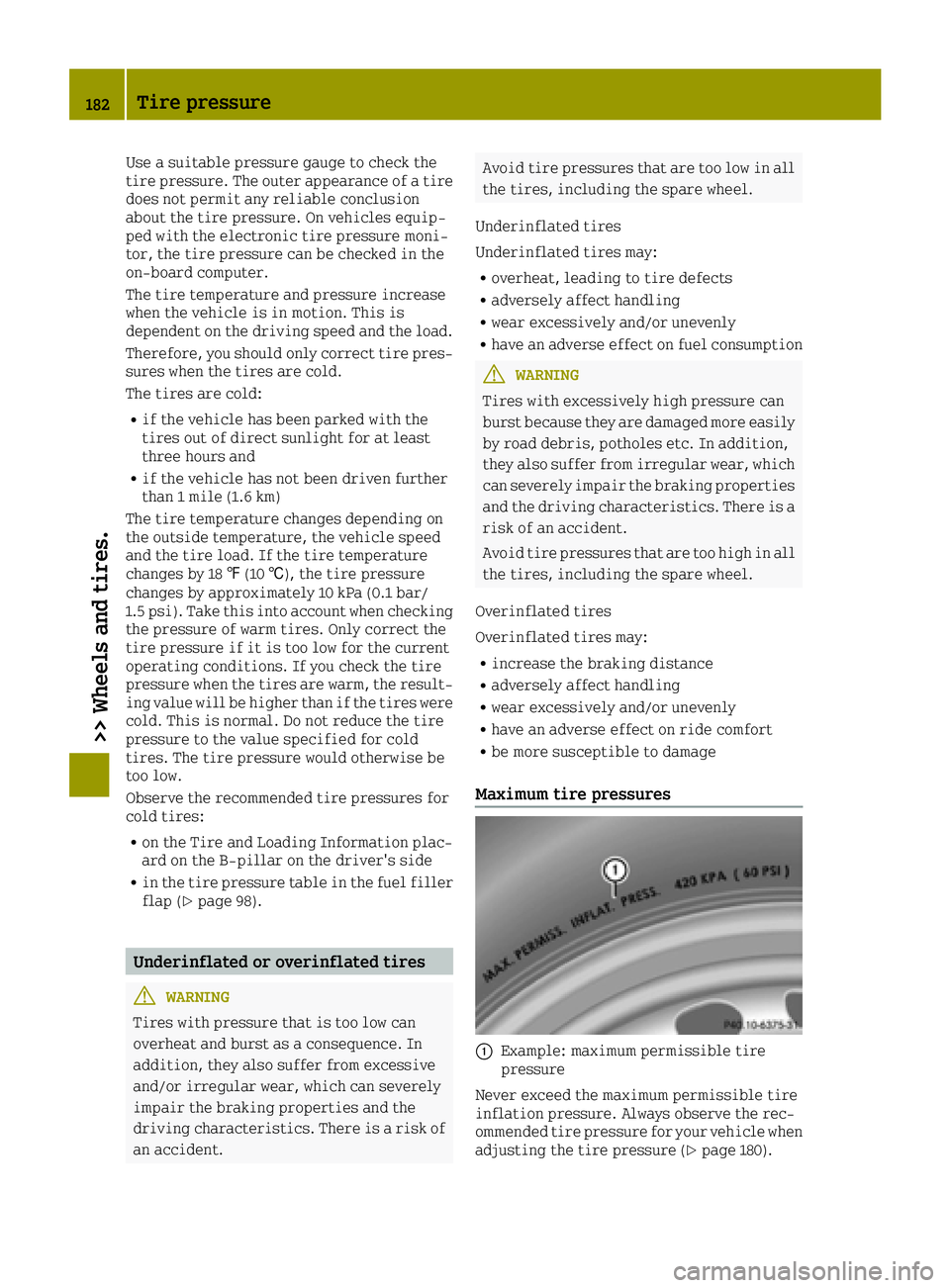
Maximum tire pressures
0043Example: maximum permissible tire
pressure
Never exceed the maximum permissible tire
inflation pressure. Always observe the rec-
ommended tire pressure for your vehicle when
adjusting the tire pressure (
Ypage 180).
182Tire pressure
>> Wheels and tires.
Page 185 of 214
iThe actual values for tires are vehicle-
specific and may deviate from the values in
the illustration.
Checking the tire pressures
Important safety notes
Observe the notes on tire pressure
(Ypage 180).
Information on air pressure for the tires on
your vehicle can be found:
Ron the vehicle's Tire and Loading Informa- tion placard on the B-pillar
Rin the tire pressure table in the fuel filler
flap (Ypage 98)
Rin the "Tire pressure" section
Checking tire pressures manually
To determine and set the correct tire pres-
sure, proceed as follows:
XRemove the valve cap of the tire that is to bechecked.
XPress the tire pressure gauge securely onto
the valve.
XRead the tire pressure and compare it with
the recommended value on the Tire and
Loading Information placard (
Ypage 180).
XIf the tire pressure is too low increase the
tire pressure to the recommended value.
XIf the tire pressure is too high, release
air. To do this, press down the metal pin in
the valve using the tip of a pen, for exam-
ple. Then check the tire pressure again
using the tire pressure checker.
XScrew the valve cap onto the valve.
XRepeat these steps for the other tires.
Tire pressure monitor
General notes
iThis function is only available in the
USA.
If a tire pressure monitor is installed, the
vehicle's wheels have sensors that monitor
the tire pressures in all four tires. The tire
pressure monitor warns you if the pressure
drops in one or more of the tires. The tire pressure monitor only functions if the cor-
responding sensors are fitted to all wheels.
Important safety notes
GWARNING
Each tire, including the spare (if provi-
ded), should be checked at least once every
two weeks when cold and inflated to the
pressure recommended by the vehicle man- ufacturer on the Tire and Loading Informa-
tion placard on the driver's door B-pillar
or the tire pressure label on the inside of
the fuel filler flap. If your vehicle has
tires of a different size than the size indi-
cated on the Tire and Loading Information
placard or, if available, the tire pressure
label, you should determine the proper tire
pressure for those tires.
As an added safety feature, your vehicle has been equipped with a tire pressure moni-
toring system (TPMS) that illuminates a low
tire pressure telltale when one or more of
your tires are significantly underinflated.
Accordingly, when the low tire pressure
telltale lights up, you should stop and
check your tires as soon as possible, and
inflate them to the proper pressure. Driv-
ing on a significantly underinflated tire
causes the tire to overheat and can lead to
tire failure.
Underinflation also reduces fuel effi-
ciency and tire tread life, and may affect
the vehicle's handling and stopping abil-
ity. Please note that the TPMS is not a sub-
stitute for proper tire maintenance, and it
is the driver's responsibility to maintain
correct tire pressure, even if underinfla-
tion has not reached the level to trigger
illumination of the TPMS low tire pressure
telltale.
Your vehicle has also been equipped with a
TPMS malfunction indicator to indicate
when the system is not operating properly.
The TPMS malfunction indicator is com-
bined with the low tire pressure telltale.
When the system detects a malfunction, the
Tire pressure183
>> Wheels and tires.
Z
Page 186 of 214
warning lamp will flash for approximately
a minute and then remain continuously
illuminated. This sequence will be repea-
ted every time the vehicle is started as long
as the malfunction exists. When the mal-
function indicator is illuminated, the sys-
tem may not be able to detect or signal low
tire pressure as intended.
TPMS malfunctions may occur for a variety
of reasons, including the installation of
incompatible replacement or alternate
tires or wheels on the vehicle that prevent
the TPMS from functioning properly. Always
check the TPMS malfunction telltale after
replacing one or more tires or wheels on
your vehicle to ensure that the replacement
or alternate Tires and wheels allow the
TPMS to continue to function properly.
It is the driver's responsibility to set the
tire pressure to that recommended for cold
tires which is suitable for the operating sit-
uation (
Ypage 180). Note that the correct tire
pressure for the current operating situation
must first be taught-in to the tire pressure
monitor. If there is a substantial loss of
pressure, the warning threshold for the warn-
ing message is aligned to the reference val-
ues taught-in. Restart the tire pressure mon-
itor after adjusting to the cold tire pressure.
The current pressures are saved as new ref-
erence values. As a result, a warning message
will appear if the tire pressure drops sig-
nificantly.
The tire pressure monitor does not warn you of
an incorrectly set tire pressure. Observe the notes on the recommended tire pressure
(
Ypage 180).
The tire pressure monitor is not able to warn
you of a sudden loss of pressure, e.g. if the
tire is penetrated by a foreign object. In the
event of a sudden loss of pressure, bring the
vehicle to a halt by braking carefully. Avoid
abrupt steering maneuvers. The tire pressure monitor has a yellow warn-
ing lamp in the instrument cluster for indi-
cating a pressure loss or malfunction.
Whether the warning lamp flashes or lights up
indicates whether a tire pressure is too low
or the tire pressure monitor is malfunction-
ing:
RIf the warning lamp is lit continuously, the
tire pressure on one or more tires is sig-
nificantly too low. The tire pressure mon-
itor is not malfunctioning.
RIf the warning lamp flashes for around a
minute and then remains lit constantly, the
tire pressure monitor is malfunctioning.
iA message appears in the display in addi-
tion to the warning lamp.
Observe the information on display mes-
sages (
Ypage 126).
If the tire pressure monitor is malfunction-
ing, it may take up to ten minutes for the tire
pressure warning lamp to inform you of the
malfunction. The malfunction will be indi-
cated first by the tire pressure warning lamp
flashing for approximately one minute and
then remaining lit. When the malfunction has
been rectified, the tire pressure warning
lamp goes out after a few minutes of driving.
The operation of the tire pressure monitor
can be affected by interference from radio
transmitting equipment (e.g. radio head-
phones, two-way radios) that may be being
operated in or near the vehicle.
Tire pressure monitor warning messages
If the tire pressure monitor detects a pres-
sure loss in one or more tires, a warning mes-
sage is shown in the display. The yellow warn-
ing light in the tire pressure monitor lights
up. For certain display messages a warning
tone also sounds.
RIf the Correct Tire Pressuremessage
appears in the display, the tire pressure in
at least one tire is too low. Correct the tire
pressure at the next opportunity.
RIf the Tire Pressure Warning TireFailuremessage appears in the display,
the tire pressure in one or more tires has
dropped suddenly and the tires must be
checked.
Observe the instructions and safety notes for the display messages in the "Tires" section
184Tire pressure
>> Wheels and tires.
Page 187 of 214
(Ypage 126) and the indicator and warning
lamps in the instrument cluster in the "Tires" section (
Ypage 139).
Restarting the tire pressure monitor
When you restart the tire pressure monitor,
all existing warning messages are deleted
and the warning lamps go out. The monitor
uses the currently set tire pressures as the
reference values for monitoring. In most
cases, the tire pressure monitor will auto-
matically detect the new reference values
after you have changed the tire pressure.
However, you can also define reference values
manually as described here. The tire pres-
sure monitor then monitors the new tire pres-
sure values.
XSet the tire pressure to the value recom-
mended for the corresponding driving sit-
uation on the Tire and Loading Information
placard on the B-pillar on the driver's side
(
Ypage 180).
Additional tire pressure values for dif-
ferent loads can also be found on the tire
pressure table on the inside of the fuel
filler flap (
Ypage 180).
XMake sure that the tire pressure is correct on all four wheels.
On-board computer with a color display
XTo restart the tire pressure monitor: press
the 0063 or0064 button on the steering
wheel to select the Settings
menu and
press 0076on the steering wheel to con-
firm.
XPress the 0063or0064 button to select the
TirePressureMonitorsubmenu and con-
firm with 0076.
The Tire Pressure Monitor Use Cur‐
rentPressuresAsNewReferenceVal‐ues?message appears in the display.
If you wish to confirm the restart:
XPress the 0063or0064 button to select yesand press the0076button to confirm.
The Tire Pressure Monitor Restarted
message appears in the display.
XPress 0076to confirm.
After a short while, the message is also
hidden without pressing the 0076button.
After driving for a few minutes, the system
checks whether the current tire pressures are within the specified range. The new
tire pressures are then accepted as refer-
ence values and monitored.
iIf the
Tire Pressure Monitor Restar‐tedmessage does not appear after approx-
imately 5 seconds, the restart was not suc-
cessful. If this occurs, repeat the restart.
If you wish to cancel the restart:
XPress the 0063or0064 button to select noand press the0076button to confirm.
The tire pressure values stored at the last
restart will continue to be monitored.
Radio type approval for the tire pressure
monitor
CountryRadio type approval number
USAFCC ID: MRXMW2433A
FCC ID: MRXGG4
FCC ID: MRXMC34MA4
CanadaIC: 2546A-MW2433A
IC: 2546A-GG4
IC: 2546A-MC34MA4
Loading the vehicle
Instruction labels for tires and loads
GWARNING
Overloaded tires can overheat, causing a
blowout. Overloaded tires can also impair
the steering and driving characteristics
and lead to brake failure. There is a risk of
accident.
Observe the load rating of the tires. The
load rating must be at least half of the GAWR
of your vehicle. Never overload the tires by exceeding the maximum load.
Two instruction labels on your vehicle show
the maximum possible load.
(1) The Tire and Loading Information plac- ard is on the B-pillar on the driver's
side. The Tire and Loading Information
placard shows the maximum permissible
number of occupants and the maximum
permissible vehicle load. It also con-
Loading the vehicle185
>> Wheels and tires.
Z
Page 192 of 214
All passenger car tires must conform to the
statutory safety requirements in addition to
these grades.
iThe actual values for tires are vehicle-
specific and may deviate from the values in
the illustration.
Treadwear
The treadwear grade is a comparative rating
based on the wear rate of the tire when tested under controlled conditions on a specified
U.S. government course. For example, a tire
graded 150 would wear one and one-half times
as well on the government test track as a tire
graded 100.
The relative performance of tires depends
upon the actual conditions of their use, how- ever, and may depart significantly from the
norm due to variations in driving habits,
service practices and differences in road
characteristics and climate conditions.
Traction
GWARNING
The traction grade assigned to this tire is
based on straight-ahead braking traction
tests, and does not include acceleration,
cornering, hydroplaning, or peak traction
characteristics.
!Avoid wheelspin. This can lead to damage
to the drive train.
The traction grades – from highest to lowest –
are AA, A, B and C. Those grades represent the
tire's ability to stop on wet pavement as
measured under controlled conditions on
specified government test surfaces of
asphalt and concrete. A tire marked C may
have poor traction performance.
The safe speed on a wet, snow covered or icy
road is always lower than on dry road surfa-
ces.
You should pay special attention to road con-
ditions when temperatures are around freez-
ing point.
smart recommends a minimum tread depth of
00CF in (4 mm) on all four winter tires. Observe
the legally required minimum tire tread
depth (
Ypage 178). Winter tires can reduce
the braking distance on snow-covered surfa- ces in comparison with summer tires. The
braking distance is still much further than on
surfaces that are not icy or covered with snow.
Take appropriate care when driving.
Further information on winter tires (M+S
tires) (
Ypage 179).
Temperature
GWARNING
The temperature grade for this tire is
established for a tire that is properly
inflated and not overloaded. Excessive
speed, underinflation, or excessive load-
ing, either separately or in combination,
can cause excessive heat build-up and pos- sible tire failure.
The temperature grades are A (the highest), B
and C. They represent the tire's resistance to
the generation of heat and its ability to dis-
sipate heat when tested under controlled con-
ditions on a specified indoor laboratory test
wheel. Sustained high temperature can cause
the material of the tire to degenerate and
reduce tire life, and excessive temperature
can lead to sudden tire failure. The grade C
corresponds to a level of performance which
all passenger car tires must meet under the
Federal Motor Vehicle Safety Standard No.
109. Grades B and A represent higher levels of
performance on the laboratory test wheel than
the minimum required by law.
190All about wheels and tires
>> Wheels and tires.
Page 193 of 214
Tire labeling
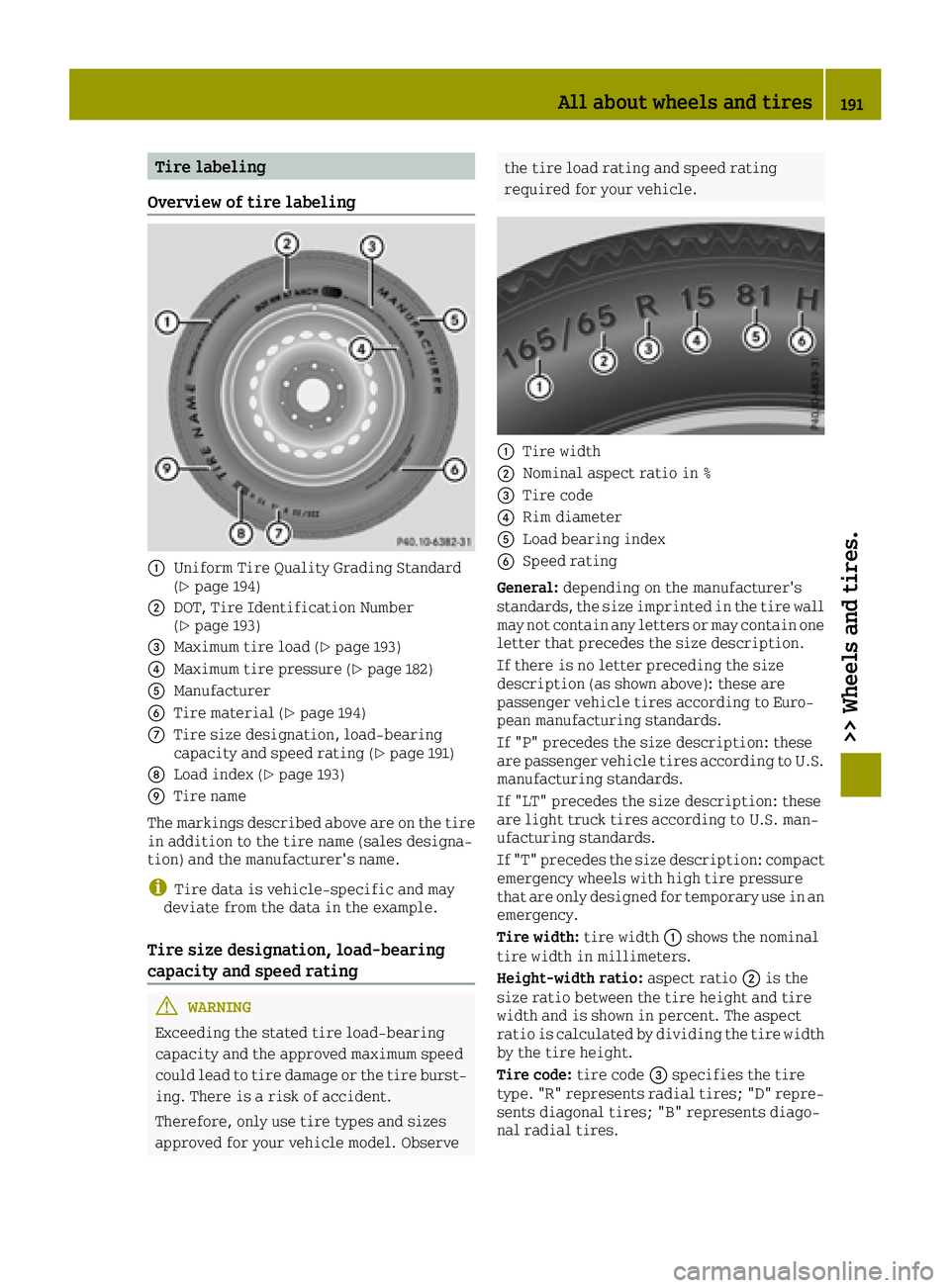
Overview of tire labeling
0043Uniform Tire Quality Grading Standard
(Ypage 194)
0044DOT, Tire Identification Number
(Ypage 193)
0087Maximum tire load (Ypage 193)
0085Maximum tire pressure (Ypage 182)
0083Manufacturer
0084Tire material (Ypage 194)
006BTire size designation, load-bearing
capacity and speed rating (Ypage 191)
006CLoad index (Ypage 193)
006DTire name
The markings described above are on the tire
in addition to the tire name (sales designa-
tion) and the manufacturer's name.
iTire data is vehicle-specific and may
deviate from the data in the example.
Tire size designation, load-bearing
capacity and speed rating
GWARNING
Exceeding the stated tire load-bearing
capacity and the approved maximum speed
could lead to tire damage or the tire burst- ing. There is a risk of accident.
Therefore, only use tire types and sizes
approved for your vehicle model. Observe
the tire load rating and speed rating
required for your vehicle.
0043Tire width
0044Nominal aspect ratio in %
0087Tire code
0085Rim diameter
0083Load bearing index
0084Speed rating
General: depending on the manufacturer's
standards, the size imprinted in the tire wall may not contain any letters or may contain one
letter that precedes the size description.
If there is no letter preceding the size
description (as shown above): these are
passenger vehicle tires according to Euro-
pean manufacturing standards.
If "P" precedes the size description: these
are passenger vehicle tires according to U.S.
manufacturing standards.
If "LT" precedes the size description: these
are light truck tires according to U.S. man-
ufacturing standards.
If "T" precedes the size description: compact
emergency wheels with high tire pressure
that are only designed for temporary use in an
emergency.
Tire width: tire width0043shows the nominal
tire width in millimeters.
Height-width ratio: aspect ratio0044is the
size ratio between the tire height and tire
width and is shown in percent. The aspect
ratio is calculated by dividing the tire width
by the tire height.
Tire code: tire code0087specifies the tire
type. "R" represents radial tires; "D" repre-
sents diagonal tires; "B" represents diago-
nal radial tires.
All about wheels and tires191
>> Wheels and tires.
Z
Page 198 of 214
Tread
The part of the tire that comes into contact
with the road.
Bead
The tire bead ensures that the tire sits
securely on the wheel. There are several steel
wires in the bead to prevent the tire from
coming loose from the wheel rim.
Sidewall
The part of the tire between the tread and the
bead.
Weight of optional extras
The combined weight of those optional extras
that weigh more than the replaced standard
parts and more than 5 lbs (2.3 kilograms).
These optional extras, such as high-perform-
ance brakes, level control, a roof rack or a
high-performance battery, are not included
in the curb weight and the weight of the
accessories.
TIN (Tire Identification Number)
This is a unique identifier which can be used
by a tire manufacturer to identify tires, for
example for a product recall, and thus iden-
tify the purchasers. The TIN is made up of the manufacturer's identity code, tire size, tire
type code and the manufacturing date.
Load bearing index
The load bearing index (also load index) is a
code that contains the maximum load bearing
capacity of a tire.
Traction
Traction is the result of friction between the
tires and the road surface.
Treadwear indicators
Narrow bars (tread wear bars) that are dis-
tributed over the tire tread. If the tire tread
is level with the bars, the wear limit of 00CDin
(1.6 mm) has been reached.
Occupant distribution
The distribution of occupants in a vehicle at
their designated seating positions.
Total load limit
Nominal load and luggage load plus 68 kg
(150 lbs) multiplied by the number of seats in
the vehicle.
Changing a wheel
Flat tire
You can find information on what to do in the
event of a flat tire in the "Flat tire" section
(
Ypage 161).
Rotating the wheels
GWARNING
Never interchange the front and rear wheels
as they have different dimensions, e.g.
size, wheel offset etc. Otherwise, there
could be a negative effect on the road hold- ing and you could endanger yourself or oth-
ers.
!On vehicles equipped with a tire pressure
monitor, electronic components are loca-
ted in the wheel.
Tire-mounting tools should not be used
near the valve. This could damage the elec-
tronic components.
Only have tires changed at a qualified spe-
cialist workshop.
Various types of steel wheel can be fitted on
your vehicle. Some steel wheels have a red
mark in the hub cap area. The hub cap has to be
removed to see the red mark, see "Raising the
vehicle" in the "Wheel change" section
(
Ypage 197). When changing the wheels,
always fit wheels of the same type on all axles.
Always pay attention to the instructions and
safety notes when changing a wheel
(
Ypage 196).
The wear patterns on the front and rear tires
differ, depending on the operating condi-
tions. Front tires typically wear more on the
shoulders and the rear tires in the center.
Clean the contact surfaces of the wheel and
the brake disc thoroughly every time a wheel
is rotated. Check the tire pressure and reac-
tivate the tire pressure monitor if necessary.
196Changing a wheel
>> Wheels and tires.
Page 199 of 214
Direction of rotation
Tires with a specified direction of rotation
have additional benefits, e.g. if there is a
risk of hydroplaning. These advantages can
only be gained if the tires are fitted corre-
sponding to the direction of rotation.
An arrow on the sidewall of the tire indicates
its correct direction of rotation.
Storing wheels
Store wheels that are not being used in a cool,
dry and preferably dark place. Protect the
tires from oil, grease, gasoline and diesel.
Mounting a wheel
Preparing the vehicle
XMake sure that you have the appropriate
tire-changing tools. For further informa-
tion inquire at any smart center.
XStop the vehicle on solid, non-slippery and
level ground.
XApply the parking brake (Ypage 101).
XBring the front wheels into the straight-
ahead position.
XVehicles with automatic transmission:
shift the transmission to position P.
XVehicles with manual transmission:
depress the clutch pedal fully and engage
first or reverse gear.
XSwitch off the engine.
XRemove the SmartKey from the ignition
lock.
XAlso secure the vehicle against rolling
away.
Securing the vehicle to prevent it from
rolling away
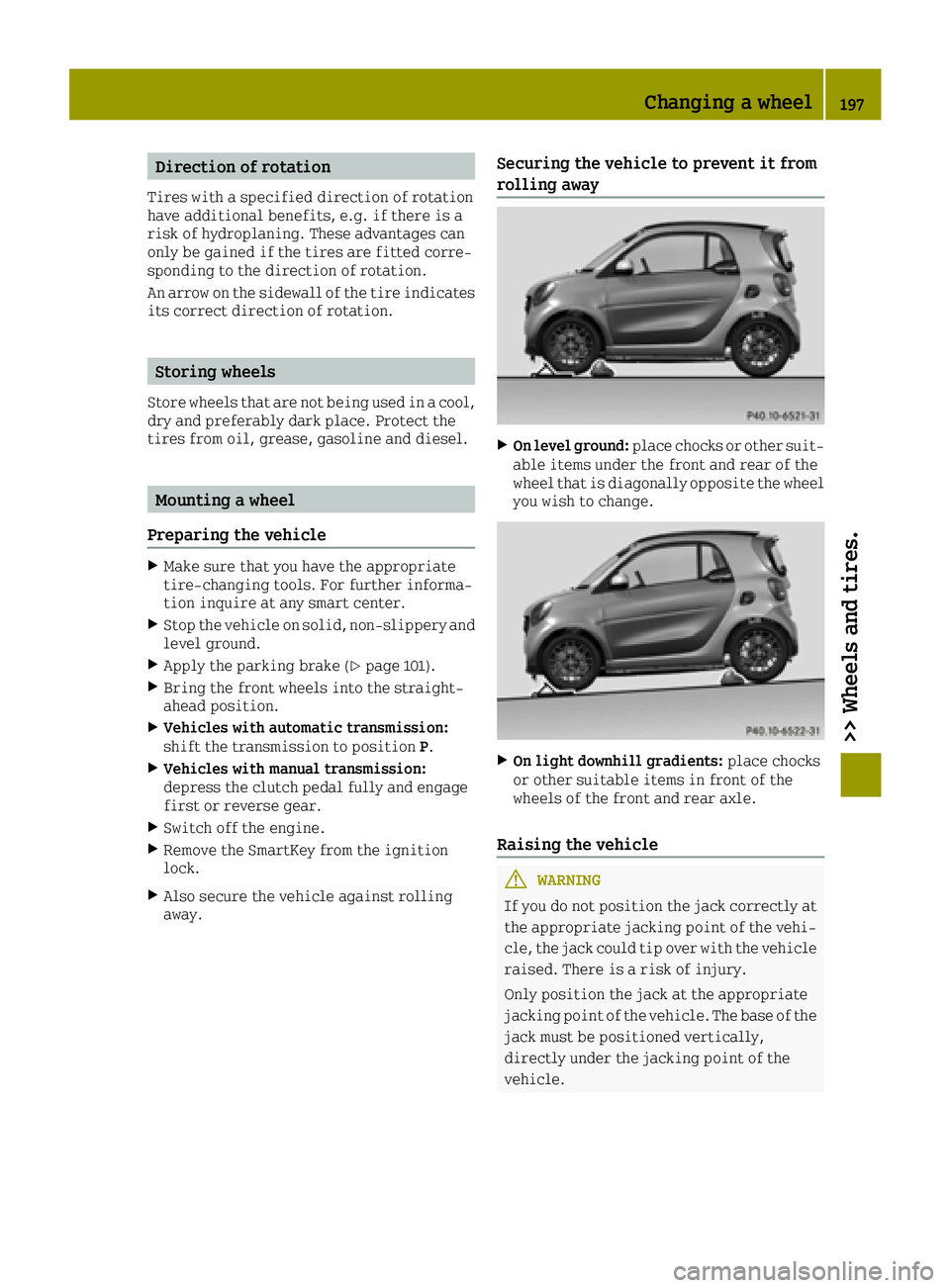
XOn level ground:place chocks or other suit-
able items under the front and rear of the
wheel that is diagonally opposite the wheel
you wish to change.
XOn light downhill gradients: place chocks
or other suitable items in front of the
wheels of the front and rear axle.
Raising the vehicle
GWARNING
If you do not position the jack correctly at
the appropriate jacking point of the vehi- cle, the jack could tip over with the vehicle
raised. There is a risk of injury.
Only position the jack at the appropriate
jacking point of the vehicle. The base of the jack must be positioned vertically,
directly under the jacking point of the
vehicle.
Changing a wheel197
>> Wheels and tires.
Z
Page 201 of 214

The vehicle may only be raised at the desig-
nated jacking points on the sill.
The jacking points are located just behind
the wheel housings of the front wheels and
just in front of the wheel housings of the rear
wheels (arrows). You can identify the jacking
points by the triangular indentations on the
sill.
To avoid damage, position the jack centrally
under the triangular indentations.
XPosition jack 0044centrally under the tri-
angular indentations at the jacking points on the sill 0043.
Example
XMake sure the foot of the jack is directly
beneath the jacking point.
XRaise the vehicle with jack 0044until the
tire is a maximum of 1.2 in (3 centimeters)
off the ground.
Removing a wheel
!Do not place wheel bolts in sand or on a
dirty surface. The bolt and wheel hub
threads could otherwise be damaged when
you screw them in.
XUnscrew the wheel bolts.
XRemove the wheel.
Mounting a new wheel
GWARNING
Oiled or greased wheel bolts or damaged
wheel bolts/hub threads can cause the wheel
bolts to come loose. As a result, you could
lose a wheel while driving. There is a risk of accident.
Never oil or grease wheel bolts. In the event
of damage to the threads, contact a quali-
fied specialist workshop immediately.
Have the damaged wheel bolts or hub threads
replaced/renewed. Do not continue driv-
ing.
GWARNING
If you tighten the wheel bolts or wheel nuts when the vehicle is raised, the jack could
tip over. There is a risk of injury.
Only tighten the wheel bolts or wheel nuts
when the vehicle is on the ground.
Always pay attention to the instructions and
safety notes in the "Changing a wheel" sec-
tion (
Ypage 196).
Only use wheel bolts that are designed for the
wheel and the vehicle. For safety reasons,
smart recommends that you only use wheel
bolts which have been approved for smart
vehicles and the respective wheel.
!To prevent damage to the paintwork, hold
the wheel securely against the wheel hub
while screwing in the first wheel bolt.
Changing a wheel199
>> Wheels and tires.
Z
Page 202 of 214
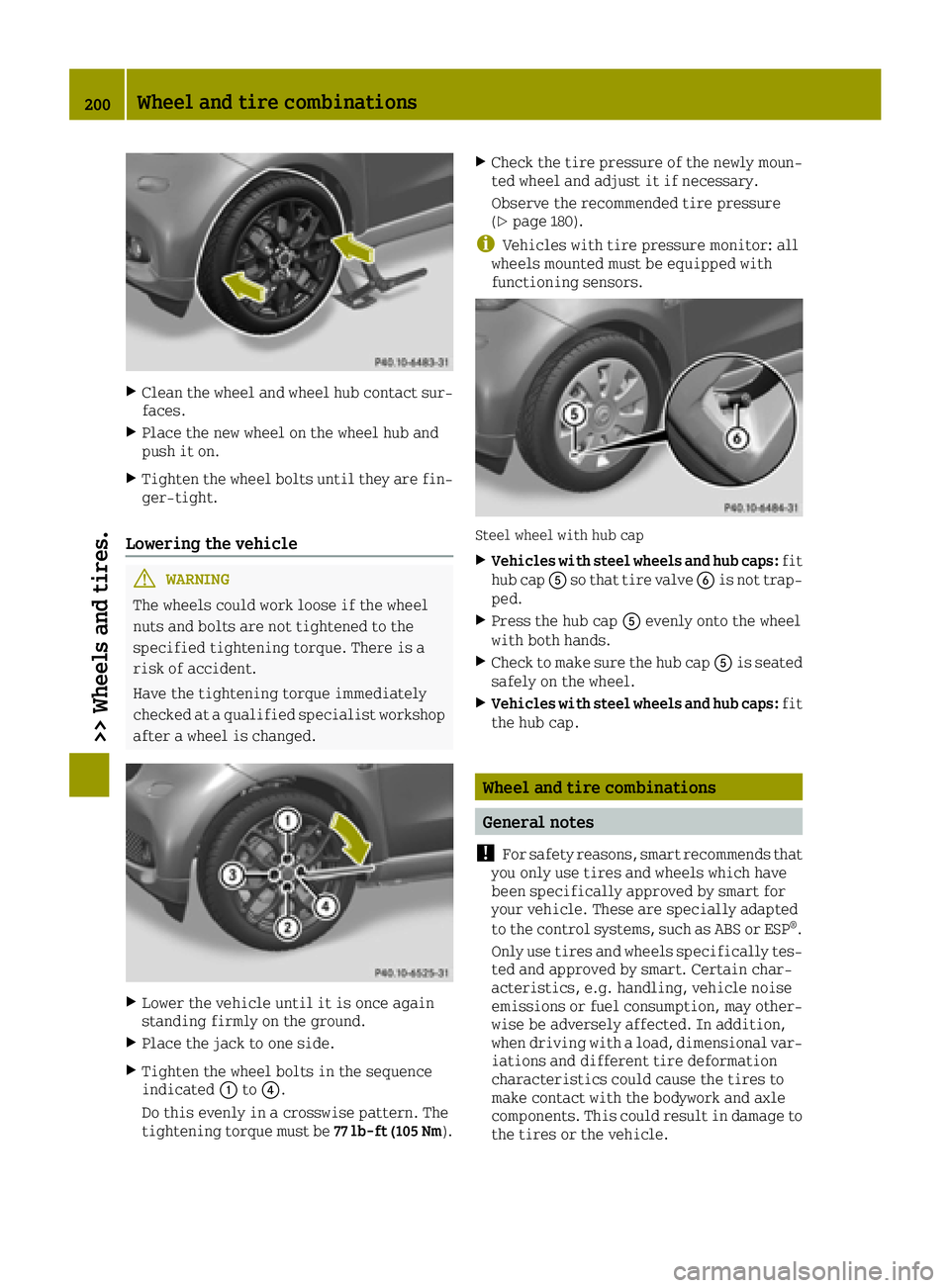
XClean the wheel and wheel hub contact sur-faces.
XPlace the new wheel on the wheel hub and
push it on.
XTighten the wheel bolts until they are fin-
ger-tight.
Lowering the vehicle
GWARNING
The wheels could work loose if the wheel
nuts and bolts are not tightened to the
specified tightening torque. There is a
risk of accident.
Have the tightening torque immediately
checked at a qualified specialist workshop
after a wheel is changed.
XLower the vehicle until it is once again
standing firmly on the ground.
XPlace the jack to one side.
XTighten the wheel bolts in the sequence
indicated 0043to0085.
Do this evenly in a crosswise pattern. The
tightening torque must be 77 lb-ft (105 Nm).
XCheck the tire pressure of the newly moun-
ted wheel and adjust it if necessary.
Observe the recommended tire pressure
(
Ypage 180).
iVehicles with tire pressure monitor: all
wheels mounted must be equipped with
functioning sensors.
Steel wheel with hub cap
XVehicles with steel wheels and hub caps: fit
hub cap 0083so that tire valve 0084is not trap-
ped.
XPress the hub cap 0083evenly onto the wheel
with both hands.
XCheck to make sure the hub cap 0083is seated
safely on the wheel.
XVehicles with steel wheels and hub caps: fit
the hub cap.
Wheel and tire combinations
General notes
!
For safety reasons, smart recommends that
you only use tires and wheels which have
been specifically approved by smart for
your vehicle. These are specially adapted
to the control systems, such as ABS or ESP
®.
Only use tires and wheels specifically tes-
ted and approved by smart. Certain char-
acteristics, e.g. handling, vehicle noise
emissions or fuel consumption, may other-
wise be adversely affected. In addition,
when driving with a load, dimensional var-
iations and different tire deformation
characteristics could cause the tires to
make contact with the bodywork and axle
components. This could result in damage to
the tires or the vehicle.
200Wheel and tire combinations
>> Wheels and tires.