fuel SMART FORTWO 2016 Owners Manual
[x] Cancel search | Manufacturer: SMART, Model Year: 2016, Model line: FORTWO, Model: SMART FORTWO 2016Pages: 214, PDF Size: 4.93 MB
Page 8 of 214
Display messageCalling up (message memory) .......1 13
Color display .......................... 118
Language setting ......................1 17
Service display ....................... 153
Display messages
Calling up (on-board computer) ... 113
Driving systems ....................... 126
Engine ................................... 124
General notes (on-board com-
puter with a color display) .........118
Hiding ................................... 118
Lights .................................... 128
Safety systems .........................1 19
SmartKey ................................ 130
Tires .....................................1 26
Vehicle ................................. .128
Distance recorder .........................112
Distance warning function
Function/notes .........................4 8
Warning lamp (red) ................... 136
Warning lamp (yellow) ............... 135
Door
Warning lamp ........................... 141
Doors
Automatic locking (switch) .......... 55
Central locking/unlocking
(SmartKey) ................................ 51
Control panel ........................... 28
Display message ....................... 128
Emergency locking ..................... 55
Emergency unlocking .................. 55
Important safety notes ................ 54
Opening (from inside) ................ 54
Drinking and driving ..................... 102
Drive program
Automatic transmission .............. 94
Display ................................... 92
Driver's door
see Doors
Driver's seat
see Seats
Driving abroad
smart service .......................... 154
Driving on flooded roads ................ 104
Driving safety systems
ABS (Anti-lock Braking System) .... 47
Distance warning function .......... 48 EBD (electronic brake force
distribution) ........................... 50
ESP
®(Electronic Stability Pro-
gram) ...................................... 49
ETS (Electronic Traction Sys-
tem) ........................................ 49
Important safety information ....... 47
Overview ................................. 47
Driving system
Parking aid ............................. 107
Driving systems
Cruise control ......................... 105
Display message ....................... 126
Driving tips
Automatic transmission .............. 93
Brakes ................................... 103
Break-in period ........................ 86
Downhill gradient .................... 103
Drinking and driving ................ 102
Driving in winter ..................... 105
Driving on flooded roads ........... 104
Driving on wet roads ................. 104
Exhaust check .......................... 103
Fuel ...................................... 102
General .................................. 102
Hydroplaning .......................... 104
Icy road surfaces ..................... 105
Limited braking efficiency on
salted roads ............................ 104
Snow chains ............................. 179
Subjecting brakes to a load ........ 103
Wet road surface ...................... 103
E
EBD (electronic brake force distri-
bution)Display message ...................... 120
Function/notes ......................... 50
EBD (Electronic Brake-force Dis-
tribution)
Indicator lamp ........................ 133
Electronic Brake-force Distribu-
tion
see EBD (electronic brake force
distribution)
Electronic Traction System
see ETS (Electronic Traction System)
6Index
Page 9 of 214
Emergency releaseDriver's door ........................... .55
Vehicle ................................... 55
Emergency Tensioning Devices
Activation ............................... 40
Emissions control
Service and warranty informa-
tion ........................................ 17
Engine
Check Engine warning lamp ........1 36
Display message ...................... 124
Engine number ......................... 206
Irregular running ...................... 90
Jump-starting ......................... 168
Starting problems ..................... 90
Starting the engine with the
SmartKey ................................. 88
Switching off ........................... 101
Tow-starting (vehicle) .............. 172
Engine compartment cover .............. 149
Engine electronics
Problem (malfunction) ................ 90
Engine oil
Adding ................................... 150
Additives ............................... 209
Checking the oil level ............... 150
Display message ...................... 124
Filling capacity ...................... 209
Notes about oil grades .............. 209
Notes on oil level/consumption ... 149
Viscosity ............................... 210
Warning lamp .......................... 138
Engine oil additives
see Additives (engine oil)
ESP
®(Electronic Stability Program)
Characteristics ........................4 9
Crosswind Assist ....................... 50
Display message ....................... 121
ETS .........................................4 9
Function/notes ......................... 49
General notes ........................... 49
Important safety information ....... 49
Warning and indicator lamps ...... 134
ETS (Electronic Traction System) ...... 49
Exhaust check .............................. 103
Exhaust pipe (cleaning instruc-
tions) ......................................... 158 Exterior lighting
Cleaning ................................ 158
Setting options ......................... 67
Exterior mirrors
Adjusting (electrically) ............. 66
Adjusting (manually) .................. 66
Out of position (troubleshoot-
ing) ........................................ 66
F
Filler capsee Refueling
Filling capacities (Technical data) .. 207
Flat tire
Preparing the vehicle ............... 161
TIREFIT kit ............................. 161
Floormats .................................... 148
Fog lamps
Switching on/off ....................... 68
Frequencies
Mobile phone .......................... 204
Two-way radio ......................... 204
Front cover
see Service cover
Front fog lamps
Changing bulbs ......................... 72
Switching on/off ....................... 68
Front-passenger seat
Folding down ............................ 63
Frontal area cover
see Service cover
Fuel
Additives ............................... 208
Consumption information .......... 209
Displaying the current con-
sumption ................................ 112
Driving tips ........................... 102
Fuel gauge .............................. 110
Grade (gasoline) ...................... 208
Important safety notes .............. 207
Problem (malfunction) ............... 100
Refueling ................................ 97
Tank content/reserve fuel .......... 207
Fuel filler flap
Opening .................................. 98
Fuel tank
Capacity ................................ 207
Index7
Page 13 of 214
Rear parking aidActivating/deactivating ............ 108
Function/notes ........................ 107
Rear window defroster
Problem (malfunction) ................ 84
Switching on/off ....................... 82
Rear window wiper
Replacing the wiper blade ........... 76
Switching on/off ....................... 75
Rear-view mirror
Anti-glare (manual) ................... 66
Recycling
see Protection of the environment
Refrigerant (air-conditioning sys-
tem)
Important safety notes ............... 211
Refueling
Fuel gauge .............................. 110
Important safety notes ................ 97
Refueling process ..................... 98
see Fuel
Replacing bulbs
Important safety notes ................ 70
Interior lighting ...................... 74
Overview of bulb types ................ 70
Removing/replacing the cover
(front wheel arch) ...................... 72
Side turn signal lamps ............... 73
Rescue card .................................. 20
Reserve (fuel tank)
see Fuel
Reserve fuel
Display message ....................... 125
see Fuel
Restraint system
Display message ....................... 119
Introduction ............................ 29
Warning lamp .......................... 132
Warning lamp (function) .............. 30
Reverse gear
Engaging (manual transmission) ... 91
Reversing feature
Side windows ............................ 58
Roadside Assistance (breakdown) ....... 17
Roller sunblind for the panorama
roof
Operating ................................ 60 Roof
see Panoramic roof
Roof lining and carpets (cleaning
guidelines) ................................. 160
S
Safety
Child restraint systems .............. 43
Children in the vehicle .............. 42
see Operating safety
Safety system
see Driving safety systems
Seat
Folding the front-passenger
seat down ................................. 63
Seat belts
Cleaning ................................ 159
Correct usage ........................... 32
Fastening ................................ 33
Important safety guidelines ........ 31
Introduction ............................. 31
Releasing ................................ 33
Warning lamp ........................... 131
Warning lamp (function) .............. 33
Seats
Adjusting (manually) .................. 62
Cleaning the cover ................... 159
Correct driver's seat position ...... 61
Important safety notes ................ 61
Seat heating problem ................. 65
Switching seat heating on/off ...... 64
Sensors (cleaning instructions) ....... 158
Service Center
see Qualified specialist workshop
Service cover ............................... 151
Service display
Calling up (on-board computer
with a color display) ................. 113
Displaying a service message ..... 154
Hiding a service message .......... 154
Notes ..................................... 153
Resetting ............................... 154
Service message ....................... 153
Special service requirements ..... 154
Service products
Brake fluid ............................. 210
Coolant (engine) ...................... 210
Index11
Page 14 of 214
Engine oil .............................. 209
Fuel ...................................... 207
Important safety notes .............. 207
Refrigerant (air-conditioning
system) ................................... 211
Washer fluid ............................ 211
Setting a speed
see Cruise control
Setting the air distribution ............. 81
Setting the airflow ......................... 82
Shifting to neutral (manual trans-
mission) ....................................... 91
Side turn signal lamps
Replacing bulbs ........................ 73
Side windows
Cleaning ................................ 157
Important safety information ....... 57
Opening/closing ....................... 58
Problem (malfunction) ................ 60
Resetting ................................ 59
smart center
see Qualified specialist workshop
SmartKey
Changing the battery .................. 52
Door central locking/unlocking .... 51
Important safety notes ................ 51
Loss ........................................ 53
Positions (ignition lock) ............ 87
Problem (malfunction) ................ 53
Starting the engine ................... 88
SmartKey positions (ignition lock) .... 87
Snow chains ................................. 179
Sockets
Center console ......................... 147
General notes .......................... 147
Speakers
see Subwoofer
Special seat belt retractor .............. 43
Specialist workshop ....................... 20
Speedometer
Digital .................................. 109
In the Instrument cluster ........... 109
SRS (Supplemental Restraint Sys-
tem)
see Restraint system
Starting (engine) ........................... 87 Starting the engine
see Starting (engine)
Steering
Display message (color display) .. 128
Warning lamps ......................... 141
Steering wheel
Adjusting (manually) .................. 65
Button overview ........................ 25
Cleaning ................................ 159
Important safety notes ................ 65
Paddle shifters ......................... 96
Stowage areas .............................. 142
Stowage compartment
Door stowage compartment .......... 143
Stowage compartment in the tail-
gate ........................................... 143
Stowage compartments
Center console ......................... 143
Cup holders ............................. 146
Glove box ............................... 143
Important safety information ...... 142
Stowage space
Stowage compartment in the
tailgate ................................. 143
Submenu
Ambient lighting ..................... 116
Subwoofer
Fitting/removing ..................... 145
Summer tires
In winter ................................ 179
Sun visor ..................................... 147
Switching air-recirculation mode
on/off .......................................... 84
T
Tachometer .................................. 110
Tailgate
Important safety notes ................ 56
Opening dimensions ................. 212
Opening/closing ....................... 57
Warning lamp ........................... 141
Tank
see Fuel tank
Tank content
Fuel gauge .............................. 110
Technical data
Capacities ............................. 207
12Index
Page 18 of 214
Protection of the environment
General notes
HEnvironmental note
Daimler's declared policy is one of com-
prehensive environmental protection.
The objectives are for the natural resour-
ces that form the basis of our existence on
this planet to be used sparingly and in a
manner that takes the requirements of both
nature and humanity into account.
You too can help to protect the environment
by operating your vehicle in an environ-
mentally responsible manner.
Fuel consumption and the rate of engine,
transmission, brake and tire wear are
affected by these factors:
Roperating conditions of your vehicle
Ryour personal driving style
You can influence both factors. You should
bear the following in mind:
Operating conditions:
Ravoid short trips as these increase fuel
consumption.
Ralways make sure that the tire pressures
are correct.
Rdo not carry any unnecessary weight.
Ra regularly serviced vehicle will con-
tribute to environmental protection. You
should therefore adhere to the service
intervals.
RAlways have service work carried out at a
qualified specialist workshop.
Personal driving style:
Rdo not depress the accelerator pedal
when starting the engine.
Rdo not warm up the engine when the vehi-
cle is stationary.
Rdrive carefully and maintain a safe dis- tance from the vehicle in front.
Ravoid frequent, sudden acceleration and
braking.
Rchange gear in good time and use each
gear only up to 00C3of its maximum engine
speed.
Rswitch off the engine in stationary traf-
fic.
Rkeep an eye on the vehicle's fuel con-
sumption.
Environmental concerns and recom-
mendations
Wherever the operating instructions require you to dispose of materials, first try to
regenerate or re-use them. Observe the rel-
evant environmental rules and regulations
when disposing of materials. In this way you
will help to protect the environment.
Genuine smart parts
HEnvironmental note
Daimler AG also supplies reconditioned
major assemblies and parts which are of the
same quality as new parts. They are covered
by the same Limited Warranty entitlements
as new parts.
!Air bags and Emergency Tensioning Devi-
ces, as well as control units and sensors for
these restraint systems, may be installed
in the following areas of your vehicle:
Rdoors
Rdoor pillars
Rdoor sills
Rseats
Rcockpit
Rinstrument cluster
Rcenter console
Do not install accessories such as audio
systems in these areas. Do not carry out
repairs or welding. You could impair the
operating efficiency of the restraint sys-
tems.
Have aftermarket accessories installed at
a qualified specialist workshop.
You could jeopardize the operating safety of
your vehicle if you use parts, tires and wheels
16>> Introduction.
Page 20 of 214
will be determined by our authorized smart
center technical help or the tow service pro-
vider on a case-by-case basis. Additional
charges may be applicable for a breakdown
location determined not to be a reasonably
accessible roadside location as determined
by our authorized technician and tow service
provider.
For additional information refer to the smart
Roadside Assistance Program brochure (USA)
or the Warranty Booklet (Canada) in your vehi-
cle literature portfolio.
Change of address or change of owner-
ship
In the USA: If you change your address, be sure
to send in the “Information Change Card”
found in the Warranty Information Booklet.
In Canada: If you change your address, be sure
to send in the “Change of Address Notice”
found in the Warranty Booklet, or simply call
the Customer Service at 1-800-387-0100.
Maintaining your current address informa-
tion with smart will enable us to contact you
should important new information about the
vehicle, such as recalls, become available.
If you sell your smart, please leave all liter- ature with the vehicle to make it available to
the next operator.
In the USA: If you bought this vehicle used, be
sure to send in the “Information Change Card”
found in the Warranty Information Booklet.
In Canada: If you bought this vehicle used, be
sure to send in the “Notice of Pre‑Owned
Vehicle Purchase” found in the Warranty
Booklet, or call the Customer Service at
1-800-387-0100.
Operating your vehicle outside the USA
or Canada
When you are abroad with your vehicle,
observe the following points:
RService facilities or replacement parts
may not be readily available.
RUnleaded gasoline for vehicles with cata-
lytic converters may not be available; the use of leaded fuels will damage the cata-
lysts.
RGasoline may have a considerably lower
octane rating, and improper fuel can cause
engine damage.
Operating safety
Important safety notes
GWARNING
If you do not have the prescribed service/
maintenance work or any required repairs
carried out, this can result in malfunctions or system failures. There is a risk of an
accident.
Always have the prescribed service/main-
tenance work as well as any required
repairs carried out at a qualified special-
ist workshop.
GWARNING
Flammable material such as leaves, grass or
twigs may ignite if they come into contact
with hot parts of the exhaust system. There
is a risk of fire.
When driving off road or on unpaved roads,
check the vehicle's underside regularly. In
particular, remove parts of plants or other
flammable materials which have become
trapped. In the case of damage, contact a
qualified specialist workshop.
GWARNING
Modifications to electronic components,
their software as well as wiring can impair
their function and/or the function of other
networked components. In particular, sys-
tems relevant to safety could also be affec-
ted. As a result, these may no longer func-
tion as intended and/or jeopardize the
operating safety of the vehicle. There is an increased risk of an accident and injury.
Never tamper with the wiring as well as
electronic components or their software.
You should have all work to electrical and
18>> Introduction.
Page 22 of 214
requirements of the next emissions test dur-
ing the main inspection.
Qualified specialist workshop
A smart center is a qualified specialist
workshop. It has the necessary specialist
knowledge, tools and qualifications to cor-
rectly carry out the work required on your
vehicle. This is especially the case for work
relevant to safety.
Observe the notes in the Maintenance Book-
let.
Always have the following work carried out at
a smart center:
Rwork relevant to safety
Rservice and maintenance work
Rrepair work
Ralterations, installation work and modifi-
cations
Rwork on electronic components
Correct use
If you remove any warning stickers, you or
others could fail to recognize certain dan-
gers. Leave warning stickers in position.
Observe the following information when
driving your vehicle:
Rthe safety notes in this manual
Rthe Technical Data section in this manual
Rtraffic rules and regulations
Rlaws and safety standards pertaining to
motor vehicles
Problems with your vehicle
If you should experience a problem with your
vehicle, particularly one that you believe
may affect its safe operation, we urge you to
immediately contact an authorized smart
center to have the problem diagnosed and
corrected if required. Do not drive the vehi-
cle if you believe it may not be safely oper-
ated. If the matter is not handled to your sat-
isfaction, please discuss the problem with
the smart center management, or if necessarycontact us at one of the following addresses:
In the USA Mercedes-Benz USA, LLC
One Mercedes Drive
Montvale, NJ 07645
In Canada
Customer Relations Department
98 Vanderhoof Avenue
Mercedes-Benz Canada, Inc.
Toronto, Ontario M4G 4C9
QR codes for rescue card
The QR codes are secured in the fuel filler
flap and on the opposite side on the B-pillar.
In the event of an accident, rescue services
can use the QR code to quickly find the appro-
priate rescue card for your vehicle. The cur-
rent rescue card contains the most important
information about your vehicle in a compact
form, e.g. the routing of the electric cables.
You can find more information under http://
portal.aftersales.i.daimler.com/public/
content/asportal/en/communication/
informationen_fuer/QRCode.html.
Data stored in the vehicle
Data recording
This vehicle is capable of recording diag-
nostic information relating to vehicle oper-
ation, malfunctions, and user settings. This
may include information about the perform-
ance or status of various systems, including
but not limited to, engine, throttle, steering
or brake systems, that is stored and can be
read out with suitable devices, particularly
when the vehicle is serviced. The data
obtained is used to properly diagnose and
service your vehicle or to further optimize
and develop vehicle functions.
Event data recorders
This vehicle is equipped with an event data
recorder (EDR). The main purpose of an EDR is
to record data that will assist in understand-
ing how a vehicle’s systems performed in cer-
tain crash or near crash-like situations, such
as during air bag deployment or when hitting
a road obstacle. The EDR is designed to record
20>> Introduction.
Page 54 of 214
XTo unlock and open the tailgate:press and
hold the button
on the key.
XTo lock centrally: press the0037button.
The SmartKey centrally locks/unlocks:
Rthe doors
Rthe tailgate
Rthe fuel filler flap
When unlocking, the turn signals flash once.
When locking, they flash twice.
Locking is confirmed by an audible signal.
SmartKey battery
Important safety notes
GWARNING
Batteries contain toxic and corrosive sub-
stances. If batteries are swallowed, it can
result in severe health problems. There is a
risk of fatal injury.
Keep batteries out of the reach of children. If a battery is swallowed, seek medical
attention immediately.
The SmartKey batteries contain perchlorate
material, which may require special han-
dling and regard for the environment.
National guidelines must be observed during
disposal. In California, see www.dtsc.ca.gov/
HazardousWaste/Perchlorate/index.cfm.
smart recommends that you have the batteries
changed at a qualified specialist workshop.
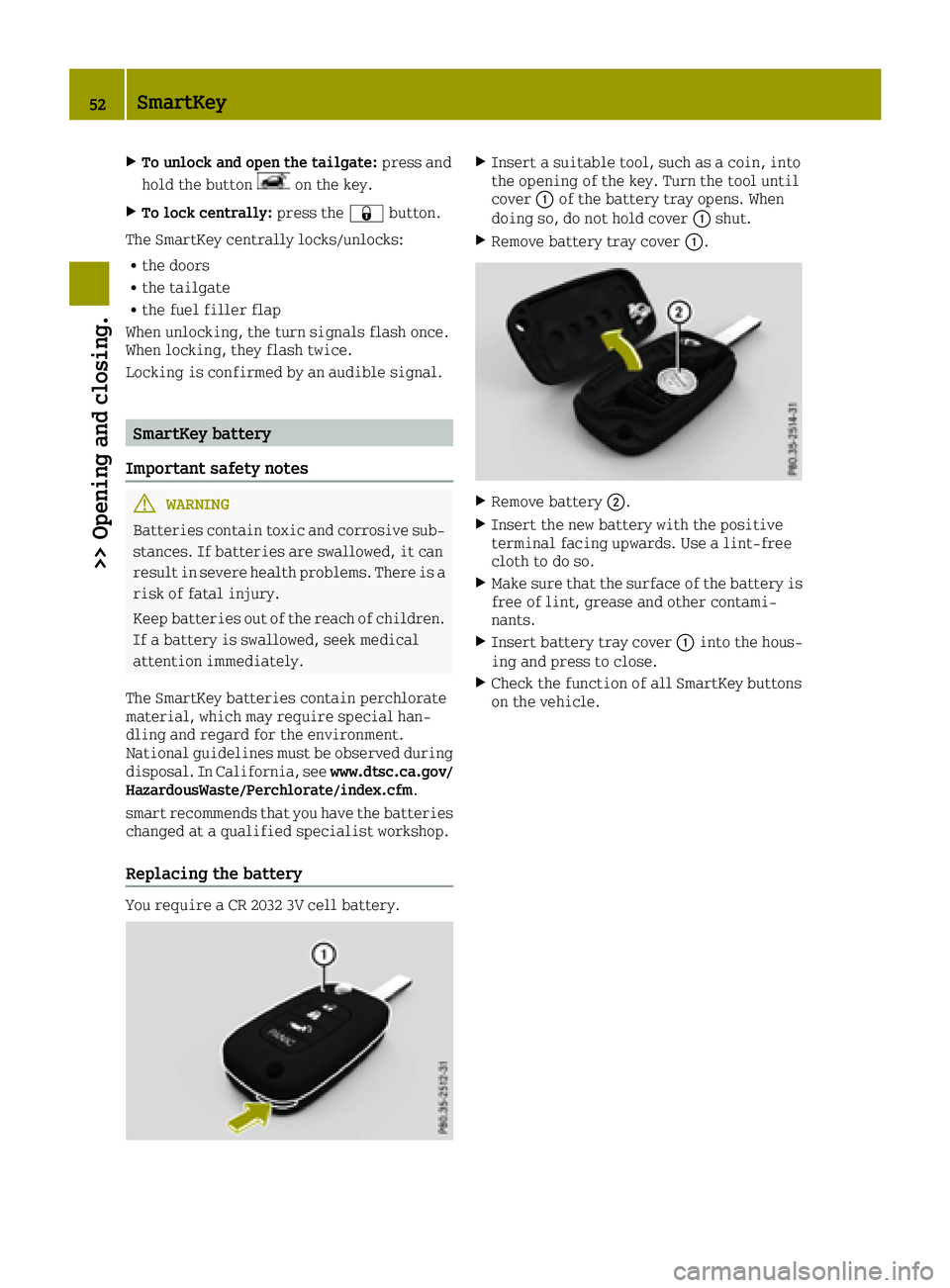
Replacing the battery
You require a CR 2032 3V cell battery.
XInsert a suitable tool, such as a coin, into
the opening of the key. Turn the tool until
cover 0043of the battery tray opens. When
doing so, do not hold cover 0043shut.
XRemove battery tray cover 0043.
XRemove battery0044.
XInsert the new battery with the positive
terminal facing upwards. Use a lint-free
cloth to do so.
XMake sure that the surface of the battery is
free of lint, grease and other contami-
nants.
XInsert battery tray cover 0043into the hous-
ing and press to close.
XCheck the function of all SmartKey buttons
on the vehicle.
52SmartKey
>> Opening and closing.
Page 56 of 214
Doors
Important safety notes
GWARNING
If children are left unsupervised in the
vehicle, they could:
Ropen the doors, thus endangering other
people or road users.
Rget out and disrupt traffic.
Roperate the vehicle's equipment.
Additionally, children could set the vehi-
cle in motion if, for example, they:
Rrelease the parking brake.
Rshift the automatic transmission out of
park position P or shift manual trans-
mission into neutral.
Rstart the engine.
There is a risk of an accident and injury.
When leaving the vehicle, always take the
SmartKey with you and lock the vehicle.
Never leave children or animals unattended
in the vehicle. Always keep the SmartKey
out of reach of children.
Preferably stow luggage or loads in the lug-
gage compartment. Observe the loading
guidelines (
Ypage 142).
Unlocking and opening doors from the
inside
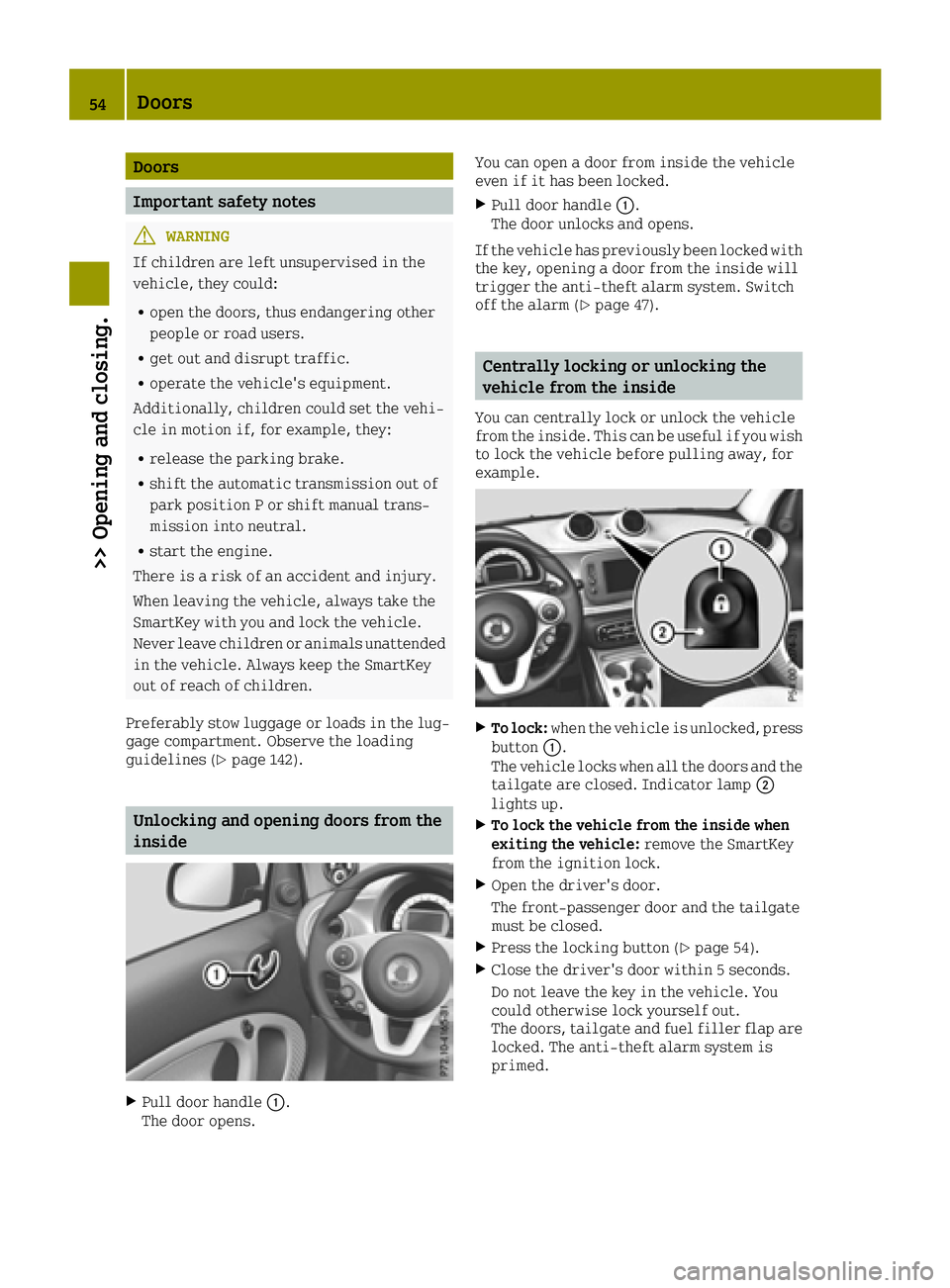
XPull door handle 0043.
The door opens. You can open a door from inside the vehicle
even if it has been locked.
XPull door handle
0043.
The door unlocks and opens.
If the vehicle has previously been locked with
the key, opening a door from the inside will
trigger the anti-theft alarm system. Switch
off the alarm (
Ypage 47).
Centrally locking or unlocking the
vehicle from the inside
You can centrally lock or unlock the vehicle
from the inside. This can be useful if you wish
to lock the vehicle before pulling away, for
example.
XTo lock: when the vehicle is unlocked, press
button 0043.
The vehicle locks when all the doors and the tailgate are closed. Indicator lamp 0044
lights up.
XTo lock the vehicle from the inside when
exiting the vehicle: remove the SmartKey
from the ignition lock.
XOpen the driver's door.
The front-passenger door and the tailgate
must be closed.
XPress the locking button (Ypage 54).
XClose the driver's door within 5 seconds.
Do not leave the key in the vehicle. You
could otherwise lock yourself out.
The doors, tailgate and fuel filler flap are
locked. The anti-theft alarm system is
primed.
54Doors
>> Opening and closing.
Page 58 of 214
XRemove the SmartKey from the ignition
lock.
XOpen the driver's door.
XClose the front-passenger door and the
tailgate.
XPress the locking button (Ypage 54).
XClose the driver's door within 5 seconds.
Do not leave the key in the vehicle. You
could otherwise lock yourself out.
The doors, tailgate and fuel filler flap are
locked. The anti-theft alarm system is
primed.
XMake sure that the doors and the tailgate
are locked.
If this does not work, use the emergency lock-
ing.
XOpen the driver's door.
XClose the front-passenger door and the
tailgate.
XPress the locking button (Ypage 54).
XCheck whether the front-passenger door is
locked. If necessary, carry out the follow-
ing steps on both doors.
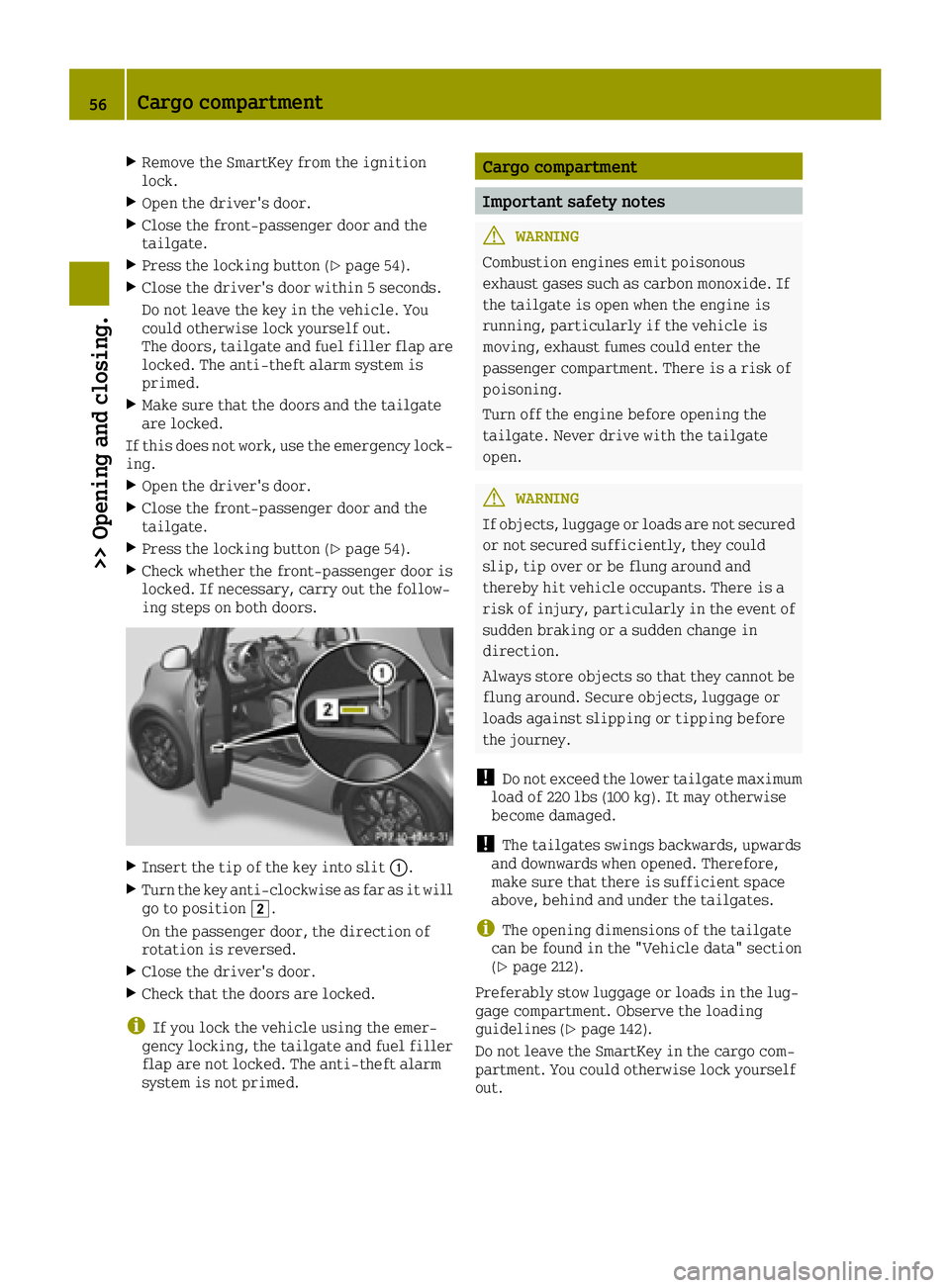
XInsert the tip of the key into slit 0043.
XTurn the key anti-clockwise as far as it will
go to position0048.
On the passenger door, the direction of
rotation is reversed.
XClose the driver's door.
XCheck that the doors are locked.
iIf you lock the vehicle using the emer-
gency locking, the tailgate and fuel filler
flap are not locked. The anti-theft alarm
system is not primed.
Cargo compartment
Important safety notes
GWARNING
Combustion engines emit poisonous
exhaust gases such as carbon monoxide. If
the tailgate is open when the engine is
running, particularly if the vehicle is
moving, exhaust fumes could enter the
passenger compartment. There is a risk of
poisoning.
Turn off the engine before opening the
tailgate. Never drive with the tailgate
open.
GWARNING
If objects, luggage or loads are not secured or not secured sufficiently, they could
slip, tip over or be flung around and
thereby hit vehicle occupants. There is a
risk of injury, particularly in the event of
sudden braking or a sudden change in
direction.
Always store objects so that they cannot be
flung around. Secure objects, luggage or
loads against slipping or tipping before
the journey.
!Do not exceed the lower tailgate maximum
load of 220 lbs (100 kg). It may otherwise
become damaged.
!The tailgates swings backwards, upwards
and downwards when opened. Therefore,
make sure that there is sufficient space
above, behind and under the tailgates.
iThe opening dimensions of the tailgate
can be found in the "Vehicle data" section
(
Ypage 212).
Preferably stow luggage or loads in the lug-
gage compartment. Observe the loading
guidelines (
Ypage 142).
Do not leave the SmartKey in the cargo com-
partment. You could otherwise lock yourself
out.
56Cargo compartment
>> Opening and closing.