ECU SMART FORTWO 2016 User Guide
[x] Cancel search | Manufacturer: SMART, Model Year: 2016, Model line: FORTWO, Model: SMART FORTWO 2016Pages: 214, PDF Size: 4.93 MB
Page 45 of 214
heat or cold, there is a risk of injury, pos-
sibly even fatal. Never leave children
unattended in the vehicle.
GWARNING
If the child restraint system is subjected to
direct sunlight, parts may get very hot.
Children may burn themselves on these
parts, particularly on the metal parts of the
child restraint system. There is a risk of
injury.
If you leave the vehicle, taking the child
with you, always ensure that the child
restraint system is not exposed to direct
sunlight. Protect it with a blanket, for
example. If the child restraint system has
been exposed to direct sunlight, let it cool
down before securing the child in it. Never
leave children unattended in the vehicle.
Always ensure that all vehicle occupants have
their seat belts fastened correctly and are
sitting properly. Particular attention must
be paid to children.
Read and follow the safety notes on the seat
belt (
Ypage 31) and the notes on correct use of
the seat belts (Ypage 32).
A booster seat may be necessary to achieve
proper seat belt positioning for children
over 41 lbs (18 kg) until they reach a height
where a lap/shoulder belt fits properly with-
out a booster seat.
Special seat belt retractor
GWARNING
If the seat belt is released while driving,
the child restraint system will no longer be
secured properly. The special seat belt
retractor is disabled and the inertia real
draws in a portion of the seat belt. The seat belt cannot be immediately refastened.
There is an increased risk of injury, pos-
sibly even fatal.
Stop the vehicle immediately, paying
attention to road and traffic conditions.
Reactivate the special seat belt retractor
and secure the child restraint system prop-erly.
The seat belt on the front-passenger side is
equipped with a special seat belt retractor.
When activated, the special seat belt retrac-
tor ensures that the seat belt will not slacken once the child restraint system has been
secured.
Installing a child restraint system:
XAlways comply with the child restraint sys-
tem manufacturer's installation instruc-
tions.
XPull the seat belt smoothly from the belt
loop.
XEngage the seat belt tongue in the belt
buckle.
Activating the special seat belt retractor:
XPull the seat belt out fully and let the seat
belt retractor retract it again.
While the seat belt is retracting, you
should hear a ratcheting sound. The special seat belt retractor is activated.
XPress the child restraint system down so
that the seat belt fits tightly and does not
slacken.
Removing a child restraint system and deac-
tivating the special seat belt retractor:
XAlways comply with the child restraint sys-
tem manufacturer's installation instruc-
tions.
XPress the seat belt buckle release button,
hold the belt tongue firmly and guide it
back towards the belt outlet.
The special seat belt retractor is deacti-
vated.
Child restraint system
The use of seat belts and child restraint sys- tems is required by law in:
Rall 50 states
Rthe U.S. territories
Rthe District of Columbia
Rall Canadian provinces
You can obtain further information about the correct child restraint system from any
authorized Mercedes-Benz Center.
Children in the vehicle43
>> Safety.
Z
Page 46 of 214
GWARNING
If the child restraint system is installed
incorrectly on a suitable seat, it cannot
protect as intended. The child cannot then
be restrained in the event of an accident,
heavy braking or sudden changes of direc-
tion. There is an increased risk of injury,
possibly even fatal.
Make sure that you observe the child
restraint system manufacturer's installa-
tion instructions and the notes on use.
Please ensure, that the base of the child
restraint system is always resting com-
pletely on the seat cushion. Never place
objects, e.g. cushions, under or behind the
child restraint system. Only use child
restraint systems with the original cover
designed for them. Only replace damaged
covers with genuine covers.
GWARNING
If the child restraint system is installed
incorrectly or is not secured, it can come
loose in the event of an accident, heavy
braking or a sudden change in direction.
The child restraint system could be thrown
about, striking vehicle occupants. There is an increased risk of injury, possibly even
fatal.
Always install child restraint systems
properly, even if they are not being used.
Make sure that you observe the child
restraint system manufacturer's installa-
tion instructions.
You will find further information on stowing
objects, luggage or loads under "Loading
guidelines" (
Ypage 142).
GWARNING
Child restraint systems or their securing
systems which have been damaged or sub-
jected to a load in an accident can no longer protect as intended. The child cannot then
be restrained in the event of an accident,
heavy braking or sudden changes of direc-
tion. There is an increased risk of injury,
possibly even fatal.
Replace child restraint systems which have
been damaged or subjected to a load in an
accident as soon as possible. Have the
securing systems on the child restraint
system checked at a qualified specialist
workshop, before you install a child
restraint system again.
Securing systems for child restraint systems
include:
Rthe seat belt system
Rthe Top Tether anchorages
iIf you install a child restraint system on
the front-passenger seat, make sure that
the backrest is securely engaged
(
Ypage 63).
iIf a child is carried on the front-
passenger seat, be sure to observe the
information on "Child restraint systems on
the front-passenger seat" (
Ypage 45).
There you will also find information on
disabling the front-passenger front air-
bag.
All child restraint systems must meet the fol-
lowing standards:
RU.S. Federal Motor Vehicle Safety Stand-
ards 213 and 225
RCanadian Motor Vehicle Safety Standards
213 and 210.2
Confirmation that the child restraint system
corresponds to the standards can be found on
an instruction label on the child restraint
system. This confirmation can also be found
in the installation instructions that are
included with the child restraint system.
Observe the warning labels in the vehicle
interior and on the child restraint system.
Top Tether
Introduction
Top Tether provides an additional connec-
tion between the child restraint system and
the vehicle. This helps reduce the risk of
injury even further. If the child restraint
44Children in the vehicle
>> Safety.
Page 47 of 214
system is fitted with a Top Tether belt, this
should always be used.
Top Tether anchorages
0043Loop
0044Top Tether anchorage
0044Top Tether anchorage
0087Top Tether hook
0085Top Tether belt
Top Tether anchorage 0044is fitted to the lug-
gage compartment floor.
XRoute Top Tether belt 0085back over the head
restraint, keeping it as central as possi-
ble, into the luggage compartment through
loop 0043.
XHook Top Tether hook 0087of Top Tether belt
0087 into Top Tether anchorage 0044.
Lift up the carpet a little if necessary.
Make sure that:
RTop Tether hook 0087is hooked into Top
Tether anchorage 0044as shown.
RTop Tether belt 0085is not twisted.
XTension Top Tether belt 0085. Always comply
with the child restraint system manufac-
turer's installation instructions when
doing so.
Child restraint system on the front-
passenger seat
General notes
If you secure a child in a child restraint sys-
tem on the front-passenger seat, be sure to
observe the instructions and safety notes on
the "Occupant Classification System (OCS)"
(
Ypage 36).
You can thus avoid the risks that could arise
as a result of:
Ran incorrectly categorized person in the
front-passenger seat
Rthe unsuitable positioning of the child
restraint system, e.g. too close to the dash-
board
Rearward-facing child restraint system
If it is absolutely necessary to fit a rear-
ward-facing child restraint system to the
front-passenger seat, always make sure that
the front-passenger front airbag is disa-
bled. Only if the PASSENGER AIR BAG OFF
indicator lamp is permanently lit is the
front-passenger front airbag disabled.
Always observe the child restraint system
manufacturer's installation and operating
instructions.
Forward-facing child restraint system
If you secure a child in a forward-facing
child restraint system on the front-
passenger seat, always move the front-
passenger seat as far back as possible. Always
make sure that the shoulder belt strap is cor-
rectly routed from the front-passenger seat
belt guide to the shoulder belt guide on the
child restraint system. The shoulder belt
strap must be routed forwards and downwards
from the front-passenger seat belt guide. If
necessary, adjust the front-passenger seat
accordingly.
Always observe the child restraint system
manufacturer's installation and operating
instructions.
Children in the vehicle45
>> Safety.
Z
Page 48 of 214
Pets in the vehicle
GWARNING
If you leave animals unattended or unse-
cured in the vehicle, they could press but-
tons or switches, for example.
As a result, they could:
Ractivate vehicle equipment and become
trapped, for example
Ractivate or deactivate systems, thereby
endangering other road users
Unsecured animals could also be flung
around the vehicle in the event of an acci- dent or sudden steering or braking, thereby
injuring vehicle occupants. There is a risk
of an accident and injury.
Never leave animals unattended in the
vehicle. Always secure animals properly
during the journey, e.g. use a suitable ani-
mal transport box.
Protection against theft
Immobilizer
The immobilizer prevents your vehicle from
being started without the correct Smart Key.
XTo activate: remove the Smart Key from the
ignition lock.
XTo deactivate: switch on the ignition.
When leaving the vehicle, always take the
Smart Key with you and lock the vehicle. The
engine can be started by anyone with a valid
Smart Key that is left inside the vehicle.
iThe immobilizer is always deactivated
when you start the engine.
In the event that the engine cannot be star-
ted when the starter battery is fully
charged, the immobilizer may be faulty.
Contact an authorized Mercedes-Benz Cen-
ter or call 1-800-367-6372 (in USA) or
1-800-387-0100 (in Canada).
Anti-theft alarm system
Switching on
XMake sure that:
Rthe side windows are closed.
Rno objects, such as mascots, are hanging
from the rear-view mirror or grab han-
dles.
This will prevent false alarms.
XMake sure that:
Rthe doors are closed.
Rthe tailgate is closed
Rthe service cover is closed.
XPress the 0037button on the key.
The alarm system is primed after approx-
imately 30 seconds.
iIf the service cover is open or is not
properly closed, the vehicle will be
locked. The anti-theft alarm system is
primed. To remind you that the service
cover is not secured, a warning tone sounds
for 30 seconds. Ensure that the service
cover is properly closed. Only then is the
anti-theft alarm system correctly primed
and the service cover properly secured.
Switching off
XPress the 0036button on the key.
or
XUnlock the vehicle by using the key in the
emergency lock.
and
Switch on the ignition.
Examples for triggering the alarm
A visual and audible alarm is triggered if the
alarm system is armed and you open:
Rthe vehicle by using the key in the emer-
gency lock
Ra door
Rthe tailgate
Rthe service cover
46Protection against theft
>> Safety.
Page 58 of 214
XRemove the SmartKey from the ignition
lock.
XOpen the driver's door.
XClose the front-passenger door and the
tailgate.
XPress the locking button (Ypage 54).
XClose the driver's door within 5 seconds.
Do not leave the key in the vehicle. You
could otherwise lock yourself out.
The doors, tailgate and fuel filler flap are
locked. The anti-theft alarm system is
primed.
XMake sure that the doors and the tailgate
are locked.
If this does not work, use the emergency lock-
ing.
XOpen the driver's door.
XClose the front-passenger door and the
tailgate.
XPress the locking button (Ypage 54).
XCheck whether the front-passenger door is
locked. If necessary, carry out the follow-
ing steps on both doors.
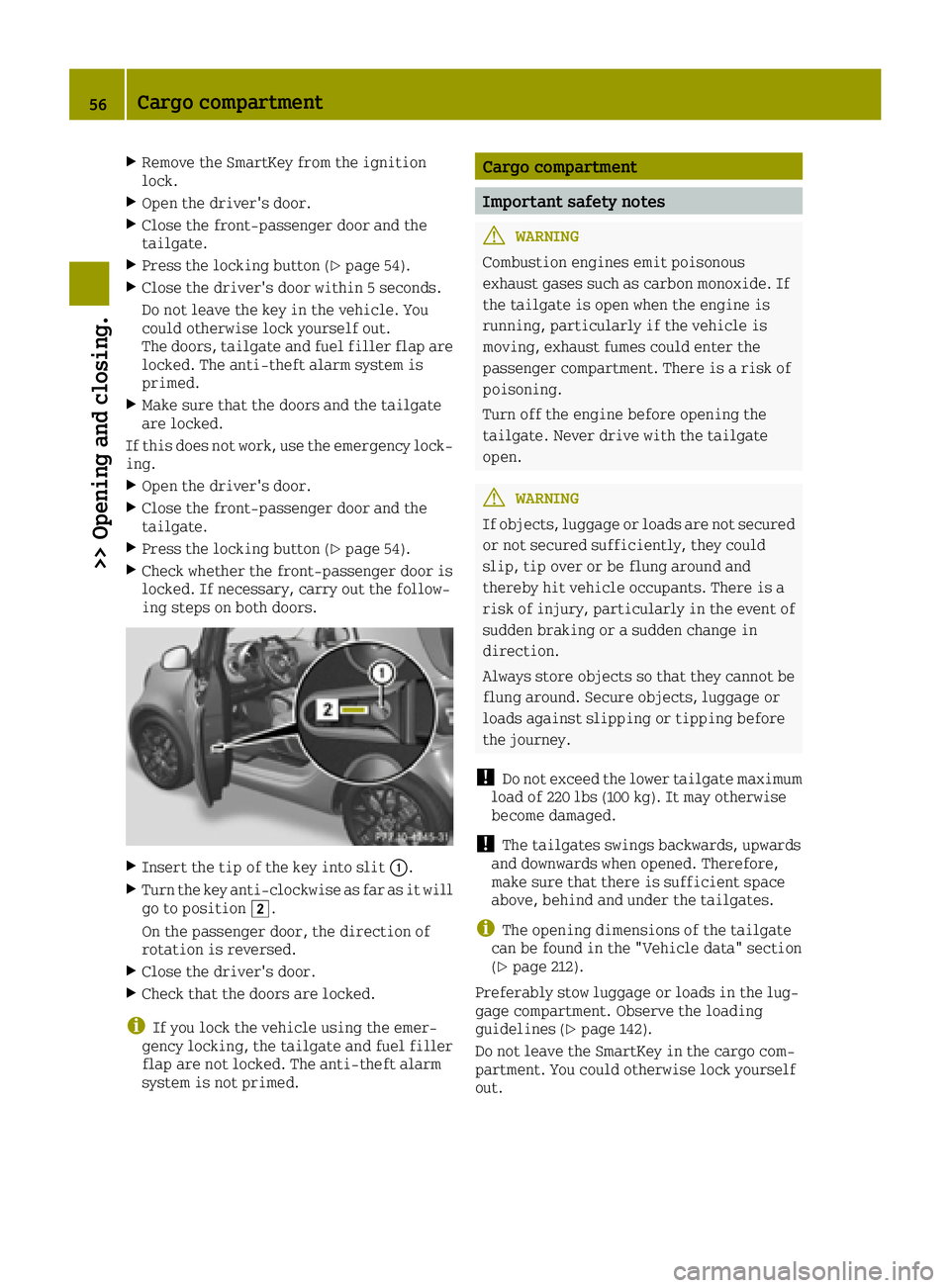
XInsert the tip of the key into slit 0043.
XTurn the key anti-clockwise as far as it will
go to position0048.
On the passenger door, the direction of
rotation is reversed.
XClose the driver's door.
XCheck that the doors are locked.
iIf you lock the vehicle using the emer-
gency locking, the tailgate and fuel filler
flap are not locked. The anti-theft alarm
system is not primed.
Cargo compartment
Important safety notes
GWARNING
Combustion engines emit poisonous
exhaust gases such as carbon monoxide. If
the tailgate is open when the engine is
running, particularly if the vehicle is
moving, exhaust fumes could enter the
passenger compartment. There is a risk of
poisoning.
Turn off the engine before opening the
tailgate. Never drive with the tailgate
open.
GWARNING
If objects, luggage or loads are not secured or not secured sufficiently, they could
slip, tip over or be flung around and
thereby hit vehicle occupants. There is a
risk of injury, particularly in the event of
sudden braking or a sudden change in
direction.
Always store objects so that they cannot be
flung around. Secure objects, luggage or
loads against slipping or tipping before
the journey.
!Do not exceed the lower tailgate maximum
load of 220 lbs (100 kg). It may otherwise
become damaged.
!The tailgates swings backwards, upwards
and downwards when opened. Therefore,
make sure that there is sufficient space
above, behind and under the tailgates.
iThe opening dimensions of the tailgate
can be found in the "Vehicle data" section
(
Ypage 212).
Preferably stow luggage or loads in the lug-
gage compartment. Observe the loading
guidelines (
Ypage 142).
Do not leave the SmartKey in the cargo com-
partment. You could otherwise lock yourself
out.
56Cargo compartment
>> Opening and closing.
Page 78 of 214
Always switch off the windshield wipers
and ignition before changing the wiper
blades.
!To avoid damaging the wiper blades, make
sure that you touch only the wiper arm of the
wiper.
!Never open the service cover/tailgate if a
windshield wiper arm has been folded away
from the windshield/rear window.
Never fold a windshield wiper arm without
a wiper blade back onto the windshield/
rear window.
Hold the windshield wiper arm firmly when
you change the wiper blade. If you release
the wiper arm without a wiper blade and it
falls onto the windshield/rear window, the
windshield/rear window may be damaged by
the force of the impact.
smart recommends that you have the wiper
blades changed at a qualified specialist
workshop.
Changing the windshield wiper blades
Removing the wiper blades
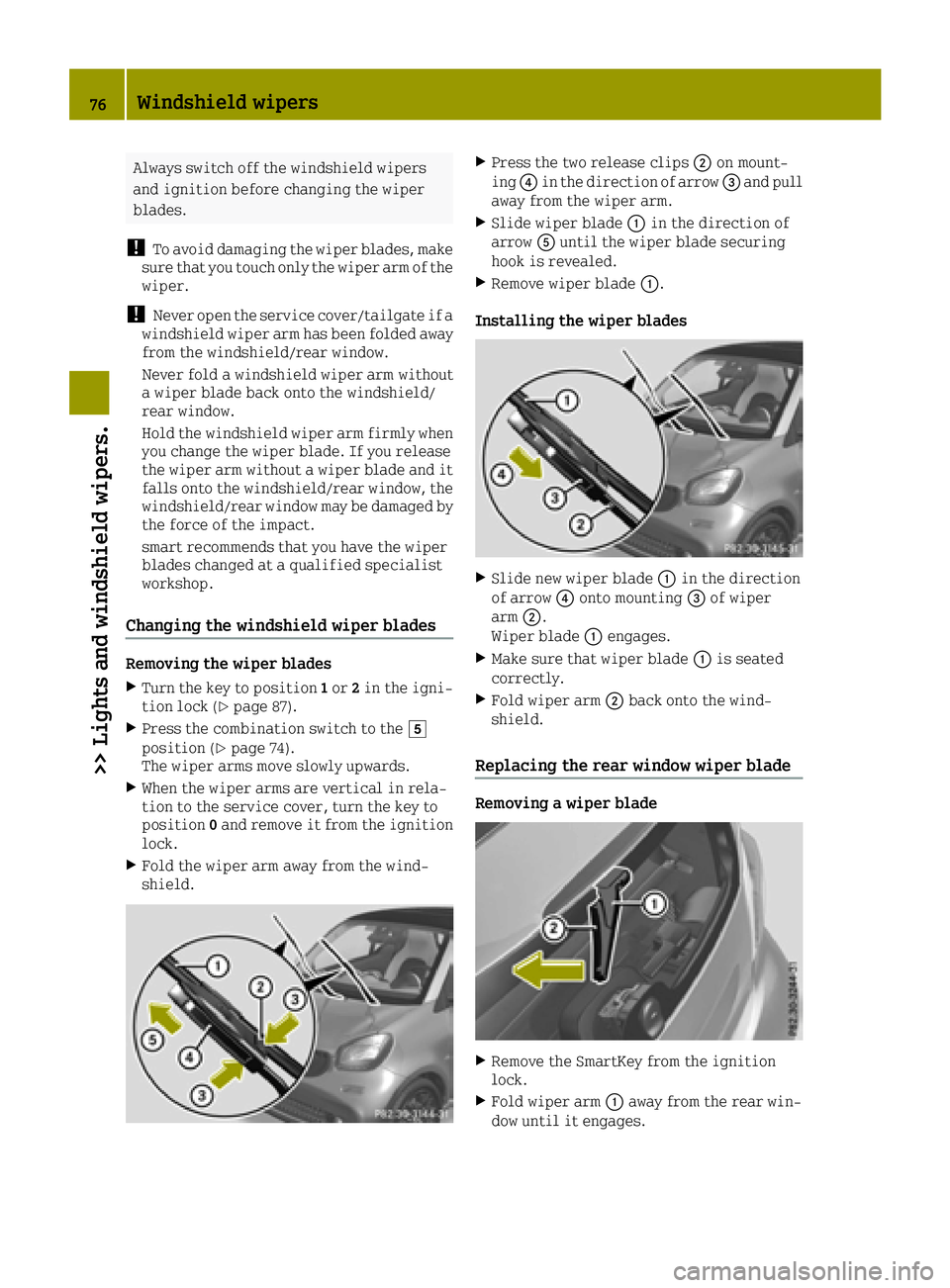
XTurn the key to position 1or 2in the igni-
tion lock (Ypage 87).
XPress the combination switch to the 004B
position (Ypage 74).
The wiper arms move slowly upwards.
XWhen the wiper arms are vertical in rela-
tion to the service cover, turn the key to
position 0and remove it from the ignition
lock.
XFold the wiper arm away from the wind-
shield.
XPress the two release clips 0044on mount-
ing 0085in the direction of arrow 0087and pull
away from the wiper arm.
XSlide wiper blade 0043in the direction of
arrow 0083until the wiper blade securing
hook is revealed.
XRemove wiper blade 0043.
Installing the wiper blades
XSlide new wiper blade 0043in the direction
of arrow 0085onto mounting 0087of wiper
arm 0044.
Wiper blade 0043engages.
XMake sure that wiper blade 0043is seated
correctly.
XFold wiper arm 0044back onto the wind-
shield.
Replacing the rear window wiper blade
Removing a wiper blade
XRemove the SmartKey from the ignition
lock.
XFold wiper arm 0043away from the rear win-
dow until it engages.
76Windshield wipers
>> Lights and windshield wipers.
Page 88 of 214
Useful information
i
This Operator's Manual describes all
models and all standard and optional
equipment of your vehicle available at the
time of publication of the Operator's Man- ual. Country-specific differences are pos-
sible. Bear in mind that your vehicle may
not feature all functions described here.
This also applies to safety-relevant sys-
tems and functions.
iRead the information on qualified spe-
cialist workshops: (Ypage 20).
Notes on breaking-in a new vehicle
Important safety notes
In certain driving and driving safety sys-
tems, the sensors adjust automatically while
a certain distance is being driven after the
vehicle has been delivered or after repairs.
Full system effectiveness is not reached until
the end of this teach-in procedure.
New and replaced brake pads and discs only
reach their optimum braking effect after sev-
eral hundred kilometers of driving. Compen-
sate for this by applying greater force to the brake pedal.
The first 1000 miles (1500 km)
The more you look after the engine when it is
new, the more satisfied you will be with its
performance in the future.
RYou should therefore drive at varying vehi-
cle and engine speeds for the first
1000 miles (1500 km).
RAvoid heavy loads, e.g. driving at full
throttle, during this period.
RChange gear in good time, before the tach-ometer needle is 00C3of the way to the red
area of the tachometer.
RDo not manually shift to a lower gear to
brake the vehicle.
RVehicles with automatic transmission: if
possible, do not depress the accelerator pedal beyond the pressure point (kick-
down).
RVehicles with automatic transmission:
ideally, for the first 1000 miles(1500 km),
drive in program
E(Comfort).
After 1000 miles (1500 km), you can increase
the engine speed gradually and bring the
vehicle to full speed.
You should also observe these notes on run-
ning-in if the engine or parts of the drive
train on your vehicle have been replaced.
Observe the maximum permissible speed.
Driving
Important safety notes
GWARNING
Objects in the driver's footwell can
restrict the pedal travel or obstruct a
depressed pedal. The operating and road
safety of the vehicle is jeopardized. There
is a risk of an accident.
Make sure that all objects in the vehicle are
stowed correctly, and that they cannot enter
the driver's footwell. Install the floormats securely and as specified in order to
ensure sufficient clearance for the pedals.
Do not use loose floormats and do not place
floormats on top of one another.
GWARNING
Unsuitable footwear can hinder correct
usage of the pedals, e.g.:
Rshoes with thick soles
Rshoes with high heels
Rslippers
There is a risk of an accident.
Wear suitable footwear to ensure correct
usage of the pedals.
GWARNING
If you switch off the ignition while driv-
ing, safety-relevant functions are only
available with limitations, or not at all.
This could affect, for example, the power
86Driving
>> Driving and parking.
Page 95 of 214
Transmission positions
0045Park position
This prevents the vehicle from
rolling away when stopped.
Only shift the transmission into
positionP(
Ypage 92) when the
vehicle is stationary. The parking
lock should not be used as a brake
when parking. Always apply the
parking brake in addition to the
parking lock in order to secure the
vehicle.
The key can only be removed if the
transmission is in position P. If
the SmartKey is removed from the
ignition lock, the selector lever is
locked.
In the event of a malfunction of the
vehicle's electronics, the trans-
mission may lock. Information on
manually disconnecting the selec-
tor lever lock (
Ypage 97).
Have the vehicle electronics
checked immediately at a quali-
fied specialist workshop.
0046Reverse gear
Only shift the transmission into
position Rwhen the vehicle is sta-
tionary.
0044Neutral
Do not shift the transmission to N
while driving. Otherwise, the
automatic transmission could be
damaged.
No power is transmitted from the
engine to the drive wheels.
Releasing the parking brake and
brake pedal will allow you to move
the vehicle freely, e.g. to push it or
tow it away.
If esp
®is deactivated or faulty:
shift the transmission to position
N if the vehicle is in danger of
skidding, e.g. on icy roads.
!Rolling in neutral Ncan dam-
age the drive train.
003ADrive
The automatic transmission
changes gear automatically. All
forward gears are available.
Driving tips
Changing gear
The automatic transmission shifts to the
individual gears automatically when it is in
transmission position D. This automatic
gearshifting behavior is determined by:
Rthe selected drive program:
Rthe position of the accelerator pedal
Rthe road speed
Accelerator pedal position
Your style of driving influences how the auto-
matic transmission shifts gear:
Rlittle throttle: early upshifts
Rmore throttle: late upshifts
Automatic transmission93
>> Driving and parking.
Z
Page 102 of 214
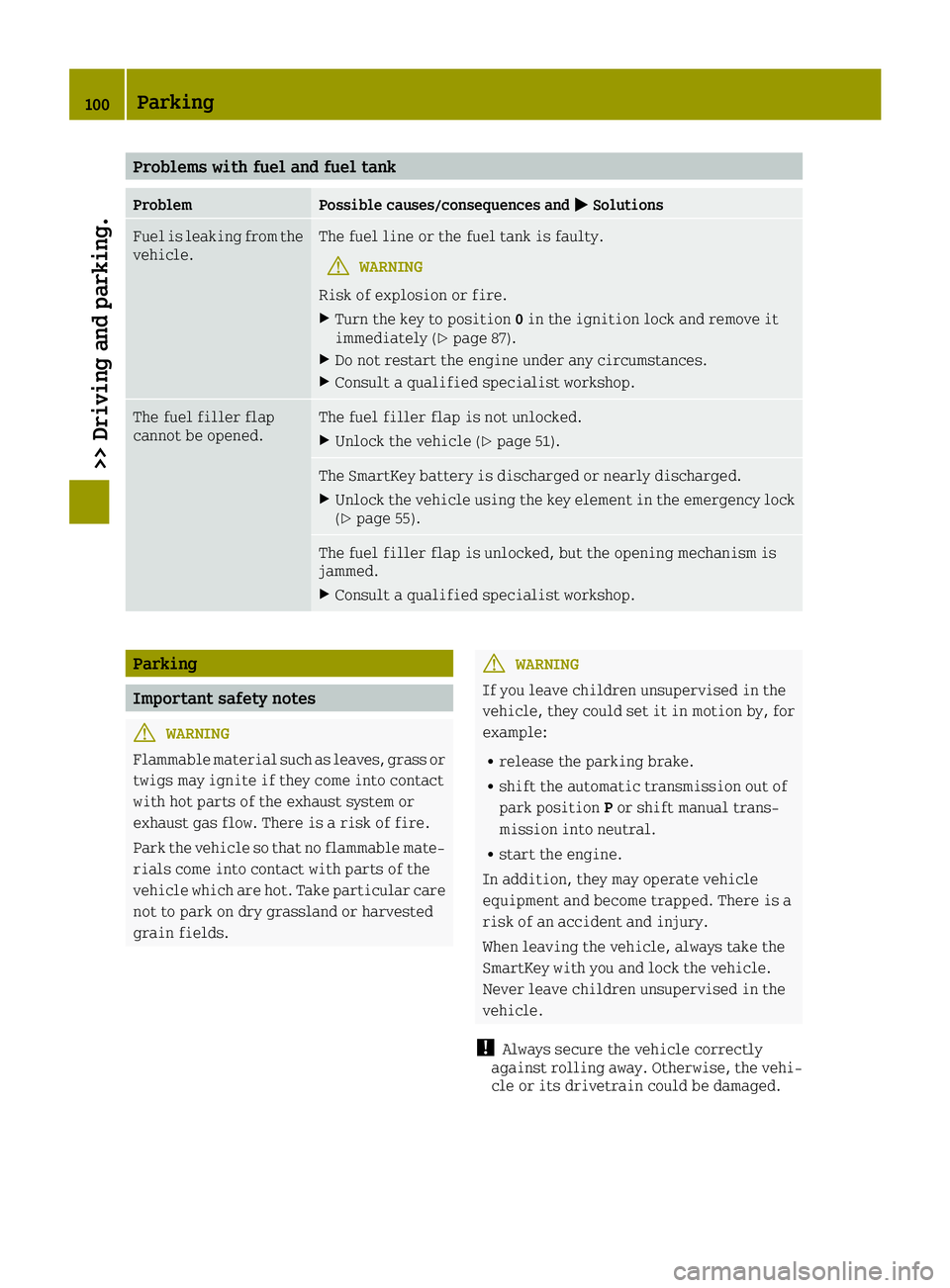
Problems with fuel and fuel tank
ProblemPossible causes/consequences and0050Solutions
Fuel is leaking from the
vehicle.The fuel line or the fuel tank is faulty.
GWARNING
Risk of explosion or fire.
XTurn the key to position 0in the ignition lock and remove it
immediately (Ypage 87).
XDo not restart the engine under any circumstances.
XConsult a qualified specialist workshop.
The fuel filler flap
cannot be opened.The fuel filler flap is not unlocked.
XUnlock the vehicle (Ypage 51).
The SmartKey battery is discharged or nearly discharged.
XUnlock the vehicle using the key element in the emergency lock
(Ypage 55).
The fuel filler flap is unlocked, but the opening mechanism is
jammed.
XConsult a qualified specialist workshop.
Parking
Important safety notes
GWARNING
Flammable material such as leaves, grass or
twigs may ignite if they come into contact
with hot parts of the exhaust system or
exhaust gas flow. There is a risk of fire.
Park the vehicle so that no flammable mate- rials come into contact with parts of the
vehicle which are hot. Take particular care
not to park on dry grassland or harvested
grain fields.
GWARNING
If you leave children unsupervised in the
vehicle, they could set it in motion by, for example:
Rrelease the parking brake.
Rshift the automatic transmission out of
park position Por shift manual trans-
mission into neutral.
Rstart the engine.
In addition, they may operate vehicle
equipment and become trapped. There is a
risk of an accident and injury.
When leaving the vehicle, always take the
SmartKey with you and lock the vehicle.
Never leave children unsupervised in the
vehicle.
!Always secure the vehicle correctly
against rolling away. Otherwise, the vehi-
cle or its drivetrain could be damaged.
100Parking
>> Driving and parking.
Page 103 of 214
To ensure that the vehicle is secured against
rolling away unintentionally:
Rthe parking brake must be applied.
Ra gear must be engaged on vehicles with
manual transmission.
Rthe selector lever must be in positionPon
vehicles with automatic transmission.
Rthe SmartKey must be removed from the
ignition lock.
Ron uphill or downhill gradients, the front
wheels must be turned towards the curb.
Switching off the engine
Important safety notes
GWARNING
The automatic transmission switches to
neutral position Nwhen you switch off the
engine. The vehicle may roll away. There is a risk of an accident.
After switching off the engine, always
switch to parking position P. Prevent the
parked vehicle from rolling away by apply-
ing the parking brake.
Vehicles with manual transmission
XSelect a gear.
XTurn the key to position 0in the ignition
lock and remove it.
The immobilizer is activated.
XApply the parking brake.
Vehicles with automatic transmission
XApply the parking brake.
XShift the transmission to position P.
XTurn the key to position0in the ignition
lock and remove it.
The immobilizer is activated.
The key can only be removed if the trans-
mission is in position P.
Parking brake
General notes
GWARNING
If you must brake the vehicle with the park-
ing brake, the braking distance is consid-
erably longer and the wheels could lock.
There is an increased danger of skidding
and accidents.
Only use the parking brake to brake the
vehicle when the service brake is faulty. Do
not apply the parking brake too firmly. If
the wheels lock, release the parking brake
until the wheels begin turning again.
GWARNING
If you leave children unsupervised in the
vehicle, they could set it in motion by, for example:
Rrelease the parking brake.
Rshift the automatic transmission out of
park position Por shift manual trans-
mission into neutral.
Rstart the engine.
In addition, they may operate vehicle
equipment and become trapped. There is a
risk of an accident and injury.
When leaving the vehicle, always take the
SmartKey with you and lock the vehicle.
Never leave children unsupervised in the
vehicle.
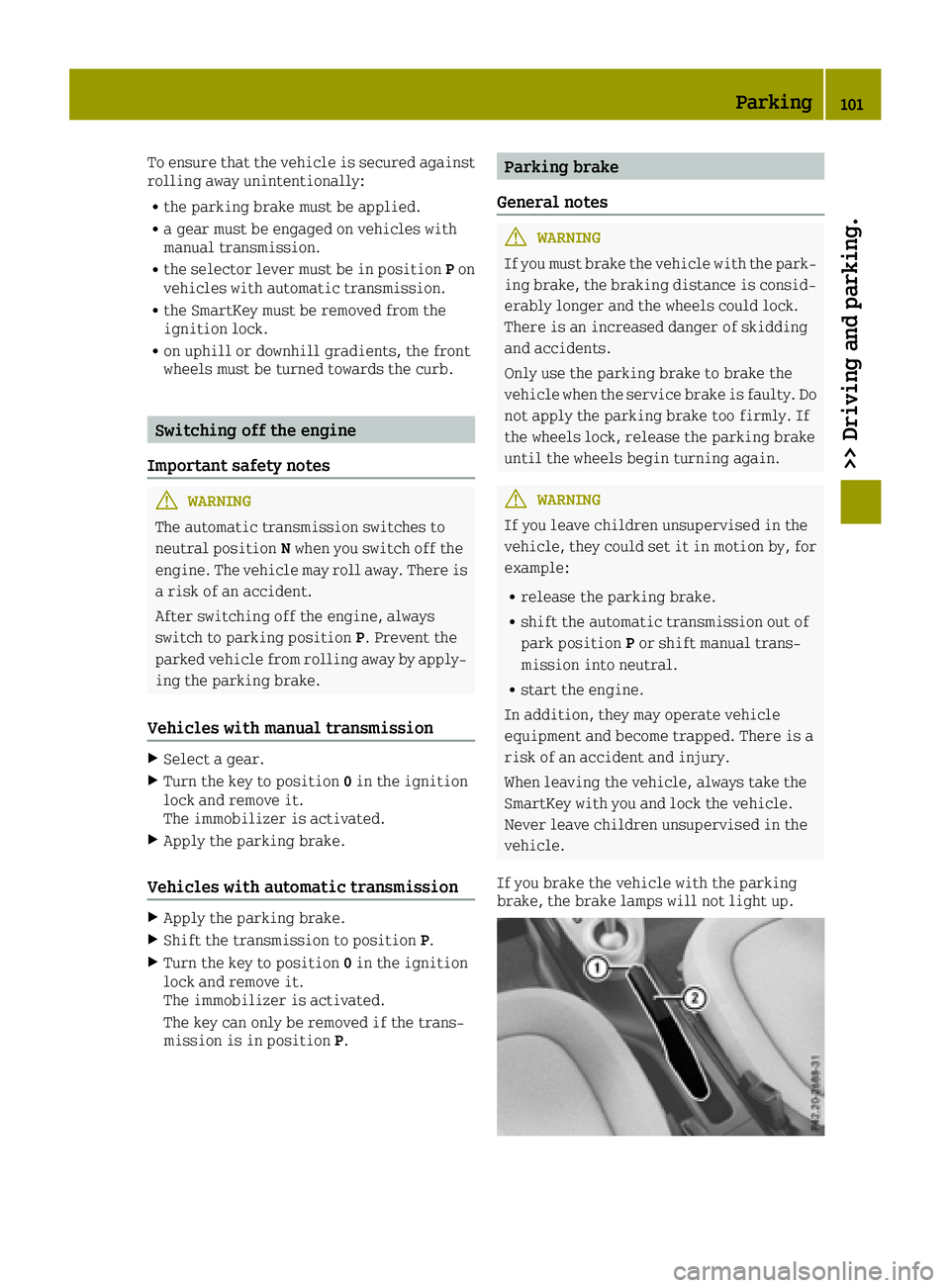
If you brake the vehicle with the parking
brake, the brake lamps will not light up.
Parking101
>> Driving and parking.
Z