ESP SMART FORTWO 2016 User Guide
[x] Cancel search | Manufacturer: SMART, Model Year: 2016, Model line: FORTWO, Model: SMART FORTWO 2016Pages: 214, PDF Size: 4.93 MB
Page 39 of 214
facing child restraint system must lie as flat
as possible against the backrest of the front-
passenger seat.
The child restraint system must not touch the
roof. Adjust the backrest angle accordingly.
Only then can OCS be guaranteed to function
correctly. Always observe the child restraint
system manufacturer's installation instruc-
tions.
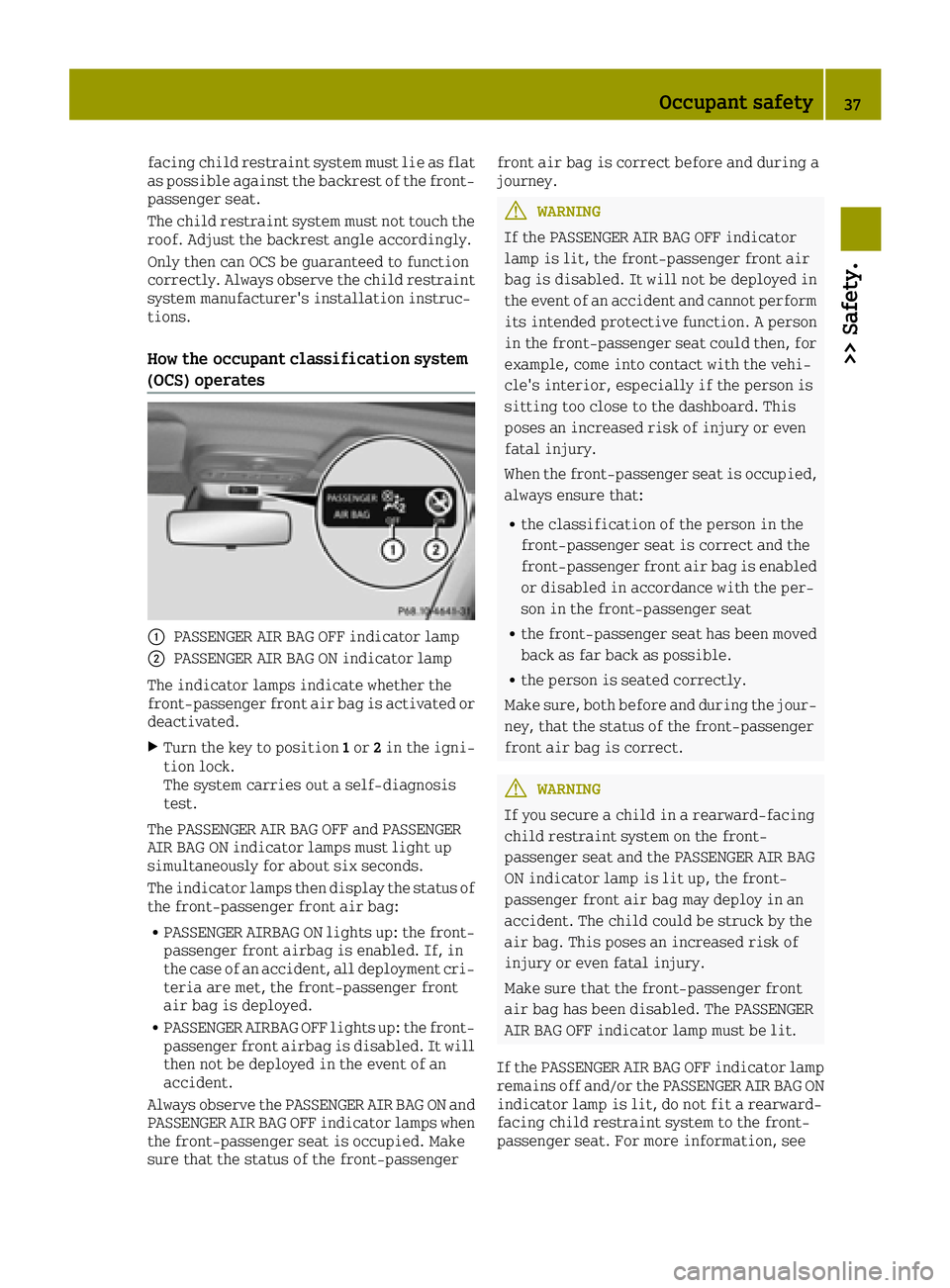
How the occupant classification system
(OCS) operates
0043PASSENGER AIR BAG OFF indicator lamp
0044PASSENGER AIR BAG ON indicator lamp
The indicator lamps indicate whether the
front-passenger front air bag is activated or
deactivated.
XTurn the key to position 1or 2in the igni-
tion lock.
The system carries out a self-diagnosis
test.
The PASSENGER AIR BAG OFF and PASSENGER
AIR BAG ON indicator lamps must light up
simultaneously for about six seconds.
The indicator lamps then display the status of
the front-passenger front air bag:
RPASSENGER AIRBAG ON lights up: the front-
passenger front airbag is enabled. If, in
the case of an accident, all deployment cri-
teria are met, the front-passenger front
air bag is deployed.
RPASSENGER AIRBAG OFF lights up: the front-
passenger front airbag is disabled. It will then not be deployed in the event of an
accident.
Always observe the PASSENGER AIR BAG ON and
PASSENGER AIR BAG OFF indicator lamps when
the front-passenger seat is occupied. Make
sure that the status of the front-passenger front air bag is correct before and during a
journey.
GWARNING
If the PASSENGER AIR BAG OFF indicator
lamp is lit, the front-passenger front air
bag is disabled. It will not be deployed in
the event of an accident and cannot perform
its intended protective function. A person
in the front-passenger seat could then, for
example, come into contact with the vehi-
cle's interior, especially if the person is
sitting too close to the dashboard. This
poses an increased risk of injury or even
fatal injury.
When the front-passenger seat is occupied, always ensure that:
Rthe classification of the person in the
front-passenger seat is correct and the
front-passenger front air bag is enabledor disabled in accordance with the per-
son in the front-passenger seat
Rthe front-passenger seat has been movedback as far back as possible.
Rthe person is seated correctly.
Make sure, both before and during the jour-
ney, that the status of the front-passenger
front air bag is correct.
GWARNING
If you secure a child in a rearward-facing
child restraint system on the front-
passenger seat and the PASSENGER AIR BAG
ON indicator lamp is lit up, the front-
passenger front air bag may deploy in an
accident. The child could be struck by the
air bag. This poses an increased risk of
injury or even fatal injury.
Make sure that the front-passenger front
air bag has been disabled. The PASSENGER
AIR BAG OFF indicator lamp must be lit.
If the PASSENGER AIR BAG OFF indicator lamp
remains off and/or the PASSENGER AIR BAG ON
indicator lamp is lit, do not fit a rearward-
facing child restraint system to the front-
passenger seat. For more information, see
Occupant safety37
>> Safety.
Z
Page 41 of 214
System self-test
GDANGER
If both the PASSENGER AIR BAG OFF and
PASSENGER AIR BAG ON indicator lamps do
not light up during the system self-test, the
system is malfunctioning. The front-
passenger front air bag might be triggered
unintentionally or might not be triggered
at all in the event of an accident with high
deceleration. This poses an increased risk
of injury or even fatal injury.
In this case the front-passenger seat may
not be used. Do not install a child restraint
system on the front-passenger seat. Have
the Occupant Classification System (OCS)
checked and repaired immediately at a
qualified specialist workshop.
GDANGER
If the PASSENGER AIR BAG OFF indicator
lamp remains lit after the system self-test, the front-passenger front air bag is disa-
bled. It will not be deployed in the event of
an accident. In this case, the front-
passenger front air bag cannot perform its
intended protective function, e.g. when a
person is seated in the front-passenger
seat.
That person could, for example, come into
contact with the vehicle's interior, espe-
cially if the person is sitting too close to
the dashboard. This poses an increased
risk of injury or even fatal injury.
When the front-passenger seat is occupied,
always ensure that:
Rthe classification of the person in the
front-passenger seat is correct and the
front-passenger front air bag is enabledor disabled in accordance with the per-
son in the front-passenger seat
Rthe person is seated properly with a cor-
rectly fastened seatbelt
Rthe front-passenger seat has been movedback as far back as possible
If the PASSENGER AIR BAG OFF indicator
lamp remains lit when it should not, the
front-passenger seat may not be used. Do
not install a child restraint system on the
front-passenger seat. Have the Occupant
Classification System (OCS) checked and
repaired immediately at a qualified spe-
cialist workshop.
GWARNING
Objects between the seat surface and the
child restraint system could affect OCS
operation. This could result in the front-
passenger air bag not functioning as
intended during an accident. This poses an increased risk of injury or even fatal
injury.
Do not place any objects between the seat
surface and the child restraint system. The
entire base of the child restraint system
must always rest on the seat cushion of the
front-passenger seat. The backrest of the
forward-facing child restraint system
must, as far as possible, be resting on the
backrest of the front-passenger seat.
Always comply with the child restraint sys-
tem manufacturer's installation instruc-
tions.
After the system self-test, the PASSENGER AIR
BAG OFF or PASSENGER AIR BAG ON indicator
lamp displays the status of the front-
passenger front air bag (
Ypage 37).
For more information about the OCS, see
"Problems with the Occupant Classification
System" (
Ypage 40).
Occupant safety39
>> Safety.
Z
Page 42 of 214
Problems with the occupant classification system (OCS)
Be sure to observe the notes on "System self-test" (Ypage 39).
ProblemPossible causes/consequences and0050Solutions
The PASSENGER AIR BAG
OFF indicator lamp
lights up and remains
lit, even though the
front-passenger seat is
occupied by an adult or
a person of a stature
corresponding to that
of an adult.The classification of the person on the front-passenger seat is
incorrect.
XMake sure the conditions for a correct classification of the
person on the front-passenger seat are met (Ypage 36).
XIf the PASSENGER AIR BAG OFF indicator lamp remains lit, the
front-passenger seat may not be used.
XHave the OCS checked at a smart center as soon as possible.
The PASSENGER AIR BAG
OFF indicator lamp
does not light up and/or
does not stay on.
The front-passenger
seat is:
Runoccupied
Roccupied with the
weight of a child up
to twelve months old
in a child restraint
system
OCS is malfunctioning.
XMake sure there is nothing between the seat cushion and the
child seat.
XMake sure that the entire base of the child restraint system rests
on the seat cushion of the front-passenger seat. The backrest of
the forward-facing child restraint system must lie as flat as
possible against the backrest of the front-passenger seat. If
necessary, adjust the position of the front-passenger seat.
XWhen installing the child restraint system, make sure that the
seat belt is tight. Do not pull the seat belt tight using the front-
passenger seat adjustment. This could result in the seat belt and
the child restraint system being pulled too tightly.
XCheck for correct installation of the child restraint system.
XMake sure that no objects are applying additional weight onto
the seat.
XIf the PASSENGER AIR BAG OFF indicator lamp remains off and/or
the PASSENGER AIR BAG ON indicator lamp lights up, do not
install a child restraint system on the front-passenger seat.
XHave the OCS checked at a smart center as soon as possible.
Deployment of belt tensioners and air
bags
Important safety notes
GWARNING
The air bag parts are hot after an air bag
has been deployed. There is a risk of
injury.
Do not touch the air bag parts. Have a
deployed air bag replaced at a qualified
specialist workshop as soon as possible.
GWARNING
A deployed air bag no longer offers any
protection and cannot provide the intended
protection in an accident. There is an
increased risk of injury.
Have the vehicle towed to a qualified spe-
cialist workshop in order to have a
deployed air bag replaced.
For your own safety and that of your front
passenger, it is important that you have
deployed air bags replaced and faulty air
bags repaired. This will help to make sure the
air bags continue to perform their protective
function for the vehicle occupants in the
event of a crash.
40Occupant safety
>> Safety.
Page 43 of 214
GWARNING
Pyrotechnic Emergency Tensioning Devices
that have been deployed are no longer
operational and are unable to perform
their intended protective function. This
poses an increased risk of injury or even
fatal injury.
Therefore, have pyrotechnic Emergency
Tensioning Devices which have been trig-
gered immediately replaced at a qualified
specialist workshop.
If Emergency Tensioning Devices are trig-
gered or air bags are deployed, you will hear
a bang, and a small amount of powder may also
be released. The 0075restraint system warn-
ing lamp lights up.
Only in rare cases will the bang affect your
hearing. The powder that is released gener-
ally does not constitute a health hazard, but it may cause short-term breathing difficulties
in people with asthma or other respiratory
problems. Provided it is safe to do so, you
should leave the vehicle immediately or open
the window in order to prevent breathing dif-
ficulties.
Air bags and pyrotechnic Emergency Tension-
ing Devices (ETDs) contain perchlorate mate-
rial, which may require special handling and
regard for the environment. National guide-
lines must be observed during disposal. In
California, see www.dtsc.ca.gov/
HazardousWaste/Perchlorate/index.cfm .
Method of operation
During the first stage of a collision, the
restraint system control unit evaluates
important physical data relating to vehicle
deceleration or acceleration, such as:
Rduration
Rdirection
Rintensity
Based on the evaluation of this data, the
restraint system control unit triggers the
Emergency Tensioning Devices during a fron- tal or rear collision. An Emergency Tensioning Device can only be
triggered, if:
Rthe ignition is switched on
Rthe components of the restraint system are
operational. You can find further informa-
tion under: "Restraint system warning
lamp" (
Ypage 30)
Rthe belt tongue has engaged in the belt
buckle of the respective seat
If the restraint system control unit detects a
more severe accident, further components of
the restraint system are activated independ- ently of each other in certain frontal colli-
sion situations:
RFront air bags as well as driver's and front-
passenger knee bags
RWindow curtain air bag, if the system
determines that deployment can offer
additional protection to that provided by
the seat belt
The front-passenger front air bag is activa-
ted or deactivated depending on the person on
the front-passenger seat. The front-
passenger front air bag can only deploy in an
accident if the PASSENGER AIR BAG ON indi-
cator lamp is lit. Observe the information on
the PASSENGER AIR BAG indicator lamps
(
Ypage 30).
Your vehicle has two-stage front air bags.
During the first deployment stage, the front
air bag is filled with propellant gas to
reduce the risk of injuries. The front air bag
is fully deployed with the maximum amount of
propellant gas if a second deployment
threshold is reached within a few millisec-
onds.
The activation threshold of the Emergency
Tensioning Devices and the air bag are
determined by evaluating the rate of vehicle
deceleration or acceleration which occurs at
various points in the vehicle. This process is
pre-emptive in nature. Deployment should
take place in good time at the start of the
collision.
The rate of vehicle deceleration or acceler-
ation and the direction of the force are
essentially determined by:
Rthe distribution of forces during the col-
lision
Rthe collision angle
Occupant safety41
>> Safety.
Z
Page 44 of 214
Rthe deformation characteristics of the
vehicle
Rthe characteristics of the object with
which the vehicle has collided
Factors which can only be seen and measured
after a collision has occurred do not play a
decisive role in the deployment of an air bag.
Nor do they provide an indication of air bag
deployment.
The vehicle can be deformed considerably,
without an air bag being deployed. This is the
case if only parts which are relatively easily deformed are affected and the rate of decel-
eration is not high. Conversely, air bags may
be deployed even though the vehicle suffers
only minor deformation. This is the case if,
for example, very rigid vehicle parts such as longitudinal body members are hit, and suf-
ficient deceleration occurs as a result.
If the control unit of the restraint system
detects a side impact or a vehicle rollover,
the relevant components of the restraint sys-
tem are activated separately depending on
the anticipated type of accident.
RThorax/pelvis air bag on the side of
impact, independently of the Emergency
Tensioning Device and the use of the seat
belt
The thorax/pelvis air bag on the front-
passenger side deploys under the following
conditions:
-the OCS system detects that the front-
passenger seat is occupied or
-the belt tongue is engaged in the belt
buckle of the front-passenger seat
RWindow curtain air bag on the side of
impact, independently of the use of the seat
belt and independently of whether the
front-passenger seat is occupied
RWindow curtain air bags on the driver's andfront-passenger side in certain situations
when the vehicle rolls over, if the system
determines that deployment can offer
additional protection to that provided by
the seat belt
REmergency Tensioning Devices, if the sys-
tem determines that deployment can offer
additional protection in this situation
iNot all air bags are deployed in an acci-
dent. The differ ent air bag systems work
independently of each other. How the air bag system works is determined
by the severity of the accident detected,
especially the vehicle deceleration or
acceleration and the apparent type of acci-
dent:
RFrontal collision
RSide impact
RRollover
Children in the vehicle
Important safety notes
If a child younger than 12 years and under 5 ft
(1.50 m) in height is traveling in the vehicle:
Ralways secure the child in a child restraint
system suitable for Mercedes-Benz vehi-
cles. The child restraint system must be
appropriate to the age, weight and size of
the child
Rbe sure to observe the instructions and
safety notes in this section in addition to
the child restraint system manufacturer's
installation instructions
Rbe sure to observe the instructions and
safety notes in "Occupant classification
system (OCS)" (
Ypage 36)
GWARNING
If you leave children unsupervised in the
vehicle, they could set it in motion by, for example:
Rrelease the parking brake.
Rshift the automatic transmission out of
park position Por shift manual trans-
mission into neutral.
Rstart the engine.
In addition, they may operate vehicle
equipment and become trapped. There is a
risk of an accident and injury.
When leaving the vehicle, always take the
SmartKey with you and lock the vehicle.
Never leave children unsupervised in the
vehicle.
GWARNING
If persons, particularly children are sub-
jected to prolonged exposure to extreme
42Children in the vehicle
>> Safety.
Page 46 of 214
GWARNING
If the child restraint system is installed
incorrectly on a suitable seat, it cannot
protect as intended. The child cannot then
be restrained in the event of an accident,
heavy braking or sudden changes of direc-
tion. There is an increased risk of injury,
possibly even fatal.
Make sure that you observe the child
restraint system manufacturer's installa-
tion instructions and the notes on use.
Please ensure, that the base of the child
restraint system is always resting com-
pletely on the seat cushion. Never place
objects, e.g. cushions, under or behind the
child restraint system. Only use child
restraint systems with the original cover
designed for them. Only replace damaged
covers with genuine covers.
GWARNING
If the child restraint system is installed
incorrectly or is not secured, it can come
loose in the event of an accident, heavy
braking or a sudden change in direction.
The child restraint system could be thrown
about, striking vehicle occupants. There is an increased risk of injury, possibly even
fatal.
Always install child restraint systems
properly, even if they are not being used.
Make sure that you observe the child
restraint system manufacturer's installa-
tion instructions.
You will find further information on stowing
objects, luggage or loads under "Loading
guidelines" (
Ypage 142).
GWARNING
Child restraint systems or their securing
systems which have been damaged or sub-
jected to a load in an accident can no longer protect as intended. The child cannot then
be restrained in the event of an accident,
heavy braking or sudden changes of direc-
tion. There is an increased risk of injury,
possibly even fatal.
Replace child restraint systems which have
been damaged or subjected to a load in an
accident as soon as possible. Have the
securing systems on the child restraint
system checked at a qualified specialist
workshop, before you install a child
restraint system again.
Securing systems for child restraint systems
include:
Rthe seat belt system
Rthe Top Tether anchorages
iIf you install a child restraint system on
the front-passenger seat, make sure that
the backrest is securely engaged
(
Ypage 63).
iIf a child is carried on the front-
passenger seat, be sure to observe the
information on "Child restraint systems on
the front-passenger seat" (
Ypage 45).
There you will also find information on
disabling the front-passenger front air-
bag.
All child restraint systems must meet the fol-
lowing standards:
RU.S. Federal Motor Vehicle Safety Stand-
ards 213 and 225
RCanadian Motor Vehicle Safety Standards
213 and 210.2
Confirmation that the child restraint system
corresponds to the standards can be found on
an instruction label on the child restraint
system. This confirmation can also be found
in the installation instructions that are
included with the child restraint system.
Observe the warning labels in the vehicle
interior and on the child restraint system.
Top Tether
Introduction
Top Tether provides an additional connec-
tion between the child restraint system and
the vehicle. This helps reduce the risk of
injury even further. If the child restraint
44Children in the vehicle
>> Safety.
Page 49 of 214
Switching off the alarm
XTo switch off the alarm:press the0036
button on the key.
The alarm is switched off.
or
XSwitch on the ignition.
The alarm is switched off.
The alarm is not switched off, even if you
close the open door that triggered it, for
example.
Driving safety systems
Overview of driving safety systems
In this section, you will find information
about the following driving safety systems:
RABS (Anti-lock BrakingSystem)
(Ypage 47)
RDistance warning function (Ypage 48)
Resp®(Electronic StabilityProgram)
(Ypage 49)
REBD (Electronic Brake forceDistribution)
(Ypage 50)
Important safety notes
If you fail to adapt your driving style or
become distracted, the driving safety sys-
tems can neither reduce the risk of accident
nor override the laws of physics. Driving
safety systems are merely aids designed to
assist driving. You are responsible for the
distance to the vehicle in front, for vehicle
speed and for braking in good time. Always
adapt your driving style to suit the prevail-
ing road, weather and traffic conditions and
maintain a safe distance from the vehicle in
front. Drive carefully.
The driving safety systems described only
work as effectively as possible when there is
adequate contact between the tires and the
road surface. Please pay special attention to
the notes on tires, recommended minimum
tire tread depths, etc. (
Ypage 177).
In wintry driving conditions, always use win-
ter tires (M+S tires) and if necessary, snow
chains. Only in this way will the driving
safety systems described in this section work
as effectively as possible. For safety reasons, smart recommends that you
only use snow chains that have been specially
approved for your vehicle by smart, or fine-
link snow chains that are of a corresponding
standard of quality. For more information,
please contact a qualified specialist work-
shop.
ABS (Anti-lock Braking System)
General information
ABS regulates brake pressure in such a way
that the wheels do not lock when you brake.
This allows you to continue steering the vehi-
cle when braking.
The 0025 (Canada only) or 00DF(USA only) abs
warning lamp in the instrument cluster lights up when the ignition is switched on. It goes
out when the engine is running.
Important safety notes
iObserve the "Important safety notes" sec-
tion for driving safety systems (Ypage 47).
When ABS is malfunctioning, other systems,
including driving safety systems, will also
become inoperative. Observe the information
on the ABS warning lamp (
Ypage 132) and
display messages which may be shown in the
instrument cluster (
Ypage 121).
GWARNING
If ABS is faulty, the wheels could lock when
braking. The steerability and braking
characteristics may be severely impaired.
Additionally, further driving safety sys-
tems are deactivated. There is an increased
danger of skidding and accidents.
Drive on carefully. Have ABS checked imme-
diately at a qualified specialist workshop.
abs works from a speed of about 4 mph (6 km/h),
regardless of road-surface conditions. ABS
works on slippery surfaces, even if you only
brake gently.
Driving safety systems47
>> Safety.
Z
Page 51 of 214
XTo switch off:press button0044.
Indicator lamp 0043lights up.
XTo switch on: press button0044.
Indicator lamp 0043goes out.
Starting at a speed of around 4 mph (7 km/h),
the distance warning function warns you if
you rapidly approach a vehicle in front. An
intermittent warning tone will then sound
and the 00BAdistance warning lamp will
light up in the instrument cluster.
XBrake immediately in order to increase the distance from the vehicle in front.
or
XTake evasive action, provided it is safe to
do so.
Due to the nature of the system, particularly
complicated but non-critical driving condi-
tions may also cause the system to display a
warning.
With the help of the radar sensor system, the
distance warning function can detect obsta-
cles that are in the path of your vehicle for an
extended period of time.
Up to a speed of around 45 mph (70 km/h), the
distance warning function can also react to
stationary obstacles, such as stopped or
parked vehicles.
ESP®(Electronic Stability Program)
General notes
iObserve the "Important safety notes" sec-
tion (Ypage 47).
esp
®monitors driving stability and traction,
i.e. power transmission between the tires and the road surface.
If esp
®detects that the vehicle is deviating
from the direction desired by the driver, one
or more wheels are braked to stabilize the
vehicle. The engine output is also modified
to keep the vehicle on the desired course
within physical limits. esp
®assists the
driver when pulling away on wet or slippery
roads. esp
®can also stabilize the vehicle
during braking.
ETS (Electronic Traction System)
iObserve the "Important safety notes" sec-
tion (Ypage 47).
ETS traction control is part of esp
®.
ETS brakes the drive wheels individually if
they spin. This enables you to pull away and
accelerate on slippery surfaces, for example if the road surface is slippery on one side. In
addition, more drive torque is transferred to
the wheel with traction.
Important safety notes
GWARNING
If ESP
®is malfunctioning, ESP®is unable to
stabilize the vehicle. Additionally, fur-
ther driving safety systems are deactiva-
ted. This increases the risk of skidding and
an accident.
Drive on carefully. Have ESP
®checked at a
qualified specialist workshop.
!If you test the parking brake using a brake
dynamometer, switch the ignition off.
Application of the brakes by ESP
®may oth-
erwise destroy the brake system.
When towing the vehicle with the rear axle
raised, observe the notes on esp
®
(Ypage 171).
If the 00E5esp®warning lamp lights up per-
manently, esp®or hill start assist are
unavailable due to a malfunction.
Observe the information on warning lamps
(
Ypage 134) and display messages which may
be shown in the instrument cluster
(
Ypage 121).
iOnly use wheels with the recommended
tire sizes. Only then will esp®function
properly.
Characteristics of ESP®
General information
If the 00E5esp®warning lamp goes out before
the journey begins, esp®is automatically
active.
If esp
®intervenes, the 00E5esp®warning
lamp flashes in the instrument cluster.
Driving safety systems49
>> Safety.
Z
Page 52 of 214
If esp®intervenes:
XOnly depress the accelerator pedal as far as
necessary when pulling away.
XAdapt your driving style to suit the pre-
vailing road and weather conditions.
Crosswind Assist
General information
Strong crosswinds can cause your vehicle to
deviate from a straight course. The crosswind
driving assistance function integrated into
esp
®significantly reduces these effects.
esp®intervenes automatically according to
the direction and intensity of the crosswinds
affecting your vehicle.
esp
®intervenes with stabilizing braking to
assist you in keeping the vehicle in the lane.
crosswind assist is active at vehicle speeds
above 45 mph (70 km/h )when driving straight
ahead or cornering gently.
Important safety notes
crosswind assist does not work if esp®is dis-
abled because of a malfunction.
EBD (electronic brake force distribu-
tion)
General information
EBD monitors and controls the brake pressure
on the rear wheels to improve driving sta-
bility while braking.
Important safety notes
iObserve the "Important safety notes" sec-
tion (Ypage 47).
GWARNING
If EBD is malfunctioning, the rear wheels
can lock, e.g. under full braking. This
increases the risk of skidding and an acci-
dent.
You should therefore adapt your driving
style to the different handling character-
istics. Have the brake system checked at a
qualified specialist workshop. Observe information regarding indicator
and warning lamps (
Ypage 134) as well as
display messages (Ypage 120).
50Driving safety systems
>> Safety.
Page 60 of 214
Side window reversing feature
In vehicles with the convenience feature, theside windows are equipped with an automatic
reversing feature. If a solid object blocks or
restricts a side window from traveling
upwards during the automatic closing proc-
ess, the side window opens again automati-
cally. During the manual closing process, the side window only opens again automatically
after the corresponding switch is released.
The automatic reversing feature is only an
aid and is no substitute for your attention
when closing a side window.
GWARNING
The reversing feature does not react:
Rto soft, light and thin objects, e.g. small
fingers
Rwhile resetting
This means that the reversing feature can-
not prevent someone being trapped in these
situations. There is a risk of injury.
Make sure that no body parts are in close
proximity during the closing procedure. If
someone becomes trapped, press the switch
to open the side window again.
GWARNING
If you close a side window again immedi-
ately after it has been blocked or reset, the
side window closes with increased or max-
imum force. The reversing feature is then
not active. Parts of the body could be trap-
ped in the closing area in the process. This
poses an increased risk of injury or even
fatal injury.
Make sure that no parts of the body are in
the closing area. To stop the closing proc- ess, release the switch or push the switch
again to reopen the side window.
Opening or closing the side windows
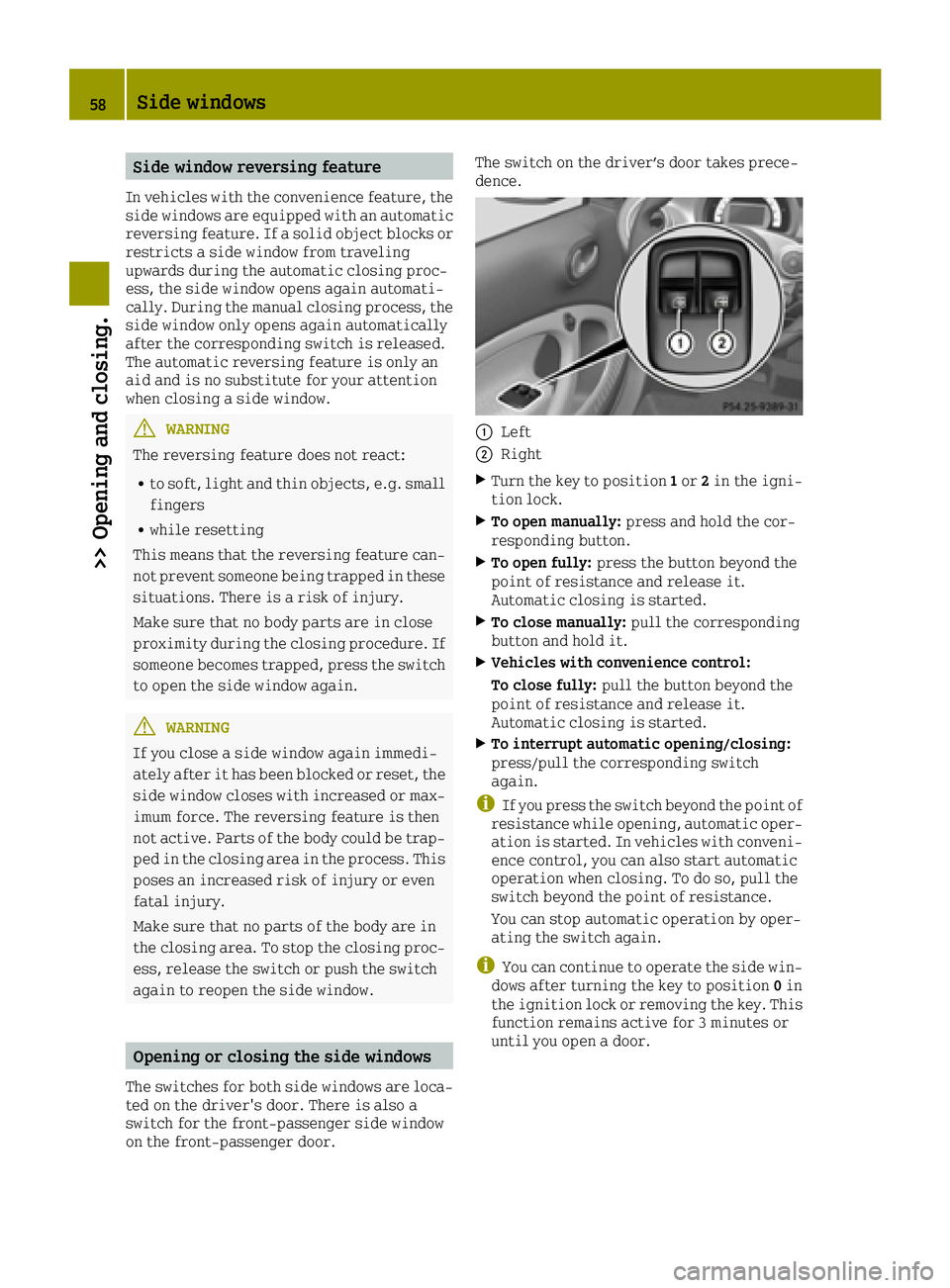
The switches for both side windows are loca-
ted on the driver's door. There is also a
switch for the front-passenger side window
on the front-passenger door. The switch on the driver’s door takes prece-
dence.
0043Left
0044Right
XTurn the key to position
1or 2in the igni-
tion lock.
XTo open manually: press and hold the cor-
responding button.
XTo open fully: press the button beyond the
point of resistance and release it.
Automatic closing is started.
XTo close manually: pull the corresponding
button and hold it.
XVehicles with convenience control:
To close fully: pull the button beyond the
point of resistance and release it.
Automatic closing is started.
XTo interrupt automatic opening/closing:
press/pull the corresponding switch
again.
iIf you press the switch beyond the point of
resistance while opening, automatic oper-
ation is started. In vehicles with conveni-
ence control, you can also start automatic
operation when closing. To do so, pull the
switch beyond the point of resistance.
You can stop automatic operation by oper-
ating the switch again.
iYou can continue to operate the side win-
dows after turning the key to position 0in
the ignition lock or removing the key. This
function remains active for 3 minutes or
until you open a door.
58Side windows
>> Opening and closing.