center SMART FORTWO 2016 User Guide
[x] Cancel search | Manufacturer: SMART, Model Year: 2016, Model line: FORTWO, Model: SMART FORTWO 2016Pages: 214, PDF Size: 4.93 MB
Page 32 of 214
ities, contact a smart center for specific
details. USA only: contact our Customer
Assistance Center on 1-800‑762-7887 for
details.
Restraint system warning lamp
The functions of the restraint system are
checked after the ignition is switched on and
at regular intervals while the engine is run-
ning. Therefore, malfunctions can be detec-
ted in good time.
The0075 restraint system warning lamp in
the instrument cluster lights up when the
ignition is switched on. It goes out no later
than a few seconds after the vehicle is star-
ted. The components of the restraint system
are in operational readiness.
A malfunction has occurred if the 0075
restraint system warning lamp:
Rdoes not light up after the ignition is
switched on
Rdoes not go out after a few seconds with the
engine running
Rlights up again while the engine is running
GWARNING
If restraint system is malfunctioning,
restraint system components may be trig-
gered unintentionally or might not be trig-
gered at all in the event of an accident with
a high rate of vehicle deceleration. This
can affect the Emergency Tensioning
Device or air bag, for example. This poses
an increased risk of injury or even fatal
injury.
Have the restraint system checked and
repaired in a qualified specialist work-
shop as soon as possible.
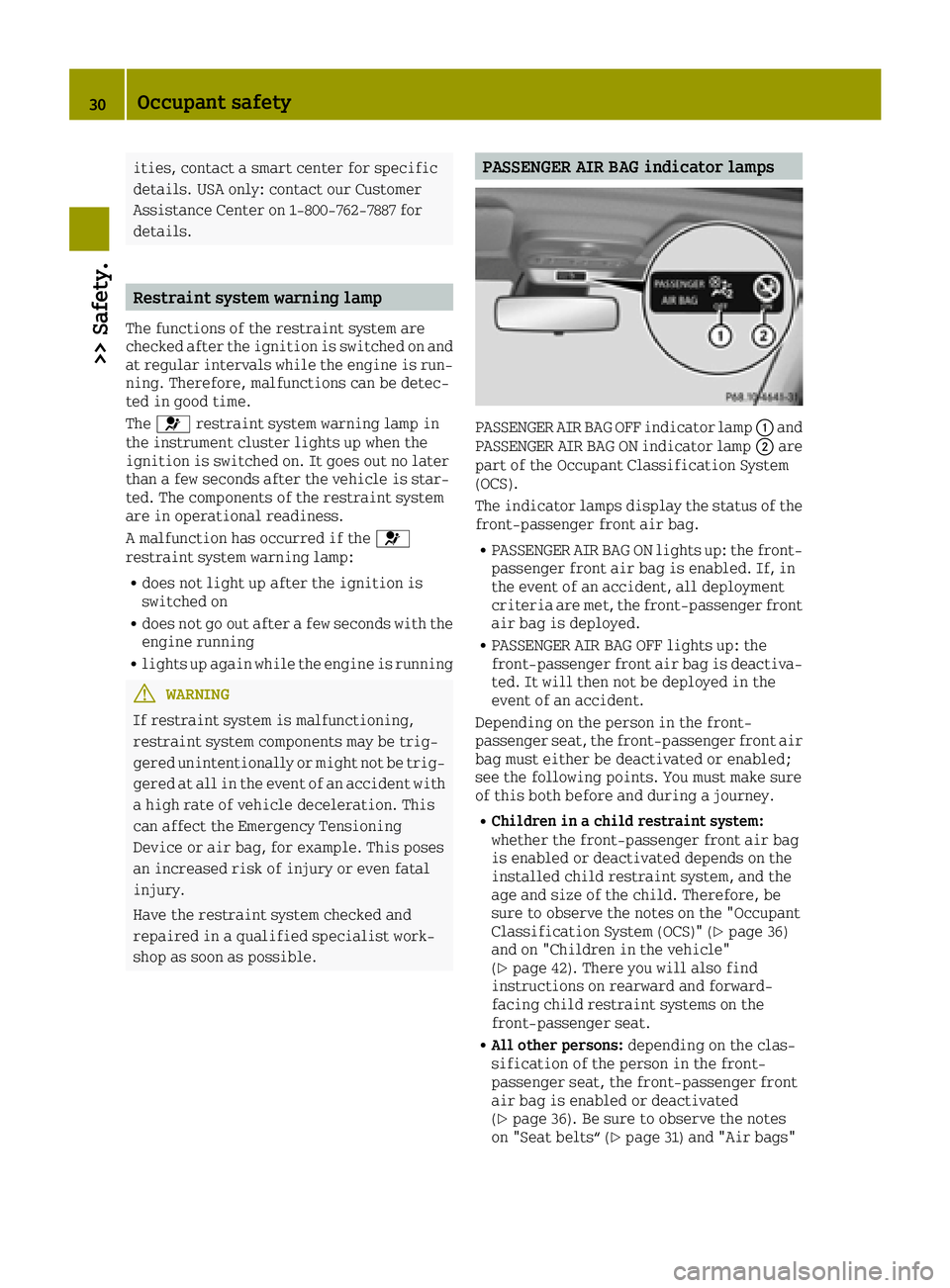
PASSENGER AIR BAG indicator lamps
PASSENGER AIR BAG OFF indicator lamp 0043and
PASSENGER AIR BAG ON indicator lamp 0044are
part of the Occupant Classification System
(OCS).
The indicator lamps display the status of the
front-passenger front air bag.
RPASSENGER AIR BAG ON lights up: the front-
passenger front air bag is enabled. If, in
the event of an accident, all deployment
criteria are met, the front-passenger front
air bag is deployed.
RPASSENGER AIR BAG OFF lights up: the
front-passenger front air bag is deactiva-
ted. It will then not be deployed in the
event of an accident.
Depending on the person in the front-
passenger seat, the front-passenger front air
bag must either be deactivated or enabled;
see the following points. You must make sure
of this both before and during a journey.
RChildren in a child restraint system:
whether the front-passenger front air bag
is enabled or deactivated depends on the
installed child restraint system, and the
age and size of the child. Therefore, be
sure to observe the notes on the "Occupant
Classification System (OCS)" (
Ypage 36)
and on "Children in the vehicle"
(
Ypage 42). There you will also find
instructions on rearward and forward-
facing child restraint systems on the
front-passenger seat.
RAll other persons: depending on the clas-
sification of the person in the front-
passenger seat, the front-passenger front
air bag is enabled or deactivated
(
Ypage 36). Be sure to observe the notes
on "Seat belts“ (Ypage 31) and "Air bags"
30Occupant safety
>> Safety.
Page 33 of 214
(Ypage 34). There you can also find infor-
mation on the correct seat position.
Seat belts
Introduction
Seat belts are the most effective means of
restricting the movement of vehicle occu-
pants in the event of an accident or the vehi-
cle rolling over. This reduces the risk of
vehicle occupants coming into contact with
parts of the vehicle interior or being ejected
from the vehicle. Furthermore, the seat belt
helps to keep the vehicle occupant in the best
position in relation to the air bag.
The seat belt system comprises:
RSeat belts
REmergency Tensioning Devices and seat
belt force limiters
If the seat belt is pulled by the seat belt
guide quickly or with a jerky movement, the
belt retractor locks. The belt strap cannot be extracted any further.
The Emergency Tensioning Device tightens
the seat belt in an accident, pulling the belt
close against the body. However it does not
pull the vehicle occupant back in the direc-
tion of the backrest.
The Emergency Tensioning Device does not
correct an incorrect seat position or the
routing of an incorrectly fastened seat belt.
When triggered, a seat belt force limiter
helps to reduce the force exerted by the seat
belt on the vehicle occupant.
The seat belt force limiters are synchronized
with the front air bags which absorb part of
the deceleration force. This can reduce the
force exerted on the vehicle occupants during
an accident.
!If the front-passenger seat is unoccu-
pied, do not insert the belt tongue into the
buckle of the front-passenger seat. This
may otherwise lead to the triggering of the
Emergency Tensioning Device in the event
of an accident, which will then need to be
replaced.
Important safety notes
The use of seat belts and child restraint sys-
tems is required by law in:
Rall 50 states
Rthe U.S. territories
Rthe District of Columbia
Rall Canadian provinces
Even where this is not required by law, all
vehicle occupants should correctly fasten
their seat belts before starting the journey.
GWARNING
If the seat belt is incorrectly fastened, it
cannot protect as intended. Furthermore,
an incorrectly fastened seat belt can cause
additional injury, for example, in an acci-
dent, during braking or when abruptly
changing direction. This poses an
increased risk of injury or even fatal
injury.
Make sure that all vehicle occupants are
seated properly with a correctly fastened
seat belt.
GWARNING
The seat belt does not offer the intended
level of protection if you have not moved
the backrest to an almost vertical position.
When braking or in the event of an accident,
you could slide underneath the seat belt and
sustain abdomen or neck injuries, for
example. This poses an increased risk of
injury or even fatal injury.
Adjust the seat properly before beginning
your journey. Always ensure that the back-
rest is in an almost vertical position and
that the shoulder section of your seat belt
is routed across the center of your shoul-
der.
GWARNING
Persons under 5 ft (1.50 m)in height cannot
fasten the seat belt correctly without an
additional suitable restraint system. If
the seat belt is incorrectly fastened, it
cannot protect as intended. Furthermore,
an incorrectly fastened seat belt can cause
Occupant safety31
>> Safety.
Z
Page 34 of 214
additional injury, for example, in an acci-
dent, during braking or an abrupt change of
direction. This poses an increased risk of
injury or even fatal injury.
For this reason, always secure persons
under 5 ft (1.50 m) in height in suitable
restraint systems.
If a child younger than twelve years old and
under 5 ft (1.50 m) in height is traveling in the
vehicle:
Ralways secure the child in a child restraint
system suitable for this smart vehicle. The
child restraint system must be appropriate
to the age, weight and size of the child
Ralways observe the instructions and safety
notes on "Children in the vehicle"
(
Ypage 42) in addition to the child
restraint system manufacturer's installa-
tion and operating instructions
Rbe sure to observe the instructions and
safety notes on the "Occupant classifica-
tion system (OCS)" (
Ypage 36)
GWARNING
The seat belts may not perform their inten- ded protective function if:
Rthey are damaged, modified, extremely
dirty, bleach or dyed
Rthe seat belt buckle is damaged or
extremely dirty
Rthe Emergency Tensioning Devices, belt
anchorages or inertia reels have been
modified
Seat belts may sustain non-visible damage
in an accident, e.g. due to glass splinters.
Modified or damaged seat belts may tear or
fail, e.g. in an accident. Modified Emer-
gency Tensioning Devices could acciden-
tally trigger or fail to deploy when neces-
sary. This poses an increased risk of injury
or even fatal injury.
Never modify the seat belts, Emergency
Tensioning Devices, belt anchorages or
inertia reels. Make sure that the seat belts
are undamaged, not worn out and clean. Fol-
lowing an accident, have the seat belts
checked immediately at a qualified spe-
cialist workshop.
Only use seat belts that have been approved
for your vehicle by smart.
Proper use of the seat belts
Pay attention to the safety notes about the
seat belt (Ypage 31).
All vehicle occupants must fasten the seat
belt correctly before setting off. Make sure
that all occupants are wearing their seat
belts correctly for the entire journey.
When fastening the seat belt, make sure that:
RThe seat belt tongue is inserted into the
belt buckle that belongs to the seat.
RThe seat belt is tightened across your body.
Avoid wearing bulky clothing, e.g. a winter coat.
RThe seat belt is not twisted.
Only then can the forces produced in the
event of an accident be evenly distributed
across the belt.
RThe shoulder section of the belt must always
be routed across the center of the shoulder.
The shoulder section of the belt should not come into contact with your neck and must
not be routed under the arm.
RThe lap belt must be taut and as low as pos-
sible over your lap.
The lap belt must always pass across your
hip joints and never across your stomach or
abdomen. Pregnant women must take par-
ticular care. If necessary, the lap belt canbe pushed down across the hip joints and
pulled tight using the shoulder section.
RThe seat belt is not routed over sharp,
pointed or fragile objects.
If these items are on or in your clothing,
e.g. eyeglasses, pens, keys, etc., stow theseitems in a more suitable location.
ROnly one person should use each seat belt at
any one time.
On no account should babies or children
travel sitting on the lap of another vehicle occupant. During an accident, they could be
crushed between the occupant and seat belt.
RObjects are not secured with a seat belt if
the seat belt is being used by one of the
vehicle’s occupants.
32Occupant safety
>> Safety.
Page 40 of 214
"Problems with the Occupant Classification
System (OCS)" (Ypage 40).
GWARNING
If you secure a child in a forward-facing
child restraint system on the front-
passenger seat and you position the front-
passenger seat too close to the dashboard,
in the event of an accident, the child could:
Rcome into contact with the vehicle's
interior if the PASSENGER AIR BAG OFF
indicator lamp is lit, for example
Rbe struck by the air bag if the PASSENGER
AIR BAG ON is lit up
This poses an increased risk of injury or
even fatal injury.
Move the front-passenger seat as far back
as possible. Always make sure that the
shoulder belt strap is correctly routed
from the vehicle belt guide to the shoulder
belt guide on the child restraint system.
The shoulder belt strap must be routed for-
wards and downwards from the belt guide.
Always observe the child restraint system
manufacturer's installation instructions.
If OCS detects that:
Rthe front-passenger seat is not occupied,
the PASSENGER AIR BAG OFF indicator lamp
lights up continuously after the system's
self-diagnosis test. This indicates that
the front-passenger front air bag is deac-
tivated.
Rthe front-passenger seat is occupied by a
child aged up to twelve months in a stand-
ard child restraint system, the PASSENGER
AIR BAG OFF indicator lamp lights up con-
tinuously after the system's self-diagnosis
test. This indicates that the front-
passenger front air bag is deactivated.
In the case of a twelve-month-old child in a
standard child restraint system, the
PASSENGER AIR BAG ON indicator lamp may
light up continuously after the system's
self-diagnosis test. This indicates that
the front-passenger front air bag is acti-
vated. Categorization is dependent on the
type of child restraint system and the stat-
ure of the child, for example. Make sure
that the prerequisites for correct catego- rizat
ion have been met. If the PASSENGER
AIR BAG ON indicator lamp remains lit, do
not install a child restraint system on the
front-passenger seat.
Rthe front-passenger seat is occupied by a
person of smaller stature (e.g. a teenager
or a small adult), either the PASSENGER AIR
BAG ON or PASSENGER AIR BAG OFF indicator
lamp lights up continuously after the sys-
tem's self-diagnosis test depending on the categorization.
-If the PASSENGER AIR BAG ON indicator
lamp is lit, position the front-
passenger seat as far back as possible.
-If the PASSENGER AIR BAG OFF indicator
lamp lights up, a person of smaller stat-
ure should not sit on the front-passenger
seat.
Rthe front-passenger seat is occupied by an
adult or a person of an appropriate size,
the PASSENGER AIR BAG ON indicator lamp
lights up continuously after the system's
self-diagnosis test. This indicates that
the front-passenger front air bag is acti-
vated.
If children are traveling in the vehicle, be
sure to observe the notes on "Children in the
vehicle" (
Ypage 42).
If the OCS is malfunctioning, both the red
0075 restraint system warning lamp in the
instrument cluster and the PASSENGER AIR
BAG OFF indicator lamp light up simultane-
ously. In this case, the front-passenger air
bag is deactivated and does not deploy during
an accident. Have the system checked by
qualified technicians as soon as possible.
Consult a smart center. Only have the front-
passenger seat repaired at a smart center.
If the front-passenger seat, the seat cover or
the seat cushion are damaged, have the nec-
essary repair work carried out at a smart cen-
ter.
For safety reasons, smart recommends that you only use seat accessories which have been
approved by smart.
If the driver's air bag deploys , this does not
mean that the front-passenger front air bag
will also deploy. The Occupant Classifica-
tion System (OCS) categorizes the occupant on
the front-passenger seat. Depending on the
result, the front-passenger air bag is acti-
vated or deactivated.
38Occupant safety
>> Safety.
Page 42 of 214
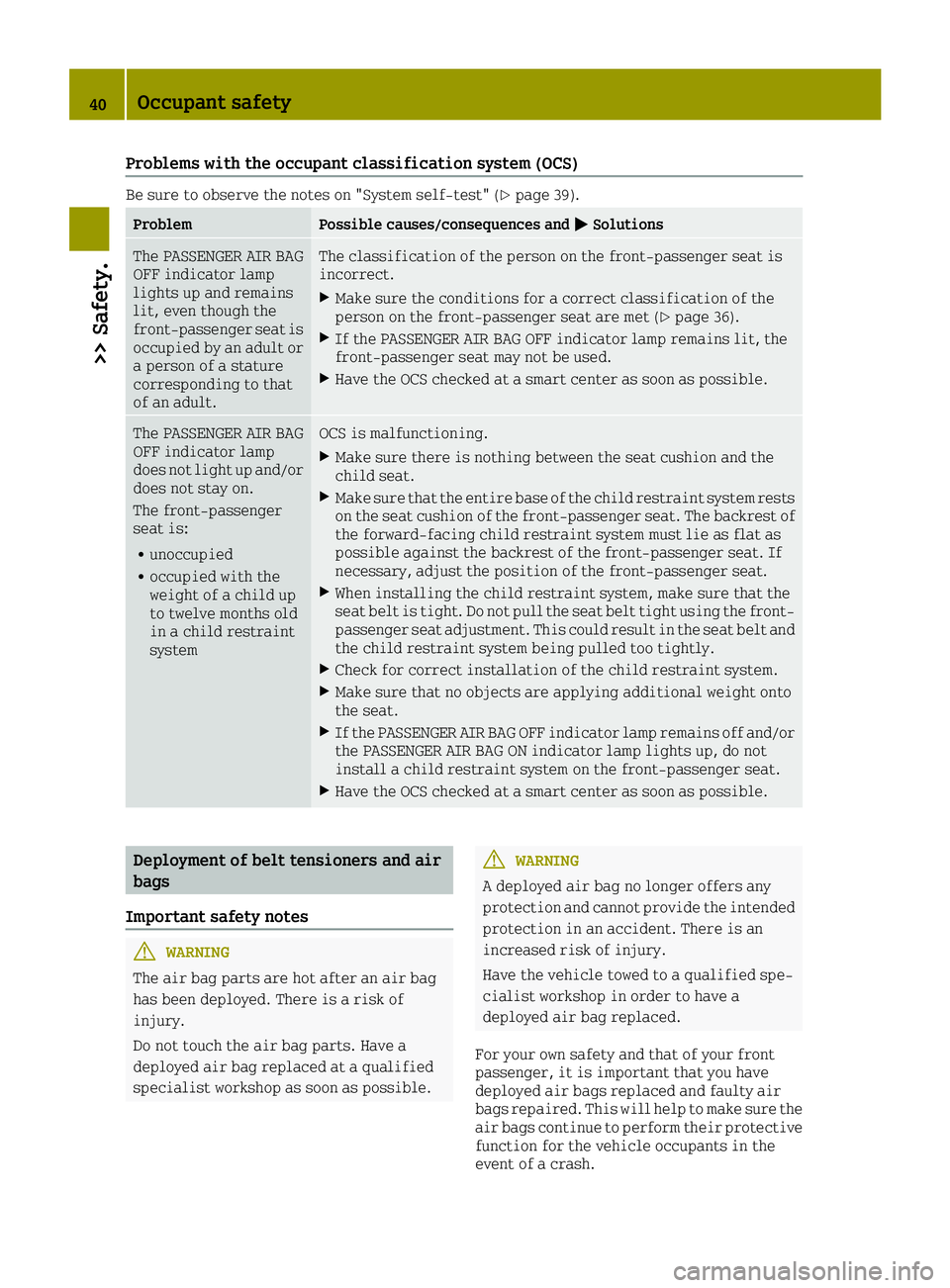
Problems with the occupant classification system (OCS)
Be sure to observe the notes on "System self-test" (Ypage 39).
ProblemPossible causes/consequences and0050Solutions
The PASSENGER AIR BAG
OFF indicator lamp
lights up and remains
lit, even though the
front-passenger seat is
occupied by an adult or
a person of a stature
corresponding to that
of an adult.The classification of the person on the front-passenger seat is
incorrect.
XMake sure the conditions for a correct classification of the
person on the front-passenger seat are met (Ypage 36).
XIf the PASSENGER AIR BAG OFF indicator lamp remains lit, the
front-passenger seat may not be used.
XHave the OCS checked at a smart center as soon as possible.
The PASSENGER AIR BAG
OFF indicator lamp
does not light up and/or
does not stay on.
The front-passenger
seat is:
Runoccupied
Roccupied with the
weight of a child up
to twelve months old
in a child restraint
system
OCS is malfunctioning.
XMake sure there is nothing between the seat cushion and the
child seat.
XMake sure that the entire base of the child restraint system rests
on the seat cushion of the front-passenger seat. The backrest of
the forward-facing child restraint system must lie as flat as
possible against the backrest of the front-passenger seat. If
necessary, adjust the position of the front-passenger seat.
XWhen installing the child restraint system, make sure that the
seat belt is tight. Do not pull the seat belt tight using the front-
passenger seat adjustment. This could result in the seat belt and
the child restraint system being pulled too tightly.
XCheck for correct installation of the child restraint system.
XMake sure that no objects are applying additional weight onto
the seat.
XIf the PASSENGER AIR BAG OFF indicator lamp remains off and/or
the PASSENGER AIR BAG ON indicator lamp lights up, do not
install a child restraint system on the front-passenger seat.
XHave the OCS checked at a smart center as soon as possible.
Deployment of belt tensioners and air
bags
Important safety notes
GWARNING
The air bag parts are hot after an air bag
has been deployed. There is a risk of
injury.
Do not touch the air bag parts. Have a
deployed air bag replaced at a qualified
specialist workshop as soon as possible.
GWARNING
A deployed air bag no longer offers any
protection and cannot provide the intended
protection in an accident. There is an
increased risk of injury.
Have the vehicle towed to a qualified spe-
cialist workshop in order to have a
deployed air bag replaced.
For your own safety and that of your front
passenger, it is important that you have
deployed air bags replaced and faulty air
bags repaired. This will help to make sure the
air bags continue to perform their protective
function for the vehicle occupants in the
event of a crash.
40Occupant safety
>> Safety.
Page 45 of 214
heat or cold, there is a risk of injury, pos-
sibly even fatal. Never leave children
unattended in the vehicle.
GWARNING
If the child restraint system is subjected to
direct sunlight, parts may get very hot.
Children may burn themselves on these
parts, particularly on the metal parts of the
child restraint system. There is a risk of
injury.
If you leave the vehicle, taking the child
with you, always ensure that the child
restraint system is not exposed to direct
sunlight. Protect it with a blanket, for
example. If the child restraint system has
been exposed to direct sunlight, let it cool
down before securing the child in it. Never
leave children unattended in the vehicle.
Always ensure that all vehicle occupants have
their seat belts fastened correctly and are
sitting properly. Particular attention must
be paid to children.
Read and follow the safety notes on the seat
belt (
Ypage 31) and the notes on correct use of
the seat belts (Ypage 32).
A booster seat may be necessary to achieve
proper seat belt positioning for children
over 41 lbs (18 kg) until they reach a height
where a lap/shoulder belt fits properly with-
out a booster seat.
Special seat belt retractor
GWARNING
If the seat belt is released while driving,
the child restraint system will no longer be
secured properly. The special seat belt
retractor is disabled and the inertia real
draws in a portion of the seat belt. The seat belt cannot be immediately refastened.
There is an increased risk of injury, pos-
sibly even fatal.
Stop the vehicle immediately, paying
attention to road and traffic conditions.
Reactivate the special seat belt retractor
and secure the child restraint system prop-erly.
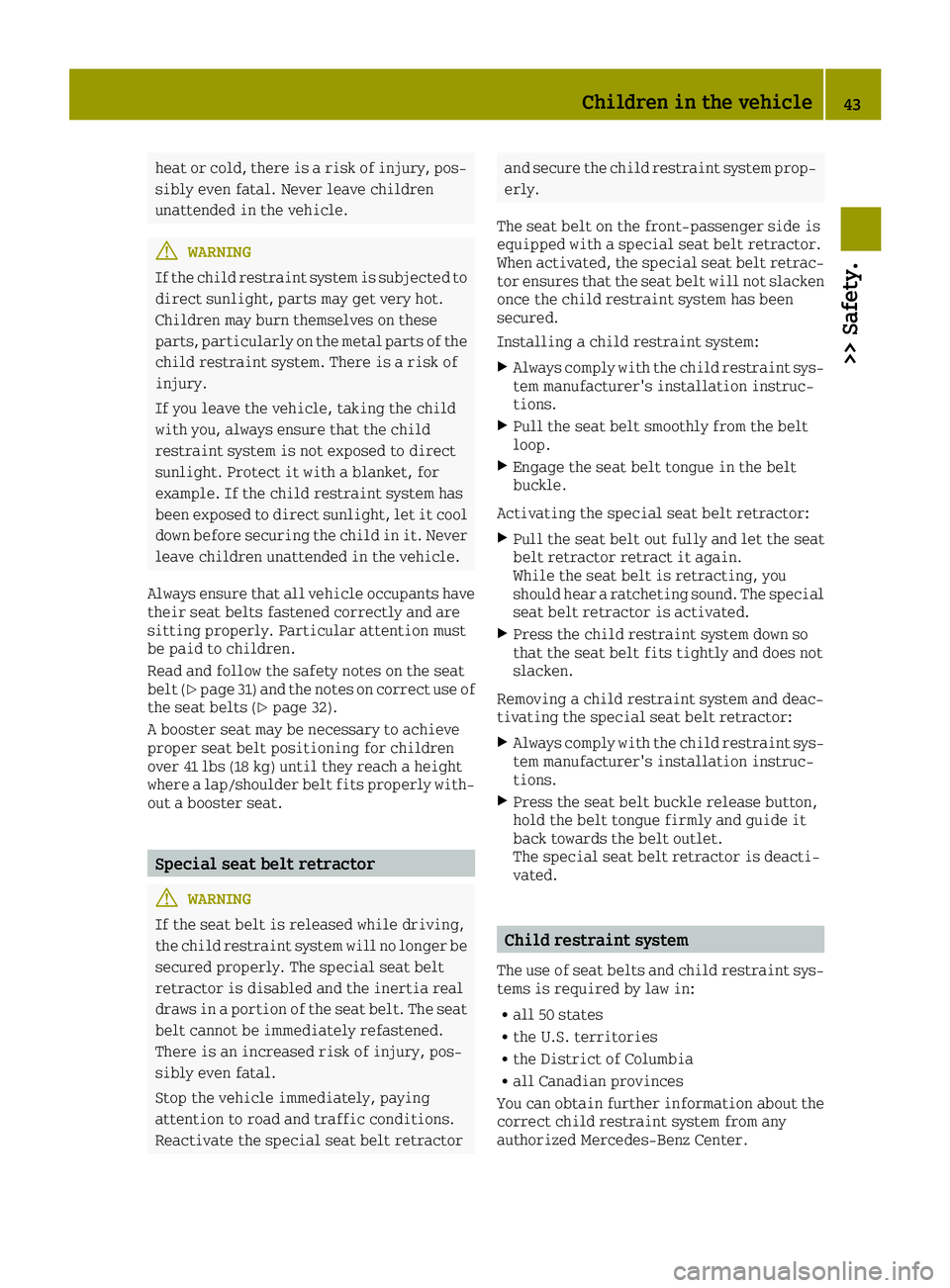
The seat belt on the front-passenger side is
equipped with a special seat belt retractor.
When activated, the special seat belt retrac-
tor ensures that the seat belt will not slacken once the child restraint system has been
secured.
Installing a child restraint system:
XAlways comply with the child restraint sys-
tem manufacturer's installation instruc-
tions.
XPull the seat belt smoothly from the belt
loop.
XEngage the seat belt tongue in the belt
buckle.
Activating the special seat belt retractor:
XPull the seat belt out fully and let the seat
belt retractor retract it again.
While the seat belt is retracting, you
should hear a ratcheting sound. The special seat belt retractor is activated.
XPress the child restraint system down so
that the seat belt fits tightly and does not
slacken.
Removing a child restraint system and deac-
tivating the special seat belt retractor:
XAlways comply with the child restraint sys-
tem manufacturer's installation instruc-
tions.
XPress the seat belt buckle release button,
hold the belt tongue firmly and guide it
back towards the belt outlet.
The special seat belt retractor is deacti-
vated.
Child restraint system
The use of seat belts and child restraint sys- tems is required by law in:
Rall 50 states
Rthe U.S. territories
Rthe District of Columbia
Rall Canadian provinces
You can obtain further information about the correct child restraint system from any
authorized Mercedes-Benz Center.
Children in the vehicle43
>> Safety.
Z
Page 64 of 214
When leaving the vehicle, always take the
SmartKey with you and lock the vehicle.
Never leave children unsupervised in the
vehicle.
GWARNING
If the driver's seat is not engaged, it could move unexpectedly while the vehicle is in
motion. This could cause you to lose control
of the vehicle. There is a risk of an acci-
dent.
Always make sure that the driver's seat is
engaged before starting the vehicle.
GWARNING
You could lose control of your vehicle if you
do the following while driving:
Radjust the driver's seat, steering wheel
or mirrors
Rfasten the seat belt
There is a risk of an accident.
Adjust the driver's seat, steering wheel or
mirrors and fasten your seat belt before
starting the engine.
GWARNING
When you adjust a seat, you or other vehicle occupants could become trapped, e.g. on the
seat guide rail. There is a risk of injury.
Make sure when adjusting a seat that no one
has any body parts in the sweep of the seat.
GWARNING
The seat belt does not offer the intended
level of protection if you have not moved
the backrest to an almost vertical position.
When braking or in the event of an accident,
you could slide underneath the seat belt and
sustain abdomen or neck injuries, for
example. This poses an increased risk of
injury or even fatal injury.
Adjust the seat properly before beginning
your journey. Always ensure that the back-
rest is in an almost vertical position and
that the shoulder section of your seat belt
is routed across the center of your shoul-
der.
Observe the safety notes on "Airbags"
(
Ypage 34) and "Children in the vehicle"
(Ypage 42).
!To avoid damage to the seats and the seat
heating, observe the following informa-
tion:
Rkeep liquids from spilling on the seats.
If liquid is spilled on the seats, dry them
as soon as possible.
Rif the seat covers are damp or wet, do not
switch on the seat heating. The seat heat- ing should also not be used to dry the
seats.
Rclean the seat covers as recommended;
see the "Interior care" section.
Rdo not transport heavy loads on the seats.
Do not place sharp objects on the seat
cushions, e.g. knives, nails or tools. The seats should only be occupied by passen-
gers, if possible.
Rwhen the seat heating is in operation, do
not cover the seats with insulating mate-
rials, e.g. blankets, coats, bags, seat
covers, child seats or booster seats.
!Make sure that there are no objects in the
footwell under or behind the seats when
moving the seats back. There is a risk that
the seats and/or the objects could be dam-
aged.
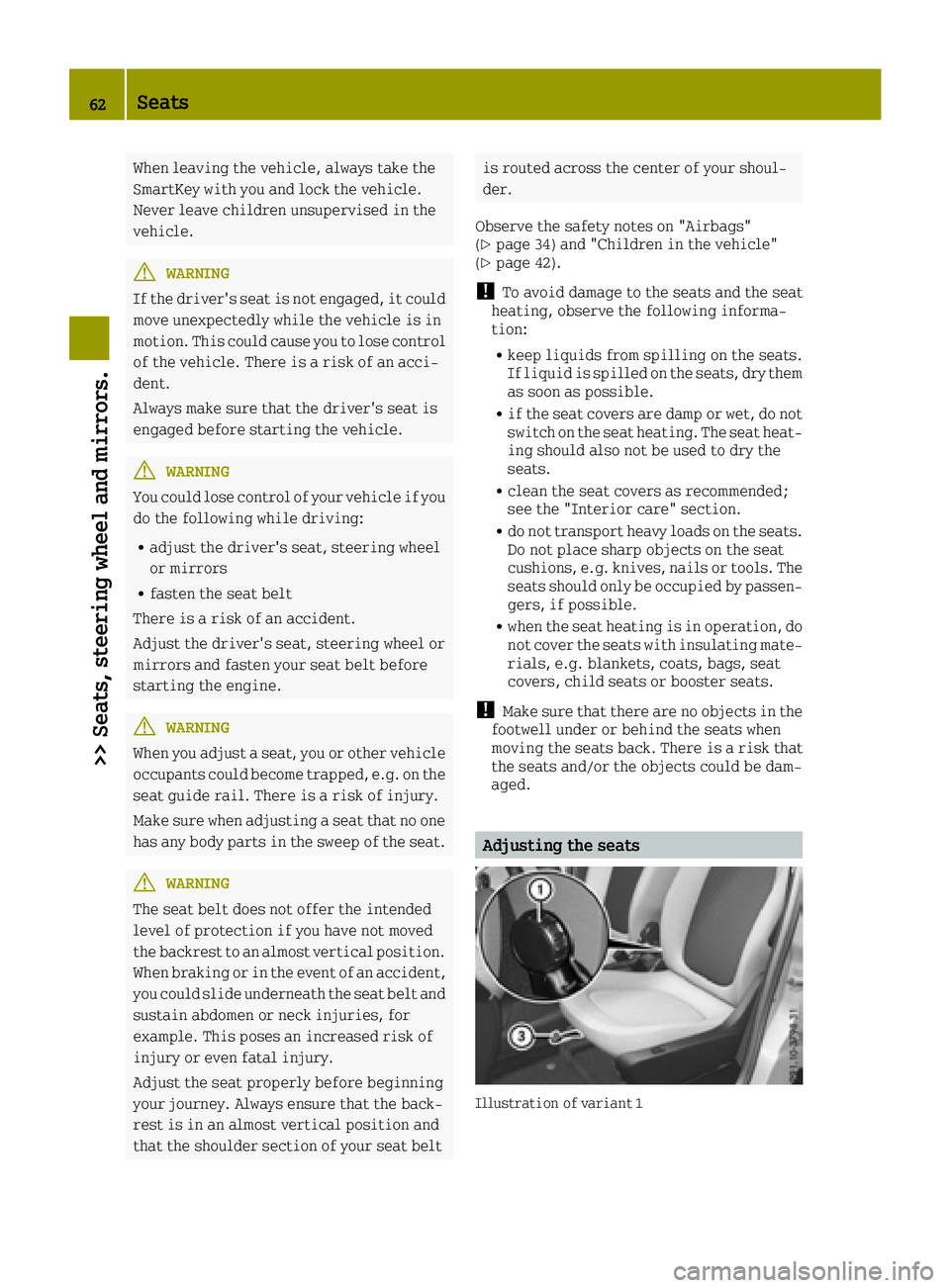
Adjusting the seats
Illustration of variant 1
62Seats
>> Seats, steering wheel and mirrors.
Page 83 of 214
XTo switch off:press the0078button.
The indicator lamp under the 0078button
lights up.
or
XPress the 00F3button repeatedly until all
the indicator lamps go out.
Switching cooling with air dehumidi-
fication on/off
General notes
If you deactivate the "Cooling with air-dehu-
midification" function, the air inside the
vehicle will not be cooled. The air inside the
vehicle will also not be dehumidified. The
windows can fog up more quickly. Therefore,
deactivate the cooling with air-dehumidifi-
cation function only briefly.
The "Cooling with air dehumidification"
function is only available when the engine is
running. The air inside the vehicle is cooled
and dehumidified according to the tempera-
ture selected.
The "Cooling with air dehumidification"
function does not function when the outside
temperature is low.
Condensation may drip from the underside of
the vehicle when it is in cooling mode. This
is normal and not a sign that there is a mal-
function.
Switching on/off
XStart the engine (Ypage 87).
XTo activate: press the00F2and005A but-
tons.
The indicator lamp in the 005Abutton
lights up.
XTo deactivate: press the005Abutton.
The indicator lamp in the 005Abutton goes
out.
Setting climate control to automatic
General notes
In automatic mode, the set temperature is
maintained automatically at a constant level. The system automatically regulates the air- flow and the air distribution according to the
temperature.
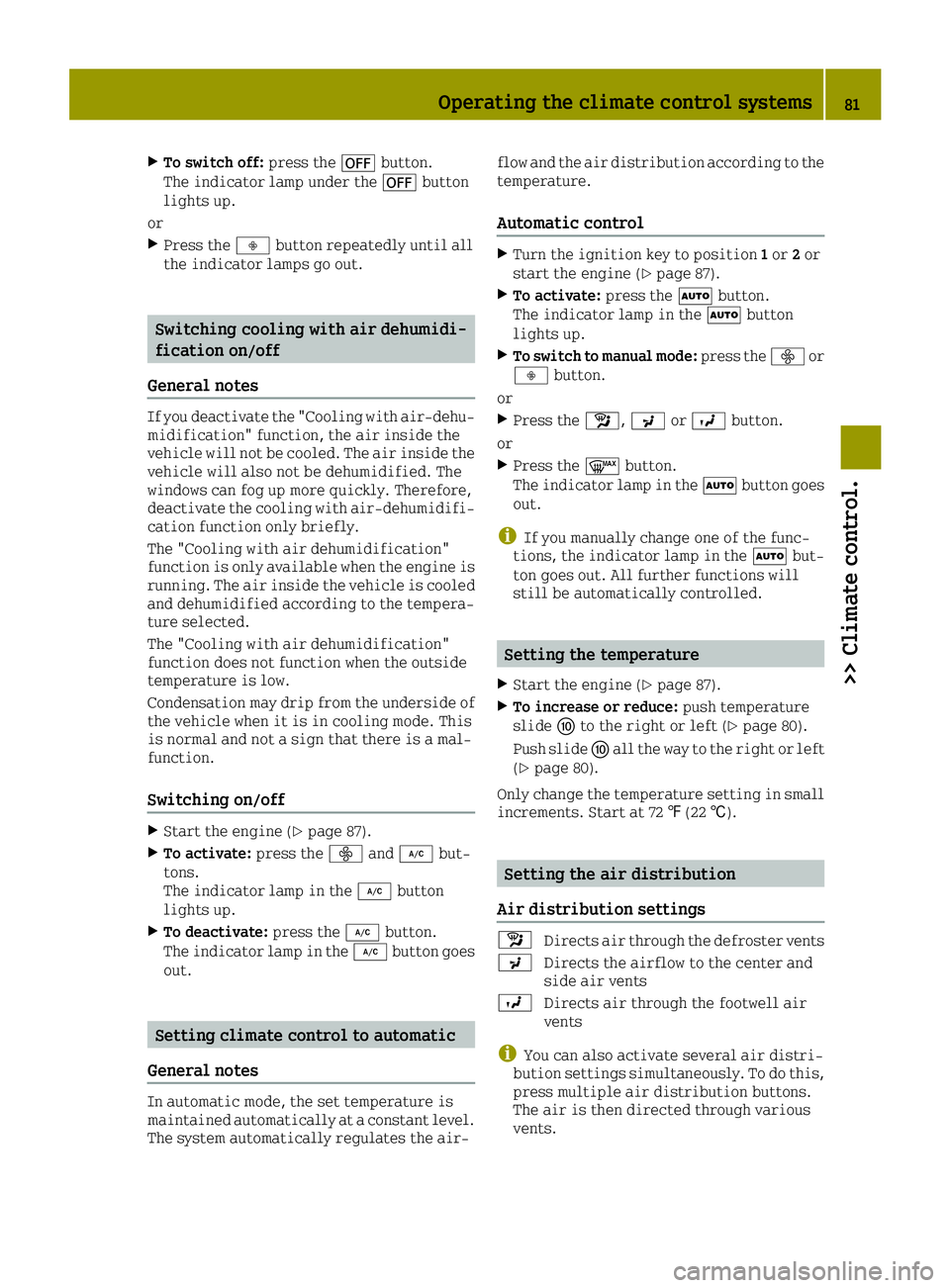
Automatic control
XTurn the ignition key to position
1or 2or
start the engine (Ypage 87).
XTo activate: press the0058button.
The indicator lamp in the 0058button
lights up.
XTo switch to manual mode: press the00F2or
00F3 button.
or
XPress the Á,009Cor009B button.
or
XPress the 0064button.
The indicator lamp in the 0058button goes
out.
iIf you manually change one of the func-
tions, the indicator lamp in the 0058but-
ton goes out. All further functions will
still be automatically controlled.
Setting the temperature
XStart the engine (Ypage 87).
XTo increase or reduce: push temperature
slide 006Eto the right or left (Ypage 80).
Push slide 006Eall the way to the right or left
(
Ypage 80).
Only change the temperature setting in small
increments. Start at 72 ‡(22 †).
Setting the air distribution
Air distribution settings
Á Directs air through the defroster vents
009C Directs the airflow to the center and
side air vents
009B Directs air through the footwell air
vents
iYou can also activate several air distri-
bution settings simultaneously. To do this,
press multiple air distribution buttons.
The air is then directed through various
vents.
Operating the climate control systems81
>> Climate control.
Page 87 of 214
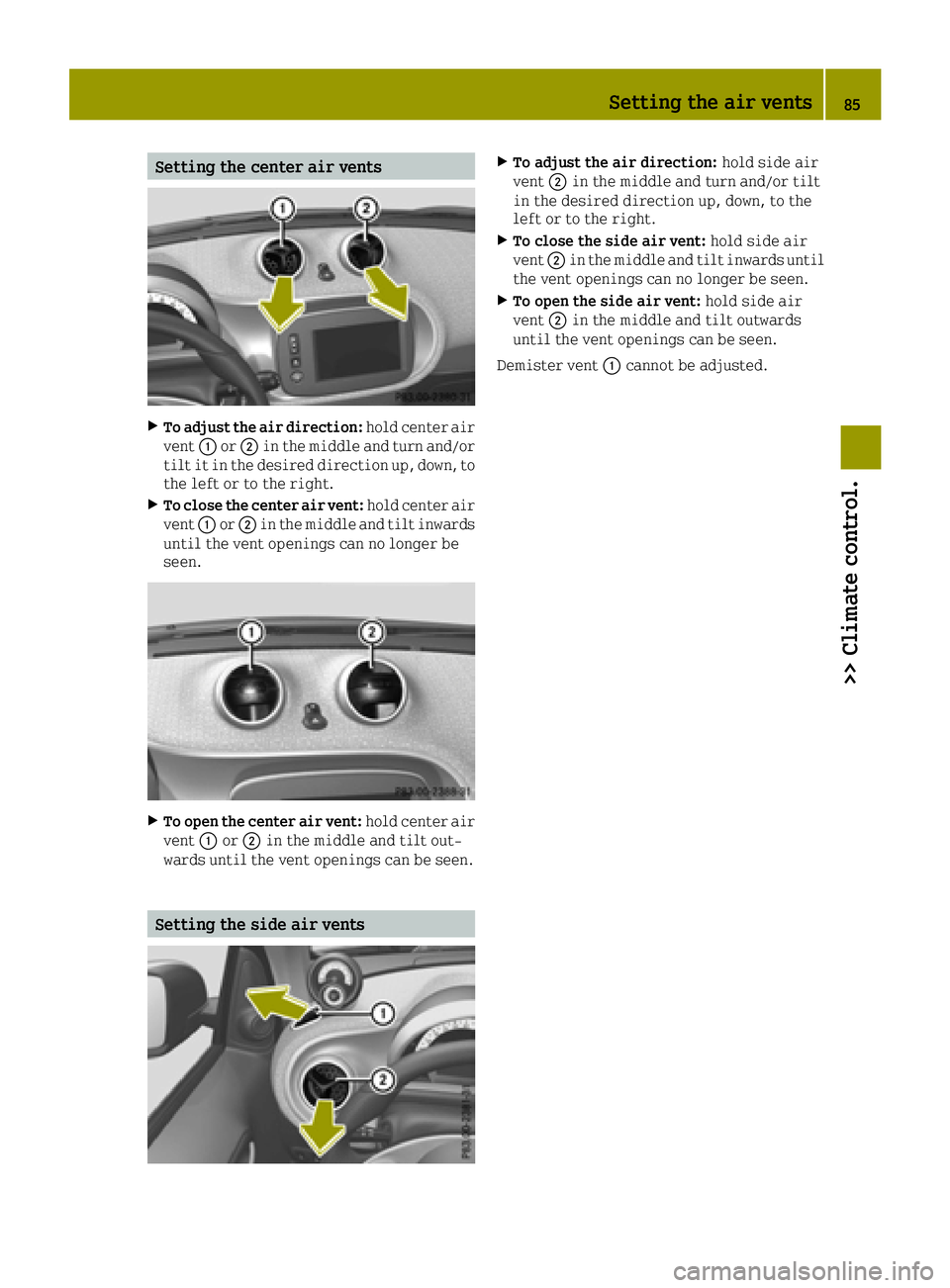
Setting the center air vents
XTo adjust the air direction:hold center air
vent 0043or0044 in the middle and turn and/or
tilt it in the desired direction up, down, to
the left or to the right.
XTo close the center air vent: hold center air
vent 0043or0044 in the middle and tilt inwards
until the vent openings can no longer be
seen.
XTo open the center air vent: hold center air
vent 0043or0044 in the middle and tilt out-
wards until the vent openings can be seen.
Setting the side air vents
XTo adjust the air direction: hold side air
vent 0044in the middle and turn and/or tilt
in the desired direction up, down, to the
left or to the right.
XTo close the side air vent: hold side air
vent 0044in the middle and tilt inwards until
the vent openings can no longer be seen.
XTo open the side air vent: hold side air
vent 0044in the middle and tilt outwards
until the vent openings can be seen.
Demister vent 0043cannot be adjusted.
Setting the air vents85
>> Climate control.
Z
Page 99 of 214
Problems with the transmission
ProblemPossible causes/consequences and0050Solutions
The transmission has
problems shifting
gear.The transmission is losing oil.
XHave the transmission checked at a qualified specialist work-
shop immediately.
The acceleration abil-
ity is deteriorating.
The transmission no
longer shifts into all of
the gears.
Reverse gear can no
longer be engaged.The transmission is in emergency mode.
XStop the vehicle.
XShift the transmission to position P.
XSwitch off the engine.
XWait at least ten seconds before restarting the engine.
XShift the transmission to positionD.
XHave the transmission checked at a qualified specialist work-
shop immediately.
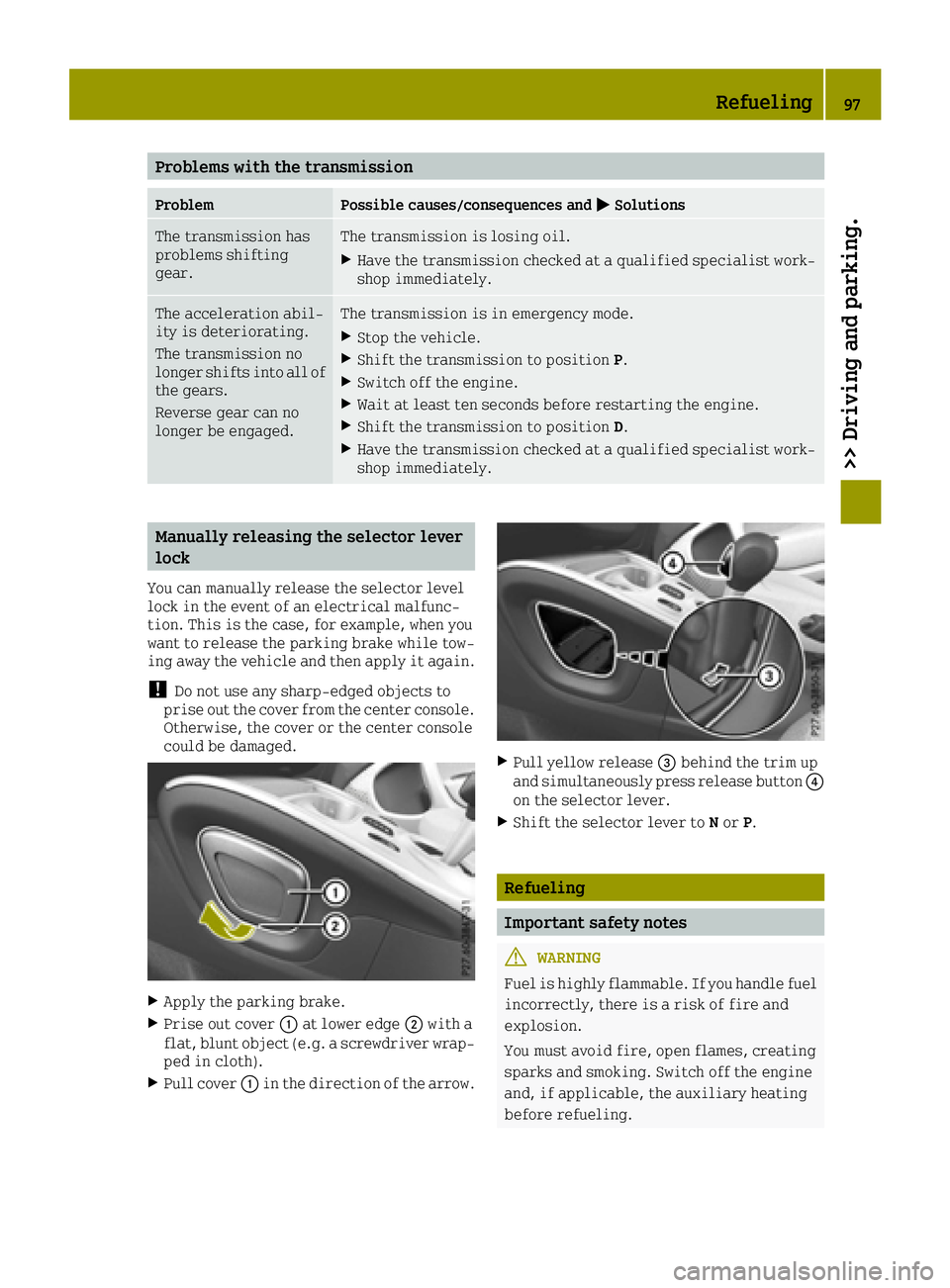
Manually releasing the selector lever
lock
You can manually release the selector level
lock in the event of an electrical malfunc-
tion. This is the case, for example, when you
want to release the parking brake while tow-
ing away the vehicle and then apply it again.
!Do not use any sharp-edged objects to
prise out the cover from the center console.
Otherwise, the cover or the center console
could be damaged.
XApply the parking brake.
XPrise out cover 0043at lower edge 0044with a
flat, blunt object (e.g. a screwdriver wrap-
ped in cloth).
XPull cover 0043in the direction of the arrow.
XPull yellow release 0087behind the trim up
and simultaneously press release button 0085
on the selector lever.
XShift the selector lever to Nor P.
Refueling
Important safety notes
GWARNING
Fuel is highly flammable. If you handle fuel
incorrectly, there is a risk of fire and
explosion.
You must avoid fire, open flames, creating
sparks and smoking. Switch off the engine
and, if applicable, the auxiliary heating
before refueling.
Refueling97
>> Driving and parking.
Z