heating SMART FORTWO 2016 User Guide
[x] Cancel search | Manufacturer: SMART, Model Year: 2016, Model line: FORTWO, Model: SMART FORTWO 2016Pages: 214, PDF Size: 4.93 MB
Page 93 of 214
Manual transmission
Gear lever
!
Only engage gear when the clutch pedal is
depressed.
!When shifting into 5thgear, you should
always push the gear lever all the way to the
right. You could otherwise shift uninten-
tionally into 3rdgear and damage the
transmission.
If you shift down at too high a speed (trans-
mission braking), this can cause the engine
to overrev, leading to engine damage.
Never hold the vehicle stopped on a hill by
using the clutch pedal. There is otherwise
a risk of damaging the clutch.
!On long and steep downhill gradients,
especially if the vehicle is laden, you must
shift into gear 1,2or 3in good time. By
doing so, you will make use of the braking
effect of the engine. This relieves the load
on the brake system and prevents the brakes
from overheating and wearing too quickly.
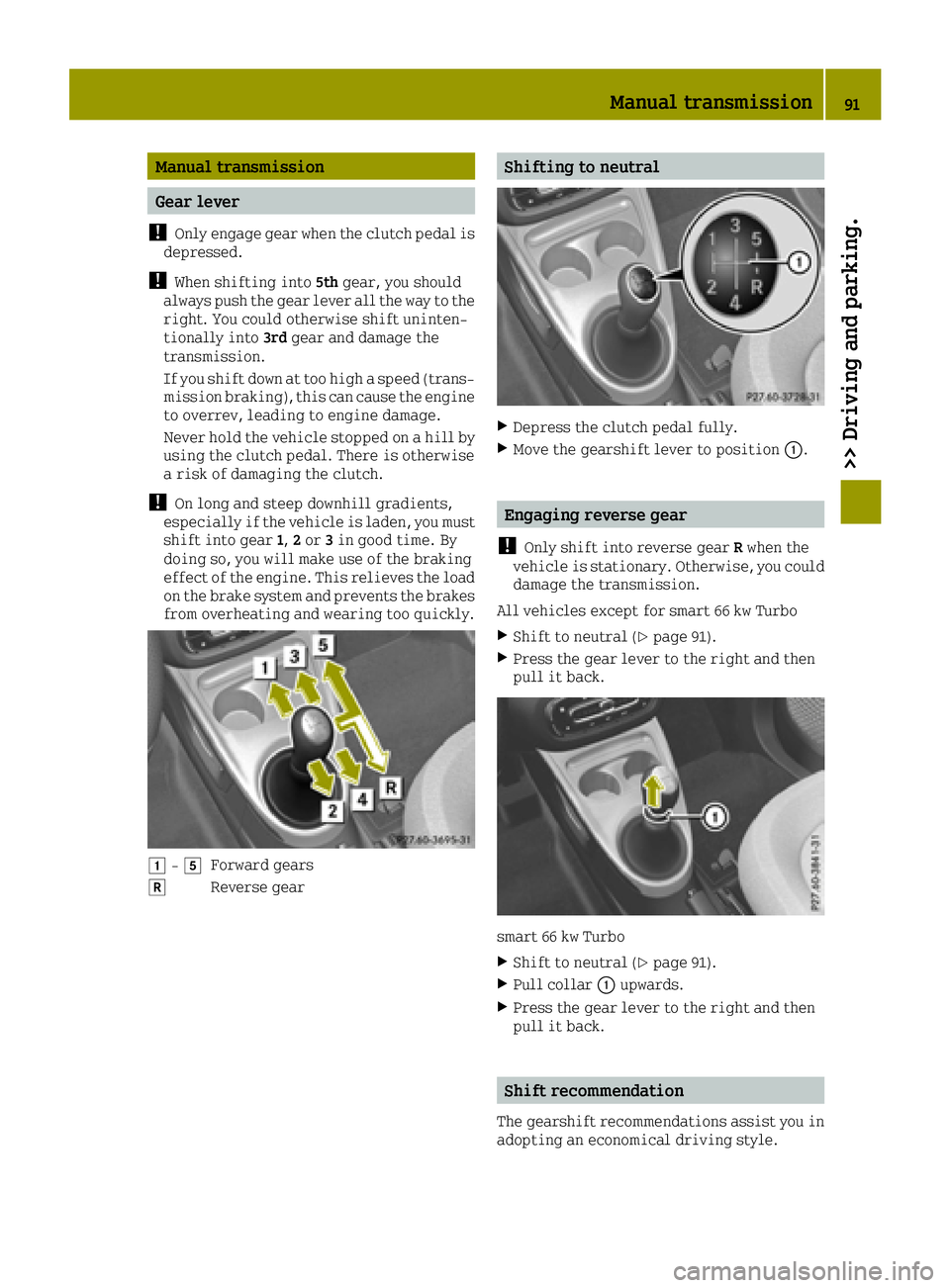
0047 -004BForward gears
005EReverse gear
Shifting to neutral
XDepress the clutch pedal fully.
XMove the gearshift lever to position 0043.
Engaging reverse gear
!
Only shift into reverse gear Rwhen the
vehicle is stationary. Otherwise, you could
damage the transmission.
All vehicles except for smart 66 kw Turbo
XShift to neutral (Ypage 91).
XPress the gear lever to the right and then
pull it back.
smart 66 kw Turbo
XShift to neutral (Ypage 91).
XPull collar 0043upwards.
XPress the gear lever to the right and then
pull it back.
Shift recommendation
The gearshift recommendations assist you in
adopting an economical driving style.
Manual transmission91
>> Driving and parking.
Z
Page 99 of 214
Problems with the transmission
ProblemPossible causes/consequences and0050Solutions
The transmission has
problems shifting
gear.The transmission is losing oil.
XHave the transmission checked at a qualified specialist work-
shop immediately.
The acceleration abil-
ity is deteriorating.
The transmission no
longer shifts into all of
the gears.
Reverse gear can no
longer be engaged.The transmission is in emergency mode.
XStop the vehicle.
XShift the transmission to position P.
XSwitch off the engine.
XWait at least ten seconds before restarting the engine.
XShift the transmission to positionD.
XHave the transmission checked at a qualified specialist work-
shop immediately.
Manually releasing the selector lever
lock
You can manually release the selector level
lock in the event of an electrical malfunc-
tion. This is the case, for example, when you
want to release the parking brake while tow-
ing away the vehicle and then apply it again.
!Do not use any sharp-edged objects to
prise out the cover from the center console.
Otherwise, the cover or the center console
could be damaged.
XApply the parking brake.
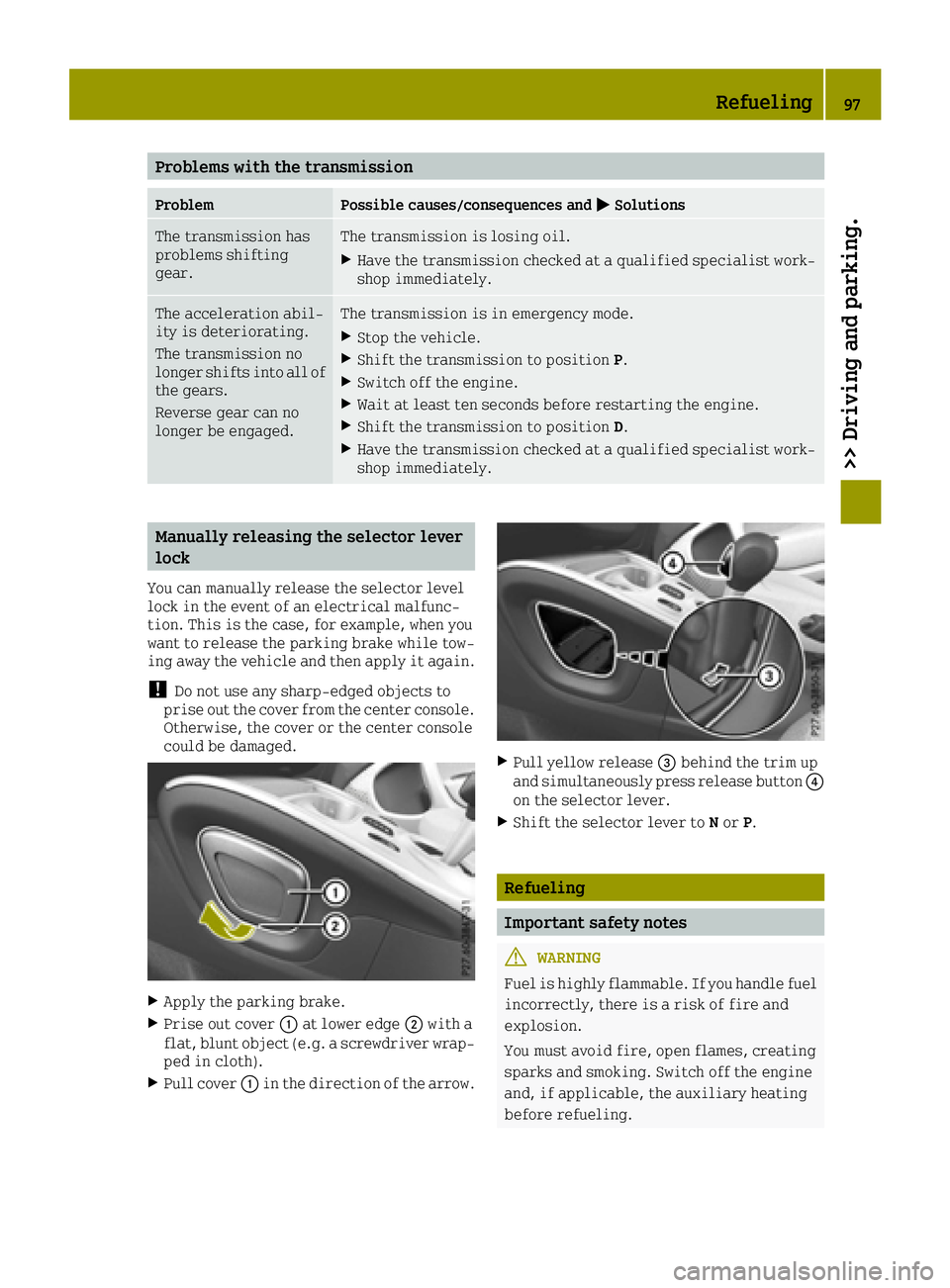
XPrise out cover 0043at lower edge 0044with a
flat, blunt object (e.g. a screwdriver wrap-
ped in cloth).
XPull cover 0043in the direction of the arrow.
XPull yellow release 0087behind the trim up
and simultaneously press release button 0085
on the selector lever.
XShift the selector lever to Nor P.
Refueling
Important safety notes
GWARNING
Fuel is highly flammable. If you handle fuel
incorrectly, there is a risk of fire and
explosion.
You must avoid fire, open flames, creating
sparks and smoking. Switch off the engine
and, if applicable, the auxiliary heating
before refueling.
Refueling97
>> Driving and parking.
Z
Page 105 of 214
tions. Even a small amount of alcohol or
drugs can affect your reflexes, perceptions
and judgment.
The possibility of a serious or even fatal
accident is greatly increased when you
drink or take drugs and drive.
Do not drink or take drugs and drive or
allow anyone to drive who has been drinkingor taking drugs.
Emission control
GWARNING
Combustion engines emit poisonous
exhaust gases such as carbon monoxide.
Inhaling these exhaust gases leads to poi-
soning. There is a risk of fatal injury.
Therefore never leave the engine running
in enclosed spaces without sufficient ven- tilation.
Certain engine systems are designed to keep
the level of poisonous components in exhaust
fumes within legal limits.
These systems only work at peak efficiency if
they are serviced exactly in accordance with
the manufacturer's specifications. There-
fore, only allow qualified and authorized
technicians to perform work on the engine.
The engine settings must not be changed
under any circumstances. Furthermore, all
specific service work must be performed at
regular intervals and in accordance with
smart service requirements. Details can be
found in the Maintenance Booklet.
Braking
Important safety notes
GWARNING
If you shift down on a slippery road surface
in an attempt to increase the engine's
braking effect, the drive wheels could lose
their grip. There is an increased danger of
skidding and accidents.
Do not shift down for additional engine
braking on a slippery road surface.
Downhill gradients
!On long and steep gradients, you must
reduce the load on the brakes by shifting to
a lower gear in good time. This allows you
to take advantage of the engine's braking
effect. This helps you to avoid overheating
the brakes and wearing them out exces-
sively.
When you take advantage of the engine's
braking effect, a drive wheel may not turn
for some time, e.g. on a slippery road sur-
face. This could cause damage to the drive
train, which is not covered by the smart
warranty.
Heavy and light loads
GWARNING
If you rest your foot on the brake pedal
while driving, the braking system can
overheat. This increases the stopping dis-
tance and can even cause the braking system
to fail. There is a risk of an accident.
Never use the brake pedal as a footrest.
Never depress the brake pedal and the
accelerator pedal at the same time.
!Depressing the brake pedal constantly
results in excessive and premature wear to
the brake pads.
If the brakes have been subjected to a heavy
load, do not stop the vehicle immediately.
Drive on for a short while. This allows the
airflow to cool the brakes more quickly.
Wet roads
If you have driven for a long time in heavy
rain without braking, there may be a delayed
reaction from the brakes when braking for the
first time. This may also occur after the vehi-
cle has been washed or driven through deep
water.
You then have to depress the brake pedal more
firmly. Maintain a greater distance from the
vehicle in front.
After driving on a wet road or having the
vehicle washed, brake firmly while paying
attention to the traffic conditions. This will warm up the brake discs, thereby drying them
Driving tips103
>> Driving and parking.
Z
Page 161 of 214
!Do not affix the following to plastic sur-
faces:
Rstickers
Rfilms
Rscented oil bottles or similar items
You can otherwise damage the plastic.
!Do not allow cosmetics, insect repellent
or sunscreen to come into contact with the
plastic trim. This maintains the high-
quality look of the surfaces.
XWipe the plastic trim with a damp, lint-
free cloth, e.g. a microfiber cloth.
XHeavy soiling: use care products and clean-
ing agents recommended and approved by
smart.
The surface may change color temporarily.
Wait until the surface is dry again.
Cleaning the steering wheel and gear or
selector lever
XThoroughly wipe with a damp cloth or use
leather care agents that have been recom-
mended and approved by smart.
Cleaning the seat covers
General notes
!Do not use a microfiber cloth to clean
covers made out of real leather, artificial leather or DINAMICA. If used often, these
can damage the cover.
iNote that regular care is essential to
ensure that the appearance and comfort of
the covers is retained over time.
Genuine leather seat covers
Leather is a natural product.
It exhibits natural surface characteristics,
for example:
RDifferences in the texture
Rmarks caused by growth and injury
RSlight nuances of color
These are characteristics of leather and not
material defects.
!To retain the natural appearance of the
leather, observe the following cleaning
instructions:
RClean genuine leather covers carefully
with a damp cloth and then wipe the cov-
ers down with a dry cloth.
RMake sure that the leather does not
become soaked. It may otherwise become
rough and cracked.
ROnly use leather care agents that have
been recommended by smart. You can
obtain these from a qualified specialist
workshop.
Seat covers of other materials
!Observe the following when cleaning:
Rclean artificial leather covers with a
cloth moistened with a solution contain-
ing 1% detergent (e.g. dish washing liq-
uid).
Rclean cloth covers with a microfiber
cloth moistened with a solution contain-
ing 1% detergent (e.g. dish washing liq-
uid). Rub carefully and always wipe
entire seat sections to avoid leaving
visible lines. Leave the seat to dry
afterwards. Cleaning results depend on
the type of dirt and how long it has been
there.
Rclean DINAMICA covers with a damp cloth.
Make sure that you wipe entire seat sec-
tions to avoid leaving visible lines.
Cleaning the seat belts
GWARNING
Seat belts can become severely weakened if bleached or dyed. This could cause the seat
belts to tear or fail, for instance, in the
event of an accident. This poses an
increased risk of injury or fatal injury.
Never bleach or dye the seat belts.
!Do not clean the seat belts using chemical
cleaning agents. Do not dry the seat belts by
heating at temperatures above 176 ‡(80 †)
or in direct sunlight.
XUse clean, lukewarm water and soap solu-
tion.
Care159
>> Maintenance and care.
Z
Page 171 of 214
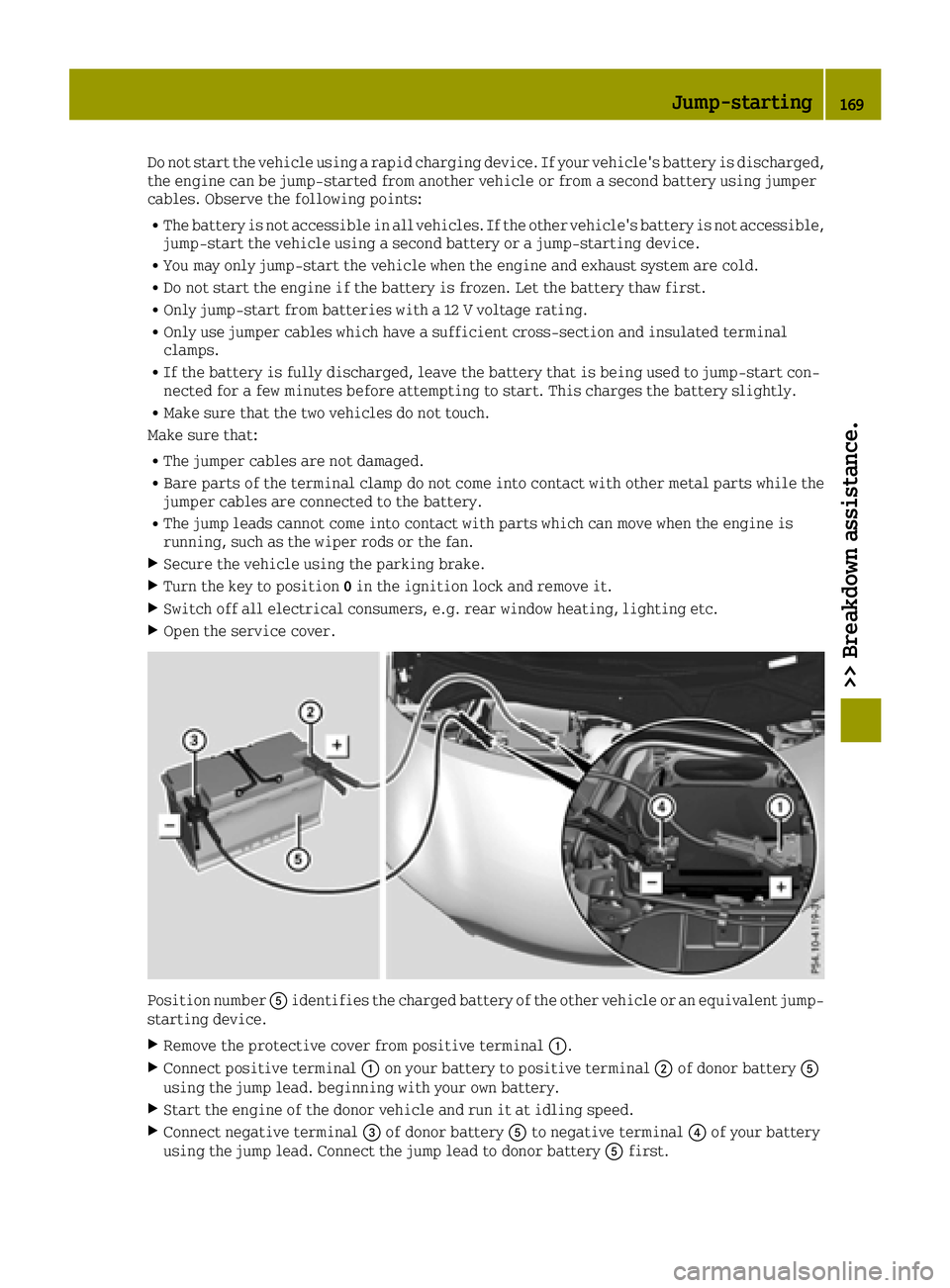
Do not start the vehicle using a rapid charging device. If your vehicle's battery is discharged,
the engine can be jump-started from another vehicle or from a second battery using jumper
cables. Observe the following points:
RThe battery is not accessible in all vehicles. If the other vehicle's battery is not accessible,
jump-start the vehicle using a second battery or a jump-starting device.
RYou may only jump-start the vehicle when the engine and exhaust system are cold.
RDo not start the engine if the battery is frozen. Let the battery thaw first.
ROnly jump-start from batteries with a 12 V voltage rating.
ROnly use jumper cables which have a sufficient cross-section and insulated terminal
clamps.
RIf the battery is fully discharged, leave the battery that is being used to jump-start con-
nected for a few minutes before attempting to start. This charges the battery slightly.
RMake sure that the two vehicles do not touch.
Make sure that:
RThe jumper cables are not damaged.
RBare parts of the terminal clamp do not come into contact with other metal parts while the
jumper cables are connected to the battery.
RThe jump leads cannot come into contact with parts which can move when the engine is
running, such as the wiper rods or the fan.
XSecure the vehicle using the parking brake.
XTurn the key to position 0in the ignition lock and remove it.
XSwitch off all electrical consumers, e.g. rear window heating, lighting etc.
XOpen the service cover.
Position number 0083identifies the charged battery of the other vehicle or an equivalent jump-
starting device.
XRemove the protective cover from positive terminal 0043.
XConnect positive terminal0043on your battery to positive terminal 0044of donor battery 0083
using the jump lead. beginning with your own battery.
XStart the engine of the donor vehicle and run it at idling speed.
XConnect negative terminal 0087of donor battery 0083to negative terminal 0085of your battery
using the jump lead. Connect the jump lead to donor battery 0083first.
Jump-starting169
>> Breakdown assistance.
Z
Page 178 of 214
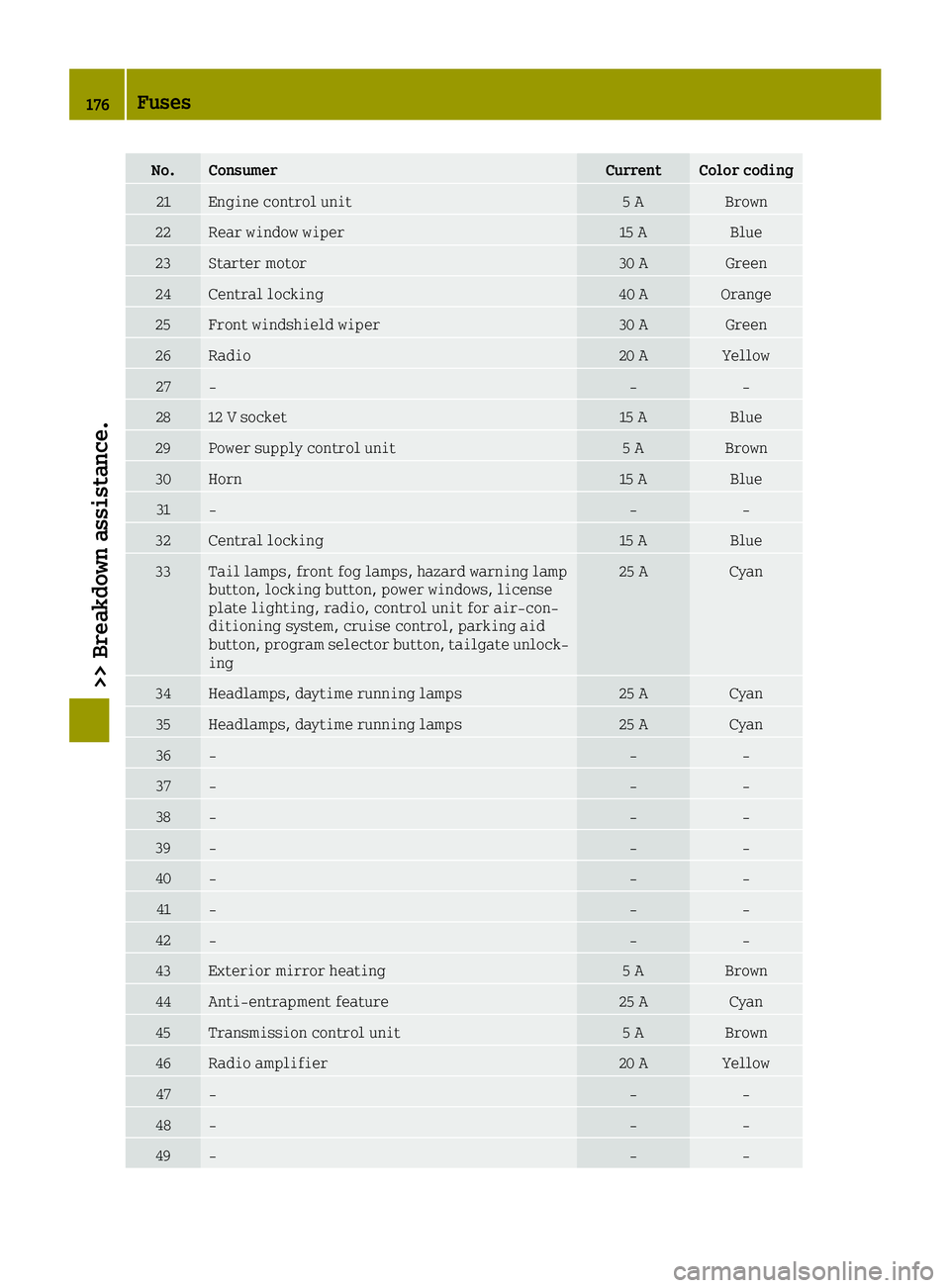
No.ConsumerCurrentColor coding
21Engine control unit5 ABrown
22Rear window wiper15 ABlue
23Starter motor30 AGreen
24Central locking40 AOrange
25Front windshield wiper30 AGreen
26Radio20 AYellow
27‑‑‑
2812 V socket15 ABlue
29Power supply control unit5 ABrown
30Horn15 ABlue
31‑‑‑
32Central locking15 ABlue
33Tail lamps, front fog lamps, hazard warning lamp
button, locking button, power windows, license
plate lighting, radio, control unit for air-con-
ditioning system, cruise control, parking aid
button, program selector button, tailgate unlock-
ing25 ACyan
34Headlamps, daytime running lamps25 ACyan
35Headlamps, daytime running lamps25 ACyan
36‑‑‑
37‑‑‑
38‑‑‑
39‑‑‑
40‑‑‑
41‑‑‑
42‑‑‑
43Exterior mirror heating5 ABrown
44Anti-entrapment feature25 ACyan
45Transmission control unit5 ABrown
46Radio amplifier20 AYellow
47‑‑‑
48‑‑‑
49‑‑‑
176Fuses
>> Breakdown assistance.
Page 209 of 214
Service products and filling capaci-
ties
Important safety notes
GWARNING
Service products may be poisonous and haz-
ardous to health. There is a risk of injury.
Comply with instructions on the use, stor-
age and disposal of service products on the
labels of the respective original contain-
ers. Always store service products sealed
in their original containers. Always keep
service products out of the reach of chil-
dren.
HEnvironmental note
Dispose of service products in an environ-
mentally responsible manner.
Service products include the following:
RFuels
RLubricants (e.g. engine oil, transmission
oil)
RCoolant
RBrake fluid
RWindshield washer fluid
RClimate control system refrigerant
Components and service products must be
matched. You should therefore only use prod-
ucts that have been tested and approved by
Mercedes-Benz.
Information on tested and approved products
can be obtained at a smart center.
You can recognize service products approved by Mercedes-Benz by the following inscrip-
tion on the containers:
RMB-Freigabe (e.g. MB-Freigabe 229.51)
RMB Approval (e.g. MB Approval 229.51)
Other designations or recommendations
indicate a level of quality or a specification in accordance with an MB Sheet Number (e.g.
MB 229.5). They have not necessarily been
approved by Mercedes-Benz.
iFor further information inquire at any
smart center.
Fuel
Important safety notes
GWARNING
Fuel is highly flammable. If you handle fuel
incorrectly, there is a risk of fire and
explosion.
You must avoid fire, open flames, creating
sparks and smoking. Switch off the engine
and, if applicable, the auxiliary heating
before refueling.
GWARNING
Fuel is poisonous and hazardous to health.
There is a risk of injury.
You must make sure that fuel does not come
into contact with your skin, eyes or cloth-
ing and that it is not swallowed. Do not
inhale fuel vapors. Keep fuel away from
children.
If you or others come into contact with fuel,
observe the following:
RWash away fuel from skin immediately
using soap and water.
RIf fuel comes into contact with your eyes,
immediately rinse them thoroughly with
clean water. Seek medical assistance
without delay.
RIf fuel is swallowed, seek medical assis-
tance without delay. Do not induce vom-
iting.
RImmediately change out of clothing
which has come into contact with fuel.
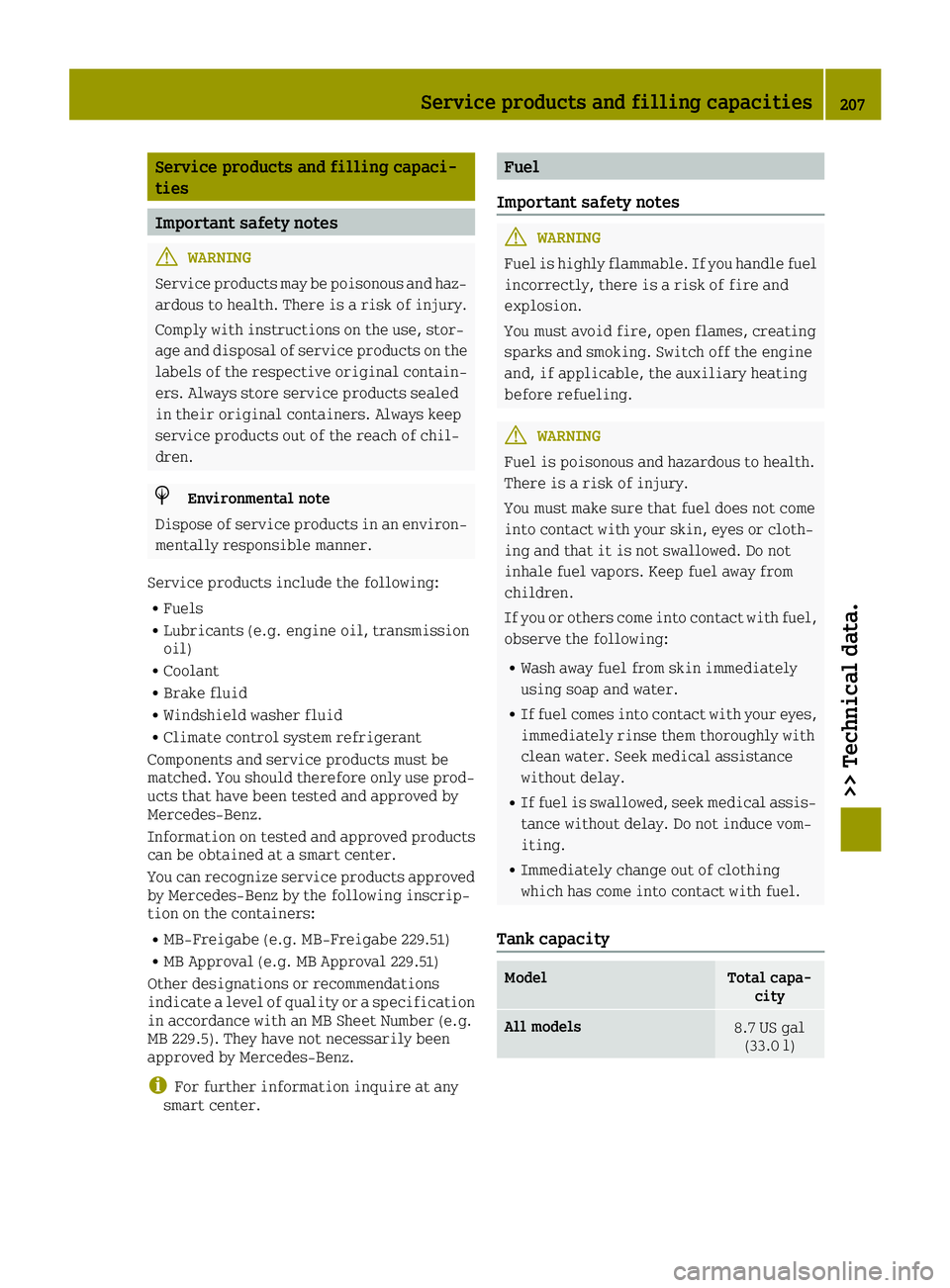
Tank capacity
ModelTotal capa- city
All models8.7 US gal(33.0 l)
Service products and filling capacities207
>> Technical data.
Z
Page 212 of 214
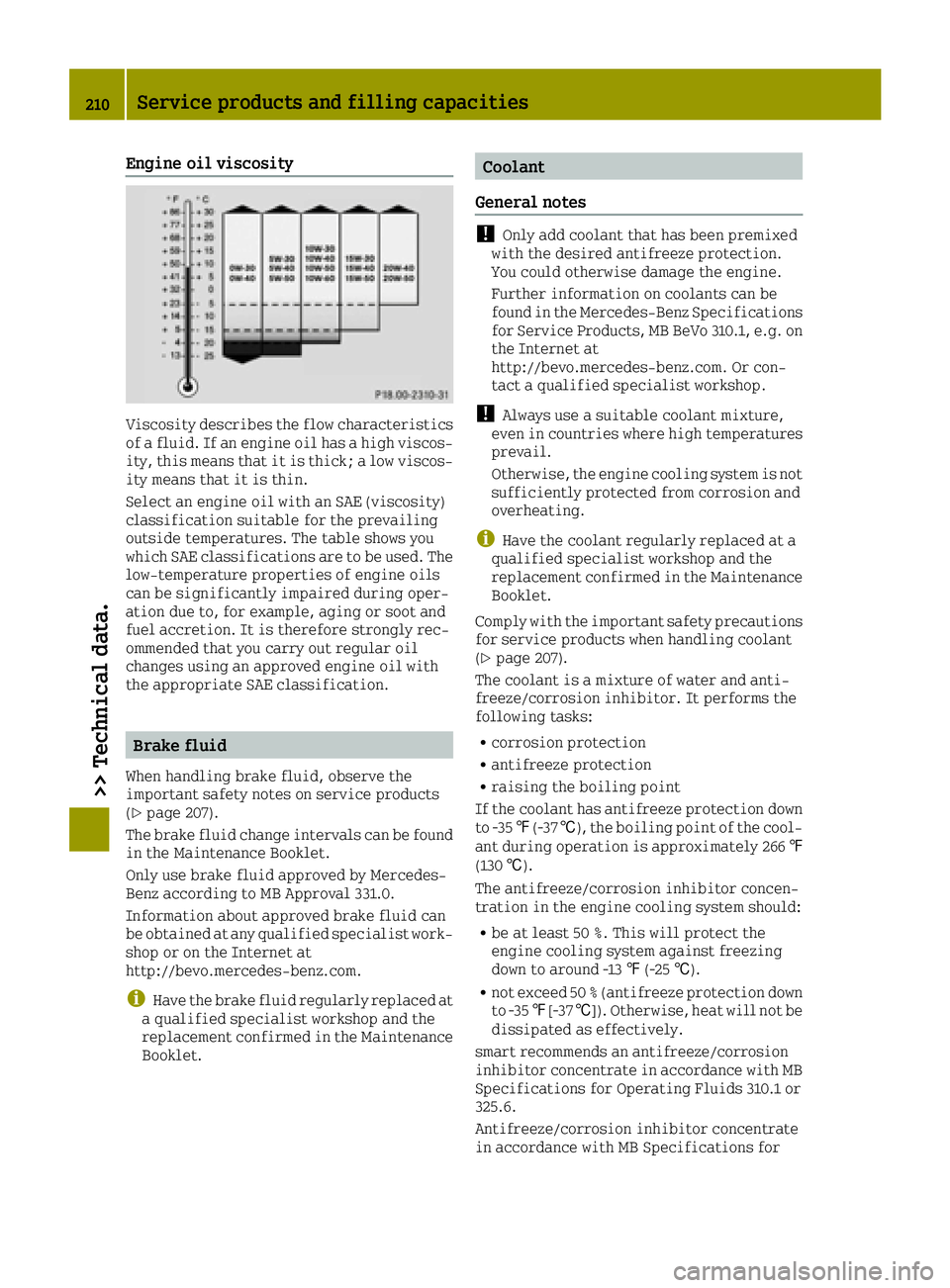
Engine oil viscosity
Viscosity describes the flow characteristics
of a fluid. If an engine oil has a high viscos-
ity, this means that it is thick; a low viscos-
ity means that it is thin.
Select an engine oil with an SAE (viscosity)
classification suitable for the prevailing
outside temperatures. The table shows you
which SAE classifications are to be used. The
low-temperature properties of engine oils
can be significantly impaired during oper-
ation due to, for example, aging or soot and
fuel accretion. It is therefore strongly rec-
ommended that you carry out regular oil
changes using an approved engine oil with
the appropriate SAE classification.
Brake fluid
When handling brake fluid, observe the
important safety notes on service products
(
Ypage 207).
The brake fluid change intervals can be found
in the Maintenance Booklet.
Only use brake fluid approved by Mercedes-
Benz according to MB Approval 331.0.
Information about approved brake fluid can
be obtained at any qualified specialist work-
shop or on the Internet at
http://bevo.mercedes-benz.com.
iHave the brake fluid regularly replaced at
a qualified specialist workshop and the
replacement confirmed in the Maintenance
Booklet.
Coolant
General notes
!Only add coolant that has been premixed
with the desired antifreeze protection.
You could otherwise damage the engine.
Further information on coolants can be
found in the Mercedes-Benz Specifications
for Service Products, MB BeVo 310.1, e.g. on
the Internet at
http://bevo.mercedes-benz.com. Or con-
tact a qualified specialist workshop.
!Always use a suitable coolant mixture,
even in countries where high temperatures
prevail.
Otherwise, the engine cooling system is not sufficiently protected from corrosion and
overheating.
iHave the coolant regularly replaced at a
qualified specialist workshop and the
replacement confirmed in the Maintenance
Booklet.
Comply with the important safety precautions
for service products when handling coolant
(
Ypage 207).
The coolant is a mixture of water and anti-
freeze/corrosion inhibitor. It performs the
following tasks:
Rcorrosion protection
Rantifreeze protection
Rraising the boiling point
If the coolant has antifreeze protection down
to -35 ‡(-37 †), the boiling point of the cool-
ant during operation is approximately 266 ‡
(130 †).
The antifreeze/corrosion inhibitor concen-
tration in the engine cooling system should:
Rbe at least 50 %. This will protect the
engine cooling system against freezing
down to around -13‡(-25 †).
Rnot exceed 50 % (antifreeze protection down
to-35 ‡[-37 †]). Otherwise, heat will not be
dissipated as effectively.
smart recommends an antifreeze/corrosion
inhibitor concentrate in accordance with MB
Specifications for Operating Fluids 310.1 or
325.6.
Antifreeze/corrosion inhibitor concentrate
in accordance with MB Specifications for
210Service products and filling capacities
>> Technical data.