instrument cluster SMART FORTWO 2016 User Guide
[x] Cancel search | Manufacturer: SMART, Model Year: 2016, Model line: FORTWO, Model: SMART FORTWO 2016Pages: 214, PDF Size: 4.93 MB
Page 49 of 214
Switching off the alarm
XTo switch off the alarm:press the0036
button on the key.
The alarm is switched off.
or
XSwitch on the ignition.
The alarm is switched off.
The alarm is not switched off, even if you
close the open door that triggered it, for
example.
Driving safety systems
Overview of driving safety systems
In this section, you will find information
about the following driving safety systems:
RABS (Anti-lock BrakingSystem)
(Ypage 47)
RDistance warning function (Ypage 48)
Resp®(Electronic StabilityProgram)
(Ypage 49)
REBD (Electronic Brake forceDistribution)
(Ypage 50)
Important safety notes
If you fail to adapt your driving style or
become distracted, the driving safety sys-
tems can neither reduce the risk of accident
nor override the laws of physics. Driving
safety systems are merely aids designed to
assist driving. You are responsible for the
distance to the vehicle in front, for vehicle
speed and for braking in good time. Always
adapt your driving style to suit the prevail-
ing road, weather and traffic conditions and
maintain a safe distance from the vehicle in
front. Drive carefully.
The driving safety systems described only
work as effectively as possible when there is
adequate contact between the tires and the
road surface. Please pay special attention to
the notes on tires, recommended minimum
tire tread depths, etc. (
Ypage 177).
In wintry driving conditions, always use win-
ter tires (M+S tires) and if necessary, snow
chains. Only in this way will the driving
safety systems described in this section work
as effectively as possible. For safety reasons, smart recommends that you
only use snow chains that have been specially
approved for your vehicle by smart, or fine-
link snow chains that are of a corresponding
standard of quality. For more information,
please contact a qualified specialist work-
shop.
ABS (Anti-lock Braking System)
General information
ABS regulates brake pressure in such a way
that the wheels do not lock when you brake.
This allows you to continue steering the vehi-
cle when braking.
The 0025 (Canada only) or 00DF(USA only) abs
warning lamp in the instrument cluster lights up when the ignition is switched on. It goes
out when the engine is running.
Important safety notes
iObserve the "Important safety notes" sec-
tion for driving safety systems (Ypage 47).
When ABS is malfunctioning, other systems,
including driving safety systems, will also
become inoperative. Observe the information
on the ABS warning lamp (
Ypage 132) and
display messages which may be shown in the
instrument cluster (
Ypage 121).
GWARNING
If ABS is faulty, the wheels could lock when
braking. The steerability and braking
characteristics may be severely impaired.
Additionally, further driving safety sys-
tems are deactivated. There is an increased
danger of skidding and accidents.
Drive on carefully. Have ABS checked imme-
diately at a qualified specialist workshop.
abs works from a speed of about 4 mph (6 km/h),
regardless of road-surface conditions. ABS
works on slippery surfaces, even if you only
brake gently.
Driving safety systems47
>> Safety.
Z
Page 51 of 214
XTo switch off:press button0044.
Indicator lamp 0043lights up.
XTo switch on: press button0044.
Indicator lamp 0043goes out.
Starting at a speed of around 4 mph (7 km/h),
the distance warning function warns you if
you rapidly approach a vehicle in front. An
intermittent warning tone will then sound
and the 00BAdistance warning lamp will
light up in the instrument cluster.
XBrake immediately in order to increase the distance from the vehicle in front.
or
XTake evasive action, provided it is safe to
do so.
Due to the nature of the system, particularly
complicated but non-critical driving condi-
tions may also cause the system to display a
warning.
With the help of the radar sensor system, the
distance warning function can detect obsta-
cles that are in the path of your vehicle for an
extended period of time.
Up to a speed of around 45 mph (70 km/h), the
distance warning function can also react to
stationary obstacles, such as stopped or
parked vehicles.
ESP®(Electronic Stability Program)
General notes
iObserve the "Important safety notes" sec-
tion (Ypage 47).
esp
®monitors driving stability and traction,
i.e. power transmission between the tires and the road surface.
If esp
®detects that the vehicle is deviating
from the direction desired by the driver, one
or more wheels are braked to stabilize the
vehicle. The engine output is also modified
to keep the vehicle on the desired course
within physical limits. esp
®assists the
driver when pulling away on wet or slippery
roads. esp
®can also stabilize the vehicle
during braking.
ETS (Electronic Traction System)
iObserve the "Important safety notes" sec-
tion (Ypage 47).
ETS traction control is part of esp
®.
ETS brakes the drive wheels individually if
they spin. This enables you to pull away and
accelerate on slippery surfaces, for example if the road surface is slippery on one side. In
addition, more drive torque is transferred to
the wheel with traction.
Important safety notes
GWARNING
If ESP
®is malfunctioning, ESP®is unable to
stabilize the vehicle. Additionally, fur-
ther driving safety systems are deactiva-
ted. This increases the risk of skidding and
an accident.
Drive on carefully. Have ESP
®checked at a
qualified specialist workshop.
!If you test the parking brake using a brake
dynamometer, switch the ignition off.
Application of the brakes by ESP
®may oth-
erwise destroy the brake system.
When towing the vehicle with the rear axle
raised, observe the notes on esp
®
(Ypage 171).
If the 00E5esp®warning lamp lights up per-
manently, esp®or hill start assist are
unavailable due to a malfunction.
Observe the information on warning lamps
(
Ypage 134) and display messages which may
be shown in the instrument cluster
(
Ypage 121).
iOnly use wheels with the recommended
tire sizes. Only then will esp®function
properly.
Characteristics of ESP®
General information
If the 00E5esp®warning lamp goes out before
the journey begins, esp®is automatically
active.
If esp
®intervenes, the 00E5esp®warning
lamp flashes in the instrument cluster.
Driving safety systems49
>> Safety.
Z
Page 57 of 214
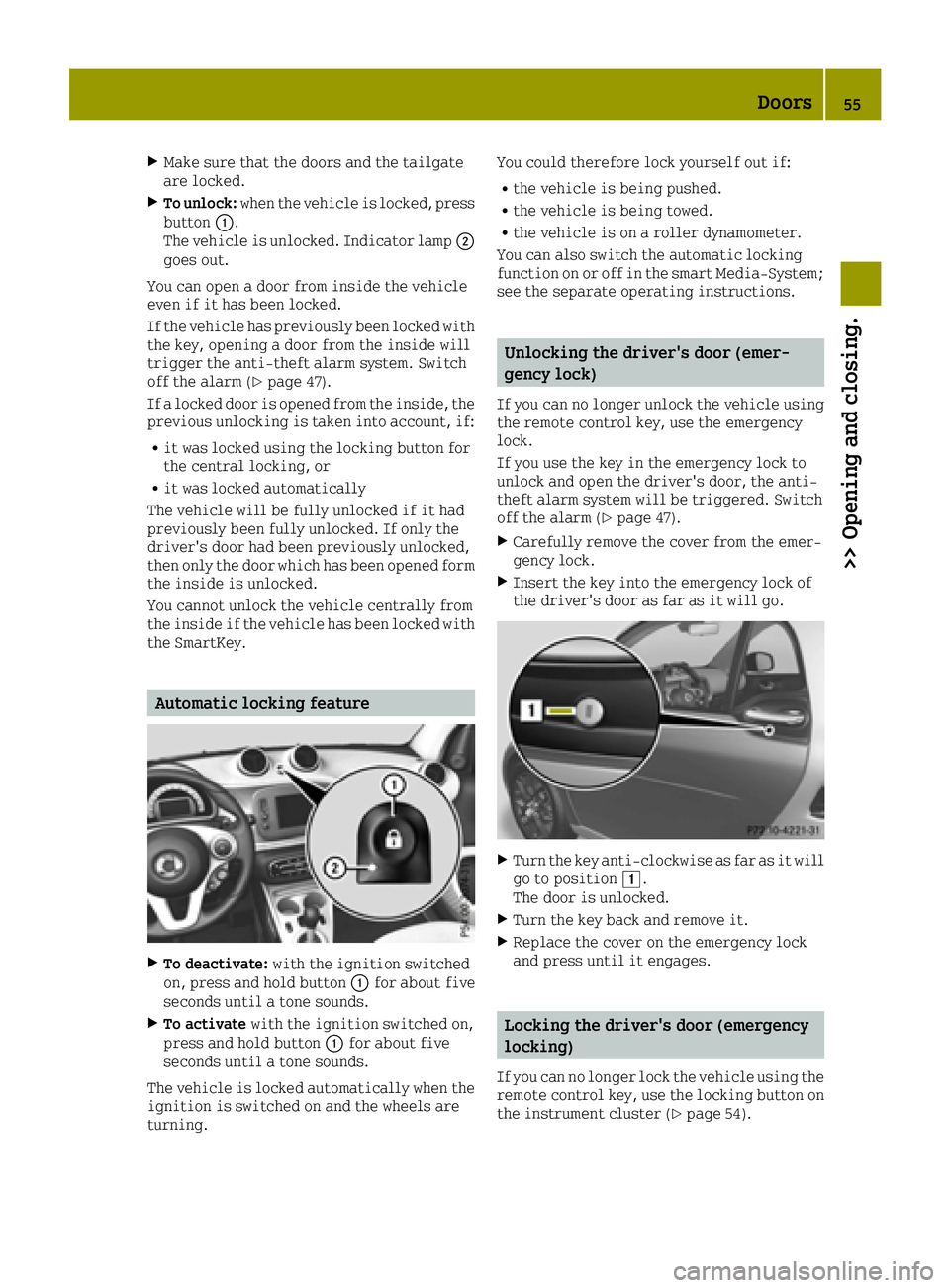
XMake sure that the doors and the tailgate
are locked.
XTo unlock:when the vehicle is locked, press
button 0043.
The vehicle is unlocked. Indicator lamp 0044
goes out.
You can open a door from inside the vehicle
even if it has been locked.
If the vehicle has previously been locked with
the key, opening a door from the inside will
trigger the anti-theft alarm system. Switch
off the alarm (
Ypage 47).
If a locked door is opened from the inside, the
previous unlocking is taken into account, if:
Rit was locked using the locking button for
the central locking, or
Rit was locked automatically
The vehicle will be fully unlocked if it had
previously been fully unlocked. If only the
driver's door had been previously unlocked,
then only the door which has been opened form
the inside is unlocked.
You cannot unlock the vehicle centrally from
the inside if the vehicle has been locked with
the SmartKey.
Automatic locking feature
XTo deactivate: with the ignition switched
on, press and hold button 0043for about five
seconds until a tone sounds.
XTo activate with the ignition switched on,
press and hold button 0043for about five
seconds until a tone sounds.
The vehicle is locked automatically when the
ignition is switched on and the wheels are
turning. You could therefore lock yourself out if:
Rthe vehicle is being pushed.
Rthe vehicle is being towed.
Rthe vehicle is on a roller dynamometer.
You can also switch the automatic locking
function on or off in the smart Media-System;
see the separate operating instructions.
Unlocking the driver's door (emer-
gency lock)
If you can no longer unlock the vehicle using
the remote control key, use the emergency
lock.
If you use the key in the emergency lock to
unlock and open the driver's door, the anti-
theft alarm system will be triggered. Switch
off the alarm (
Ypage 47).
XCarefully remove the cover from the emer-
gency lock.
XInsert the key into the emergency lock of
the driver's door as far as it will go.
XTurn the key anti-clockwise as far as it will
go to position 0047.
The door is unlocked.
XTurn the key back and remove it.
XReplace the cover on the emergency lock
and press until it engages.
Locking the driver's door (emergency
locking)
If you can no longer lock the vehicle using the
remote control key, use the locking button on
the instrument cluster (
Ypage 54).
Doors55
>> Opening and closing.
Z
Page 63 of 214
Useful information
i
This Operator's Manual describes all
models and all standard and optional
equipment of your vehicle available at the
time of publication of the Operator's Man- ual. Country-specific differences are pos-
sible. Bear in mind that your vehicle may
not feature all functions described here.
This also applies to safety-relevant sys-
tems and functions.
iRead the information on qualified spe-
cialist workshops: (Ypage 20).
Correcting the driver's seat position
GWARNING
You could lose control of your vehicle if you
do the following while driving:
Radjust the driver's seat, steering wheel
or mirrors
Rfasten the seat belt
There is a risk of an accident.
Adjust the driver's seat, steering wheel or
mirrors and fasten your seat belt before
starting the engine.
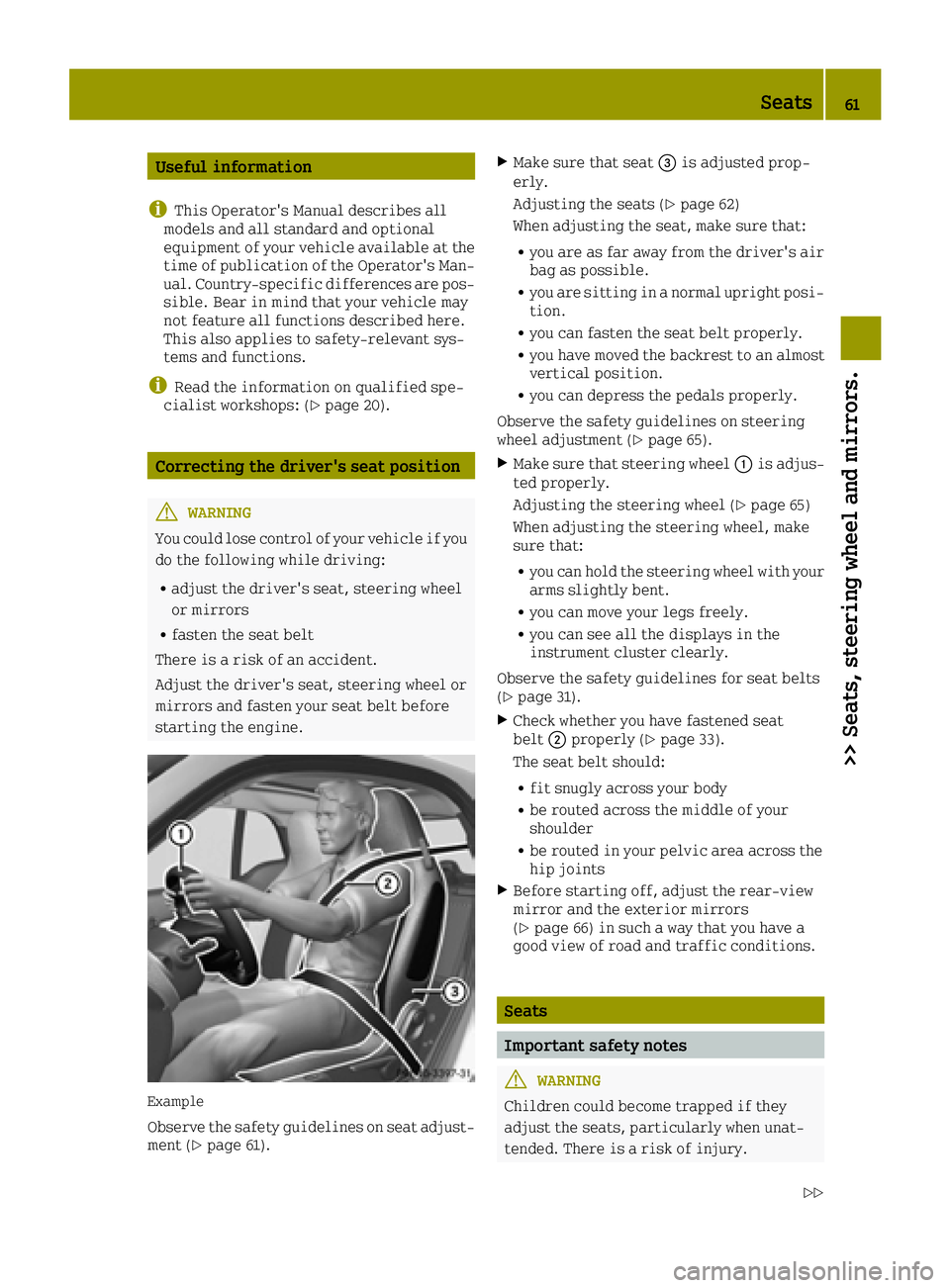
Example
Observe the safety guidelines on seat adjust-
ment (Ypage 61).
XMake sure that seat 0087is adjusted prop-
erly.
Adjusting the seats (
Ypage 62)
When adjusting the seat, make sure that:
Ryou are as far away from the driver's air
bag as possible.
Ryou are sitting in a normal upright posi-
tion.
Ryou can fasten the seat belt properly.
Ryou have moved the backrest to an almost
vertical position.
Ryou can depress the pedals properly.
Observe the safety guidelines on steering
wheel adjustment (
Ypage 65).
XMake sure that steering wheel 0043is adjus-
ted properly.
Adjusting the steering wheel (
Ypage 65)
When adjusting the steering wheel, make
sure that:
Ryou can hold the steering wheel with your
arms slightly bent.
Ryou can move your legs freely.
Ryou can see all the displays in the
instrument cluster clearly.
Observe the safety guidelines for seat belts
(
Ypage 31).
XCheck whether you have fastened seat
belt 0044properly (Ypage 33).
The seat belt should:
Rfit snugly across your body
Rbe routed across the middle of your
shoulder
Rbe routed in your pelvic area across the
hip joints
XBefore starting off, adjust the rear-view
mirror and the exterior mirrors
(
Ypage 66) in such a way that you have a
good view of road and traffic conditions.
Seats
Important safety notes
GWARNING
Children could become trapped if they
adjust the seats, particularly when unat-
tended. There is a risk of injury.
Seats61
>> Seats, steering wheel and mirrors.
Z
Page 70 of 214
conditions such as spray. There is a risk ofan accident.
In such situations, turn the light switch to
0058.
The automatic headlamp feature is only an
aid. The driver is responsible for the vehi-
cle's lighting at all times.
Low-beam headlamps
XTo switch on: turn combination switch con-
trol 0043until 0058is at marking 0044.
The 0058 indicator lamp in the instrument
cluster lights up.
Parking lamps
XTo switch on: turn combination switch con-
trol 0043until 0060is at marking 0044.
Canada only: the standing lamps are only
switched on when the engine is switched off.
When the engine is running, the low-beam
headlamps are switched on.
Front fog lamps
Only vehicles with front foglamps have the
"Foglamps" function.
XTo switch on: make sure that the standing
lamps or low-beam headlamps are switched on.
XTurn combination switch middle ring 006D
until marking 006Cis at 005A.
The 005A indicator lamp in the instrument
cluster lights up.
After releasing, the middle ring returns
automatically back to the neutral position.
XTo switch off: turn combination switch
middle ring 006Duntil marking 006Cis at
005A.
The 005A indicator lamp in the instrument
cluster goes out.
After releasing, the middle ring returns
automatically back to the neutral position.
iIf you switch off the engine (only in the
0058 position) or turn off the lights, the
foglamps are also switched off.
Rear fog lamp
XTo switch on: make sure that the fog lamps
or low-beam headlamps are switched on.
XTurn combination switch middle ring 006D
until marking 006Cis at 005E.
The 005E indicator lamp in the instrument
cluster lights up.
After releasing, the middle ring returns
automatically back to the neutral position.
XTo switch off: turn combination switch
middle ring 006Duntil marking 006Cis at
005E.
The 005E indicator lamp in the instrument
cluster goes out.
After releasing, the middle ring returns
automatically back to the neutral position.
iIf you switch off the engine (only in the
0058 position) or turn off the lights, the
rear foglamps are also switched off.
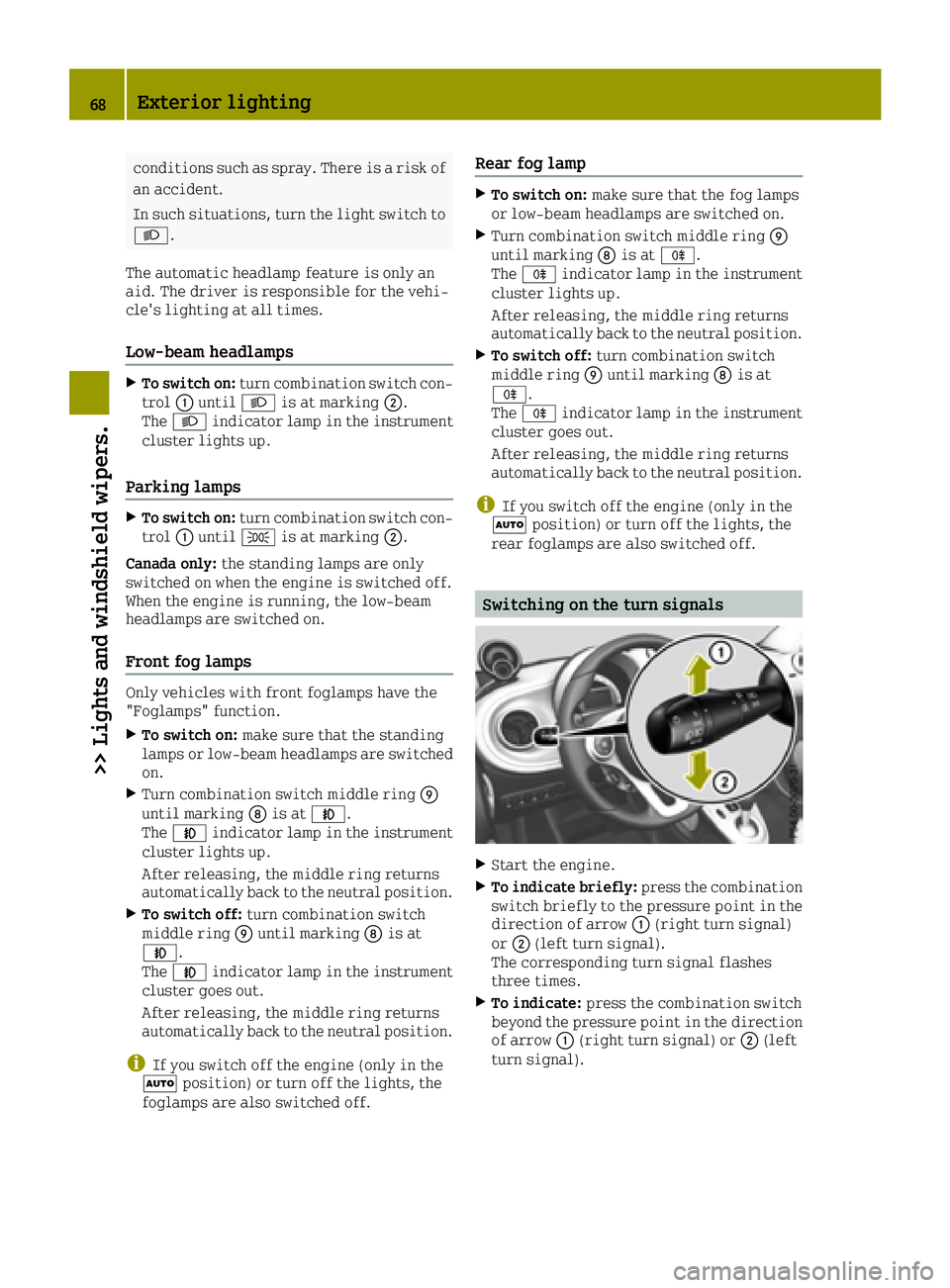
Switching on the turn signals
XStart the engine.
XTo indicate briefly: press the combination
switch briefly to the pressure point in the direction of arrow 0043(right turn signal)
or 0044 (left turn signal).
The corresponding turn signal flashes
three times.
XTo indicate: press the combination switch
beyond the pressure point in the direction
of arrow 0043(right turn signal) or 0044(left
turn signal).
68Exterior lighting
>> Lights and windshield wipers.
Page 71 of 214
Switching on the high-beam headlamps
and headlamp flasher
High-beam headlamps
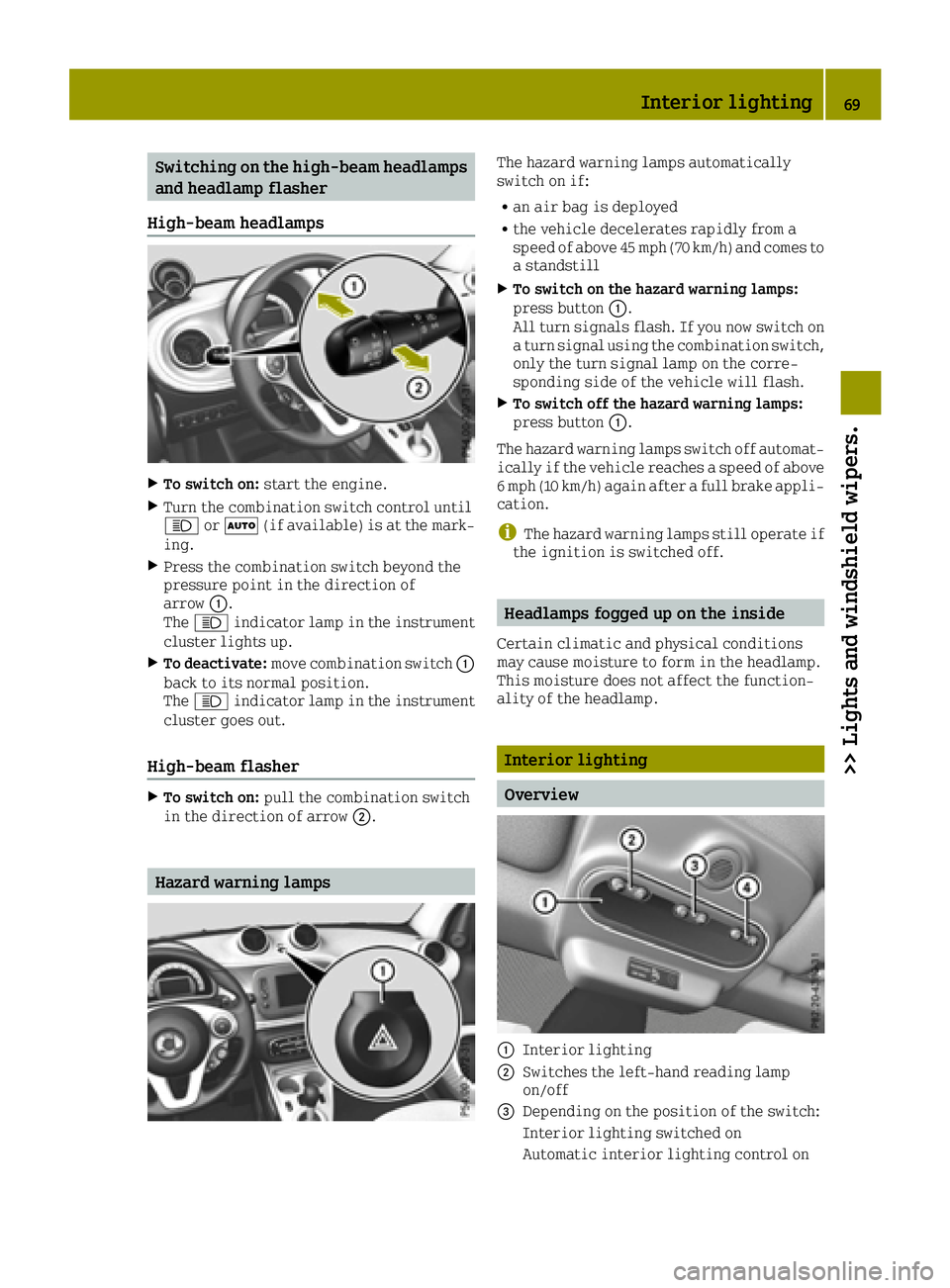
XTo switch on: start the engine.
XTurn the combination switch control until
0057or0058 (if available) is at the mark-
ing.
XPress the combination switch beyond the
pressure point in the direction of
arrow 0043.
The 0057 indicator lamp in the instrument
cluster lights up.
XTo deactivate: move combination switch 0043
back to its normal position.
The 0057 indicator lamp in the instrument
cluster goes out.
High-beam flasher
XTo switch on: pull the combination switch
in the direction of arrow 0044.
Hazard warning lamps
The hazard warning lamps automatically
switch on if:
Ran air bag is deployed
Rthe vehicle decelerates rapidly from a
speed of above 45 mph (70 km/h) and comes to
a standstill
XTo switch on the hazard warning lamps:
press button0043.
All turn signals flash. If you now switch on
a turn signal using the combination switch,
only the turn signal lamp on the corre-
sponding side of the vehicle will flash.
XTo switch off the hazard warning lamps:
press button 0043.
The hazard warning lamps switch off automat- ically if the vehicle reaches a speed of above
6 mph (10 km/h) again after a full brake appli-
cation.
iThe hazard warning lamps still operate if
the ignition is switched off.
Headlamps fogged up on the inside
Certain climatic and physical conditions
may cause moisture to form in the headlamp.
This moisture does not affect the function-
ality of the headlamp.
Interior lighting
Overview
0043Interior lighting
0044Switches the left-hand reading lamp
on/off
0087Depending on the position of the switch:
Interior lighting switched on
Automatic interior lighting control on
Interior lighting69
>> Lights and windshield wipers.
Z
Page 100 of 214
GWARNING
Fuel is poisonous and hazardous to health.
There is a risk of injury.
You must make sure that fuel does not come
into contact with your skin, eyes or cloth-
ing and that it is not swallowed. Do not
inhale fuel vapors. Keep fuel away from
children.
If you or others come into contact with fuel,
observe the following:
RWash away fuel from skin immediately
using soap and water.
RIf fuel comes into contact with your eyes,
immediately rinse them thoroughly with
clean water. Seek medical assistance
without delay.
RIf fuel is swallowed, seek medical assis-
tance without delay. Do not induce vom-
iting.
RImmediately change out of clothing
which has come into contact with fuel.
GWARNING
Electrostatic buildup can create sparks
and ignite fuel vapors. There is a risk of
fire and explosion.
Always touch the vehicle body before open-
ing the fuel filler flap or touching the fuel
pump nozzle. Any existing electrostatic
buildup is thereby discharged.
Do not get into the vehicle again during the
refueling process. Otherwise, electrostatic
charge could build up again.
!Do not use diesel to refuel vehicles with a
gasoline engine. Do not switch on the igni-
tion if you accidentally refuel with the
wrong fuel. Otherwise, the fuel will enter
the fuel system. Even small amounts of the
wrong fuel could result in damage to the
fuel system and the engine. Notify a quali- fied specialist workshop and have the fuel
tank and fuel lines drained completely.
!Overfilling the fuel tank could damage
the fuel system.
!Take care not to spill any fuel on painted
surfaces. You could otherwise damage the
paintwork.
!Use a filter when refueling from a fuel
can. Otherwise, the fuel lines and/or
injection system could be blocked by par-
ticles from the fuel can.
If you overfill the fuel tank, fuel could spray
out when the fuel pump nozzle is removed.
For further information on fuel and fuel qual-
ity (
Ypage 207).
Refueling
General information
The fuel filler flap is unlocked or locked
automatically when you lock or unlock the
vehicle with the key.
The position of the fuel filler cap is dis-
played 00B6in the instrument cluster. The
arrow next to the filling pump indicates the
side of the vehicle.
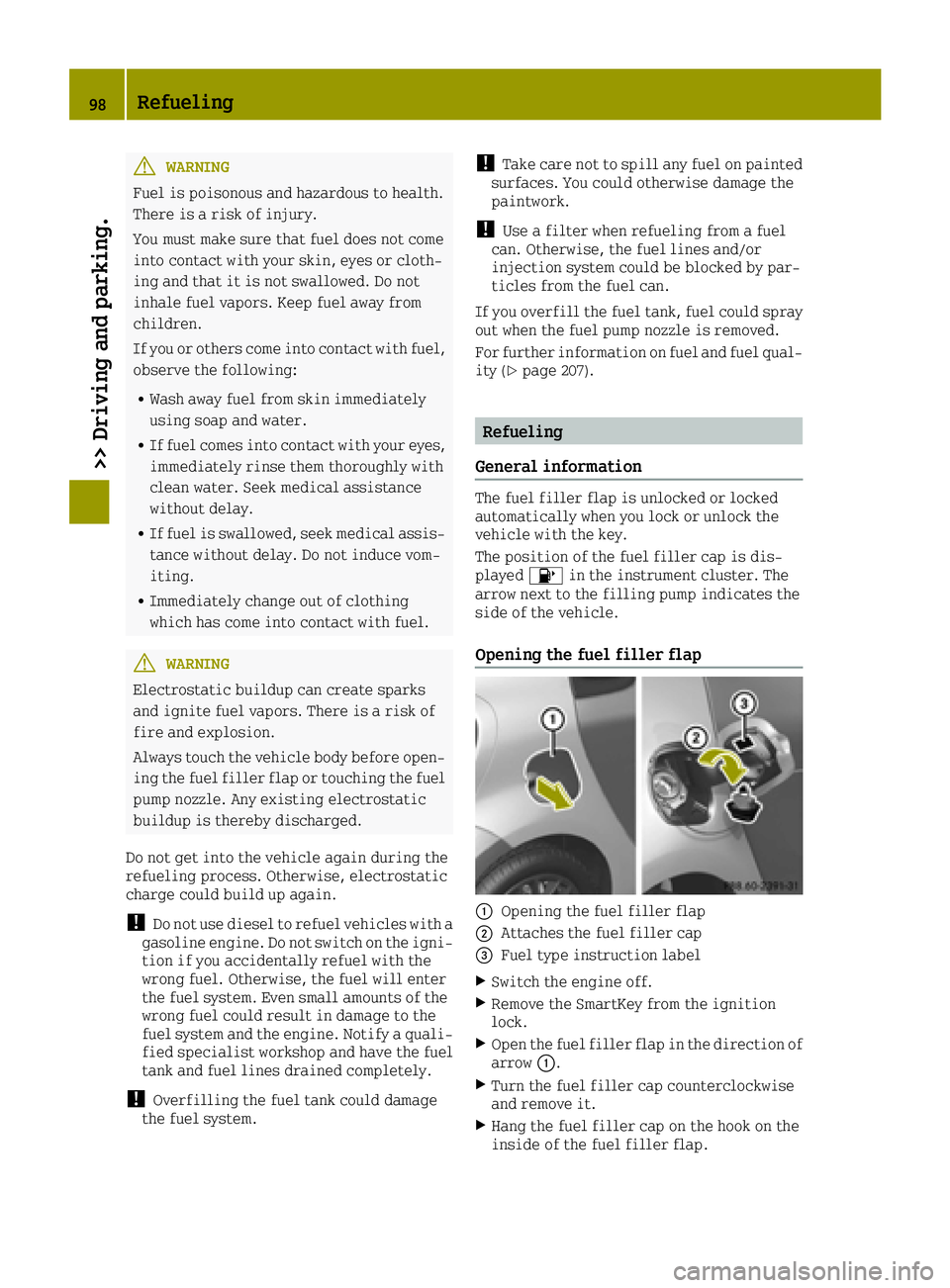
Opening the fuel filler flap
0043Opening the fuel filler flap
0044Attaches the fuel filler cap
0087Fuel type instruction label
XSwitch the engine off.
XRemove the SmartKey from the ignition
lock.
XOpen the fuel filler flap in the direction of
arrow 0043.
XTurn the fuel filler cap counterclockwise
and remove it.
XHang the fuel filler cap on the hook on the
inside of the fuel filler flap.
98Refueling
>> Driving and parking.
Page 101 of 214
XCompletely insert the filler neck of the
fuel pump nozzle into the tank, hook in
place and refuel.
XOnly fill the tank until the pump nozzle
switches off.
iDo not add any more fuel after the pump
stops filling for the first time. Otherwise,
fuel may leak out.
Closing the fuel filler flap
XReplace the cap on the filler neck and turn
clockwise until it engages audibly.
XClose the fuel filler flap.
iClose the fuel filler flap before locking
the vehicle.
iIf you are driving with the fuel filler cap
open, the 00B6reserve fuel warning lamp
flashes. A message appears in the multi-
function display (
Ypage 125).
In addition, the 00B9Check Engine warning
lamp may light up (
Ypage 136).
For further information on warning and
indicator lamps in the instrument cluster,
see (
Ypage 136).
Refueling99
>> Driving and parking.
Z
Page 104 of 214
XTo apply:firmly pull parking brake 0044
upwards.
When the engine is running, the 0027(USA
only) or 004D(Canada only) indicator lamp
lights up in the instrument cluster.
XTo release: depress the brake pedal and
keep it depressed.
XPress release button 0043on parking
brake 0044and guide the parking brake down
to the stop.
The 0027 (USA only) or 004D(Canada only)
indicator lamp in the instrument cluster
goes out.
The parking brake is not yet engaged if:
Ra warning tone sounds
RThe Release Parking Brakemessage
appears in the multifunction display and
Rthe 004D indicator lamp in the instrument
cluster lights up
Parking the vehicle for a long period
If you leave the vehicle parked for longer than
four weeks, the battery may be damaged by
exhaustive discharging.
If you leave the vehicle parked for longer than
six weeks, the vehicle may suffer damage as a
result of lack of use.
XVisit a qualified specialist workshop and
seek advice.
iYou can obtain information about trickle
chargers from a qualified specialist work-
shop.
Driving tips
General notes
Important safety notes
GWARNING
If you switch off the ignition while driv-
ing, safety-relevant functions are only
available with limitations, or not at all.
This could affect, for example, the power
steering and the brake boosting effect. You will require considerably more effort to
steer and brake. There is a risk of an acci-dent.
Do not switch off the ignition while driv-
ing.
GWARNING
If you operate mobile communication
equipment while driving, you will be dis-
tracted from traffic conditions. You could
also lose control of the vehicle. There is a
risk of an accident.
Only operate this equipment when the vehi- cle is stationary.
Observe the legal requirements for the coun-
try in which you are driving. Some jurisdic-
tions prohibit the driver from using a mobile
phone while driving a vehicle.
If you make a call while driving, always use
hands-free mode. Only use the telephone when
the traffic situation permits. If you are
unsure, pull over to a safe location and stop
before using the telephone.
Bear in mind that at a speed of only 30 mph
(approximately 50 km/h), the vehicle covers a
distance of 44 ft (approximately 14 m) per
second.
Drive sensibly – save fuel
Observe the following tips to save fuel:
RThe tires should always be inflated to the
recommended tire pressure.
RRemove unnecessary loads.
RWarm up the engine at low engine speeds.
RAvoid frequent acceleration or braking.
RHave all maintenance work carried out as
indicated by the service intervals in the
Maintenance Booklet or by the service
interval display.
Fuel consumption also increases when driv-
ing in cold weather, in stop-start traffic and
in hilly terrain.
Drinking and driving
GWARNING
Drinking and driving and/or taking drugs
and driving are very dangerous combina-
102Driving tips
>> Driving and parking.
Page 106 of 214
more quickly and protecting them against
corrosion.
Limited braking performance on salt-
treated roads
If you drive on salted roads, a layer of salt
residue may form on the brake discs and brake
pads. This can result in a significantly lon-
ger braking distance.
RBrake occasionally to remove any possible
salt residue. Make sure that you do not
endanger other road users when doing so.
RCarefully depress the brake pedal and the
beginning and end of a journey.
RMaintain a greater distance to the vehicle
ahead.
Servicing the brakes
!The brake fluid level may be too low, if:
Rif the red brake warning lamp lights up
in the instrument cluster and
Ryou hear a warning tone while the engine
is running
Observe additional warning messages in
the multifunction display.
The brake fluid level may be too low due to
brake pad wear or leaking brake lines.
Have the brake system checked immedi-
ately. Consult a qualified specialist work-
shop to arrange this.
!A function or performance test should
only be carried out on a 2-axle dynamome-
ter. If you wish to operate the vehicle on
such a dynamometer, please consult a
qualified specialist workshop in advance.
You could otherwise damage the drive train
or the brake system.
!As the ESP®system operates automati-
cally, the engine and the ignition must be
switched off (the SmartKey must be in posi-
tion 0or 1in the ignition lock) if:
Rthe parking brake is tested using a brake
dynamometer (maximum 10 seconds).
Rthe vehicle is towed with the front axle
raised.
Braking triggered automatically by ESP
®
may seriously damage the brake system. All checks and maintenance work on the brake
system must be carried out at a qualified
specialist workshop.
Have brake pads installed and brake fluid
replaced at a qualified specialist workshop.
If the brake system has only been subject to
moderate loads, you should test the function-
ality of your brakes at regular intervals.
When having brake pads/linings fitted, smart
recommends that you only use those which are
approved for smart vehicles or are of an
equivalent quality standard. Brake pads/
linings which have not been approved for
smart vehicles or which are not of an equiv-
alent quality could affect your vehicle's
operating safety.
smart recommends that you only use brake
fluid which is approved for smart vehicles or
is of an equivalent quality standard. Brake
fluid which has not been approved for smart
vehicles or which
is not of an equivalent
quality could affect your vehicle's operating
safety.
Driving on wet roads
Hydroplaning
If water has accumulated to a certain depth on the road surface, there is a danger of hydro-
planing occurring, even if:
Ryou drive at low speeds.
Rthe tires have adequate tread depth.
For this reason, in the event of heavy rain or in conditions in which hydroplaning may
occur, you must drive in the following man-
ner:
Rlower your speed.
Ravoid ruts.
Ravoid sudden steering movements
Rbrake carefully.
Driving on flooded roads
!Bear in mind that vehicles traveling in
front or in the opposite direction create
waves. This may cause the maximum per-
missible water depth to be exceeded.
Failure to observe these notes may result in damage to the engine, electrical systems
and transmission.
104Driving tips
>> Driving and parking.