seats SMART FORTWO 2016 User Guide
[x] Cancel search | Manufacturer: SMART, Model Year: 2016, Model line: FORTWO, Model: SMART FORTWO 2016Pages: 214, PDF Size: 4.93 MB
Page 66 of 214
Folding back
GWARNING
If the seat backrest is not engaged, it may
fold forwards, e.g. during braking or in the event of an accident.
RAs a result, a backrest which is not
engaged would press you into the seat
belt. The seat belt can no longer offer the
intended level of protection and can even
cause injuries.
RThe backrest cannot restrain objects or
loads in the trunk.
There is an increased risk of injury.
Before every journey, make sure that the
backrest is engaged as described.
Variant 1:
XTurn handwheel 0043back until the desired
seat backrest position is achieved
Variant 2:
XPull release lever 0043.
The backrest is released.
XFold the backrest backwards.
XEnsure that the seat backrest is engaged
again.
Switching the seat heating on/off
Activating/deactivating
GWARNING
Repeatedly switching on the seat heating
can cause the seat cushion and backrest
pads to become very hot. The health of per- sons with limited temperature sensitivity
or a limited ability to react to excessively
high temperatures may be affected or they
may even suffer burn-like injuries. There
is a risk of injury.
Therefore, do not switch the seat heating on
repeatedly.
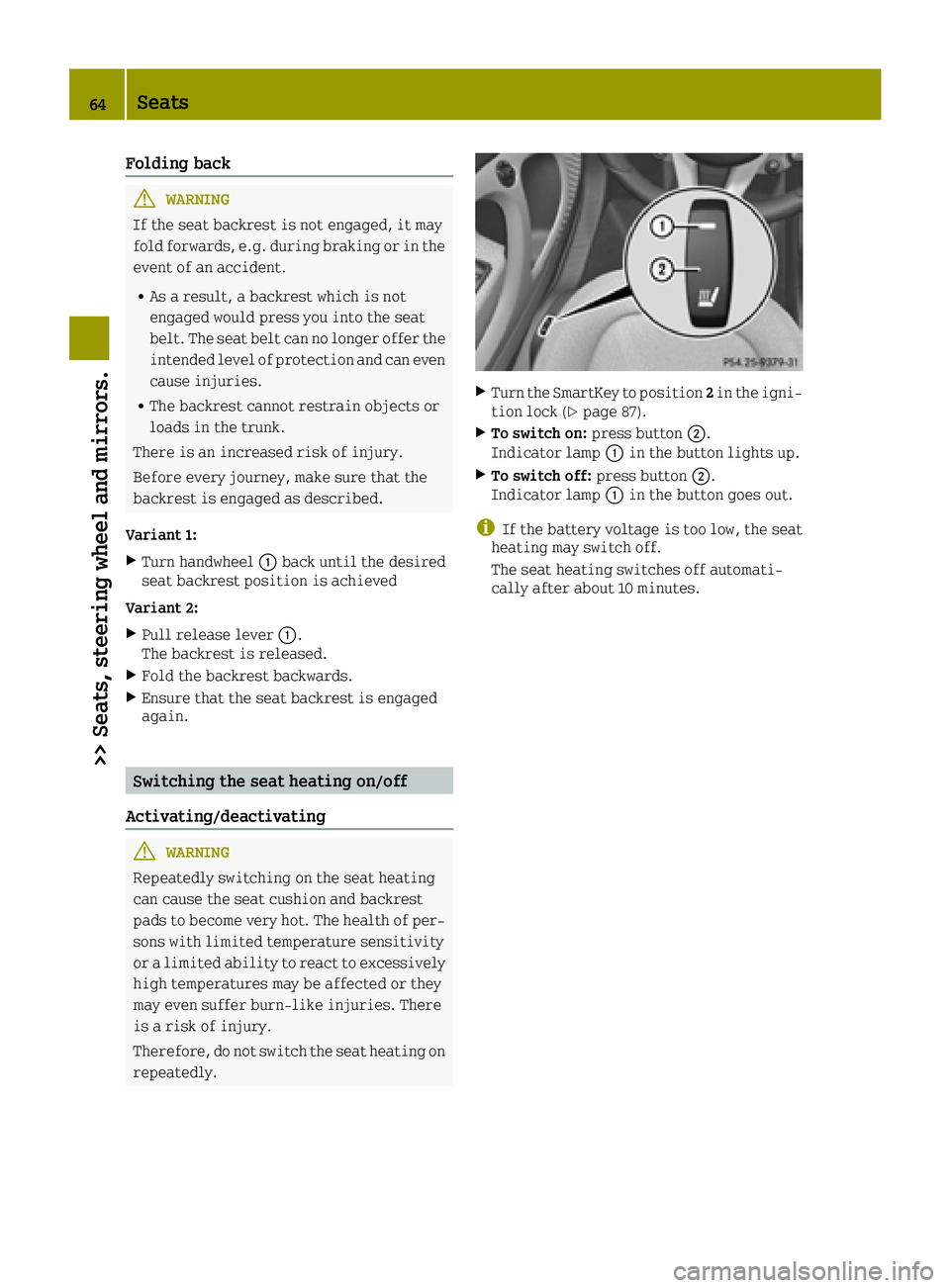
XTurn the SmartKey to position 2in the igni-
tion lock (Ypage 87).
XTo switch on: press button0044.
Indicator lamp 0043in the button lights up.
XTo switch off: press button0044.
Indicator lamp 0043in the button goes out.
iIf the battery voltage is too low, the seat
heating may switch off.
The seat heating switches off automati-
cally after about 10 minutes.
64Seats
>> Seats, steering wheel and mirrors.
Page 67 of 214
Problems with the seat heating
ProblemPossible causes/consequences and0050Solutions
The seat heating has
switched off prema-
turely or cannot be
switched on.The on-board voltage is too low because too many electrical con-
sumers are switched on.
XSwitch off electrical consumers that you do not need, such as the
rear window defroster or interior lighting.
Once the battery is sufficiently charged, the seat heating will
switch back on automatically.
Steering wheel
Important safety notes
GWARNING
You could lose control of your vehicle if you
do the following while driving:
Radjust the driver's seat, steering wheel
or mirrors
Rfasten the seat belt
There is a risk of an accident.
Adjust the driver's seat, steering wheel or
mirrors and fasten your seat belt before
starting the engine.
GWARNING
Children could injure themselves if they
adjust the steering wheel. There is a risk of
injury.
When leaving the vehicle, always take the
SmartKey with you and lock the vehicle.
Never leave children unsupervised in the
vehicle.
Adjusting the steering wheel
GWARNING
If the steering wheel is unlocked while the
vehicle is in motion, it could change posi-
tion unexpectedly. This could cause you to
lose control of the vehicle. There is a risk
of an accident.
Before starting off, make sure the steering wheel is locked. Never unlock the steering
wheel while the vehicle is in motion.
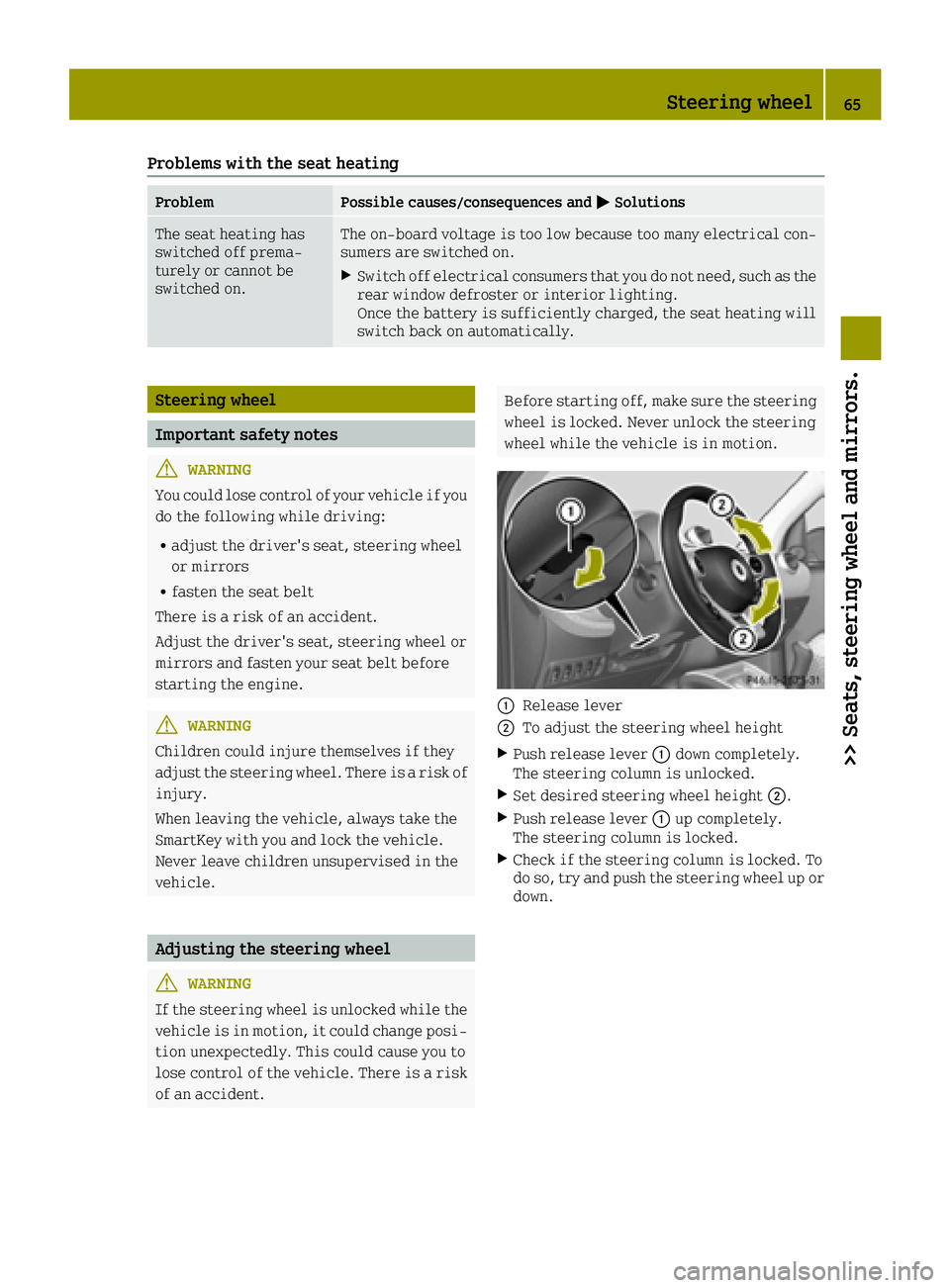
0043Release lever
0044To adjust the steering wheel height
XPush release lever 0043down completely.
The steering column is unlocked.
XSet desired steering wheel height 0044.
XPush release lever0043up completely.
The steering column is locked.
XCheck if the steering column is locked. To
do so, try and push the steering wheel up or down.
Steering wheel65
>> Seats, steering wheel and mirrors.
Z
Page 68 of 214
Mirrors
Rear-view mirror
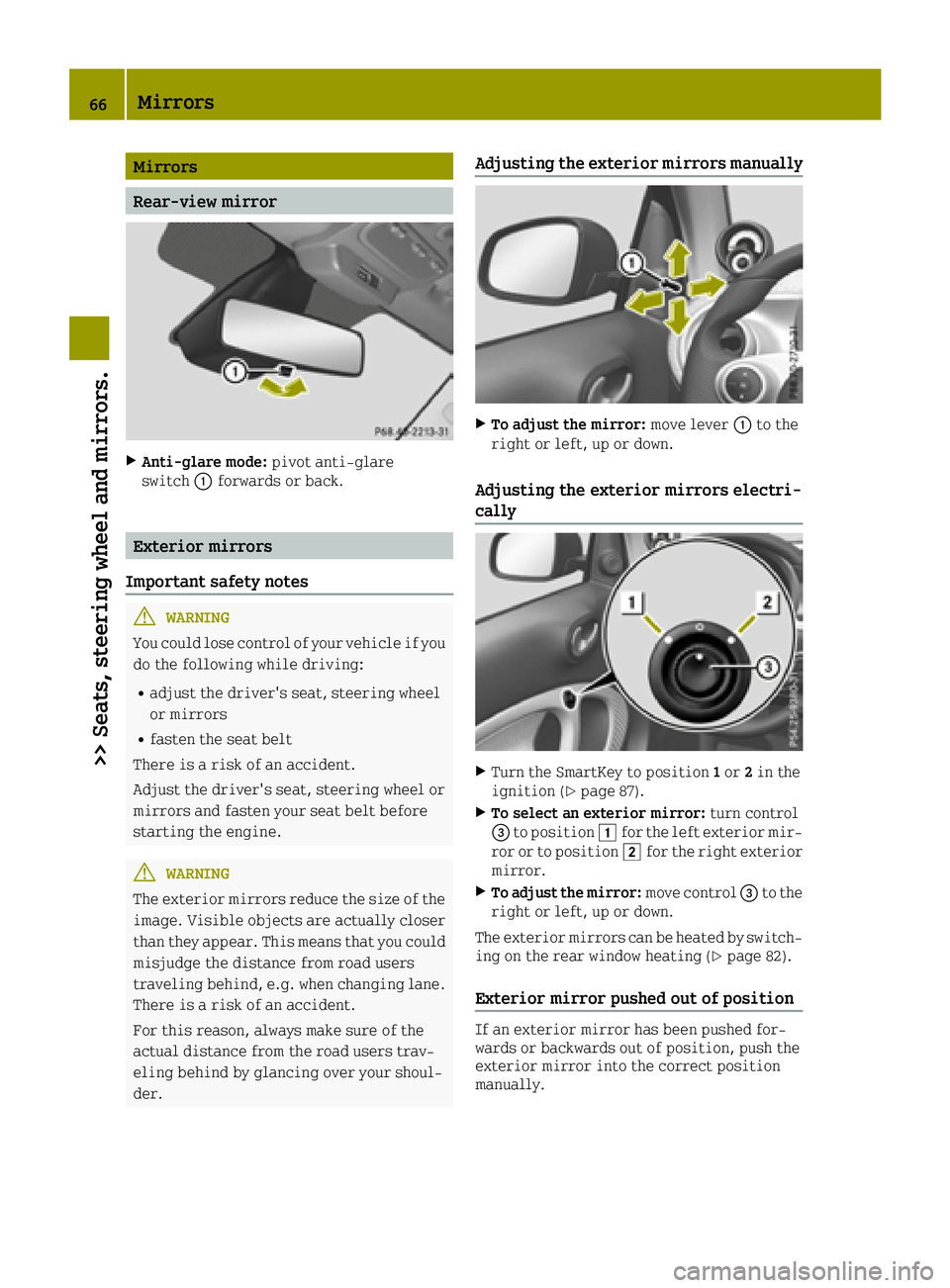
XAnti-glare mode:pivot anti-glare
switch 0043forwards or back.
Exterior mirrors
Important safety notes
GWARNING
You could lose control of your vehicle if you
do the following while driving:
Radjust the driver's seat, steering wheel
or mirrors
Rfasten the seat belt
There is a risk of an accident.
Adjust the driver's seat, steering wheel or
mirrors and fasten your seat belt before
starting the engine.
GWARNING
The exterior mirrors reduce the size of the
image. Visible objects are actually closer
than they appear. This means that you could
misjudge the distance from road users
traveling behind, e.g. when changing lane.
There is a risk of an accident.
For this reason, always make sure of the
actual distance from the road users trav-
eling behind by glancing over your shoul-
der.
Adjusting the exterior mirrors manually
XTo adjust the mirror: move lever0043to the
right or left, up or down.
Adjusting the exterior mirrors electri-
cally
XTurn the SmartKey to position 1or 2in the
ignition (Ypage 87).
XTo select an exterior mirror: turn control
0087 to position 0047for the left exterior mir-
ror or to position 0048for the right exterior
mirror.
XTo adjust the mirror: move control0087to the
right or left, up or down.
The exterior mirrors can be heated by switch- ing on the rear window heating (
Ypage 82).
Exterior mirror pushed out of position
If an exterior mirror has been pushed for-
wards or backwards out of position, push the
exterior mirror into the correct position
manually.
66Mirrors
>> Seats, steering wheel and mirrors.
Page 144 of 214
Useful information
i
This Operator's Manual describes all
models and all standard and optional
equipment of your vehicle available at the
time of publication of the Operator's Man- ual. Country-specific differences are pos-
sible. Bear in mind that your vehicle may
not feature all functions described here.
This also applies to safety-relevant sys-
tems and functions.
iRead the information on qualified spe-
cialist workshops: (Ypage 20).
Stowage areas
Loading guidelines
GWARNING
If objects, luggage or loads are not secured or not secured sufficiently, they could
slip, tip over or be flung around and
thereby hit vehicle occupants. There is a
risk of injury, particularly in the event of
sudden braking or a sudden change in
direction.
Always store objects so that they cannot be
flung around. Secure objects, luggage or
loads against slipping or tipping before
the journey.
GWARNING
Combustion engines emit poisonous
exhaust gases such as carbon monoxide. If
the tailgate is open when the engine is
running, particularly if the vehicle is
moving, exhaust fumes could enter the
passenger compartment. There is a risk of
poisoning.
Turn off the engine before opening the
tailgate. Never drive with the tailgate
open.
Your vehicle has not been approved by the
manufacturer for towing a trailer. A trailer
could seriously impair driving safety.
Mounting a basic rack, a cycle rack or a ski/
snowboard rack on the rear of the vehicle will change the axle load distribution as speci-
fied by the vehicle manufacturer. Read the
operating instructions for the individual
accessories.
The handling characteristics of a laden vehi-
cle are dependent on the distribution of the
load within the vehicle. For this reason, you
should observe the following notes when
transporting a load:
Rnever exceed the maximum permissible
gross vehicle weight or the permissible
axle loads for the vehicle (including occu-
pants). The values are specified on the
vehicle identification plate on the B-pil-
lar of the driver's door
Rthe load must not protrude above the upper
edge of the head restraints
Rensure that no items of luggage can enter
the vehicle interior above or between the
front seats
Rensure that loaded objects are stowed
safely and are secured
Rload heavy objects at the bottom and light
objects at the top
Stowage space
Important safety notes
GWARNING
If you stow objects in the vehicle interior
in an unsuitable way, they could slip or be
thrown around and thus hit vehicle occu-
pants. Additionally, the cup holders, open
stowage spaces and mobile phone brackets
cannot restrain the objects placed in them
in the event of an accident. There is a risk
of injury, especially in the event of brak-
ing or sudden changes in direction.
RAlways stow objects so they cannot be
thrown around in these or similar situa-
tions.
RAlways ensure that objects do not pro-
trude from the stowage compartments or
stowage nets.
142Stowage areas
>> Stowage and features.
Page 145 of 214
RAll closable stowage compartments
should be closed before beginning your
journey.
RAlways stow and secure heavy, hard, poin-
ted, sharp-edged, fragile objects or
objects which are too large behind the
last bench seat or under the passenger
seats.
Observe the loading guidelines (
Ypage 142).
Glove box
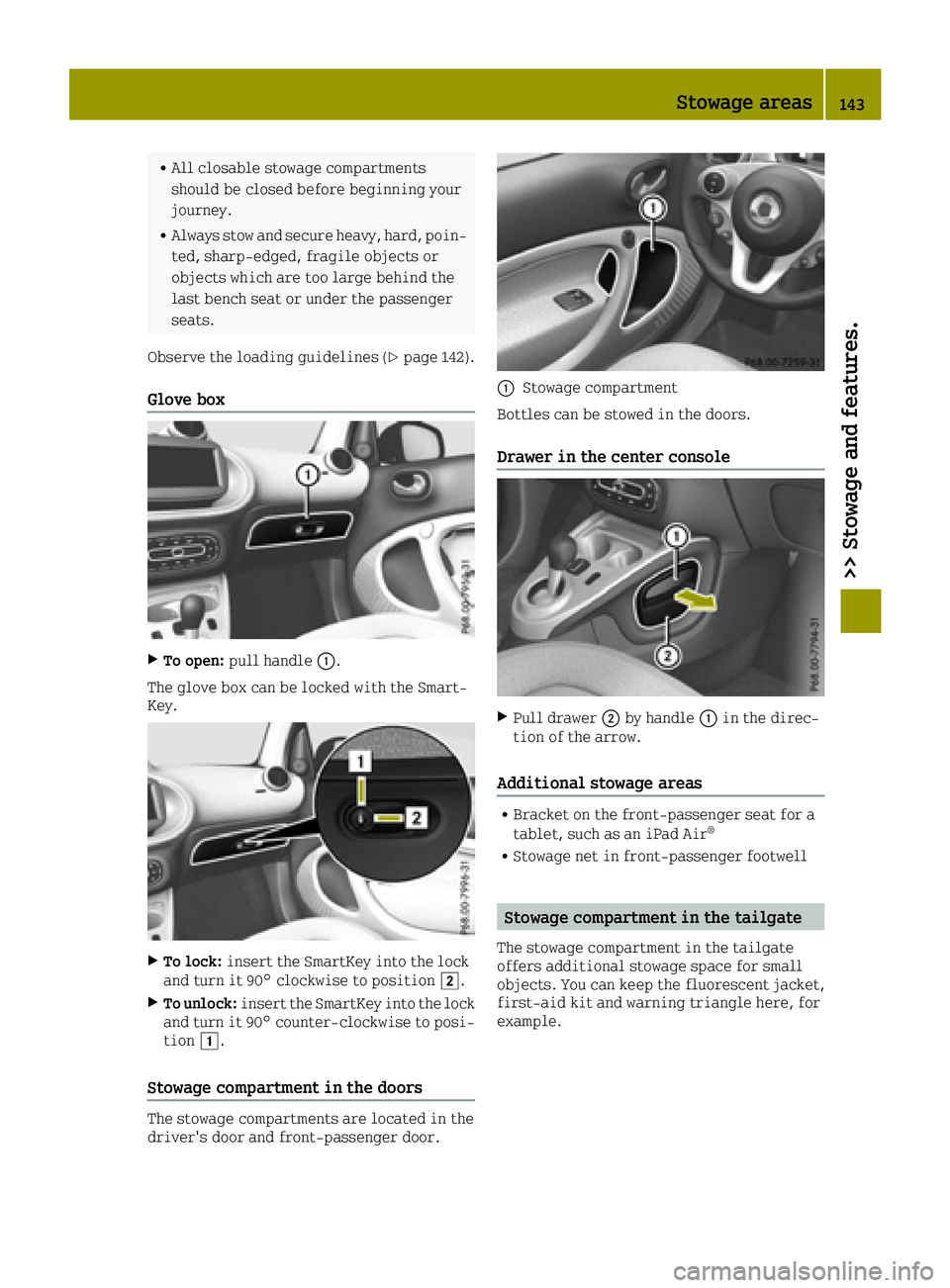
XTo open: pull handle 0043.
The glove box can be locked with the Smart-
Key.
XTo lock: insert the SmartKey into the lock
and turn it 90° clockwise to position 0048.
XTo unlock:insert the SmartKey into the lock
and turn it 90° counter-clockwise to posi-
tion 0047.
Stowage compartment in the doors
The stowage compartments are located in the
driver's door and front-passenger door.
0043Stowage compartment
Bottles can be stowed in the doors.
Drawer in the center console
XPull drawer 0044by handle 0043in the direc-
tion of the arrow.
Additional stowage areas
RBracket on the front-passenger seat for a
tablet, such as an iPad Air®
RStowage net in front-passenger footwell
Stowage compartment in the tailgate
The stowage compartment in the tailgate
offers additional stowage space for small
objects. You can keep the fluorescent jacket,
first-aid kit and warning triangle here, for
example.
Stowage areas143
>> Stowage and features.
Z
Page 167 of 214
Always make sure that neither you nor the bat-
tery is electrostatically charged. There is a
build-up of electrostatic charge, e.g.:
Rby wearing clothing made from synthetic
fibers
Rdue to friction between clothing and seats
Rif you push or pull the battery across the
carpet or other synthetic materials
Rif you wipe the battery with a cloth.
GWARNING
During the charging process, a battery pro-
duces hydrogen gas. If a short circuit
occurs or sparks are created, the hydrogen
gas can ignite. There is a risk of an explo- sion.
RMake sure that the positive terminal of a
connected battery does not come into
contact with vehicle parts.
RNever place metal objects or tools on a
battery.
RIt is important that you observe the
described order of the battery terminals
when connecting and disconnecting a
battery.
RWhen jump-starting, make sure that the
battery poles with identical polarity are
connected.
RIt is particularly important to observe
the described order when connecting and
disconnecting the jumper cables.
RNever connect or disconnect the battery
terminals while the engine is running.
GWARNING
Battery acid is caustic. There is a risk of
injury.
Avoid contact with skin, eyes or clothing.
Do not inhale any battery gases. Do not lean
over the battery. Keep children away from
batteries. Wash away battery acid immedi-
ately with plenty of clean water and seek
medical attention.
HEnvironmental note
Batteries contain danger-
ous substances. It is
against the law to dispose
of them with the household
rubbish. They must be col-
lected separately and recy-
cled to protect the envi-
ronment.
Dispose of batteries in an
environmentally friendly
manner. Take discharged
batteries to a qualified
specialist workshop or a
special collection point
for used batteries.
!Have the battery checked regularly at a
qualified specialist workshop.
Observe the service intervals in the Main-
tenance Booklet or contact a qualified spe-
cialist workshop for more information.
!You should have all work involving the
battery carried out at a qualified special-
ist workshop. In the exceptional case that
it is necessary for you to disconnect the
battery yourself, make sure that:
Ryou switch off the engine and remove the
SmartKey. Check that all the indicator
lamps in the instrument cluster are off.
Otherwise, electronic components, such
as the alternator, may be damaged.
Ryou first remove the negative terminal
clamp and then the positive terminal
clamp. Never swap the terminal clamps.
Otherwise, the vehicle's electronic sys-
tem may be damaged.
The battery and the cover of the positive
terminal clamp must be installed securely
during operation.
Comply with safety precautions and take pro-
tective measures when handling batteries.
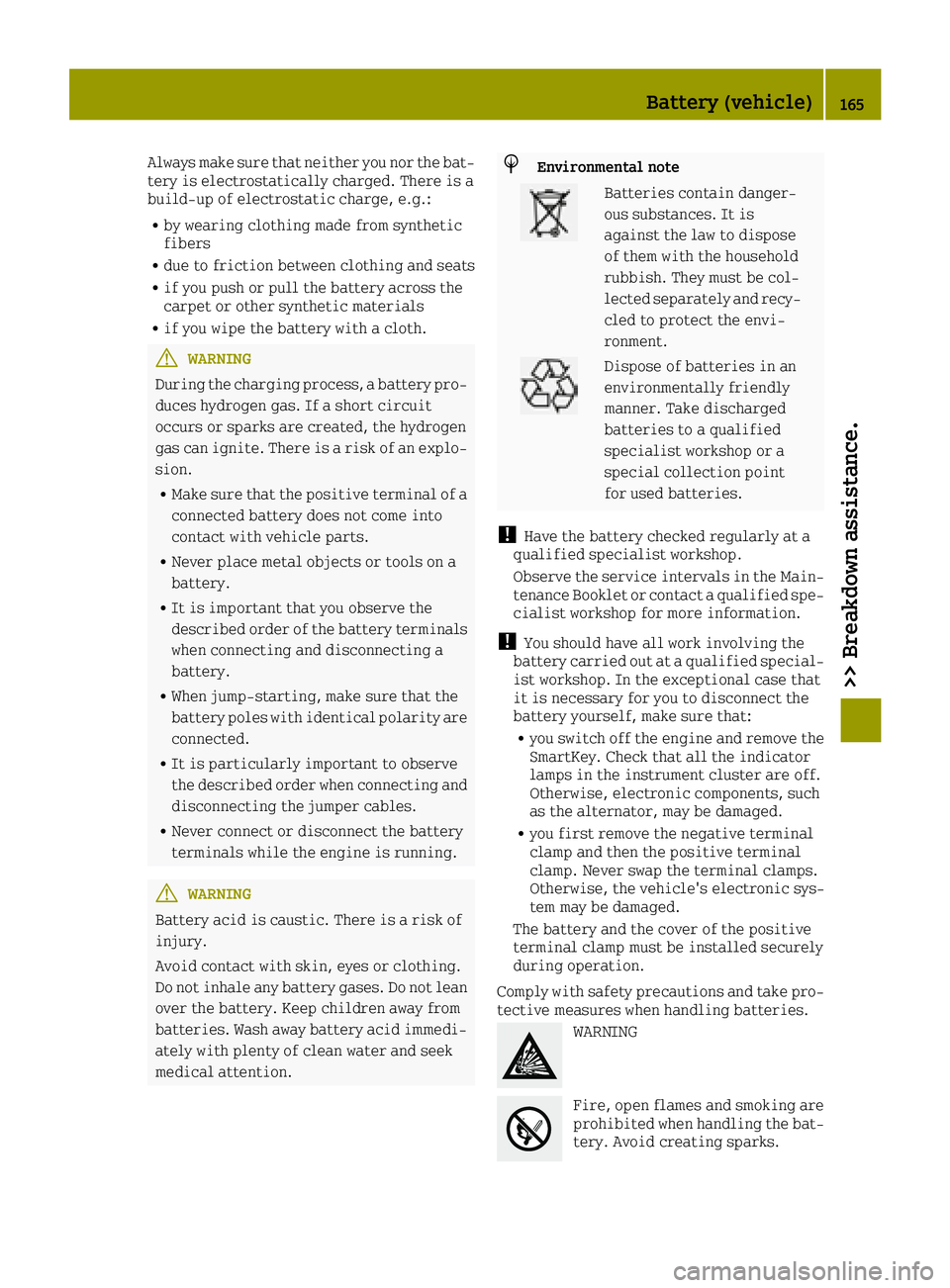
WARNING
Fire, open flames and smoking are
prohibited when handling the bat-
tery. Avoid creating sparks.
Battery (vehicle)165
>> Breakdown assistance.
Z
Page 183 of 214
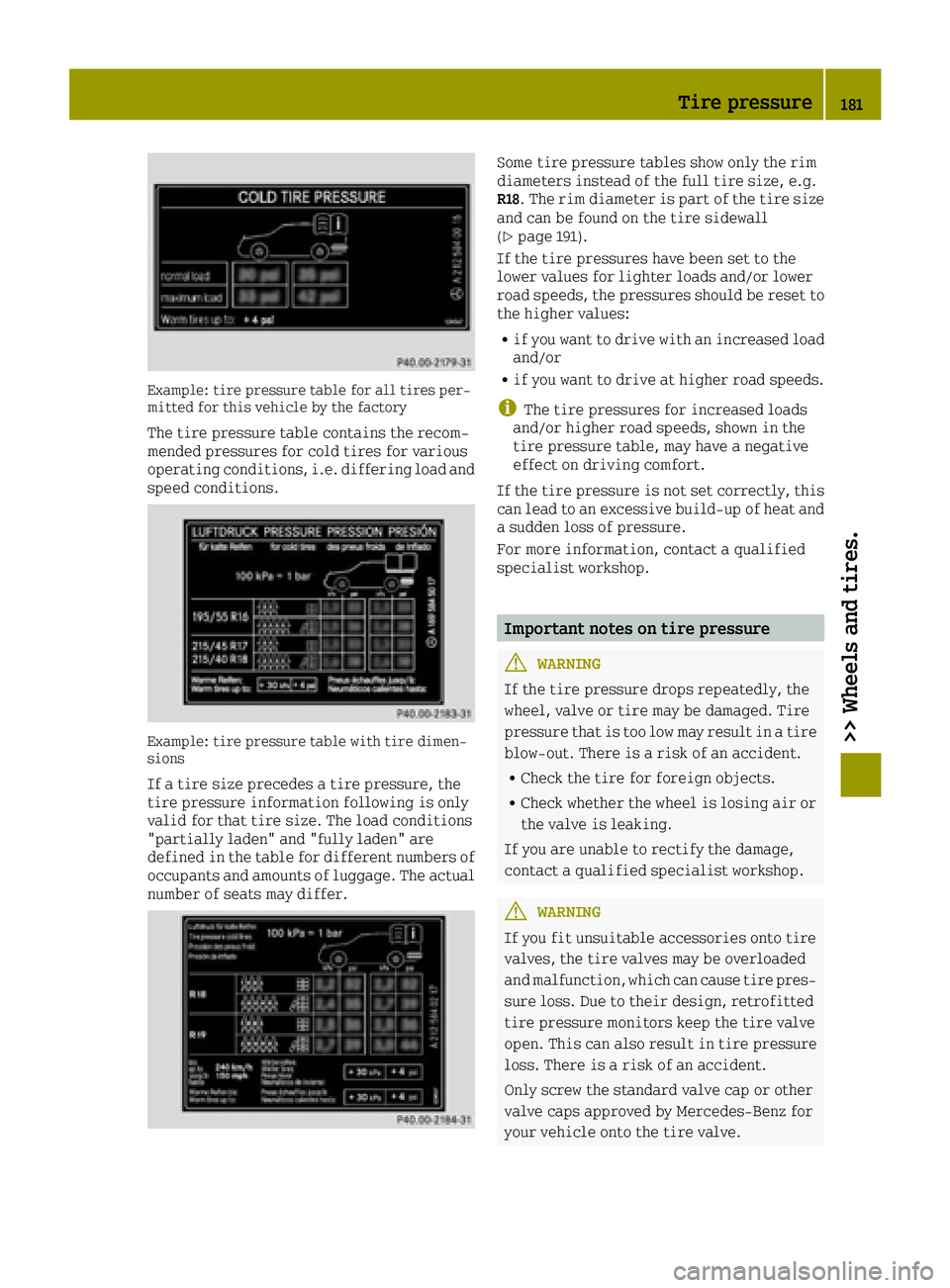
Example: tire pressure table for all tires per-
mitted for this vehicle by the factory
The tire pressure table contains the recom-
mended pressures for cold tires for various
operating conditions, i.e. differing load and
speed conditions.
Example: tire pressure table with tire dimen-
sions
If a tire size precedes a tire pressure, the
tire pressure information following is only
valid for that tire size. The load conditions
"partially laden" and "fully laden" are
defined in the table for different numbers of
occupants and amounts of luggage. The actual
number of seats may differ.
Some tire pressure tables show only the rim
diameters instead of the full tire size, e.g.
R18. The rim diameter is part of the tire size
and can be found on the tire sidewall
(
Ypage 191).
If the tire pressures have been set to the
lower values for lighter loads and/or lower
road speeds, the pressures should be reset to
the higher values:
Rif you want to drive with an increased load
and/or
Rif you want to drive at higher road speeds.
iThe tire pressures for increased loads
and/or higher road speeds, shown in the
tire pressure table, may have a negative
effect on driving comfort.
If the tire pressure is not set correctly, this
can lead to an excessive build-up of heat and
a sudden loss of pressure.
For more information, contact a qualified
specialist workshop.
Important notes on tire pressure
GWARNING
If the tire pressure drops repeatedly, the
wheel, valve or tire may be damaged. Tire
pressure that is too low may result in a tire
blow-out. There is a risk of an accident.
RCheck the tire for foreign objects.
RCheck whether the wheel is losing air or
the valve is leaking.
If you are unable to rectify the damage,
contact a qualified specialist workshop.
GWARNING
If you fit unsuitable accessories onto tire
valves, the tire valves may be overloaded
and malfunction, which can cause tire pres-
sure loss. Due to their design, retrofitted
tire pressure monitors keep the tire valve
open. This can also result in tire pressure
loss. There is a risk of an accident.
Only screw the standard valve cap or other
valve caps approved by Mercedes-Benz for
your vehicle onto the tire valve.
Tire pressure181
>> Wheels and tires.
Z
Page 188 of 214
tains details of the tire sizes and corre-
sponding pressures for tires mounted at
the factory.
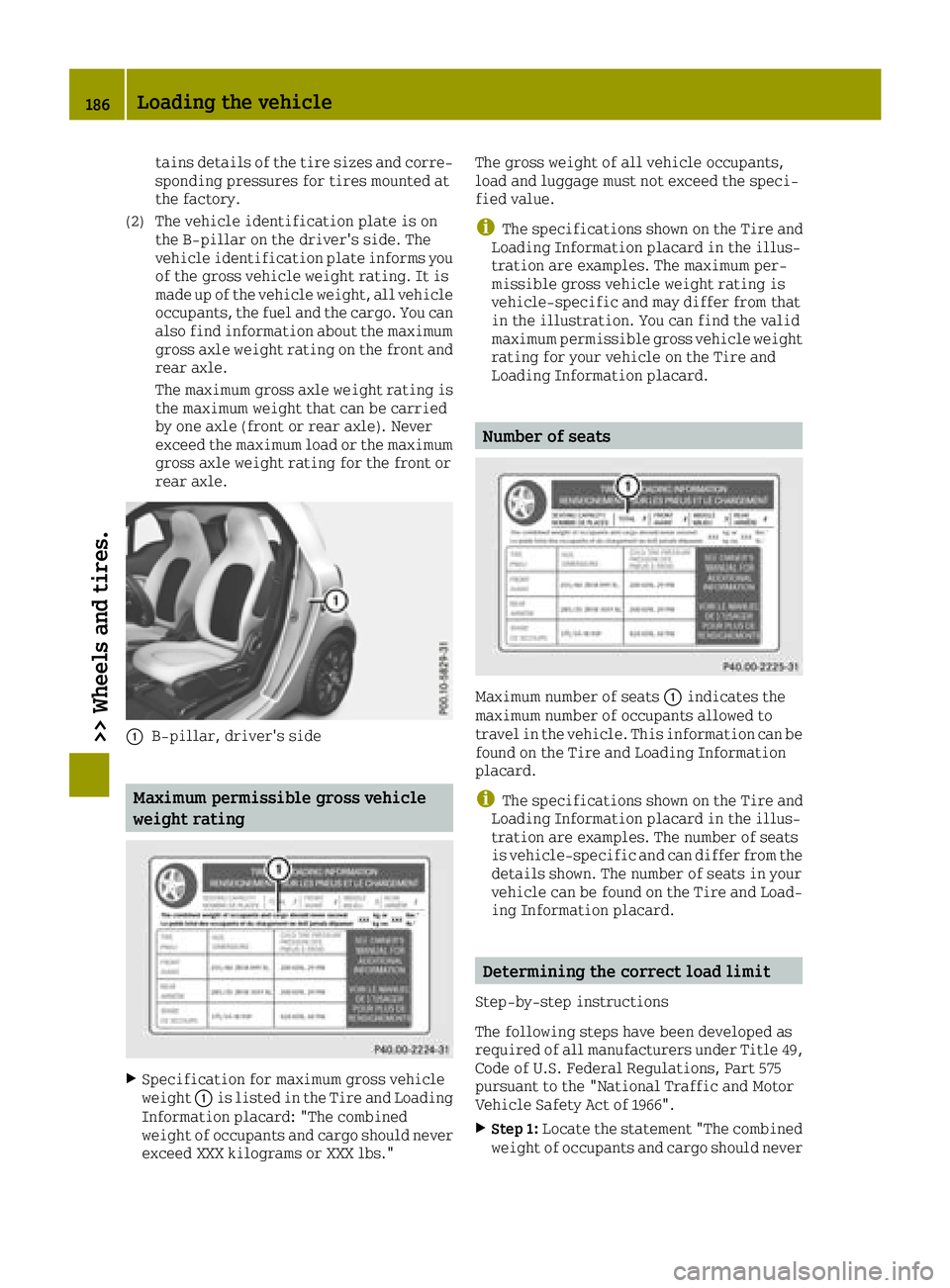
(2) The vehicle identification plate is on the B-pillar on the driver's side. The
vehicle identification plate informs you
of the gross vehicle weight rating. It is
made up of the vehicle weight, all vehicle
occupants, the fuel and the cargo. You can
also find information about the maximum
gross axle weight rating on the front and
rear axle.
The maximum gross axle weight rating is
the maximum weight that can be carried
by one axle (front or rear axle). Never
exceed the maximum load or the maximum gross axle weight rating for the front or
rear axle.
0043B-pillar, driver's side
Maximum permissible gross vehicle
weight rating
XSpecification for maximum gross vehicle
weight 0043is listed in the Tire and Loading
Information placard: "The combined
weight of occupants and cargo should never
exceed XXX kilograms or XXX lbs." The gross weight of all vehicle occupants,
load and luggage must not exceed the speci-
fied value.
iThe specifications shown on the Tire and
Loading Information placard in the illus-
tration are examples. The maximum per-
missible gross vehicle weight rating is
vehicle-specific and may differ from that
in the illustration. You can find the valid
maximum permissible gross vehicle weight
rating for your vehicle on the Tire and
Loading Information placard.
Number of seats
Maximum number of seats 0043indicates the
maximum number of occupants allowed to
travel in the vehicle. This information can be
found on the Tire and Loading Information
placard.
iThe specifications shown on the Tire and
Loading Information placard in the illus-
tration are examples. The number of seats
is vehicle-specific and can differ from the
details shown. The number of seats in your
vehicle can be found on the Tire and Load-
ing Information placard.
Determining the correct load limit
Step-by-step instructions
The following steps have been developed as
required of all manufacturers under Title 49,
Code of U.S. Federal Regulations, Part 575
pursuant to the "National Traffic and Motor
Vehicle Safety Act of 1966".
XStep 1: Locate the statement "The combined
weight of occupants and cargo should never
186Loading the vehicle
>> Wheels and tires.
Page 198 of 214
Tread
The part of the tire that comes into contact
with the road.
Bead
The tire bead ensures that the tire sits
securely on the wheel. There are several steel
wires in the bead to prevent the tire from
coming loose from the wheel rim.
Sidewall
The part of the tire between the tread and the
bead.
Weight of optional extras
The combined weight of those optional extras
that weigh more than the replaced standard
parts and more than 5 lbs (2.3 kilograms).
These optional extras, such as high-perform-
ance brakes, level control, a roof rack or a
high-performance battery, are not included
in the curb weight and the weight of the
accessories.
TIN (Tire Identification Number)
This is a unique identifier which can be used
by a tire manufacturer to identify tires, for
example for a product recall, and thus iden-
tify the purchasers. The TIN is made up of the manufacturer's identity code, tire size, tire
type code and the manufacturing date.
Load bearing index
The load bearing index (also load index) is a
code that contains the maximum load bearing
capacity of a tire.
Traction
Traction is the result of friction between the
tires and the road surface.
Treadwear indicators
Narrow bars (tread wear bars) that are dis-
tributed over the tire tread. If the tire tread
is level with the bars, the wear limit of 00CDin
(1.6 mm) has been reached.
Occupant distribution
The distribution of occupants in a vehicle at
their designated seating positions.
Total load limit
Nominal load and luggage load plus 68 kg
(150 lbs) multiplied by the number of seats in
the vehicle.
Changing a wheel
Flat tire
You can find information on what to do in the
event of a flat tire in the "Flat tire" section
(
Ypage 161).
Rotating the wheels
GWARNING
Never interchange the front and rear wheels
as they have different dimensions, e.g.
size, wheel offset etc. Otherwise, there
could be a negative effect on the road hold- ing and you could endanger yourself or oth-
ers.
!On vehicles equipped with a tire pressure
monitor, electronic components are loca-
ted in the wheel.
Tire-mounting tools should not be used
near the valve. This could damage the elec-
tronic components.
Only have tires changed at a qualified spe-
cialist workshop.
Various types of steel wheel can be fitted on
your vehicle. Some steel wheels have a red
mark in the hub cap area. The hub cap has to be
removed to see the red mark, see "Raising the
vehicle" in the "Wheel change" section
(
Ypage 197). When changing the wheels,
always fit wheels of the same type on all axles.
Always pay attention to the instructions and
safety notes when changing a wheel
(
Ypage 196).
The wear patterns on the front and rear tires
differ, depending on the operating condi-
tions. Front tires typically wear more on the
shoulders and the rear tires in the center.
Clean the contact surfaces of the wheel and
the brake disc thoroughly every time a wheel
is rotated. Check the tire pressure and reac-
tivate the tire pressure monitor if necessary.
196Changing a wheel
>> Wheels and tires.