change time SMART FORTWO 2016 Owners Manual
[x] Cancel search | Manufacturer: SMART, Model Year: 2016, Model line: FORTWO, Model: SMART FORTWO 2016Pages: 214, PDF Size: 4.93 MB
Page 3 of 214
Let the fun begin!
We urge you to read it carefully and famili-
arize yourself with the vehicle before driv-
ing. For your own safety and a longer vehiclelife, follow the instructions and warning
notices in this manual. Ignoring them could
result in damage to the vehicle or personal
injury to you or others.
This Operator's Manual provides information
on the most important functions of your vehi-
cle.
The equipment or product designation of your
vehicle may vary depending on:
RModel
ROrder
RCountry specification
RAvailability
The illustrations in this manual show a left-
hand-drive vehicle. On right-hand-drive
vehicles, the layout of components and con-
trols differs accordingly.
smart is constantly updating its vehicles to
the state of the art.
smart therefore reserves the right to intro-
duce changes in the following areas:
RDesign
REquipment
RTechnical features
The equipment in your vehicle may therefore
differ from that shown in the descriptions
and illustrations.
The following are integral components of the
vehicle:
ROperator's Manual
RMaintenance Booklet
REquipment-dependent supplements
Keep printed copies of the documents in the
vehicle at all times. If you sell the vehicle,
always pass the documents on to the new owner.
The technical documentation team at
Daimler AG wishes you safe and pleasant
motoring.
4535841703
É4535841703SËÍ
Page 18 of 214
Protection of the environment
General notes
HEnvironmental note
Daimler's declared policy is one of com-
prehensive environmental protection.
The objectives are for the natural resour-
ces that form the basis of our existence on
this planet to be used sparingly and in a
manner that takes the requirements of both
nature and humanity into account.
You too can help to protect the environment
by operating your vehicle in an environ-
mentally responsible manner.
Fuel consumption and the rate of engine,
transmission, brake and tire wear are
affected by these factors:
Roperating conditions of your vehicle
Ryour personal driving style
You can influence both factors. You should
bear the following in mind:
Operating conditions:
Ravoid short trips as these increase fuel
consumption.
Ralways make sure that the tire pressures
are correct.
Rdo not carry any unnecessary weight.
Ra regularly serviced vehicle will con-
tribute to environmental protection. You
should therefore adhere to the service
intervals.
RAlways have service work carried out at a
qualified specialist workshop.
Personal driving style:
Rdo not depress the accelerator pedal
when starting the engine.
Rdo not warm up the engine when the vehi-
cle is stationary.
Rdrive carefully and maintain a safe dis- tance from the vehicle in front.
Ravoid frequent, sudden acceleration and
braking.
Rchange gear in good time and use each
gear only up to 00C3of its maximum engine
speed.
Rswitch off the engine in stationary traf-
fic.
Rkeep an eye on the vehicle's fuel con-
sumption.
Environmental concerns and recom-
mendations
Wherever the operating instructions require you to dispose of materials, first try to
regenerate or re-use them. Observe the rel-
evant environmental rules and regulations
when disposing of materials. In this way you
will help to protect the environment.
Genuine smart parts
HEnvironmental note
Daimler AG also supplies reconditioned
major assemblies and parts which are of the
same quality as new parts. They are covered
by the same Limited Warranty entitlements
as new parts.
!Air bags and Emergency Tensioning Devi-
ces, as well as control units and sensors for
these restraint systems, may be installed
in the following areas of your vehicle:
Rdoors
Rdoor pillars
Rdoor sills
Rseats
Rcockpit
Rinstrument cluster
Rcenter console
Do not install accessories such as audio
systems in these areas. Do not carry out
repairs or welding. You could impair the
operating efficiency of the restraint sys-
tems.
Have aftermarket accessories installed at
a qualified specialist workshop.
You could jeopardize the operating safety of
your vehicle if you use parts, tires and wheels
16>> Introduction.
Page 34 of 214
additional injury, for example, in an acci-
dent, during braking or an abrupt change of
direction. This poses an increased risk of
injury or even fatal injury.
For this reason, always secure persons
under 5 ft (1.50 m) in height in suitable
restraint systems.
If a child younger than twelve years old and
under 5 ft (1.50 m) in height is traveling in the
vehicle:
Ralways secure the child in a child restraint
system suitable for this smart vehicle. The
child restraint system must be appropriate
to the age, weight and size of the child
Ralways observe the instructions and safety
notes on "Children in the vehicle"
(
Ypage 42) in addition to the child
restraint system manufacturer's installa-
tion and operating instructions
Rbe sure to observe the instructions and
safety notes on the "Occupant classifica-
tion system (OCS)" (
Ypage 36)
GWARNING
The seat belts may not perform their inten- ded protective function if:
Rthey are damaged, modified, extremely
dirty, bleach or dyed
Rthe seat belt buckle is damaged or
extremely dirty
Rthe Emergency Tensioning Devices, belt
anchorages or inertia reels have been
modified
Seat belts may sustain non-visible damage
in an accident, e.g. due to glass splinters.
Modified or damaged seat belts may tear or
fail, e.g. in an accident. Modified Emer-
gency Tensioning Devices could acciden-
tally trigger or fail to deploy when neces-
sary. This poses an increased risk of injury
or even fatal injury.
Never modify the seat belts, Emergency
Tensioning Devices, belt anchorages or
inertia reels. Make sure that the seat belts
are undamaged, not worn out and clean. Fol-
lowing an accident, have the seat belts
checked immediately at a qualified spe-
cialist workshop.
Only use seat belts that have been approved
for your vehicle by smart.
Proper use of the seat belts
Pay attention to the safety notes about the
seat belt (Ypage 31).
All vehicle occupants must fasten the seat
belt correctly before setting off. Make sure
that all occupants are wearing their seat
belts correctly for the entire journey.
When fastening the seat belt, make sure that:
RThe seat belt tongue is inserted into the
belt buckle that belongs to the seat.
RThe seat belt is tightened across your body.
Avoid wearing bulky clothing, e.g. a winter coat.
RThe seat belt is not twisted.
Only then can the forces produced in the
event of an accident be evenly distributed
across the belt.
RThe shoulder section of the belt must always
be routed across the center of the shoulder.
The shoulder section of the belt should not come into contact with your neck and must
not be routed under the arm.
RThe lap belt must be taut and as low as pos-
sible over your lap.
The lap belt must always pass across your
hip joints and never across your stomach or
abdomen. Pregnant women must take par-
ticular care. If necessary, the lap belt canbe pushed down across the hip joints and
pulled tight using the shoulder section.
RThe seat belt is not routed over sharp,
pointed or fragile objects.
If these items are on or in your clothing,
e.g. eyeglasses, pens, keys, etc., stow theseitems in a more suitable location.
ROnly one person should use each seat belt at
any one time.
On no account should babies or children
travel sitting on the lap of another vehicle occupant. During an accident, they could be
crushed between the occupant and seat belt.
RObjects are not secured with a seat belt if
the seat belt is being used by one of the
vehicle’s occupants.
32Occupant safety
>> Safety.
Page 72 of 214
Interior lighting switched off
0085Switches the right-hand reading lamp on/
off
The interior lighting is switched on when a
door is open: if the corresponding door is
closed correctly the interior lighting goes
out.
Interior lighting control
If the doors are unlocked with the remote con-
trol, the interval timer for the interior
lighting is triggered. The interval timer
restarts when a door is opened.
The front interior lighting and the luggage
compartment light go out gradually.
The interior lighting interval timer is
switched off:
Rif a door remains open, the interior light-
ing switches off after 15 minutes without
dimming
Rif all doors (with additional locking mech-
anism) are closed, the interior lighting
switches off after 15 seconds
Rif all doors (without locking mechanism)
are closed, the interior lighting switches
off after 3 to 4 minutes
Ras soon as the engine is started and for as
long as the engine is running
Replacing bulbs
Important safety notes
GWARNING
Bulbs, lamps and connectors can get very
hot when operating. If you change a bulb,
you could burn yourself on these compo-
nents. There is a risk of injury.
Allow these components to cool down before changing a bulb.
Do not use a bulb that has been dropped or if
its glass tube has been scratched.
The bulb may explode if:
Ryou touch it
Rit is hot
Ryou drop it
Ryou scratch it
Only operate bulbs in enclosed lamps
designed for that purpose. Only fit spare
bulbs of the same type and the specified volt-
age.
Marks on the glass tube reduce the service
life of the bulbs. Do not touch the glass tube
with your bare hands. If necessary, clean the
glass tube when cold with alcohol or spirit
and rub it off with a lint-free cloth.
Protect bulbs from moisture during opera-
tion. Do not allow bulbs to come into contact
with liquids.
Replace only the bulbs listed (
Ypage 70).
If you require assistance replacing bulbs,
consult a qualified specialist workshop.
If the new bulb still does not light up, consult
a qualified specialist workshop.
The daytime driving lights and part of the
rear light clusters of your vehicle are equip-
ped with LED light bulbs. Do not replace these
bulbs yourself. Contact a qualified special-
ist workshop which has the necessary spe-
cialist knowledge and tools to carry out the
work required.
Headlamps and lamps are an important aspect
of vehicle safety. You must therefore make
sure that these function correctly at all
times. Have the headlamp setting checked
regularly.
Overview: changing bulbs/bulb types
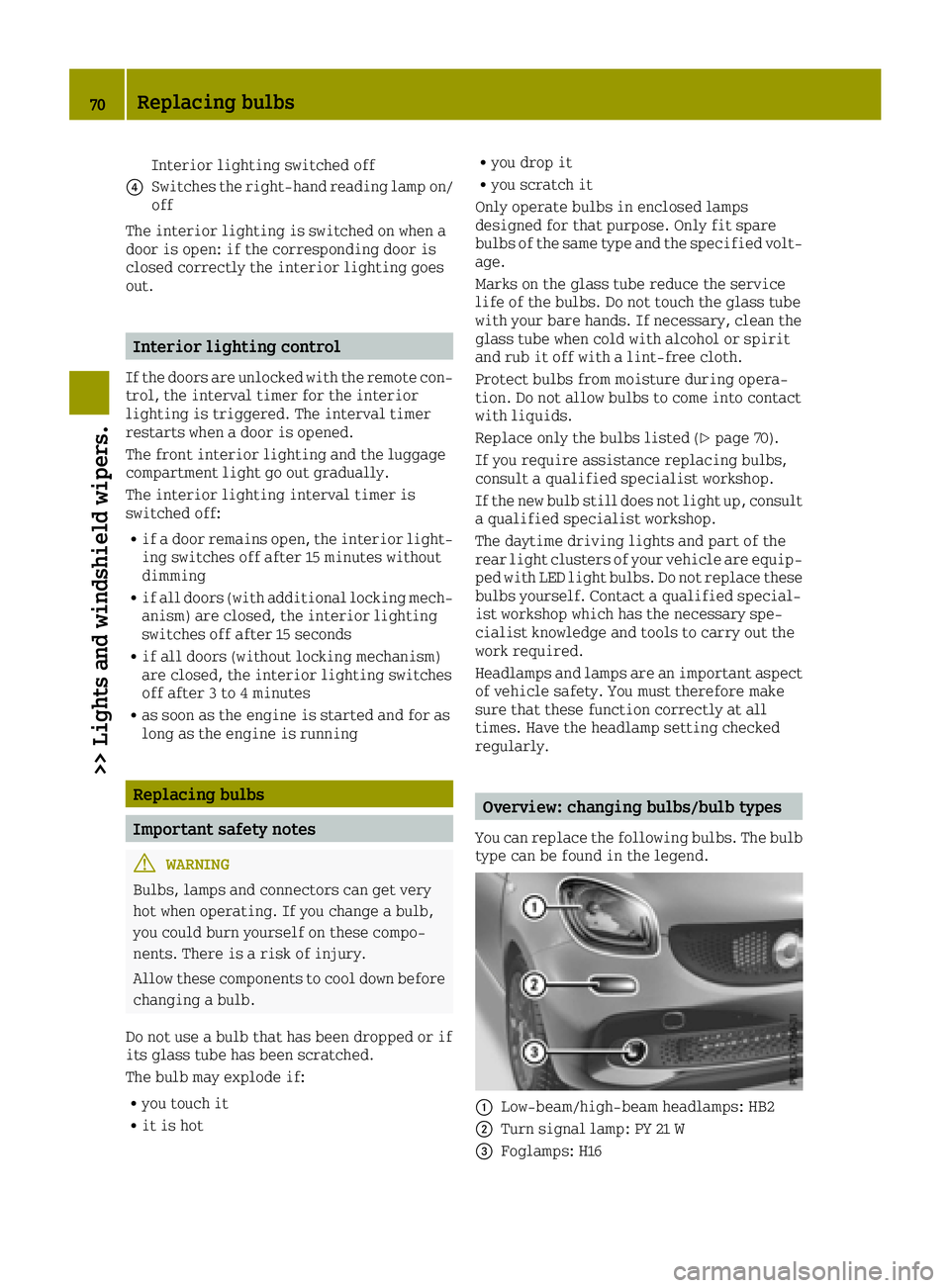
You can replace the following bulbs. The bulb
type can be found in the legend.
0043Low-beam/high-beam headlamps: HB2
0044Turn signal lamp: PY 21 W
0087Foglamps: H16
70Replacing bulbs
>> Lights and windshield wipers.
Page 88 of 214
Useful information
i
This Operator's Manual describes all
models and all standard and optional
equipment of your vehicle available at the
time of publication of the Operator's Man- ual. Country-specific differences are pos-
sible. Bear in mind that your vehicle may
not feature all functions described here.
This also applies to safety-relevant sys-
tems and functions.
iRead the information on qualified spe-
cialist workshops: (Ypage 20).
Notes on breaking-in a new vehicle
Important safety notes
In certain driving and driving safety sys-
tems, the sensors adjust automatically while
a certain distance is being driven after the
vehicle has been delivered or after repairs.
Full system effectiveness is not reached until
the end of this teach-in procedure.
New and replaced brake pads and discs only
reach their optimum braking effect after sev-
eral hundred kilometers of driving. Compen-
sate for this by applying greater force to the brake pedal.
The first 1000 miles (1500 km)
The more you look after the engine when it is
new, the more satisfied you will be with its
performance in the future.
RYou should therefore drive at varying vehi-
cle and engine speeds for the first
1000 miles (1500 km).
RAvoid heavy loads, e.g. driving at full
throttle, during this period.
RChange gear in good time, before the tach-ometer needle is 00C3of the way to the red
area of the tachometer.
RDo not manually shift to a lower gear to
brake the vehicle.
RVehicles with automatic transmission: if
possible, do not depress the accelerator pedal beyond the pressure point (kick-
down).
RVehicles with automatic transmission:
ideally, for the first 1000 miles(1500 km),
drive in program
E(Comfort).
After 1000 miles (1500 km), you can increase
the engine speed gradually and bring the
vehicle to full speed.
You should also observe these notes on run-
ning-in if the engine or parts of the drive
train on your vehicle have been replaced.
Observe the maximum permissible speed.
Driving
Important safety notes
GWARNING
Objects in the driver's footwell can
restrict the pedal travel or obstruct a
depressed pedal. The operating and road
safety of the vehicle is jeopardized. There
is a risk of an accident.
Make sure that all objects in the vehicle are
stowed correctly, and that they cannot enter
the driver's footwell. Install the floormats securely and as specified in order to
ensure sufficient clearance for the pedals.
Do not use loose floormats and do not place
floormats on top of one another.
GWARNING
Unsuitable footwear can hinder correct
usage of the pedals, e.g.:
Rshoes with thick soles
Rshoes with high heels
Rslippers
There is a risk of an accident.
Wear suitable footwear to ensure correct
usage of the pedals.
GWARNING
If you switch off the ignition while driv-
ing, safety-relevant functions are only
available with limitations, or not at all.
This could affect, for example, the power
86Driving
>> Driving and parking.
Page 90 of 214
or parts of the engine that heat up. There is
a risk of fire.
Carry out regular checks to make sure that
there are no flammable foreign materials
in the engine compartment or in the exhaust
system.
!Do not depress the accelerator when
starting the engine.
iDuring a cold start, the engine runs at
higher speeds to enable the catalytic con-
verter to reach its operating temperature.
The sound of the engine may change during
this time.
Manual transmission
XDepress the brake pedal and keep it
depressed.
XDepress the clutch pedal fully.
XShift to neutral.
Automatic transmission
XShift the transmission to position P
(Ypage 92).
The transmission position display in the
multifunction display shows P
(
Ypage 92).
iYou can start the engine in transmission
positions Pand N.
In order to start the engine in transmission
position Nyou must depress the brake pedal
and keep it depressed.
Starting procedure
XTurn the key to position 3in the ignition
lock (Ypage 87) and release it as soon as the
engine is running.
Pulling away
General notes
GWARNING
Vehicles with automatic transmission:
If the engine speed is above the idling
speed and you engage transmission posi-
tion Dor R, the vehicle could pull away
suddenly. There is a risk of an accident.
When engaging transmission position Dor
R, always firmly depress the brake pedal
and do not simultaneously accelerate.
!Vehicles with manual transmission:
change gear in good time and avoid spin-
ning the wheels. You could otherwise dam-
age the vehicle.
!Release the parking brake before driving
off. The parking brake can otherwise over-
heat, malfunction and wear out quickly.
Accelerate gently when pulling away.
The vehicle locks centrally once you have
pulled away.
You can open the doors from the inside at any
time.
You can also deactivate the automatic locking
feature (
Ypage 55).
Vehicles with automatic transmission: you
can only shift the transmission from position
P to the desired transmission position if:
Rthe ignition is switched on
Ryou depress the brake pedal and keep it
depressed and
Ryou press release button on the selector
lever (Ypage 92).
Only then is the shift lock released.
iVehicles with automatic transmission:
transmission shifts take place at higher
engine speeds after a cold start. This helps
the catalytic converter to reach its oper-
ating temperature more quickly.
Hill start assist
Hill start assist helps you when pulling away forwards or in reverse on an uphill gradient.
It holds the vehicle for a short time after you have removed your foot from the brake pedal.
This gives you enough time to move your foot
from the brake pedal to the accelerator pedal
and to depress it before the vehicle begins to
roll.
GWARNING
After a short time, hill start assist will no
longer brake your vehicle and it could roll
88Driving
>> Driving and parking.
Page 96 of 214
Kickdown
If you want maximum acceleration, use kick-
down:
XDepress the accelerator pedal beyond the
pressure point.
The automatic transmission shifts to a
lower gear depending on the engine speed.
XEase off the accelerator pedal once the
desired speed is reached.
The automatic transmission shifts back up.
Rocking the vehicle free
Shifting the transmission repeatedly
between gearsDand Rmay help to free the
vehicle if it has become stuck in slush or
snow.
XShift the selector lever alternately
between positions Dand R.
The vehicle's engine management system lim-
its the speed to a maximum of 5 mph (9 km/h)
when shifting back and forth.
Program selector button
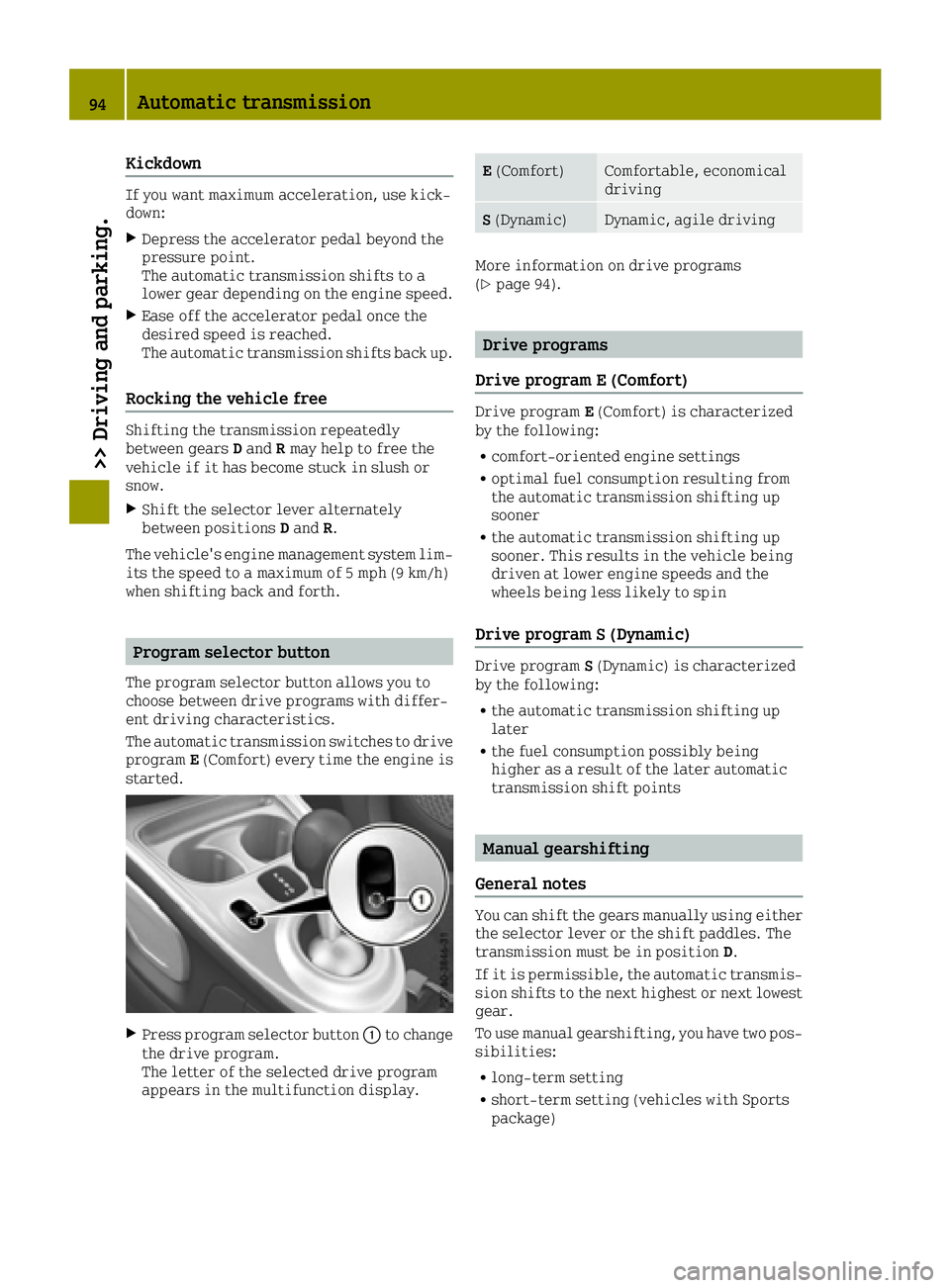
The program selector button allows you to
choose between drive programs with differ-
ent driving characteristics.
The automatic transmission switches to drive
program E(Comfort) every time the engine is
started.
XPress program selector button 0043to change
the drive program.
The letter of the selected drive program
appears in the multifunction display.
E (Comfort)Comfortable, economical
driving
S(Dynamic)Dynamic, agile driving
More information on drive programs
(Ypage 94).
Drive programs
Drive program E (Comfort)
Drive program E(Comfort) is characterized
by the following:
Rcomfort-oriented engine settings
Roptimal fuel consumption resulting from
the automatic transmission shifting up
sooner
Rthe automatic transmission shifting up
sooner. This results in the vehicle being
driven at lower engine speeds and the
wheels being less likely to spin
Drive program S (Dynamic)
Drive program S(Dynamic) is characterized
by the following:
Rthe automatic transmission shifting up
later
Rthe fuel consumption possibly being
higher as a result of the later automatic
transmission shift points
Manual gearshifting
General notes
You can shift the gears manually using either
the selector lever or the shift paddles. The
transmission must be in position D.
If it is permissible, the automatic transmis-
sion shifts to the next highest or next lowest
gear.
To use manual gearshifting, you have two pos-
sibilities:
Rlong-term setting
Rshort-term setting (vehicles with Sports
package)
94Automatic transmission
>> Driving and parking.
Page 97 of 214
If you activate the manual gearshift setting,
the currently selected gear is shown in the
multifunction display instead ofD.
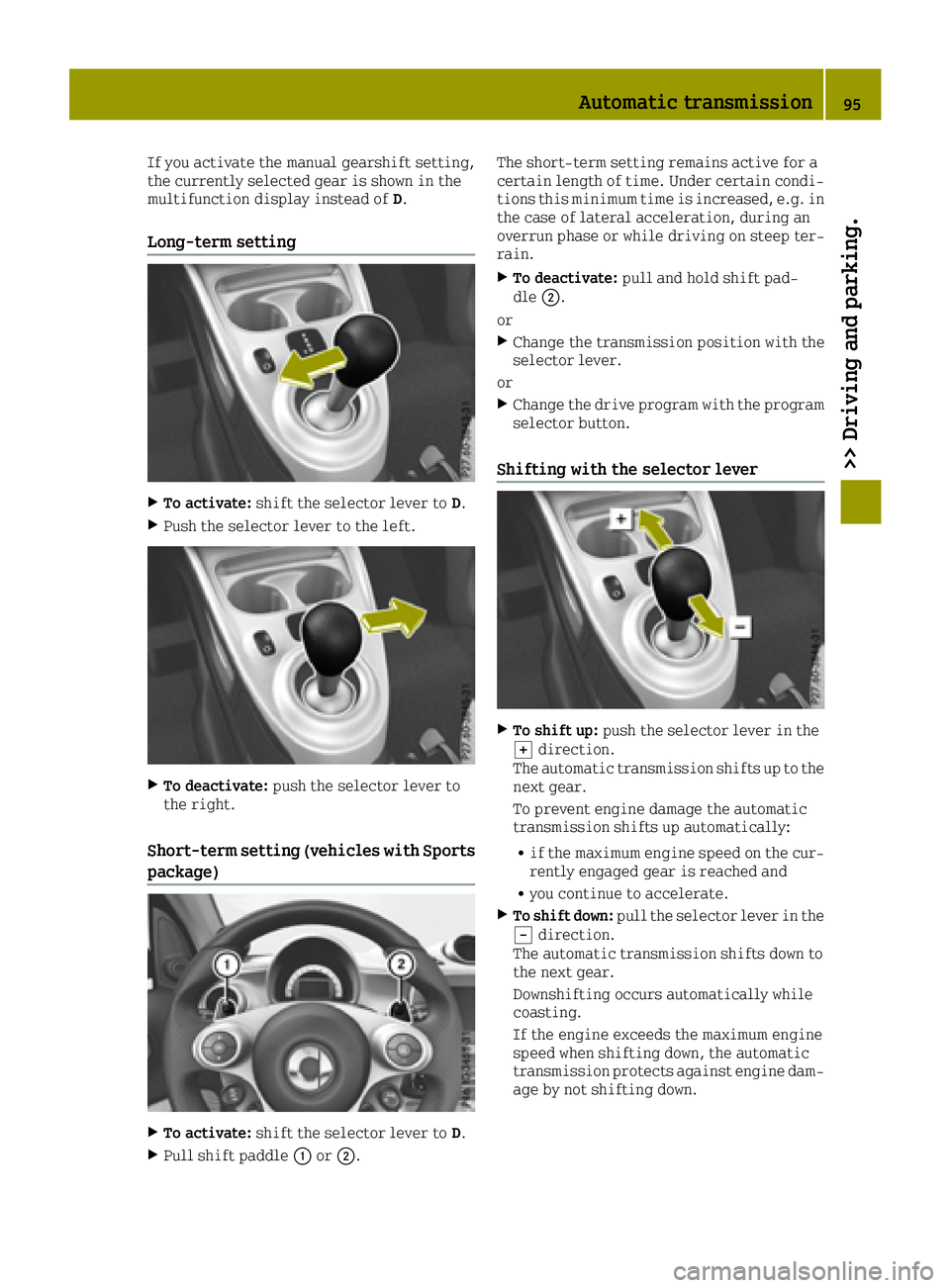
Long-term setting
XTo activate:shift the selector lever to D.
XPush the selector lever to the left.
XTo deactivate:push the selector lever to
the right.
Short-term setting (vehicles with Sports
package)
XTo activate: shift the selector lever to D.
XPull shift paddle0043or0044. The short-term setting remains active for a
certain length of time. Under certain condi-
tions this minimum time is increased, e.g. in
the case of lateral acceleration, during an
overrun phase or while driving on steep ter-
rain.
XTo deactivate:
pull and hold shift pad-
dle 0044.
or
XChange the transmission position with the
selector lever.
or
XChange the drive program with the program
selector button.
Shifting with the selector lever
XTo shift up: push the selector lever in the
0064 direction.
The automatic transmission shifts up to the
next gear.
To prevent engine damage the automatic
transmission shifts up automatically:
Rif the maximum engine speed on the cur-
rently engaged gear is reached and
Ryou continue to accelerate.
XTo shift down: pull the selector lever in the
0058 direction.
The automatic transmission shifts down to
the next gear.
Downshifting occurs automatically while
coasting.
If the engine exceeds the maximum engine
speed when shifting down, the automatic
transmission protects against engine dam-
age by not shifting down.
Automatic transmission95
>> Driving and parking.
Z
Page 105 of 214
tions. Even a small amount of alcohol or
drugs can affect your reflexes, perceptions
and judgment.
The possibility of a serious or even fatal
accident is greatly increased when you
drink or take drugs and drive.
Do not drink or take drugs and drive or
allow anyone to drive who has been drinkingor taking drugs.
Emission control
GWARNING
Combustion engines emit poisonous
exhaust gases such as carbon monoxide.
Inhaling these exhaust gases leads to poi-
soning. There is a risk of fatal injury.
Therefore never leave the engine running
in enclosed spaces without sufficient ven- tilation.
Certain engine systems are designed to keep
the level of poisonous components in exhaust
fumes within legal limits.
These systems only work at peak efficiency if
they are serviced exactly in accordance with
the manufacturer's specifications. There-
fore, only allow qualified and authorized
technicians to perform work on the engine.
The engine settings must not be changed
under any circumstances. Furthermore, all
specific service work must be performed at
regular intervals and in accordance with
smart service requirements. Details can be
found in the Maintenance Booklet.
Braking
Important safety notes
GWARNING
If you shift down on a slippery road surface
in an attempt to increase the engine's
braking effect, the drive wheels could lose
their grip. There is an increased danger of
skidding and accidents.
Do not shift down for additional engine
braking on a slippery road surface.
Downhill gradients
!On long and steep gradients, you must
reduce the load on the brakes by shifting to
a lower gear in good time. This allows you
to take advantage of the engine's braking
effect. This helps you to avoid overheating
the brakes and wearing them out exces-
sively.
When you take advantage of the engine's
braking effect, a drive wheel may not turn
for some time, e.g. on a slippery road sur-
face. This could cause damage to the drive
train, which is not covered by the smart
warranty.
Heavy and light loads
GWARNING
If you rest your foot on the brake pedal
while driving, the braking system can
overheat. This increases the stopping dis-
tance and can even cause the braking system
to fail. There is a risk of an accident.
Never use the brake pedal as a footrest.
Never depress the brake pedal and the
accelerator pedal at the same time.
!Depressing the brake pedal constantly
results in excessive and premature wear to
the brake pads.
If the brakes have been subjected to a heavy
load, do not stop the vehicle immediately.
Drive on for a short while. This allows the
airflow to cool the brakes more quickly.
Wet roads
If you have driven for a long time in heavy
rain without braking, there may be a delayed
reaction from the brakes when braking for the
first time. This may also occur after the vehi-
cle has been washed or driven through deep
water.
You then have to depress the brake pedal more
firmly. Maintain a greater distance from the
vehicle in front.
After driving on a wet road or having the
vehicle washed, brake firmly while paying
attention to the traffic conditions. This will warm up the brake discs, thereby drying them
Driving tips103
>> Driving and parking.
Z
Page 107 of 214
Prevent water from entering the vehicle inte-
rior or the engine compartment. If you must
drive through standing water, bear in mind
that:
Rthe water level should not exceed the lower
edge of the vehicle body in still water
Ryou should drive no faster than at walking
pace.
Winter driving
GWARNING
If you shift down on a slippery road surface
in an attempt to increase the engine's
braking effect, the drive wheels could lose
their grip. There is an increased danger of
skidding and accidents.
Do not shift down for additional engine
braking on a slippery road surface.
GDANGER
If the exhaust pipe is blocked or adequate
ventilation is not possible, poisonous
gases such as carbon monoxide (CO) may
enter the vehicle. This is the case, e.g. if
the vehicle becomes trapped in snow. There
is a risk of fatal injury.
If you have to leave the engine running,
keep the exhaust pipe and the area around
the vehicle free of snow. To ensure an ade- quate supply of fresh air, open a window on
the side of the vehicle that is not facing
into the wind.
Have your vehicle winterproofed at a quali-
fied specialist workshop at the onset of win-
ter.
Drive particularly carefully on slippery road
surfaces. Avoid sudden acceleration, steer-
ing and braking maneuvers. Do not use cruise
control.
If the vehicle threatens to skid or cannot be
stopped when moving at low speed:
XTry to bring the vehicle under control
using corrective steering.
XVehicles with automatic transmission:
shift the transmission to position N.The outside temperature indicator is not
designed to serve as an ice-warning device
and is therefore unsuitable for that purpose.
Changes in the outside temperature are dis-
played after a short delay.
Indicated temperatures just above the freez-
ing point do not guarantee that the road sur-
face is free of ice. The road may still be icy,
especially in wooded areas or on bridges.
You should pay special attention to road con-
ditions when temperatures are around freez-
ing point.
For more information on driving with snow
chains, see (
Ypage 179).
For more information on driving with summer
tires, see (
Ypage 179).
Observe the notes in the "Winter operation"
section (
Ypage 179).
Driving systems
Cruise control
General notes
Cruise control maintains a constant road
speed for you. Cruise control does not brake
the vehicle automatically. Only the engine's
braking effect is available. In order to
reduce speed and maintain distance to other
road users, you need to brake yourself. This
interrupts cruise control.
Use cruise control only if road and traffic
conditions make it appropriate to maintain a steady speed for a prolonged period. You can
use cruise control at speeds above 20 mph
(30 km/h).
Important safety notes
If you fail to adapt your driving style, cruise
control can neither reduce the risk of an
accident nor override the laws of physics.
Cruise control cannot take into account road,
weather or traffic conditions. Cruise control
is only an aid. You are responsible for the
distance to the vehicle in front, for vehicle
speed, for braking in good time and for stay-ing in lane.
Driving systems105
>> Driving and parking.
Z