oil SMART FORTWO COUPE 2010 User Guide
[x] Cancel search | Manufacturer: SMART, Model Year: 2010, Model line: FORTWO COUPE, Model: SMART FORTWO COUPE 2010Pages: 216, PDF Size: 9.7 MB
Page 111 of 216
! Do not use any special lubricant
additives, as these may increase wear
and damage the drive assemblies. Using
special additives not approved by smart
may cause damage not covered by the
smart Limited Warranty. More
information on this subject is available
at any smart center.
Checking engine oil level
! Check the engine oil level at regular
intervals.
When checking the engine oil level
R the vehicle must be parked on level
ground
R the vehicle must have been stationary for
at least five minutes with the engine
turned off
XTurn off the engine.XEngage the parking brake.XOpen the tailgate.XOpen the engine compartment cover
( Y page 107).
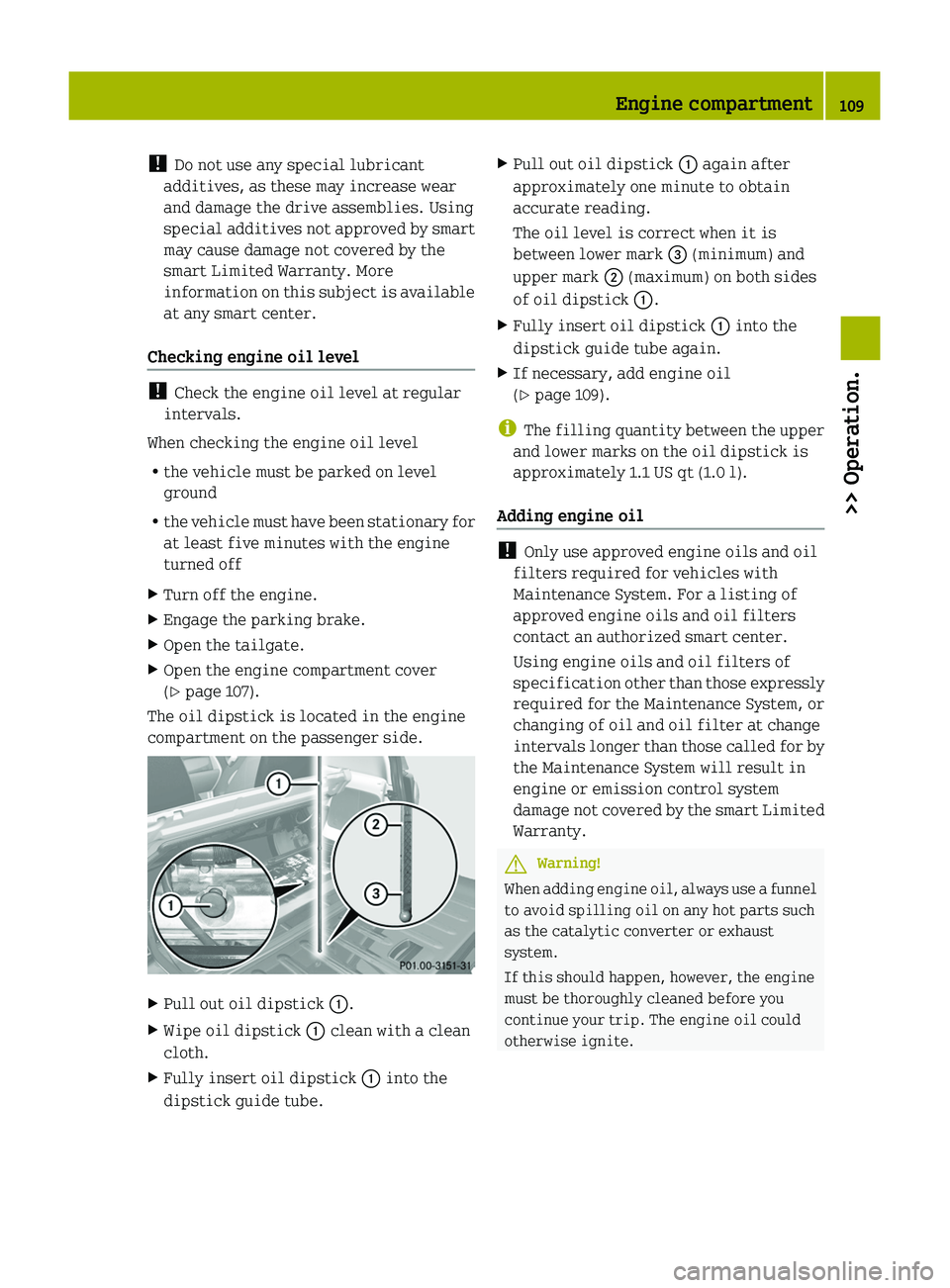
The oil dipstick is located in the engine
compartment on the passenger side.
XPull out oil dipstick 0046.XWipe oil dipstick 0046 clean with a clean
cloth.XFully insert oil dipstick 0046 into the
dipstick guide tube.XPull out oil dipstick 0046 again after
approximately one minute to obtain
accurate reading.
The oil level is correct when it is
between lower mark 008A (minimum) and
upper mark 0047 (maximum) on both sides
of oil dipstick 0046.XFully insert oil dipstick 0046 into the
dipstick guide tube again.XIf necessary, add engine oil
( Y page 109).
i
The filling quantity between the upper
and lower marks on the oil dipstick is
approximately 1.1 US qt (1.0 l).
Adding engine oil
! Only use approved engine oils and oil
filters required for vehicles with
Maintenance System. For a listing of
approved engine oils and oil filters
contact an authorized smart center.
Using engine oils and oil filters of
specification other than those expressly
required for the Maintenance System, or
changing of oil and oil filter at change
intervals longer than those called for by
the Maintenance System will result in
engine or emission control system
damage not covered by the smart Limited
Warranty.
GWarning!
When adding engine oil, always use a funnel
to avoid spilling oil on any hot parts such
as the catalytic converter or exhaust
system.
If this should happen, however, the engine
must be thoroughly cleaned before you
continue your trip. The engine oil could
otherwise ignite.
Engine compartment109>> Operation.451_AKB; 3; 22, en-USd2ureepe,Version: 2.11.8.12009-07-27T09:36:34+02:00 - Seite 109Z
Page 112 of 216
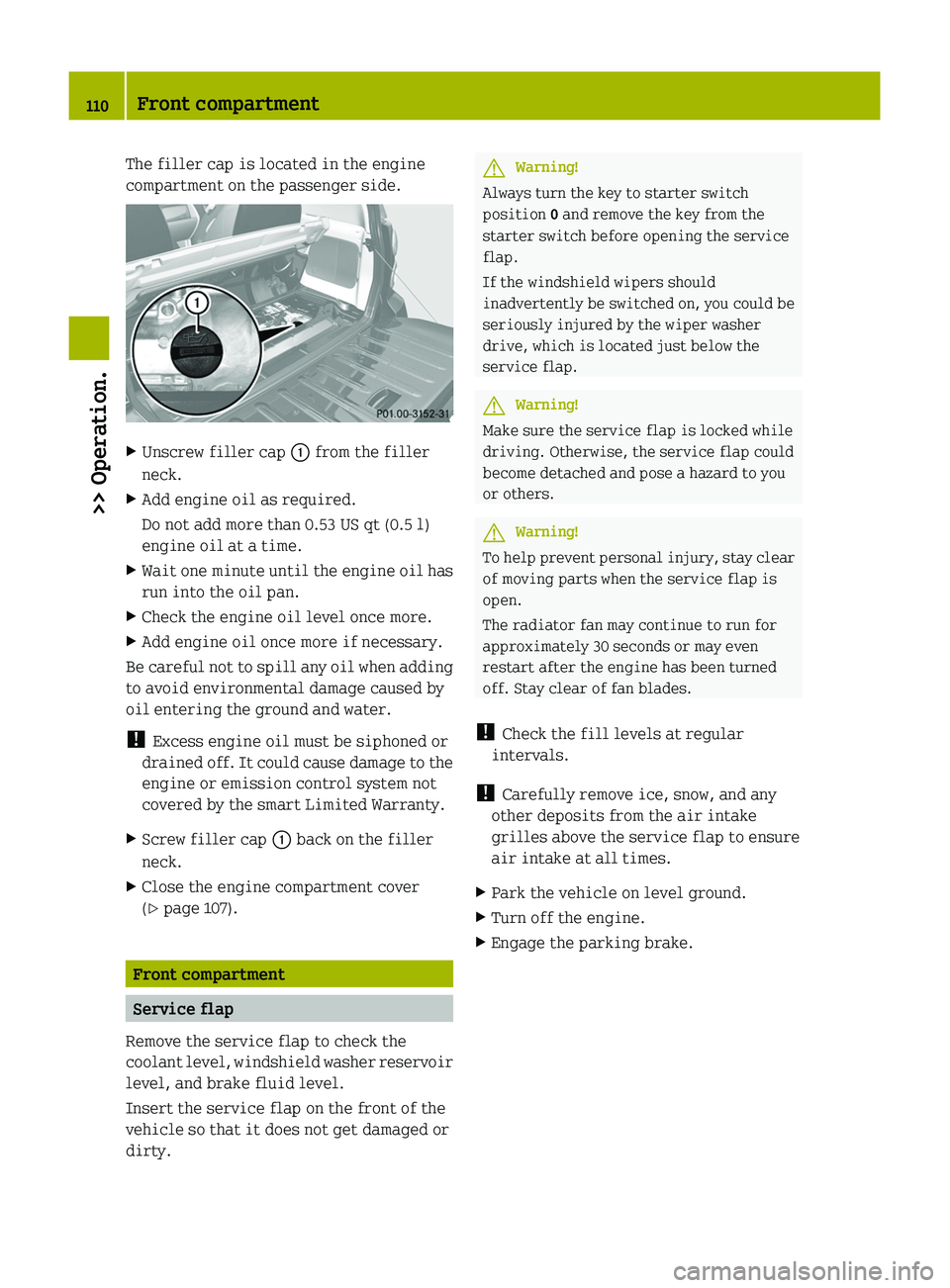
The filler cap is located in the engine
compartment on the passenger side.XUnscrew filler cap 0046 from the filler
neck.XAdd engine oil as required.
Do not add more than 0.53 US qt (0.5 l)
engine oil at a time.XWait one minute until the engine oil has
run into the oil pan.XCheck the engine oil level once more.XAdd engine oil once more if necessary.
Be careful not to spill any oil when adding
to avoid environmental damage caused by
oil entering the ground and water.
! Excess engine oil must be siphoned or
drained off. It could cause damage to the
engine or emission control system not
covered by the smart Limited Warranty.
XScrew filler cap 0046 back on the filler
neck.XClose the engine compartment cover
( Y page 107).
Front compartment
Service flap
Remove the service flap to check the
coolant level, windshield washer reservoir
level, and brake fluid level.
Insert the service flap on the front of the
vehicle so that it does not get damaged or
dirty.
GWarning!
Always turn the key to starter switch
position 0 and remove the key from the
starter switch before opening the service
flap.
If the windshield wipers should
inadvertently be switched on, you could be
seriously injured by the wiper washer
drive, which is located just below the
service flap.
GWarning!
Make sure the service flap is locked while
driving. Otherwise, the service flap could
become detached and pose a hazard to you
or others.
GWarning!
To help prevent personal injury, stay clear
of moving parts when the service flap is
open.
The radiator fan may continue to run for
approximately 30 seconds or may even
restart after the engine has been turned
off. Stay clear of fan blades.
! Check the fill levels at regular
intervals.
! Carefully remove ice, snow, and any
other deposits from the air intake
grilles above the service flap to ensure
air intake at all times.
XPark the vehicle on level ground.XTurn off the engine.XEngage the parking brake.110Front compartment>> Operation.
451_AKB; 3; 22, en-USd2ureepe,Version: 2.11.8.12009-07-27T09:36:34+02:00 - Seite 110
Page 115 of 216
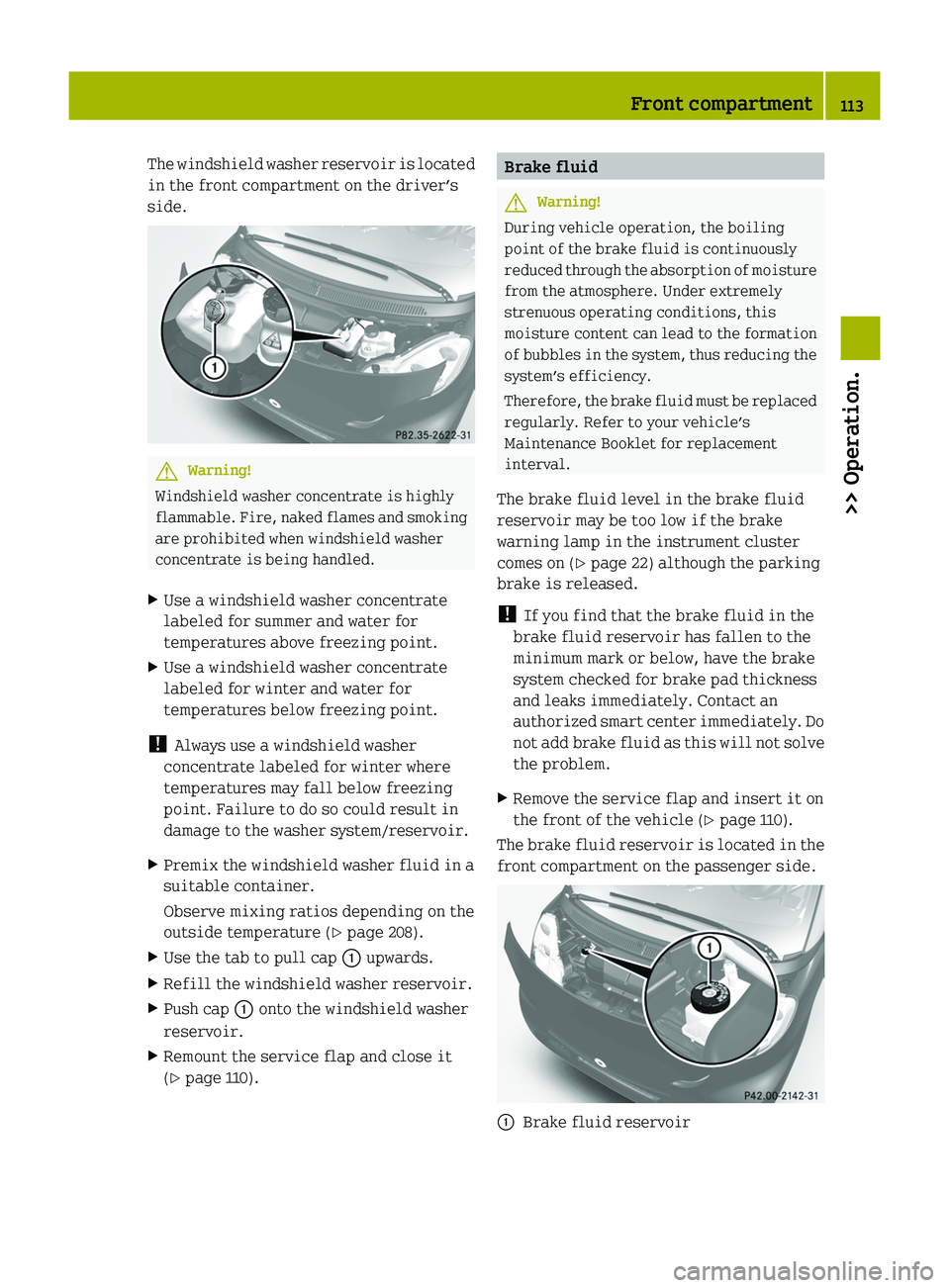
The windshield washer reservoir is located
in the front compartment on the driver’s
side.GWarning!
Windshield washer concentrate is highly
flammable. Fire, naked flames and smoking
are prohibited when windshield washer
concentrate is being handled.
XUse a windshield washer concentrate
labeled for summer and water for
temperatures above freezing point.XUse a windshield washer concentrate
labeled for winter and water for
temperatures below freezing point.
! Always use a windshield washer
concentrate labeled for winter where
temperatures may fall below freezing
point. Failure to do so could result in
damage to the washer system/reservoir.
XPremix the windshield washer fluid in a
suitable container.
Observe mixing ratios depending on the
outside temperature ( Y page 208).XUse the tab to pull cap 0046 upwards.XRefill the windshield washer reservoir.XPush cap 0046 onto the windshield washer
reservoir.XRemount the service flap and close it
( Y page 110).Brake fluidGWarning!
During vehicle operation, the boiling
point of the brake fluid is continuously
reduced through the absorption of moisture
from the atmosphere. Under extremely
strenuous operating conditions, this
moisture content can lead to the formation
of bubbles in the system, thus reducing the
system’s efficiency.
Therefore, the brake fluid must be replaced
regularly. Refer to your vehicle’s
Maintenance Booklet for replacement
interval.
The brake fluid level in the brake fluid
reservoir may be too low if the brake
warning lamp in the instrument cluster
comes on ( Y page 22) although the parking
brake is released.
! If you find that the brake fluid in the
brake fluid reservoir has fallen to the
minimum mark or below, have the brake
system checked for brake pad thickness
and leaks immediately. Contact an
authorized smart center immediately. Do
not add brake fluid as this will not solve
the problem.
XRemove the service flap and insert it on
the front of the vehicle ( Y page 110).
The brake fluid reservoir is located in the
front compartment on the passenger side.
0046Brake fluid reservoirFront compartment113>> Operation.451_AKB; 3; 22, en-USd2ureepe,Version: 2.11.8.12009-07-27T09:36:34+02:00 - Seite 113Z
Page 126 of 216
Depending upon the weather and/or road
surface (conditions), the tire traction
varies widely.
Do not allow your tires to wear down too far.
Adhesion properties on wet roads are
sharply reduced at tread depths of less than
1 / 8 in (3 mm).
Treadwear indicators (TWI) are required by
law. These indicators are located in six
places on the tread circumference and
become visible at a tread depth of
approximately 1
/ 16 in (1.6 mm), at which
point the tire is considered worn and
should be replaced.
Recommended minimum tire tread depth:
Summer tires 1
/ 8 in (3 mm)
Winter tires 1
/ 6 in (4 mm)
Treadwear indicator
0046 appears as a solid
band across the tread.
Storing tires
! Keep unmounted tires in a cool, dry
place with as little exposure to light as
possible. Protect tires from contact with
oil, grease and fuels.
Cleaning tires
! Never use a round nozzle to power wash
tires. The intense jet of water can result
in damage to the tire.
Always replace a damaged tire.
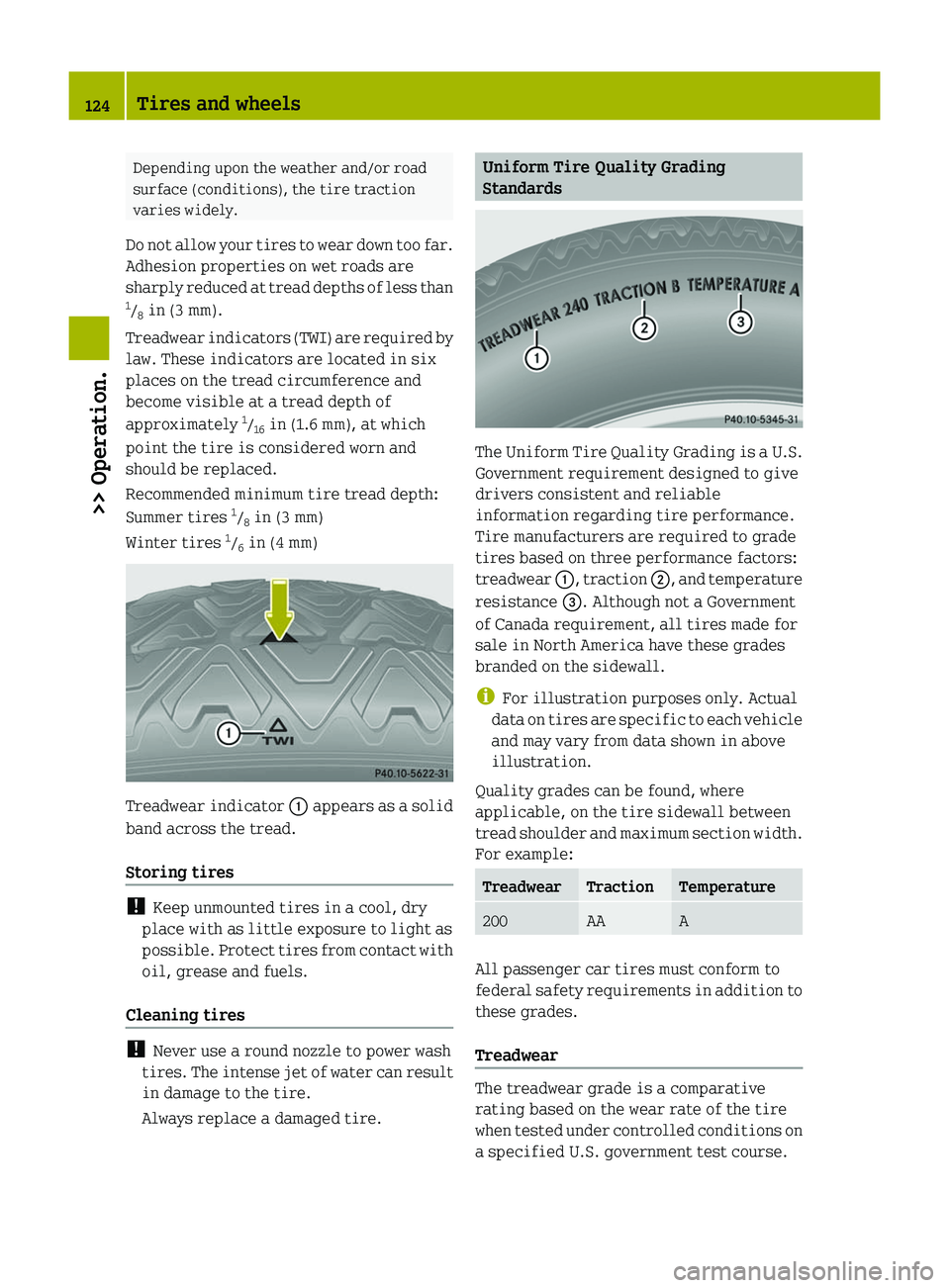
Uniform Tire Quality Grading
Standards
The Uniform Tire Quality Grading is a U.S.
Government requirement designed to give
drivers consistent and reliable
information regarding tire performance.
Tire manufacturers are required to grade
tires based on three performance factors:
treadwear 0046, traction 0047, and temperature
resistance 008A. Although not a Government
of Canada requirement, all tires made for
sale in North America have these grades
branded on the sidewall.
i For illustration purposes only. Actual
data on tires are specific to each vehicle
and may vary from data shown in above
illustration.
Quality grades can be found, where
applicable, on the tire sidewall between
tread shoulder and maximum section width.
For example:
TreadwearTractionTemperature200AAA
All passenger car tires must conform to
federal safety requirements in addition to
these grades.
Treadwear
The treadwear grade is a comparative
rating based on the wear rate of the tire
when tested under controlled conditions on
a specified U.S. government test course.
124Tires and wheels>> Operation.
451_AKB; 3; 22, en-USd2ureepe,Version: 2.11.8.12009-07-27T09:36:34+02:00 - Seite 124
Page 132 of 216
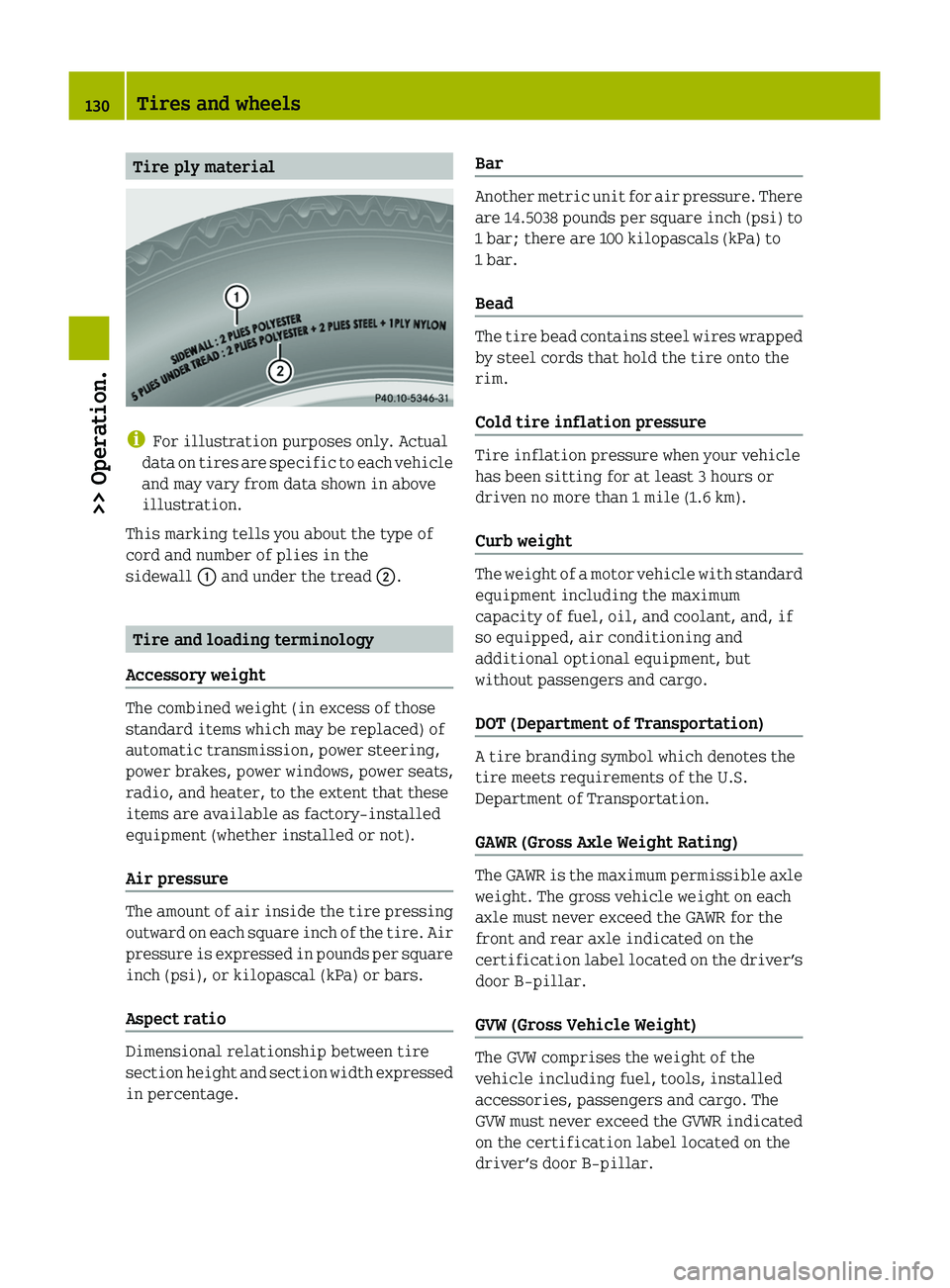
Tire ply material
iFor illustration purposes only. Actual
data on tires are specific to each vehicle
and may vary from data shown in above
illustration.
This marking tells you about the type of
cord and number of plies in the
sidewall 0046 and under the tread 0047.
Tire and loading terminology
Accessory weight
The combined weight (in excess of those
standard items which may be replaced) of
automatic transmission, power steering,
power brakes, power windows, power seats,
radio, and heater, to the extent that these
items are available as factory-installed
equipment (whether installed or not).
Air pressure
The amount of air inside the tire pressing
outward on each square inch of the tire. Air
pressure is expressed in pounds per square
inch (psi), or kilopascal (kPa) or bars.
Aspect ratio
Dimensional relationship between tire
section height and section width expressed
in percentage.
Bar
Another metric unit for air pressure. There
are 14.5038 pounds per square inch (psi) to
1 bar; there are 100 kilopascals (kPa) to
1 bar.
Bead
The tire bead contains steel wires wrapped
by steel cords that hold the tire onto the
rim.
Cold tire inflation pressure
Tire inflation pressure when your vehicle
has been sitting for at least 3 hours or
driven no more than 1 mile (1.6 km).
Curb weight
The weight of a motor vehicle with standard
equipment including the maximum
capacity of fuel, oil, and coolant, and, if
so equipped, air conditioning and
additional optional equipment, but
without passengers and cargo.
DOT (Department of Transportation)
A tire branding symbol which denotes the
tire meets requirements of the U.S.
Department of Transportation.
GAWR (Gross Axle Weight Rating)
The GAWR is the maximum permissible axle
weight. The gross vehicle weight on each
axle must never exceed the GAWR for the
front and rear axle indicated on the
certification label located on the driver’s
door B‑pillar.
GVW (Gross Vehicle Weight)
The GVW comprises the weight of the
vehicle including fuel, tools, installed
accessories, passengers and cargo. The
GVW must never exceed the GVWR indicated
on the certification label located on the
driver’s door B‑pillar.
130Tires and wheels>> Operation.
451_AKB; 3; 22, en-USd2ureepe,Version: 2.11.8.12009-07-27T09:36:34+02:00 - Seite 130
Page 143 of 216
road than the country in which the
vehicle is registered, you must have the
headlamps modified for symmetrical low
beams. Relevant information can be
obtained at any authorized smart center.
Vehicle care
Care tips
Regular and proper care will help to
maintain the value of your vehicle. The
best way to protect your vehicle from
harmful environmental influences is to
wash it and use protective treatments
regularly.
smart recommends that you care for the
paintwork at least twice a year (e.g. in the
spring and autumn).
GWarning!
Many cleaning products can be hazardous.
Some are poisonous, others are flammable.
Always follow the instructions on the
particular container. Always open your
vehicle’s doors or windows when cleaning
the inside.
Never use fluids or solvents that are not
designed for cleaning your vehicle.
Always lock away cleaning products and
keep them out of reach of children.
! Follow the care tips. Wash your vehicle
preferably by hand.
While in operation or even while parked,
your vehicle is subjected to varying
external influences, which left unchecked
can attack the paint as well as the vehicle
underbody and lead to permanent damage.
Such damage is caused not only by extreme
and varying climatic conditions, but also
by:
R Air pollution
R Road salt
RTar
R Gravel and stone chipping
To avoid paint damage, you should
immediately remove:
R Insects
R Bird droppings
R Tree sap, etc.
R Grease and oil
R Brake fluid
R Coolant
R Fuel
R Tar spots
! Failure to remove such dirt
immediately can cause damage to the
paint or the soft top fabric*.
Environmental influences are not
covered by the smart Limited Warranty.
Frequent washing reduces and/or
eliminates the aggressiveness and potency
of the above adverse influences.
More frequent washings are necessary to
deal with unfavorable conditions:
R near the ocean
R in industrial areas (smoke, exhaust
emissions)
R during winter operation
You should check your vehicle from time to
time for stone chipping or other damage.
Any damage should be repaired as soon as
possible to prevent corrosion.
In doing so, do not neglect the underbody
of the vehicle. A prerequisite for a
thorough check is a washing of the
underbody followed by a thorough
inspection. Damaged areas need to be re-
undercoated.
Your vehicle has been treated at the factory
with a wax-base rustproofing in the body
cavities which will last for the lifetime of
the vehicle. Post-production treatment is
neither necessary nor recommended byVehicle care141>> Operation.* optional451_AKB; 3; 22, en-USd2ureepe,Version: 2.11.8.12009-07-27T09:36:34+02:00 - Seite 141Z
Page 144 of 216
smart because of the possibility of
incompatibility between materials used in
the production process and others applied
later.
We have selected vehicle-care products
and compiled recommendations which are
specially matched to our vehicles and
which always reflect the latest technology.
You can obtain smart approved vehicle-
care products at an authorized smart
center.
Scratches, corrosive deposits, corrosion
or damage due to negligent or incorrect
care cannot always be removed or repaired
with the vehicle-care products
recommended here. In such cases it is best
to seek aid at an authorized smart center.
The following topics deal with the cleaning
and care of your vehicle and give important“how-to” information as well as references
to smart approved vehicle-care products.
Vehicle care
Contact an authorized smart center for
recommended and approved care products.
i Advice on caring for the soft top
system, see ( Y page 145).
GWarning!
After washing the vehicle, the brakes may
still be wet and thus their functionality
impaired. Therefore, when you start off,
brake lightly several times without
endangering traffic.
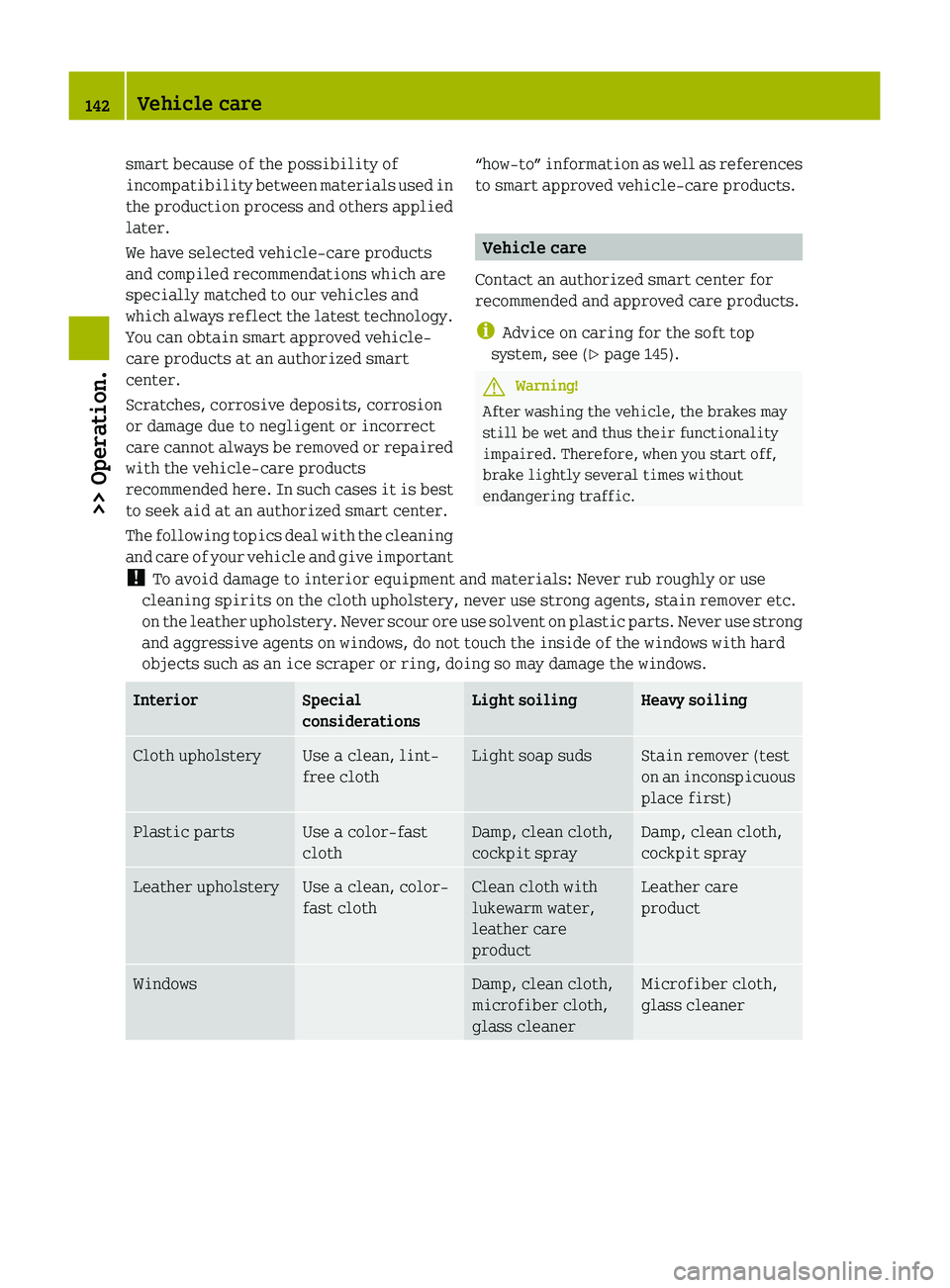
! To avoid damage to interior equipment and materials: Never rub roughly or use
cleaning spirits on the cloth upholstery, never use strong agents, stain remover etc.
on the leather upholstery. Never scour ore use solvent on plastic parts. Never use strong
and aggressive agents on windows, do not touch the inside of the windows with hard
objects such as an ice scraper or ring, doing so may damage the windows.InteriorSpecial
considerationsLight soilingHeavy soilingCloth upholsteryUse a clean, lint-
free clothLight soap sudsStain remover (test
on an inconspicuous
place first)Plastic partsUse a color-fast
clothDamp, clean cloth,
cockpit sprayDamp, clean cloth,
cockpit sprayLeather upholsteryUse a clean, color-
fast clothClean cloth with
lukewarm water,
leather care
productLeather care
productWindowsDamp, clean cloth,
microfiber cloth,
glass cleanerMicrofiber cloth,
glass cleaner142Vehicle care>> Operation.
451_AKB; 3; 22, en-USd2ureepe,Version: 2.11.8.12009-07-27T09:36:34+02:00 - Seite 142
Page 145 of 216
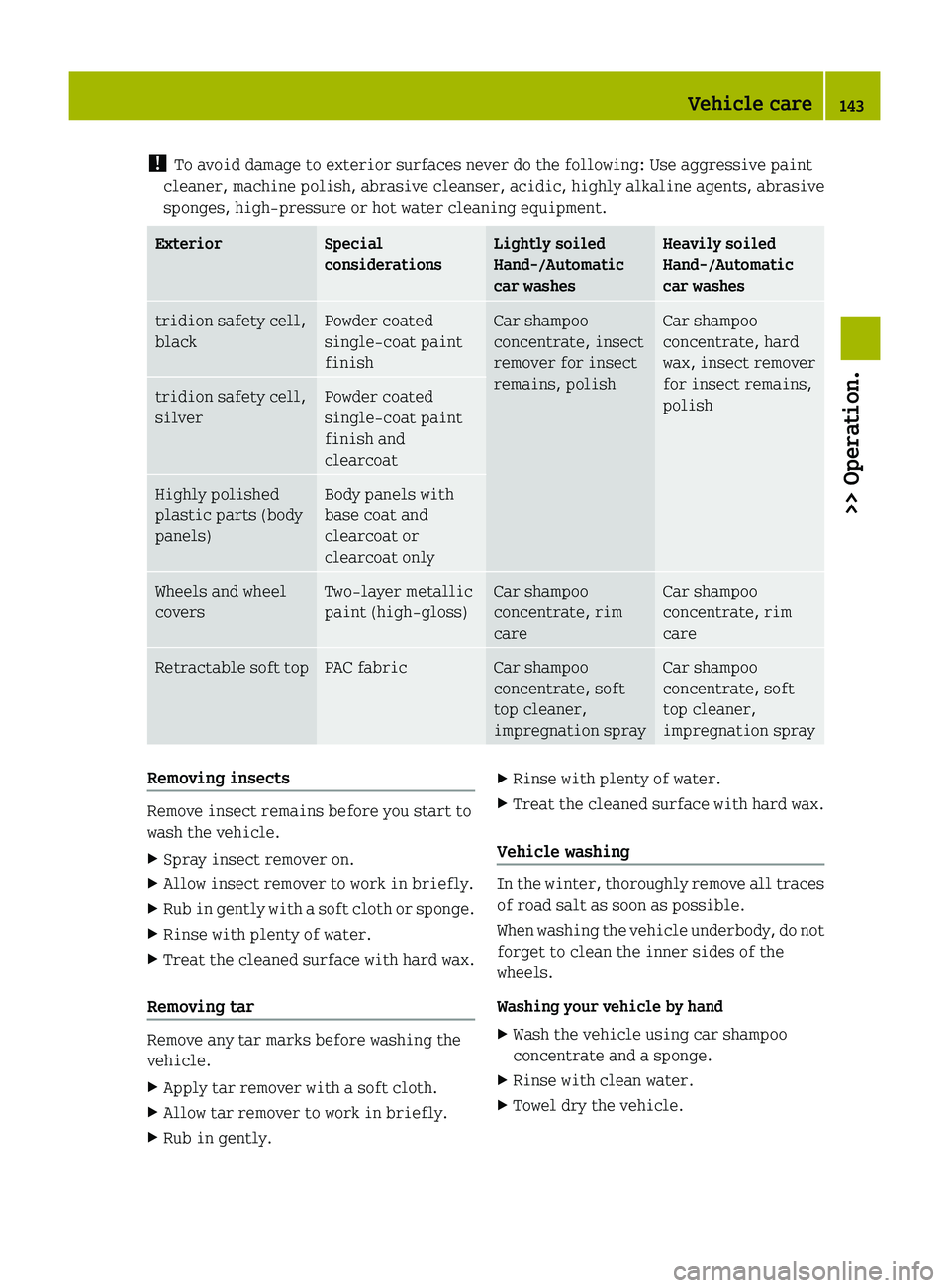
! To avoid damage to exterior surfaces never do the following: Use aggressive paint
cleaner, machine polish, abrasive cleanser, acidic, highly alkaline agents, abrasive
sponges, high-pressure or hot water cleaning equipment.ExteriorSpecial
considerationsLightly soiled
Hand-/Automatic
car washesHeavily soiled
Hand-/Automatic
car washestridion safety cell,
blackPowder coated
single-coat paint
finishCar shampoo
concentrate, insect
remover for insect
remains, polishCar shampoo
concentrate, hard
wax, insect remover
for insect remains,
polishtridion safety cell,
silverPowder coated
single-coat paint
finish and
clearcoatHighly polished
plastic parts (body
panels)Body panels with
base coat and
clearcoat or
clearcoat onlyWheels and wheel
coversTwo-layer metallic
paint (high-gloss)Car shampoo
concentrate, rim
careCar shampoo
concentrate, rim
careRetractable soft topPAC fabricCar shampoo
concentrate, soft
top cleaner,
impregnation sprayCar shampoo
concentrate, soft
top cleaner,
impregnation sprayRemoving insects
Remove insect remains before you start to
wash the vehicle.
XSpray insect remover on.XAllow insect remover to work in briefly.XRub in gently with a soft cloth or sponge.XRinse with plenty of water.XTreat the cleaned surface with hard wax.
Removing tar
Remove any tar marks before washing the
vehicle.
XApply tar remover with a soft cloth.XAllow tar remover to work in briefly.XRub in gently.XRinse with plenty of water.XTreat the cleaned surface with hard wax.
Vehicle washing
In the winter, thoroughly remove all traces
of road salt as soon as possible.
When washing the vehicle underbody, do not
forget to clean the inner sides of the
wheels.
Washing your vehicle by hand
XWash the vehicle using car shampoo
concentrate and a sponge.XRinse with clean water.XTowel dry the vehicle.Vehicle care143>> Operation.451_AKB; 3; 22, en-USd2ureepe,Version: 2.11.8.12009-07-27T09:36:34+02:00 - Seite 143Z
Page 146 of 216
! Do not wash the vehicle in direct
sunlight. The body panel surfaces and
paint finish may be damaged.
Washing your vehicle in an automatic car
wash
i When running your vehicle through an
automatic car wash, water droplets can
run down the inside of the side windows.
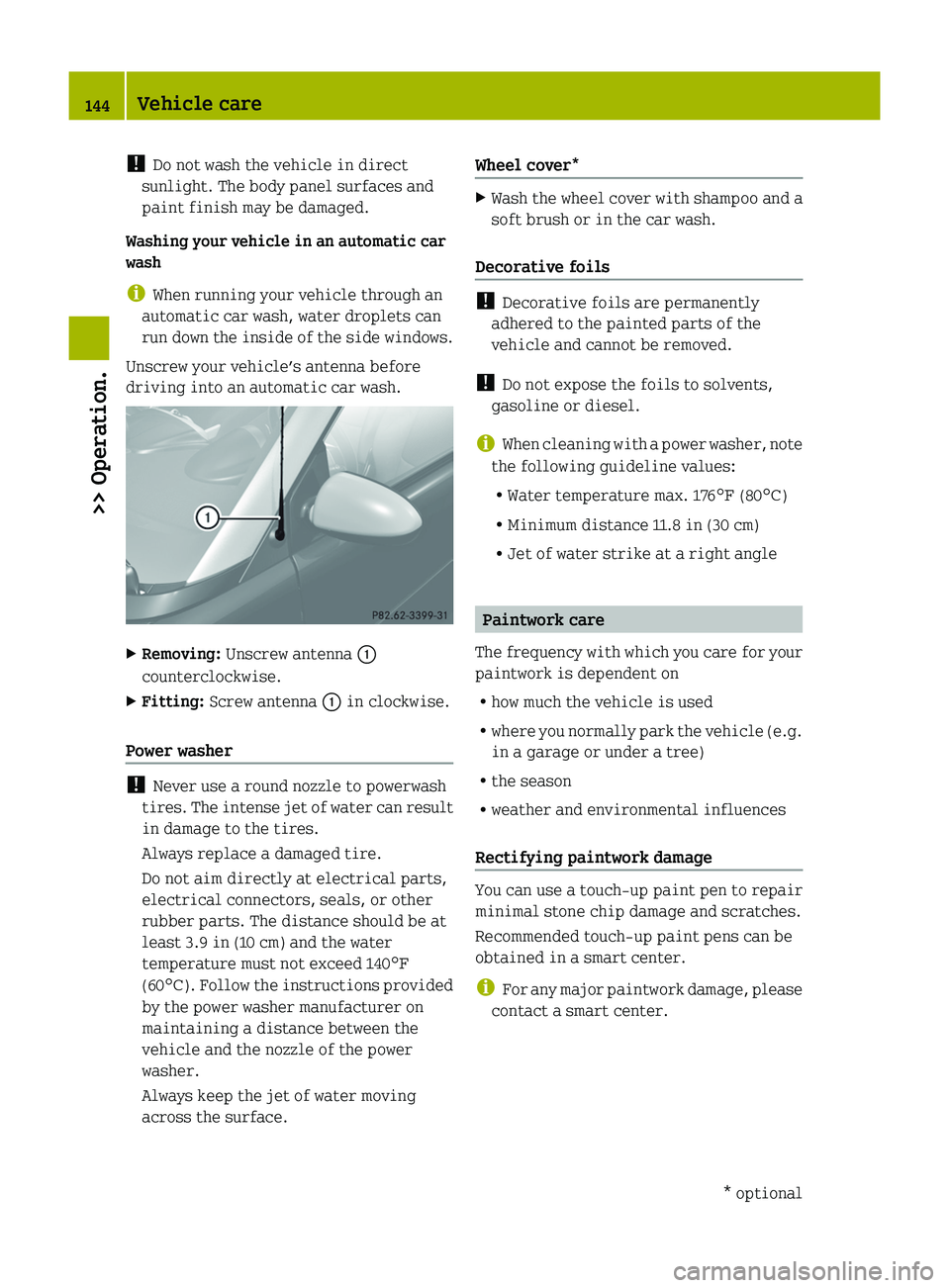
Unscrew your vehicle’s antenna before
driving into an automatic car wash.XRemoving: Unscrew antenna 0046
counterclockwise.XFitting: Screw antenna 0046 in clockwise.
Power washer
!
Never use a round nozzle to powerwash
tires. The intense jet of water can result
in damage to the tires.
Always replace a damaged tire.
Do not aim directly at electrical parts,
electrical connectors, seals, or other
rubber parts. The distance should be at
least 3.9 in (10 cm) and the water
temperature must not exceed 140 ¦
(60 ¥). Follow the instructions provided
by the power washer manufacturer on
maintaining a distance between the
vehicle and the nozzle of the power
washer.
Always keep the jet of water moving
across the surface.
Wheel cover*XWash the wheel cover with shampoo and a
soft brush or in the car wash.
Decorative foils
! Decorative foils are permanently
adhered to the painted parts of the
vehicle and cannot be removed.
! Do not expose the foils to solvents,
gasoline or diesel.
i When cleaning with a power washer, note
the following guideline values:
R Water temperature max. 176 ¦ (80 ¥)
R Minimum distance 11.8 in (30 cm)
R Jet of water strike at a right angle
Paintwork care
The frequency with which you care for your
paintwork is dependent on
R how much the vehicle is used
R where you normally park the vehicle (e.g.
in a garage or under a tree)
R the season
R weather and environmental influences
Rectifying paintwork damage
You can use a touch-up paint pen to repair
minimal stone chip damage and scratches.
Recommended touch-up paint pens can be
obtained in a smart center.
i For any major paintwork damage, please
contact a smart center.
144Vehicle care>> Operation.* optional451_AKB; 3; 22, en-USd2ureepe,Version: 2.11.8.12009-07-27T09:36:34+02:00 - Seite 144
Page 159 of 216
ProblemPossible causes/consequences and 0050 Solutions00BBThe engine
malfunction
indicator lamp
illuminates
while driving.There is a malfunction in the system.XHave the vehicle checked at an authorized smart center
immediately.
i Some states may by law require you to visit a workshop as soon as the engine
malfunction indicator lamp comes on. Check local requirements.
ProblemPossible causes/consequences and 0050 Solutions00B5The engine oil
pressure
indicator lamp
illuminates
while driving.The engine oil pressure is low.XStop the vehicle immediately in a safe location.XDo not continue to drive.XTurn off the engine.XEngage the parking brake when leaving the vehicle.XContact Roadside Assistance or an authorized smart center.00B5The engine oil
pressure
indicator lamp
goes out before
the engine
starts.The engine oil pressure indicator lamp has failed.XCheck the engine oil level.XHave the system checked at an authorized smart center.! The engine oil pressure indicator lamp should not be ignored. Extended driving with
the engine oil pressure indicator lamp illuminated could result in serious engine
damage that is not covered by the smart Limited Warranty.What to do if ...157>> Practical hints.451_AKB; 3; 22, en-USd2ureepe,Version: 2.11.8.12009-07-27T09:36:34+02:00 - Seite 157Z