ESP SMART FORTWO COUPE 2011 Service Manual
[x] Cancel search | Manufacturer: SMART, Model Year: 2011, Model line: FORTWO COUPE, Model: SMART FORTWO COUPE 2011Pages: 228, PDF Size: 11.48 MB
Page 167 of 228

BrakeProblemPossible causes/consequences and 0050 Solutions00EB (USA only)
0031 (Canada only)
The ABS indicator
lamp illuminates
while the engine is
running. There is a malfunction in the ABS system.XHave the ABS system checked at an authorized smart center
immediately.00EB (USA only)
0031 (Canada only)
The ABS indicator
lamp illuminates
together with the
brake warning lamp
while the engine is
running.The ABS system fails.XStop the vehicle immediately in a safe location.XDo not continue to drive.XTurn off the engine.XEngage the parking brake when leaving the vehicle.XContact Roadside Assistance or an authorized smart center.GWarning!
When the ABS system is malfunctioning, the wheels may lock during hard braking, reducing
steering capability and extending the braking distance.
When the ABS is switched off due to a malfunction, the ESP ®
is also switched off. The basic
driving and braking functions are still available.
The risk of your vehicle skidding is then increased in certain situations. You should
therefore always adapt your speed and driving style to the prevailing road and weather
conditions.
What to do if ...165>> Practical hints.BA 451 USA, CA Edition A 2011; 1; 4, en-UShereepeVersion: 3.0.3.62010-05-11T15:12:26+02:00 - Seite 165Z
Page 171 of 228

ProblemPossible causes/consequences and 0050 Solutions0067The ESP ®
warning lamp
flashes while
driving.The ESP ®
has engaged because of detected traction loss in at
least one tire. XWhen driving off, apply as little throttle as possible.XWhile driving, ease up on the accelerator pedal.XAdapt your speed and driving to the prevailing road and
weather conditions.0067The ESP ®
warning lamp
illuminates
continuously
while the
engine is
running.The ESP ®
is not operational due to a system failure.XHave the system checked at an authorized smart center.The ESP ®
is not available.XHave the system checked at an authorized smart center.GWarning!
When the ESP ®
warning lamp is illuminated continuously, the ESP ®
is not available or not
operational due to a system failure.
Adapt your speed and driving to the prevailing road conditions and the non-operating status
of the ESP ®
.
i It may be possible to clear a system failure by restarting the engine.
XRestart the engine.
If the warning lamp still does not go out, have the system checked at an authorized smart
center immediately.
i More information on the ESP ®
can be found in the “Safety” section ( Y page 47).
ProblemPossible causes/consequences and 0050 Solutions0052The EPS*
warning lamp
illuminates
while the
engine is
running. The Electronic Power Steering (EPS)* is not available.XHave the EPS* checked at an authorized smart center
immediately.GWarning!
When the EPS* is not available a higher degree of effort is necessary to steer the vehicle.
Have the system checked at a smart center.
What to do if ...169>> Practical hints.* optionalBA 451 USA, CA Edition A 2011; 1; 4, en-UShereepeVersion: 3.0.3.62010-05-11T15:12:26+02:00 - Seite 169Z
Page 173 of 228
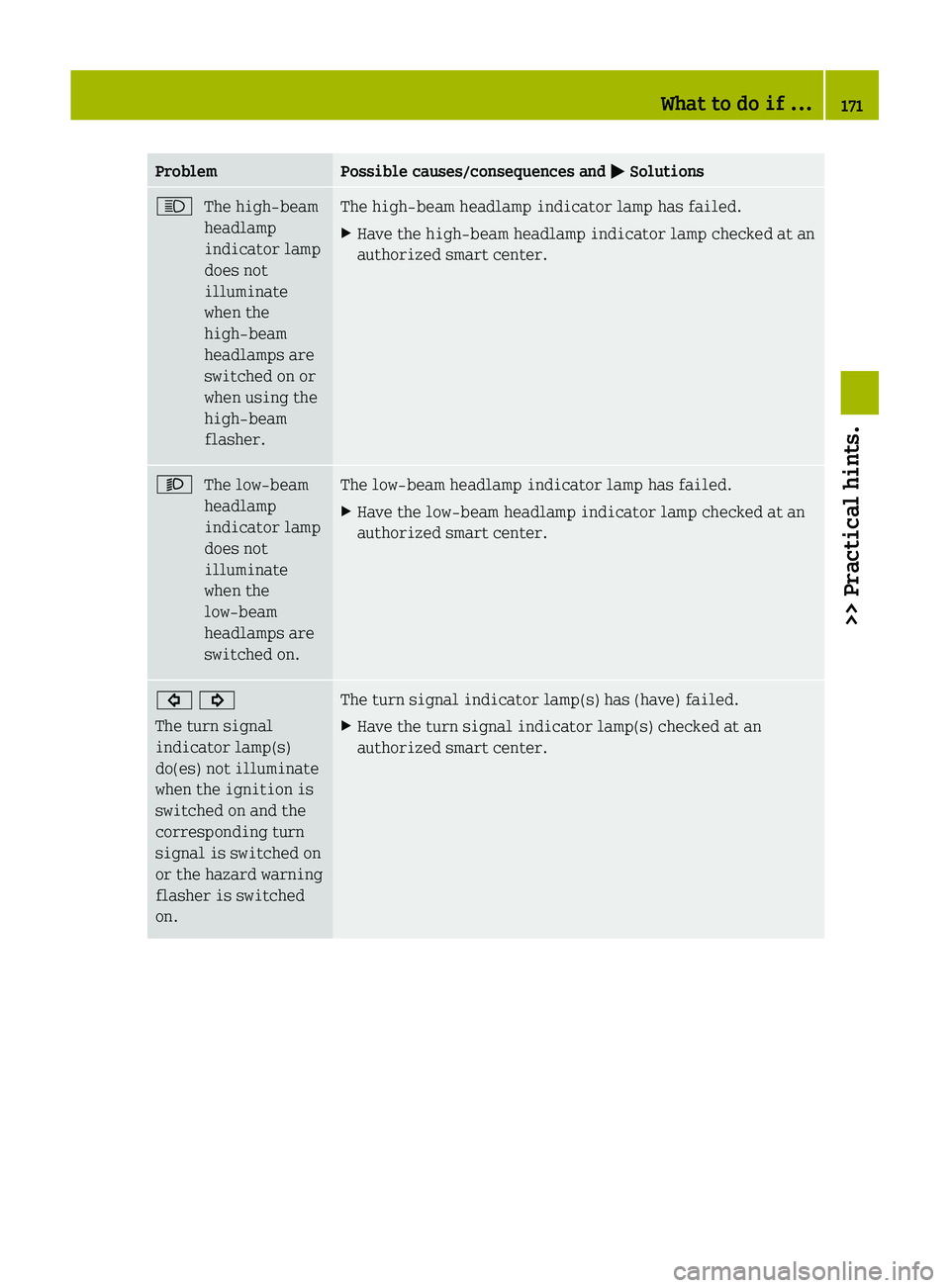
ProblemPossible causes/consequences and 0050 Solutions0063The high‑beam
headlamp
indicator lamp
does not
illuminate
when the
high‑beam
headlamps are
switched on or
when using the
high‑beam
flasher.The high‑beam headlamp indicator lamp has failed.XHave the high‑beam headlamp indicator lamp checked at an
authorized smart center.0065The low‑beam
headlamp
indicator lamp
does not
illuminate
when the
low‑beam
headlamps are
switched on.The low‑beam headlamp indicator lamp has failed.XHave the low‑beam headlamp indicator lamp checked at an
authorized smart center.0026 0024
The turn signal
indicator lamp(s)
do(es) not illuminate
when the ignition is
switched on and the
corresponding turn
signal is switched on
or the hazard warning
flasher is switched
on.The turn signal indicator lamp(s) has (have) failed. XHave the turn signal indicator lamp(s) checked at an
authorized smart center.What to do if ...171>> Practical hints.BA 451 USA, CA Edition A 2011; 1; 4, en-UShereepeVersion: 3.0.3.62010-05-11T15:12:26+02:00 - Seite 171Z
Page 176 of 228
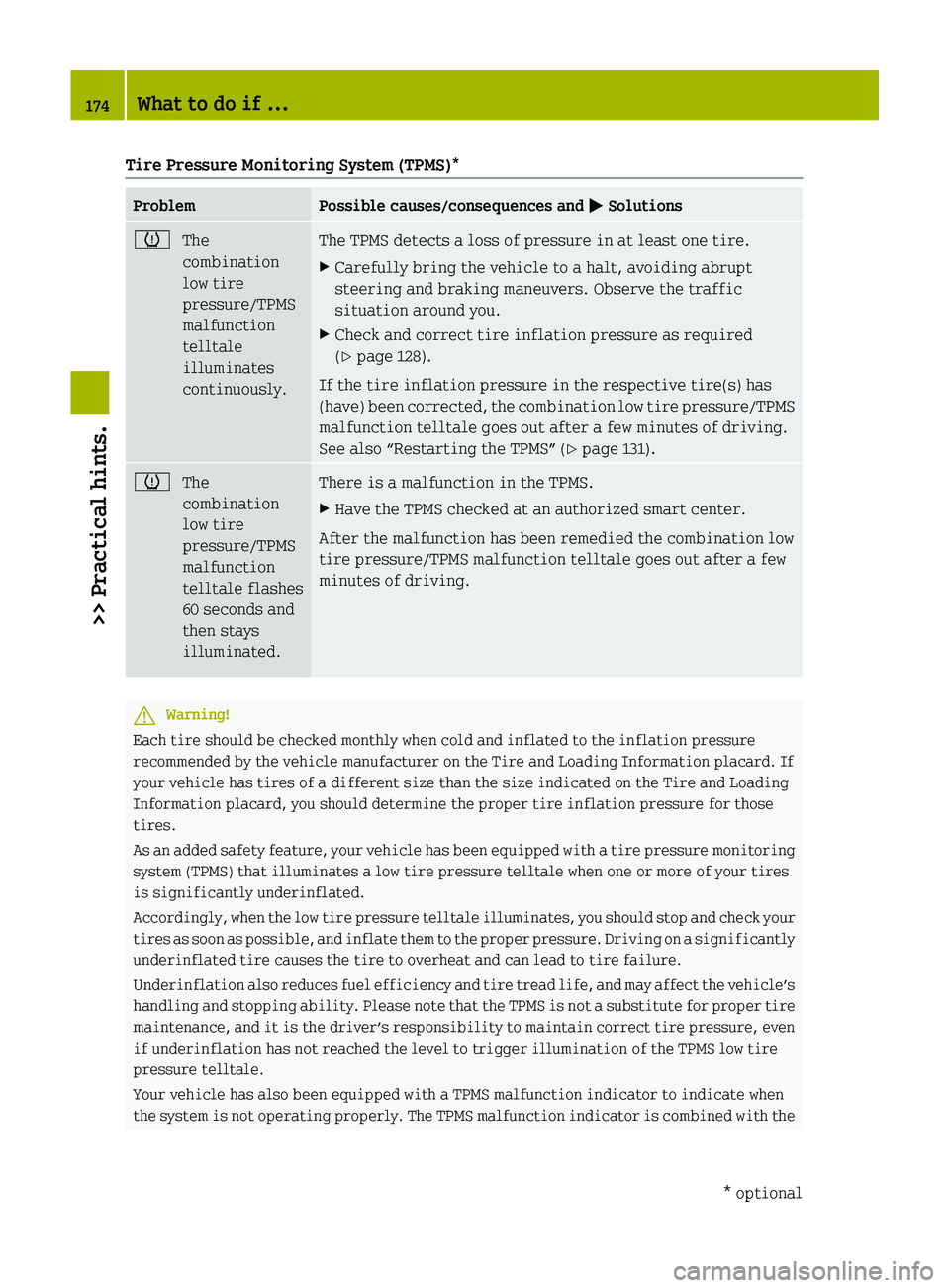
Tire Pressure Monitoring System (TPMS)* ProblemPossible causes/consequences and 0050 Solutions0077The
combination
low tire
pressure/TPMS
malfunction
telltale
illuminates
continuously.The TPMS detects a loss of pressure in at least one tire.XCarefully bring the vehicle to a halt, avoiding abrupt
steering and braking maneuvers. Observe the traffic
situation around you.XCheck and correct tire inflation pressure as required
( Y page 128).
If the tire inflation pressure in the respective tire(s) has
(have) been corrected, the combination low tire pressure/TPMS
malfunction telltale goes out after a few minutes of driving.
See also “Restarting the TPMS” ( Y page 131).
0077The
combination
low tire
pressure/TPMS
malfunction
telltale flashes
60 seconds and
then stays
illuminated.There is a malfunction in the TPMS.XHave the TPMS checked at an authorized smart center.
After the malfunction has been remedied the combination low
tire pressure/TPMS malfunction telltale goes out after a few
minutes of driving.
GWarning!
Each tire should be checked monthly when cold and inflated to the inflation pressure
recommended by the vehicle manufacturer on the Tire and Loading Information placard. If
your vehicle has tires of a different size than the size indicated on the Tire and Loading
Information placard, you should determine the proper tire inflation pressure for those
tires.
As an added safety feature, your vehicle has been equipped with a tire pressure monitoring
system (TPMS) that illuminates a low tire pressure telltale when one or more of your tires
is significantly underinflated.
Accordingly, when the low tire pressure telltale illuminates, you should stop and check your
tires as soon as possible, and inflate them to the proper pressure. Driving on a significantly
underinflated tire causes the tire to overheat and can lead to tire failure.
Underinflation also reduces fuel efficiency and tire tread life, and may affect the vehicle’s
handling and stopping ability. Please note that the TPMS is not a substitute for proper tire
maintenance, and it is the driver’s responsibility to maintain correct tire pressure, even
if underinflation has not reached the level to trigger illumination of the TPMS low tire
pressure telltale.
Your vehicle has also been equipped with a TPMS malfunction indicator to indicate when
the system is not operating properly. The TPMS malfunction indicator is combined with the
174What to do if ...>> Practical hints.* optionalBA 451 USA, CA Edition A 2011; 1; 4, en-UShereepeVersion: 3.0.3.62010-05-11T15:12:26+02:00 - Seite 174
Page 186 of 228
The arrow on bulb socket \000F must be in
line with the line on the headlamp
housing.
XTurn bulb socket \000F clockwise by a
quarter of turn.
Side turn signal lamp bulb
XRemoving: Open the door on the
corresponding side.
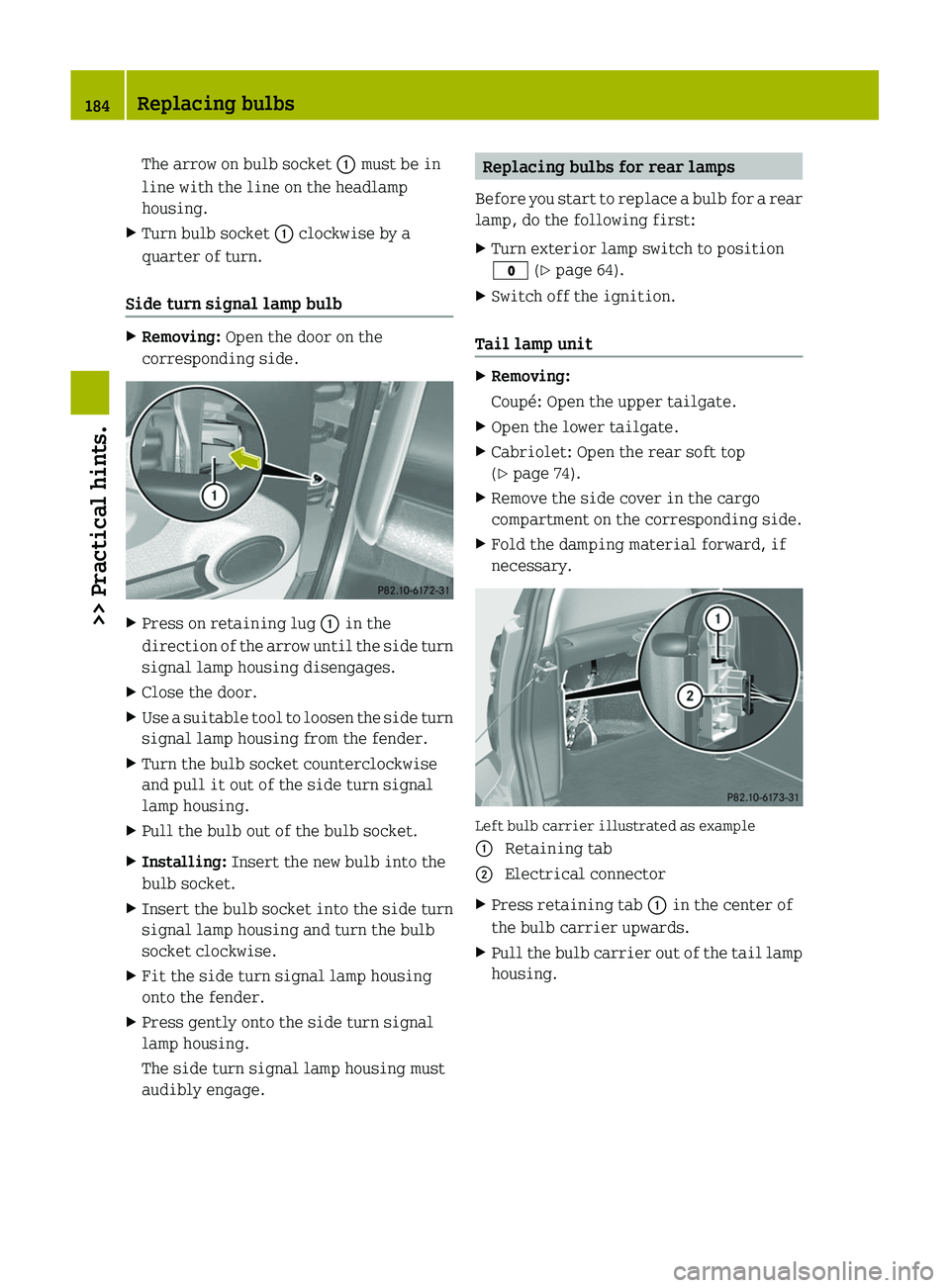
XPress on retaining lug \000F in the
direction of the arrow until the side turn
signal lamp housing disengages.
XClose the door.XUse a suitable tool to loosen the side turn
signal lamp housing from the fender.
XTurn the bulb socket counterclockwise
and pull it out of the side turn signal
lamp housing.
XPull the bulb out of the bulb socket.XInstalling: Insert the new bulb into the
bulb socket.
XInsert the bulb socket into the side turn
signal lamp housing and turn the bulb
socket clockwise.
XFit the side turn signal lamp housing
onto the fender.
XPress gently onto the side turn signal
lamp housing.
The side turn signal lamp housing must
audibly engage.
Replacing bulbs for rear lamps
Before you start to replace a bulb for a rear
lamp, do the following first:
XTurn exterior lamp switch to position
\000' (Y page 64).
XSwitch off the ignition.
Tail lamp unit
XRemoving:
Coupé: Open the upper tailgate.
XOpen the lower tailgate.XCabriolet: Open the rear soft top
(Y page 74).
XRemove the side cover in the cargo
compartment on the corresponding side.
XFold the damping material forward, if
necessary.
Left bulb carrier illustrated as example
\000F Retaining tab\000G Electrical connectorXPress retaining tab \000F in the center of
the bulb carrier upwards.
XPull the bulb carrier out of the tail lamp
housing.
184Replacing bulbs>> Practical hints.
BA 451 USA, CA Edition A 2011; 1; 4, en-UShereepeVersion: 3.0.3.62010-05-11T15:12:26+02:00 - Seite 184
Page 188 of 228
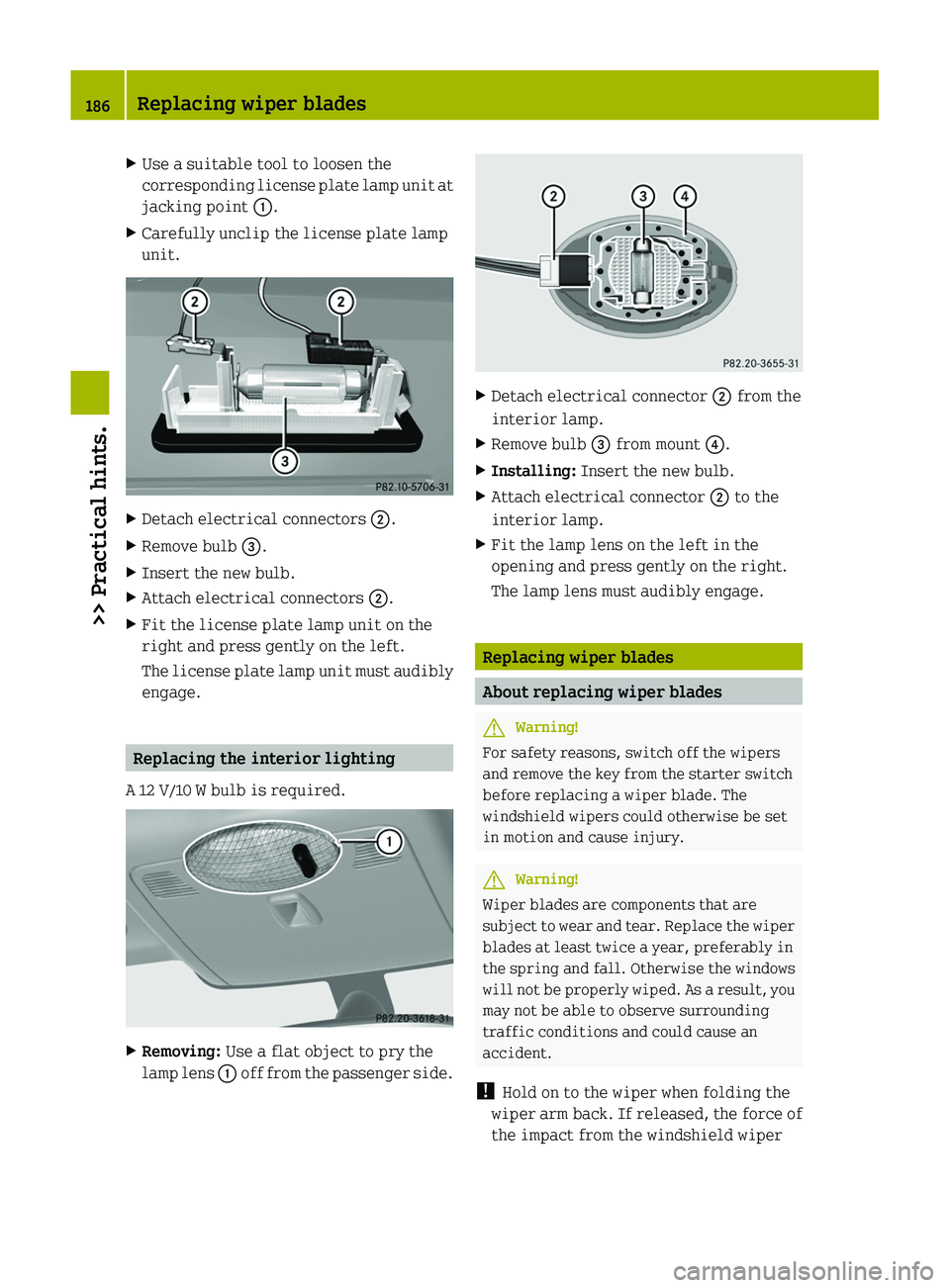
XUse a suitable tool to loosen the
corresponding license plate lamp unit at
jacking point \000F.
XCarefully unclip the license plate lamp
unit.
XDetach electrical connectors \000G.XRemove bulb \000
Page 191 of 228
The tire repair kit enables you to drive on
the sealed tire to the nearest authorized
smart center.XYou should have the sealed tire replaced
at an authorized smart center.GWarning!
Take care not to allow the contents of the
tire sealant to come in contact with hair,
eyes or clothing. The tire sealant is
harmful if inhaled, swallowed or absorbed
through the skin - causes skin, eye and
respiratory irritation. Wear gloves while
using this product if they are available.
Any contact with eyes or skin should be
flushed immediately with plenty of water.
If clothing comes in contact with the tire
sealant, change clothing as soon as
possible.
In case of allergic reaction or rash, consult
a physician immediately.
Notes
R Small tire punctures, particularly those
in the tread, can be sealed with the tire
sealant.
R The tire sealant can be used in ambient
temperatures from ‑4 ¦ (‑20 ¥) to
104 ¦ (+40 ¥).
R Do not remove any foreign objects such as
nails or screws that have penetrated the
tire.
R Do not use the tire sealant if the tire has
been damaged by being driven when
insufficiently inflated (e.g. bumps,
cuts, cracks etc. on the tire).
R Allow escaped tire sealant to dry, then
peel it off.
R Immediately wash all painted surfaces
that came into contact with the tire
sealant using a damp cloth.
R Avoid skin and eye contact with the tire
sealant.
R Do not swallow the tire sealant.
RAllow the tire sealant that is inside the
damaged tire to dry and dispose of
together with the tire.
R Do not use the tire sealant after the
expiration date has elapsed (see top of
container).
Instead, have it replaced at an
authorized smart center.GWarning!
The tire sealant is a limited repair device.
The tire sealant cannot be used for cuts or
punctures larger than approximately
0.16 in (4 mm) and tire damage caused by
driving with extremely low tire inflation
pressure, or on a flat tire, or a damaged
wheel.
Do not drive the vehicle under such
circumstances.
If you are unsure of the condition of the tire
or have any question whatsoever about its
suitability for driving contact the nearest
smart center for assistance or call
Roadside Assistance.
GWarning!
Please review the instructions below for
using the tire repair kit. If you are not
confident that you can competently follow
the instructions for using this kit, do not
use the kit, but instead call for Roadside
Assistance.
GWarning!
Keep the tire sealant out of reach of
children. If swallowed, rinse mouth
immediately with plenty of water and drink
plenty of water.
Do not induce vomiting!
Consult a physician immediately.
Keep away from open flame, heat source or
sparks. Do not smoke.
Flat tire189>> Practical hints.BA 451 USA, CA Edition A 2011; 1; 4, en-UShereepeVersion: 3.0.3.62010-05-11T15:12:26+02:00 - Seite 189Z
Page 198 of 228
authorized smart center about steps you
need to observe.
GWarning!
Observe all safety instructions and
precautions when handling automotive
batteries.
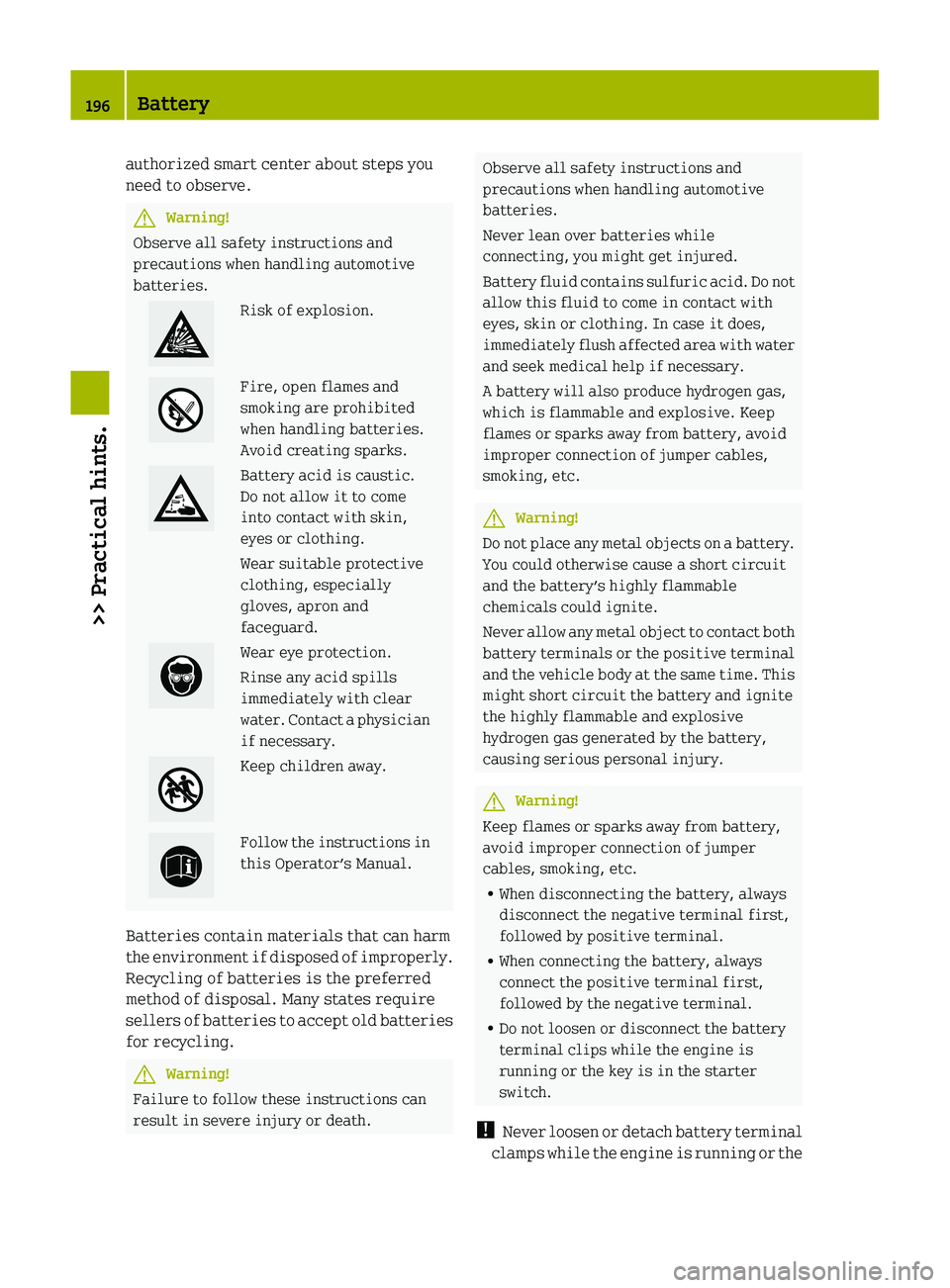
Risk of explosion.Fire, open flames and
smoking are prohibited
when handling batteries.
Avoid creating sparks.
Battery acid is caustic.
Do not allow it to come
into contact with skin,
eyes or clothing.
Wear suitable protective
clothing, especially
gloves, apron and
faceguard.
Wear eye protection.
Rinse any acid spills
immediately with clear
water. Contact a physician
if necessary.
Keep children away.Follow the instructions in
this Operator’s Manual.
Batteries contain materials that can harm
the environment if disposed of improperly.
Recycling of batteries is the preferred
method of disposal. Many states require
sellers of batteries to accept old batteries
for recycling.
GWarning!
Failure to follow these instructions can
result in severe injury or death.
Observe all safety instructions and
precautions when handling automotive
batteries.
Never lean over batteries while
connecting, you might get injured.
Battery fluid contains sulfuric acid. Do not
allow this fluid to come in contact with
eyes, skin or clothing. In case it does,
immediately flush affected area with water
and seek medical help if necessary.
A battery will also produce hydrogen gas,
which is flammable and explosive. Keep
flames or sparks away from battery, avoid
improper connection of jumper cables,
smoking, etc.
GWarning!
Do not place any metal objects on a battery.
You could otherwise cause a short circuit
and the battery’s highly flammable
chemicals could ignite.
Never allow any metal object to contact both
battery terminals or the positive terminal
and the vehicle body at the same time. This
might short circuit the battery and ignite
the highly flammable and explosive
hydrogen gas generated by the battery,
causing serious personal injury.
GWarning!
Keep flames or sparks away from battery,
avoid improper connection of jumper
cables, smoking, etc.
RWhen disconnecting the battery, always
disconnect the negative terminal first,
followed by positive terminal.
RWhen connecting the battery, always
connect the positive terminal first,
followed by the negative terminal.
RDo not loosen or disconnect the battery
terminal clips while the engine is
running or the key is in the starter
switch.
! Never loosen or detach battery terminal
clamps while the engine is running or the
196Battery>> Practical hints.
BA 451 USA, CA Edition A 2011; 1; 4, en-UShereepeVersion: 3.0.3.62010-05-11T15:12:26+02:00 - Seite 196
Page 204 of 228
cause damage to the radiator and other
supports if towing on a bumpy road.
RTowing the vehicle should only be done
using the properly installed towing
eye bolt. Never attach a tow cable, tow
rope, or tow rod to the vehicle chassis,
frame, or suspension parts.
! Make sure the ignition is switched off
while towing the vehicle. Doing
otherwise may result in
Rthe ESP® being activated. Active
braking action through the ESP® may
seriously damage the brake system
which is not covered by the smart
Limited Warranty.
Ra discharged battery.
! Make sure the gear selector lever is in
neutral position N while towing the
vehicle. Doing otherwise may result in
significant transmission damage.
! Towing the vehicle with a luggage
rack* mounted is not permissible. The
vehicle must not be towed by the luggage
rack*.
iIf the battery is disconnected or
discharged, the gear selector lever will
remain locked in park position P.
Contact an authorized smart center for
assistance or call Roadside Assistance.
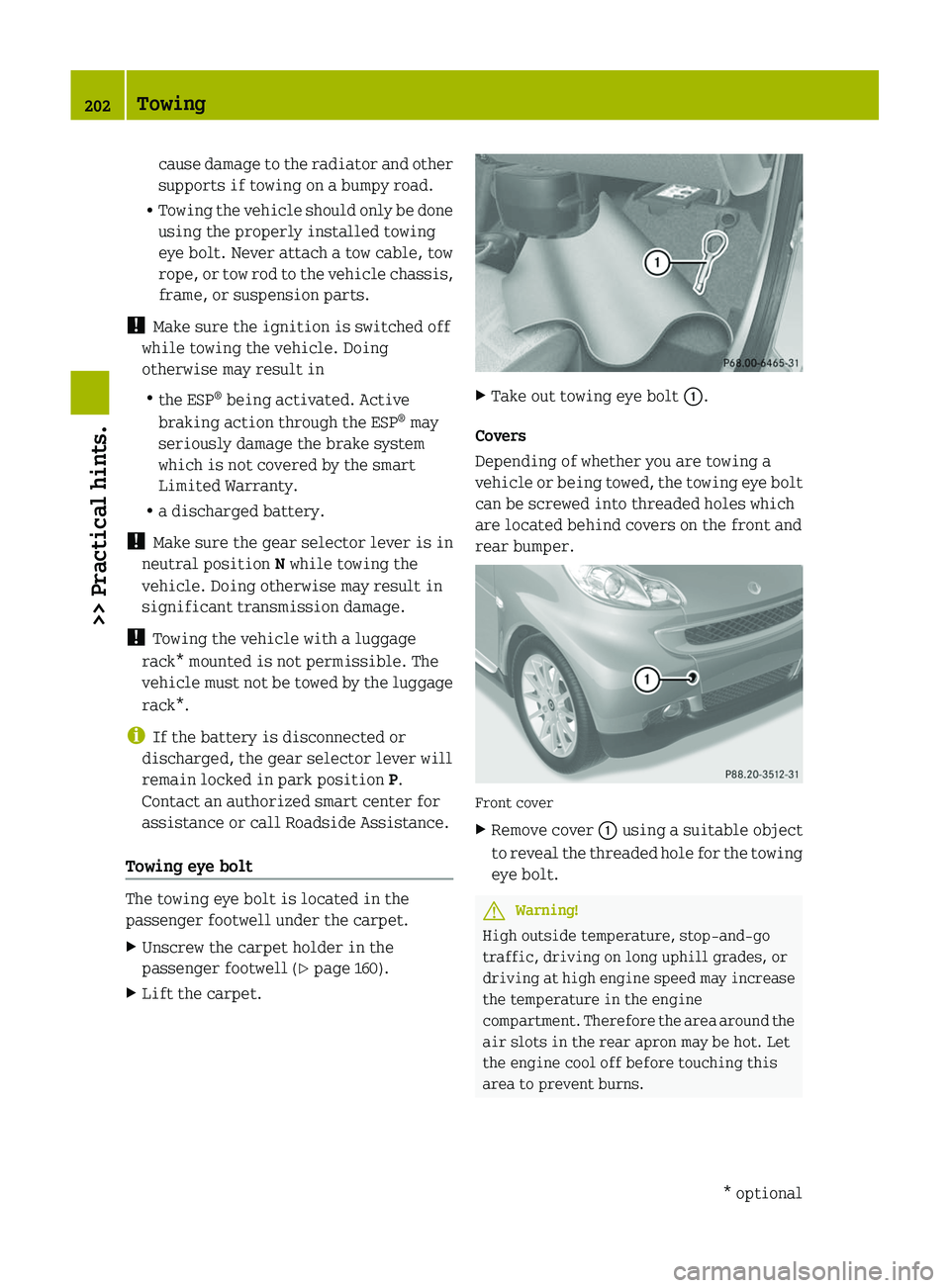
Towing eye bolt
The towing eye bolt is located in the
passenger footwell under the carpet.
XUnscrew the carpet holder in the
passenger footwell (Y page 160).
XLift the carpet.XTake out towing eye bolt \000F.
Covers
Depending of whether you are towing a
vehicle or being towed, the towing eye bolt
can be screwed into threaded holes which
are located behind covers on the front and
rear bumper.
Front cover
XRemove cover \000F using a suitable object
to reveal the threaded hole for the towing
eye bolt.
GWarning!
High outside temperature, stop-and-go
traffic, driving on long uphill grades, or
driving at high engine speed may increase
the temperature in the engine
compartment. Therefore the area around the
air slots in the rear apron may be hot. Let
the engine cool off before touching this
area to prevent burns.
202Towing>> Practical hints.* optionalBA 451 USA, CA Edition A 2011; 1; 4, en-UShereepeVersion: 3.0.3.62010-05-11T15:12:26+02:00 - Seite 202
Page 206 of 228
XTurn the battery on using the previously
installed battery switch.
XMove the gear selector lever to park
position P.
XRemove the key from the starter switch.XLock the doors.
! Do not flat tow the vehicle with the front
axle raised. Doing so may cause serious
damage to the brake system which is not
covered by the smart Limited Warranty.
! Failure to follow the recommendations
for flat towing can cause damage to your
vehicle:
RNot following the battery disconnect
procedure in the proper sequence may
result in data loss in the vehicle’s
control units.
RNot disconnecting the battery and
leaving the key in starter switch
position 1 (ignition on) may result in
-the vehicle locking. The vehicle will
lock if the wheels are turning at
vehicle speeds of approximately
8 mph (14 km/h) or more.
-the ESP® being activated. Active
braking action through the ESP® may
seriously damage the brake system
which is not covered by the smart
Limited Warranty.
RNot moving the gear selector lever to
neutral position N may result in
significant transmission damage.
Rin a discharged battery.
Fuses
The electrical fuses in your vehicle serve
to switch off malfunctioning power
circuits.
If a fuse is blown, the components and
systems secured by that fuse will stop
operating.
GWarning!
Only use fuses approved by smart with the
specified amperage for the system in
question and do not attempt to repair or
bridge a blown fuse this may cause an
overload leading to a fire, and/or cause
damage to electrical components and/or
systems. Contact a smart center if you
encounter any electrical problems.
! A blown fuse must be replaced by an
appropriate spare fuse (recognizable by
its color or the fuse rating given on the
fuse) of the amperage recommended in
the fuse chart. Any smart center will be
glad to advise you on this subject.
If a newly inserted fuse blows again, have
the cause determined and rectified at an
authorized smart center.
Before replacing fuses:
REngage the parking brake.
RMake sure the gear selector lever is in
park position P.
RTurn off all electrical accessories.
RTurn off the engine.
RRemove the key from the starter switch.
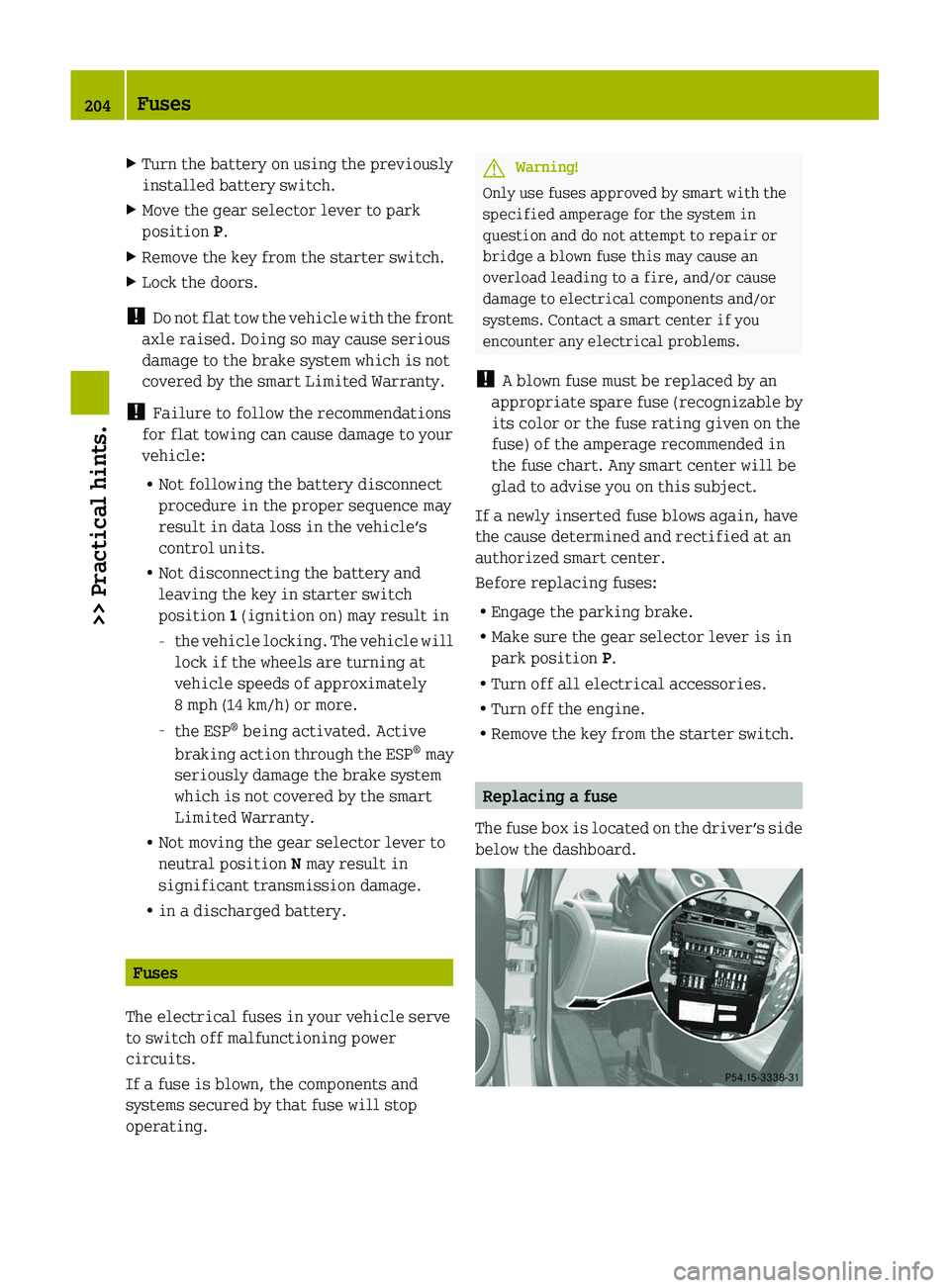
Replacing a fuse
The fuse box is located on the driver’s side
below the dashboard.
204Fuses>> Practical hints.
BA 451 USA, CA Edition A 2011; 1; 4, en-UShereepeVersion: 3.0.3.62010-05-11T15:12:26+02:00 - Seite 204