ABS SMART FORTWO COUPE 2011 Owners Manual
[x] Cancel search | Manufacturer: SMART, Model Year: 2011, Model line: FORTWO COUPE, Model: SMART FORTWO COUPE 2011Pages: 228, PDF Size: 11.48 MB
Page 6 of 228
A
ABS (Antilock Brake System) ............. 46
Indicator lamp ........................ 165
Accessory weight .......................... 142
Accidents Air bags .................................. 33
Additives
Engine oil .............................. 221
Gasoline ................................ 222
Address change .............................. 15
Air bags ....................................... 33
Children .................................. 33
Front, driver and passenger .........36
Front, passenger ....................... 36
Head-thorax ............................. 37
Knee bag .................................. 37
Passenger front air bag off
indicator lamp ..................... 28, 41
Safety guidelines ......................35
SRS indicator lamp ...................168
Thorax-pelvis .......................... 38
Window curtain ......................... 38
Air conditioning
see HVAC ................................ 103
Air conditioning refrigerant .......... 221
Air pressure see Tire inflation pressure
Air pressure (tires) ....................... 142
Air vents ..................................... 105
Alarm system see Anti-theft systems
Ambient lighting ........................... 69
Anticorrosion/antifreeze ............... 223
Antiglare, Interior rear view
mirror ......................................... 62
Antilock Brake System see ABS
Anti-theft systems ......................... 48
Anti-theft warning system ...........48
Electronic immobilizer ..............48
Interior motion sensor ...............49
Tow-away alarm ......................... 49
Aquaplaning
see Hydroplaning
Armrest ........................................ 59
Aspect ratio (tires) ....................... 142Audio system ................................. 99
Automatic headlamp mode ................ 65
Automatic locking .......................... 53
Automatic transmission .................. 82
Display message ....................... 161
Driving tips ............................. 84
Emergency operation (limp-
home mode) ............................... 86
Gear selector lever ....................82
Gear selector lever positions ......83
Gearshift pattern ...................... 82
Hill-start assist system .............. 84
Manual gearshifting ..................84
Shifting procedure ....................82
Auxiliary instruments
Cockpit clock ........................... 92
Tachometer .............................. 92
AUX socket .................................. 100
B
Backrest see Seats
Backup lamp ................................. 182
Bar (air pressure unit) ................... 143
Battery Charging ................................ 195
Indicator lamp ......................... 170
Jump starting .......................... 198
Removing and installing ............195
Battery (key)
Replacing the transmitter
battery ................................... 179
Bead (tire) .................................. 143
Brake fluid .................................. 125
Checking ................................ 125
Brake lamp .................................. 182
Brake pedal ................................... 81
Brakes ........................................ 147
Parking brake ........................... 80
Warning lamp .......................... 166
Break-in period ........................... 118
Bulbs Front ..................................... 181
Rear ...................................... 182
Replacing ............................... 180
4IndexBA 451 USA, CA Edition A 2011; 1; 4, en-UShereepeVersion: 3.0.3.62010-05-11T15:12:26+02:00 - Seite 4
Page 8 of 228
Driving and parkingSafety notes .............................. 78
Driving safety systems .................... 46
ABS ........................................ 46
ESP ®
....................................... 47
Hydraulic brake assistant ...........48
E
Electrical system Improper work on or
modifications ........................... 15
Power outlet ............................ 115
Electronic immobilizer .................. 48
Display message ....................... 161
Electronic Power Steering
see EPS
Electronic Stability Program
see ESP ®
Emergency, in case of
Hazard warning flasher ..........48, 68
Roadside Assistance ..................14
Emergency operation (limp-home
mode) .......................................... 86
Emergency Tensioning Device see ETD
Emission control .......................... 152
Information label ..................... 213
System warranties ......................13
Engine
Break-in recommendations .........118
Compartment ........................... 119
Compartment cover .................... 119
Electronics ............................. 212
Malfunction indicator lamp ........173
Number .................................. 215
Starting .................................. 78
Turning off .............................. 81
Engine coolant
see Coolant
Engine oil
Adding ................................... 121
Additives ............................... 221
Checking level ......................... 120
Consumption ........................... 120
Oil dipstick ............................ 121
EPS (Electronic Power Steering)
Warning lamp .......................... 169
ESP®
(Electronic Stability Program) ... 47
Warning lamp .......................... 169
ETD (Emergency Tensioning Device) ... 33
Safety guidelines ......................35
Exterior lamp switch ...................... 64
Exterior lighting Overview ................................ 181
Exterior rear view mirrors .............. 61
Exterior view of vehicle .................. 20
F
First-aid kit ............................... 160
Flat tire ..................................... 188
Fluids Capacities ............................. 220
Engine coolant ........................ 220
Engine oil .............................. 220
Fog lamps ................................ 68, 181
Front air bags see Air bags
Front compartment ........................ 122
Front lamps Overview ................................ 181
Fuel ........................................... 148
Additives ............................... 222
Capacity, fuel tank ...................220
Fuel filler flap and cap .............118
Fuel level display .....................90
Premium unleaded
gasoline ..................... 119, 220, 221
Refueling ............................... 118
Requirements .......................... 222
Fuel cap
Indicator lamp ......................... 172
Fuel filler flap ............................. 118
Fuel level display .......................... 90
Fuel tank Capacity ................................ 220
Fuel filler flap and cap .............118
Refueling ............................... 118
Fuse chart ................................... 207
Fuses ......................................... 204
6IndexBA 451 USA, CA Edition A 2011; 1; 4, en-UShereepeVersion: 3.0.3.62010-05-11T15:12:26+02:00 - Seite 6
Page 10 of 228
L
Labels ........................................ 213
Emission control information .....213
Lamps, exterior
Exterior lamp switch ..................64
Switching on/off ....................... 64
Lamps, indicator and warning
ABS ....................................... 165
Battery ................................... 170
Brakes ................................... 166
Coolant temperature .................172
Engine malfunction ................... 173
EPS ........................................ 169
ESP ®
...................................... 169
Fog lamps ................................ 68
Fuel cap ................................. 172
High-beam headlamps ................171
Low-beam headlamps .................171
Low tire pressure/TPMS
malfunction telltale .................174
Oil pressure ............................ 173
Overview (kilometers) ................25
Overview (miles) ....................... 23
Passenger front air bag off ....36, 175
Seat belt telltale ..................... 167
SRS ........................................ 168
Turn signals ............................ 171
License plate lamps ....................... 182
Lighter see Cigarette lighter
Lighting ...................................... 64
Coming home function ................. 67
Daytime running lamp mode .........66
Exterior .................................. 64
Interior .................................. 69
Loading
see Vehicle loading
Locking the vehicle ........................ 52
Manually ................................. 178
Loss of
Key ........................................ 176
Service and Warranty
Information booklet ..................212
Low-beam headlamps ................. 65, 181
Exterior lamp switch ..................64
Indicator lamp ......................... 171
Switching on ............................ 65M
Main odometer display .................... 88
Maintenance .................................. 14
Service interval display .............91
Malfunction
Electronic immobilizer .............161
Shifting system ........................ 161
Manual headlamp mode (Low-beam
headlamps) ................................... 65
Maximum loaded vehicle weight ....... 143
Maximum load rating (tires) ............ 143
Maximum permissible tire
inflation pressure ........................ 143
Mirrors Exterior rear view mirrors ..........61
Interior rear view mirror ...........62
MON (Motor Octane Number) ............. 222
Motor Octane Number see MON
Multifunction display ..................... 87
N
Normal occupant weight ................. 143
Number, vehicle identification
(VIN) .......................................... 214
O
Occupant Classification System see OCS (Occupant
Classification System)
Occupant distribution ................... 143
Occupant safety Air bags .................................. 33
Children and air bags ................33
Children in the vehicle ..............42
Infant and child restraint
systems ................................... 43
Introduction ............................ 30
OCS (Occupant Classification
System) ................................... 39
Passenger front air bag off
indicator lamp ......................... 39
Seat belts ............................ 31, 35
SRS indicator lamp, malfunction . 168
8IndexBA 451 USA, CA Edition A 2011; 1; 4, en-UShereepeVersion: 3.0.3.62010-05-11T15:12:26+02:00 - Seite 8
Page 25 of 228
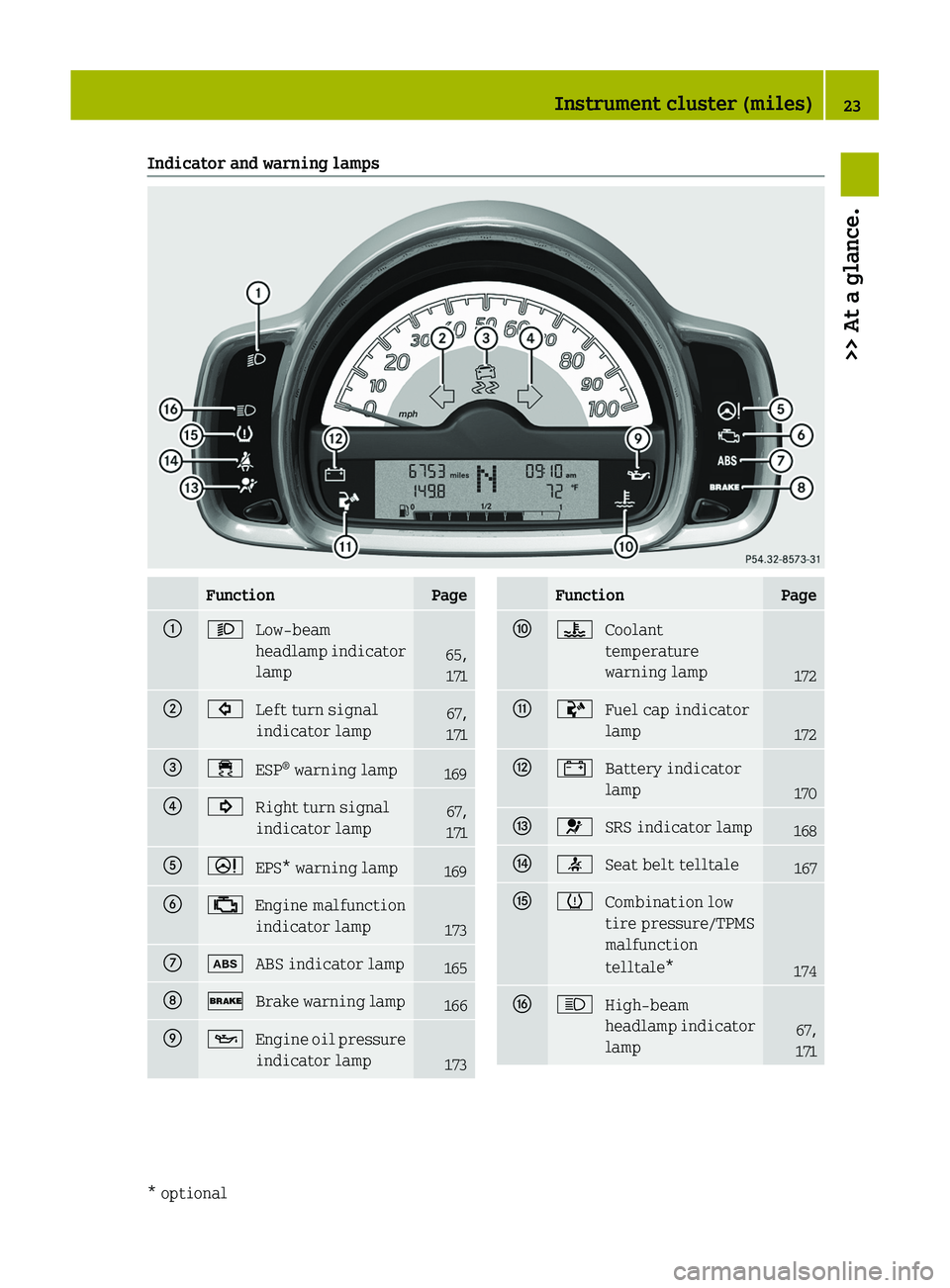
Indicator and warning lampsFunctionPage00460065Low‑beam
headlamp indicator
lamp
65, 171
00470026Left turn signal
indicator lamp67, 171008A00F2ESP ®
warning lamp16900880024Right turn signal
indicator lamp67, 17100860052EPS* warning lamp169008700BBEngine malfunction
indicator lamp
173
006E00EBABS indicator lamp165006F0027Brake warning lamp166007000B5Engine oil pressure
indicator lamp
173
FunctionPage007100AECoolant
temperature
warning lamp
172
007200ACFuel cap indicator
lamp
172
0073003FBattery indicator
lamp
170
00740081SRS indicator lamp16800750082Seat belt telltale16700760077Combination low
tire pressure/TPMS
malfunction
telltale*
174
00770063High‑beam
headlamp indicator
lamp
67, 171
Instrument cluster (miles)23>> At a glance.* optionalBA 451 USA, CA Edition A 2011; 1; 4, en-UShereepeVersion: 3.0.3.62010-05-11T15:12:26+02:00 - Seite 23
Page 27 of 228
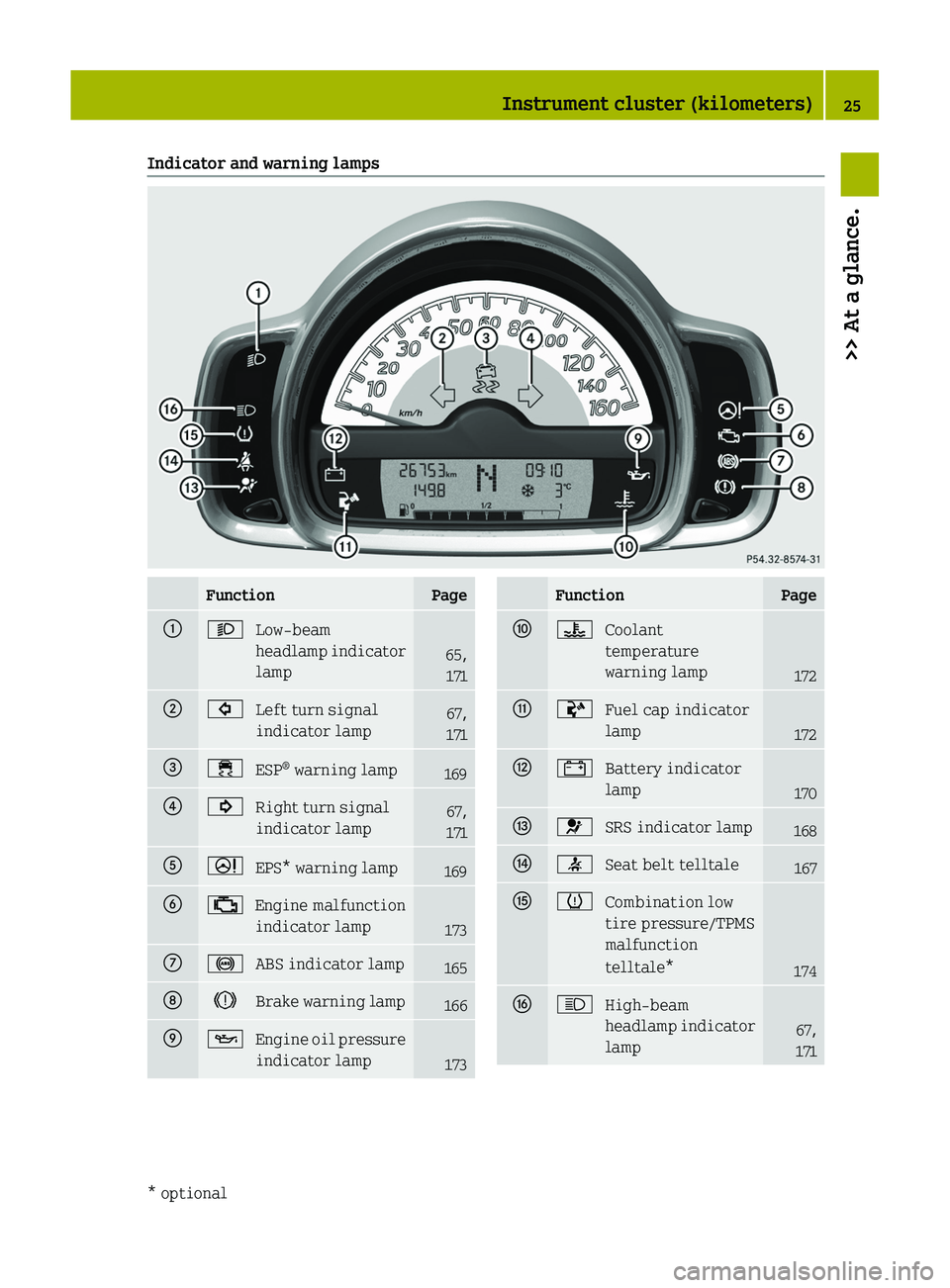
Indicator and warning lampsFunctionPage00460065Low‑beam
headlamp indicator
lamp
65, 171
00470026Left turn signal
indicator lamp67, 171008A00F2ESP ®
warning lamp16900880024Right turn signal
indicator lamp67, 17100860052EPS* warning lamp169008700BBEngine malfunction
indicator lamp
173
006E0031ABS indicator lamp165006F0052Brake warning lamp166007000B5Engine oil pressure
indicator lamp
173
FunctionPage007100AECoolant
temperature
warning lamp
172
007200ACFuel cap indicator
lamp
172
0073003FBattery indicator
lamp
170
00740081SRS indicator lamp16800750082Seat belt telltale16700760077Combination low
tire pressure/TPMS
malfunction
telltale*
174
00770063High‑beam
headlamp indicator
lamp
67, 171
Instrument cluster (kilometers)25>> At a glance.* optionalBA 451 USA, CA Edition A 2011; 1; 4, en-UShereepeVersion: 3.0.3.62010-05-11T15:12:26+02:00 - Seite 25
Page 35 of 228
should be positioned as low as possible
on the hips to avoid any possible
pressure on the abdomen.
R Never place your feet on the instrument
panel, dashboard or on the seat. Always
keep both feet on the floor in front of the
seat.
R When using a seat belt to secure infant or
toddler restraints or children in booster
seats, always follow the child seat
manufacturer’s instructions.
Emergency Tensioning Devices (ETDs)
and seat belt force limiters
The seat belts are equipped with
Emergency Tensioning Devices and seat
belt force limiters.
Emergency Tensioning Devices are
designed to activate in the following
cases:
R in frontal or rear-end impacts
exceeding the system deployment
threshold
R if the restraint systems are operational
and functioning correctly
R in collisions with high vehicle
deceleration/acceleration in the
longitudinal direction, e.g. a head-on
collision
R on passenger side when the seat is
occupied and the seat belt is fastened
R independently of the front air bags
When activated, Emergency Tensioning
Devices remove slack from the seat belts in
such a way that the seat belts fit more
snugly against the body. Seat belt force
limiters, when activated, reduce the force
exerted by the seat belts on occupants
during a crash.
When the emergency tensioning device is
triggered, the SRS indicator lamp 0081 in
the instrument cluster illuminates, see
“SRS indicator lamp” ( Y page 168).
GWarning!
Once they have been triggered, Emergency
Tensioning Devices will no longer function
properly and must be replaced. smart
recommends that you visit a qualified
workshop to have this done. In particular,
work relevant to safety or on safety-related
systems must be carried out at a qualified
specialist workshop.
Comply with safety regulations when
disposing of Emergency Tensioning
Devices. These regulations are available at
any smart center.
The belt force limiter is designed to
operate in unison with the front air bag,
which absorbs a portion of the seat belt’s
decelerating forces, distributing the load
over a larger area.
In the event of a head-on or rear-end
collision, the emergency tensioning
device is activated if the vehicle is
decelerated or accelerated sufficiently in
the longitudinal direction at the start of
impact with the ignition switched on.
Air bags
Air bags can reduce the severity of
injuries in serious collisions, e.g. in a
head-on collision or a side impact.
GWarning!
Air bags are designed to reduce the
potential of injury in certain frontal
impacts (front air bags and knee bags), or
side impacts (head-thorax air bags,
window curtain air bags and thorax-pelvis
air bags) which may cause significant
injuries. However, no system available
today can completely eliminate injuries
and fatalities.
The deployment of the air bags temporarily
releases a small amount of dust from the air
bags. This dust is neither injurious to your
health, nor does it indicate a fire in the
vehicle. The dust might cause some
Occupant safety33>> Safety.BA 451 USA, CA Edition A 2011; 1; 4, en-UShereepeVersion: 3.0.3.62010-05-11T15:12:26+02:00 - Seite 33Z
Page 48 of 228
iCanada only:
This device complies with RSS‑210 of
Industry Canada. Operation is subject to
the following two conditions:
R This device may not cause
interference, and
R this device must accept any
interference received, including
interference that may cause undesired
operation of the device.
Any unauthorized modification to this
device could void the user’s authority to
operate the equipment.
Driving safety systems
Introduction
GWarning!
The following factors increase the risk of
accidents:
R Excessive speed, especially in turns
R Wet and slippery road surfaces
R Following another vehicle too closely
The driving safety systems described in
this section cannot reduce these risks or
prevent the natural laws of physics from
acting on the vehicle.
Always adapt your driving style to the
prevailing road and weather and traffic
conditions and keep a safe distance to
other road users and objects on the street.
i In winter operation, the maximum
effectiveness of the ABS, the hydraulic
brake assistant, and the ESP ®
is only
achieved with winter tires ( Y page 145)
or snow chains* as required.
Antilock Brake System (ABS)
GWarning!
Do not pump the brake pedal. Use firm,
steady brake pedal pressure instead.
Pumping the brake pedal defeats the
purpose of the ABS and significantly
reduces braking effectiveness.
The Antilock Brake System (ABS) regulates
the brake pressure so that the wheels do not
lock during braking. This allows you to
maintain the ability to steer your vehicle.
On slippery road surfaces, the ABS will
respond even to light brake pressure.
The ABS indicator lamp in the instrument
cluster ( Y page 22) comes on when you
switch on the ignition. It goes out when the
engine is running.
Braking
At the instant one of the wheels is about to
lock up, a slight pulsation can be felt in
the brake pedal, indicating that the ABS is
regulating the brake pressure.
XKeep firm and steady pressure on the
brake pedal while experiencing the
pulsation.
Continuous, steady brake pedal pressure
yields the advantages provided by the ABS,
namely braking power and the ability to
steer the vehicle.
A pulsating brake pedal can be an
indication of hazardous road conditions
and functions as a reminder to take extra
care while driving.
Emergency brake maneuver
XKeep continuous full pressure on the
brake pedal.GWarning!
When the ABS is malfunctioning, the
hydraulic brake assistant and the ESP ®
are
also switched off.
When the ABS is malfunctioning, the wheels
may lock during hard braking, reducing
steering capability and extending the
braking distance.
46Driving safety systems>> Safety.* optionalBA 451 USA, CA Edition A 2011; 1; 4, en-UShereepeVersion: 3.0.3.62010-05-11T15:12:26+02:00 - Seite 46
Page 49 of 228
GWarning!
The ABS cannot prevent the natural laws of
physics from acting on the vehicle, nor can
it increase braking or steering efficiency
beyond that afforded by the condition of the
vehicle brakes and tires or the traction
afforded. The ABS cannot prevent
accidents, including those resulting from
excessive speed in turns, following
another vehicle too closely, or
hydroplaning. Only a safe, attentive, and
skillful driver can prevent accidents. The
capabilities of an ABS equipped vehicle
must never be exploited in a reckless or
dangerous manner which could jeopardize
the user’s safety or the safety of others.
Electronic Stability Program (ESP ®
)
Your vehicle is equipped with the
E lectronic Stability Program (ESP ®
). The
ESP ®
is operational as soon as the engine
is running and it monitors the vehicle’s
traction (force of adhesive friction
between the tires and the road surface) and
handling.
The ESP ®
recognizes when a wheel is
spinning or if the vehicle starts to skid.
By applying brakes to the appropriate
wheel and by limiting the engine output,
the ESP ®
works to stabilize the vehicle. The
ESP ®
is especially useful while driving off
and on wet or slippery road surfaces. The
ESP ®
also stabilizes the vehicle during
braking and steering maneuvers.
The ESP ®
warning lamp 00F2 in the
instrument cluster flashes when the ESP ®
is
engaged.
The ESP ®
warning lamp 00F2 in the
instrument cluster comes on when you
switch on the ignition. It goes out when the
engine is running.
Depending on the driving situation, the
ESP ®
R reduces the speed
R selectively brakes individual wheels
R equalizes the speed of the driven wheels
R stabilizes the vehicle when braking
R assists you in evasive maneuvers on all
roadsGWarning!
If the ESP ®
warning lamp 00F2 in the
instrument cluster flashes, proceed as
follows:
R While driving off, apply as little
throttle as possible.
R While driving, ease up on the accelerator
pedal.
R Adapt your speed and driving style to the
prevailing road conditions.
Failure to observe these guidelines could
cause the vehicle to skid.
The ESP ®
cannot prevent accidents
resulting from excessive speed.
GWarning!
The ESP ®
cannot prevent the natural laws of
physics from acting on the vehicle, nor can
it increase the traction afforded. The
ESP ®
cannot prevent accidents, including
those resulting from excessive speed in
turns, or hydroplaning. Only a safe,
attentive, and skillful driver can prevent
accidents. The capabilities of an ESP ®
equipped vehicle must never be exploited
in a reckless or dangerous manner which
could jeopardize the user’s safety or the
safety of others.
! Because the ESP ®
operates
automatically, the engine must be turned
off (ignition switched off) when the
parking brake is being tested on a brake
test dynamometer. Active braking action
through the ESP ®
may otherwise seriously
Driving safety systems47>> Safety.BA 451 USA, CA Edition A 2011; 1; 4, en-UShereepeVersion: 3.0.3.62010-05-11T15:12:26+02:00 - Seite 47Z
Page 50 of 228
damage the brake system which is not
covered by the smart Limited Warranty.
i The ESP ®
will only function properly if
you use wheels of the recommended tire
size ( Y page 217).
Hydraulic brake assistant
The hydraulic brake assistant operates in
emergency situations. If you apply the
brakes very quickly, the hydraulic brake
assistant automatically provides full
brake boost, thereby potentially reducing
the braking distance.
XApply continuous full braking pressure
until the emergency braking situation is
over.
The ABS will prevent the wheels from
locking.
When you release the brake pedal, the
brakes function again as normal. The
hydraulic brake assistant is then
deactivated.
GWarning!
When the hydraulic brake assistant is
malfunctioning, the brake system is still
functioning normally, but without the
additional brake boost that would normally
be provided during an emergency braking
maneuver. Therefore, the braking distance
may increase.
GWarning!
The hydraulic brake assistant cannot
prevent the natural laws of physics from
acting on the vehicle, nor can it increase
braking efficiency beyond that afforded by
the condition of the vehicle brakes and
tires or the traction afforded. The
hydraulic brake assistant cannot prevent
accidents, including those resulting from
excessive speed in turns, following
another vehicle too closely, or
hydroplaning. Only a safe, attentive, and
skillful driver can prevent accidents. The
capabilities of a hydraulic brake assistant
equipped vehicle must never be exploited
in a reckless or dangerous manner which
could jeopardize the user’s safety or the
safety of others.
Activating the hazard warning flasher
after an emergency braking maneuver
If you bring the vehicle to a complete stop
by strongly braking at a speed of more than
43 mph (70 km/h), the hazard warning
flasher comes on automatically as soon as
the vehicle is at a standstill. The hazard
warning flasher will remain on until it is
switched off using the hazard warning
flasher switch ( Y page 68) or until the
speed of the vehicle has exceeded 6 mph
(10 km/h).
Anti-theft systems
Electronic immobilizer
The electronic immobilizer prevents
unauthorized persons from starting your
vehicle.
When leaving the vehicle, always take the
key with you and lock the vehicle. The
engine can be started by anyone with a key
that is left inside the vehicle.
XActivating: Remove the key from the
starter switch.XDeactivating: Insert the key in the
starter switch.XTurn the key to starter switch position 1.
Anti-theft warning system*
Once the anti-theft warning system has
been armed, a visual and audible alarm is
triggered when
R someone opens a door or the tailgate
R someone enters the vehicle’s interior
48Anti-theft systems>> Safety.* optionalBA 451 USA, CA Edition A 2011; 1; 4, en-UShereepeVersion: 3.0.3.62010-05-11T15:12:26+02:00 - Seite 48
Page 54 of 228
Opening and closing
Key
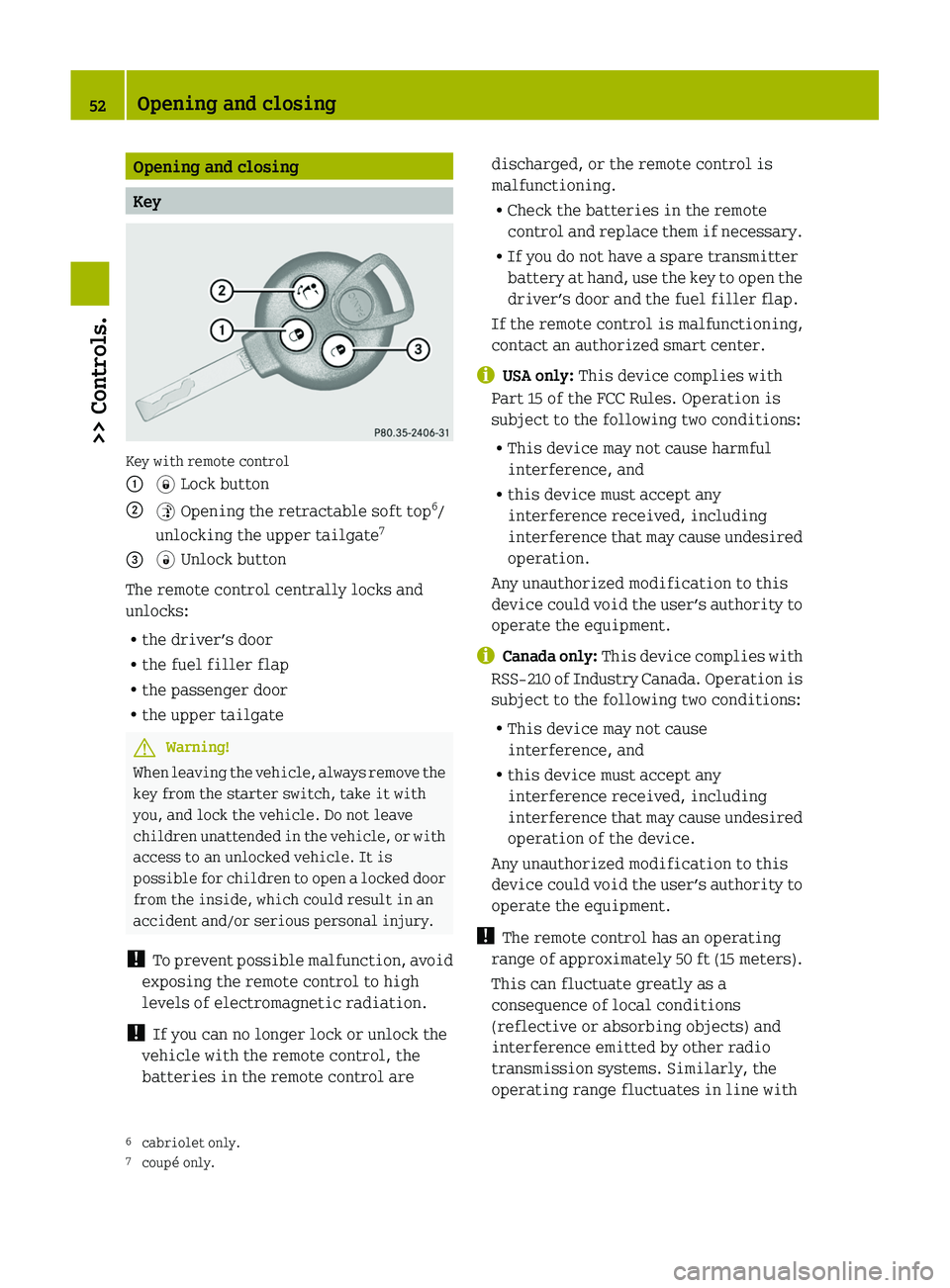
Key with remote control
0046 0038 Lock button0047 0035 Opening the retractable soft top 6
/
unlocking the upper tailgate 7008A
0034 Unlock button
The remote control centrally locks and
unlocks:
R the driver’s door
R the fuel filler flap
R the passenger door
R the upper tailgate
GWarning!
When leaving the vehicle, always remove the
key from the starter switch, take it with
you, and lock the vehicle. Do not leave
children unattended in the vehicle, or with
access to an unlocked vehicle. It is
possible for children to open a locked door
from the inside, which could result in an
accident and/or serious personal injury.
! To prevent possible malfunction, avoid
exposing the remote control to high
levels of electromagnetic radiation.
! If you can no longer lock or unlock the
vehicle with the remote control, the
batteries in the remote control are
discharged, or the remote control is
malfunctioning.
R Check the batteries in the remote
control and replace them if necessary.
R If you do not have a spare transmitter
battery at hand, use the key to open the
driver’s door and the fuel filler flap.
If the remote control is malfunctioning,
contact an authorized smart center.
i USA only: This device complies with
Part 15 of the FCC Rules. Operation is
subject to the following two conditions:
R This device may not cause harmful
interference, and
R this device must accept any
interference received, including
interference that may cause undesired
operation.
Any unauthorized modification to this
device could void the user’s authority to
operate the equipment.
i Canada only: This device complies with
RSS-210 of Industry Canada. Operation is
subject to the following two conditions:
R This device may not cause
interference, and
R this device must accept any
interference received, including
interference that may cause undesired
operation of the device.
Any unauthorized modification to this
device could void the user’s authority to
operate the equipment.
! The remote control has an operating
range of approximately 50 ft (15 meters).
This can fluctuate greatly as a
consequence of local conditions
(reflective or absorbing objects) and
interference emitted by other radio
transmission systems. Similarly, the
operating range fluctuates in line with6 cabriolet only.
7 coupé only.52Opening and closing>> Controls.
BA 451 USA, CA Edition A 2011; 1; 4, en-UShereepeVersion: 3.0.3.62010-05-11T15:12:26+02:00 - Seite 52