ABS SMART FORTWO COUPE 2011 User Guide
[x] Cancel search | Manufacturer: SMART, Model Year: 2011, Model line: FORTWO COUPE, Model: SMART FORTWO COUPE 2011Pages: 228, PDF Size: 11.48 MB
Page 80 of 228
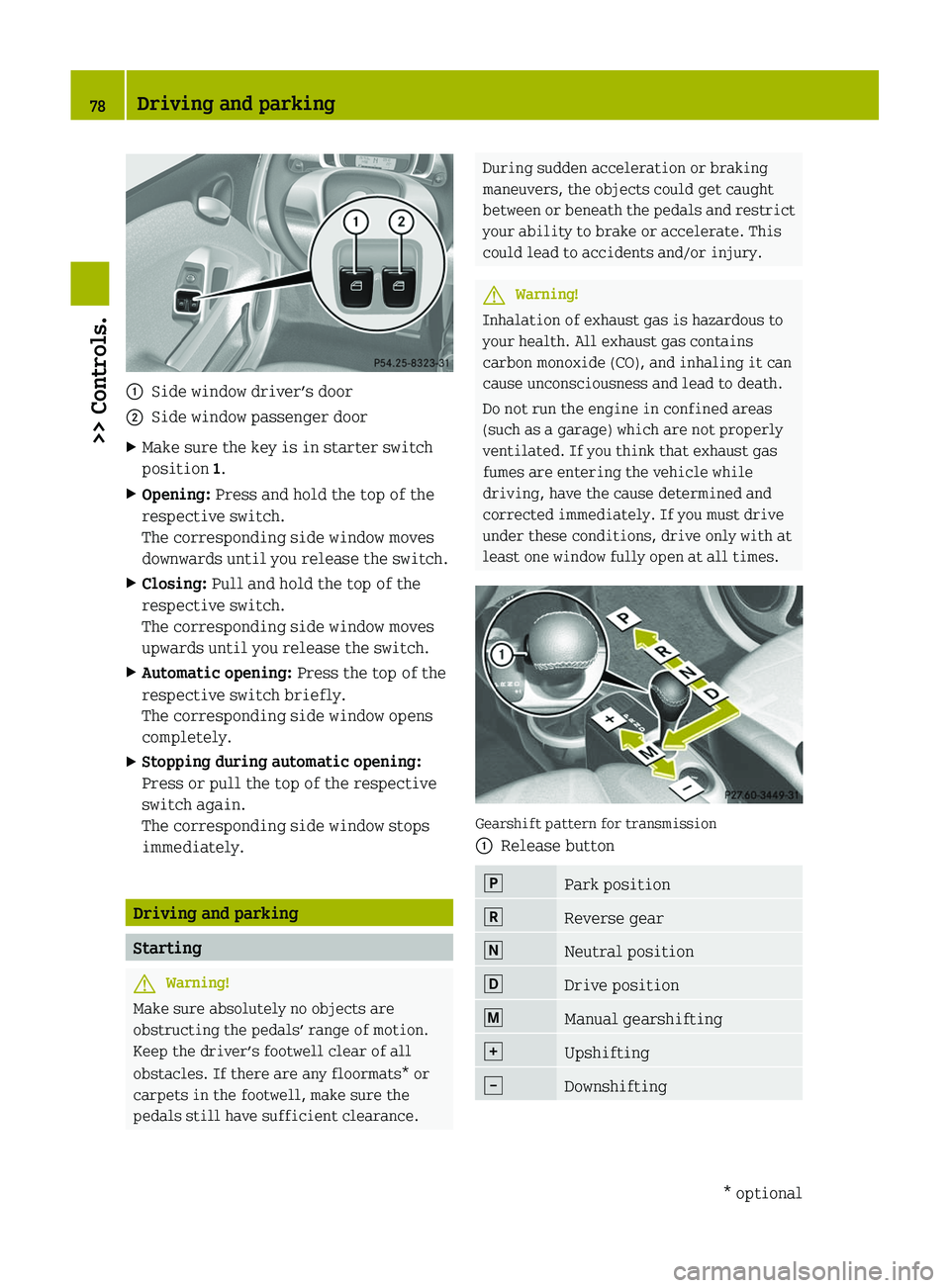
\000FSide window driver’s door\000GSide window passenger doorXMake sure the key is in starter switch
position 1.
XOpening: Press and hold the top of the
respective switch.
The corresponding side window moves
downwards until you release the switch.
XClosing: Pull and hold the top of the
respective switch.
The corresponding side window moves
upwards until you release the switch.
XAutomatic opening: Press the top of the
respective switch briefly.
The corresponding side window opens
completely.
XStopping during automatic opening:
Press or pull the top of the respective
switch again.
The corresponding side window stops
immediately.
Driving and parking
Starting
GWarning!
Make sure absolutely no objects are
obstructing the pedals’ range of motion.
Keep the driver’s footwell clear of all
obstacles. If there are any floormats* or
carpets in the footwell, make sure the
pedals still have sufficient clearance.
During sudden acceleration or braking
maneuvers, the objects could get caught
between or beneath the pedals and restrict
your ability to brake or accelerate. This
could lead to accidents and/or injury.
GWarning!
Inhalation of exhaust gas is hazardous to
your health. All exhaust gas contains
carbon monoxide (CO), and inhaling it can
cause unconsciousness and lead to death.
Do not run the engine in confined areas
(such as a garage) which are not properly
ventilated. If you think that exhaust gas
fumes are entering the vehicle while
driving, have the cause determined and
corrected immediately. If you must drive
under these conditions, drive only with at
least one window fully open at all times.
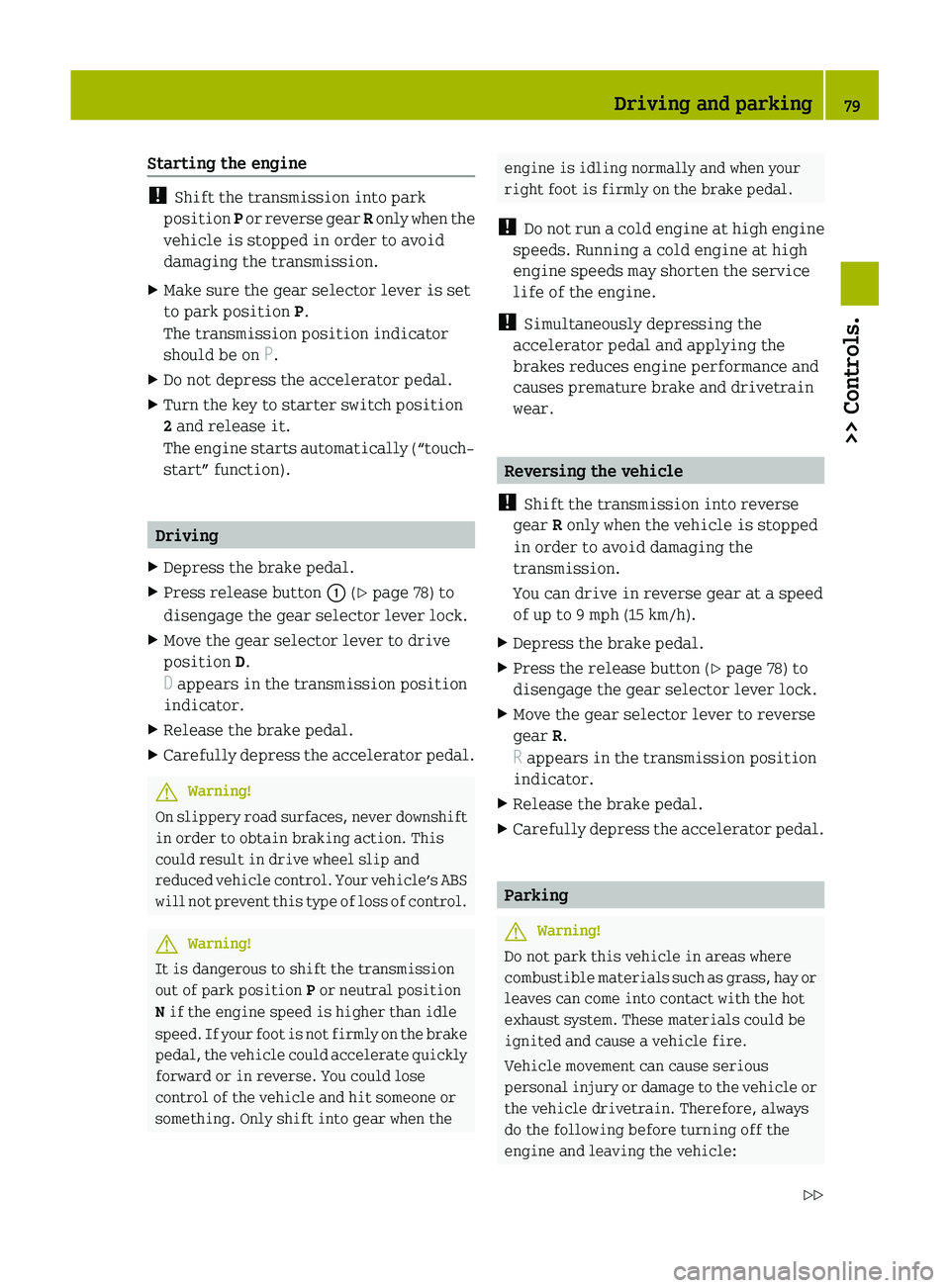
Gearshift pattern for transmission
\000FRelease button\000`Park position\000aReverse gear\000_Neutral position\000^Drive position\000fManual gearshifting\000gUpshifting\000XDownshifting78Driving and parking>> Controls.* optionalBA 451 USA, CA Edition A 2011; 1; 4, en-UShereepeVersion: 3.0.3.62010-05-11T15:12:26+02:00 - Seite 78
Page 81 of 228
Starting the engine
! Shift the transmission into park
position P or reverse gear R only when the
vehicle is stopped in order to avoid
damaging the transmission.
XMake sure the gear selector lever is set
to park position P.
The transmission position indicator
should be on P.XDo not depress the accelerator pedal.XTurn the key to starter switch position
2 and release it.
The engine starts automatically (“touch-
start” function).
Driving
XDepress the brake pedal.XPress release button 0046 (Y page 78) to
disengage the gear selector lever lock.XMove the gear selector lever to drive
position D.
D appears in the transmission position
indicator.XRelease the brake pedal.XCarefully depress the accelerator pedal.GWarning!
On slippery road surfaces, never downshift
in order to obtain braking action. This
could result in drive wheel slip and
reduced vehicle control. Your vehicle’s ABS
will not prevent this type of loss of control.
GWarning!
It is dangerous to shift the transmission
out of park position P or neutral position
N if the engine speed is higher than idle
speed. If your foot is not firmly on the brake
pedal, the vehicle could accelerate quickly
forward or in reverse. You could lose
control of the vehicle and hit someone or
something. Only shift into gear when the
engine is idling normally and when your
right foot is firmly on the brake pedal.
! Do not run a cold engine at high engine
speeds. Running a cold engine at high
engine speeds may shorten the service
life of the engine.
! Simultaneously depressing the
accelerator pedal and applying the
brakes reduces engine performance and
causes premature brake and drivetrain
wear.
Reversing the vehicle
! Shift the transmission into reverse
gear R only when the vehicle is stopped
in order to avoid damaging the
transmission.
You can drive in reverse gear at a speed
of up to 9 mph (15 km/h).
XDepress the brake pedal.XPress the release button ( Y page 78) to
disengage the gear selector lever lock.XMove the gear selector lever to reverse
gear R.
R appears in the transmission position
indicator.XRelease the brake pedal.XCarefully depress the accelerator pedal.
Parking
GWarning!
Do not park this vehicle in areas where
combustible materials such as grass, hay or
leaves can come into contact with the hot
exhaust system. These materials could be
ignited and cause a vehicle fire.
Vehicle movement can cause serious
personal injury or damage to the vehicle or
the vehicle drivetrain. Therefore, always
do the following before turning off the
engine and leaving the vehicle:
Driving and parking79>> Controls.BA 451 USA, CA Edition A 2011; 1; 4, en-UShereepeVersion: 3.0.3.62010-05-11T15:12:26+02:00 - Seite 79Z
Page 83 of 228
you, and lock the vehicle. Do not leave
children unattended in the vehicle, or with
access to an unlocked vehicle. Children
could release the parking brake and/or
move the gear selector lever from park
position P, either of which could result in
an accident and/or serious personal
injury.
Brake pedal
The brake pedal has two brake circuits
independent of each other. A brake servo is
used during braking (when the engine is
running) to increase pedal force.
GWarning!
Make sure absolutely no objects are
obstructing the pedals’ range of motion.
Keep the driver’s footwell clear of all
obstacles. If there are any floormats* or
carpets in the footwell, make sure the
pedals still have sufficient clearance.
During sudden acceleration or braking
maneuvers, the objects could get caught
between or beneath the pedals and restrict
your ability to brake or accelerate. This
could lead to accidents and/or injury.
GWarning!
Considerably more effort will be required
to apply the brakes if
Rthe brake servo has failed
Ra brake circuit has failed
Rthe engine is switched off, e.g. for
towing the vehicle
The braking distance is likewise greater.
Make sure the engine is running whenever
the vehicle is rolling. Have the brake
system repaired at an authorized smart
center, if there is a fault in the brake
system.
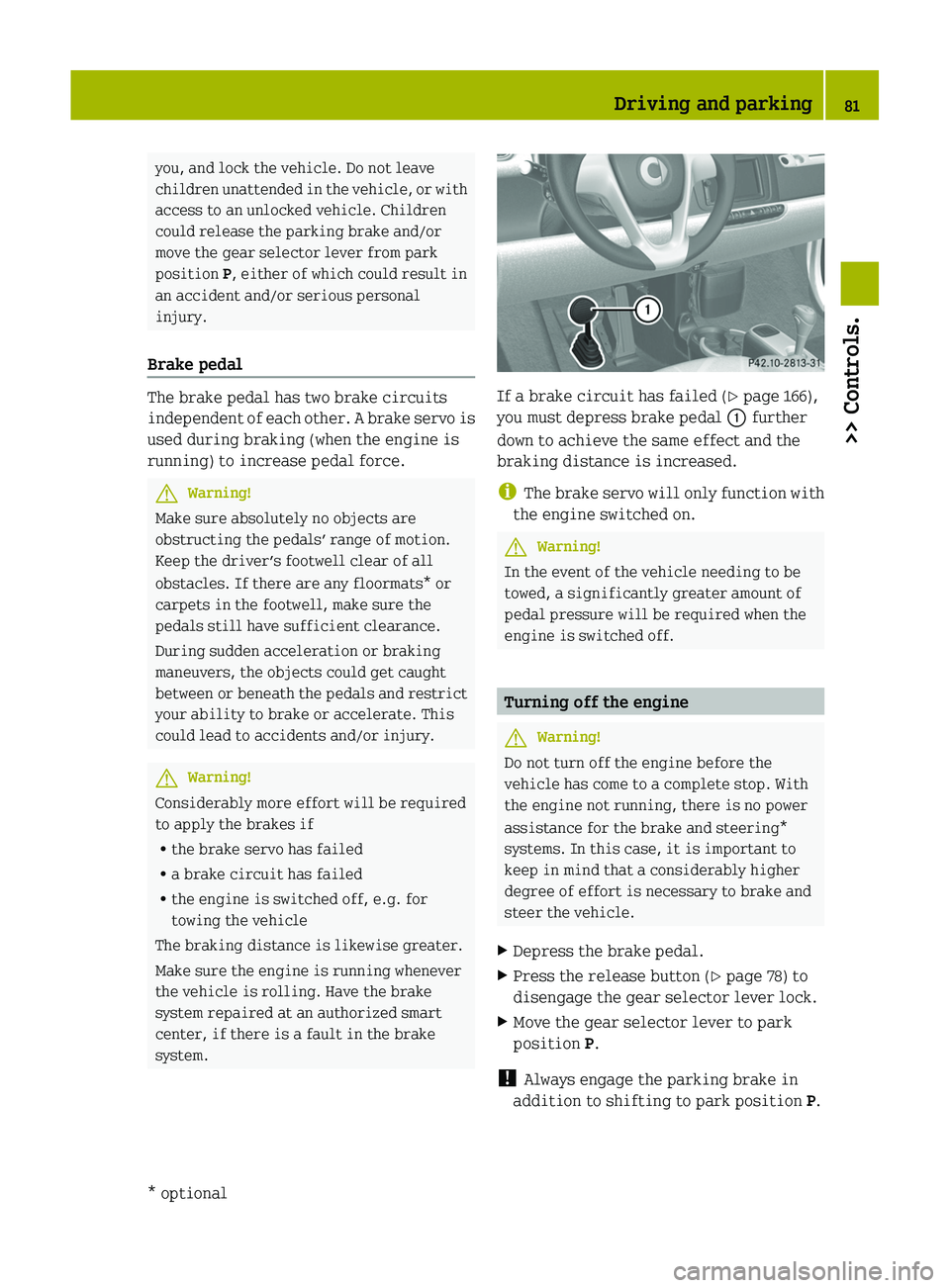
If a brake circuit has failed (Y page 166),
you must depress brake pedal \000F further
down to achieve the same effect and the
braking distance is increased.
iThe brake servo will only function with
the engine switched on.
GWarning!
In the event of the vehicle needing to be
towed, a significantly greater amount of
pedal pressure will be required when the
engine is switched off.
Turning off the engine
GWarning!
Do not turn off the engine before the
vehicle has come to a complete stop. With
the engine not running, there is no power
assistance for the brake and steering*
systems. In this case, it is important to
keep in mind that a considerably higher
degree of effort is necessary to brake and
steer the vehicle.
XDepress the brake pedal.XPress the release button (Y page 78) to
disengage the gear selector lever lock.
XMove the gear selector lever to park
position P.
! Always engage the parking brake in
addition to shifting to park position P.
Driving and parking81>> Controls.* optionalBA 451 USA, CA Edition A 2011; 1; 4, en-UShereepeVersion: 3.0.3.62010-05-11T15:12:26+02:00 - Seite 81Z
Page 84 of 228
XRelease the brake pedal.XTurn the key to starter switch position
0 .XRemove the key from the starter switch.
The electronic immobilizer is
activated.
Transmission
Introduction
Your vehicle is equipped with a 5‑speed
automated transmission with manual or
automatic mode. For information on
driving with the transmission see also
“Starting” ( Y page 78).
GWarning!
Make sure absolutely no objects are
obstructing the pedals’ range of motion.
Keep the driver’s footwell clear of all
obstacles. If there are any floormats* or
carpets in the footwell, make sure the
pedals still have sufficient clearance.
During sudden acceleration or braking
maneuvers, the objects could get caught
between or beneath the pedals and restrict
your ability to brake or accelerate. This
could lead to accidents and/or injury.
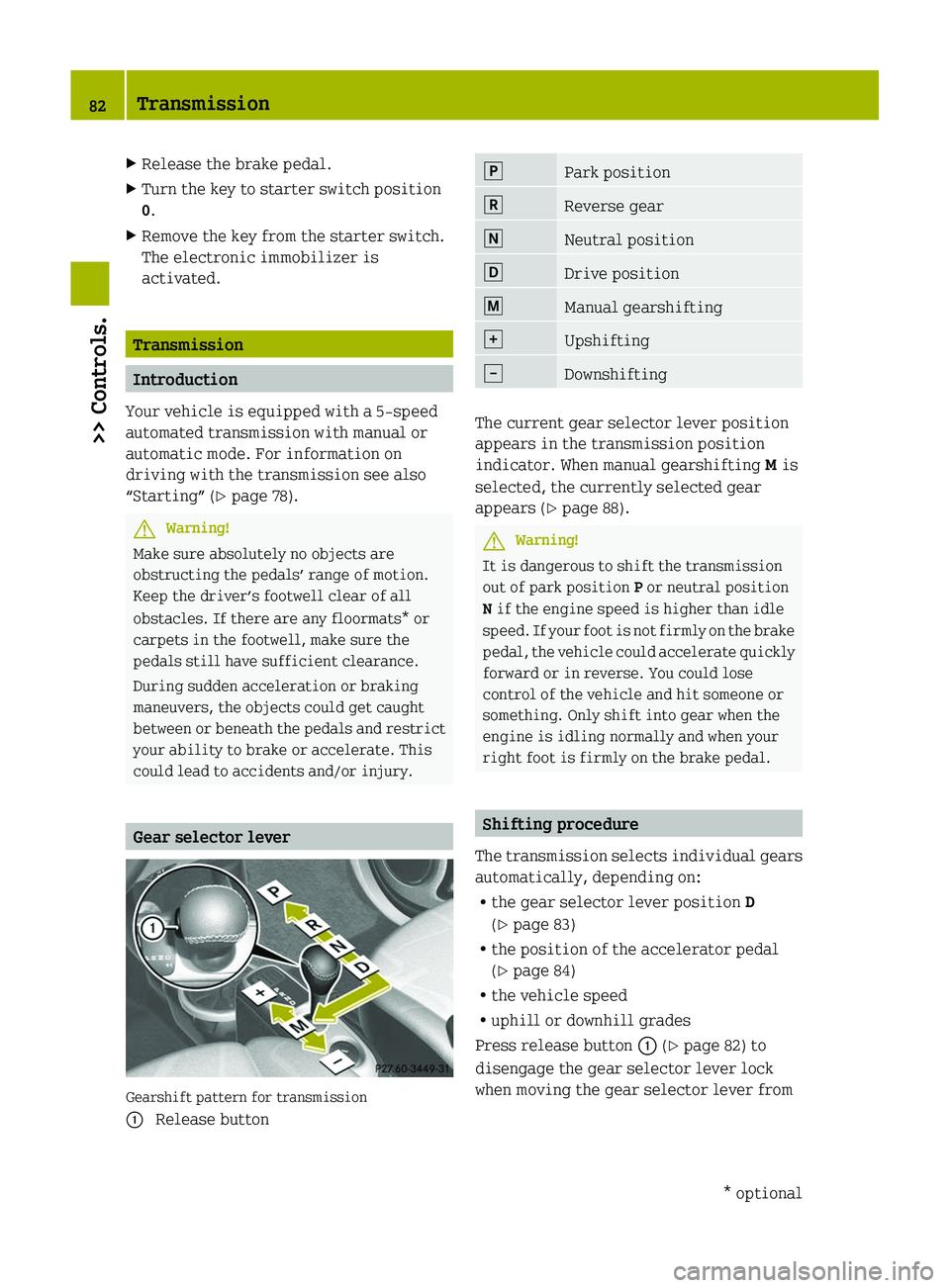
Gear selector lever
Gearshift pattern for transmission
0046 Release button0060Park position0061Reverse gear005FNeutral position005EDrive position0066Manual gearshifting0067Upshifting0058Downshifting
The current gear selector lever position
appears in the transmission position
indicator. When manual gearshifting M is
selected, the currently selected gear
appears ( Y page 88).
GWarning!
It is dangerous to shift the transmission
out of park position P or neutral position
N if the engine speed is higher than idle
speed. If your foot is not firmly on the brake
pedal, the vehicle could accelerate quickly
forward or in reverse. You could lose
control of the vehicle and hit someone or
something. Only shift into gear when the
engine is idling normally and when your
right foot is firmly on the brake pedal.
Shifting procedure
The transmission selects individual gears
automatically, depending on:
R the gear selector lever position D
( Y page 83)
R the position of the accelerator pedal
( Y page 84)
R the vehicle speed
R uphill or downhill grades
Press release button 0046 (Y page 82) to
disengage the gear selector lever lock
when moving the gear selector lever from
82Transmission>> Controls.* optionalBA 451 USA, CA Edition A 2011; 1; 4, en-UShereepeVersion: 3.0.3.62010-05-11T15:12:26+02:00 - Seite 82
Page 87 of 228
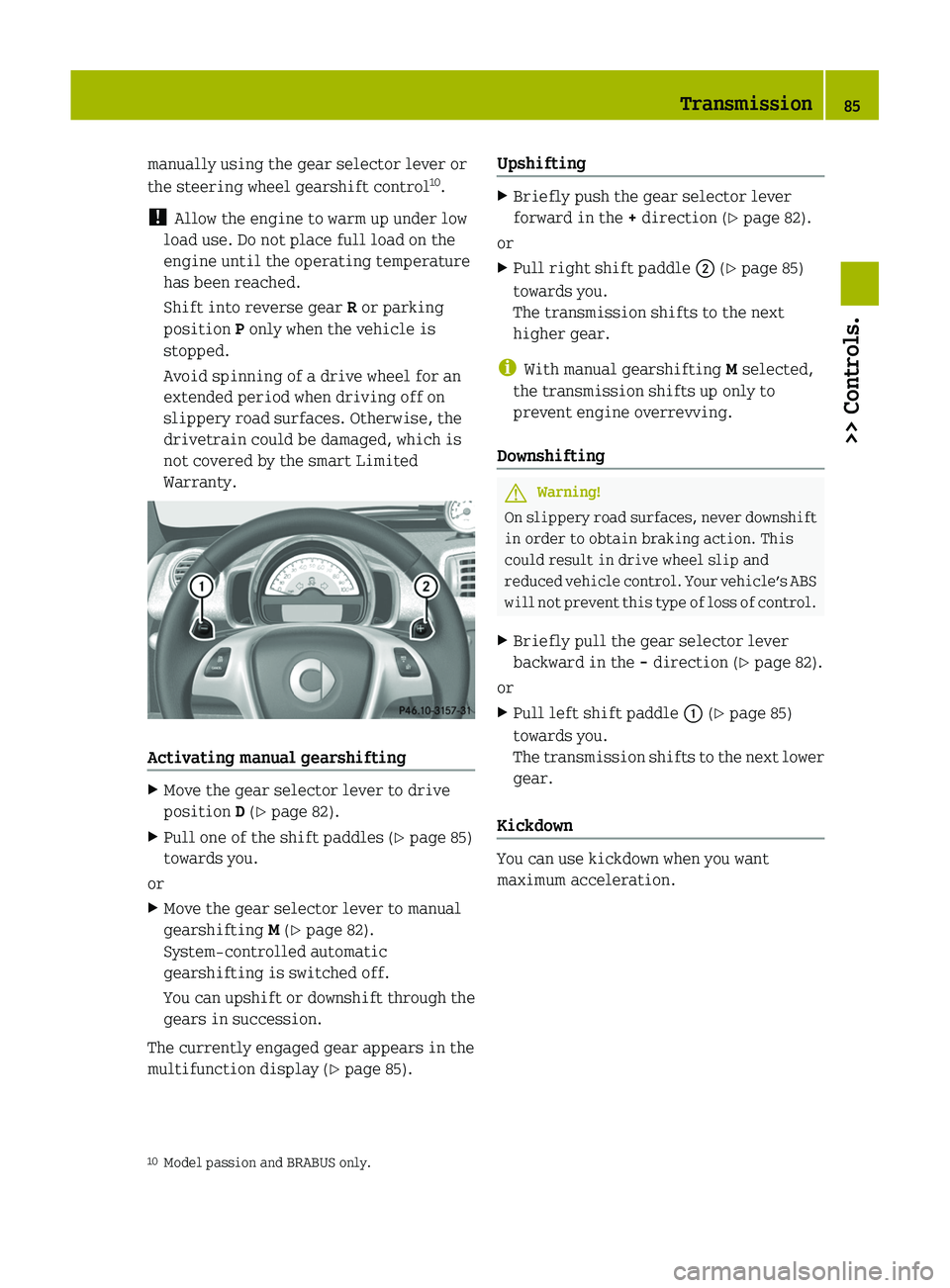
manually using the gear selector lever or
the steering wheel gearshift control 10
.
! Allow the engine to warm up under low
load use. Do not place full load on the
engine until the operating temperature
has been reached.
Shift into reverse gear R or parking
position P only when the vehicle is
stopped.
Avoid spinning of a drive wheel for an
extended period when driving off on
slippery road surfaces. Otherwise, the
drivetrain could be damaged, which is
not covered by the smart Limited
Warranty.
Activating manual gearshifting
XMove the gear selector lever to drive
position D ( Y page 82).XPull one of the shift paddles ( Y page 85)
towards you.
or
XMove the gear selector lever to manual
gearshifting M (Y page 82).
System-controlled automatic
gearshifting is switched off.
You can upshift or downshift through the
gears in succession.
The currently engaged gear appears in the
multifunction display ( Y page 85).
UpshiftingXBriefly push the gear selector lever
forward in the + direction ( Y page 82).
or
XPull right shift paddle 0047 (Y page 85)
towards you.
The transmission shifts to the next
higher gear.
i With manual gearshifting M selected,
the transmission shifts up only to
prevent engine overrevving.
Downshifting
GWarning!
On slippery road surfaces, never downshift
in order to obtain braking action. This
could result in drive wheel slip and
reduced vehicle control. Your vehicle’s ABS
will not prevent this type of loss of control.
XBriefly pull the gear selector lever
backward in the - direction ( Y page 82).
or
XPull left shift paddle 0046 (Y page 85)
towards you.
The transmission shifts to the next lower
gear.
Kickdown
You can use kickdown when you want
maximum acceleration.
10 Model passion and BRABUS only.Transmission85>> Controls.BA 451 USA, CA Edition A 2011; 1; 4, en-UShereepeVersion: 3.0.3.62010-05-11T15:12:26+02:00 - Seite 85Z
Page 127 of 228
GWarning!
Windshield washer concentrate is highly
flammable. Fire, naked flames and smoking
are prohibited when windshield washer
concentrate is being handled.
XUse a windshield washer concentrate
labeled for summer and water for
temperatures above freezing point.
XUse a windshield washer concentrate
labeled for winter and water for
temperatures below freezing point.
! Always use a windshield washer
concentrate labeled for winter where
temperatures may fall below freezing
point. Failure to do so could result in
damage to the washer system/reservoir.
XPremix the windshield washer fluid in a
suitable container.
Observe mixing ratios depending on the
outside temperature (Y page 222).
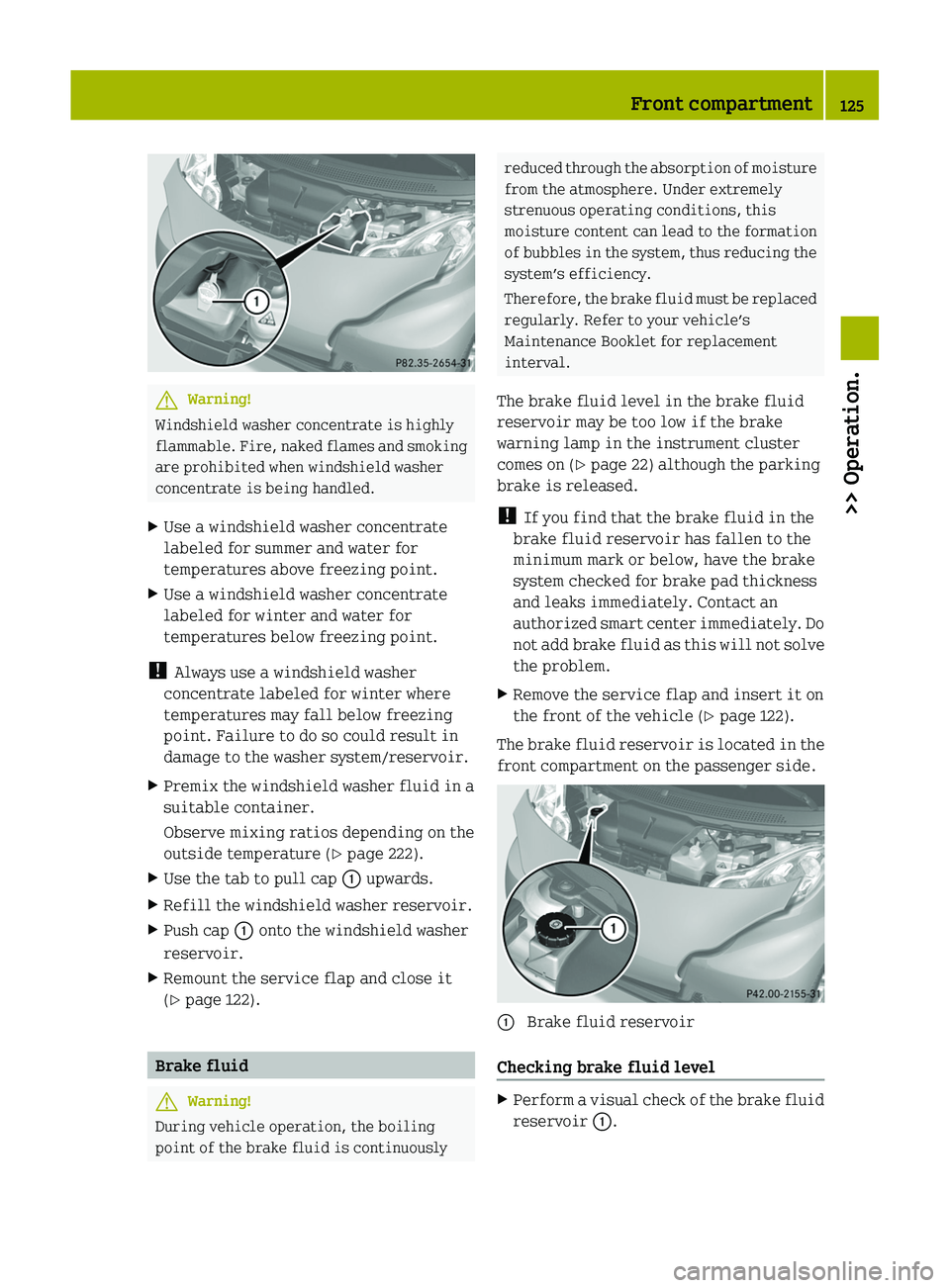
XUse the tab to pull cap \000F upwards.XRefill the windshield washer reservoir.XPush cap \000F onto the windshield washer
reservoir.
XRemount the service flap and close it
(Y page 122).
Brake fluid
GWarning!
During vehicle operation, the boiling
point of the brake fluid is continuously
reduced through the absorption of moisture
from the atmosphere. Under extremely
strenuous operating conditions, this
moisture content can lead to the formation
of bubbles in the system, thus reducing the
system’s efficiency.
Therefore, the brake fluid must be replaced
regularly. Refer to your vehicle’s
Maintenance Booklet for replacement
interval.
The brake fluid level in the brake fluid
reservoir may be too low if the brake
warning lamp in the instrument cluster
comes on (Y page 22) although the parking
brake is released.
! If you find that the brake fluid in the
brake fluid reservoir has fallen to the
minimum mark or below, have the brake
system checked for brake pad thickness
and leaks immediately. Contact an
authorized smart center immediately. Do
not add brake fluid as this will not solve
the problem.
XRemove the service flap and insert it on
the front of the vehicle (Y page 122).
The brake fluid reservoir is located in the
front compartment on the passenger side.
\000F Brake fluid reservoir
Checking brake fluid level
XPerform a visual check of the brake fluid
reservoir \000F.
Front compartment125>> Operation.BA 451 USA, CA Edition A 2011; 1; 4, en-UShereepeVersion: 3.0.3.62010-05-11T15:12:26+02:00 - Seite 125Z
Page 143 of 228
manufacturer for the actual maximum
permissible speed of the tire.
All-season and winter tiresIndexSpeed ratingQ M+S 15up to 100 mph (160 km/h)T M+S 15up to 118 mph (190 km/h)H M+S 15up to 130 mph (210 km/h)V M+S 15up to 149 mph (240 km/h)
i
Not all M+S rated tires provide special
winter performance. Make sure the tires
you use show M+S and the mountain/
snowflake marking 004D on the tire
sidewall. These tires meet specific snow
traction performance requirements of
the Rubber Manufacturers Association
(RMA) and the Rubber Association of
Canada (RAC) and have been designed
specifically for use in snow conditions.
Load identification
i For illustration purposes only. Actual
data on tires are specific to each vehicle
and may vary from data shown in above
illustration.
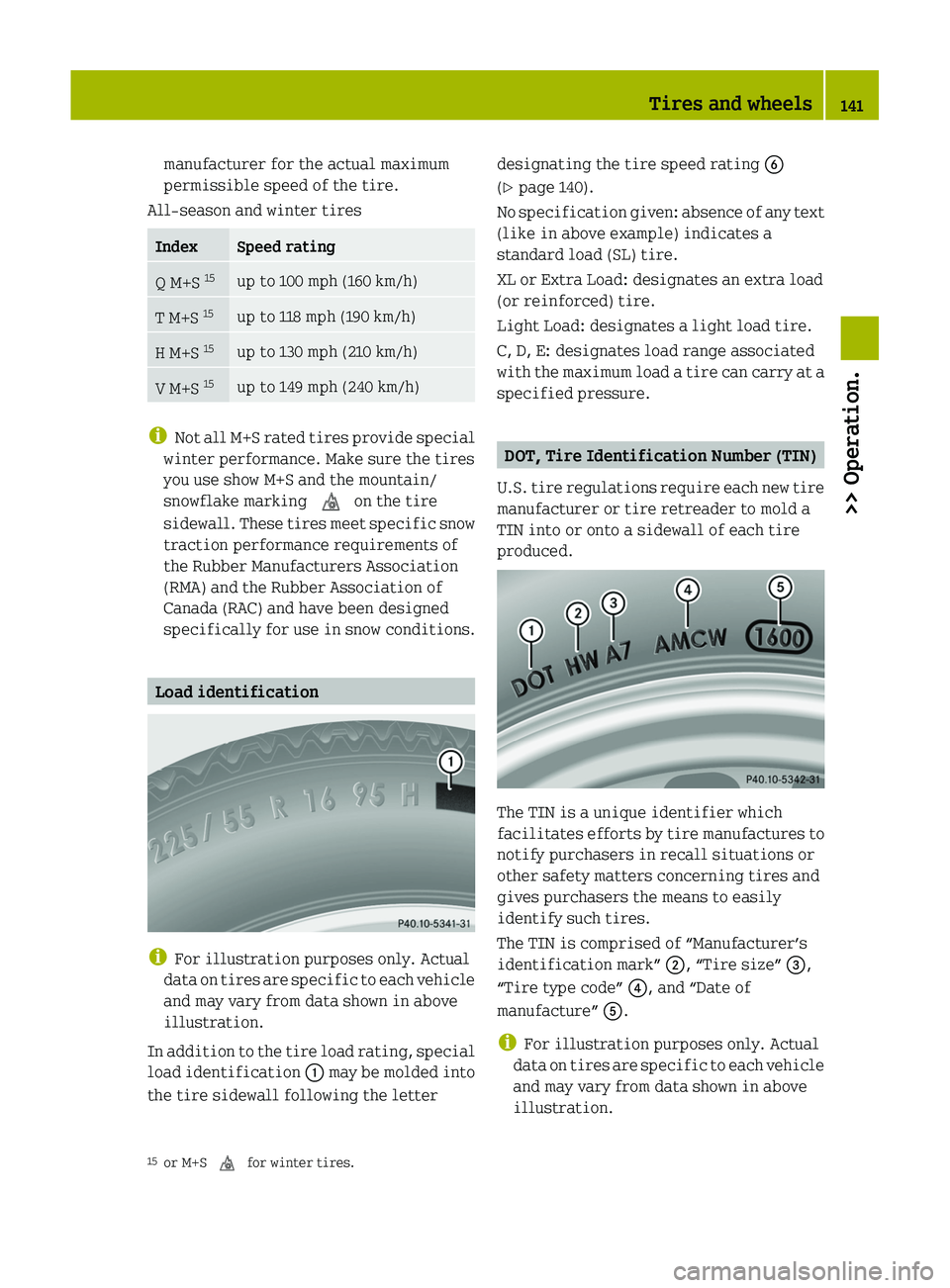
In addition to the tire load rating, special
load identification 0046 may be molded into
the tire sidewall following the letter
designating the tire speed rating 0087
( Y page 140).
No specification given: absence of any text
(like in above example) indicates a
standard load (SL) tire.
XL or Extra Load: designates an extra load
(or reinforced) tire.
Light Load: designates a light load tire.
C, D, E: designates load range associated
with the maximum load a tire can carry at a
specified pressure.
DOT, Tire Identification Number (TIN)
U.S. tire regulations require each new tire
manufacturer or tire retreader to mold a
TIN into or onto a sidewall of each tire
produced.
The TIN is a unique identifier which
facilitates efforts by tire manufactures to
notify purchasers in recall situations or
other safety matters concerning tires and
gives purchasers the means to easily
identify such tires.
The TIN is comprised of “Manufacturer’s
identification mark” 0047, “Tire size” 008A,
“Tire type code” 0088, and “Date of
manufacture” 0086.
i For illustration purposes only. Actual
data on tires are specific to each vehicle
and may vary from data shown in above
illustration.
15 or M+S 004D for winter tires.Tires and wheels141>> Operation.BA 451 USA, CA Edition A 2011; 1; 4, en-UShereepeVersion: 3.0.3.62010-05-11T15:12:26+02:00 - Seite 141Z
Page 147 of 228
Vehicle maximum load on the tire
Load on an individual tire that is
determined by distributing to each axle
its share of the maximum loaded vehicle
weight and dividing it by two.
Winter driving
Before the onset of winter, have your
vehicle winterized at an authorized smart
center. This service includes:
R Check of anticorrosion and antifreeze
concentration.
R Addition of washer concentrate to the
water of the windshield/rear window.
Use a windshield washer concentrate
labeled for winter which is formulated
for temperatures below freezing point
( Y page 222).
R Battery test. Battery capacity drops with
decreasing ambient temperature. A well
charged battery helps to make sure the
engine can be started, even at low
ambient temperatures.
R Tire change.
Winter tires
GWarning!
Winter tires with a tread depth of less
than 1
/ 6 in (4 mm) must be replaced. They
are no longer suitable for winter
operation.
Always use winter tires at temperatures
below 45 ¦ (7¥ ) and whenever wintry road
conditions prevail. Not all M+S rated tires
provide special winter performance. Make
sure the tires you use show the mountain/
snowflake marking 004D on the tire
sidewall. These tires meet specific snow
traction performance requirements of the
Rubber Manufacturers Association (RMA)
and the Rubber Association of Canada (RAC)
and have been designed specifically for
use in snow conditions. Use of winter tires
is the only way to achieve the maximum
effectiveness of the ABS and ESP ®
in winter
operation.
For safe handling, make sure all mounted
winter tires are of the same make and have
the same tread design.
For information on winter tires for your
vehicle model, see the "Technical data"
section ( Y page 217).
Always observe the speed rating of the
winter tires installed on your vehicle. If
the maximum speed for which your tires are
rated is below the speed rating of your
vehicle, you must place a notice to this
effect where it will be seen by the driver.
Such notices are available at your tire
dealer or any authorized smart center.
Snow chains*
! Remember that snow chains must always
be compatible with the tire sizes of a
vehicle. Snow chains that are approved
by smart are only permitted for the
following tire size:
175/55 R15 on the rear axle.
For safety reasons, smart recommends
that you only use snow chains that have
been approved by smart.
Information on this is available from any
smart center.
Please refer to the separate operating
instructions for detailed information on
mounting the snow chains.
Snow chains should only be driven on
snow-covered roads at speeds not to
exceed 30 mph (50 km/h). Remove chains
as soon as possible when driving on roads
without snow.
Winter driving145>> Operation.* optionalBA 451 USA, CA Edition A 2011; 1; 4, en-UShereepeVersion: 3.0.3.62010-05-11T15:12:26+02:00 - Seite 145Z
Page 148 of 228
Please observe the following guidelines
when using snow chains:
R Using snow chains is not permissible
with all wheel/tire combinations
( Y page 217).
R Use snow chains in pairs and on rear
wheels only. Follow the manufacturer’s
mounting instructions.
R Use of snow chains may be prohibited
depending on location. Always check
local and state laws before mounting
snow chains.GWarning!
When mounting or removing snow chains,
always park your vehicle on level ground,
engage the parking brake, and turn off the
engine. The vehicle could otherwise move
and injure yourself or other road users.
GWarning!
When mounting and removing snow chains,
ensure that you and your vehicle are at a
safe distance from moving traffic. Not
doing so could endanger other road users or
even lead to you being injured by the
vehicles behind you.
GWarning!
The vehicle’s handling changes when
driving with snow chains on any kind of
road surface. This means that you should
always adapt your driving style to suit the
current road and weather conditions.
! If snow chains that do not meet
requirements are mounted, they may
scrape against the body or axle
components when the vehicle is in
motion. This could result in damage to
the rim/tire or vehicle.
Driving instructions
Drinking and driving
GWarning!
Do not drink alcohol or take drugs and drive
or allow anyone to drive who has been
drinking alcohol or taking drugs. Even a
small amount of alcohol or drugs can affect
your reflexes, perceptions and judgment.
The possibility of a serious or even fatal
accident are greatly increased when you
drink or take drugs and drive.
Pedals
GWarning!
Make sure absolutely no objects are
obstructing the pedals’ range of motion.
Keep the driver’s footwell clear of all
obstacles. If there are any floormats* or
carpets in the footwell, make sure the
pedals still have sufficient clearance.
During sudden acceleration or braking
maneuvers, the objects could get caught
between or beneath the pedals and restrict
your ability to brake or accelerate. This
could lead to accidents and/or injury.
Power assistance
GWarning!
With the engine not running, there is no
power assistance for the brake and
steering* systems. In this case, it is
important to keep in mind that a
considerably higher degree of effort is
necessary to brake and steer the vehicle.
Adapt your driving accordingly.
146Driving instructions>> Operation.* optionalBA 451 USA, CA Edition A 2011; 1; 4, en-UShereepeVersion: 3.0.3.62010-05-11T15:12:26+02:00 - Seite 146
Page 153 of 228
size designation, load and speed rating”
( Y page 139).
If you are uncertain about the correct
reading of the information given on a
tire’s sidewall, any authorized smart
center will be glad to assist you.
i For information on speed ratings for
winter tires, see “All-season and winter
tires” ( Y page 140).
Winter driving instructions
The most important rule for slippery or icy
roads is to drive sensibly and to avoid
abrupt acceleration, braking and steering
maneuvers.
When the vehicle is in danger of skidding,
move gear selector lever to neutral
position N. Try to keep the vehicle under
control by corrective steering action.
For information on driving with snow
chains*, see “Snow chains*” ( Y page 145).
GWarning!
On slippery road surfaces, never downshift
in order to obtain braking action. This
could result in drive wheel slip and
reduced vehicle control. Your vehicle’s ABS
will not prevent this type of loss of control.
Road salts and chemicals can adversely
affect braking efficiency. Increased pedal
force may become necessary to produce the
normal braking effect.
Depressing the brake pedal periodically
when traveling at length on salt-strewn
roads can bring road-salt-impaired
braking efficiency back to normal.
If the vehicle is parked after being driven
on salt-treated roads, the braking
efficiency should be tested as soon as
possible after driving is resumed.
GWarning!
Make sure not to endanger any other road
users when carrying out these braking
maneuvers.
GWarning!
If the vehicle becomes stuck in snow, make
sure snow is kept clear of the exhaust pipe
and from around the vehicle with the engine
running. Otherwise, deadly carbon
monoxide (CO) gases may enter vehicle
interior resulting in unconsciousness and
death.
To assure sufficient fresh air ventilation,
open a window slightly on the side of the
vehicle not facing the wind.
GWarning!
The outside temperature display is not
designed to serve as an ice-warning device
and is therefore unsuitable for that
purpose. Indicated temperatures just
above the freezing point do not guarantee
that the road surface is free of ice.
For more information, see “Winter driving”
( Y page 145).
Standing water
! Do not drive through flooded areas or
water of unknown depth. Before driving
through water, determine its depth.
Never accelerate before driving into
water. The bow wave could force water
into the engine and auxiliary
equipment, thus damaging them.
If you must drive through standing water,
drive slowly to prevent water from entering
the passenger compartment, the front
compartment, or the engine compartment.
Water in these areas could cause damage to
electrical components or wiring of the
engine or transmission, or could result in
water being ingested by the engine through
Driving instructions151>> Operation.* optionalBA 451 USA, CA Edition A 2011; 1; 4, en-UShereepeVersion: 3.0.3.62010-05-11T15:12:26+02:00 - Seite 151Z