page 90 SMART FORTWO COUPE 2012 Owners Manual
[x] Cancel search | Manufacturer: SMART, Model Year: 2012, Model line: FORTWO COUPE, Model: SMART FORTWO COUPE 2012Pages: 228, PDF Size: 12.76 MB
Page 168 of 228
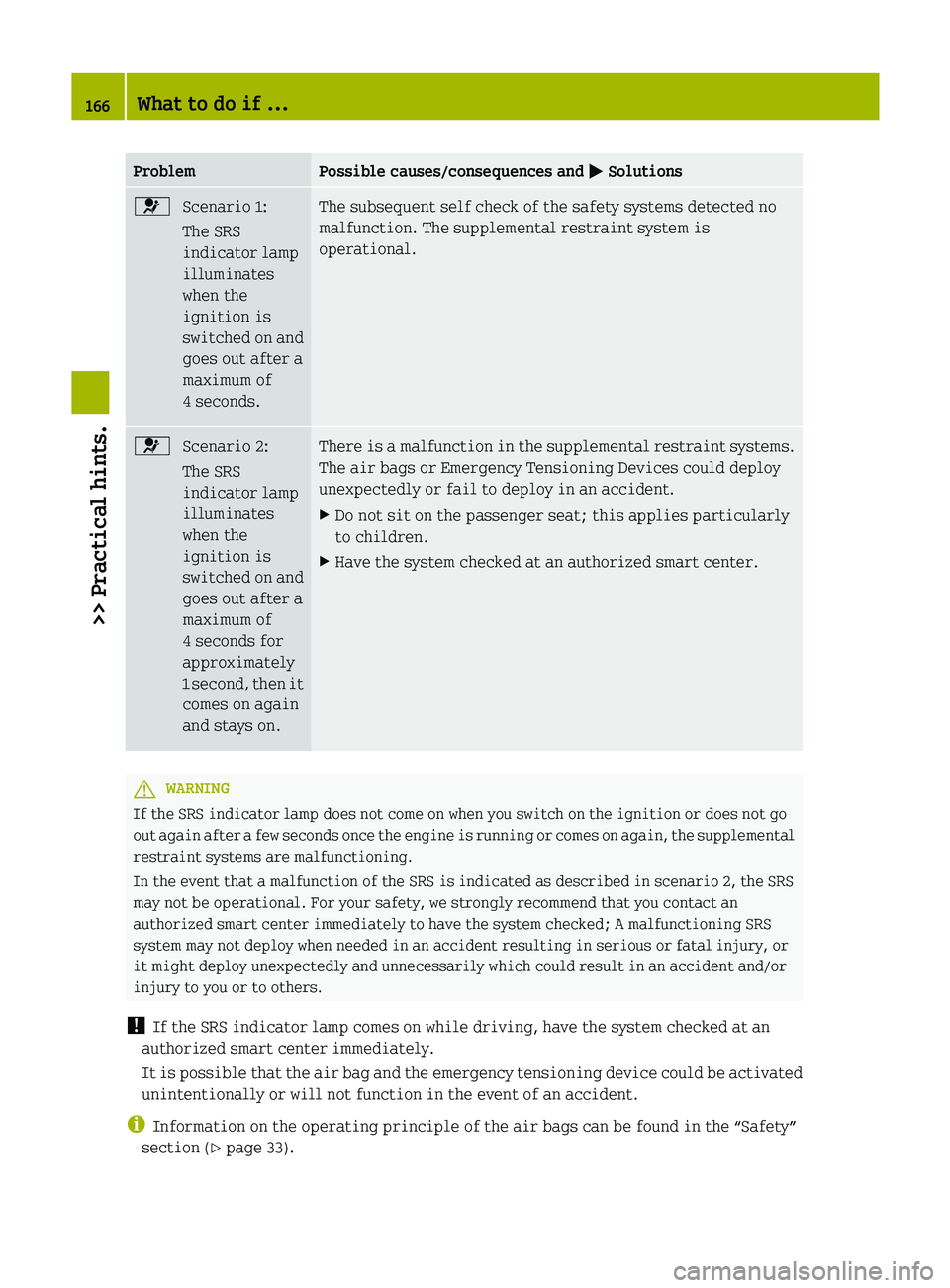
Problem Possible causes/consequences and
M Solutions6
Scenario 1:
The SRS
indicator lamp
illuminates
when the
ignition is
switched
on and
goes out after a
maximum of
4 seconds. The subsequent self check of the safety systems detected no
malfunction. The supplemental restraint system is
operational.
6
Scenario 2:
The SRS
indicator lamp
illuminates
when the
ignition is
switched
on and
goes out after a
maximum of
4 seconds for
approximately
1 second, then it
comes on again
and stays on. There is a malfunction in the supplemental restraint systems.
The air bags or Emergency Tensioning Devices could deploy
unexpectedly or fail to deploy in an accident.
X
Do not sit on the passenger seat; this applies particularly
to children.
X Have the system checked at an authorized smart center. G
WARNING
If the SRS indicator lamp does not come on when you switch on the ignition or does not go
out
again after a few seconds once the engine is running or comes on again, the supplemental
restraint systems are malfunctioning.
In the event that a malfunction of the SRS is indicated as described in scenario 2, the SRS
may not be operational. For your safety, we strongly recommend that you contact an
authorized smart center immediately to have the system checked; A malfunctioning SRS
system may not deploy when needed in an accident resulting in serious or fatal injury, or
it might deploy unexpectedly and unnecessarily which could result in an accident and/or
injury to you or to others.
! If the SRS indicator lamp comes on while driving, have the system checked at an
authorized smart center immediately.
It is possible that the air bag and the emergency tensioning device could be activated
unintentionally or will not function in the event of an accident.
i Information on the operating principle of the air bags can be found in the “Safety”
section (Y page 33). 166
What to do if ...
>> Practical hints.
Page 169 of 228
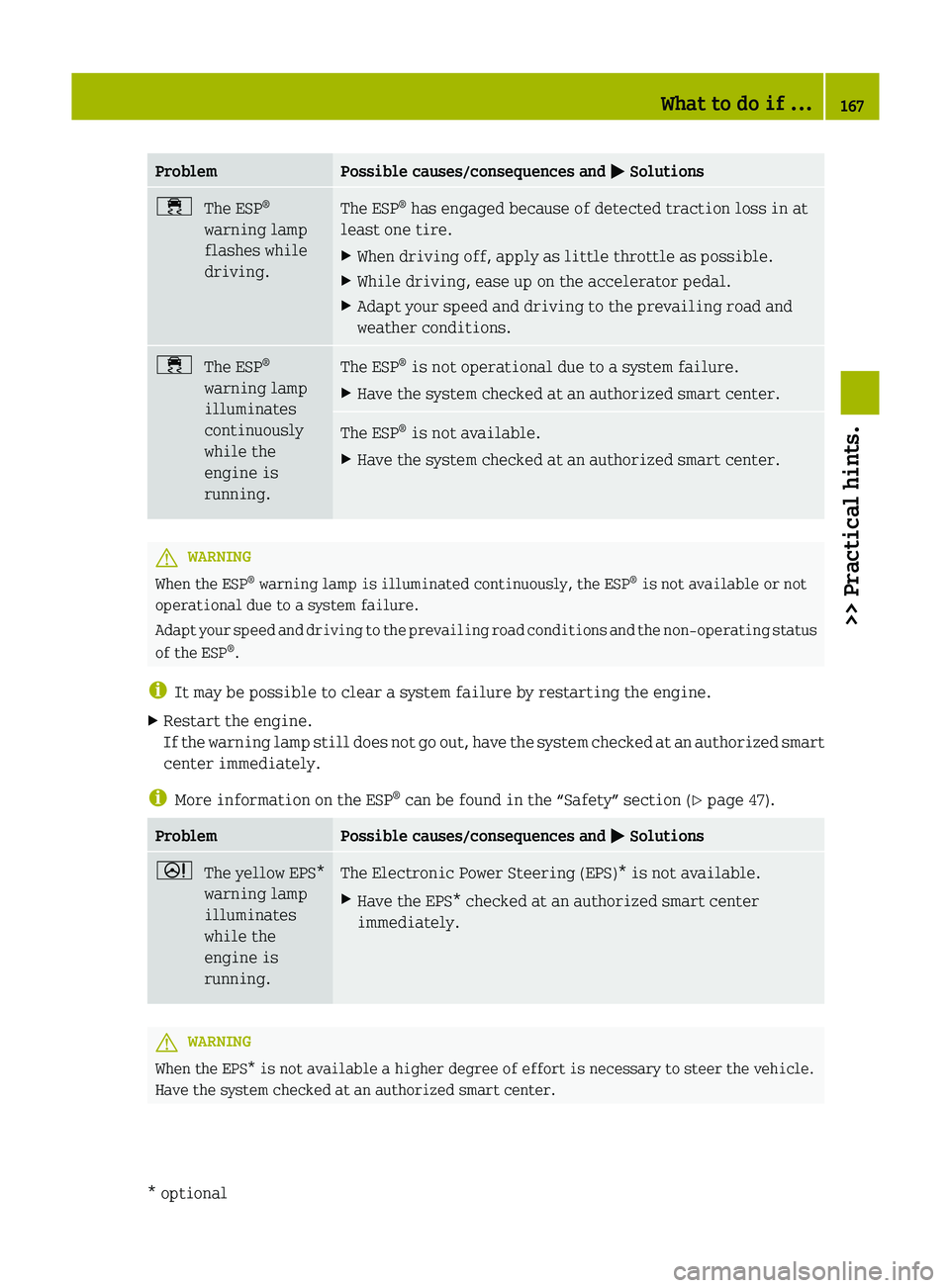
Problem Possible causes/consequences and
M Solutions÷
The ESP ®
warning lamp
flashes while
driving. The ESP
®
has engaged because of detected traction loss in at
least one tire.
X When driving off, apply as little throttle as possible.
X While driving, ease up on the accelerator pedal.
X Adapt your speed and driving to the prevailing road and
weather conditions. ÷
The ESP ®
warning lamp
illuminates
continuously
while the
engine is
running. The ESP
®
is not operational due to a system failure.
X Have the system checked at an authorized smart center. The ESP
®
is not available.
X Have the system checked at an authorized smart center. G
WARNING
When the ESP ®
warning lamp is illuminated continuously, the ESP ®
is not available or not
operational due to a system failure.
Adapt
your speed and driving to the prevailing road conditions and the non-operating status
of the ESP ®
.
i It may be possible to clear a system failure by restarting the engine.
X Restart the engine.
If
the warning lamp still does not go out, have the system checked at an authorized smart
center immediately.
i More information on the ESP ®
can be found in the “Safety” section (Y page 47). Problem Possible causes/consequences and
M SolutionsD
The yellow EPS*
warning lamp
illuminates
while the
engine is
running. The Electronic Power Steering (EPS)* is not available.
X
Have the EPS* checked at an authorized smart center
immediately. G
WARNING
When the EPS* is not available a higher degree of effort is necessary to steer the vehicle.
Have the system checked at an authorized smart center. What to do if ...
167
>> Practical hints.
* optional Z
Page 172 of 228
Problem Possible causes/consequences and
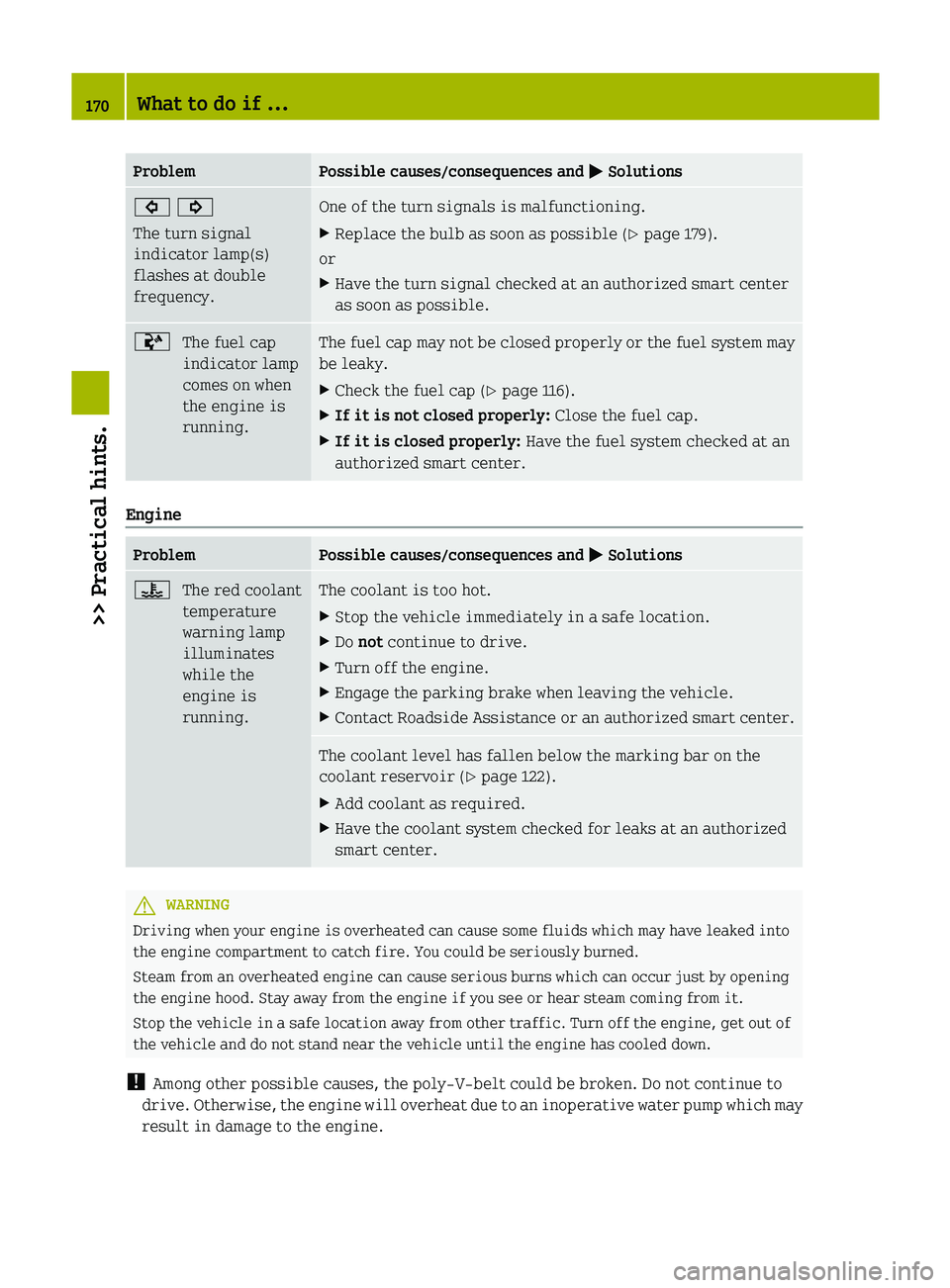
M Solutions# !
The turn signal
indicator lamp(s)
flashes at double
frequency. One of the turn signals is malfunctioning.
X
Replace the bulb as soon as possible ( Y page 179).
or
X Have the turn signal checked at an authorized smart center
as soon as possible. ®
The fuel cap
indicator lamp
comes on when
the engine is
running. The fuel cap may not be closed properly or the fuel system may
be leaky.
X
Check the fuel cap ( Y page 116).
X If it is not closed properly: Close the fuel cap.
X If it is closed properly: Have the fuel system checked at an
authorized smart center. Engine
Problem Possible causes/consequences and
M Solutions?
The red coolant
temperature
warning lamp
illuminates
while the
engine is
running. The coolant is too hot.
X
Stop the vehicle immediately in a safe location.
X Do not continue to drive.
X Turn off the engine.
X Engage the parking brake when leaving the vehicle.
X Contact Roadside Assistance or an authorized smart center. The coolant level has fallen below the marking bar on the
coolant reservoir (Y page 122).
X
Add coolant as required.
X Have the coolant system checked for leaks at an authorized
smart center. G
WARNING
Driving when your engine is overheated can cause some fluids which may have leaked into
the engine compartment to catch fire. You could be seriously burned.
Steam from an overheated engine can cause serious burns which can occur just by opening
the engine hood. Stay away from the engine if you see or hear steam coming from it.
Stop the vehicle in a safe location away from other traffic. Turn off the engine, get out of
the vehicle and do not stand near the vehicle until the engine has cooled down.
! Among other possible causes, the poly-V-belt could be broken. Do not continue to
drive.
Otherwise, the engine will overheat due to an inoperative water pump which may
result in damage to the engine. 170
What to do if ...
>> Practical hints.
Page 174 of 228
Tire Pressure Monitoring System (TPMS)*
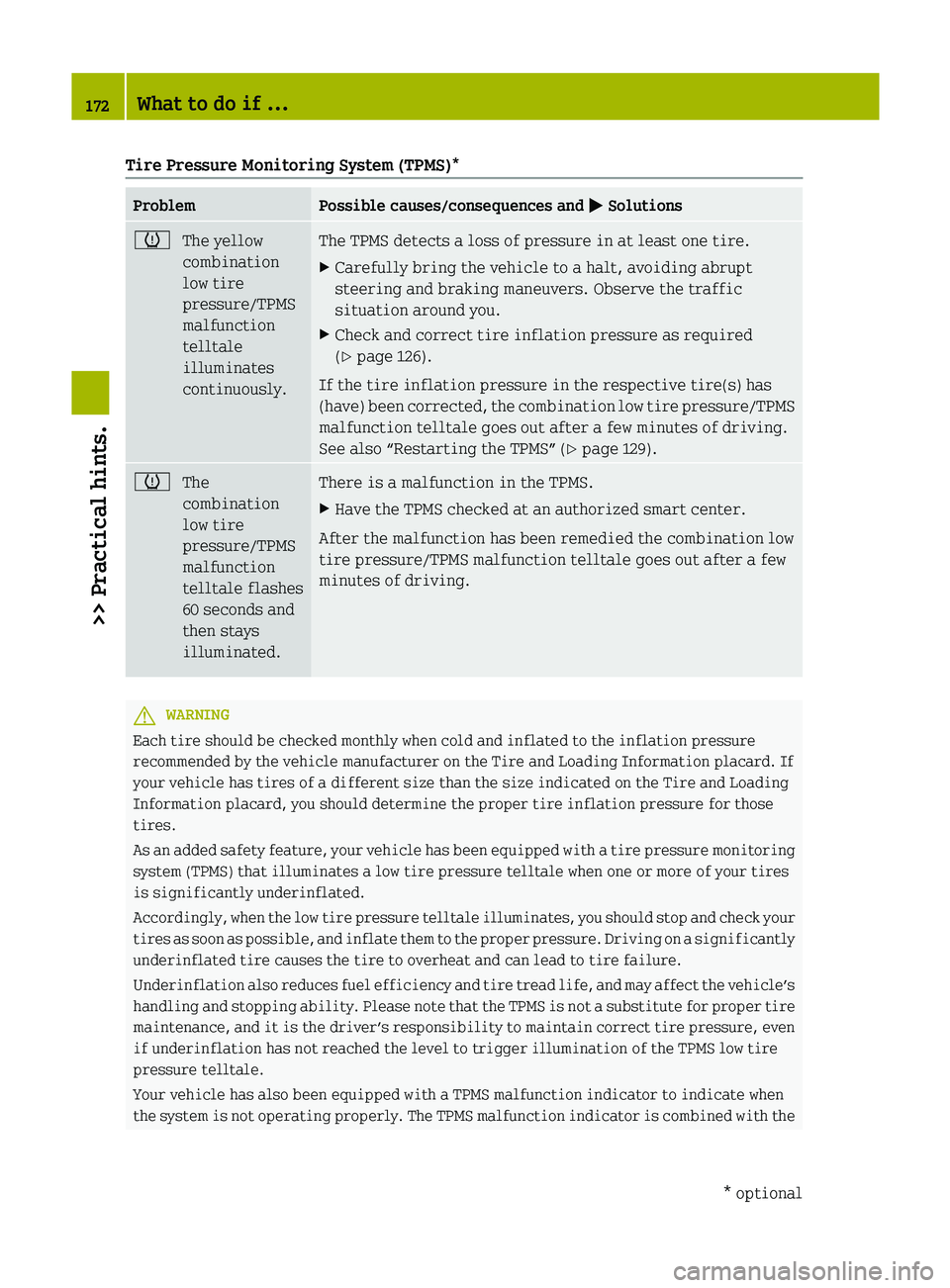
Problem Possible causes/consequences and
M Solutionsh
The yellow
combination
low tire
pressure/TPMS
malfunction
telltale
illuminates
continuously. The TPMS detects a loss of pressure in at least one tire.
X
Carefully bring the vehicle to a halt, avoiding abrupt
steering and braking maneuvers. Observe the traffic
situation around you.
X Check and correct tire inflation pressure as required
(Y page 126).
If the tire inflation pressure in the respective tire(s) has
(have) been corrected, the combination low tire pressure/TPMS
malfunction telltale goes out after a few minutes of driving.
See also “Restarting the TPMS” (Y page 129). h
The
combination
low tire
pressure/TPMS
malfunction
telltale flashes
60 seconds and
then stays
illuminated. There is a malfunction in the TPMS.
X
Have the TPMS checked at an authorized smart center.
After the malfunction has been remedied the combination low
tire pressure/TPMS malfunction telltale goes out after a few
minutes of driving. G
WARNING
Each tire should be checked monthly when cold and inflated to the inflation pressure
recommended by the vehicle manufacturer on the Tire and Loading Information placard. If
your vehicle has tires of a different size than the size indicated on the Tire and Loading
Information placard, you should determine the proper tire inflation pressure for those
tires.
As
an added safety feature, your vehicle has been equipped with a tire pressure monitoring
system (TPMS) that illuminates a low tire pressure telltale when one or more of your tires
is significantly underinflated.
Accordingly, when the low tire pressure telltale illuminates, you should stop and check your
tires as soon as possible, and inflate them to the proper pressure. Driving on a significantly
underinflated tire causes the tire to overheat and can lead to tire failure.
Underinflation also reduces fuel efficiency and tire tread life, and may affect the vehicle’s
handling and stopping ability. Please note that the TPMS is not a substitute for proper tire
maintenance, and it is the driver’s responsibility to maintain correct tire pressure, even
if underinflation has not reached the level to trigger illumination of the TPMS low tire
pressure telltale.
Your vehicle has also been equipped with a TPMS malfunction indicator to indicate when
the system is not operating properly. The TPMS malfunction indicator is combined with the 172
What to do if ...
>> Practical hints.
* optional
Page 177 of 228
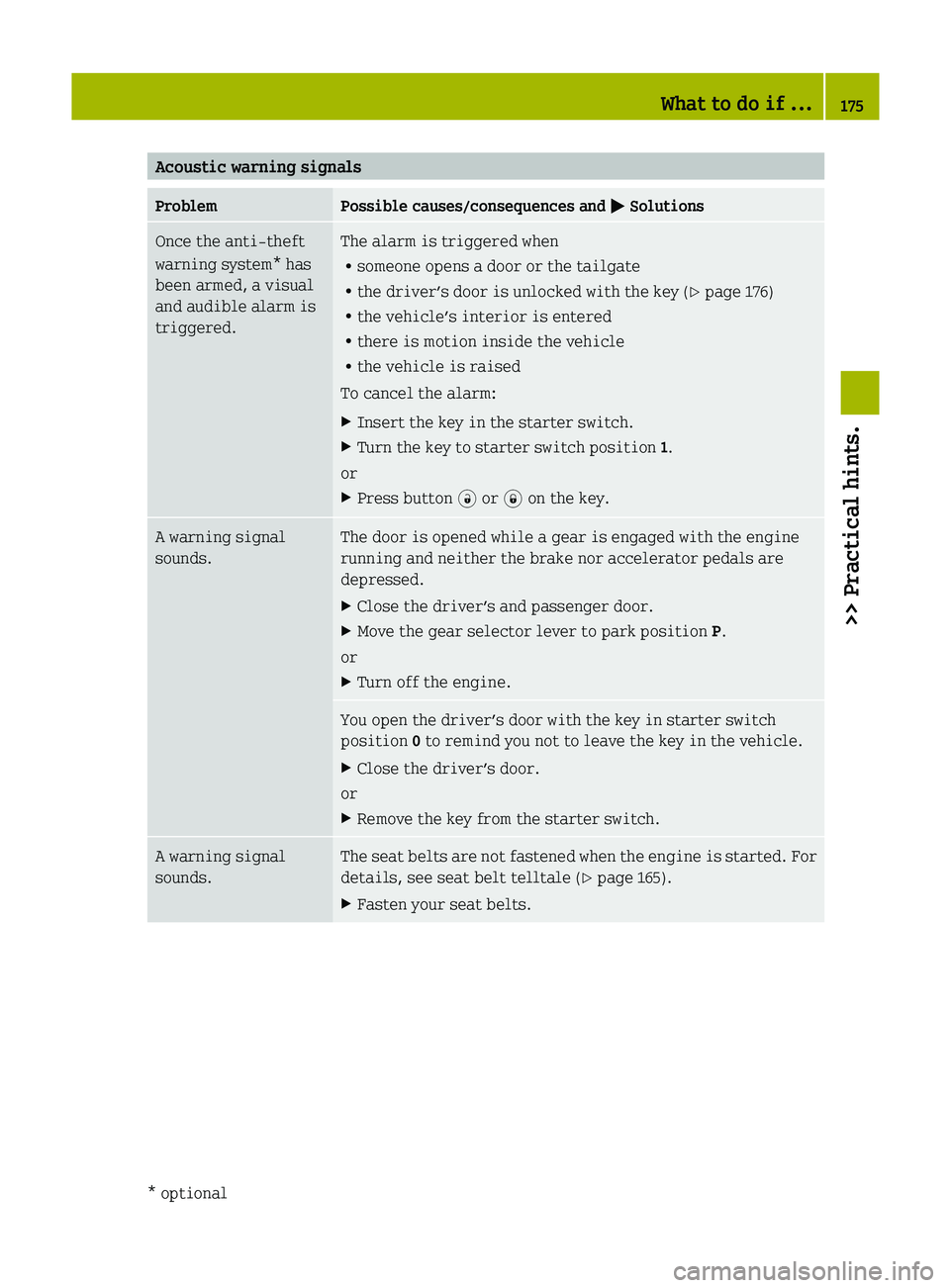
Acoustic warning signals
Problem Possible causes/consequences and
M SolutionsOnce the anti-theft
warning system* has
been armed, a visual
and audible alarm is
triggered. The alarm is triggered when
R
someone opens a door or the tailgate
R the driver’s door is unlocked with the key (Y page 176)
R the vehicle’s interior is entered
R there is motion inside the vehicle
R the vehicle is raised
To cancel the alarm:
X Insert the key in the starter switch.
X Turn the key to starter switch position 1.
or
X Press button # or * on the key.A warning signal
sounds. The door is opened while a gear is engaged with the engine
running and neither the brake nor accelerator pedals are
depressed.
X
Close the driver’s and passenger door.
X Move the gear selector lever to park position P.
or
X Turn off the engine. You open the driver’s door with the key in starter switch
position 0 to remind you not to leave the key in the vehicle.
X
Close the driver’s door.
or
X Remove the key from the starter switch. A warning signal
sounds. The seat belts are not fastened when the engine is started. For
details, see seat belt telltale (
Y page 165).
X Fasten your seat belts. What to do if ...
175>> Practical hints.
* optional Z
Page 178 of 228
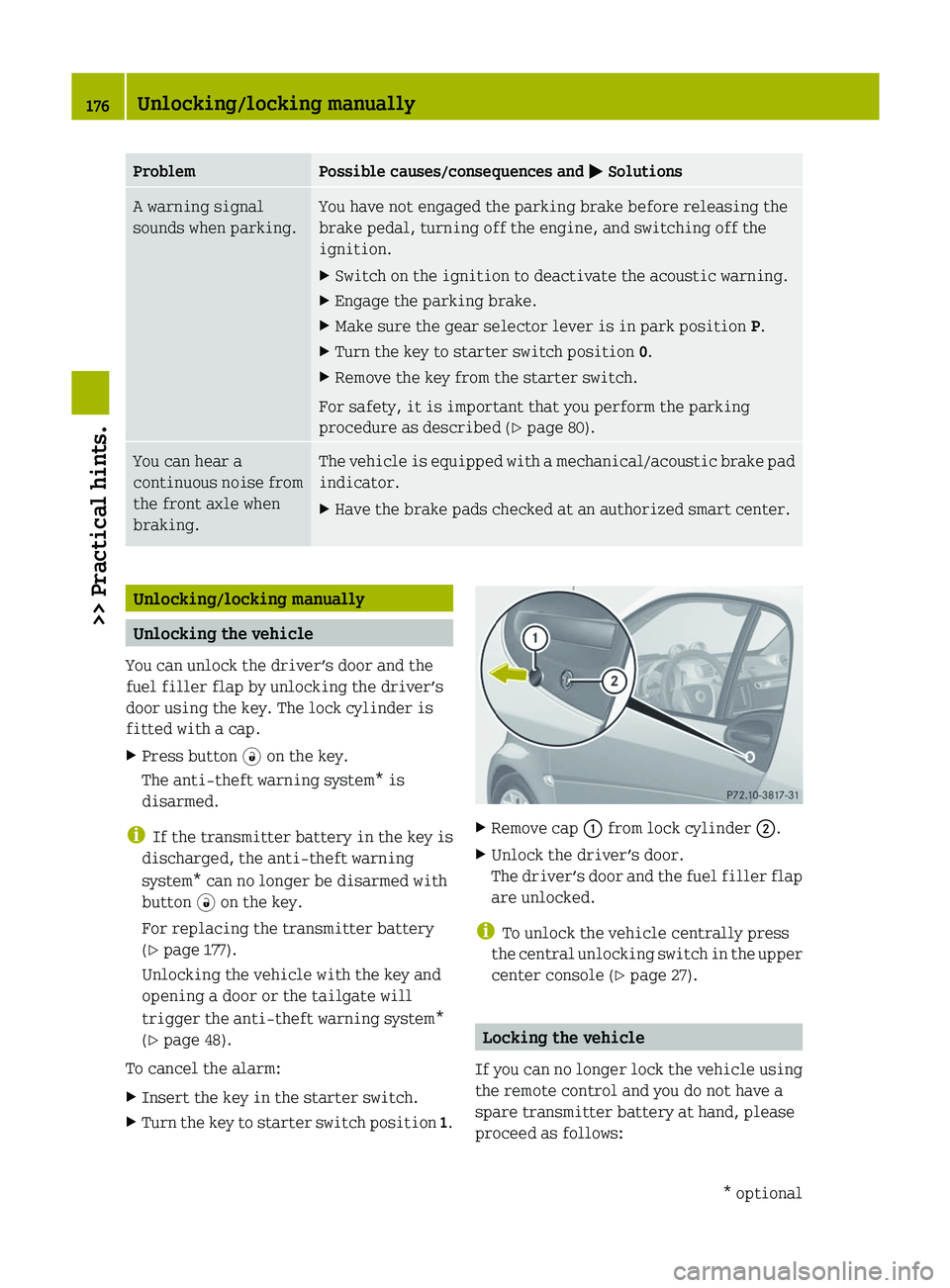
Problem Possible causes/consequences and
M SolutionsA warning signal
sounds when parking. You have not engaged the parking brake before releasing the
brake pedal, turning off the engine, and switching off the
ignition.
X
Switch on the ignition to deactivate the acoustic warning.
X Engage the parking brake.
X Make sure the gear selector lever is in park position P.
X Turn the key to starter switch position 0.
X Remove the key from the starter switch.
For safety, it is important that you perform the parking
procedure as described (Y page 80). You can hear a
continuous
noise from
the front axle when
braking. The vehicle is equipped with a mechanical/acoustic brake pad
indicator.
X
Have the brake pads checked at an authorized smart center. Unlocking/locking manually
Unlocking the vehicle
You can unlock the driver’s door and the
fuel filler flap by unlocking the driver’s
door using the key. The lock cylinder is
fitted with a cap.
X Press button # on the key.
The anti-theft warning system* is
disarmed.
i If the transmitter battery in the key is
discharged, the anti-theft warning
system* can no longer be disarmed with
button # on the key.
For replacing the transmitter battery
(Y page 177).
Unlocking the vehicle with the key and
opening a door or the tailgate will
trigger the anti-theft warning system*
(Y page 48).
To cancel the alarm:
X Insert the key in the starter switch.
X Turn the key to starter switch position 1. X
Remove cap : from lock cylinder ;.
X Unlock the driver’s door.
The
driver’s door and the fuel filler flap
are unlocked.
i To unlock the vehicle centrally press
the
central unlocking switch in the upper
center console ( Y page 27). Locking the vehicle
If
you can no longer lock the vehicle using
the remote control and you do not have a
spare transmitter battery at hand, please
proceed as follows: 176
Unlocking/locking manually
>> Practical hints.
* optional
Page 179 of 228
X
Open the driver’s door.
X Press the central locking switch
(Y page 54).
The indicator lamp on the central
locking
switch comes on, when the starter
switch is in position 1.
The indicator lamp on the central
locking switch flashes, when the starter
switch is in position 0.
X Remove the key from the starter switch,
take it with you, and close all doors.
The vehicle is now locked and the anti-
theft warning system* is armed. Closing the rear soft top
If the rear soft top does not lock properly
after being closed, proceed as follows:
X Stop the vehicle in a safe location.
X Engage the parking brake.
X Make sure the key is in starter switch
position 1.
X Fold up the rear soft top completely.
The rear soft top stops in the unlocked
position.
X Within one minute, press and hold symbol
G on the retractable soft top switch
for 15 seconds twice.
The rear soft top closes the locking
hooks.
X Close the retractable soft top
completely.
X Have the rear soft top checked at an
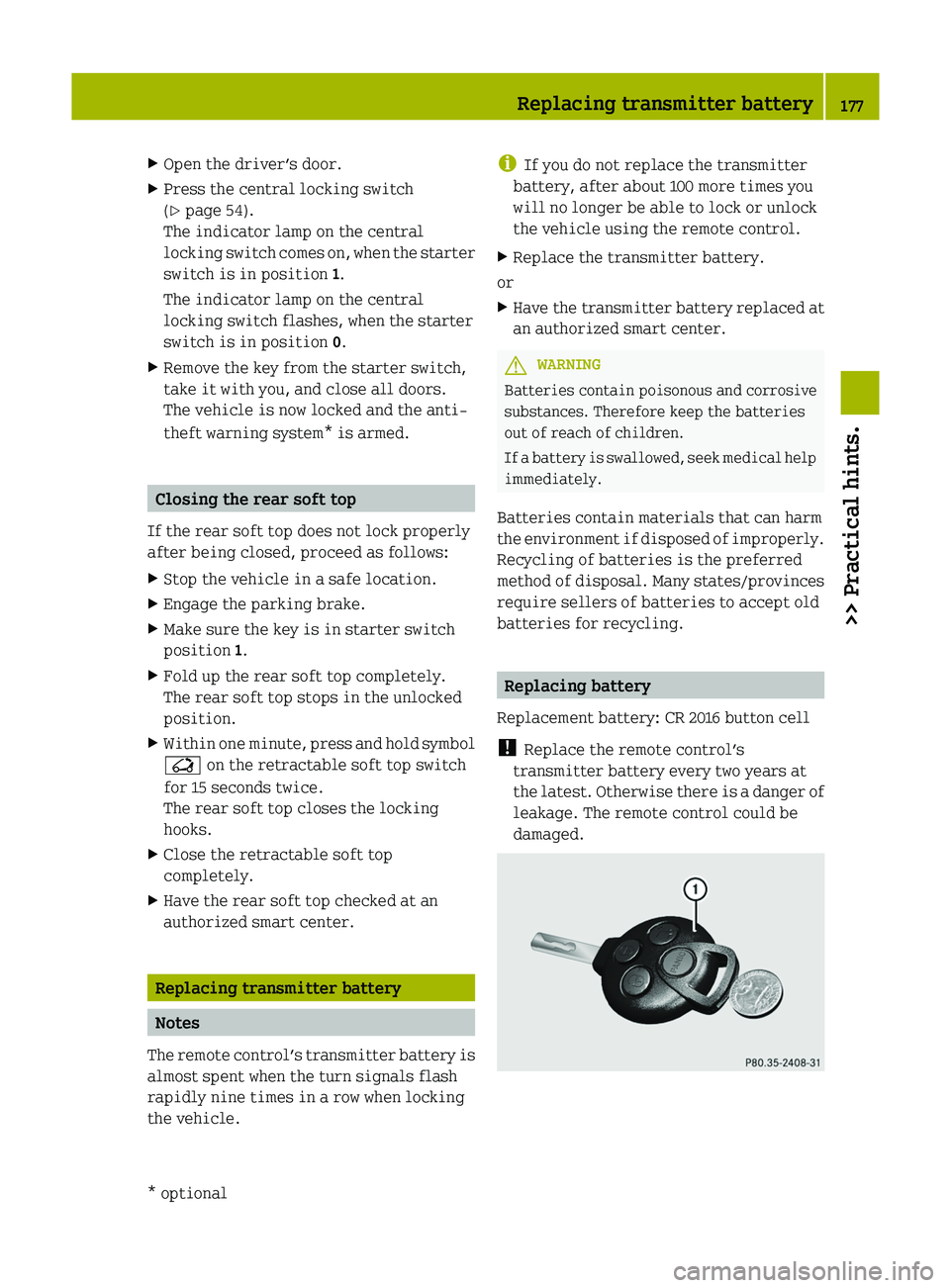
authorized smart center. Replacing transmitter battery
Notes
The
remote control’s transmitter battery is
almost spent when the turn signals flash
rapidly nine times in a row when locking
the vehicle. i
If you do not replace the transmitter
battery, after about 100 more times you
will no longer be able to lock or unlock
the vehicle using the remote control.
X Replace the transmitter battery.
or
X Have the transmitter battery replaced at
an authorized smart center. G
WARNING
Batteries contain poisonous and corrosive
substances. Therefore keep the batteries
out of reach of children.
If
a battery is swallowed, seek medical help
immediately.
Batteries contain materials that can harm
the environment if disposed of improperly.
Recycling of batteries is the preferred
method of disposal. Many states/provinces
require sellers of batteries to accept old
batteries for recycling. Replacing battery
Replacement battery: CR 2016 button cell
! Replace the remote control’s
transmitter battery every two years at
the
latest. Otherwise there is a danger of
leakage. The remote control could be
damaged. Replacing transmitter battery
177
>> Practical hints.
* optional Z
Page 183 of 228
Replacing bulbs for front lamps
Before you start to replace a bulb for a
front lamp, do the following first:
X Turn the exterior lamp switch to position
$ (Y page 64).
X Switch off the ignition.
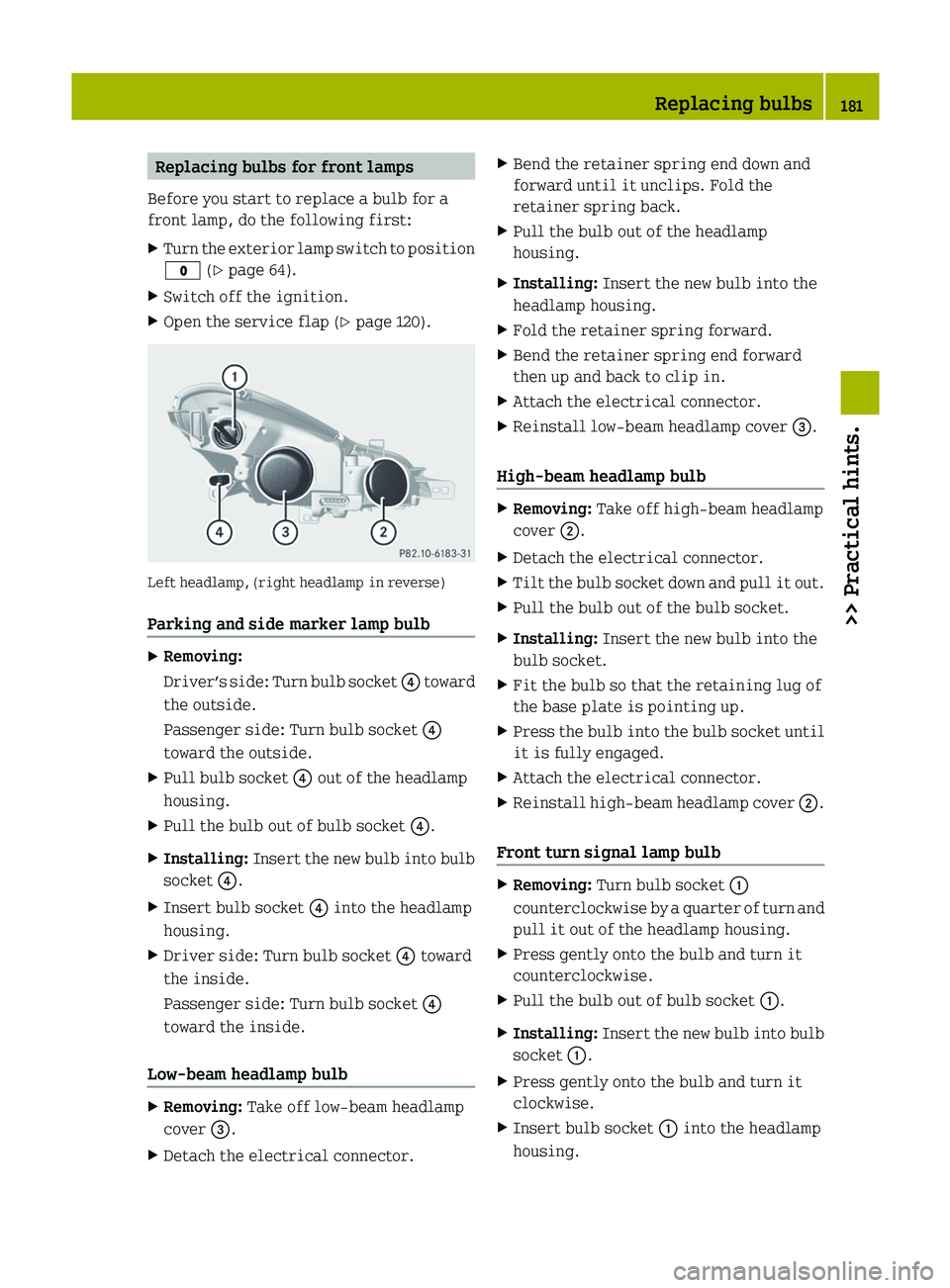
X Open the service flap (Y page 120). Left headlamp, (right headlamp in reverse)
Parking and side marker lamp bulb
X
Removing:
Driver’s
side: Turn bulb socket ? toward
the outside.
Passenger side: Turn bulb socket ?
toward the outside.
X Pull bulb socket ? out of the headlamp
housing.
X Pull the bulb out of bulb socket ?.
X Installing:
Insert the new bulb into bulb
socket ?.
X Insert bulb socket ? into the headlamp
housing.
X Driver side: Turn bulb socket ? toward
the inside.
Passenger side: Turn bulb socket ?
toward the inside.
Low‑beam headlamp bulb X
Removing: Take off low‑beam headlamp
cover =.
X Detach the electrical connector. X
Bend the retainer spring end down and
forward until it unclips. Fold the
retainer spring back.
X Pull the bulb out of the headlamp
housing.
X Installing: Insert the new bulb into the
headlamp housing.
X Fold the retainer spring forward.
X Bend the retainer spring end forward
then up and back to clip in.
X Attach the electrical connector.
X Reinstall low‑beam headlamp cover =.
High‑beam headlamp bulb X
Removing: Take off high‑beam headlamp
cover ;.
X Detach the electrical connector.
X Tilt the bulb socket down and pull it out.
X Pull the bulb out of the bulb socket.
X Installing: Insert the new bulb into the
bulb socket.
X Fit the bulb so that the retaining lug of
the base plate is pointing up.
X Press the bulb into the bulb socket until
it is fully engaged.
X Attach the electrical connector.
X Reinstall high‑beam headlamp cover ;.
Front turn signal lamp bulb X
Removing: Turn bulb socket :
counterclockwise
by a quarter of turn and
pull it out of the headlamp housing.
X Press gently onto the bulb and turn it
counterclockwise.
X Pull the bulb out of bulb socket :.
X Installing:
Insert the new bulb into bulb
socket :.
X Press gently onto the bulb and turn it
clockwise.
X Insert bulb socket : into the headlamp
housing. Replacing bulbs
181
>> Practical hints. Z
Page 184 of 228
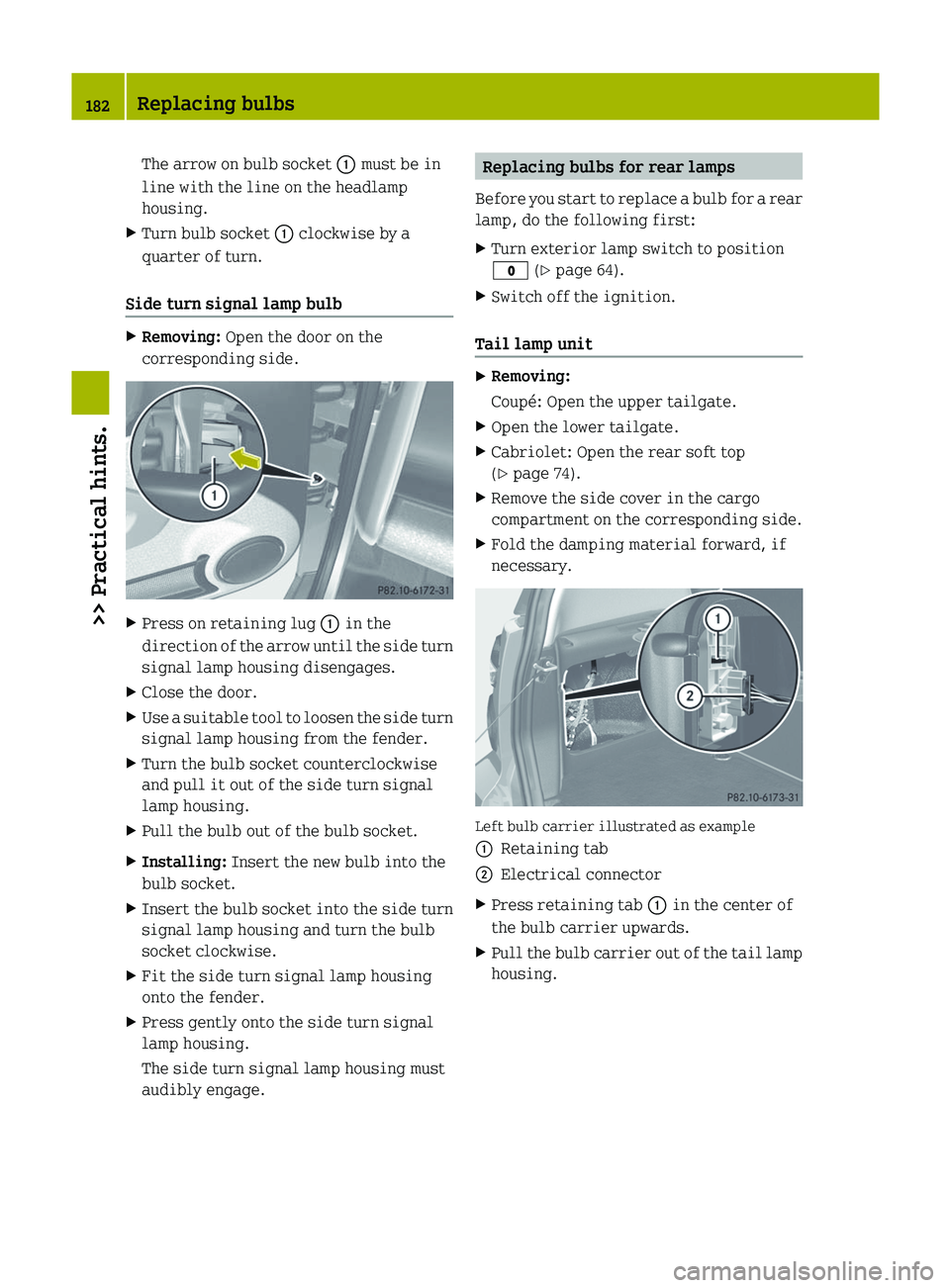
The arrow on bulb socket : must be in
line with the line on the headlamp
housing.
X Turn bulb socket : clockwise by a
quarter of turn.
Side turn signal lamp bulb X
Removing: Open the door on the
corresponding side. X
Press on retaining lug : in the
direction of the arrow until the side turn
signal lamp housing disengages.
X Close the door.
X Use a suitable tool to loosen the side turn
signal lamp housing from the fender.
X Turn the bulb socket counterclockwise
and pull it out of the side turn signal
lamp housing.
X Pull the bulb out of the bulb socket.
X Installing: Insert the new bulb into the
bulb socket.
X Insert the bulb socket into the side turn
signal lamp housing and turn the bulb
socket clockwise.
X Fit the side turn signal lamp housing
onto the fender.
X Press gently onto the side turn signal
lamp housing.
The side turn signal lamp housing must
audibly engage. Replacing bulbs for rear lamps
Before
you start to replace a bulb for a rear
lamp, do the following first:
X Turn exterior lamp switch to position
$ (Y page 64).
X Switch off the ignition.
Tail lamp unit X
Removing:
Coupé: Open the upper tailgate.
X Open the lower tailgate.
X Cabriolet: Open the rear soft top
(Y page 74).
X Remove the side cover in the cargo
compartment on the corresponding side.
X Fold the damping material forward, if
necessary. Left bulb carrier illustrated as example
:
Retaining tab
; Electrical connector
X Press retaining tab : in the center of
the bulb carrier upwards.
X Pull the bulb carrier out of the tail lamp
housing.182
Replacing bulbs
>> Practical hints.
Page 190 of 228
Keep away from open flame, heat source or
sparks. Do not smoke.
Sealing a tire (Version 1)
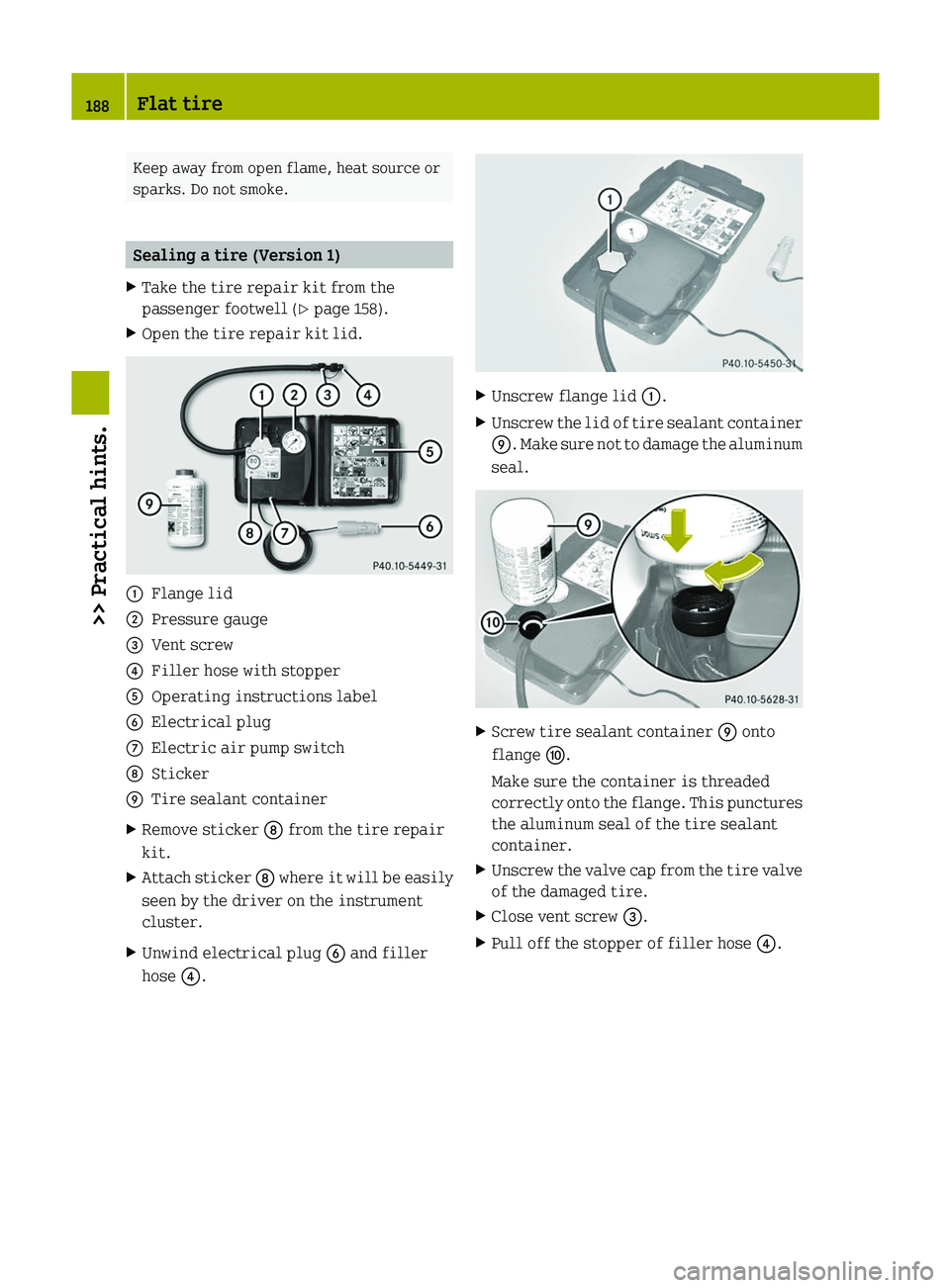
X Take the tire repair kit from the
passenger footwell (Y page 158).
X Open the tire repair kit lid. :
Flange lid
; Pressure gauge
= Vent screw
? Filler hose with stopper
A Operating instructions label
B Electrical plug
C Electric air pump switch
D Sticker
E Tire sealant container
X Remove sticker D from the tire repair
kit.
X Attach sticker D where it will be easily
seen by the driver on the instrument
cluster.
X Unwind electrical plug B and filler
hose ?. X
Unscrew flange lid :.
X Unscrew the lid of tire sealant container
E.
Make sure not to damage the aluminum
seal. X
Screw tire sealant container E onto
flange F.
Make sure the container is threaded
correctly
onto the flange. This punctures
the aluminum seal of the tire sealant
container.
X Unscrew the valve cap from the tire valve
of the damaged tire.
X Close vent screw =.
X Pull off the stopper of filler hose ?.188
Flat tire
>> Practical hints.