page 90 SMART FORTWO COUPE 2012 Owners Manual
[x] Cancel search | Manufacturer: SMART, Model Year: 2012, Model line: FORTWO COUPE, Model: SMART FORTWO COUPE 2012Pages: 228, PDF Size: 12.76 MB
Page 191 of 228
X
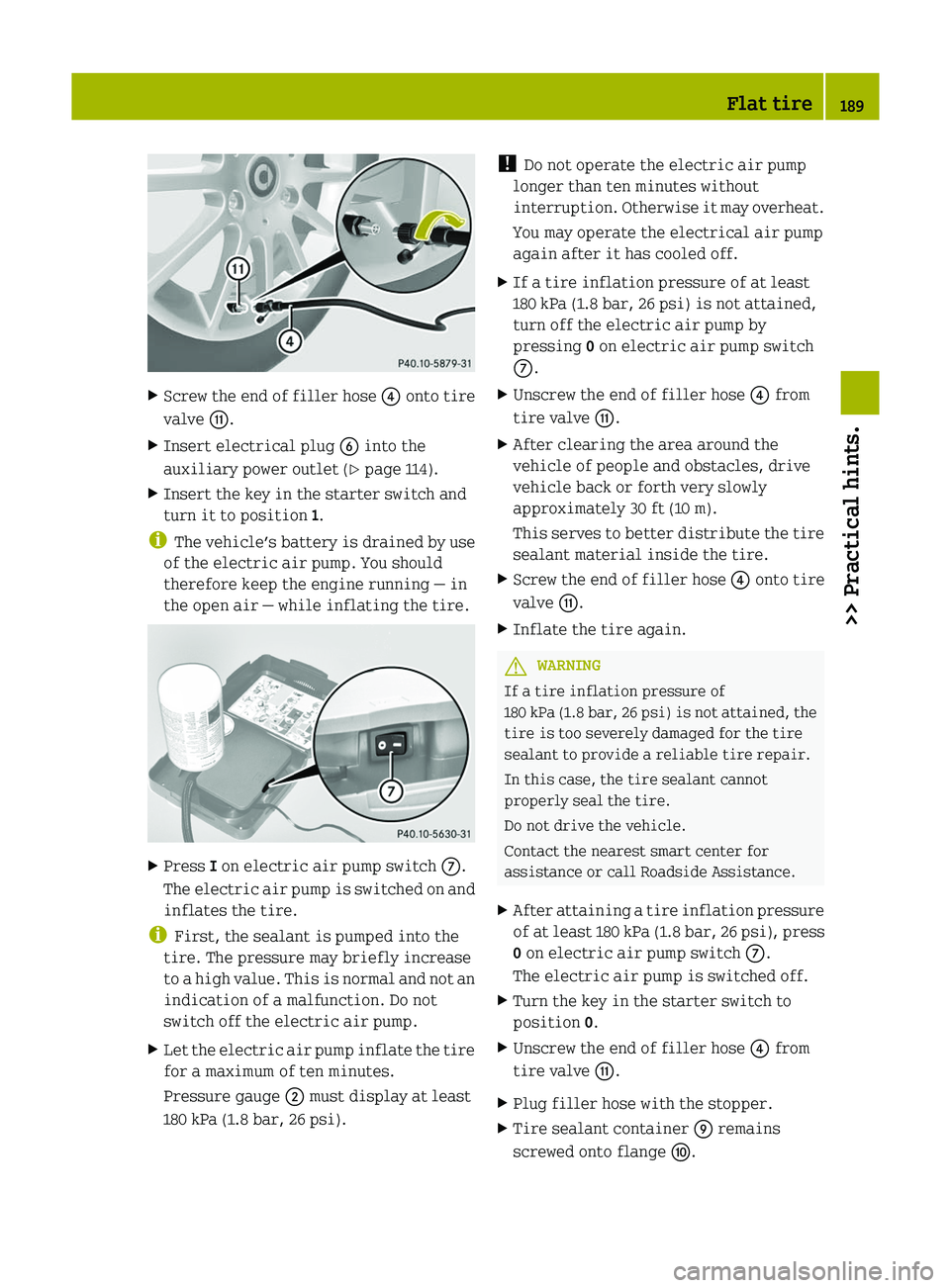
Screw the end of filler hose ? onto tire
valve G.
X Insert electrical plug B into the
auxiliary power outlet
(Y page 114).
X Insert the key in the starter switch and
turn it to position 1.
i The
vehicle’s battery is drained by use
of the electric air pump. You should
therefore keep the engine running — in
the open air — while inflating the tire. X
Press I on electric air pump switch C.
The
electric air pump is switched on and
inflates the tire.
i First, the sealant is pumped into the
tire. The pressure may briefly increase
to
a high value. This is normal and not an
indication of a malfunction. Do not
switch off the electric air pump.
X Let the electric air pump inflate the tire
for a maximum of ten minutes.
Pressure gauge ; must display at least
180 kPa (1.8 bar, 26 psi)
.!
Do not operate the electric air pump
longer than ten minutes without
interruption.
Otherwise it may overheat.
You may operate the electrical air pump
again after it has cooled off.
X If a tire inflation pressure of at least
180 kPa (1.8 bar, 26 psi)
is not attained,
turn off the electric air pump by
pressing 0 on electric air pump switch
C.
X Unscrew the end of filler hose ? from
tire valve G.
X After clearing the area around the
vehicle of people and obstacles, drive
vehicle back or forth very slowly
approximately 30 ft (10 m).
This
serves to better distribute the tire
sealant material inside the tire.
X Screw the end of filler hose ? onto tire
valve G.
X Inflate the tire again. G
WARNING
If a tire inflation pressure of
180
kPa (1.8 bar, 26 psi) is not attained, the
tire is too severely damaged for the tire
sealant to provide a reliable tire repair.
In this case, the tire sealant cannot
properly seal the tire.
Do not drive the vehicle.
Contact the nearest smart center for
assistance or call Roadside Assistance.
X After attaining a tire inflation pressure
of
at least 180 kPa (1.8 bar, 26 psi), press
0 on electric air pump switch C.
The electric air pump is switched off.
X Turn the key in the starter switch to
position 0.
X Unscrew the end of filler hose ? from
tire valve G.
X Plug filler hose with the stopper.
X Tire sealant container E remains
screwed onto flange F. Flat tire
189
>> Practical hints. Z
Page 193 of 228
result in handling or steering problems, or
brake failure.
X Drive to the nearest authorized smart
center, to have the damaged tire
replaced.
X Contact an authorized smart center as
soon as possible to obtain a new filler
hose and a new tire sealant container.
X Bring used tire sealant materials to an
authorized smart center for proper
disposal.
X Replace your tire sealant container
every 4 years. Replacement containers
are available at any authorized smart
center. G
WARNING
After changing a tire, contact a smart
center to make sure the bolts holding the
wheel to the car are tight enough.
Otherwise, the wheels could come off. Each
bolt should be tightened to a torque of
81 lb‑ft (110 Nm). Sealing a tire (Version 2)
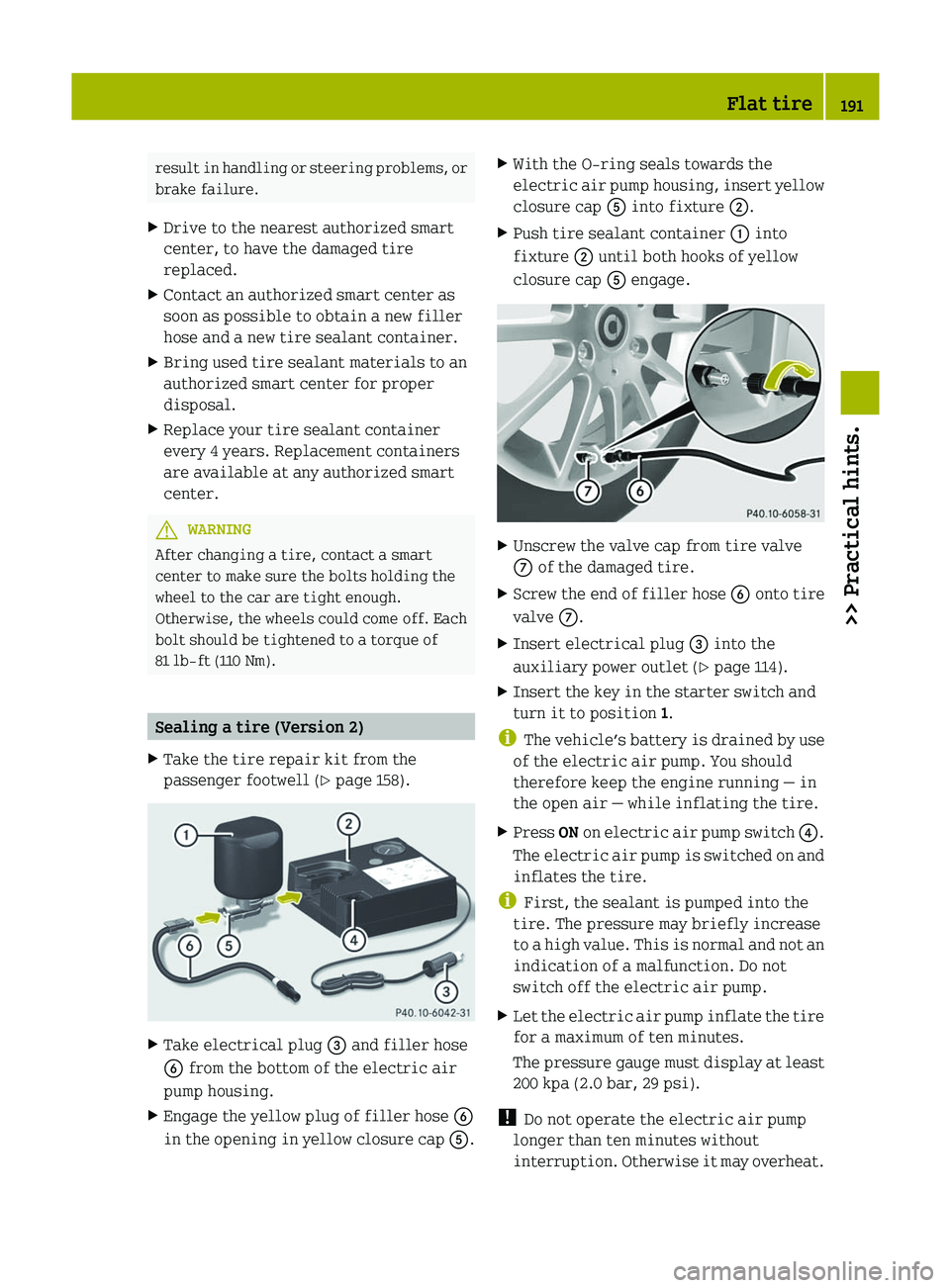
X Take the tire repair kit from the
passenger footwell (Y page 158). X
Take electrical plug = and filler hose
B from the bottom of the electric air
pump housing.
X Engage the yellow plug of filler hose B
in the opening in yellow closure cap A.X
With the O-ring seals towards the
electric
air pump housing, insert yellow
closure cap A into fixture ;.
X Push tire sealant container : into
fixture ; until both hooks of yellow
closure cap A engage. X
Unscrew the valve cap from tire valve
C of the damaged tire.
X Screw the end of filler hose B onto tire
valve C.
X Insert electrical plug = into the
auxiliary power outlet
(Y page 114).
X Insert the key in the starter switch and
turn it to position 1.
i The
vehicle’s battery is drained by use
of the electric air pump. You should
therefore keep the engine running — in
the open air — while inflating the tire.
X Press ON
on electric air pump switch ?.
The electric air pump is switched on and
inflates the tire.
i First, the sealant is pumped into the
tire. The pressure may briefly increase
to
a high value. This is normal and not an
indication of a malfunction. Do not
switch off the electric air pump.
X Let the electric air pump inflate the tire
for a maximum of ten minutes.
The
pressure gauge must display at least
200 kpa (2.0 bar, 29 psi).
! Do not operate the electric air pump
longer than ten minutes without
interruption.
Otherwise it may overheat. Flat tire
191
>> Practical hints. Z
Page 196 of 228
Wheel change
Preparing the vehicle
X Park the vehicle on a hard, flat surface
when possible.
X Turn on the hazard warning flasher.
X Turn the steering wheel so that the front
wheels
are in a straight-ahead position.
X Engage the parking brake.
X Move the gear selector lever to park
position P.
X Turn off the engine.
X Have any passenger exit the vehicle at a
safe distance from the roadway. Removing the wheel
G
WARNING
When jacking up the vehicle, only use a
suitable jack. Observe the manufacturer’s
safety instructions.
The jack must be designed for jacking up
this vehicle at the jack take-up brackets
built into both sides of the vehicle.
The jack is intended only for lifting the
vehicle
briefly for wheel changes. It is not
suited for performing maintenance work
under the vehicle. To help avoid personal
injury, use the jack only to lift the vehicle
during a wheel change.
Never get beneath the vehicle while it is
supported by the jack. Keep hands and feet
away from the area under the lifted vehicle.
Always lower the vehicle onto sufficient
capacity jackstands before working under
the vehicle.
Always firmly engage the parking brake and
block the wheels with wheel chocks or other
sizeable objects before raising the
vehicle with the jack. Do not release the
parking brake while the vehicle is raised.
Make sure the ground on which the vehicle
is standing and where you place the jack is solid, level and not slippery. If necessary,
use
a large underlay. On slippery surfaces,
such as tiled floors, you should use a non-
slip underlay, for example a rubber mat.
Do not use wooden blocks or similar objects
to support the jack. Otherwise the jack may
not be able to achieve its load-bearing
capacity if it is not at its full height.
The jack must always be vertical when in
use. Always try to use the jack on level
surface. If you do not position the jack
correctly, the vehicle can fall off the jack
and seriously or fatally injure you or
others.
Never start the engine when the vehicle is
raised.
Also observe the notes on the jack.
X Make sure to have a suitable jack 18
,
wheel
wrench 18
and wheel chock 18
.
Contact an authorized smart center for
information on which jack and wheel
wrench are required.
X Prepare the vehicle as described
(Y page 194).
X Make sure the surface is level.
Prevent the vehicle from rolling away by
blocking
wheels with wheel chocks or other
sizeable objects:
X Place one wheel chock or other sizeable
object in front of and another wheel
chock or other sizeable object behind
the wheel that is diagonally opposite to
the wheel being changed.
18 Not included and not available as factory equipment.194
Wheel change
>> Practical hints.
Page 198 of 228
to come off. This could cause an accident.
Be sure to use the correct wheel bolts.
G
WARNING
Only use genuine smart wheel bolts. Other
wheel bolts may come loose.
Do not tighten the wheel bolts when the
vehicle is raised. Otherwise the vehicle
could fall off the jack.
X Clean contact surfaces of wheel and wheel
hub.
! To avoid paint damage, place wheel flat
against hub and hold it there while
installing first wheel bolt. X
Guide the wheel onto the wheel hub and
push it on.
X Insert two wheel bolts and tighten them
slightly.
X Vehicles with wheel trim cap on steel
rim: Attach the wheel trim cap so that it
is held by the two wheel bolts.
X Install last wheel bolt and tighten it
slightly.
X Lower the vehicle until the vehicle is
resting fully on its own weight.
X Remove the jack.
X Tighten the wheel bolts. Observe a
tightening torque of 80 lb-ft (110 Nm)
.G
WARNING
Have the tightening torque checked after
changing a wheel. The wheels could come loose if they are not tightened to a torque
of 80 lb-ft (110 Nm).
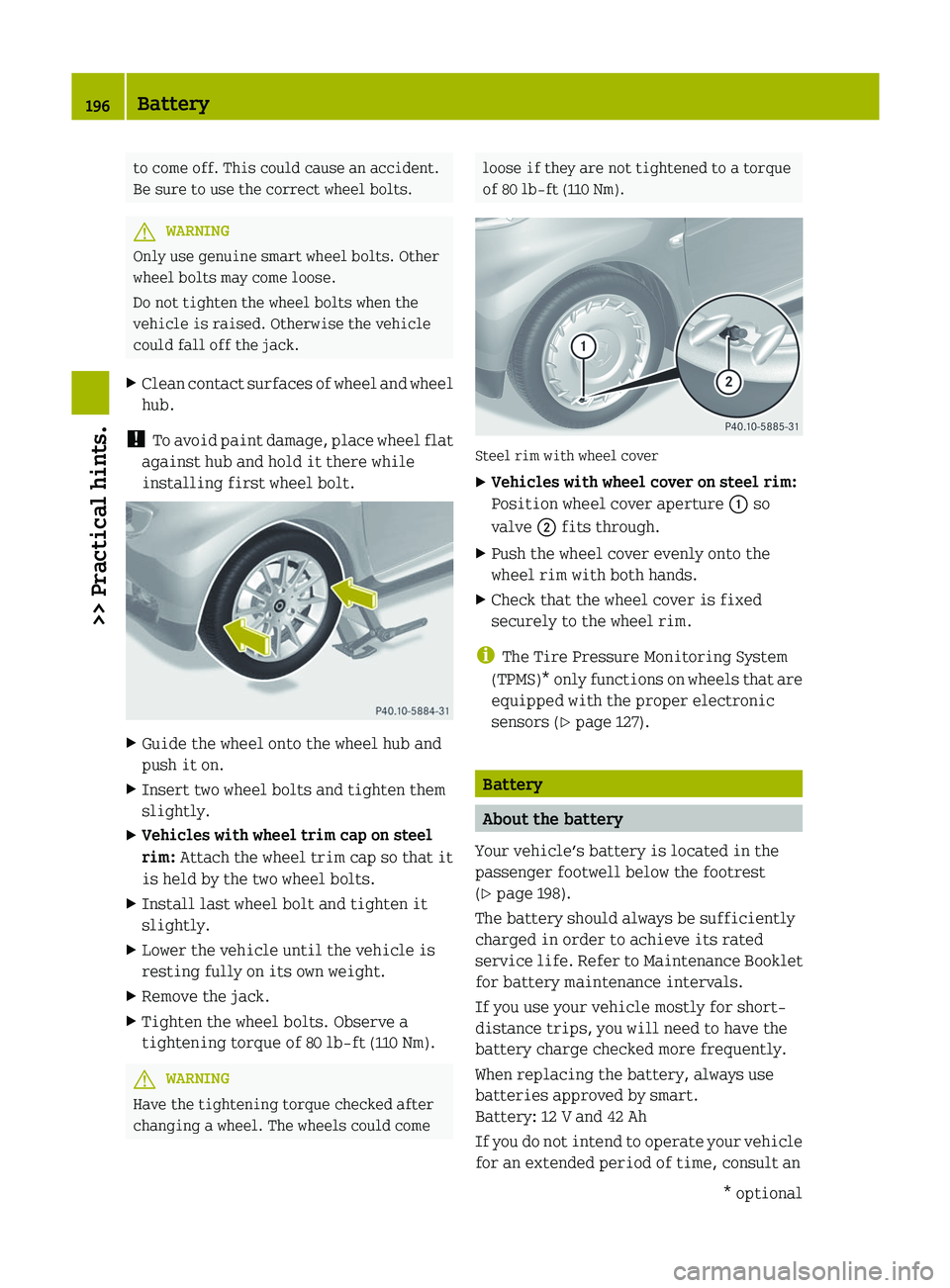
Steel rim with wheel cover
X
Vehicles with wheel cover on steel rim:
Position wheel cover aperture : so
valve ; fits through.
X Push the wheel cover evenly onto the
wheel rim with both hands.
X Check that the wheel cover is fixed
securely to the wheel rim.
i The Tire Pressure Monitoring System
(TPMS)*
only functions on wheels that are
equipped with the proper electronic
sensors (Y page 127). Battery
About the battery
Your vehicle’s battery is located in the
passenger footwell below the footrest
(Y page 198).
The battery should always be sufficiently
charged in order to achieve its rated
service
life. Refer to Maintenance Booklet
for battery maintenance intervals.
If you use your vehicle mostly for short-
distance trips, you will need to have the
battery charge checked more frequently.
When replacing the battery, always use
batteries approved by smart.
Battery: 12 V and 42 Ah
If you do not intend to operate your vehicle
for an extended period of time, consult an 196
Battery
>> Practical hints.
* optional
Page 200 of 228
key is in the starter switch. Otherwise
the alternator and other electronic
components could be severely damaged.
Have the battery checked regularly at an
authorized smart center.
Refer to Maintenance Booklet for
maintenance intervals or contact an
authorized smart center for further
information.
! Never invert the terminal connections! Disconnecting, removing, charging,
reinstalling and reconnecting the
battery
Disconnecting the battery i
If the battery is disconnected or
discharged
R the key will not turn in the starter
switch
R the automatic transmission will
remain in park position P
For more information see “Jump
starting” ( Y page 199).
X Engage the parking brake.
X Move the gear selector lever to park
position P.
X Turn off all electrical accessories.
X Turn off the engine.
X Open the passenger door.
X Move the passenger seat to the rear as far
as possible.
X Unscrew the carpet holder in the
passenger footwell (Y page 158).
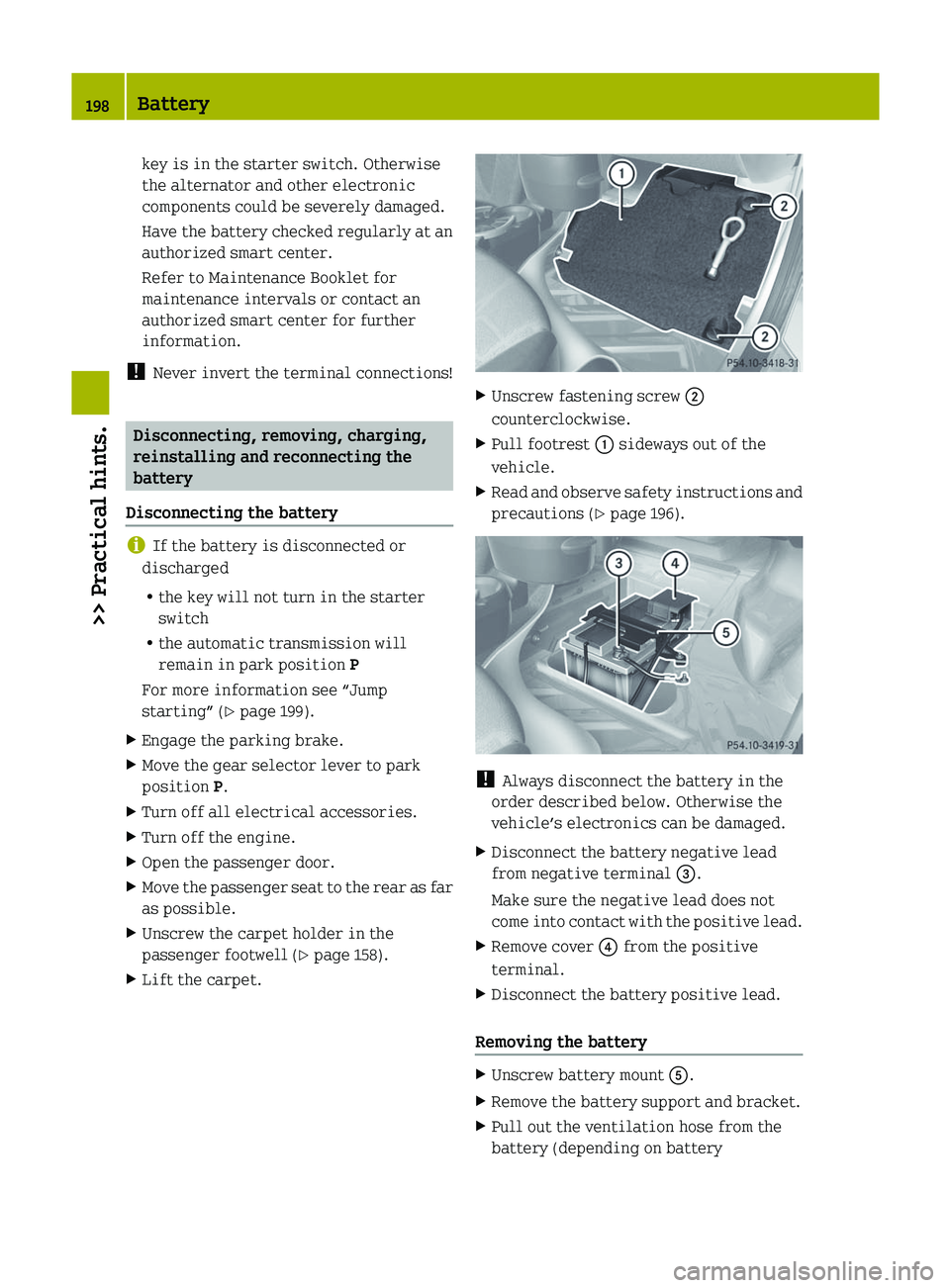
X Lift the carpet. X
Unscrew fastening screw ;
counterclockwise.
X Pull footrest : sideways out of the
vehicle.
X Read and observe safety instructions and
precautions (Y page 196). !
Always disconnect the battery in the
order described below. Otherwise the
vehicle’s electronics can be damaged.
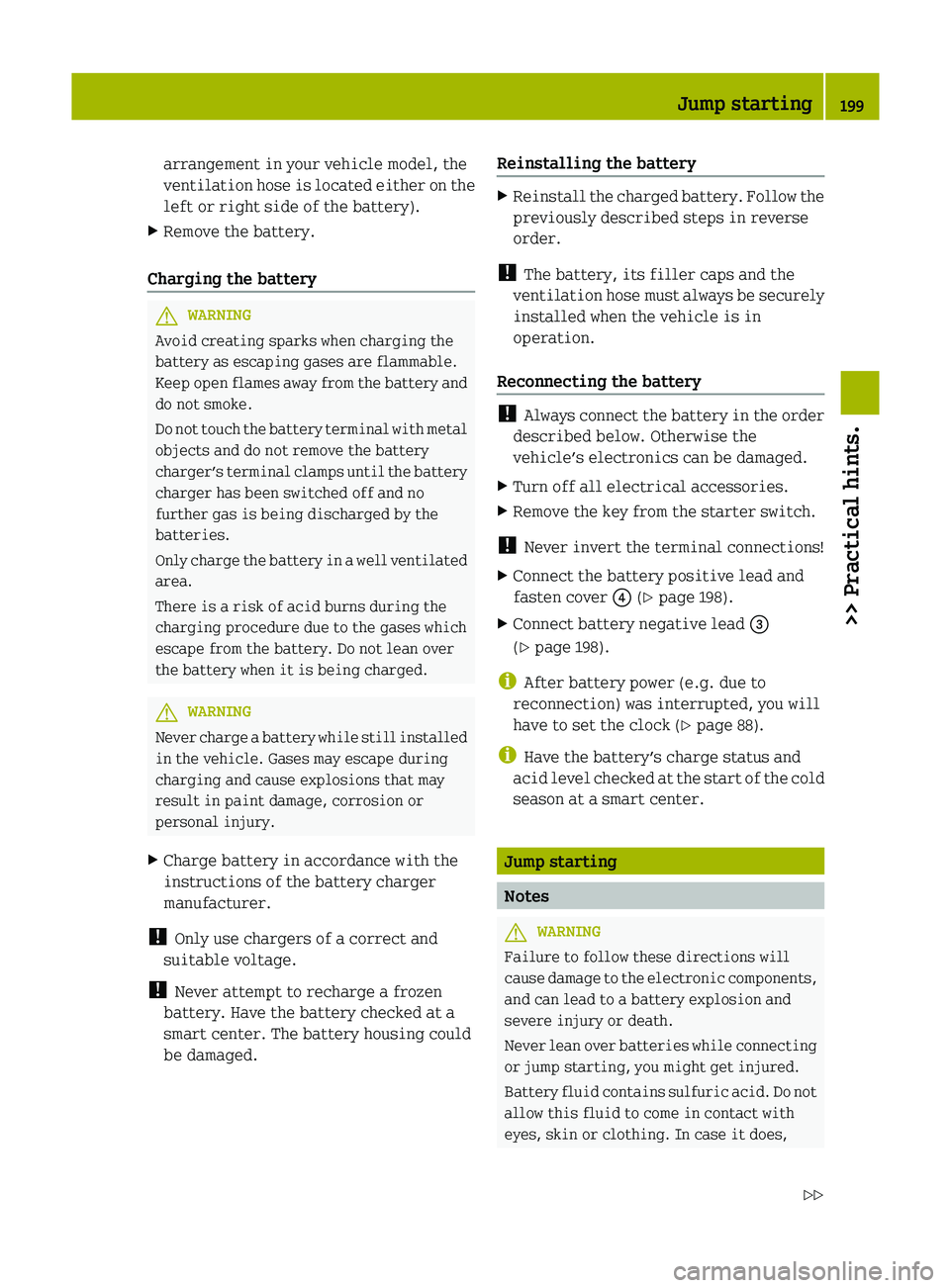
X Disconnect the battery negative lead
from negative terminal =.
Make sure the negative lead does not
come
into contact with the positive lead.
X Remove cover ? from the positive
terminal.
X Disconnect the battery positive lead.
Removing the battery X
Unscrew battery mount A.
X Remove the battery support and bracket.
X Pull out the ventilation hose from the
battery (depending on battery198
Battery
>> Practical hints.
Page 201 of 228
arrangement in your vehicle model, the
ventilation
hose is located either on the
left or right side of the battery).
X Remove the battery.
Charging the battery G
WARNING
Avoid creating sparks when charging the
battery as escaping gases are flammable.
Keep
open flames away from the battery and
do not smoke.
Do not touch the battery terminal with metal
objects and do not remove the battery
charger’s terminal clamps until the battery
charger has been switched off and no
further gas is being discharged by the
batteries.
Only charge the battery in a well ventilated
area.
There is a risk of acid burns during the
charging procedure due to the gases which
escape from the battery. Do not lean over
the battery when it is being charged. G
WARNING
Never charge a battery while still installed
in the vehicle. Gases may escape during
charging and cause explosions that may
result in paint damage, corrosion or
personal injury.
X Charge battery in accordance with the
instructions of the battery charger
manufacturer.
! Only use chargers of a correct and
suitable voltage.
! Never attempt to recharge a frozen
battery. Have the battery checked at a
smart center. The battery housing could
be damaged. Reinstalling the battery X
Reinstall the charged battery. Follow the
previously described steps in reverse
order.
! The battery, its filler caps and the
ventilation
hose must always be securely
installed when the vehicle is in
operation.
Reconnecting the battery !
Always
connect the battery in the order
described below. Otherwise the
vehicle’s electronics can be damaged.
X Turn off all electrical accessories.
X Remove the key from the starter switch.
! Never invert the terminal connections!
X Connect the battery positive lead and
fasten cover ? (Y page 198).
X Connect battery negative lead =
(Y page 198).
i After battery power (e.g. due to
reconnection) was interrupted, you will
have to set the clock (Y page 88).
i Have the battery’s charge status and
acid
level checked at the start of the cold
season at a smart center. Jump starting
Notes
G
WARNING
Failure to follow these directions will
cause
damage to the electronic components,
and can lead to a battery explosion and
severe injury or death.
Never lean over batteries while connecting
or jump starting, you might get injured.
Battery fluid contains sulfuric acid. Do not
allow this fluid to come in contact with
eyes, skin or clothing. In case it does, Jump starting
199
>> Practical hints.
Z
Page 203 of 228
Jump start assistance
Your vehicle’s battery is located in the passenger footwell below the footrest
(Y page 198).
For jump starting, use the terminals of the battery, keeping the leads connected.
X Make sure the two vehicles do not touch.
X Switch off all electrical consumers.
X Engage the parking brake.
X Move the gear selector lever to park position P.
X Turn off the engine.
X Get access to the battery in the passenger footwell (Y page 198).
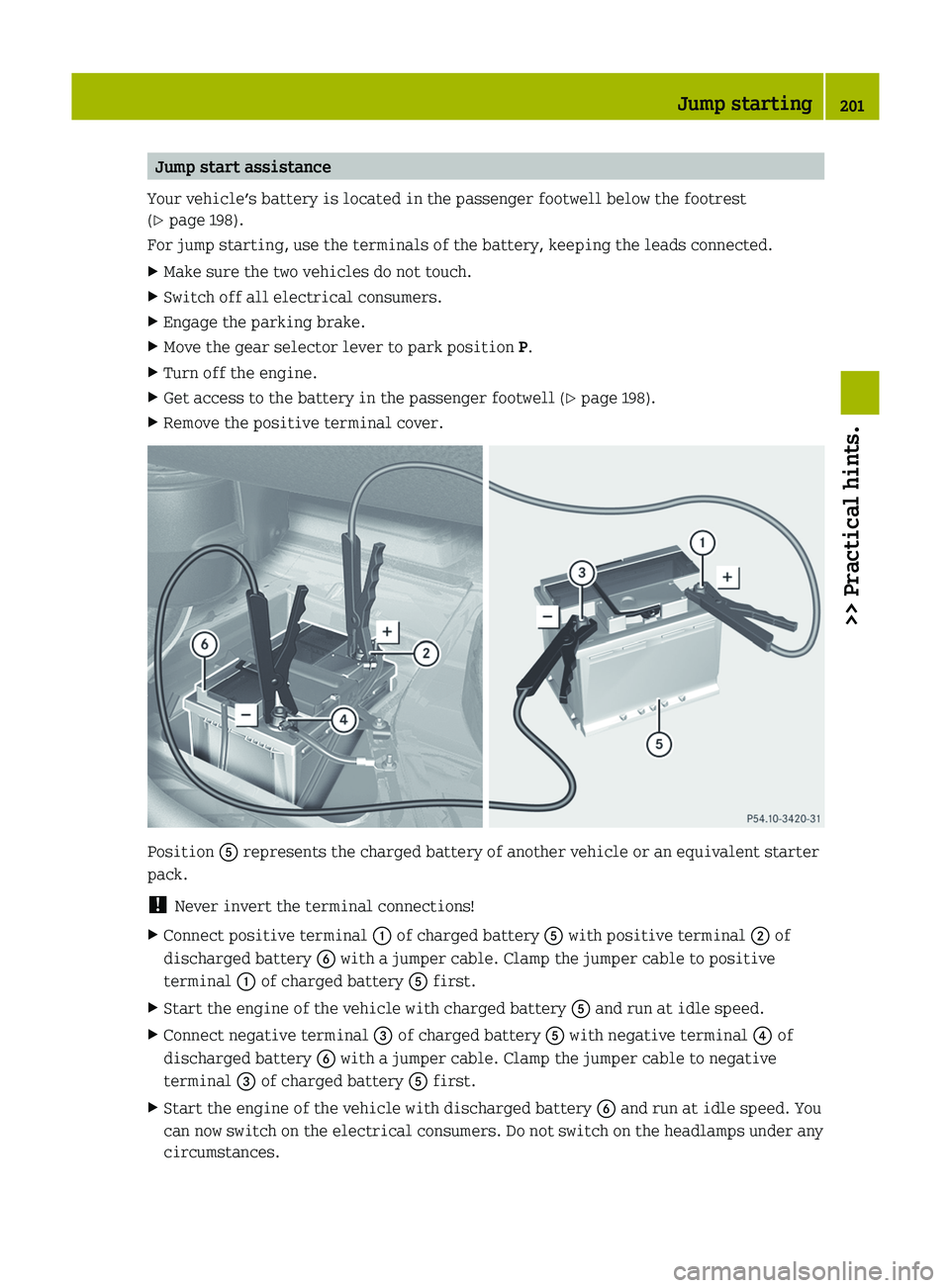
X Remove the positive terminal cover. Position
A represents the charged battery of another vehicle or an equivalent starter
pack.
! Never invert the terminal connections!
X Connect positive terminal : of charged battery A with positive terminal ; of
discharged battery B with a jumper cable. Clamp the jumper cable to positive
terminal : of charged battery A first.
X Start the engine of the vehicle with charged battery A and run at idle speed.
X Connect negative terminal = of charged battery A with negative terminal ? of
discharged battery B with a jumper cable. Clamp the jumper cable to negative
terminal = of charged battery A first.
X Start the engine of the vehicle with discharged battery B and run at idle speed. You
can now switch on the electrical consumers. Do not switch on the headlamps under any
circumstances. Jump starting
201>> Practical hints. Z
Page 204 of 228
X
Remove the jumper cables from negative terminals = and ? first.
X Remove the jumper cables from positive terminals : and ;.
You can now switch on the headlamps.
X Remount the positive terminal cover.
X Have the battery checked at the nearest authorized smart center. Towing
About towing
This section offers information on towing
methods for breakdown situations,
emergency towing, and flat towing smart
vehicles. Recommended towing method -
Breakdown situation
smart recommends that the vehicle be
transported with all wheels off the ground
using a flatbed carrier truck or
appropriate wheel lift/dolly equipment.
X Switch off the tow‑away protection* and
interior motion sensor*
(Y page 49).
! To
prevent damage during transport, do
not tie down the vehicle by its chassis or
suspension parts — use only wheel straps
to position and hold down the vehicle.
Improper tie down on a flatbed carrier
truck or trailer can damage suspension
parts and body panels. Emergency towing
When circumstances do not permit the
recommended towing method, the vehicle
may
be towed with all wheels on the ground
using a strap or tow bar connected to
another vehicle. Only tow the vehicle as far
as necessary to have the vehicle moved to a
safe location where the recommended
towing method can be employed. G
WARNING
If circumstances require towing the
vehicle with all wheels on the ground,
always tow with a tow bar if:
R the engine will not run
R there is a malfunction in the brake
system
R there is a malfunction in the power
supply or in the vehicle’s electrical
system
A
tow bar is necessary to adequately control
the towed vehicle.
Prior to towing the vehicle with all wheels
on the ground, make sure the gear selector
lever is in neutral position N and the
ignition is switched off. G
WARNING
With the engine not running, there is no
power assistance for the brake and
steering* systems. In this case, it is
important to keep in mind that a
considerably higher degree of effort is
necessary to brake and steer the vehicle.
Adapt your driving accordingly.
! Do not tow the vehicle with the front
axle raised. Doing so may cause serious
damage to the brake system which is not
covered by the smart Limited Warranty.
! Before towing the vehicle observe the
following instructions:
R Do not tow with sling-type equipment
attached
to suspension parts. This may202
Towing
>> Practical hints.
* optional
Page 205 of 228
cause damage to the radiator and other
supports if towing on a bumpy road.
R Towing
the vehicle should only be done
using the properly installed towing
eye bolt. Never attach a tow cable, tow
rope, or tow rod to the vehicle chassis,
frame, or suspension parts.
! Make sure the ignition is switched off
while towing the vehicle. Doing
otherwise may result in
R the ESP ®
being activated. Active
braking action through the ESP ®
may
seriously damage the brake system
which is not covered by the smart
Limited Warranty.
R a discharged battery.
! Make sure the gear selector lever is in
neutral position N while towing the
vehicle. Doing otherwise may result in
significant transmission damage.
! Towing the vehicle with a luggage
rack* mounted is not permissible. The
vehicle must not be towed by the luggage
rack*.
i If the battery is disconnected or
discharged, the gear selector lever will
remain locked in park position P.
Contact an authorized smart center for
assistance or call Roadside Assistance.
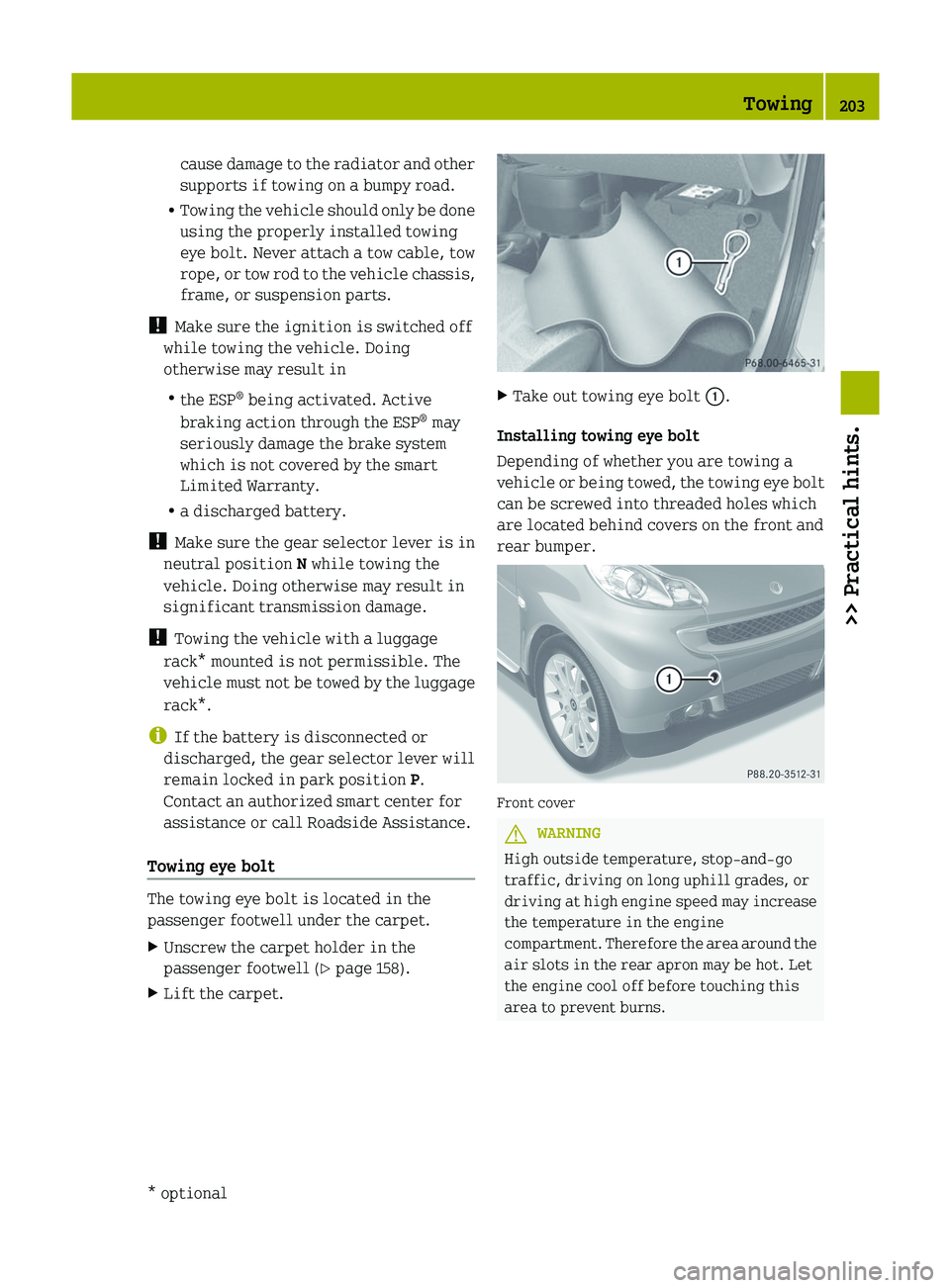
Towing eye bolt The towing eye bolt is located in the
passenger footwell under the carpet.
X
Unscrew the carpet holder in the
passenger footwell (Y page 158).
X Lift the carpet. X
Take out towing eye bolt :.
Installing towing eye bolt
Depending of whether you are towing a
vehicle
or being towed, the towing eye bolt
can be screwed into threaded holes which
are located behind covers on the front and
rear bumper. Front cover
G
WARNING
High outside temperature, stop-and-go
traffic, driving on long uphill grades, or
driving
at high engine speed may increase
the temperature in the engine
compartment. Therefore the area around the
air slots in the rear apron may be hot. Let
the engine cool off before touching this
area to prevent burns. Towing
203
>> Practical hints.
* optional Z
Page 208 of 228

X
From the fuse chart (Y page 208),
determine which fuse belongs to the
malfunctioning accessory or component.
X Remove the respective fuse.
X Replace the defective fuse with a new one
of the same amperage.206
Fuses>> Practical hints.