coolant SMART FORTWO COUPE 2012 User Guide
[x] Cancel search | Manufacturer: SMART, Model Year: 2012, Model line: FORTWO COUPE, Model: SMART FORTWO COUPE 2012Pages: 228, PDF Size: 12.76 MB
Page 120 of 228

X
Engage the parking brake.
X Move the gear selector lever to park
position P.
X Switch off the ignition.
X Open the tailgate. G
WARNING
Exercise extreme caution if you see flames
or smoke coming from the engine
compartment. Move away from the vehicle
and call the fire department.
If the coolant temperature warning lamp
indicates
that the engine is overheated, do
not attempt to open the engine compartment
cover. Move away from the vehicle and wait
until the engine has cooled before opening
the engine compartment. G
WARNING
To help prevent personal injury, stay clear
of moving parts when the engine
compartment cover is open and the engine
is running. G
WARNING
The engine is equipped with a
transistorized ignition system that
utilizes high voltage. Do not touch any
components (ignition coils, spark plug
sockets,
diagnostic socket) of the ignition
system
R while the engine is running
R while starting the engine
R if ignition is “on” and the engine is
turned manually X
Opening: Grasp the strap on cargo
compartment floor ;.
X Lift cargo compartment floor ;
with the
strap.
X Engage hook ? into top mounting = of
cargo compartment cover blind A.
X Remove fastening screw :.
X Remove engine compartment cover A.
X Closing:
Slide engine compartment cover
A forward into the tabs provided.
X Tighten fastening screw :.
X Disengage hook ? from top mounting
=.
X Fold cargo compartment floor ; back
down.
X Push the right hand and left hand cargo
compartment
floor edges under the edges
of the side panels.
X Close the tailgate. Engine oil
The amount of oil your engine needs will
depend on a number of factors, including
driving style. Increased oil consumption
can occur when the vehicle is new or the
vehicle is driven at higher engine speeds
frequently.
Engine
oil consumption checks should only
be made after the vehicle break-in period.
! Do not use any special lubricant
additives, as these may increase wear
and damage the drive assemblies. Using
special additives not approved by smart
may cause damage not covered by the
smart Limited Warranty. More
information on this subject is available
at any smart center.
Checking engine oil level !
Check the engine oil level at regular
intervals. 118
Engine compartment
>> Operation.
Page 122 of 228
X
Check the engine oil level once more.
X Add engine oil once more if necessary.
Be careful not to spill any oil when adding
to avoid environmental damage caused by
oil entering the ground and water.
! Excess engine oil must be siphoned or
drained
off. It could cause damage to the
engine or emission control system not
covered by the smart Limited Warranty.
X Screw filler cap : back on the filler
neck.
X Close the engine compartment cover
(Y page 117). Front compartment
Service flap
Remove the service flap to check the
coolant
level, windshield washer reservoir
level, and brake fluid level.
Insert the service flap on the front of the
vehicle so that it does not get damaged or
dirty.
i The service flap has a strap on the rear
side that ties it to the vehicle body. G
WARNING
Always turn the key to starter switch
position 0 and remove the key from the
starter switch before opening the service
flap.
If the windshield wipers should
inadvertently be switched on, you could be
seriously injured by the wiper washer
drive, which is located just below the
service flap. G
WARNING
Make sure the service flap is locked while
driving. Otherwise, the service flap could
become detached and pose a hazard to you
or others. G
WARNING
To help prevent personal injury, stay clear
of moving parts when the service flap is
open.
The radiator fan may continue to run for
approximately 30 seconds or may even
restart after the engine has been turned
off. Stay clear of fan blades.
! Check the fill levels at regular
intervals.
! Carefully remove ice, snow, and any
other deposits from the air intake
grilles above the service flap to ensure
air intake at all times.
X Park the vehicle on level ground.
X Turn off the engine.
X Engage the parking brake.
Removing X
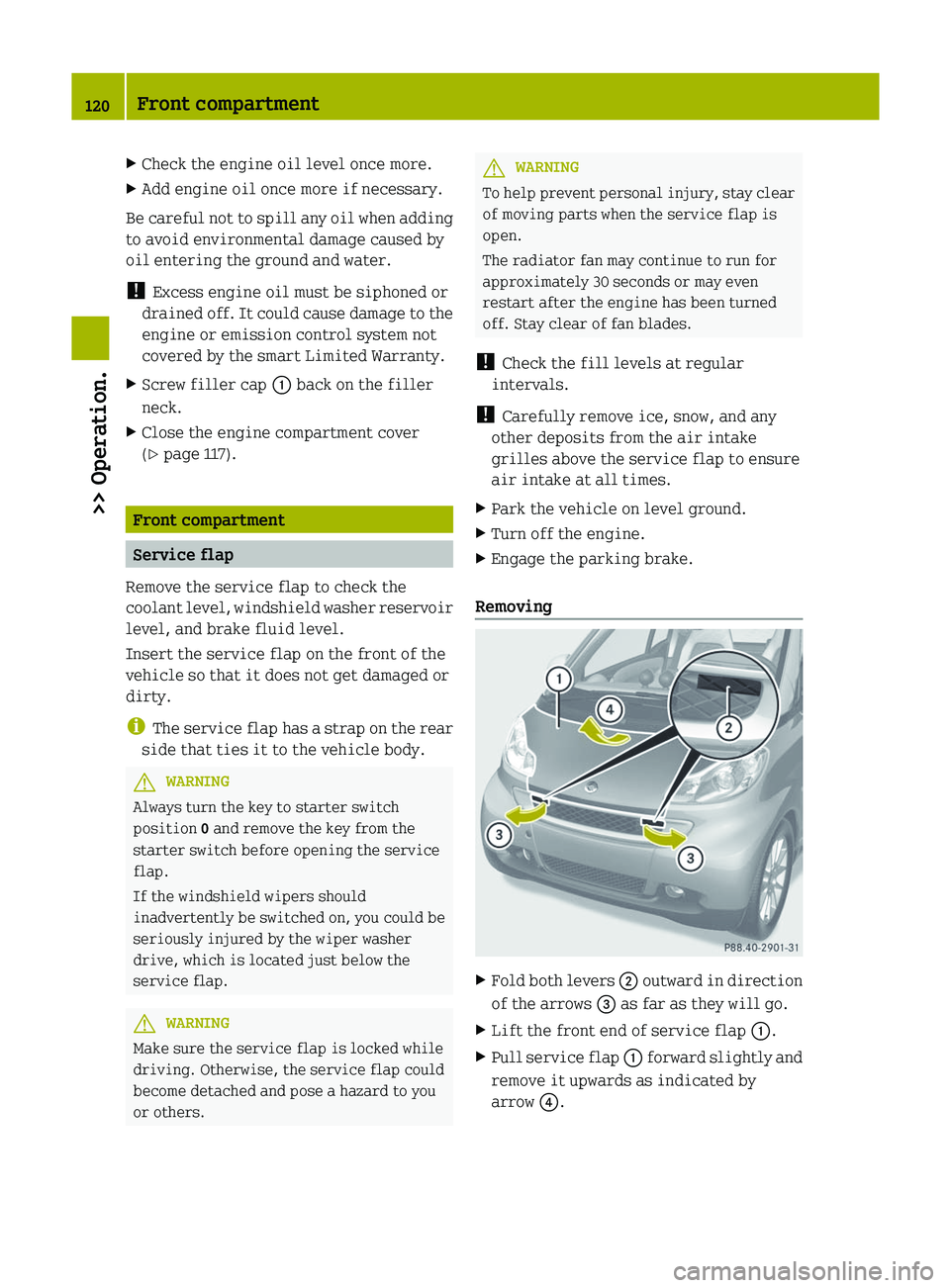
Fold both levers ;
outward in direction
of the arrows = as far as they will go.
X Lift the front end of service flap :.
X Pull service flap :
forward slightly and
remove it upwards as indicated by
arrow ?. 120
Front compartment
>> Operation.
Page 124 of 228
Coolant
G
WARNING
In order to avoid potentially serious burns:
R Use extreme caution when opening the
service flap if there are any signs of
steam or coolant leaking from the
cooling system, or if the coolant
temperature warning lamp ? in the
instrument cluster indicates that the
coolant is overheated.
R Do
not remove the pressure cap on coolant
reservoir if coolant temperature is
above 158¦ (70¥). Allow engine to cool
down before removing cap. The coolant
reservoir contains hot fluid and is under
pressure.
R Using a rag, slowly turn the cap
approximately 1
/ 2 turn to relieve excess
pressure. If opened immediately,
scalding hot fluid and steam will be
blown out under pressure.
The engine coolant is a mixture of water
and anticorrosion/antifreeze. To check the
coolant level the vehicle must be parked on
level ground and the engine must have
cooled down. For more information, see
“Coolants” (Y page 223).
Checking coolant level X
Remove the service flap and insert it on
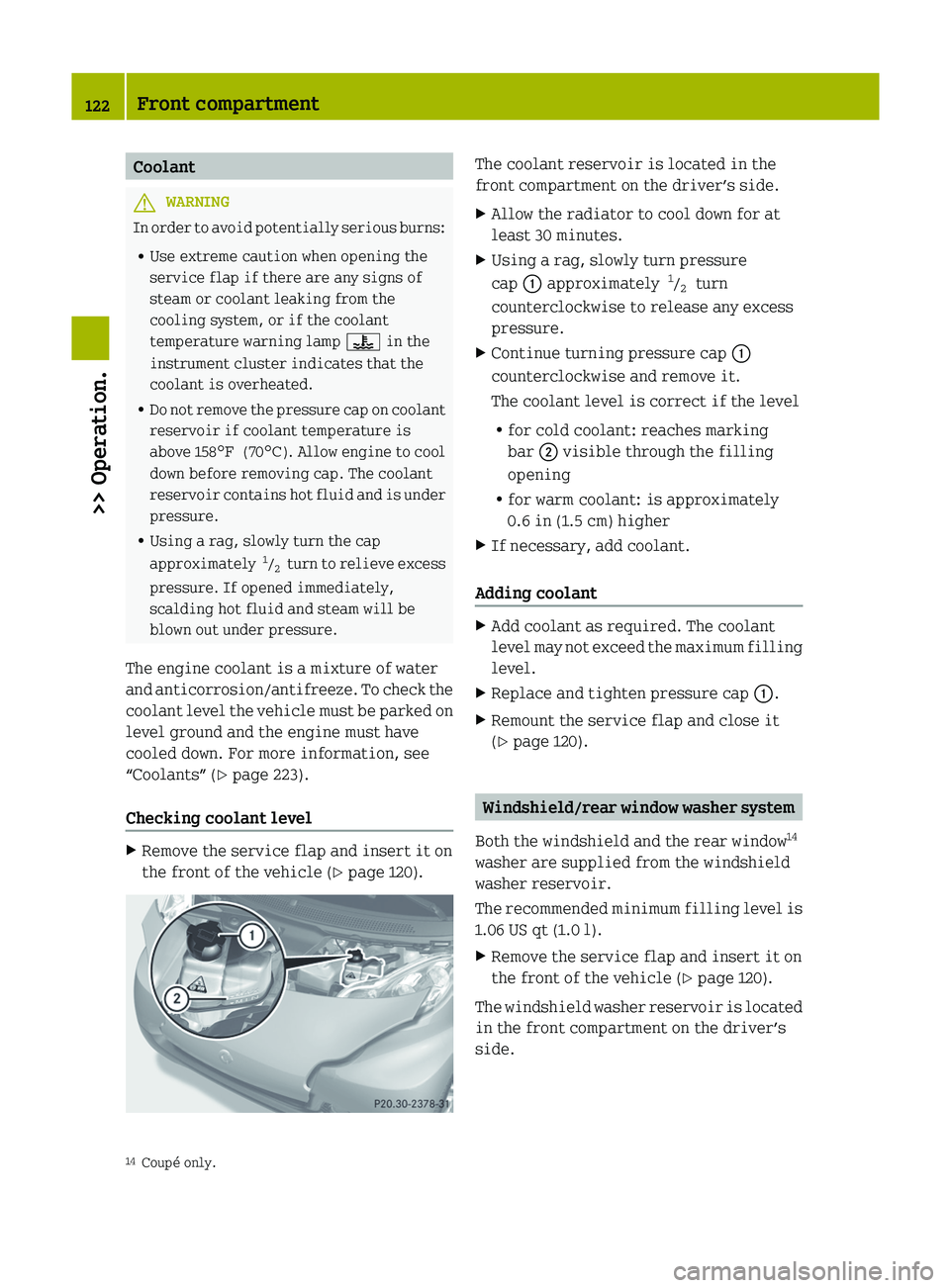
the front of the vehicle ( Y page 120). The coolant reservoir is located in the
front compartment on the driver’s side.
X
Allow the radiator to cool down for at
least 30 minutes.
X Using a rag, slowly turn pressure
cap : approximately 1
/ 2 turn
counterclockwise to release any excess
pressure.
X Continue turning pressure cap :
counterclockwise and remove it.
The coolant level is correct if the level
R
for cold coolant: reaches marking
bar ; visible through the filling
opening
R for warm coolant: is approximately
0.6 in (1.5 cm) higher
X If necessary, add coolant.
Adding coolant X
Add coolant as required. The coolant
level
may not exceed the maximum filling
level.
X Replace and tighten pressure cap :.
X Remount the service flap and close it
(Y page 120). Windshield/rear window washer system
Both the windshield and the rear window 14
washer are supplied from the windshield
washer reservoir.
The
recommended minimum filling level is
1.06 US qt (1.0 l).
X Remove the service flap and insert it on
the front of the vehicle ( Y page 120).
The windshield washer reservoir is located
in the front compartment on the driver’s
side.
14 Coupé only.122
Front compartment
>> Operation.
Page 142 of 228
radio, and heater, to the extent that these
items are available as factory-installed
equipment (whether installed or not).
Air pressure
The amount of air inside the tire pressing
outward
on each square inch of the tire. Air
pressure is expressed in pounds per square
inch (psi), or kilopascal (kPa) or bars.
Aspect ratio Dimensional relationship between tire
section
height and section width expressed
in percentage.
Bar Another metric unit for air pressure. There
are
14.5038 pounds per square inch (psi) to
1 bar; there are 100 kilopascals (kPa) to
1 bar.
Bead The tire bead contains steel wires wrapped
by steel cords that hold the tire onto the
rim.
Cold tire inflation pressure
Tire inflation pressure when your vehicle
has been sitting for at least 3 hours or
driven no more than 1 mile (1.6 km).
Curb weight
The weight of a motor vehicle with standard
equipment including the maximum
capacity of fuel, oil, and coolant, and, if
so equipped, air conditioning and
additional optional equipment, but
without passengers and cargo.
DOT (Department of Transportation)
A tire branding symbol which denotes the
tire meets requirements of the U.S.
Department of Transportation. GAWR (Gross Axle Weight Rating) The GAWR is the maximum permissible axle
weight. The gross vehicle weight on each
axle must never exceed the GAWR for the
front and rear axle indicated on the
certification
label located on the driver’s
door B‑pillar.
GVW (Gross Vehicle Weight) The GVW comprises the weight of the
vehicle including fuel, tools, installed
accessories, passengers and cargo. The
GVW
must never exceed the GVWR indicated
on the certification label located on the
driver’s door B‑pillar.
GVWR (Gross Vehicle Weight Rating) This is the maximum permissible vehicle
weight of the fully loaded vehicle (weight
of the vehicle including all options,
passengers,
fuel, and cargo. It is indicated
on certification label located on the
driver’s door B‑pillar.
Kilopascal (kPa) The metric unit for air pressure. There are
6.9
kPa to 1 psi; another metric unit for air
pressure is bars. There are
100 kilopascals (kPa) to 1 bar.
Maximum load rating The maximum load in kilograms and pounds
that can be carried by the tire.
Maximum loaded vehicle weight
The sum of curb weight, accessory weight,
total load limit and production options
weight.
Maximum permissible tire inflation
pressure
This number is the greatest amount of air
pressure
that should ever be put in the tire.140
Tires and wheels
>> Operation.
Page 152 of 228
Coolant temperature
During severe operating conditions and
stop-and-go city traffic, the coolant
temperature may rise.
! Excessive coolant temperature causes
the red coolant temperature warning
lamp ? in the instrument cluster to
come on.
The engine should not be operated with
the red coolant temperature warning
lamp ? illuminated. Doing so may
cause serious engine damage which is
not covered by the smart Limited
Warranty.
For more information on coolant
temperature warning lamp ( Y page 170).G
WARNING
Driving when your engine is overheated can
cause some fluids which may have leaked
into the engine compartment to catch fire.
You could be seriously burned.
Steam
from an overheated engine can cause
serious burns which can occur just by
opening the engine hood. Stay away from the
engine if you see or hear steam coming from
it.
Stop the vehicle in a safe location away
from other traffic. Turn off the engine, get
out of the vehicle and do not stand near the
vehicle until the engine has cooled down. Driving abroad
Abroad,
there is an extensive smart service
network at your disposal. If you plan to
drive into areas which are not listed in the
index of your smart center directory, you
should request pertinent information from
an authorized smart center. Symmetrical low beams
i If you drive in countries where
vehicles drive on the other side of the
road than the country in which the
vehicle is registered, you must have the
headlamps
modified for symmetrical low
beams. Relevant information can be
obtained at any authorized smart center. Vehicle care
Care tips
Regular and proper care will help to
maintain the value of your vehicle. The
best way to protect your vehicle from
harmful environmental influences is to
wash it and use protective treatments
regularly.
smart recommends that you care for the
paintwork
at least twice a year (e.g. in the
spring and autumn). G
WARNING
Many cleaning products can be hazardous.
Some are poisonous, others are flammable.
Always follow the instructions on the
particular container. Always open your
vehicle’s doors or windows when cleaning
the inside.
Never use fluids or solvents that are not
designed for cleaning your vehicle.
Always lock away cleaning products and
keep them out of reach of children.
! Follow
the care tips. Wash your vehicle
preferably by hand.
While in operation or even while parked,
your vehicle is subjected to varying
external influences, which left unchecked
can attack the paint as well as the vehicle
underbody and lead to permanent damage. 150
Vehicle care
>> Operation.
Page 153 of 228
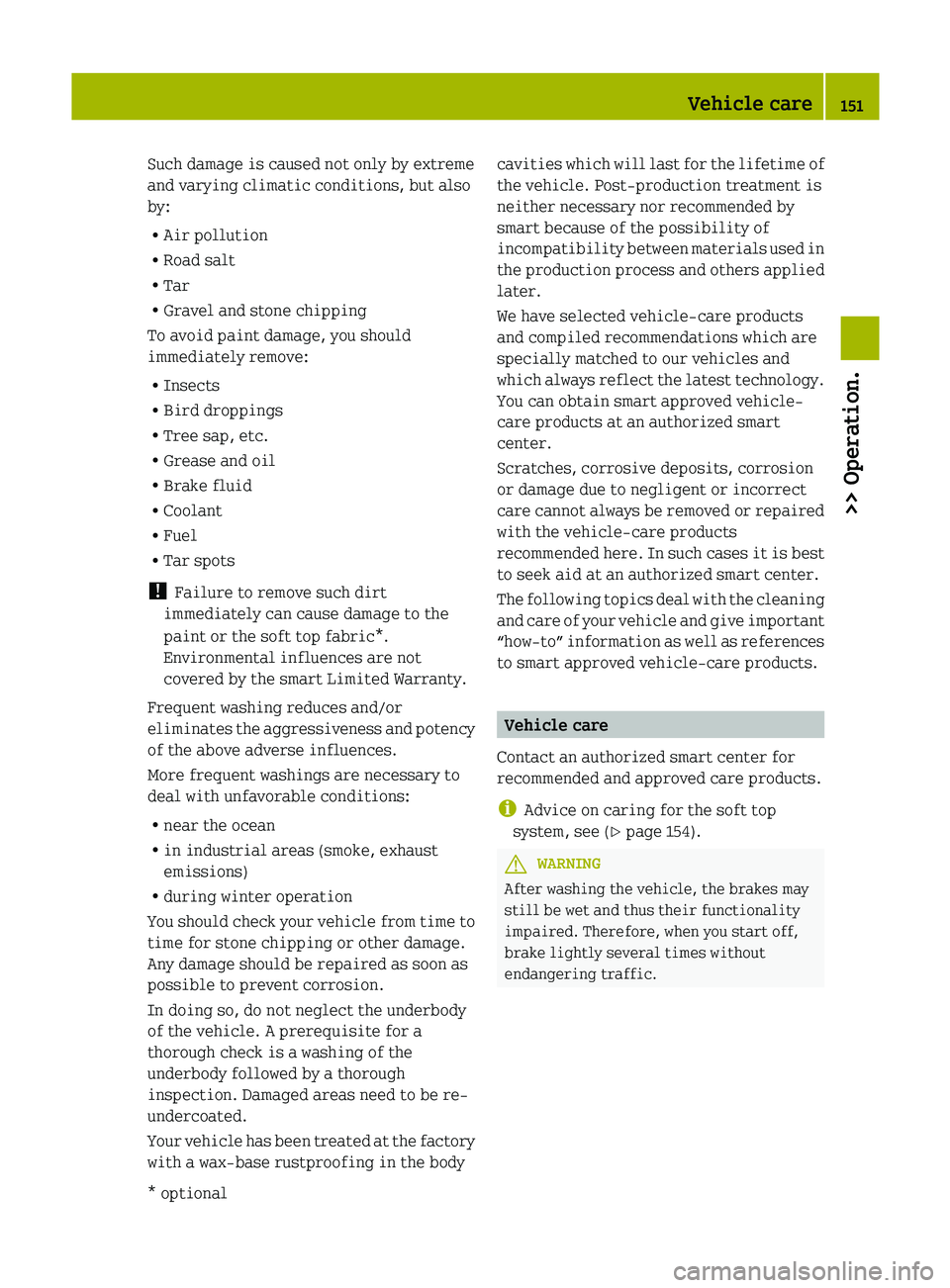
Such damage is caused not only by extreme
and varying climatic conditions, but also
by:
R
Air pollution
R Road salt
R Tar
R Gravel and stone chipping
To avoid paint damage, you should
immediately remove:
R Insects
R Bird droppings
R Tree sap, etc.
R Grease and oil
R Brake fluid
R Coolant
R Fuel
R Tar spots
! Failure to remove such dirt
immediately can cause damage to the
paint or the soft top fabric*
.
Environmental influences are not
covered by the smart Limited Warranty.
Frequent washing reduces and/or
eliminates the aggressiveness and potency
of the above adverse influences.
More frequent washings are necessary to
deal with unfavorable conditions:
R near the ocean
R in industrial areas (smoke, exhaust
emissions)
R during winter operation
You should check your vehicle from time to
time for stone chipping or other damage.
Any damage should be repaired as soon as
possible to prevent corrosion.
In doing so, do not neglect the underbody
of the vehicle. A prerequisite for a
thorough check is a washing of the
underbody followed by a thorough
inspection. Damaged areas need to be re-
undercoated.
Your vehicle has been treated at the factory
with a wax-base rustproofing in the body cavities which will last for the lifetime of
the vehicle. Post-production treatment is
neither necessary nor recommended by
smart because of the possibility of
incompatibility
between materials used in
the production process and others applied
later.
We have selected vehicle-care products
and compiled recommendations which are
specially matched to our vehicles and
which always reflect the latest technology.
You can obtain smart approved vehicle-
care products at an authorized smart
center.
Scratches, corrosive deposits, corrosion
or damage due to negligent or incorrect
care cannot always be removed or repaired
with the vehicle-care products
recommended here. In such cases it is best
to seek aid at an authorized smart center.
The following topics deal with the cleaning
and care of your vehicle and give important
“how-to” information as well as references
to smart approved vehicle-care products. Vehicle care
Contact an authorized smart center for
recommended and approved care products.
i Advice on caring for the soft top
system, see (Y page 154). G
WARNING
After washing the vehicle, the brakes may
still be wet and thus their functionality
impaired. Therefore, when you start off,
brake lightly several times without
endangering traffic. Vehicle care
151
>> Operation.
* optional Z
Page 161 of 228
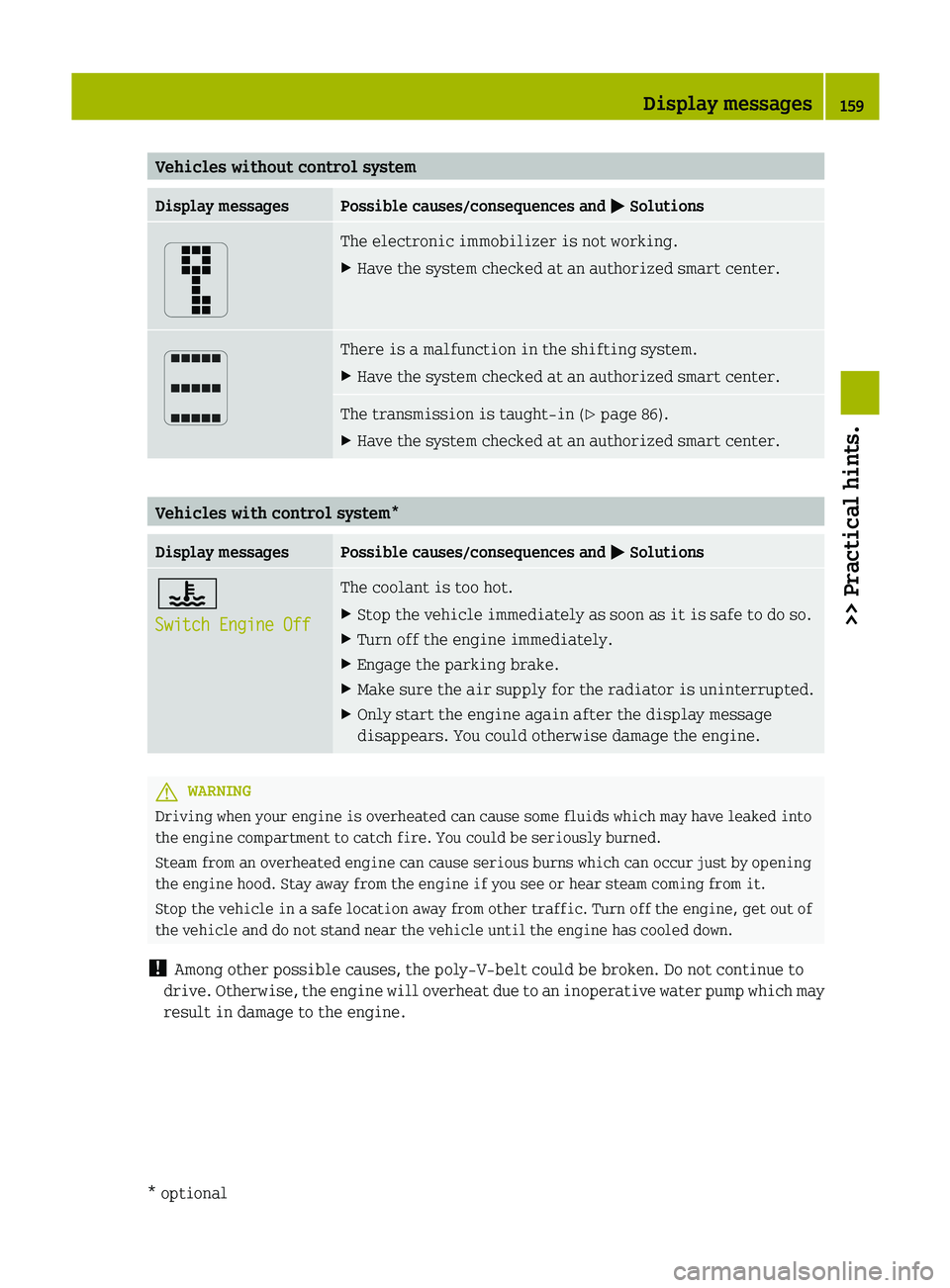
Vehicles without control system
Display messages Possible causes/consequences and
M Solutions The electronic immobilizer is not working.
X
Have the system checked at an authorized smart center. There is a malfunction in the shifting system.
X
Have the system checked at an authorized smart center. The transmission is taught-in (
Y page 86).
X Have the system checked at an authorized smart center. Vehicles with control system*
Display messages Possible causes/consequences and
M Solutions?
Switch Engine Off The coolant is too hot.
X
Stop the vehicle immediately as soon as it is safe to do so.
X Turn off the engine immediately.
X Engage the parking brake.
X Make sure the air supply for the radiator is uninterrupted.
X Only start the engine again after the display message
disappears. You could otherwise damage the engine. G
WARNING
Driving when your engine is overheated can cause some fluids which may have leaked into
the engine compartment to catch fire. You could be seriously burned.
Steam from an overheated engine can cause serious burns which can occur just by opening
the engine hood. Stay away from the engine if you see or hear steam coming from it.
Stop the vehicle in a safe location away from other traffic. Turn off the engine, get out of
the vehicle and do not stand near the vehicle until the engine has cooled down.
! Among other possible causes, the poly-V-belt could be broken. Do not continue to
drive.
Otherwise, the engine will overheat due to an inoperative water pump which may
result in damage to the engine. Display messages
159
>> Practical hints.
* optional Z
Page 172 of 228
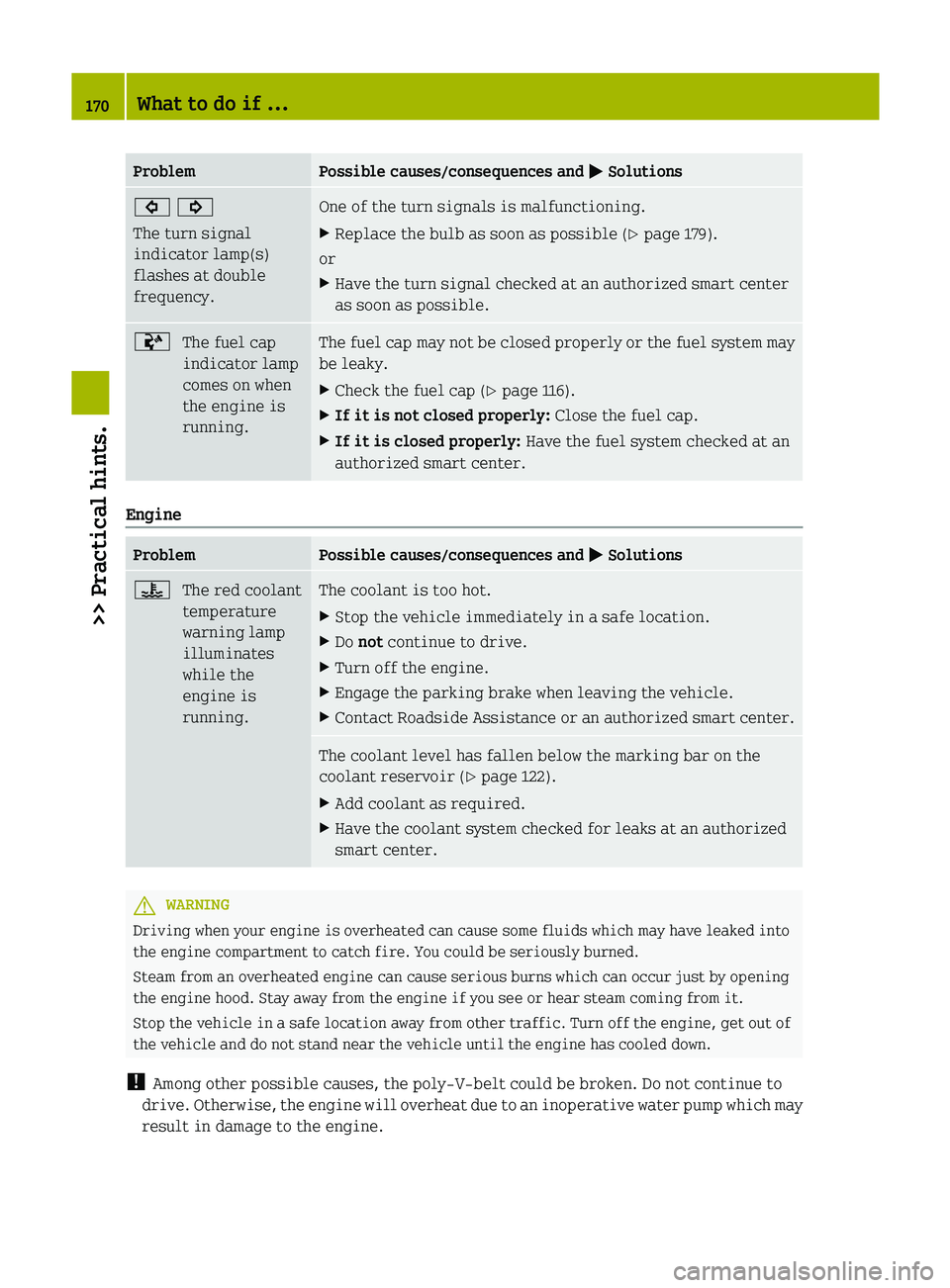
Problem Possible causes/consequences and
M Solutions# !
The turn signal
indicator lamp(s)
flashes at double
frequency. One of the turn signals is malfunctioning.
X
Replace the bulb as soon as possible ( Y page 179).
or
X Have the turn signal checked at an authorized smart center
as soon as possible. ®
The fuel cap
indicator lamp
comes on when
the engine is
running. The fuel cap may not be closed properly or the fuel system may
be leaky.
X
Check the fuel cap ( Y page 116).
X If it is not closed properly: Close the fuel cap.
X If it is closed properly: Have the fuel system checked at an
authorized smart center. Engine
Problem Possible causes/consequences and
M Solutions?
The red coolant
temperature
warning lamp
illuminates
while the
engine is
running. The coolant is too hot.
X
Stop the vehicle immediately in a safe location.
X Do not continue to drive.
X Turn off the engine.
X Engage the parking brake when leaving the vehicle.
X Contact Roadside Assistance or an authorized smart center. The coolant level has fallen below the marking bar on the
coolant reservoir (Y page 122).
X
Add coolant as required.
X Have the coolant system checked for leaks at an authorized
smart center. G
WARNING
Driving when your engine is overheated can cause some fluids which may have leaked into
the engine compartment to catch fire. You could be seriously burned.
Steam from an overheated engine can cause serious burns which can occur just by opening
the engine hood. Stay away from the engine if you see or hear steam coming from it.
Stop the vehicle in a safe location away from other traffic. Turn off the engine, get out of
the vehicle and do not stand near the vehicle until the engine has cooled down.
! Among other possible causes, the poly-V-belt could be broken. Do not continue to
drive.
Otherwise, the engine will overheat due to an inoperative water pump which may
result in damage to the engine. 170
What to do if ...
>> Practical hints.
Page 222 of 228
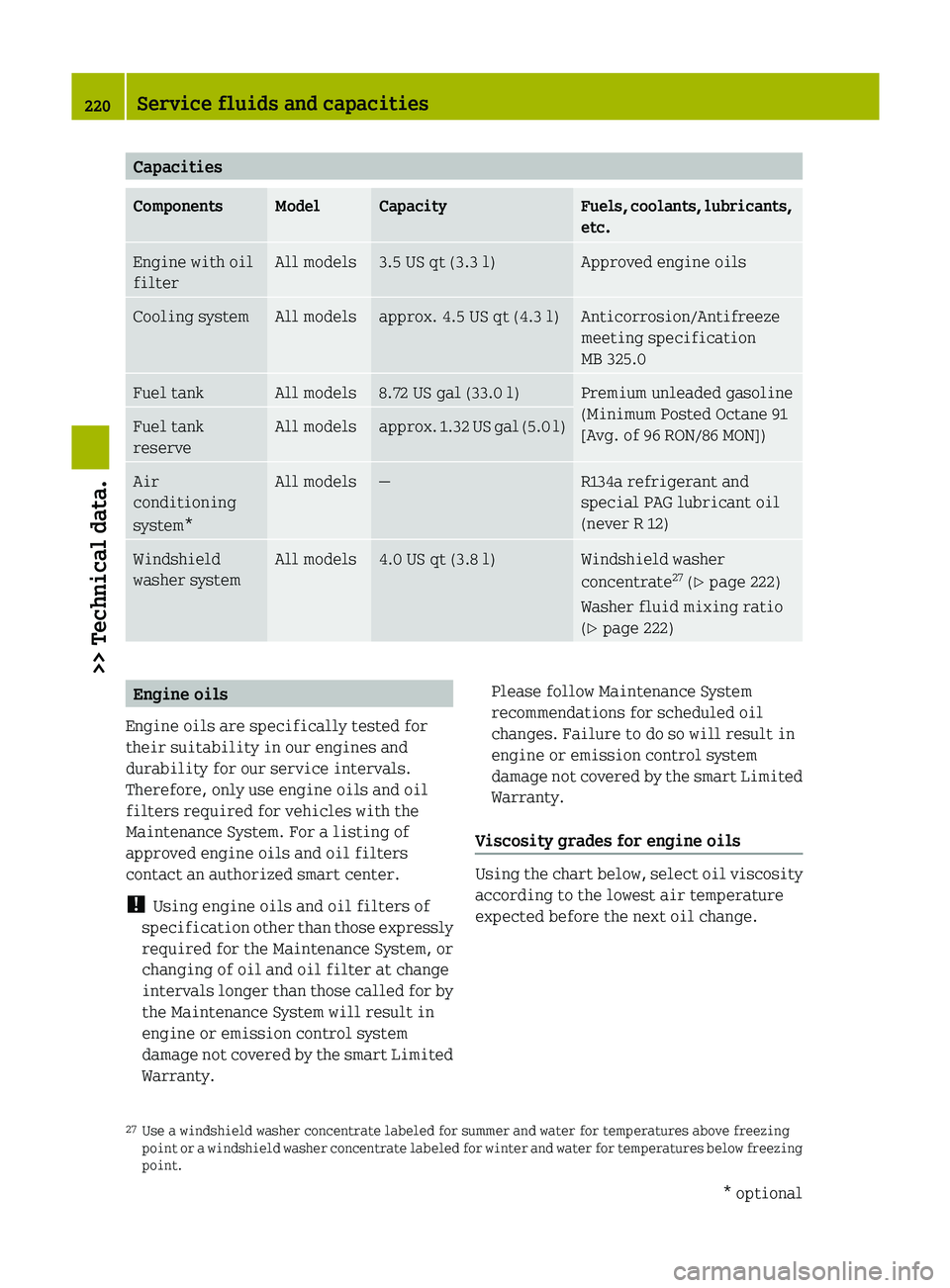
Capacities
Components Model Capacity Fuels, coolants, lubricants,
etc.
Engine with oil
filter All models 3.5 US qt (3.3 l) Approved engine oils
Cooling system All models approx. 4.5 US qt (4.3 l) Anticorrosion/Antifreeze
meeting specification
MB 325.0
Fuel tank All models 8.72 US gal (33.0 l) Premium unleaded gasoline
(Minimum Posted Octane 91
[Avg. of 96 RON/86 MON])
Fuel tank
reserve All models approx. 1.32 US gal (5.0 l)
Air
conditioning
system* All models — R134a refrigerant and
special PAG lubricant oil
(never R 12)
Windshield
washer system All models 4.0 US qt (3.8 l) Windshield washer
concentrate
27
(Y page 222)
Washer fluid mixing ratio
(Y page 222) Engine oils
Engine oils are specifically tested for
their suitability in our engines and
durability for our service intervals.
Therefore, only use engine oils and oil
filters required for vehicles with the
Maintenance System. For a listing of
approved engine oils and oil filters
contact an authorized smart center.
! Using engine oils and oil filters of
specification
other than those expressly
required for the Maintenance System, or
changing of oil and oil filter at change
intervals longer than those called for by
the Maintenance System will result in
engine or emission control system
damage not covered by the smart Limited
Warranty. Please follow Maintenance System
recommendations for scheduled oil
changes. Failure to do so will result in
engine or emission control system
damage
not covered by the smart Limited
Warranty.
Viscosity grades for engine oils Using the chart below, select oil viscosity
according to the lowest air temperature
expected before the next oil change.
27 Use a windshield washer concentrate labeled for summer and water for temperatures above freezing
point
or a windshield washer concentrate labeled for winter and water for temperatures below freezing
point. 220
Service fluids and capacities
>> Technical data.
* optional
Page 225 of 228
are prohibited when windshield washer
concentrate is being handled.
Coolants
The engine coolant is a mixture of water
and anticorrosion/antifreeze, which
provides:
R Corrosion protection
R Freeze protection
R Boiling protection (by increasing the
boiling point)
The
cooling system was filled at the factory
with a coolant providing freeze protection
to approximately -35¦ (-37 ¥) and
corrosion protection.
! Add premixed coolant solution only.
Adding water and MB 325.0
Anticorrosion/Antifreeze separately
from each other, could cause engine
damage not covered by the smart Limited
Warranty.
If the antifreeze mixture is effective to
-35¦ (-37 ¥), the boiling point of the
coolant in the pressurized cooling system
is reached at approximately 266 ¦
(130¥ ).
The coolant solution must be used year
round, even in countries which have high
temperatures to provide the necessary
corrosion protection and increase
boil‑over protection. Refer to
Maintenance/ Service Booklet for
replacement interval.
Coolant system design and coolant used
determine the replacement interval. The
replacement interval published in the
Maintenance booklet is only applicable if
MB 325.0 Anticorrosion/Antifreeze
solution or other smart approved products
of equal specification are used to renew
the coolant concentration or bring it back
up to the proper level. For information on other smart approved
products
of equal specification, contact an
authorized smart center.
To provide important corrosion
protection, the solution must be at least
50% anticorrosion/antifreeze (equivalent
to freeze protection to approximately
-35¦ [-37 ¥]).
If you use a solution that is more than 55%
anticorrosion/antifreeze (freeze
protection to approximately -49¦
[(-45 ¥]), the engine temperature will
increase due to the lower heat transfer
capability of the solution. Therefore, do
not use more than this amount of
anticorrosion/antifreeze.
If the coolant level is low, water and
MB 325.0 Anticorrosion/Antifreeze should
be used to bring it up to the proper level
(have cooling system checked for signs of
leakage). Please make sure the mixture is
in accordance with label instructions.
Always use anticorrosion/antifreeze that
has been approved by smart. For
information contact an authorized smart
center.
The water in the cooling system must meet
minimum requirements, which are usually
satisfied by normal drinking water.
If you are not sure about the water quality,
consult an authorized smart center.
Anticorrosion/antifreeze Your vehicle contains a number of
aluminum parts. The use of aluminum
components in motor vehicle engines
necessitates that anticorrosion/
antifreeze
coolant used in such engines be
specifically formulated to protect the
aluminum parts.
Failure to use such anticorrosion/
antifreeze coolant will result in a
significantly shortened service life.
Therefore, the following product is
strongly recommended for use in your Service fluids and capacities
223
>> Technical data. Z