fuel cap SMART FORTWO COUPE 2012 User Guide
[x] Cancel search | Manufacturer: SMART, Model Year: 2012, Model line: FORTWO COUPE, Model: SMART FORTWO COUPE 2012Pages: 228, PDF Size: 12.76 MB
Page 178 of 228
Problem Possible causes/consequences and
M SolutionsA warning signal
sounds when parking. You have not engaged the parking brake before releasing the
brake pedal, turning off the engine, and switching off the
ignition.
X
Switch on the ignition to deactivate the acoustic warning.
X Engage the parking brake.
X Make sure the gear selector lever is in park position P.
X Turn the key to starter switch position 0.
X Remove the key from the starter switch.
For safety, it is important that you perform the parking
procedure as described (Y page 80). You can hear a
continuous
noise from
the front axle when
braking. The vehicle is equipped with a mechanical/acoustic brake pad
indicator.
X
Have the brake pads checked at an authorized smart center. Unlocking/locking manually
Unlocking the vehicle
You can unlock the driver’s door and the
fuel filler flap by unlocking the driver’s
door using the key. The lock cylinder is
fitted with a cap.
X Press button # on the key.
The anti-theft warning system* is
disarmed.
i If the transmitter battery in the key is
discharged, the anti-theft warning
system* can no longer be disarmed with
button # on the key.
For replacing the transmitter battery
(Y page 177).
Unlocking the vehicle with the key and
opening a door or the tailgate will
trigger the anti-theft warning system*
(Y page 48).
To cancel the alarm:
X Insert the key in the starter switch.
X Turn the key to starter switch position 1. X
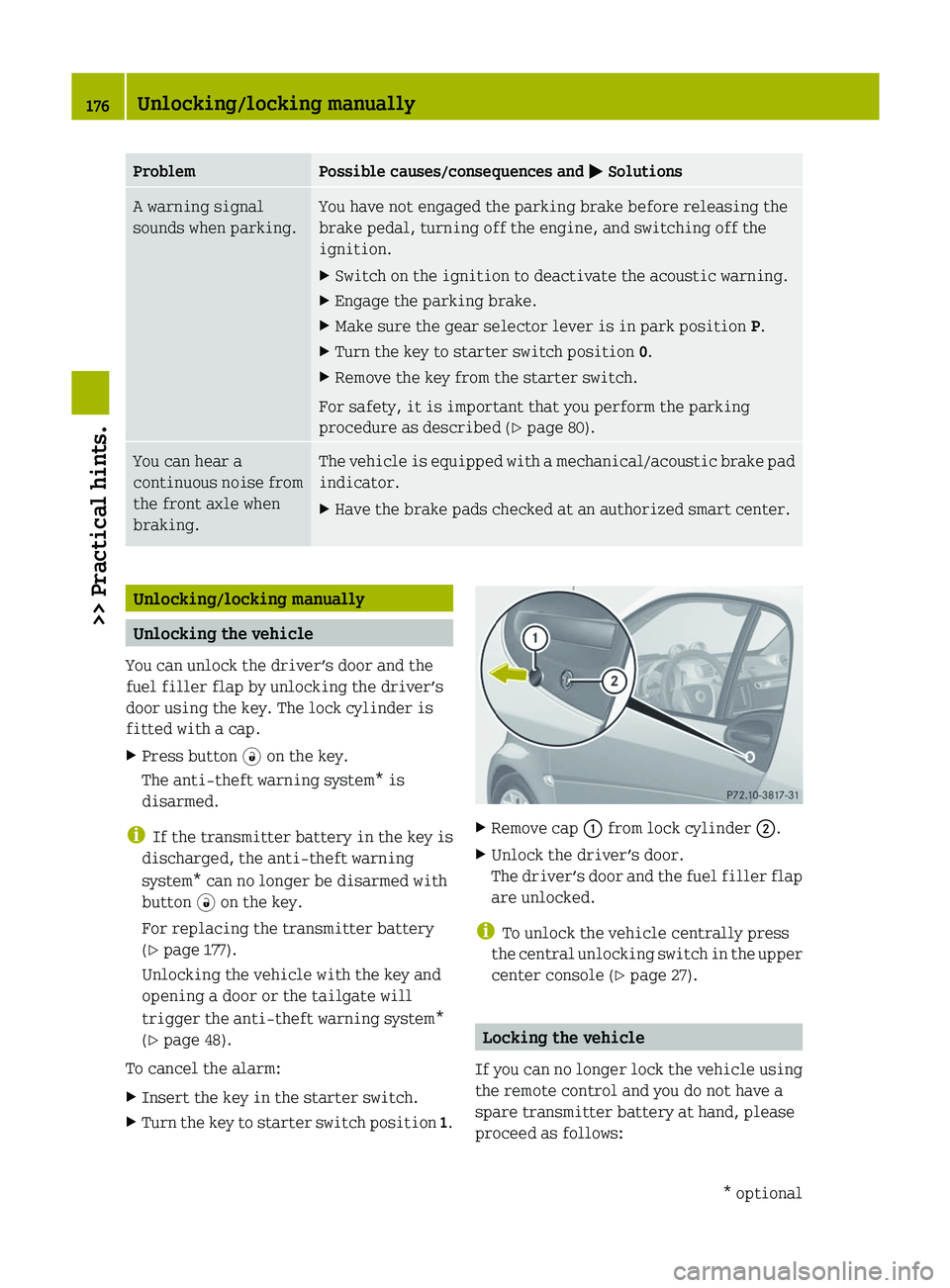
Remove cap : from lock cylinder ;.
X Unlock the driver’s door.
The
driver’s door and the fuel filler flap
are unlocked.
i To unlock the vehicle centrally press
the
central unlocking switch in the upper
center console ( Y page 27). Locking the vehicle
If
you can no longer lock the vehicle using
the remote control and you do not have a
spare transmitter battery at hand, please
proceed as follows: 176
Unlocking/locking manually
>> Practical hints.
* optional
Page 192 of 228
X
Place the tire repair kit securely in the
vehicle.
X Drive off immediately.
The tire sealant will distribute itself
evenly inside the tire. G
WARNING
Do not exceed vehicle speed of 50 mph
(80 km/h). A tire sealant repair is not
designed to operate at higher speeds.
The sticker must be attached on the
instrument cluster where it will be easily
seen by the driver.
Vehicle handling characteristics of a tire
sealant repaired tire may change. Adapt
your driving accordingly.
X After driving for about 1.8 miles (3 km)
or
ten minutes, stop and exit the vehicle
taking all of the appropriate safety
precautions.
X Take the tire repair kit from the vehicle.
X Screw the end of filler hose ? onto tire
valve G.
X Check the tire inflation pressure using
pressure gauge ;. G
WARNING
If tire inflation pressure has fallen below
130 kPa (1.3 bar, 19 psi) do not continue to
drive the vehicle.
Park your vehicle safely away from the
roadway and contact the nearest smart
center or call Roadside Assistance.
Have the damaged tire replaced.
X If the tire inflation pressure is at least
130
kPa (1.3 bar, 19 psi), inflate or deflate
the tire to correct tire inflation
pressure (see Tire and Loading
Information placard located on the
driver’s door B‑pillar). R
To increase the tire inflation
pressure: Switch on the electric air
pump.
R To decrease the tire inflation
pressure:
Open vent screw =. Recheck
the tire inflation pressure with the
electric air pump’s pressure gauge.
X After checking the tire inflation
pressure, unscrew the end of filler
hose ? from tire valve G.
X Screw the valve cap onto the tire valve.
X Plug filler hose with the stopper.
X Place the tire repair kit securely in the
vehicle.
! The manufacturer is unable to
guarantee that all tire punctures can be
repaired with the tire repair kit, in
particular cuts or perforations larger
than
approximately 0.16 in (4 mm) or away
from the tire’s tread. The manufacturer
is not liable for damage sustained
through improper use of the tire repair
kit. G
WARNING
Follow recommended tire inflation
pressures.
Do not underinflate tires. Underinflated
tires wear excessively and/or unevenly,
adversely affect handling and fuel
economy, and are more likely to fail from
being overheated.
Do not overinflate tires. Overinflated
tires can adversely affect handling and
ride comfort, wear unevenly, increase
stopping distance, and result in sudden
deflation (blowout) because they are more
likely to become punctured or damaged by
road debris, potholes etc.
Do not overload the tires by exceeding the
specified load limit as indicated on the
Tire and Loading Information placard on
the
driver’s door B‑pillar. Overloading the
tires can overheat them, possibly causing
a blowout. Overloading the tires can also 190
Flat tire
>> Practical hints.
Page 195 of 228
Information placard located on the
driver’s door B‑pillar).
R
To increase the tire inflation
pressure: Switch on the electric air
pump.
R To decrease the tire inflation
pressure: Press deflate button D.
Recheck the tire inflation pressure
with the electric air pump’s pressure
gauge E.
X When the tire inflation pressure is
correct, unscrew the end of filler
hose ? from tire valve C.
X Screw the valve cap onto the tire valve. X
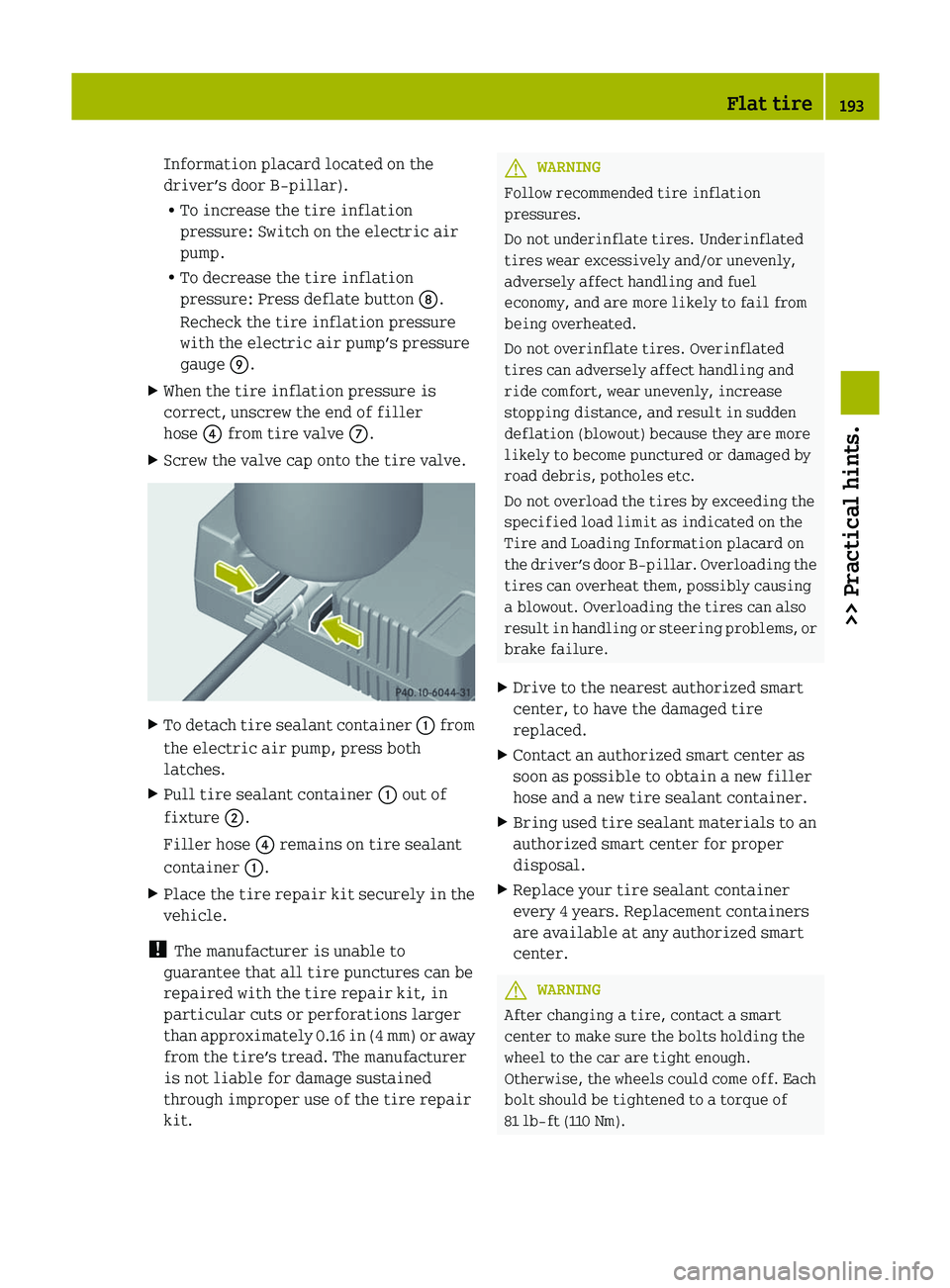
To detach tire sealant container : from
the electric air pump, press both
latches.
X Pull tire sealant container : out of
fixture ;.
Filler hose ? remains on tire sealant
container :.
X Place the tire repair kit securely in the
vehicle.
! The manufacturer is unable to
guarantee that all tire punctures can be
repaired with the tire repair kit, in
particular cuts or perforations larger
than
approximately 0.16 in (4 mm) or away
from the tire’s tread. The manufacturer
is not liable for damage sustained
through improper use of the tire repair
kit. G
WARNING
Follow recommended tire inflation
pressures.
Do not underinflate tires. Underinflated
tires wear excessively and/or unevenly,
adversely affect handling and fuel
economy, and are more likely to fail from
being overheated.
Do not overinflate tires. Overinflated
tires can adversely affect handling and
ride comfort, wear unevenly, increase
stopping distance, and result in sudden
deflation (blowout) because they are more
likely to become punctured or damaged by
road debris, potholes etc.
Do not overload the tires by exceeding the
specified load limit as indicated on the
Tire and Loading Information placard on
the
driver’s door B‑pillar. Overloading the
tires can overheat them, possibly causing
a blowout. Overloading the tires can also
result in handling or steering problems, or
brake failure.
X Drive to the nearest authorized smart
center, to have the damaged tire
replaced.
X Contact an authorized smart center as
soon as possible to obtain a new filler
hose and a new tire sealant container.
X Bring used tire sealant materials to an
authorized smart center for proper
disposal.
X Replace your tire sealant container
every 4 years. Replacement containers
are available at any authorized smart
center. G
WARNING
After changing a tire, contact a smart
center to make sure the bolts holding the
wheel to the car are tight enough.
Otherwise, the wheels could come off. Each
bolt should be tightened to a torque of
81 lb‑ft (110 Nm). Flat tire
193
>> Practical hints. Z
Page 222 of 228
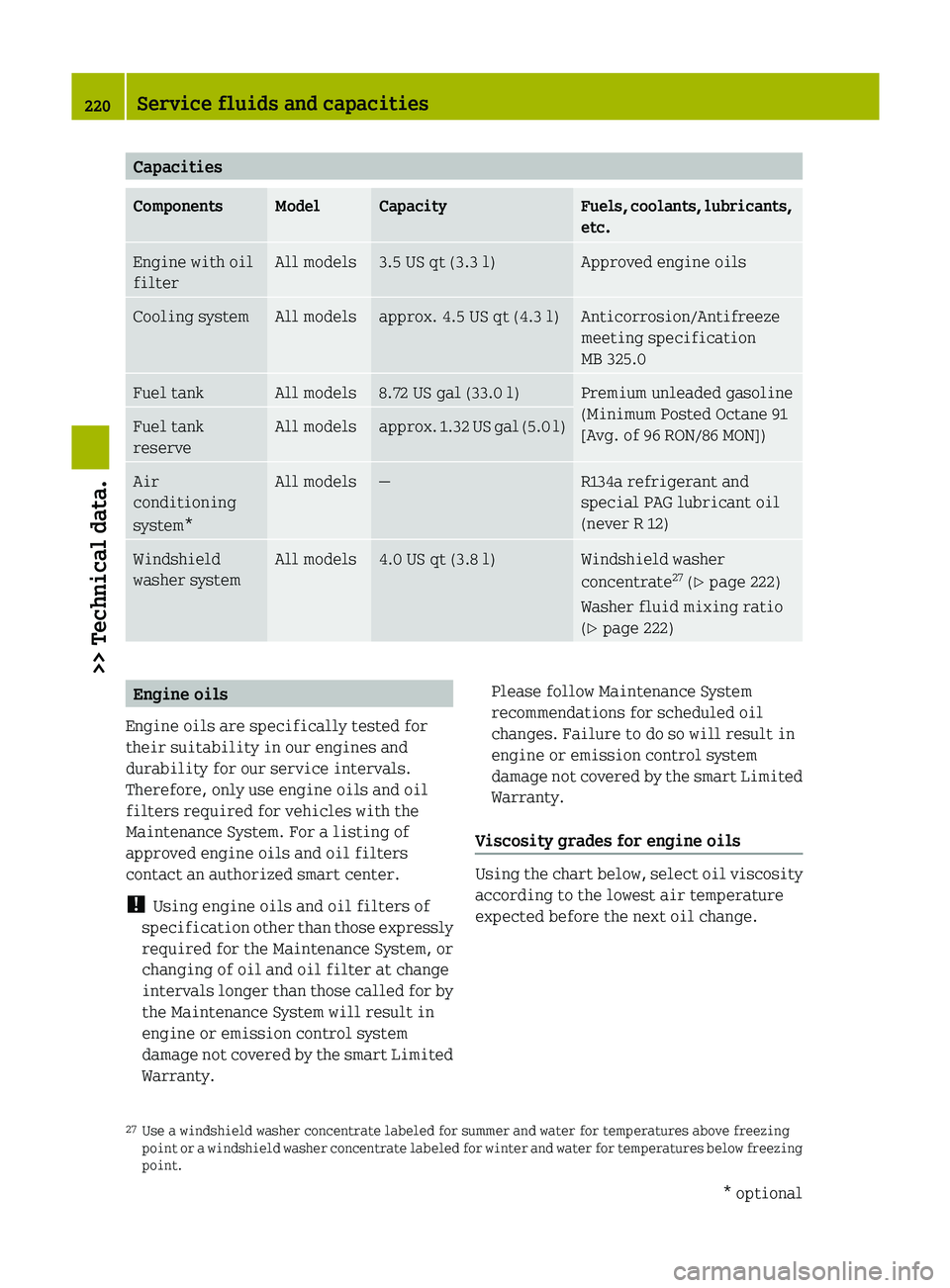
Capacities
Components Model Capacity Fuels, coolants, lubricants,
etc.
Engine with oil
filter All models 3.5 US qt (3.3 l) Approved engine oils
Cooling system All models approx. 4.5 US qt (4.3 l) Anticorrosion/Antifreeze
meeting specification
MB 325.0
Fuel tank All models 8.72 US gal (33.0 l) Premium unleaded gasoline
(Minimum Posted Octane 91
[Avg. of 96 RON/86 MON])
Fuel tank
reserve All models approx. 1.32 US gal (5.0 l)
Air
conditioning
system* All models — R134a refrigerant and
special PAG lubricant oil
(never R 12)
Windshield
washer system All models 4.0 US qt (3.8 l) Windshield washer
concentrate
27
(Y page 222)
Washer fluid mixing ratio
(Y page 222) Engine oils
Engine oils are specifically tested for
their suitability in our engines and
durability for our service intervals.
Therefore, only use engine oils and oil
filters required for vehicles with the
Maintenance System. For a listing of
approved engine oils and oil filters
contact an authorized smart center.
! Using engine oils and oil filters of
specification
other than those expressly
required for the Maintenance System, or
changing of oil and oil filter at change
intervals longer than those called for by
the Maintenance System will result in
engine or emission control system
damage not covered by the smart Limited
Warranty. Please follow Maintenance System
recommendations for scheduled oil
changes. Failure to do so will result in
engine or emission control system
damage
not covered by the smart Limited
Warranty.
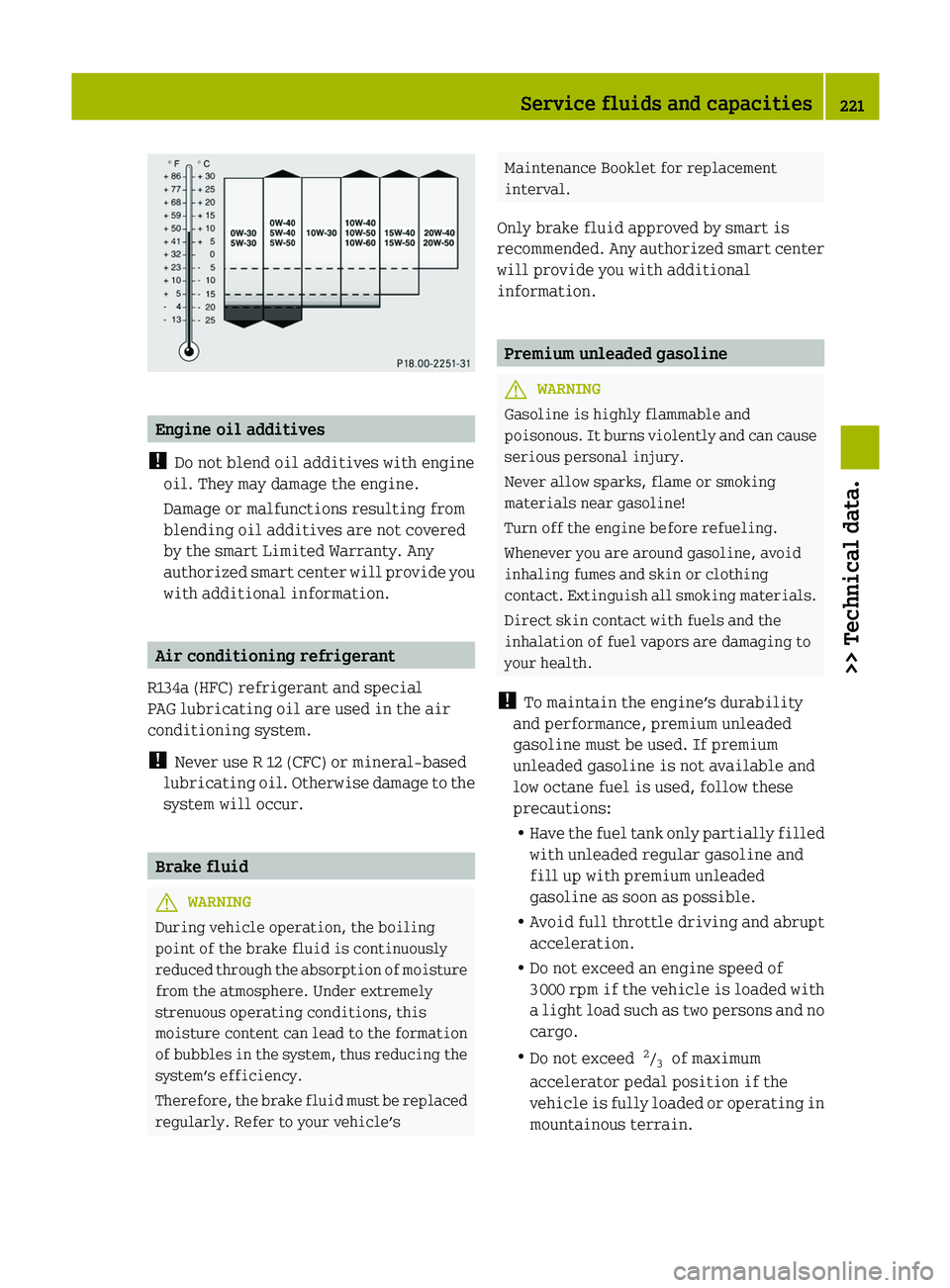
Viscosity grades for engine oils Using the chart below, select oil viscosity
according to the lowest air temperature
expected before the next oil change.
27 Use a windshield washer concentrate labeled for summer and water for temperatures above freezing
point
or a windshield washer concentrate labeled for winter and water for temperatures below freezing
point. 220
Service fluids and capacities
>> Technical data.
* optional
Page 223 of 228
Engine oil additives
! Do not blend oil additives with engine
oil. They may damage the engine.
Damage or malfunctions resulting from
blending oil additives are not covered
by the smart Limited Warranty. Any
authorized
smart center will provide you
with additional information. Air conditioning refrigerant
R134a (HFC) refrigerant and special
PAG lubricating oil are used in the air
conditioning system.
! Never use R 12 (CFC) or mineral-based
lubricating
oil. Otherwise damage to the
system will occur. Brake fluid
G
WARNING
During vehicle operation, the boiling
point of the brake fluid is continuously
reduced
through the absorption of moisture
from the atmosphere. Under extremely
strenuous operating conditions, this
moisture content can lead to the formation
of bubbles in the system, thus reducing the
system’s efficiency.
Therefore, the brake fluid must be replaced
regularly. Refer to your vehicle’s Maintenance Booklet for replacement
interval.
Only brake fluid approved by smart is
recommended.
Any authorized smart center
will provide you with additional
information. Premium unleaded gasoline
G
WARNING
Gasoline is highly flammable and
poisonous.
It burns violently and can cause
serious personal injury.
Never allow sparks, flame or smoking
materials near gasoline!
Turn off the engine before refueling.
Whenever you are around gasoline, avoid
inhaling fumes and skin or clothing
contact. Extinguish all smoking materials.
Direct skin contact with fuels and the
inhalation of fuel vapors are damaging to
your health.
! To maintain the engine’s durability
and performance, premium unleaded
gasoline must be used. If premium
unleaded gasoline is not available and
low octane fuel is used, follow these
precautions:
R Have the fuel tank only partially filled
with unleaded regular gasoline and
fill up with premium unleaded
gasoline as soon as possible.
R Avoid full throttle driving and abrupt
acceleration.
R Do not exceed an engine speed of
3 000 rpm if the vehicle is loaded with
a light load such as two persons and no
cargo.
R Do not exceed 2
/ 3 of maximum
accelerator pedal position if the
vehicle is fully loaded or operating in
mountainous terrain. Service fluids and capacities
221
>> Technical data. Z
Page 224 of 228
Fuel requirements
Only use premium unleaded fuel. The octane
number (posted at the pump) must be 91 min.
It is an average of both the Research Octane
Number (RON) and the Motor Octane Number
(MON): (RON+MON)/2. This is also known as
the ANTI‑KNOCK INDEX.
Unleaded gasoline containing oxygenates
such as ethanol, IPA, IBA and TBA can be
used provided the ratio of any one of these
oxygenates to gasoline does not exceed
10%; MTBE must not exceed 15%.
The ratio of methanol to gasoline must not
exceed 3% plus additional cosolvents.
Using mixtures of ethanol and methanol is
not allowed. Gasohol, which contains 10%
ethanol and 90% unleaded gasoline, can be
used.
These blends must also meet all other fuel
requirements, such as resistance to spark
knock, boiling range, vapor pressure, etc. Gasoline additives
A major concern among engine
manufacturers is carbon build-up caused
by
gasoline. smart recommends only the use
of quality gasoline containing additives
that prevent the build-up of carbon
deposits.
After an extended period of using fuels
without such additives carbon deposits can
build up, especially on the intake valves
and in the combustion area, leading to
engine performance problems such as:
R Warm-up hesitation
R Unstable idle
R Knocking/pinging
R Misfire
R Power loss
In areas where carbon deposits may be
encountered due to lack of availability of
gasolines which contain these additives, the use of smart approved additives is
recommended.
Contact an authorized smart
center for a listing of approved products.
Follow directions on the product label.
Do not blend other fuel additives with fuel.
This only results in unnecessary costs and
may be harmful to the engine operation.
! Damage or malfunction resulting from
poor fuel quality or from blending
additional fuel additives other than
those tested and approved by us for use
on smart vehicles are not covered by the
smart Limited Warranty. Windshield/rear window washer system
During all seasons:
X Use a windshield washer concentrate
labeled for summer and water for
temperatures above freezing point.
X Use a windshield washer concentrate
labeled for winter and water for
temperatures below freezing point.
X Premix the windshield washer fluid in a
suitable container depending on the
outside temperature and in accordance
with the manufacturer’s instructions 28
.
Washer fluid mixing ratio R
Temperature above 32 ¦ (0¥):
1 part windshield washer concentrate
labeled for summer to 100 parts water
R Temperature of 14 ¦ (-10¥):
1 part windshield washer concentrate
labeled for winter to 2 parts water
R Temperature of -4¦ (-20¥):
1 part windshield washer concentrate
labeled for winter to 1 part water G
WARNING
Windshield washer concentrate is highly
flammable.
Fire, naked flames and smoking
28 Refer to the notes for use on the container.222
Service fluids and capacities
>> Technical data.