ECU SMART FORTWO COUPE 2012 Owner's Manual
[x] Cancel search | Manufacturer: SMART, Model Year: 2012, Model line: FORTWO COUPE, Model: SMART FORTWO COUPE 2012Pages: 228, PDF Size: 12.76 MB
Page 115 of 228
B‑pillar (Y page 214). In addition, the
load must be distributed in such a way so
that the weight on each axle never exceeds
the
Gross Axle Weight Rating (GAWR) for the
front and rear axle. The GVWR and GAWR for
your vehicle are indicated on the
certification label which can be found on
the driver’s door B‑pillar.
For more information, see “Loading the
vehicle” ( Y page 130).
The handling characteristics of a fully
loaded vehicle depend greatly on the load
distribution. It is therefore recommended
to load the vehicle with the heaviest items
being placed towards the front of the
vehicle.
Please pay attention to and comply with the
following instructions when loading the
vehicle and transporting cargo:
R Always place items being carried
against seat backrests, and fasten them
as securely as possible.
R The heaviest portion of the cargo should
always be kept as low as possible against
seat backrests.
R Do not stack loads higher than the top
edge of the head restraints.
R Make sure no luggage/cargo items can get
above or next to the driver’s and/or
passenger seat into the passenger
compartment.
R Make sure luggage/cargo is properly
secured.
R Always use, if so equipped, cargo net*
when transporting cargo.
Do not carry any unnecessary weight in the
vehicle. This increases vehicle weight,
which results in increased energy
consumption. Useful features
Sun visors
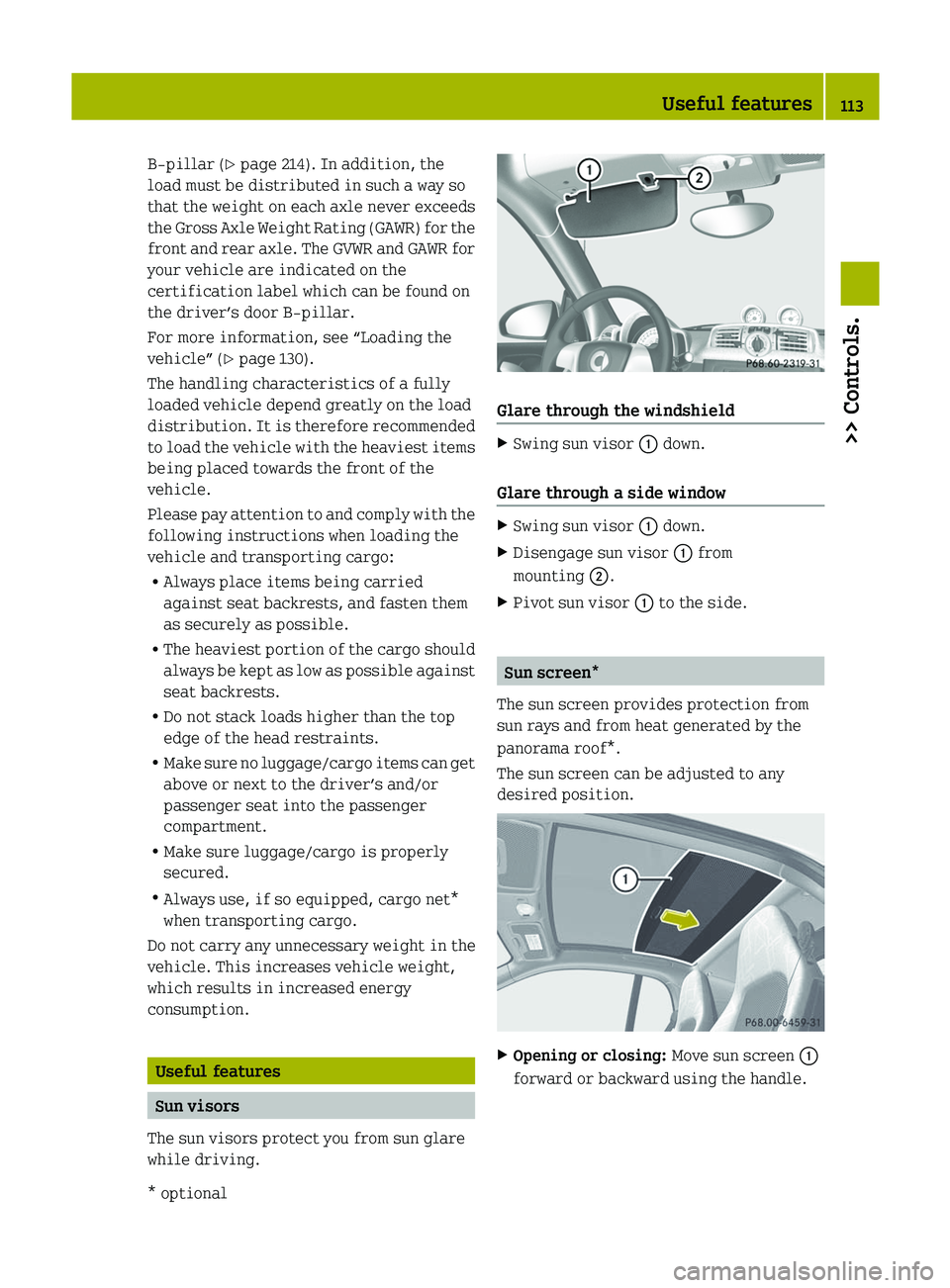
The sun visors protect you from sun glare
while driving. Glare through the windshield
X
Swing sun visor : down.
Glare through a side window X
Swing sun visor : down.
X Disengage sun visor : from
mounting ;.
X Pivot sun visor : to the side. Sun screen*
The sun screen provides protection from
sun rays and from heat generated by the
panorama roof*.
The sun screen can be adjusted to any
desired position. X
Opening or closing: Move sun screen :
forward or backward using the handle. Useful features
113
>> Controls.
* optional Z
Page 151 of 228
water being ingested by the engine through
the air intake, causing severe internal
engine damage.
Any
such damage is not covered by the smart
Limited Warranty. Passenger compartment
G
WARNING
Always fasten items being carried as
securely as possible.
In an accident, during hard braking or
sudden maneuvers, loose items thrown
around inside the vehicle may injure
vehicle occupants.
The cargo compartment is the preferred
place to carry objects. Control and operation of radio
transmitters
Radio and telephone G
WARNING
Please do not forget that your primary
responsibility is to drive the vehicle
safely. Only operate the radio or
telephone 16
if road, weather and traffic
conditions permit.
Bear in mind that at a speed of just 30 mph
(approximately 50 km/h), your vehicle is
covering a distance of 44 feet
(approximately 14 m) every second.
Telephones and two-way radios G
WARNING
Never operate radio transmitters equipped
with a built-in or attached antenna (i.e.
without being connected to an external
antenna) from inside the vehicle while the
engine
is running. Doing so could lead to a
malfunction of the vehicle’s electronic system, possibly resulting in an accident
and/or serious personal injury.
Radio
transmitters, such as a mobile phone
or a citizens band unit should only be used
inside the vehicle if they are connected to
an antenna that is installed on the outside
of the vehicle.
Refer to the radio transmitter operation
instructions regarding use of an external
antenna. Emission control
Certain engine systems serve to keep the
toxic components of the exhaust gases
within permissible legal limits.
These systems, of course, will function
properly only when maintained strictly
according to factory specifications.
Any adjustments to the engine should
therefore
be carried out only by qualified
smart center authorized technicians.
Engine adjustments should not be altered
in any way. Moreover, the specified service
jobs must be carried out regularly
according to smart servicing
requirements. For details refer to the
Maintenance Booklet. G
WARNING
Inhalation of exhaust gas is hazardous to
your health. All exhaust gas contains
carbon monoxide (CO), and inhaling it can
cause unconsciousness and lead to death.
Do not run the engine in confined areas
(such as a garage) which are not properly
ventilated. If you think that exhaust gas
fumes are entering the vehicle while
driving, have the cause determined and
corrected immediately. If you must drive
under these conditions, drive only with at
least one window fully open at all times.
16 Observe all legal requirements. Driving instructions
149
>> Operation. Z
Page 187 of 228
tensioning spring could crack the
windshield.
Do
not allow the wiper arms to contact the
windshield glass without a wiper blade
inserted.
We recommend that you have this work
carried out at an authorized smart
center.
To ensure proper visibility
R it is vital that you have wiper blades that
are in perfect shape
R clean the wiper blades regularly with a
cleaning agent
R remove any tough dirt stains with a
sponge or brush Windshield wiper blades
! Do not pull on the wiper blade inserts.
They could tear.
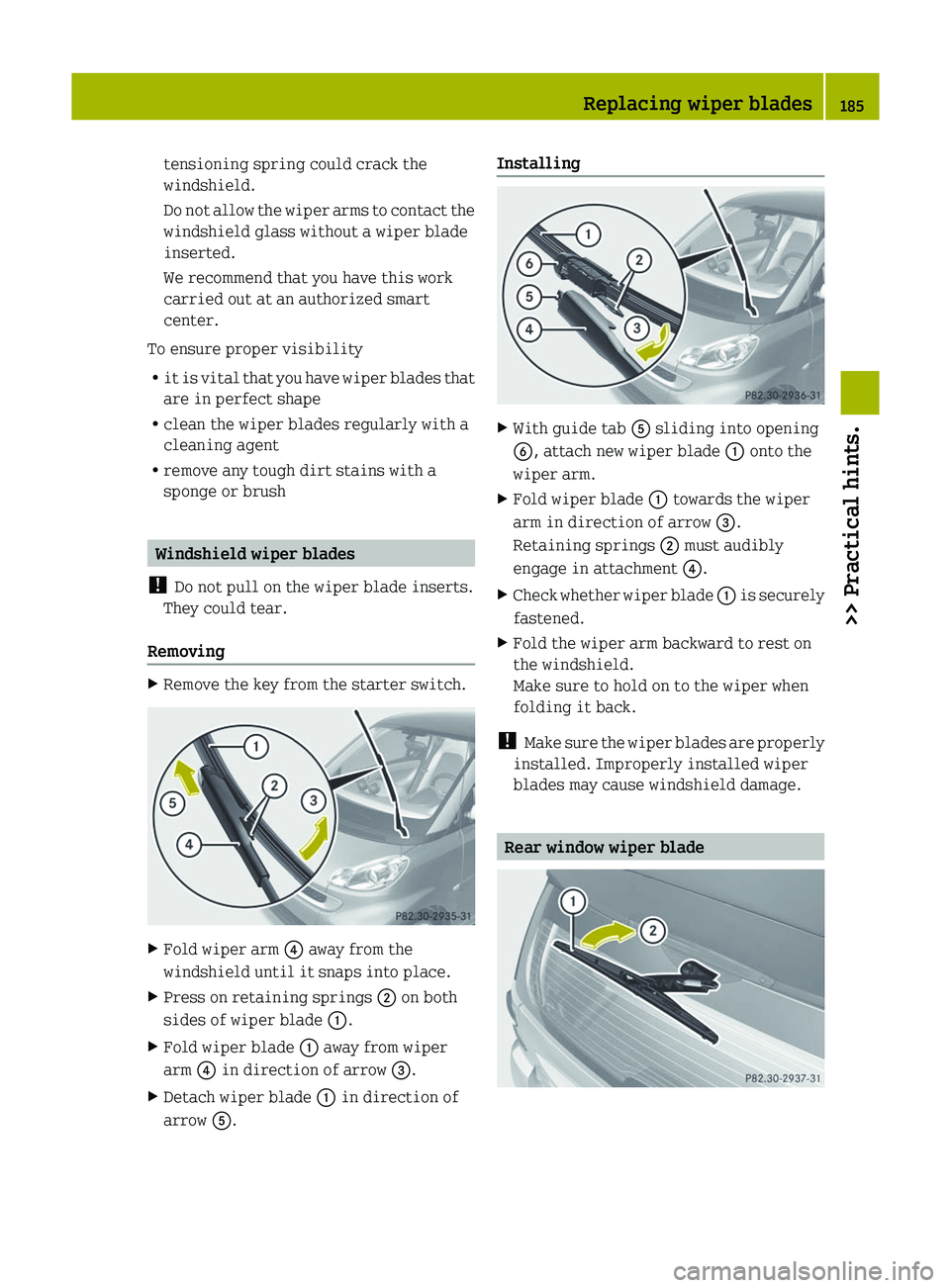
Removing X
Remove the key from the starter switch. X
Fold wiper arm ? away from the
windshield until it snaps into place.
X Press on retaining springs ; on both
sides of wiper blade :.
X Fold wiper blade : away from wiper
arm ? in direction of arrow =.
X Detach wiper blade : in direction of
arrow A. Installing
X
With guide tab A sliding into opening
B, attach new wiper blade : onto the
wiper arm.
X Fold wiper blade : towards the wiper
arm in direction of arrow =.
Retaining springs ; must audibly
engage in attachment ?.
X Check whether wiper blade :
is securely
fastened.
X Fold the wiper arm backward to rest on
the windshield.
Make sure to hold on to the wiper when
folding it back.
! Make
sure the wiper blades are properly
installed. Improperly installed wiper
blades may cause windshield damage. Rear window wiper blade Replacing wiper blades
185
>> Practical hints. Z
Page 192 of 228
X
Place the tire repair kit securely in the
vehicle.
X Drive off immediately.
The tire sealant will distribute itself
evenly inside the tire. G
WARNING
Do not exceed vehicle speed of 50 mph
(80 km/h). A tire sealant repair is not
designed to operate at higher speeds.
The sticker must be attached on the
instrument cluster where it will be easily
seen by the driver.
Vehicle handling characteristics of a tire
sealant repaired tire may change. Adapt
your driving accordingly.
X After driving for about 1.8 miles (3 km)
or
ten minutes, stop and exit the vehicle
taking all of the appropriate safety
precautions.
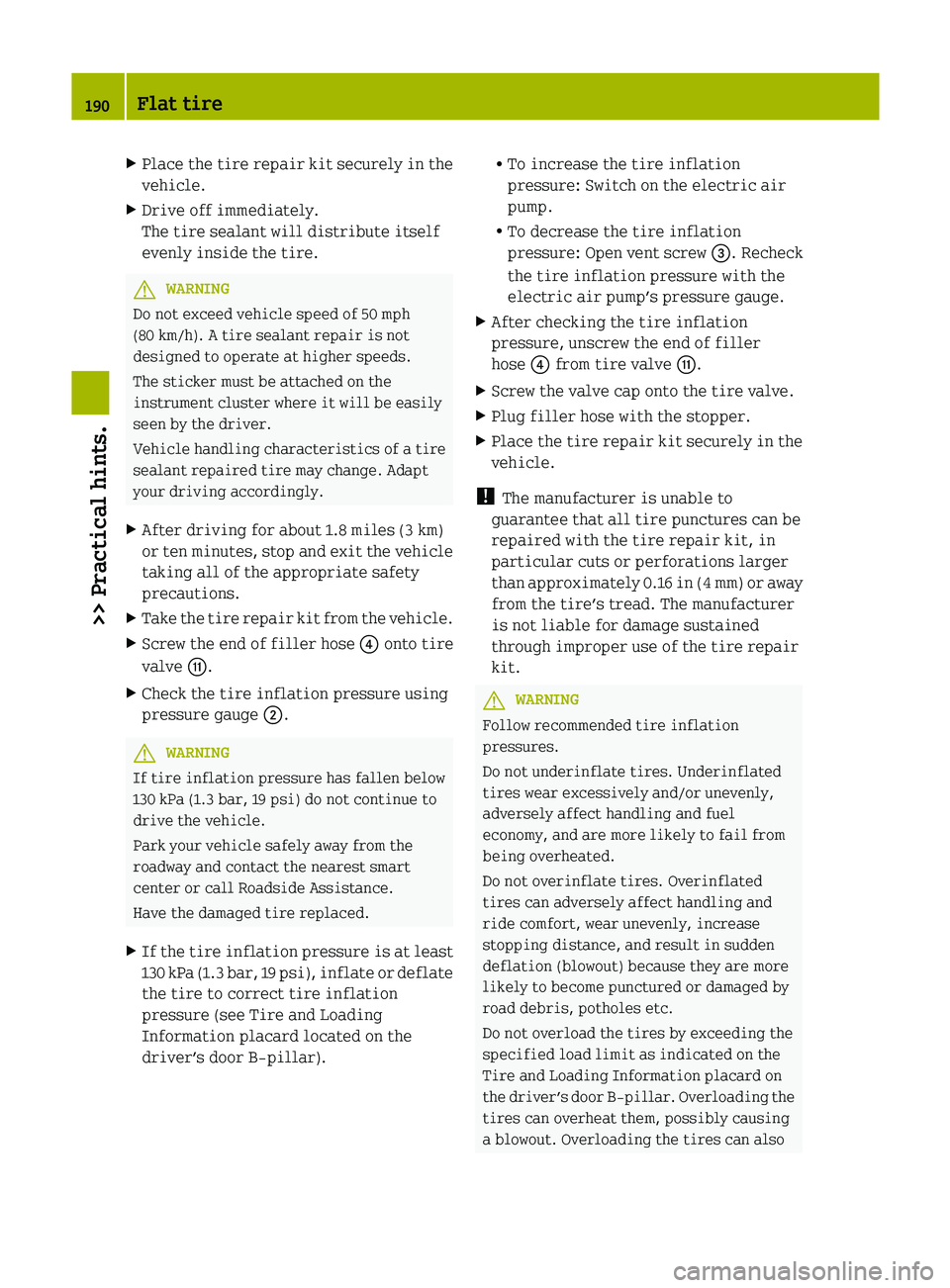
X Take the tire repair kit from the vehicle.
X Screw the end of filler hose ? onto tire
valve G.
X Check the tire inflation pressure using
pressure gauge ;. G
WARNING
If tire inflation pressure has fallen below
130 kPa (1.3 bar, 19 psi) do not continue to
drive the vehicle.
Park your vehicle safely away from the
roadway and contact the nearest smart
center or call Roadside Assistance.
Have the damaged tire replaced.
X If the tire inflation pressure is at least
130
kPa (1.3 bar, 19 psi), inflate or deflate
the tire to correct tire inflation
pressure (see Tire and Loading
Information placard located on the
driver’s door B‑pillar). R
To increase the tire inflation
pressure: Switch on the electric air
pump.
R To decrease the tire inflation
pressure:
Open vent screw =. Recheck
the tire inflation pressure with the
electric air pump’s pressure gauge.
X After checking the tire inflation
pressure, unscrew the end of filler
hose ? from tire valve G.
X Screw the valve cap onto the tire valve.
X Plug filler hose with the stopper.
X Place the tire repair kit securely in the
vehicle.
! The manufacturer is unable to
guarantee that all tire punctures can be
repaired with the tire repair kit, in
particular cuts or perforations larger
than
approximately 0.16 in (4 mm) or away
from the tire’s tread. The manufacturer
is not liable for damage sustained
through improper use of the tire repair
kit. G
WARNING
Follow recommended tire inflation
pressures.
Do not underinflate tires. Underinflated
tires wear excessively and/or unevenly,
adversely affect handling and fuel
economy, and are more likely to fail from
being overheated.
Do not overinflate tires. Overinflated
tires can adversely affect handling and
ride comfort, wear unevenly, increase
stopping distance, and result in sudden
deflation (blowout) because they are more
likely to become punctured or damaged by
road debris, potholes etc.
Do not overload the tires by exceeding the
specified load limit as indicated on the
Tire and Loading Information placard on
the
driver’s door B‑pillar. Overloading the
tires can overheat them, possibly causing
a blowout. Overloading the tires can also 190
Flat tire
>> Practical hints.
Page 194 of 228
You may operate the electrical air pump
again after it has cooled off.
X If a tire inflation pressure of at least
200 kpa (2.0 bar, 29 psi)
is not attained,
turn off the electric air pump by
pressing OFF on electric air pump
switch ?.
X Unscrew the end of filler hose ? from
tire valve C.
X After clearing the area around the
vehicle of people and obstacles, drive
vehicle back or forth very slowly
approximately 30 ft (10 m).
This
serves to better distribute the tire
sealant material inside the tire.
X Screw the end of filler hose ? onto tire
valve C.
X Inflate the tire again. G
WARNING
If a tire inflation pressure of
200
kPa (2.0 bar, 29 psi) is not attained, the
tire is too severely damaged for the tire
sealant to provide a reliable tire repair.
In this case, the tire sealant cannot
properly seal the tire.
Do not drive the vehicle.
Contact the nearest smart center for
assistance or call Roadside Assistance.
X After attaining a tire inflation pressure
of
at least 200 kPa (2.0 bar, 29 psi), press
OFF on electric air pump switch ?.
The electric air pump is switched off.
X Turn the key in the starter switch to
position 0.
X Unscrew the end of filler hose ? from
tire valve C.
X Place the tire repair kit securely in the
vehicle.
X Drive off immediately.
The tire sealant will distribute itself
evenly inside the tire. G
WARNING
Do not exceed vehicle speed of 50 mph
(80 km/h). A tire sealant repair is not
designed to operate at higher speeds.
The sticker must be attached on the
instrument cluster where it will be easily
seen by the driver.
Vehicle handling characteristics of a tire
sealant repaired tire may change. Adapt
your driving accordingly.
X After driving for about 1.8 miles (3 km)
or
ten minutes, stop and exit the vehicle
taking all of the appropriate safety
precautions.
X Take the tire repair kit from the vehicle.
X Screw the end of filler hose ? onto tire
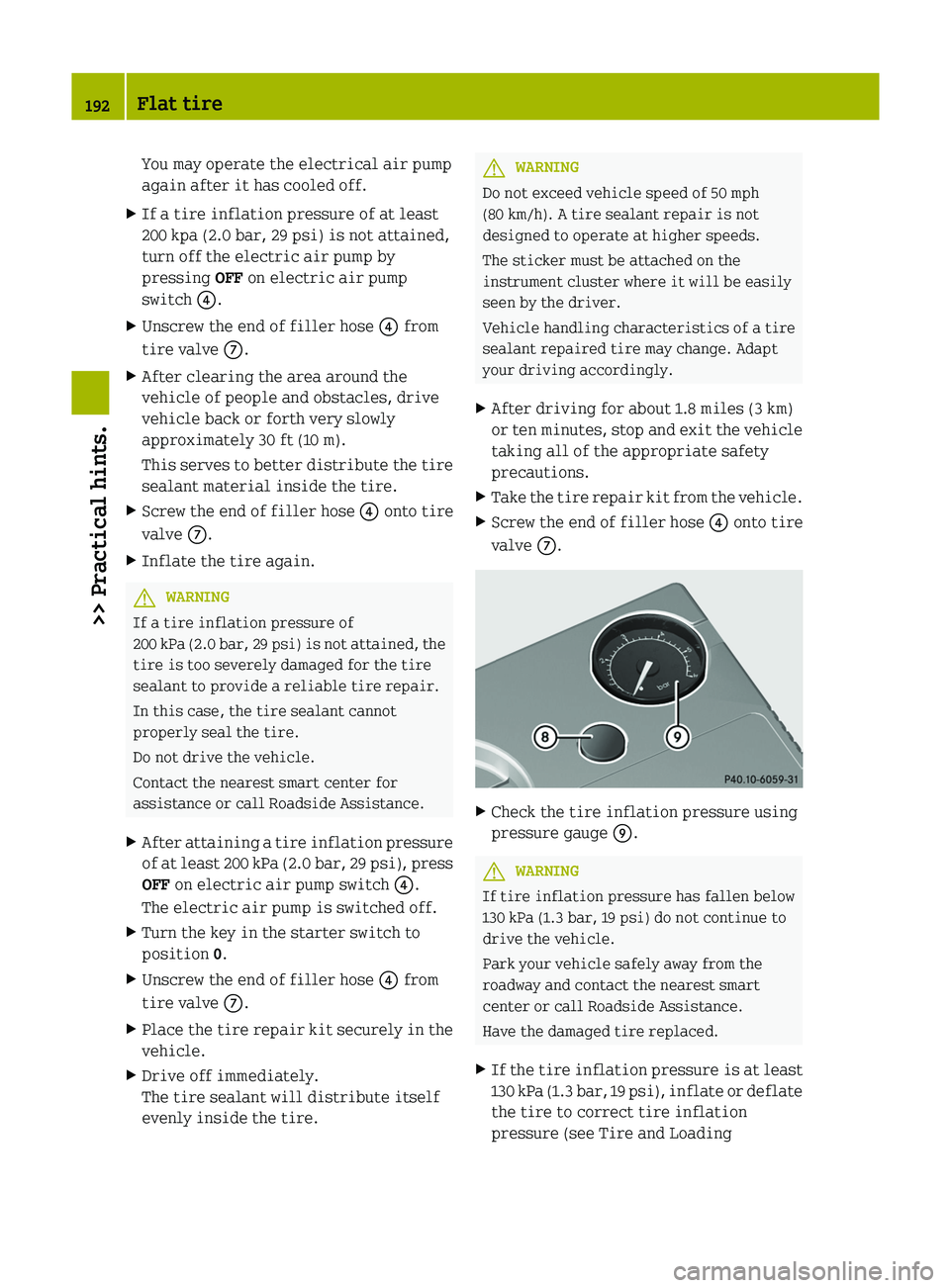
valve C. X
Check the tire inflation pressure using
pressure gauge E. G
WARNING
If tire inflation pressure has fallen below
130 kPa (1.3 bar, 19 psi) do not continue to
drive the vehicle.
Park your vehicle safely away from the
roadway and contact the nearest smart
center or call Roadside Assistance.
Have the damaged tire replaced.
X If the tire inflation pressure is at least
130
kPa (1.3 bar, 19 psi), inflate or deflate
the tire to correct tire inflation
pressure (see Tire and Loading 192
Flat tire
>> Practical hints.
Page 195 of 228
Information placard located on the
driver’s door B‑pillar).
R
To increase the tire inflation
pressure: Switch on the electric air
pump.
R To decrease the tire inflation
pressure: Press deflate button D.
Recheck the tire inflation pressure
with the electric air pump’s pressure
gauge E.
X When the tire inflation pressure is
correct, unscrew the end of filler
hose ? from tire valve C.
X Screw the valve cap onto the tire valve. X
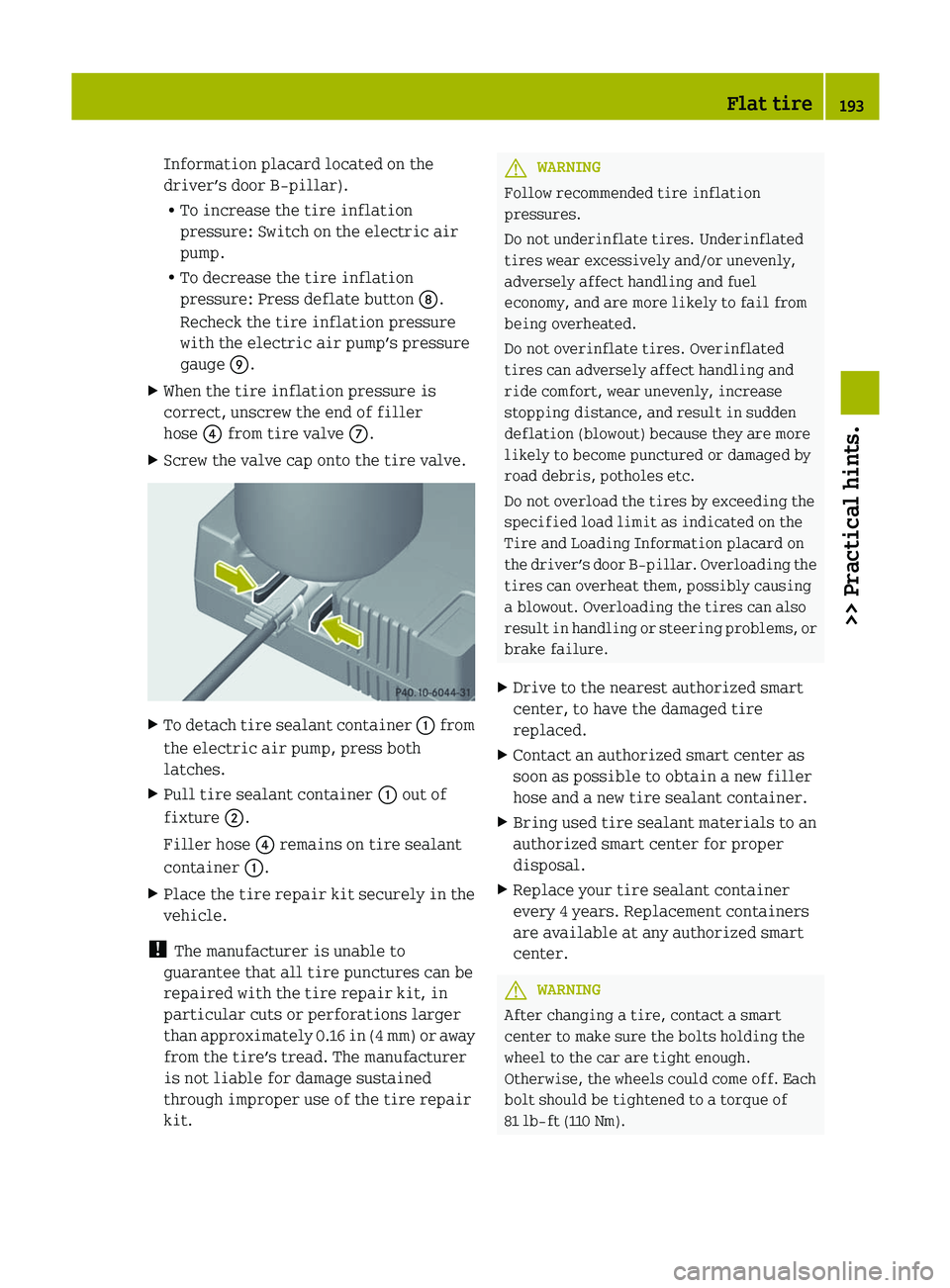
To detach tire sealant container : from
the electric air pump, press both
latches.
X Pull tire sealant container : out of
fixture ;.
Filler hose ? remains on tire sealant
container :.
X Place the tire repair kit securely in the
vehicle.
! The manufacturer is unable to
guarantee that all tire punctures can be
repaired with the tire repair kit, in
particular cuts or perforations larger
than
approximately 0.16 in (4 mm) or away
from the tire’s tread. The manufacturer
is not liable for damage sustained
through improper use of the tire repair
kit. G
WARNING
Follow recommended tire inflation
pressures.
Do not underinflate tires. Underinflated
tires wear excessively and/or unevenly,
adversely affect handling and fuel
economy, and are more likely to fail from
being overheated.
Do not overinflate tires. Overinflated
tires can adversely affect handling and
ride comfort, wear unevenly, increase
stopping distance, and result in sudden
deflation (blowout) because they are more
likely to become punctured or damaged by
road debris, potholes etc.
Do not overload the tires by exceeding the
specified load limit as indicated on the
Tire and Loading Information placard on
the
driver’s door B‑pillar. Overloading the
tires can overheat them, possibly causing
a blowout. Overloading the tires can also
result in handling or steering problems, or
brake failure.
X Drive to the nearest authorized smart
center, to have the damaged tire
replaced.
X Contact an authorized smart center as
soon as possible to obtain a new filler
hose and a new tire sealant container.
X Bring used tire sealant materials to an
authorized smart center for proper
disposal.
X Replace your tire sealant container
every 4 years. Replacement containers
are available at any authorized smart
center. G
WARNING
After changing a tire, contact a smart
center to make sure the bolts holding the
wheel to the car are tight enough.
Otherwise, the wheels could come off. Each
bolt should be tightened to a torque of
81 lb‑ft (110 Nm). Flat tire
193
>> Practical hints. Z
Page 198 of 228
to come off. This could cause an accident.
Be sure to use the correct wheel bolts.
G
WARNING
Only use genuine smart wheel bolts. Other
wheel bolts may come loose.
Do not tighten the wheel bolts when the
vehicle is raised. Otherwise the vehicle
could fall off the jack.
X Clean contact surfaces of wheel and wheel
hub.
! To avoid paint damage, place wheel flat
against hub and hold it there while
installing first wheel bolt. X
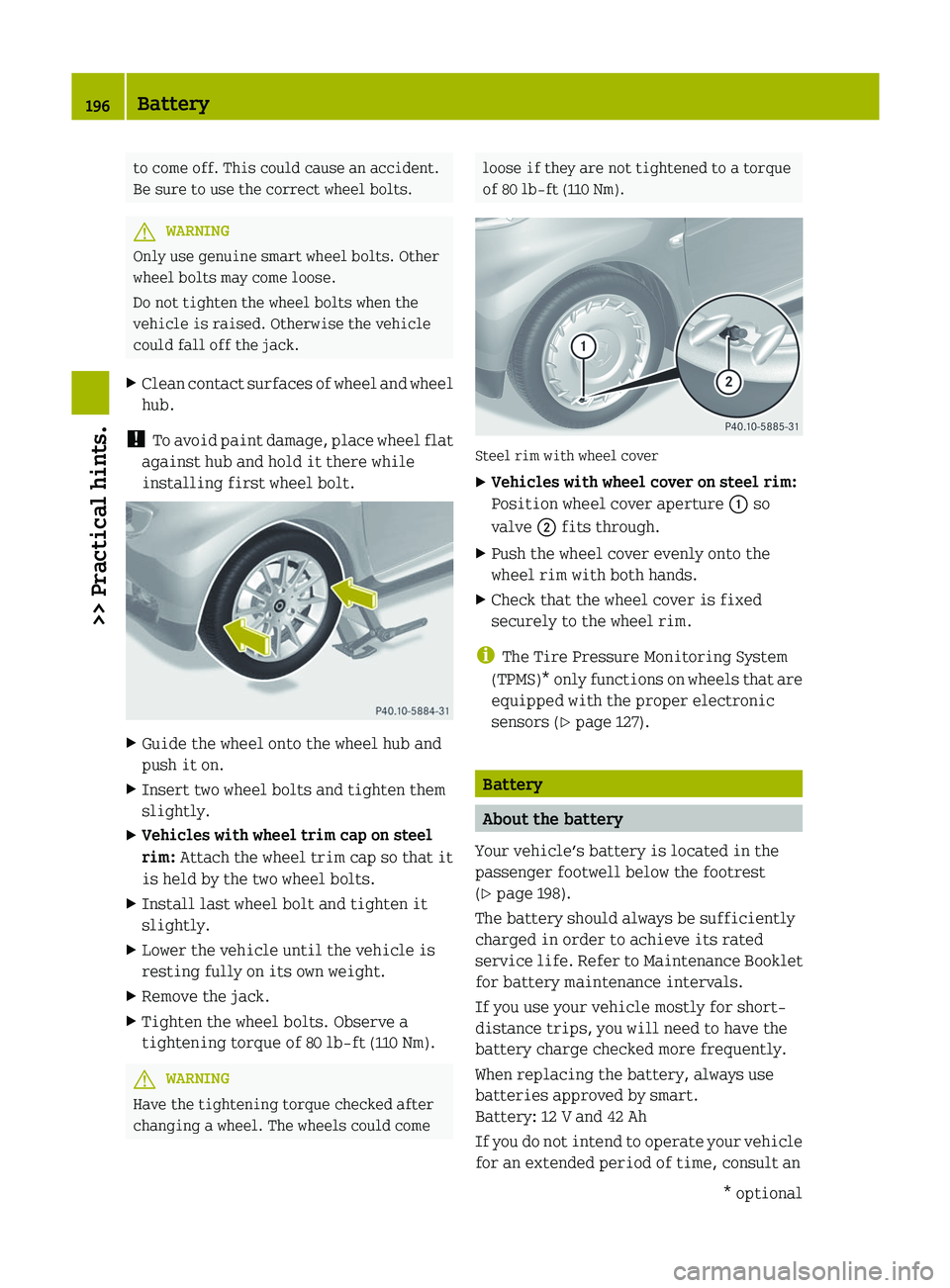
Guide the wheel onto the wheel hub and
push it on.
X Insert two wheel bolts and tighten them
slightly.
X Vehicles with wheel trim cap on steel
rim: Attach the wheel trim cap so that it
is held by the two wheel bolts.
X Install last wheel bolt and tighten it
slightly.
X Lower the vehicle until the vehicle is
resting fully on its own weight.
X Remove the jack.
X Tighten the wheel bolts. Observe a
tightening torque of 80 lb-ft (110 Nm)
.G
WARNING
Have the tightening torque checked after
changing a wheel. The wheels could come loose if they are not tightened to a torque
of 80 lb-ft (110 Nm).
Steel rim with wheel cover
X
Vehicles with wheel cover on steel rim:
Position wheel cover aperture : so
valve ; fits through.
X Push the wheel cover evenly onto the
wheel rim with both hands.
X Check that the wheel cover is fixed
securely to the wheel rim.
i The Tire Pressure Monitoring System
(TPMS)*
only functions on wheels that are
equipped with the proper electronic
sensors (Y page 127). Battery
About the battery
Your vehicle’s battery is located in the
passenger footwell below the footrest
(Y page 198).
The battery should always be sufficiently
charged in order to achieve its rated
service
life. Refer to Maintenance Booklet
for battery maintenance intervals.
If you use your vehicle mostly for short-
distance trips, you will need to have the
battery charge checked more frequently.
When replacing the battery, always use
batteries approved by smart.
Battery: 12 V and 42 Ah
If you do not intend to operate your vehicle
for an extended period of time, consult an 196
Battery
>> Practical hints.
* optional
Page 201 of 228
arrangement in your vehicle model, the
ventilation
hose is located either on the
left or right side of the battery).
X Remove the battery.
Charging the battery G
WARNING
Avoid creating sparks when charging the
battery as escaping gases are flammable.
Keep
open flames away from the battery and
do not smoke.
Do not touch the battery terminal with metal
objects and do not remove the battery
charger’s terminal clamps until the battery
charger has been switched off and no
further gas is being discharged by the
batteries.
Only charge the battery in a well ventilated
area.
There is a risk of acid burns during the
charging procedure due to the gases which
escape from the battery. Do not lean over
the battery when it is being charged. G
WARNING
Never charge a battery while still installed
in the vehicle. Gases may escape during
charging and cause explosions that may
result in paint damage, corrosion or
personal injury.
X Charge battery in accordance with the
instructions of the battery charger
manufacturer.
! Only use chargers of a correct and
suitable voltage.
! Never attempt to recharge a frozen
battery. Have the battery checked at a
smart center. The battery housing could
be damaged. Reinstalling the battery X
Reinstall the charged battery. Follow the
previously described steps in reverse
order.
! The battery, its filler caps and the
ventilation
hose must always be securely
installed when the vehicle is in
operation.
Reconnecting the battery !
Always
connect the battery in the order
described below. Otherwise the
vehicle’s electronics can be damaged.
X Turn off all electrical accessories.
X Remove the key from the starter switch.
! Never invert the terminal connections!
X Connect the battery positive lead and
fasten cover ? (Y page 198).
X Connect battery negative lead =
(Y page 198).
i After battery power (e.g. due to
reconnection) was interrupted, you will
have to set the clock (Y page 88).
i Have the battery’s charge status and
acid
level checked at the start of the cold
season at a smart center. Jump starting
Notes
G
WARNING
Failure to follow these directions will
cause
damage to the electronic components,
and can lead to a battery explosion and
severe injury or death.
Never lean over batteries while connecting
or jump starting, you might get injured.
Battery fluid contains sulfuric acid. Do not
allow this fluid to come in contact with
eyes, skin or clothing. In case it does, Jump starting
199
>> Practical hints.
Z
Page 207 of 228
X
Turn the battery on using the previously
installed battery switch.
X Move the gear selector lever to park
position P.
X Remove the key from the starter switch.
X Lock the doors.
! Do not flat tow the vehicle with the front
axle raised. Doing so may cause serious
damage to the brake system which is not
covered by the smart Limited Warranty.
! Failure to follow the recommendations
for flat towing can cause damage to your
vehicle:
R Not following the battery disconnect
procedure in the proper sequence may
result in data loss in the vehicle’s
control units.
R Not disconnecting the battery and
leaving the key in starter switch
position 1 (ignition on) may result in
-the vehicle locking. The vehicle will
lock if the wheels are turning at
vehicle speeds of approximately
8 mph (14 km/h) or more.
- the ESP ®
being activated. Active
braking action through the ESP ®
may
seriously damage the brake system
which is not covered by the smart
Limited Warranty.
R Not moving the gear selector lever to
neutral position N may result in
significant transmission damage.
R in a discharged battery. Fuses
The electrical fuses in your vehicle serve
to switch off malfunctioning power
circuits.
If a fuse is blown, the components and
systems secured by that fuse will stop
operating. G
WARNING
Only use fuses approved by smart with the
specified amperage for the system in
question and do not attempt to repair or
bridge a blown fuse this may cause an
overload leading to a fire, and/or cause
damage to electrical components and/or
systems. Contact a smart center if you
encounter any electrical problems.
! A blown fuse must be replaced by an
appropriate
spare fuse (recognizable by
its color or the fuse rating given on the
fuse) of the amperage recommended in
the fuse chart. Any smart center will be
glad to advise you on this subject.
If a newly inserted fuse blows again, have
the cause determined and rectified at an
authorized smart center.
Before replacing fuses:
R Engage the parking brake.
R Make sure the gear selector lever is in
park position P.
R Turn off all electrical accessories.
R Turn off the engine.
R Remove the key from the starter switch. Replacing a fuse
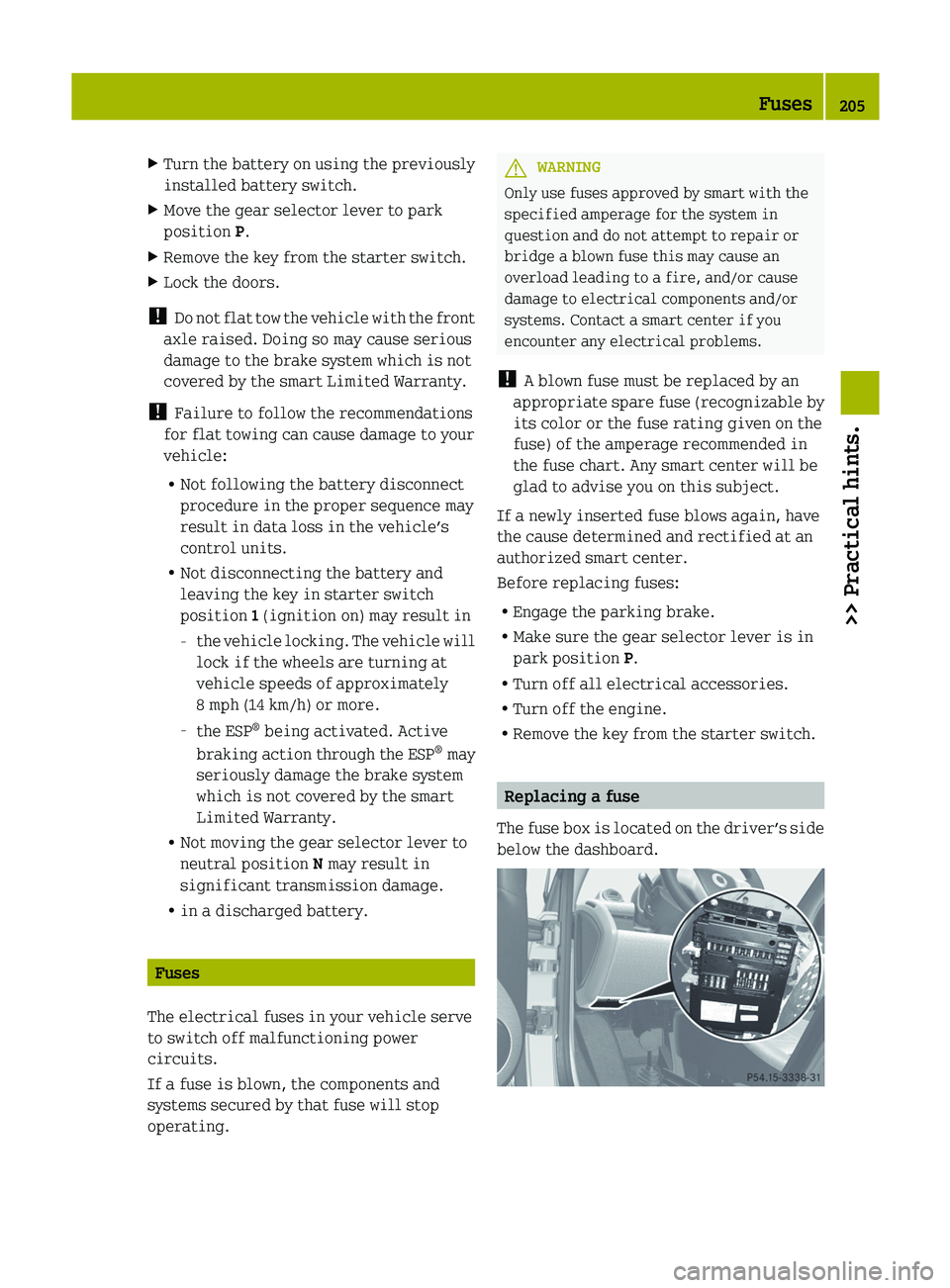
The
fuse box is located on the driver’s side
below the dashboard. Fuses
205
>> Practical hints. Z
Page 217 of 228
:
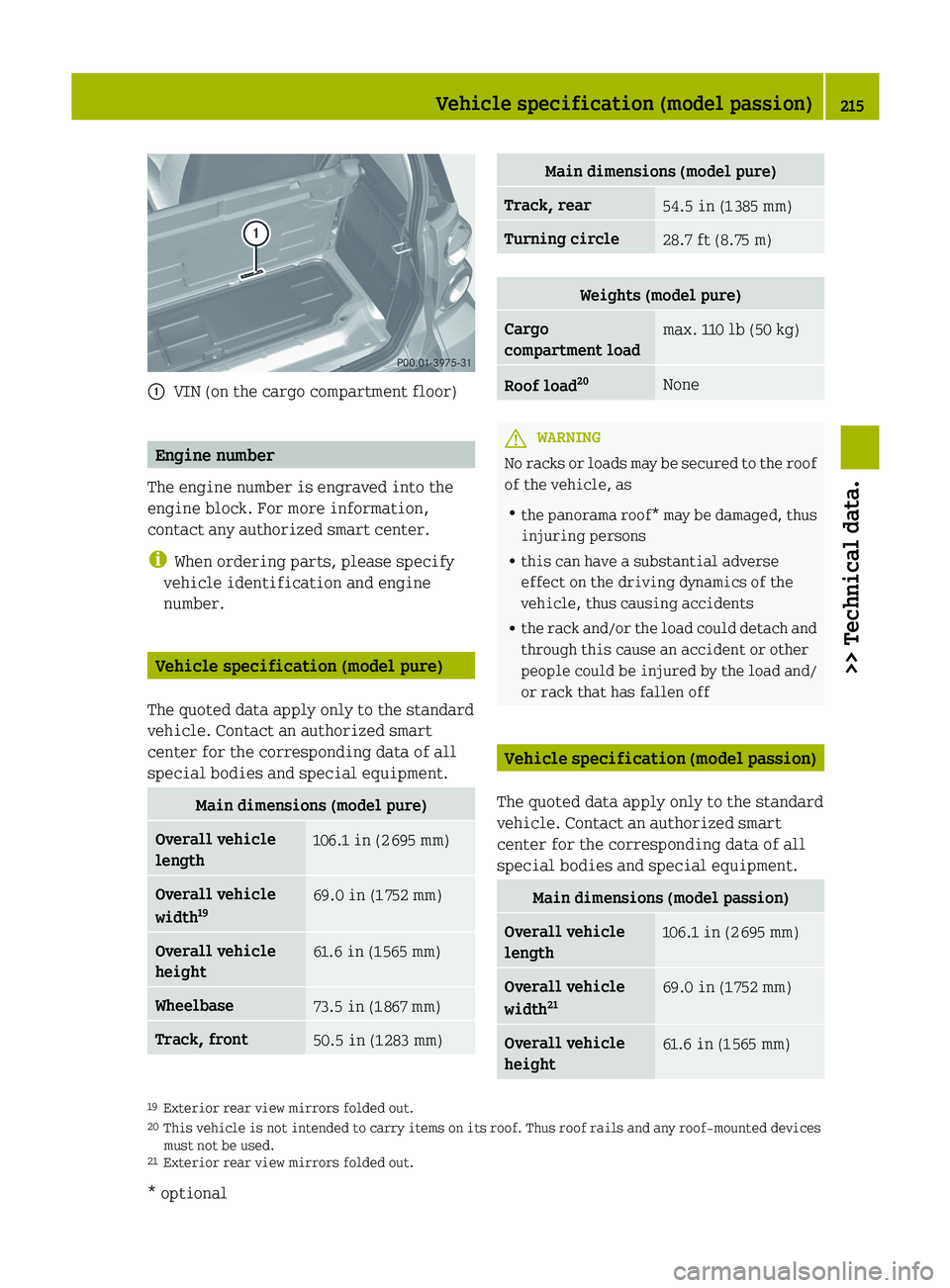
VIN (on the cargo compartment floor) Engine number
The engine number is engraved into the
engine block. For more information,
contact any authorized smart center.
i When ordering parts, please specify
vehicle identification and engine
number. Vehicle specification (model pure)
The quoted data apply only to the standard
vehicle. Contact an authorized smart
center for the corresponding data of all
special bodies and special equipment. Main dimensions (model pure)
Overall vehicle
length
106.1 in (2
695 mm) Overall vehicle
width
19
69.0 in (1 752 mm)
Overall vehicle
height
61.6 in (1 565 mm)
Wheelbase
73.5 in (1
867 mm) Track, front
50.5 in (1 283 mm) Main dimensions (model pure)
Track, rear
54.5 in (1 385 mm)
Turning circle
28.7 ft (8.75 m)
Weights (model pure)
Cargo
compartment load
max. 110 lb (50 kg)
Roof load
20
None
G
WARNING
No racks or loads may be secured to the roof
of the vehicle, as
R the
panorama roof* may be damaged, thus
injuring persons
R this can have a substantial adverse
effect on the driving dynamics of the
vehicle, thus causing accidents
R the rack and/or the load could detach and
through this cause an accident or other
people could be injured by the load and/
or rack that has fallen off Vehicle specification (model passion)
The quoted data apply only to the standard
vehicle. Contact an authorized smart
center for the corresponding data of all
special bodies and special equipment. Main dimensions (model passion)
Overall vehicle
length
106.1 in (2
695 mm) Overall vehicle
width
21
69.0 in (1 752 mm)
Overall vehicle
height
61.6 in (1 565 mm)
19
Exterior rear view mirrors folded out.
20 This
vehicle is not intended to carry items on its roof. Thus roof rails and any roof-mounted devices
must not be used.
21 Exterior rear view mirrors folded out. Vehicle specification (model passion)
215
>> Technical data.
* optional Z