ECU SMART FORTWO COUPE 2012 User Guide
[x] Cancel search | Manufacturer: SMART, Model Year: 2012, Model line: FORTWO COUPE, Model: SMART FORTWO COUPE 2012Pages: 228, PDF Size: 12.76 MB
Page 64 of 228
Exterior rear view mirror heating
This feature is only available on the model
passion and BRABUS and in conjunction
with power exterior rear view mirrors.
After switching on the rear window
defroster, the exterior rear view mirrors
will be heated automatically. This
prevents icing up the exterior rear view
mirrors
and also creates a clear view when
the exterior rear view mirrors have fogged
up.
If the rear window defroster is
automatically deactivated after
approximately 10 minutes of operation, the
exterior rear view mirror heating also
deactivates.
X Make sure the key is in starter switch
position 1.
X Switching on: Switch on the rear window
defroster (Y page 106).
The
exterior rear view mirror heating is
switched on.
X Switching off:
Switch off the rear window
defroster (Y page 106).
The exterior rear view mirror heating is
switched off.
i The exterior rear view mirror heating
also switches off if the key is turned to
starter switch position 0.Interior rear view mirror X
Adjusting the mirror: Manually move the
interior
rear view mirror up, down, left,
or right to the desired setting.
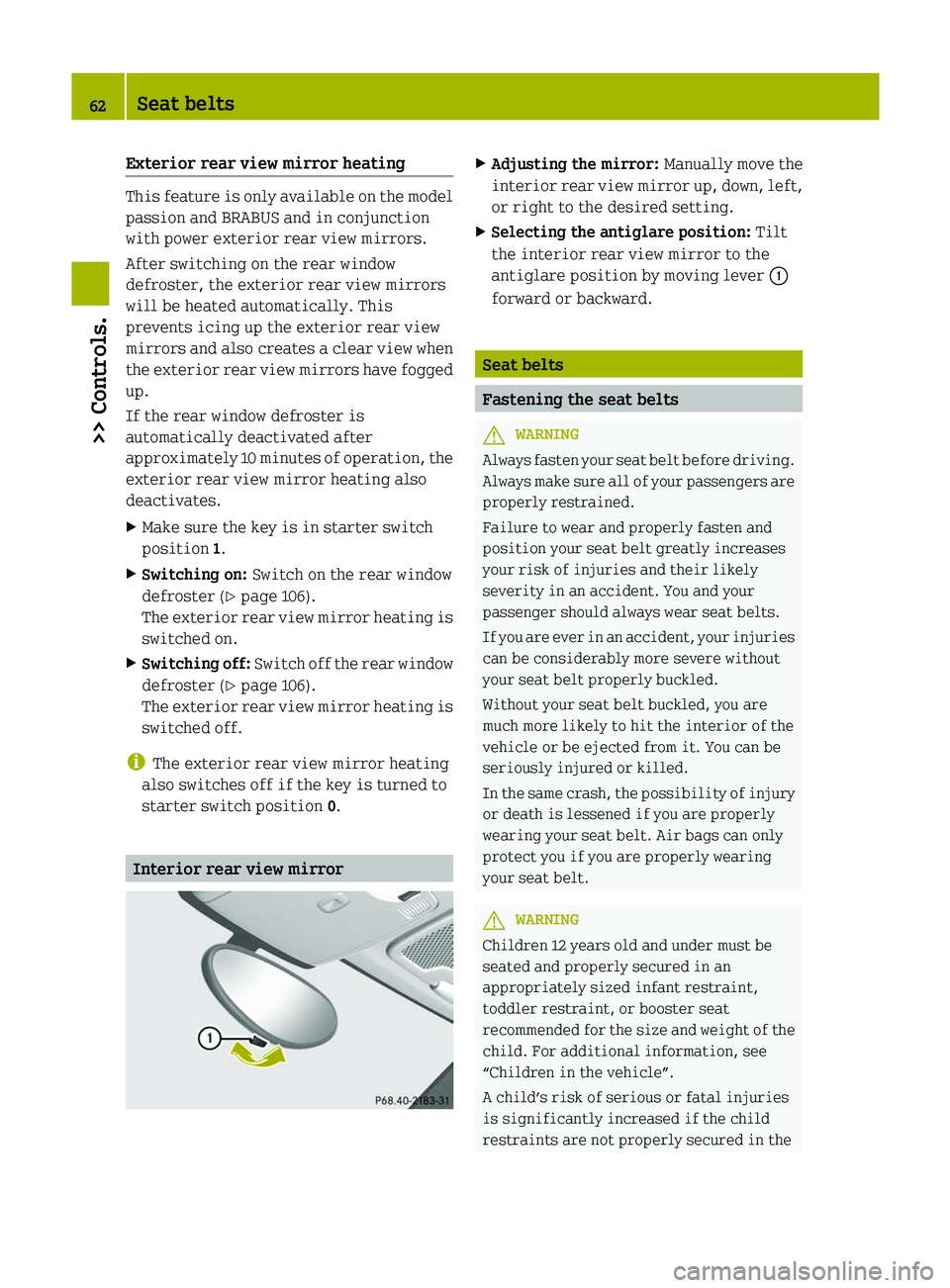
X Selecting the antiglare position: Tilt
the interior rear view mirror to the
antiglare position by moving lever :
forward or backward. Seat belts
Fastening the seat belts
G
WARNING
Always fasten your seat belt before driving.
Always
make sure all of your passengers are
properly restrained.
Failure to wear and properly fasten and
position your seat belt greatly increases
your risk of injuries and their likely
severity in an accident. You and your
passenger should always wear seat belts.
If you are ever in an accident, your injuries
can be considerably more severe without
your seat belt properly buckled.
Without your seat belt buckled, you are
much more likely to hit the interior of the
vehicle or be ejected from it. You can be
seriously injured or killed.
In the same crash, the possibility of injury
or death is lessened if you are properly
wearing your seat belt. Air bags can only
protect you if you are properly wearing
your seat belt. G
WARNING
Children 12 years old and under must be
seated and properly secured in an
appropriately sized infant restraint,
toddler restraint, or booster seat
recommended
for the size and weight of the
child. For additional information, see
“Children in the vehicle”.
A child’s risk of serious or fatal injuries
is significantly increased if the child
restraints are not properly secured in the 62
Seat belts
>> Controls.
Page 65 of 228
vehicle and/or the child is not properly
secured in the child restraint.
G
WARNING
Never let more people ride in the vehicle
than there are seat belts available. Make
sure everyone riding in the vehicle is
correctly restrained with a separate seat
belt.
Never use a seat belt for more than one
person at a time. G
WARNING
Never ride in a moving vehicle with the seat
backrest in an excessively reclined
position as this can be dangerous. You
could slide under the seat belt in a
collision. If you slide under it, the belt
would apply force at the abdomen or neck,
causing
serious or even fatal injuries. The
seat backrest and seat belt provide the best
restraint when the wearer is in a position
that is as upright as possible and the belt
is properly positioned on the body. G
WARNING
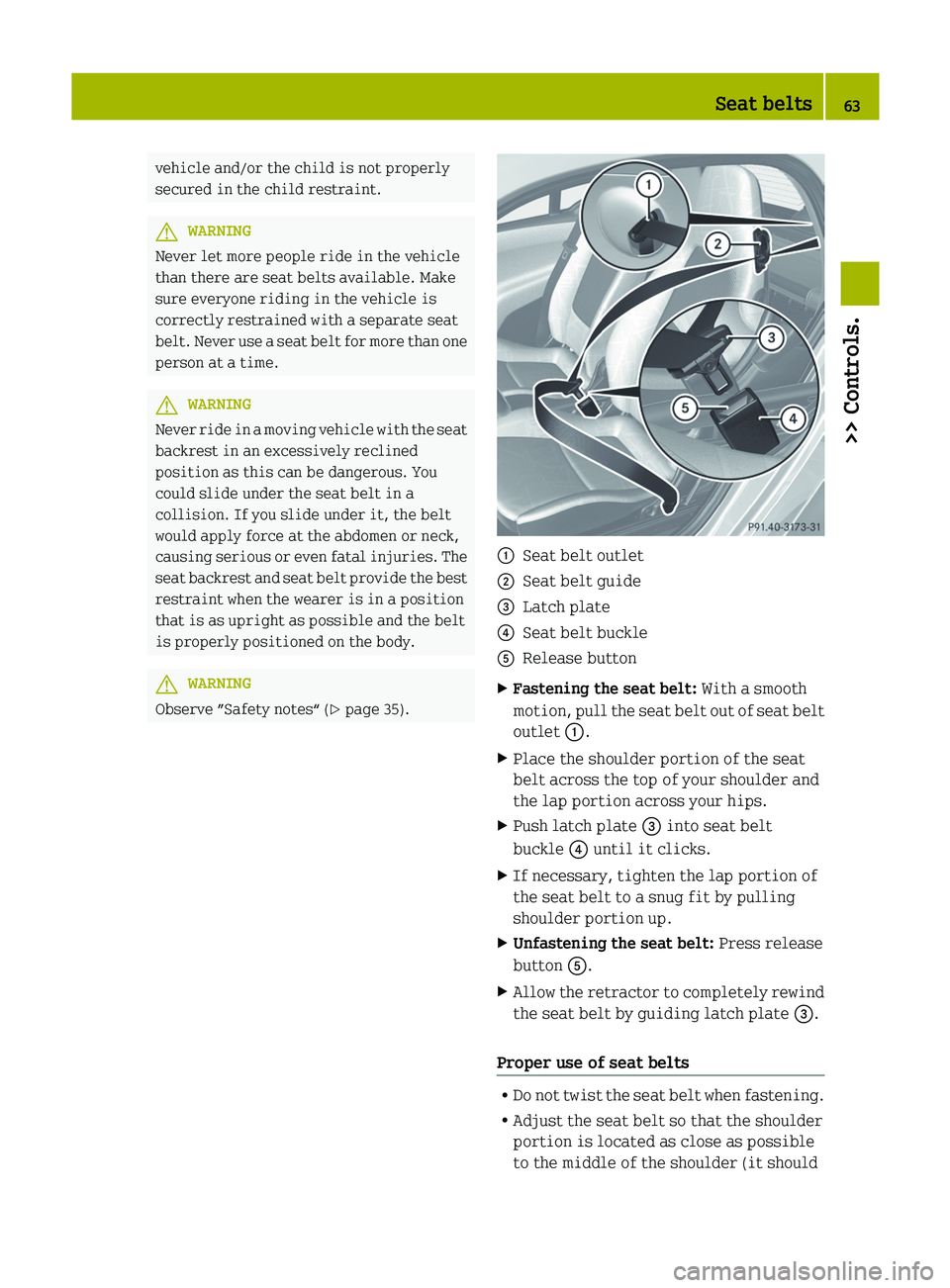
Observe ”Safety notes“ ( Y page 35). :
Seat belt outlet
; Seat belt guide
= Latch plate
? Seat belt buckle
A Release button
X Fastening the seat belt: With a smooth
motion,
pull the seat belt out of seat belt
outlet :.
X Place the shoulder portion of the seat
belt across the top of your shoulder and
the lap portion across your hips.
X Push latch plate = into seat belt
buckle ? until it clicks.
X If necessary, tighten the lap portion of
the seat belt to a snug fit by pulling
shoulder portion up.
X Unfastening the seat belt: Press release
button A.
X Allow the retractor to completely rewind
the seat belt by guiding latch plate =.
Proper use of seat belts R
Do
not twist the seat belt when fastening.
R Adjust the seat belt so that the shoulder
portion is located as close as possible
to the middle of the shoulder (it should Seat belts
63
>> Controls. Z
Page 66 of 228
not touch the neck). Never pass the
shoulder portion of the seat belt under
your arm.
R Position the lap belt as low as possible
on your hips (over hip joint) and not
across the abdomen.
R Place
the seat backrest in a position that
is as upright as possible.
R Never use a seat belt for more than one
person at a time.
R Do not fasten a seat belt around a person
and another object at the same time. When
using a seat belt to secure infant or
toddler restraints or children in booster
seats, always follow the child seat
manufacturer’s instructions.
R Check your seat belt during travel to
make sure it is properly positioned.
R Make sure the seat belt is always fitted
snugly. Take special care to maintain a
snug fit when wearing loose clothing. G
WARNING
Do not pass seat belts over sharp edges.
They could tear.
Do not allow the seat belt to get caught in
the door or in the seat adjustment
mechanism. This could damage the seat
belt.
Never attempt to make modifications to
seat belts. This could impair the
effectiveness of the seat belts.
Do not bleach or dye seat belts as this may
severely weaken them. In a crash they may
not
be able to provide adequate protection.
Damaged seat belts or seat belts that were
highly stressed in an accident must be
replaced. Contact an authorized smart
center. Correct driver seat adjustment
G
WARNING
Observe ”Safety notes“ ( Y page 58). X
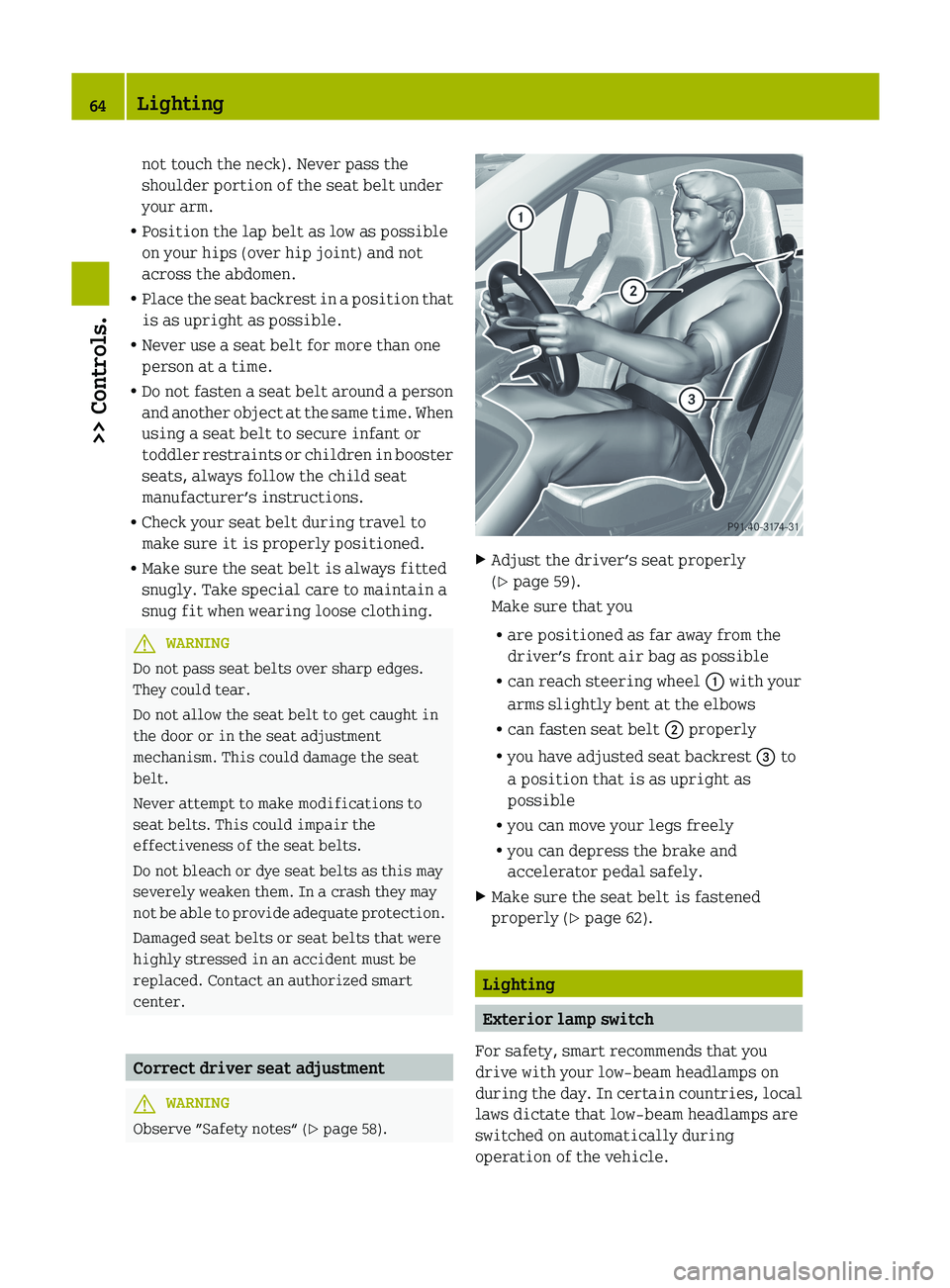
Adjust the driver’s seat properly
(Y page 59).
Make sure that you
R are positioned as far away from the
driver’s front air bag as possible
R can reach steering wheel : with your
arms slightly bent at the elbows
R can fasten seat belt ; properly
R you have adjusted seat backrest = to
a position that is as upright as
possible
R you can move your legs freely
R you can depress the brake and
accelerator pedal safely.
X Make sure the seat belt is fastened
properly (Y page 62). Lighting
Exterior lamp switch
For safety, smart recommends that you
drive with your low‑beam headlamps on
during
the day. In certain countries, local
laws dictate that low‑beam headlamps are
switched on automatically during
operation of the vehicle. 64
Lighting
>> Controls.
Page 77 of 228
Closing the rear soft top
X
Press symbol : on the retractable soft
top switch until the rear soft top has
folded up completely.
X Release retractable soft top switch :.
i If you release the retractable soft top
switch
while driving before the rear soft
top has closed completely, the rear soft
top will fold down again. Removing the side rails
X Open the retractable soft top
(Y page 56).
X Open the rear soft top ( Y page 74).
X Open the driver’s and passenger door
when conditions are safe to do so.
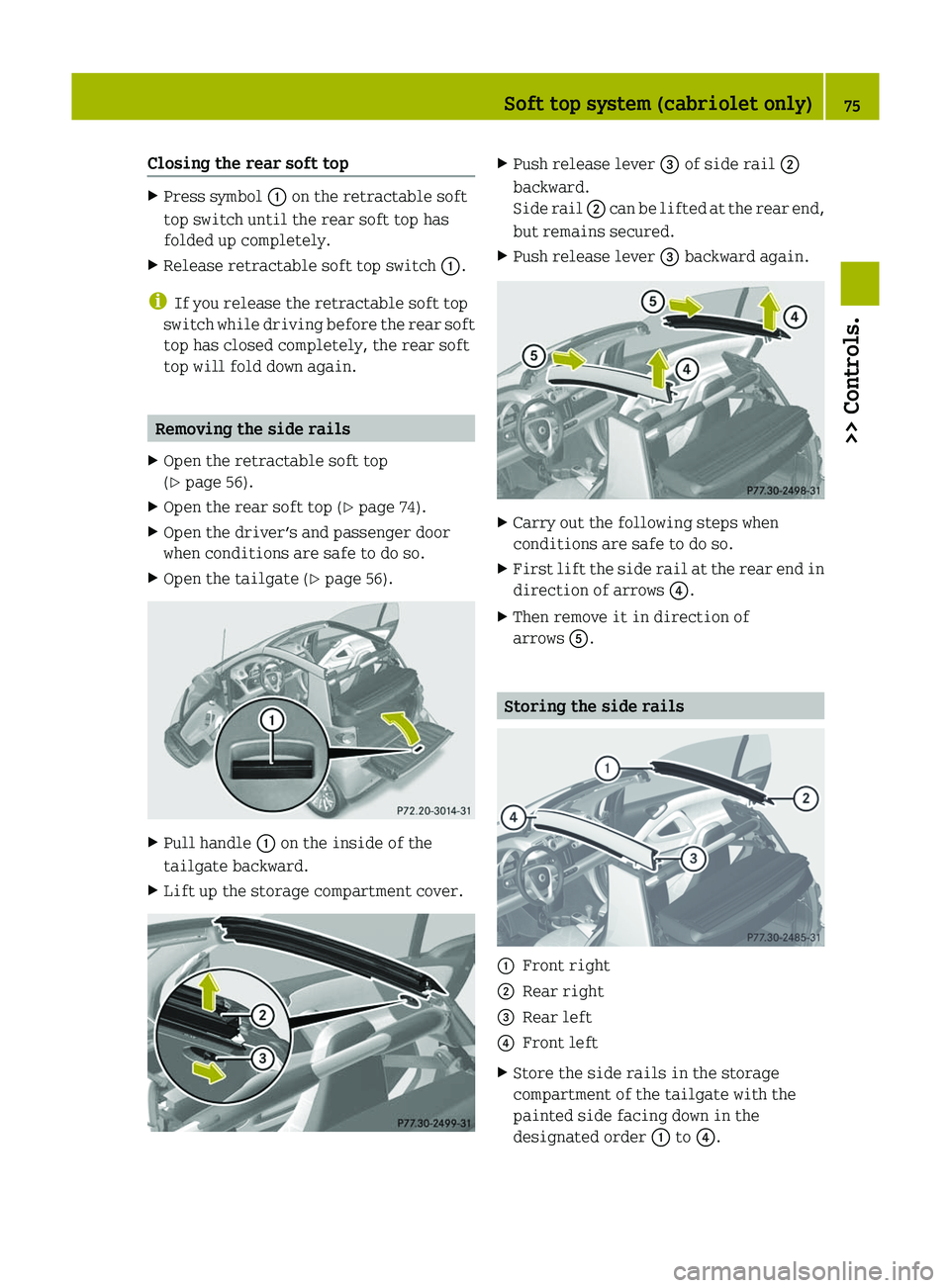
X Open the tailgate (Y page 56). X
Pull handle : on the inside of the
tailgate backward.
X Lift up the storage compartment cover. X
Push release lever = of side rail ;
backward.
Side
rail ; can be lifted at the rear end,
but remains secured.
X Push release lever = backward again. X
Carry out the following steps when
conditions are safe to do so.
X First lift the side rail at the rear end in
direction of arrows ?.
X Then remove it in direction of
arrows A. Storing the side rails
:
Front right
; Rear right
= Rear left
? Front left
X Store the side rails in the storage
compartment of the tailgate with the
painted side facing down in the
designated order : to ?. Soft top system (cabriolet only)
75
>> Controls. Z
Page 82 of 228
X
Depress the brake pedal.
X Press the release button (Y page 79) to
disengage the gear selector lever lock.
X Move the gear selector lever to reverse
gear R.
R appears in the transmission position
indicator.
X Release the brake pedal.
X Carefully depress the accelerator pedal. Parking
G
WARNING
Do not park this vehicle in areas where
combustible materials such as grass, hay or
leaves can come into contact with the hot
exhaust system. These materials could be
ignited and cause a vehicle fire.
Vehicle movement can cause serious
personal injury or damage to the vehicle or
the vehicle drivetrain. Therefore, always
do the following before turning off the
engine and leaving the vehicle:
R Keep right foot on the brake pedal.
R Engage the parking brake.
R Move the gear selector lever to park
position P.
R Slowly release the brake pedal.
R When parked on an incline, always turn
the front wheels towards the curb.
R Turn the key to starter switch position 0
and remove the key from the starter
switch.
R Take the key with you and lock the vehicle
when leaving. G
WARNING
With the engine not running, there is no
power assistance for the brake and
steering* systems. In this case, it is
important to keep in mind that a
considerably higher degree of effort is
necessary to brake and steer the vehicle.
Adapt your driving accordingly. X
Properly stop and park the vehicle.
X Depress the brake pedal.
X Engage the parking brake ( Y page 80).
When the ignition is switched on or the
engine is running, the brake warning
lamp $ (USA only) or J (Canada
only)
in the instrument cluster comes on.
X Release the brake pedal.
Parking brake The parking brake serves to secure the
vehicle against rolling away when it is
stationary or parked.
G
WARNING
Engaging the parking brake while the
vehicle is in motion can cause the rear
wheels
to lock up. You could lose control of
the vehicle and cause an accident. In
addition, the vehicle’s brake lights do not
light up when the parking brake is engaged. X
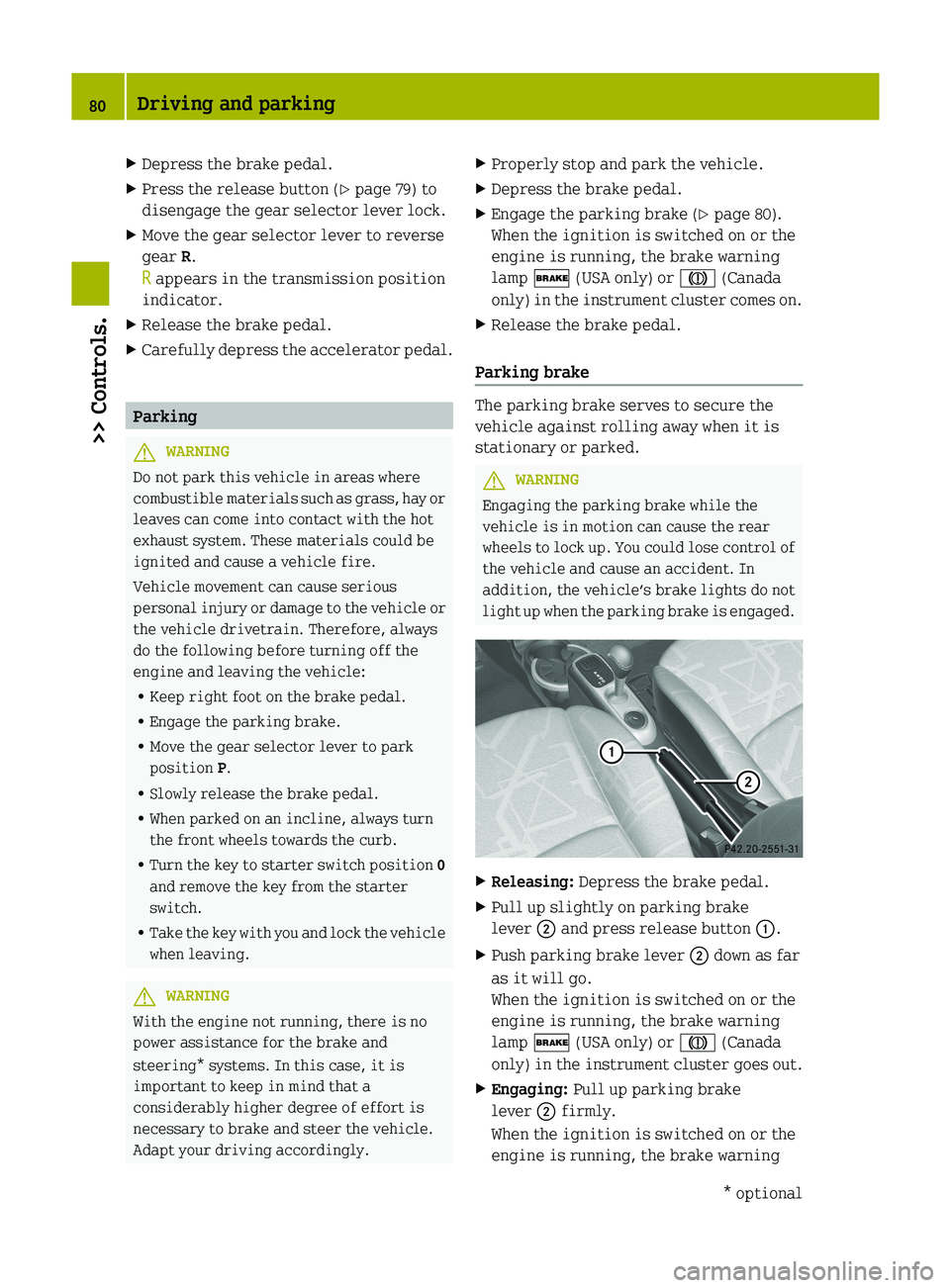
Releasing: Depress the brake pedal.
X Pull up slightly on parking brake
lever ; and press release button :.
X Push parking brake lever ; down as far
as it will go.
When the ignition is switched on or the
engine is running, the brake warning
lamp $ (USA only) or J (Canada
only)
in the instrument cluster goes out.
X Engaging: Pull up parking brake
lever ; firmly.
When the ignition is switched on or the
engine is running, the brake warning 80
Driving and parking
>> Controls.
* optional
Page 85 of 228
control of the vehicle and hit someone or
something. Only shift into gear when the
engine is idling normally and when your
right foot is firmly on the brake pedal.
Shifting procedure
The transmission selects individual gears
automatically, depending on:
R the gear selector lever position D
(Y page 83)
R the position of the accelerator pedal
(Y page 84)
R the vehicle speed
R uphill or downhill grades
Press release button : (Y page 82) to
disengage the gear selector lever lock
when moving the gear selector lever from
R P to R, N, or D
R R to P
R N to R or P
! Allow the engine to warm up under low
load use. Do not place full load on the
engine until the operating temperature
has been reached.
Shift into reverse gear R or parking
position P only when the vehicle is
stopped.
Avoid spinning of a drive wheel for an
extended period when driving off on
slippery road surfaces. Otherwise, the
drivetrain could be damaged, which is
not covered by the smart Limited
Warranty.
With manual gearshifting M selected
(Y page 84), you can use the gear selector
lever or steering wheel gearshift control
to change the gears manually. Gear selector lever positions
Effect
B
Park position
Gear selector lever position
when the vehicle is parked.
Place the gear selector lever
in park position
P only when
the vehicle is stopped. The
park position is not intended
to serve as a brake when the
vehicle is parked.
Rather, the driver should
always engage the parking
brake in addition to placing
the
gear selector lever in park
position P to secure the
vehicle.
The key can only be removed
from the starter switch with
the gear selector lever in park
position P. With the key
removed, the gear selector
lever is locked in park
position P. C
Reverse gear
Shift into reverse gear
R only
when vehicle is stopped. A
Neutral position
No power is transmitted from
the engine to the drive axle.
When the brakes are released,
the vehicle can be moved
freely (pushed or towed).
7
Drive position
The transmission shifts
automatically.
x
Manual gearshifting
System-controlled automatic
gearshifting is switched off.
The driver has to change the
gears manually. Transmission
83
>> Controls. Z
Page 109 of 228
Air recirculation mode*
Switch to air recirculation mode 12
to
prevent
unpleasant odors from entering the
vehicle from the outside (e.g. before
driving through a tunnel). This setting cuts
off the intake of outside air and
recirculates the air in the passenger
compartment. G
WARNING
When the air recirculation mode is
switched
on, windows can fog on the inside
immediately. Fogged windows impair
visibility, endangering you and others. If
the windows begin to fog on the inside,
switching off the air recirculation mode
immediately should clear interior window
fogging. If interior window fogging
persists, make sure the air conditioning is
switched on, turn air distribution control
B to position z and increase the air
volume using air volume control :.
Control panel (Y page 103).
X Switching on: Press air recirculation
switch ?.
The indicator lamp in air recirculation
switch ? comes on.
X Switching off: Press air recirculation
switch ? once more.
The indicator lamp in air recirculation
switch ? goes out. Loading and storing
Cup holder
G
WARNING
In order to help prevent spilling liquids
on vehicle occupants and/or vehicle
equipment, only use containers that fit
into the cup holder. Use lids on open
containers and do not fill containers to a
height where the contents, especially hot liquids, could spill during braking,
vehicle
maneuvers, or an accident. Liquids
spilled on vehicle occupants may cause
serious personal injury. Liquids spilled
on vehicle equipment may cause damage not
covered by the smart Limited Warranty.
Keep in mind that objects placed in a cup
holder may come loose during braking,
vehicle maneuvers, or an accident and be
thrown around in the vehicle interior.
Objects thrown around in the vehicle
interior may cause an accident and/or
serious personal injury.
The cup holder can be used to safely store
sealed drink bottles, containers with a lid,
or beverage cans.
! Do not use the cup holder as an ashtray.
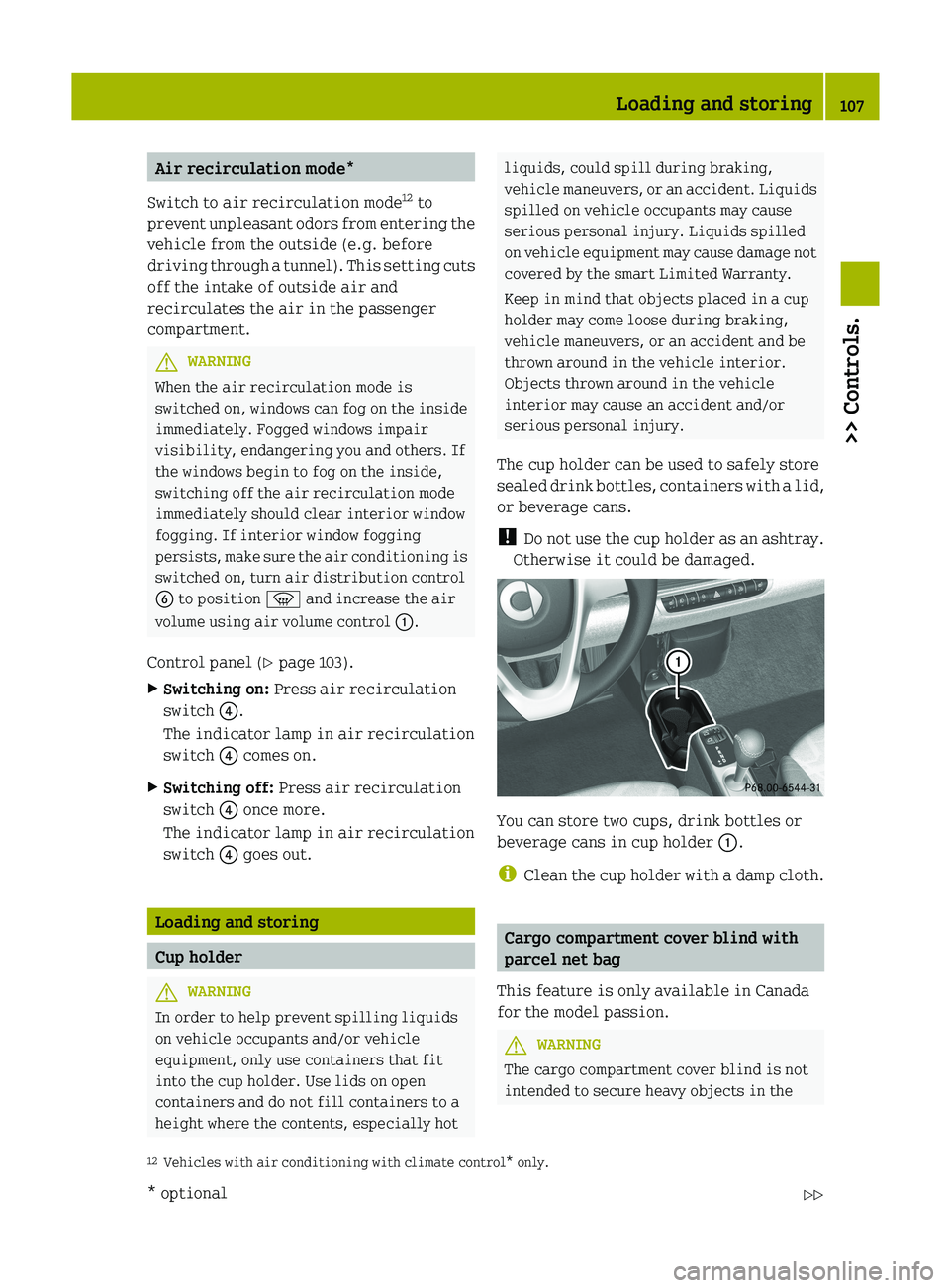
Otherwise it could be damaged. You can store two cups, drink bottles or
beverage cans in cup holder :.
i
Clean
the cup holder with a damp cloth. Cargo compartment cover blind with
parcel net bag
This feature is only available in Canada
for the model passion. G
WARNING
The cargo compartment cover blind is not
intended to secure heavy objects in the
12 Vehicles with air conditioning with climate control* only. Loading and storing
107
>> Controls.
* optional Z
Page 110 of 228
event of an accident. For this reason, heavy
objects must be tied down.
Vehicle occupants could be injured by
objects
being thrown around in the vehicle
in the event of
R hard braking
R a change of direction
R an accident G
WARNING
Do not place any objects on the mounted
cargo compartment cover blind.
Vehicle occupants could be injured by
objects
being thrown around in the vehicle
in the event of
R hard braking
R a change of direction
R an accident G
WARNING
Only place light loads in the parcel net
bag.
Do not transport heavy, sharp-edged or
fragile objects in the parcel net bag. The
parcel net bag cannot sufficiently secure
loads in an accident.
Vehicle occupants could be injured by
objects being thrown around in the vehicle
in the event of
R hard braking
R a change of direction
R an accident
Observe the loading guidelines.
The cargo compartment cover blind
R serves to protect objects that are stored
in the vehicle’s cargo compartment from
prying eyes
R prevents smaller objects from
penetrating into the passenger
compartment from the cargo
compartment; however, it is not intended
to act as a load restraining device The parcel net bag
R
is
for storing small, lightweight objects
R prevents small objects from sliding
around inside the passenger
compartment
! If objects are placed on the cargo
compartment cover blind when mounted,
the cover may be damaged.
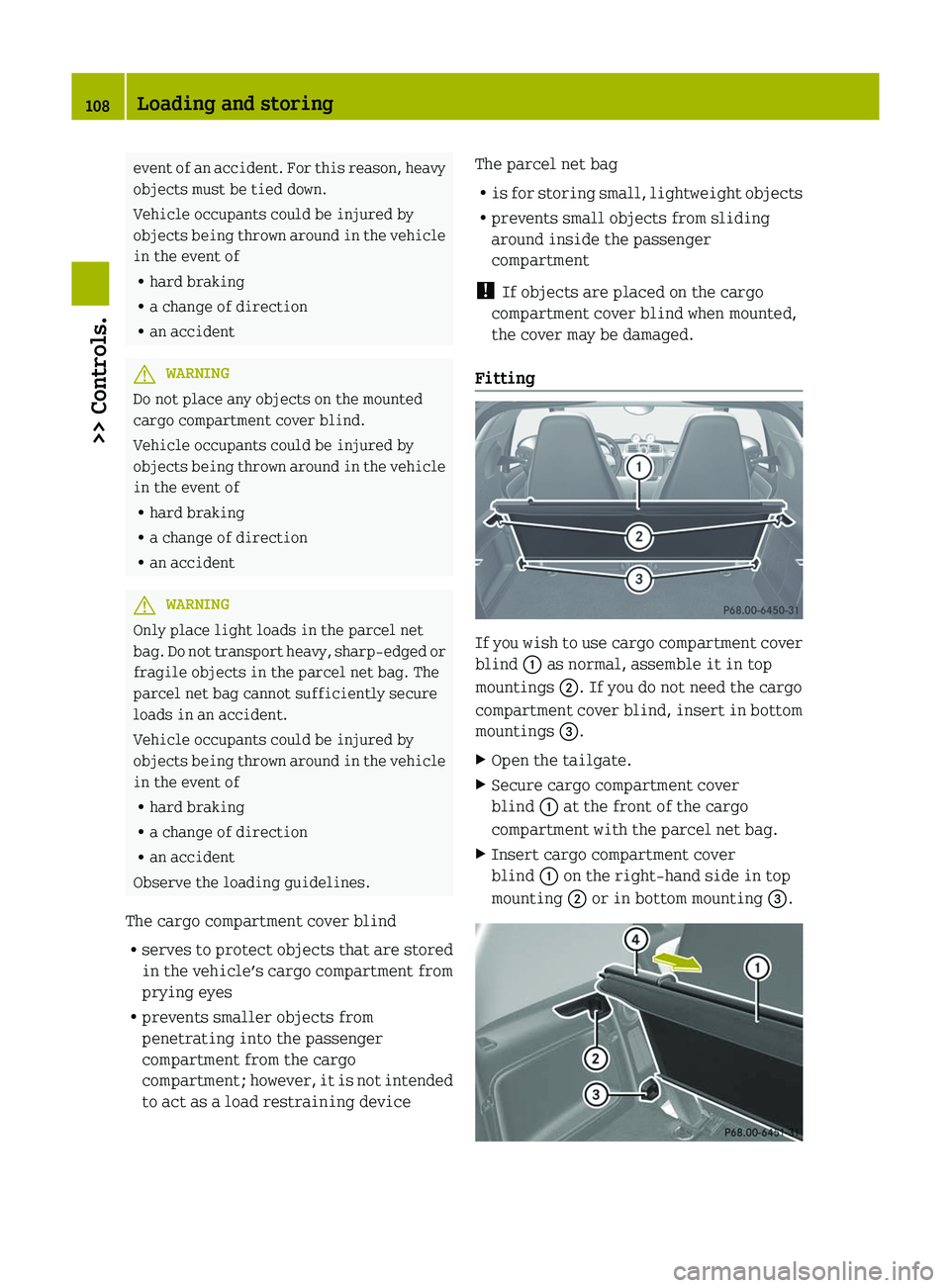
Fitting If you wish to use cargo compartment cover
blind : as normal, assemble it in top
mountings ;. If you do not need the cargo
compartment
cover blind, insert in bottom
mountings =.
X Open the tailgate.
X Secure cargo compartment cover
blind : at the front of the cargo
compartment with the parcel net bag.
X Insert cargo compartment cover
blind : on the right-hand side in top
mounting ; or in bottom mounting =.108
Loading and storing
>> Controls.
Page 111 of 228
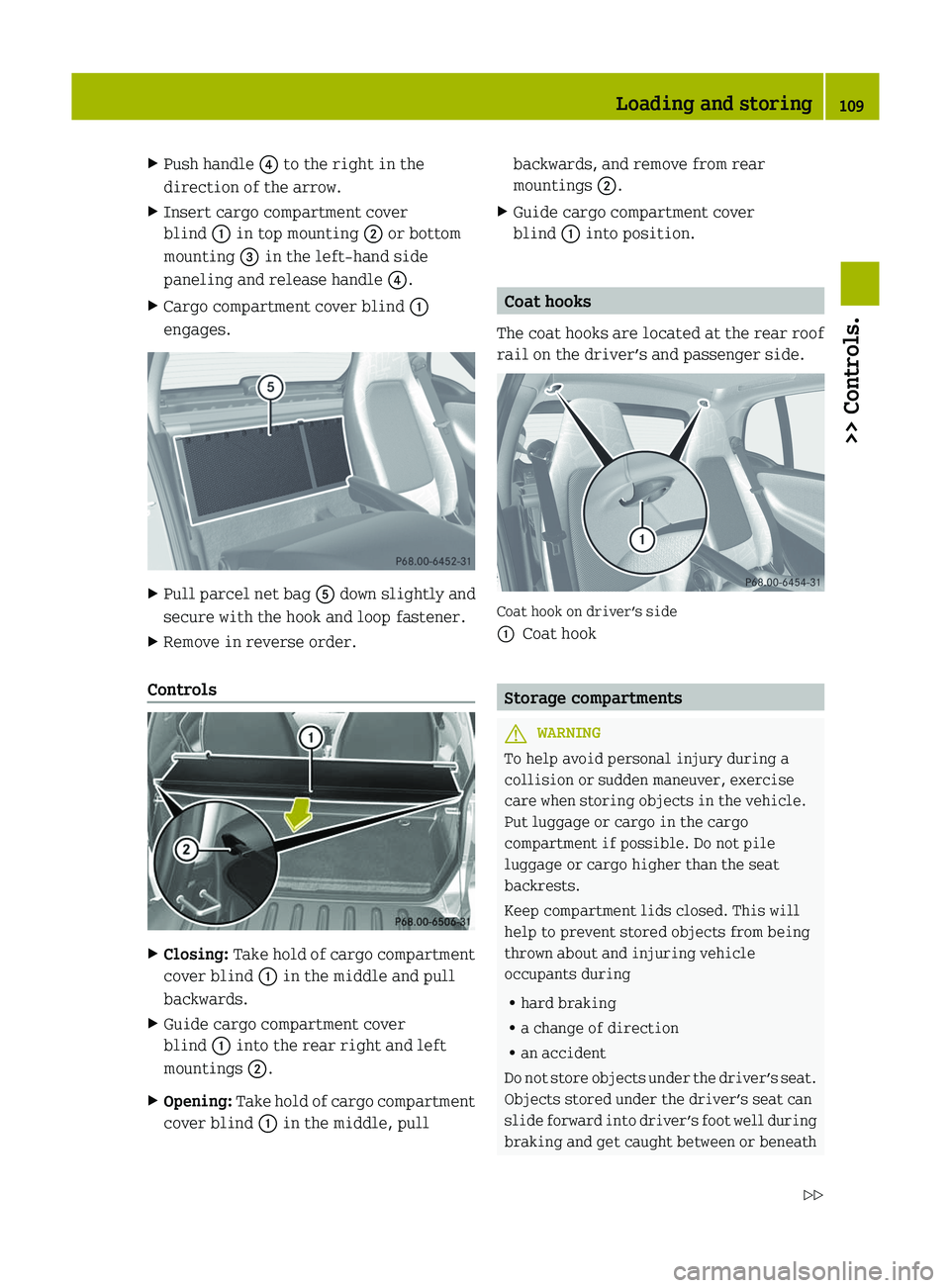
X
Push handle ? to the right in the
direction of the arrow.
X Insert cargo compartment cover
blind : in top mounting ; or bottom
mounting = in the left-hand side
paneling and release handle ?.
X Cargo compartment cover blind :
engages. X
Pull parcel net bag A down slightly and
secure with the hook and loop fastener.
X Remove in reverse order.
Controls X
Closing: Take hold of cargo compartment
cover blind : in the middle and pull
backwards.
X Guide cargo compartment cover
blind : into the rear right and left
mountings ;.
X Opening:
Take hold of cargo compartment
cover blind : in the middle, pull backwards, and remove from rear
mountings ;.
X Guide cargo compartment cover
blind : into position. Coat hooks
The coat hooks are located at the rear roof
rail on the driver’s and passenger side. Coat hook on driver’s side
:
Coat hook Storage compartments
G
WARNING
To help avoid personal injury during a
collision or sudden maneuver, exercise
care when storing objects in the vehicle.
Put luggage or cargo in the cargo
compartment if possible. Do not pile
luggage or cargo higher than the seat
backrests.
Keep compartment lids closed. This will
help to prevent stored objects from being
thrown about and injuring vehicle
occupants during
R hard braking
R a change of direction
R an accident
Do
not store objects under the driver’s seat.
Objects stored under the driver’s seat can
slide forward into driver’s foot well during
braking and get caught between or beneath Loading and storing
109
>> Controls.
Z
Page 114 of 228
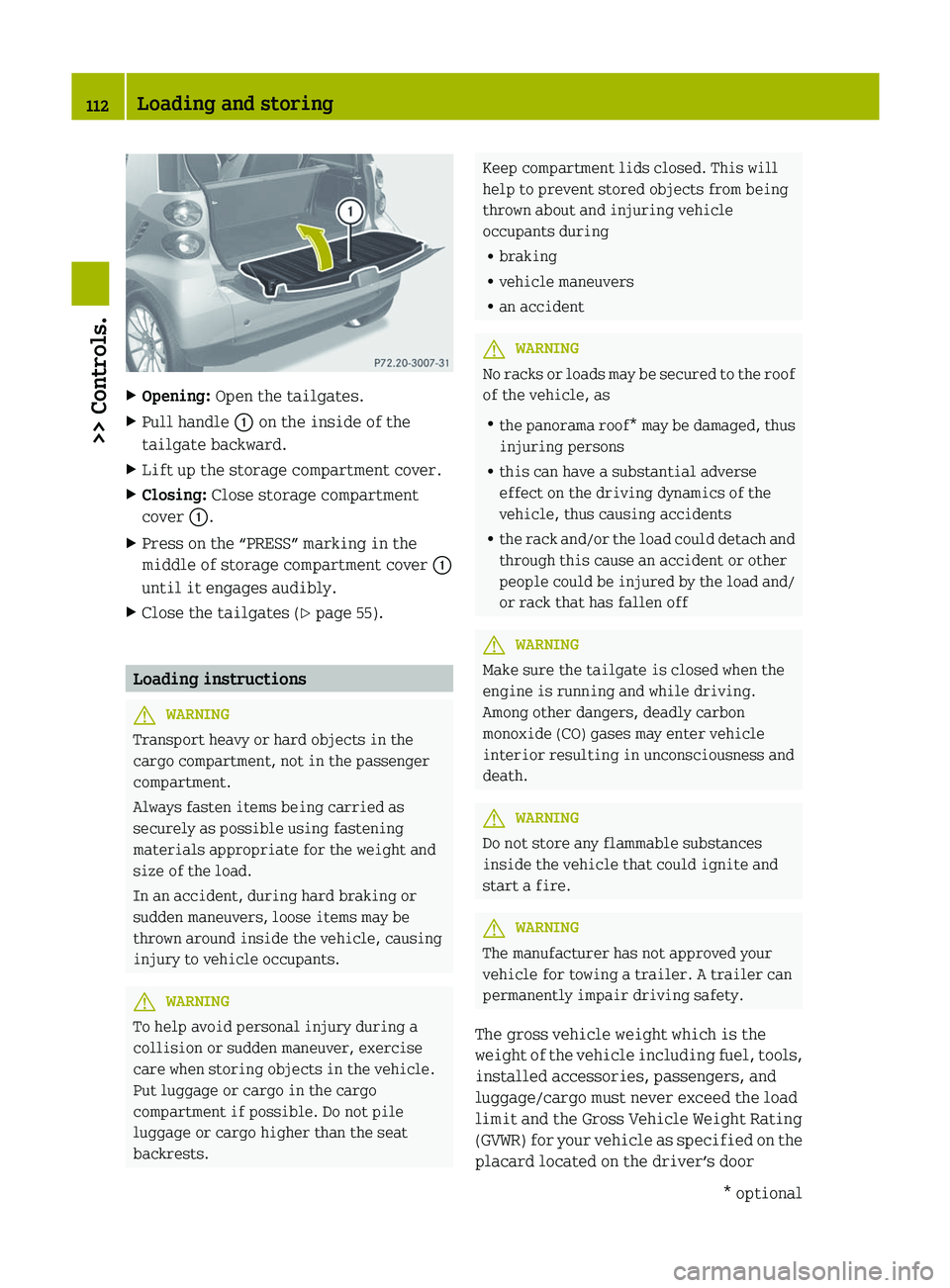
X
Opening: Open the tailgates.
X Pull handle : on the inside of the
tailgate backward.
X Lift up the storage compartment cover.
X Closing: Close storage compartment
cover :.
X Press on the “PRESS” marking in the
middle of storage compartment cover :
until it engages audibly.
X Close the tailgates ( Y page 55).Loading instructions
G
WARNING
Transport heavy or hard objects in the
cargo compartment, not in the passenger
compartment.
Always fasten items being carried as
securely as possible using fastening
materials appropriate for the weight and
size of the load.
In an accident, during hard braking or
sudden maneuvers, loose items may be
thrown around inside the vehicle, causing
injury to vehicle occupants. G
WARNING
To help avoid personal injury during a
collision or sudden maneuver, exercise
care when storing objects in the vehicle.
Put luggage or cargo in the cargo
compartment if possible. Do not pile
luggage or cargo higher than the seat
backrests. Keep compartment lids closed. This will
help to prevent stored objects from being
thrown about and injuring vehicle
occupants during
R
braking
R vehicle maneuvers
R an accident G
WARNING
No racks or loads may be secured to the roof
of the vehicle, as
R the
panorama roof* may be damaged, thus
injuring persons
R this can have a substantial adverse
effect on the driving dynamics of the
vehicle, thus causing accidents
R the rack and/or the load could detach and
through this cause an accident or other
people could be injured by the load and/
or rack that has fallen off G
WARNING
Make sure the tailgate is closed when the
engine is running and while driving.
Among other dangers, deadly carbon
monoxide (CO) gases may enter vehicle
interior resulting in unconsciousness and
death. G
WARNING
Do not store any flammable substances
inside the vehicle that could ignite and
start a fire. G
WARNING
The manufacturer has not approved your
vehicle for towing a trailer. A trailer can
permanently impair driving safety.
The gross vehicle weight which is the
weight
of the vehicle including fuel, tools,
installed accessories, passengers, and
luggage/cargo must never exceed the load
limit and the Gross Vehicle Weight Rating
(GVWR) for your vehicle as specified on the
placard located on the driver’s door 112
Loading and storing
>> Controls.
* optional