air condition SMART FORTWO COUPE 2012 Owner's Manual
[x] Cancel search | Manufacturer: SMART, Model Year: 2012, Model line: FORTWO COUPE, Model: SMART FORTWO COUPE 2012Pages: 228, PDF Size: 12.76 MB
Page 153 of 228
Such damage is caused not only by extreme
and varying climatic conditions, but also
by:
R
Air pollution
R Road salt
R Tar
R Gravel and stone chipping
To avoid paint damage, you should
immediately remove:
R Insects
R Bird droppings
R Tree sap, etc.
R Grease and oil
R Brake fluid
R Coolant
R Fuel
R Tar spots
! Failure to remove such dirt
immediately can cause damage to the
paint or the soft top fabric*
.
Environmental influences are not
covered by the smart Limited Warranty.
Frequent washing reduces and/or
eliminates the aggressiveness and potency
of the above adverse influences.
More frequent washings are necessary to
deal with unfavorable conditions:
R near the ocean
R in industrial areas (smoke, exhaust
emissions)
R during winter operation
You should check your vehicle from time to
time for stone chipping or other damage.
Any damage should be repaired as soon as
possible to prevent corrosion.
In doing so, do not neglect the underbody
of the vehicle. A prerequisite for a
thorough check is a washing of the
underbody followed by a thorough
inspection. Damaged areas need to be re-
undercoated.
Your vehicle has been treated at the factory
with a wax-base rustproofing in the body cavities which will last for the lifetime of
the vehicle. Post-production treatment is
neither necessary nor recommended by
smart because of the possibility of
incompatibility
between materials used in
the production process and others applied
later.
We have selected vehicle-care products
and compiled recommendations which are
specially matched to our vehicles and
which always reflect the latest technology.
You can obtain smart approved vehicle-
care products at an authorized smart
center.
Scratches, corrosive deposits, corrosion
or damage due to negligent or incorrect
care cannot always be removed or repaired
with the vehicle-care products
recommended here. In such cases it is best
to seek aid at an authorized smart center.
The following topics deal with the cleaning
and care of your vehicle and give important
“how-to” information as well as references
to smart approved vehicle-care products. Vehicle care
Contact an authorized smart center for
recommended and approved care products.
i Advice on caring for the soft top
system, see (Y page 154). G
WARNING
After washing the vehicle, the brakes may
still be wet and thus their functionality
impaired. Therefore, when you start off,
brake lightly several times without
endangering traffic. Vehicle care
151
>> Operation.
* optional Z
Page 188 of 228
X
Removing: Fold the wiper arm away from
the
rear window until you feel it engage.
X Fold wiper blade :
away from the wiper
arm in direction of arrow ; until it
disengages from its mounting.
X Detach wiper blade :.
X Installing:
Push the new wiper blade onto
the wiper arm until you feel it engage.
X Fold the wiper blade into a position
parallel to the wiper arm.
X Fold the wiper arm backward to rest on
the rear window.
Make sure to hold on to the wiper when
folding the wiper arm back.
! Make sure the wiper blade is properly
installed. An improperly installed
wiper blade may cause rear window
damage. Adjusting the washer jet nozzles
:
Front washer jet nozzles
; Rear washer jet nozzles
X Adjusting: Use a needle to move washer
jet nozzles : or ; left, right, up, or
down.
i Check the setting of the washer jet
nozzles at regular intervals. The washer
jet nozzles are correctly set when the
water
jet hits the windshield or the rear
window approximately in the center. Flat tire
Preparing the vehicle
Upon experiencing any type of problem
with the vehicle’s tires, switch on the
hazard warning flasher, carefully slow
down and exit the roadway in a cautious
manner.
X Park the vehicle at a safe distance from
moving traffic on a hard, flat surface
when possible.
X Make sure the tire valve of the damaged
tire
is located below the horizontal axle
of the wheel hub.
X Engage the parking brake.
X Turn the steering wheel so that the front
wheels are in a straight ahead position.
X Move the gear selector lever to park
position P.
X Turn off the engine.
X Remove the key from the starter switch
and take the key with you.
i Open
door only when conditions are safe
to do so.
X Have any passenger exit the vehicle at a
safe distance from the roadway. Using the tire repair kit
! Depending
on the type of damage on the
tire, the tire sealant could damage the
sensor of the Tire Pressure Monitoring
System (TPMS)*. Such damage is not
covered by the smart Limited Warranty.
When having the damaged tire replaced,
also have the TPMS sensors* checked for
proper function. When the sensor is
damaged, the TPMS* will not function
properly. The sensor must then be
replaced at an authorized smart center as
soon as possible.
i Depending on production date of your
vehicle, it will be equipped with version
1 or version 2 of the tire repair kit. 186
Flat tire
>> Practical hints.
* optional
Page 189 of 228
Please make sure to refer to the
description
of the tire repair kit in your
vehicle before sealing a tire.
The tire repair kit can be used to seal
punctures of up to approximately 0.16 in
(4 mm) on the tire tread.
The tire repair kit enables you to drive on
the sealed tire to the nearest authorized
smart center.
X You should have the sealed tire replaced
at an authorized smart center. G
WARNING
Take care not to allow the contents of the
tire sealant to come in contact with hair,
eyes or clothing. The tire sealant is
harmful if inhaled, swallowed or absorbed
through the skin - causes skin, eye and
respiratory irritation. Wear gloves while
using this product if they are available.
Any contact with eyes or skin should be
flushed immediately with plenty of water.
If clothing comes in contact with the tire
sealant, change clothing as soon as
possible.
In
case of allergic reaction or rash, consult
a physician immediately. Notes
R Small tire punctures, particularly those
in the tread, can be sealed with the tire
sealant.
R The tire sealant can be used in ambient
temperatures from ‑4 ¦ (‑20¥) to
104¦ (+40¥).
R Do
not remove any foreign objects such as
nails or screws that have penetrated the
tire.
R Do not use the tire sealant if the tire has
been damaged by being driven when
insufficiently inflated (e.g. bumps,
cuts, cracks etc. on the tire).
R Allow escaped tire sealant to dry, then
peel it off. R
Immediately wash all painted surfaces
that came into contact with the tire
sealant using a damp cloth.
R Avoid skin and eye contact with the tire
sealant.
R Do not swallow the tire sealant.
R Allow the tire sealant that is inside the
damaged tire to dry and dispose of
together with the tire.
R Do not use the tire sealant after the
expiration date has elapsed (see top of
container).
Instead, have it replaced at an
authorized smart center. G
WARNING
The tire sealant is a limited repair device.
The tire sealant cannot be used for cuts or
punctures larger than approximately
0.16 in (4 mm) and tire damage caused by
driving with extremely low tire inflation
pressure, or on a flat tire, or a damaged
wheel.
Do not drive the vehicle under such
circumstances.
If
you are unsure of the condition of the tire
or have any question whatsoever about its
suitability for driving contact the nearest
smart center for assistance or call
Roadside Assistance. G
WARNING
Please review the instructions below for
using the tire repair kit. If you are not
confident that you can competently follow
the instructions for using this kit, do not
use the kit, but instead call for Roadside
Assistance. G
WARNING
Keep the tire sealant out of reach of
children. If swallowed, rinse mouth
immediately
with plenty of water and drink
plenty of water.
Do not induce vomiting!
Consult a physician immediately. Flat tire
187
>> Practical hints.
Z
Page 211 of 228
No. Accessory/Component Amperage Color
F
Engine 15 A Blue
G
ESP
®
control unit 25 A Neutral
H
Cockpit switch module, on-board
diagnostics
socket, turn signal lamp switch,
transmission control unit, exterior lamp
switch, anti-theft warning system, rain-
light sensor, auxiliary instruments, central
locking system, instrument cluster, exterior
rear view mirror heating, Tire Pressure
Monitoring System (TPMS) 10 A Red
I
— — —
J
Air conditioning compressor 15 A Blue
K
Audio, subwoofer, sound system, soft top
(cabriolet only) 15 A Blue
L
Fuel pump with fuel level sensor 15 A Blue
M
Rear window wiper (coupé only) 15 A Blue
N
ESP
®
control unit, EPS control unit, restraint
system, instrument cluster 10 A Red
O
Engine control unit, on-board diagnostics
socket, transmission control unit, Tire
Pressure Monitoring System (TPMS) 7.5 A Brown
P
Air conditioning system, exterior rear view
mirror
adjustment, washer pump, audio, seat
heating, wiper switch, backup lamps, soft top
switch (cabriolet only) 10 A Red
Q
Auxiliary power outlet 15 A Blue
R
Left low‑beam headlamp 7.5 A Brown
S
Right low‑beam headlamp 7.5 A Brown
T
Brake lamps 15 A Blue
U
Right high‑beam headlamp 7.5 A Brown
V
Left high‑beam headlamp 7.5 A Brown
W
Engine 7.5 A Brown
X
Rear window defroster, radiator fan 40 A Orange
Y
Soft top (cabriolet only) 30 A Green Fuses
209
>> Practical hints. Z
Page 222 of 228
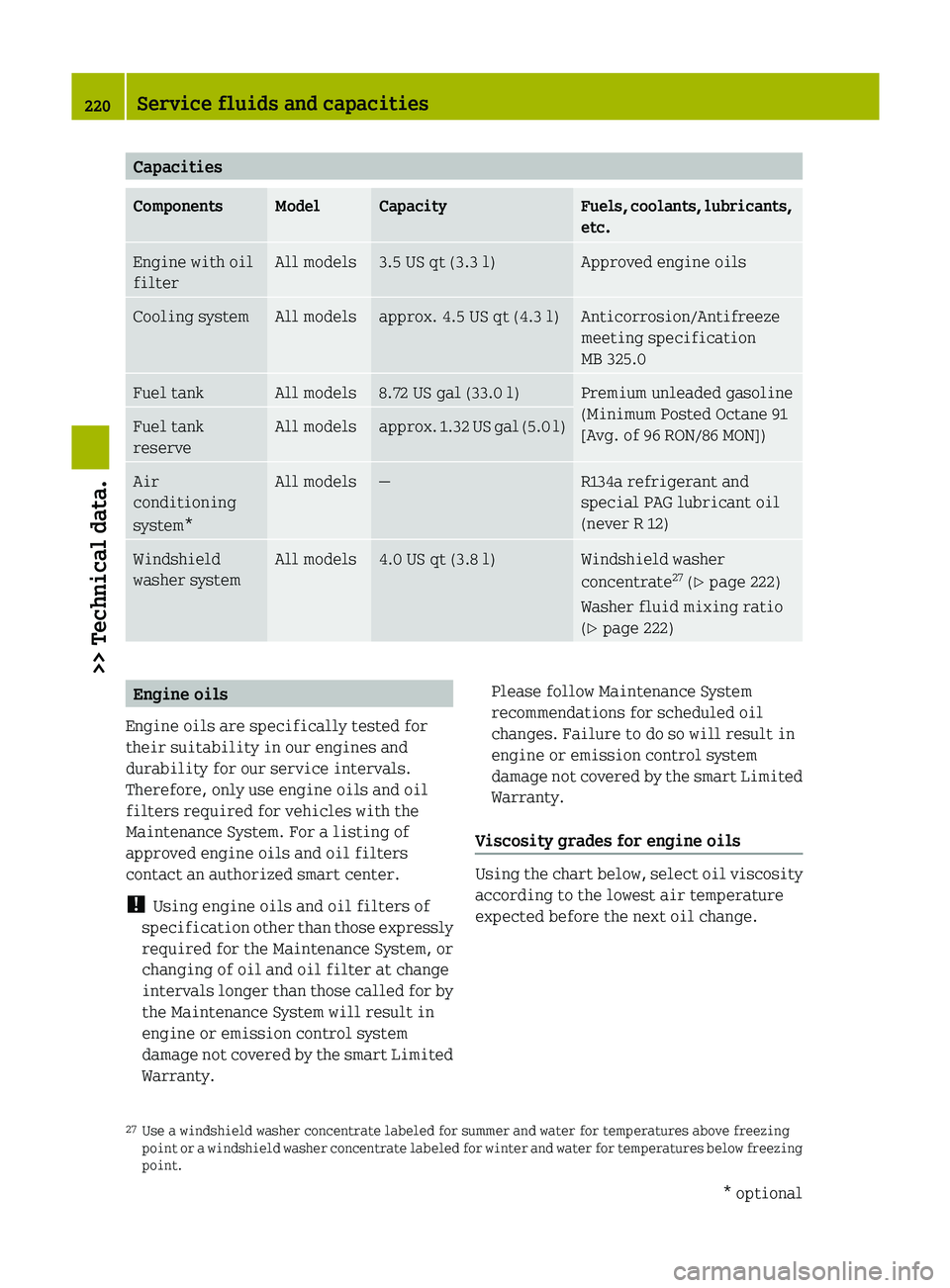
Capacities
Components Model Capacity Fuels, coolants, lubricants,
etc.
Engine with oil
filter All models 3.5 US qt (3.3 l) Approved engine oils
Cooling system All models approx. 4.5 US qt (4.3 l) Anticorrosion/Antifreeze
meeting specification
MB 325.0
Fuel tank All models 8.72 US gal (33.0 l) Premium unleaded gasoline
(Minimum Posted Octane 91
[Avg. of 96 RON/86 MON])
Fuel tank
reserve All models approx. 1.32 US gal (5.0 l)
Air
conditioning
system* All models — R134a refrigerant and
special PAG lubricant oil
(never R 12)
Windshield
washer system All models 4.0 US qt (3.8 l) Windshield washer
concentrate
27
(Y page 222)
Washer fluid mixing ratio
(Y page 222) Engine oils
Engine oils are specifically tested for
their suitability in our engines and
durability for our service intervals.
Therefore, only use engine oils and oil
filters required for vehicles with the
Maintenance System. For a listing of
approved engine oils and oil filters
contact an authorized smart center.
! Using engine oils and oil filters of
specification
other than those expressly
required for the Maintenance System, or
changing of oil and oil filter at change
intervals longer than those called for by
the Maintenance System will result in
engine or emission control system
damage not covered by the smart Limited
Warranty. Please follow Maintenance System
recommendations for scheduled oil
changes. Failure to do so will result in
engine or emission control system
damage
not covered by the smart Limited
Warranty.
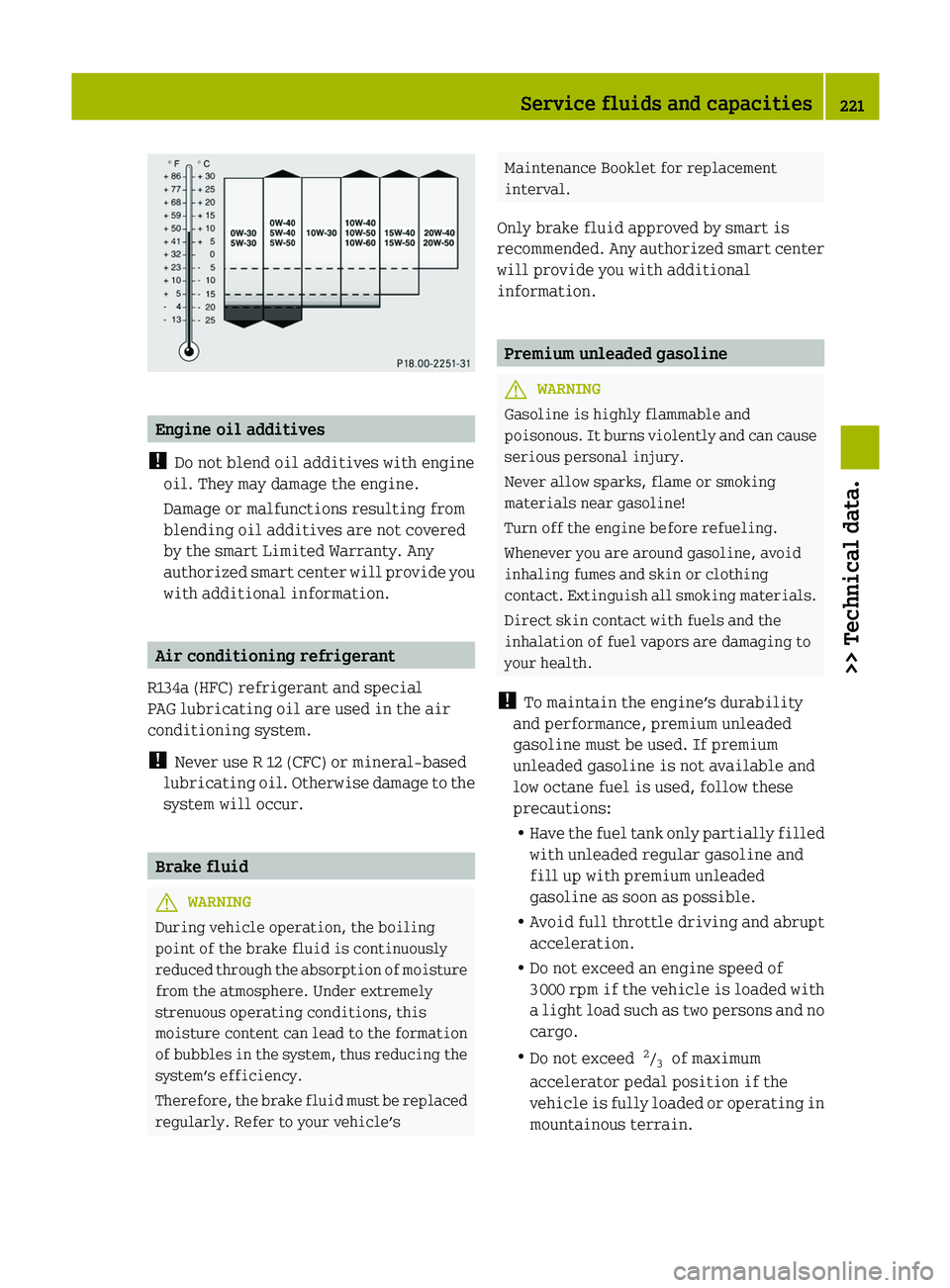
Viscosity grades for engine oils Using the chart below, select oil viscosity
according to the lowest air temperature
expected before the next oil change.
27 Use a windshield washer concentrate labeled for summer and water for temperatures above freezing
point
or a windshield washer concentrate labeled for winter and water for temperatures below freezing
point. 220
Service fluids and capacities
>> Technical data.
* optional
Page 223 of 228
Engine oil additives
! Do not blend oil additives with engine
oil. They may damage the engine.
Damage or malfunctions resulting from
blending oil additives are not covered
by the smart Limited Warranty. Any
authorized
smart center will provide you
with additional information. Air conditioning refrigerant
R134a (HFC) refrigerant and special
PAG lubricating oil are used in the air
conditioning system.
! Never use R 12 (CFC) or mineral-based
lubricating
oil. Otherwise damage to the
system will occur. Brake fluid
G
WARNING
During vehicle operation, the boiling
point of the brake fluid is continuously
reduced
through the absorption of moisture
from the atmosphere. Under extremely
strenuous operating conditions, this
moisture content can lead to the formation
of bubbles in the system, thus reducing the
system’s efficiency.
Therefore, the brake fluid must be replaced
regularly. Refer to your vehicle’s Maintenance Booklet for replacement
interval.
Only brake fluid approved by smart is
recommended.
Any authorized smart center
will provide you with additional
information. Premium unleaded gasoline
G
WARNING
Gasoline is highly flammable and
poisonous.
It burns violently and can cause
serious personal injury.
Never allow sparks, flame or smoking
materials near gasoline!
Turn off the engine before refueling.
Whenever you are around gasoline, avoid
inhaling fumes and skin or clothing
contact. Extinguish all smoking materials.
Direct skin contact with fuels and the
inhalation of fuel vapors are damaging to
your health.
! To maintain the engine’s durability
and performance, premium unleaded
gasoline must be used. If premium
unleaded gasoline is not available and
low octane fuel is used, follow these
precautions:
R Have the fuel tank only partially filled
with unleaded regular gasoline and
fill up with premium unleaded
gasoline as soon as possible.
R Avoid full throttle driving and abrupt
acceleration.
R Do not exceed an engine speed of
3 000 rpm if the vehicle is loaded with
a light load such as two persons and no
cargo.
R Do not exceed 2
/ 3 of maximum
accelerator pedal position if the
vehicle is fully loaded or operating in
mountainous terrain. Service fluids and capacities
221
>> Technical data. Z