oil SMART FORTWO COUPE 2012 Owner's Manual
[x] Cancel search | Manufacturer: SMART, Model Year: 2012, Model line: FORTWO COUPE, Model: SMART FORTWO COUPE 2012Pages: 228, PDF Size: 12.76 MB
Page 173 of 228
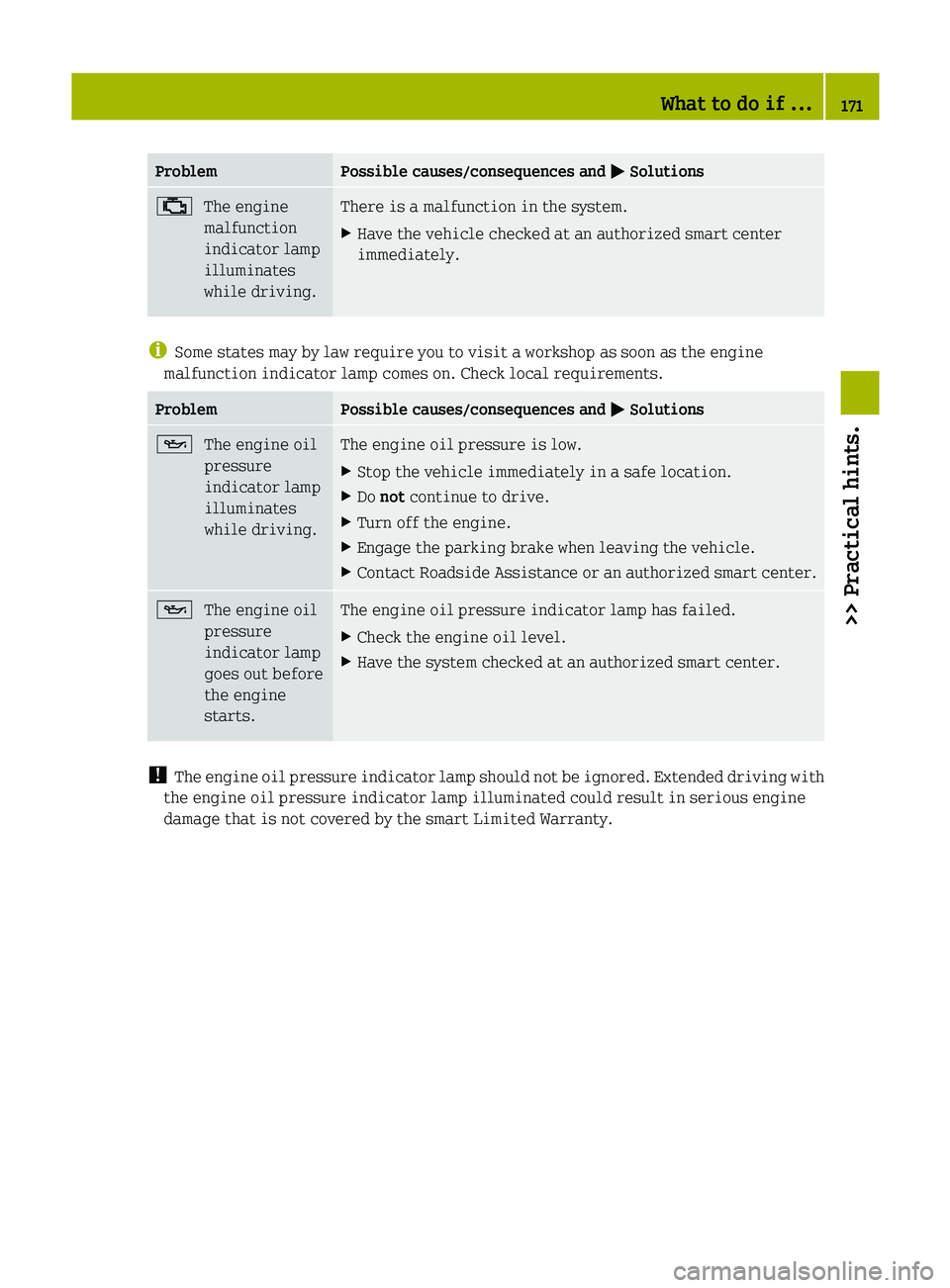
Problem Possible causes/consequences and
M Solutions;
The engine
malfunction
indicator lamp
illuminates
while driving. There is a malfunction in the system.
X
Have the vehicle checked at an authorized smart center
immediately. i
Some states may by law require you to visit a workshop as soon as the engine
malfunction indicator lamp comes on. Check local requirements. Problem Possible causes/consequences and
M Solutions5
The engine oil
pressure
indicator lamp
illuminates
while driving. The engine oil pressure is low.
X
Stop the vehicle immediately in a safe location.
X Do not continue to drive.
X Turn off the engine.
X Engage the parking brake when leaving the vehicle.
X Contact Roadside Assistance or an authorized smart center. 5
The engine oil
pressure
indicator lamp
goes out before
the engine
starts. The engine oil pressure indicator lamp has failed.
X
Check the engine oil level.
X Have the system checked at an authorized smart center. !
The engine oil pressure indicator lamp should not be ignored. Extended driving with
the engine oil pressure indicator lamp illuminated could result in serious engine
damage that is not covered by the smart Limited Warranty. What to do if ...
171
>> Practical hints. Z
Page 180 of 228
X
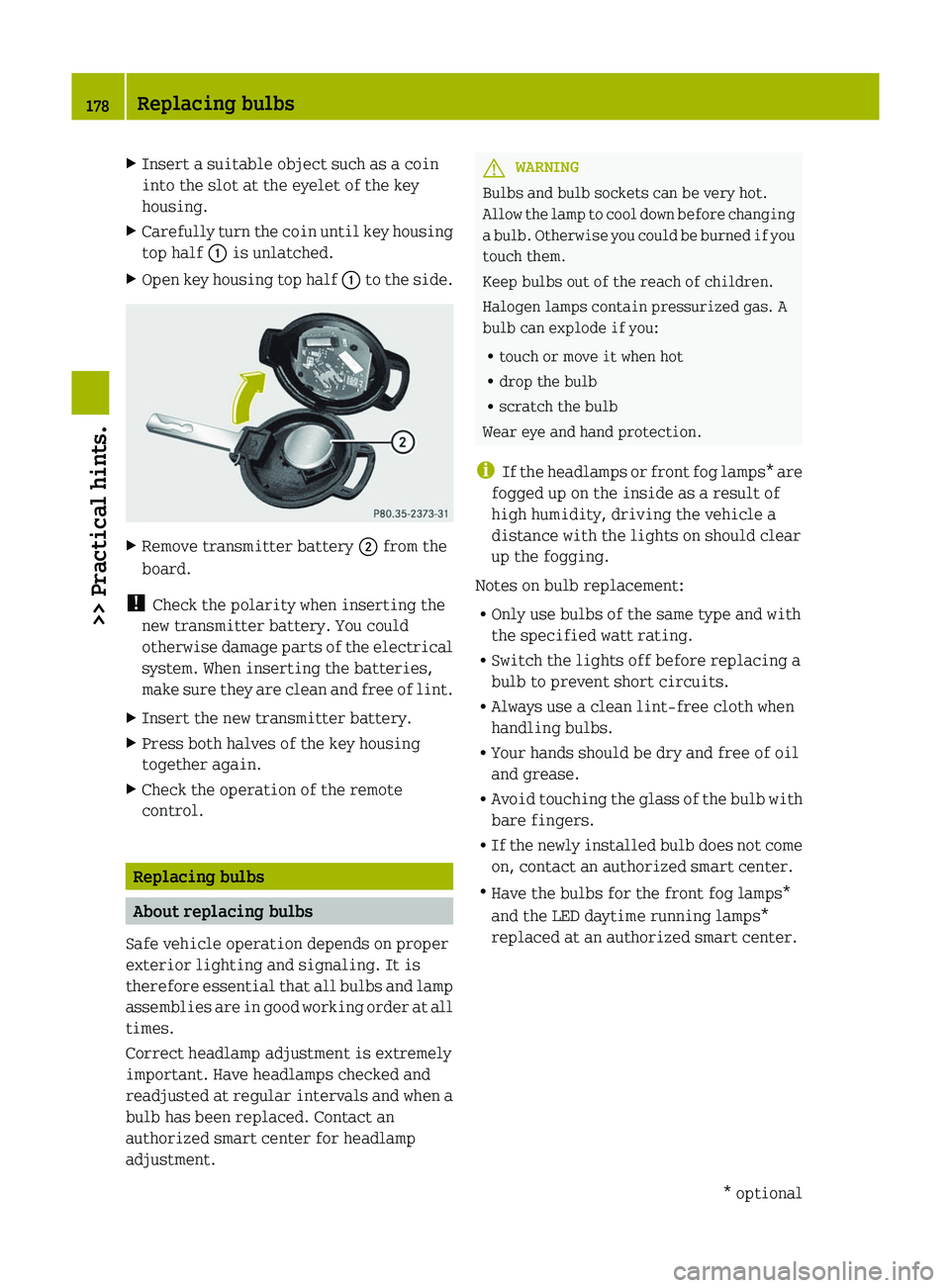
Insert a suitable object such as a coin
into the slot at the eyelet of the key
housing.
X Carefully turn the coin until key housing
top half : is unlatched.
X Open key housing top half : to the side.X
Remove transmitter battery ; from the
board.
! Check the polarity when inserting the
new transmitter battery. You could
otherwise
damage parts of the electrical
system. When inserting the batteries,
make sure they are clean and free of lint.
X Insert the new transmitter battery.
X Press both halves of the key housing
together again.
X Check the operation of the remote
control. Replacing bulbs
About replacing bulbs
Safe vehicle operation depends on proper
exterior lighting and signaling. It is
therefore
essential that all bulbs and lamp
assemblies are in good working order at all
times.
Correct headlamp adjustment is extremely
important. Have headlamps checked and
readjusted at regular intervals and when a
bulb has been replaced. Contact an
authorized smart center for headlamp
adjustment. G
WARNING
Bulbs and bulb sockets can be very hot.
Allow
the lamp to cool down before changing
a bulb. Otherwise you could be burned if you
touch them.
Keep bulbs out of the reach of children.
Halogen lamps contain pressurized gas. A
bulb can explode if you:
R touch or move it when hot
R drop the bulb
R scratch the bulb
Wear eye and hand protection.
i If the headlamps or front fog lamps* are
fogged up on the inside as a result of
high humidity, driving the vehicle a
distance with the lights on should clear
up the fogging.
Notes on bulb replacement:
R Only use bulbs of the same type and with
the specified watt rating.
R Switch the lights off before replacing a
bulb to prevent short circuits.
R Always use a clean lint-free cloth when
handling bulbs.
R Your hands should be dry and free of oil
and grease.
R Avoid touching the glass of the bulb with
bare fingers.
R If the newly installed bulb does not come
on, contact an authorized smart center.
R Have the bulbs for the front fog lamps*
and the LED daytime running lamps*
replaced at an authorized smart center.178
Replacing bulbs
>> Practical hints.
* optional
Page 197 of 228
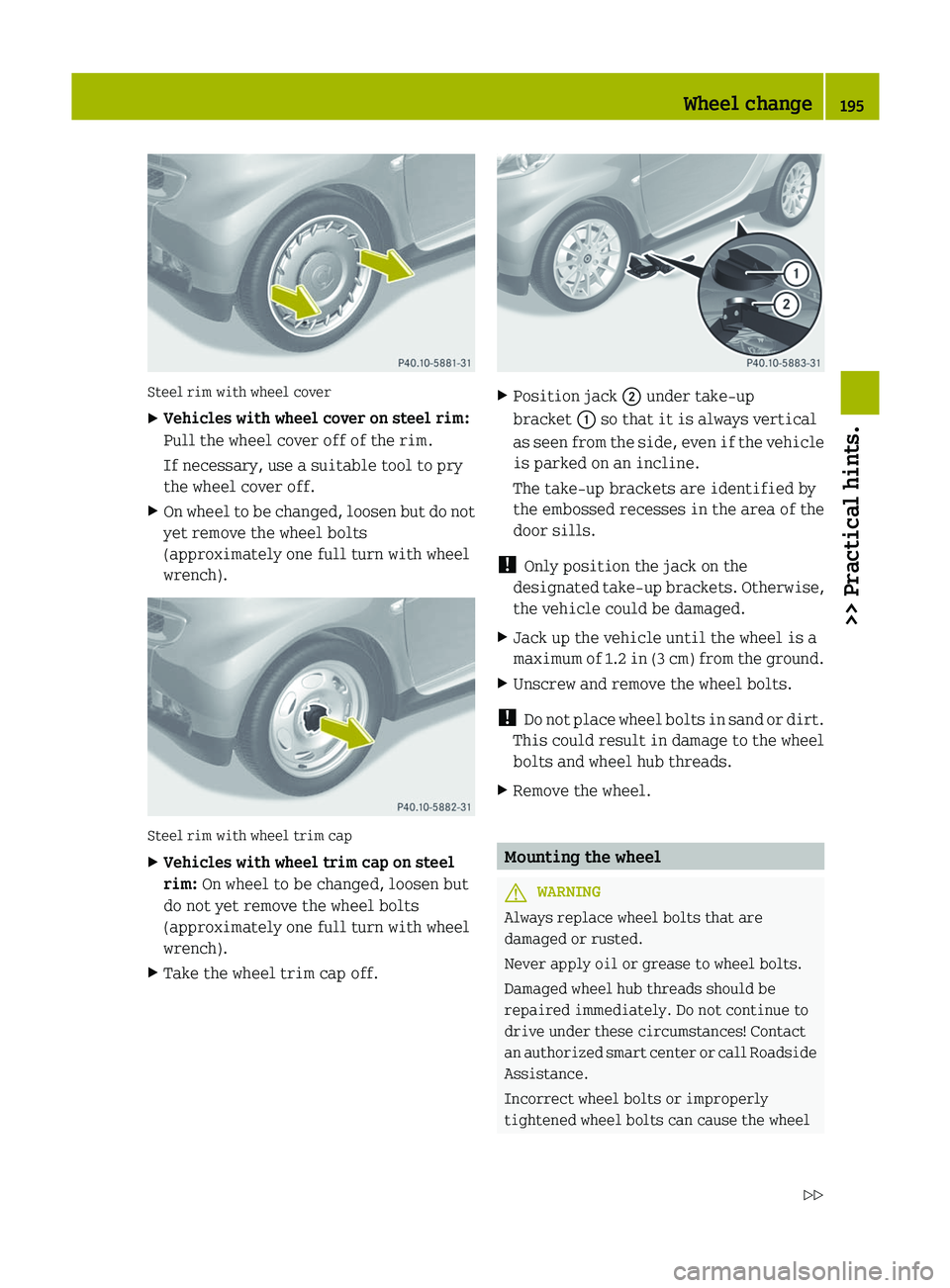
Steel rim with wheel cover
X
Vehicles with wheel cover on steel rim:
Pull the wheel cover off of the rim.
If necessary, use a suitable tool to pry
the wheel cover off.
X On wheel to be changed, loosen but do not
yet remove the wheel bolts
(approximately one full turn with wheel
wrench). Steel rim with wheel trim cap
X
Vehicles with wheel trim cap on steel
rim: On wheel to be changed, loosen but
do not yet remove the wheel bolts
(approximately one full turn with wheel
wrench).
X Take the wheel trim cap off. X
Position jack ; under take-up
bracket : so that it is always vertical
as
seen from the side, even if the vehicle
is parked on an incline.
The take-up brackets are identified by
the embossed recesses in the area of the
door sills.
! Only position the jack on the
designated
take-up brackets. Otherwise,
the vehicle could be damaged.
X Jack up the vehicle until the wheel is a
maximum
of 1.2 in (3 cm) from the ground.
X Unscrew and remove the wheel bolts.
! Do
not place wheel bolts in sand or dirt.
This could result in damage to the wheel
bolts and wheel hub threads.
X Remove the wheel. Mounting the wheel
G
WARNING
Always replace wheel bolts that are
damaged or rusted.
Never apply oil or grease to wheel bolts.
Damaged wheel hub threads should be
repaired immediately. Do not continue to
drive under these circumstances! Contact
an
authorized smart center or call Roadside
Assistance.
Incorrect wheel bolts or improperly
tightened wheel bolts can cause the wheel Wheel change
195
>> Practical hints.
Z
Page 222 of 228
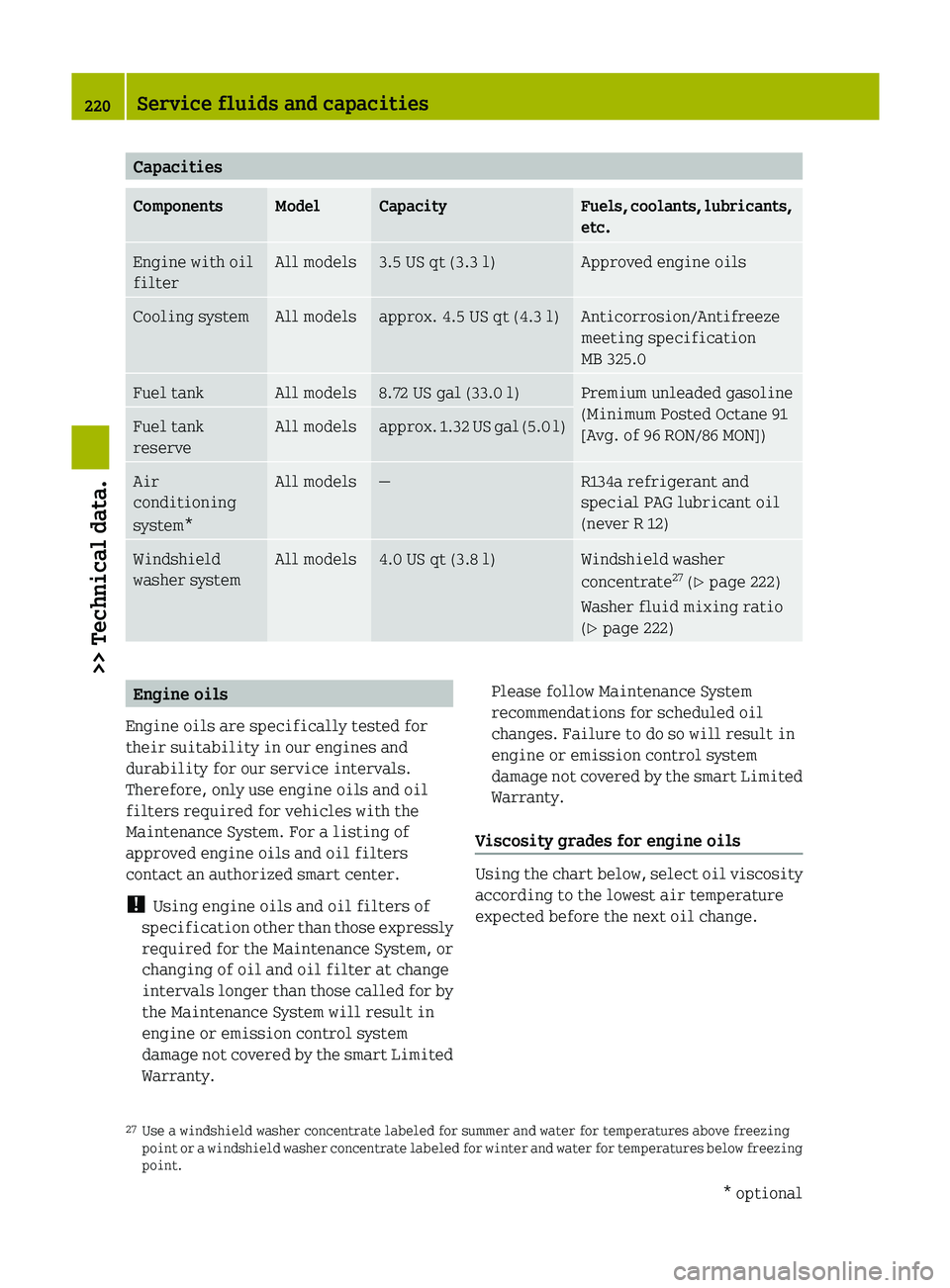
Capacities
Components Model Capacity Fuels, coolants, lubricants,
etc.
Engine with oil
filter All models 3.5 US qt (3.3 l) Approved engine oils
Cooling system All models approx. 4.5 US qt (4.3 l) Anticorrosion/Antifreeze
meeting specification
MB 325.0
Fuel tank All models 8.72 US gal (33.0 l) Premium unleaded gasoline
(Minimum Posted Octane 91
[Avg. of 96 RON/86 MON])
Fuel tank
reserve All models approx. 1.32 US gal (5.0 l)
Air
conditioning
system* All models — R134a refrigerant and
special PAG lubricant oil
(never R 12)
Windshield
washer system All models 4.0 US qt (3.8 l) Windshield washer
concentrate
27
(Y page 222)
Washer fluid mixing ratio
(Y page 222) Engine oils
Engine oils are specifically tested for
their suitability in our engines and
durability for our service intervals.
Therefore, only use engine oils and oil
filters required for vehicles with the
Maintenance System. For a listing of
approved engine oils and oil filters
contact an authorized smart center.
! Using engine oils and oil filters of
specification
other than those expressly
required for the Maintenance System, or
changing of oil and oil filter at change
intervals longer than those called for by
the Maintenance System will result in
engine or emission control system
damage not covered by the smart Limited
Warranty. Please follow Maintenance System
recommendations for scheduled oil
changes. Failure to do so will result in
engine or emission control system
damage
not covered by the smart Limited
Warranty.
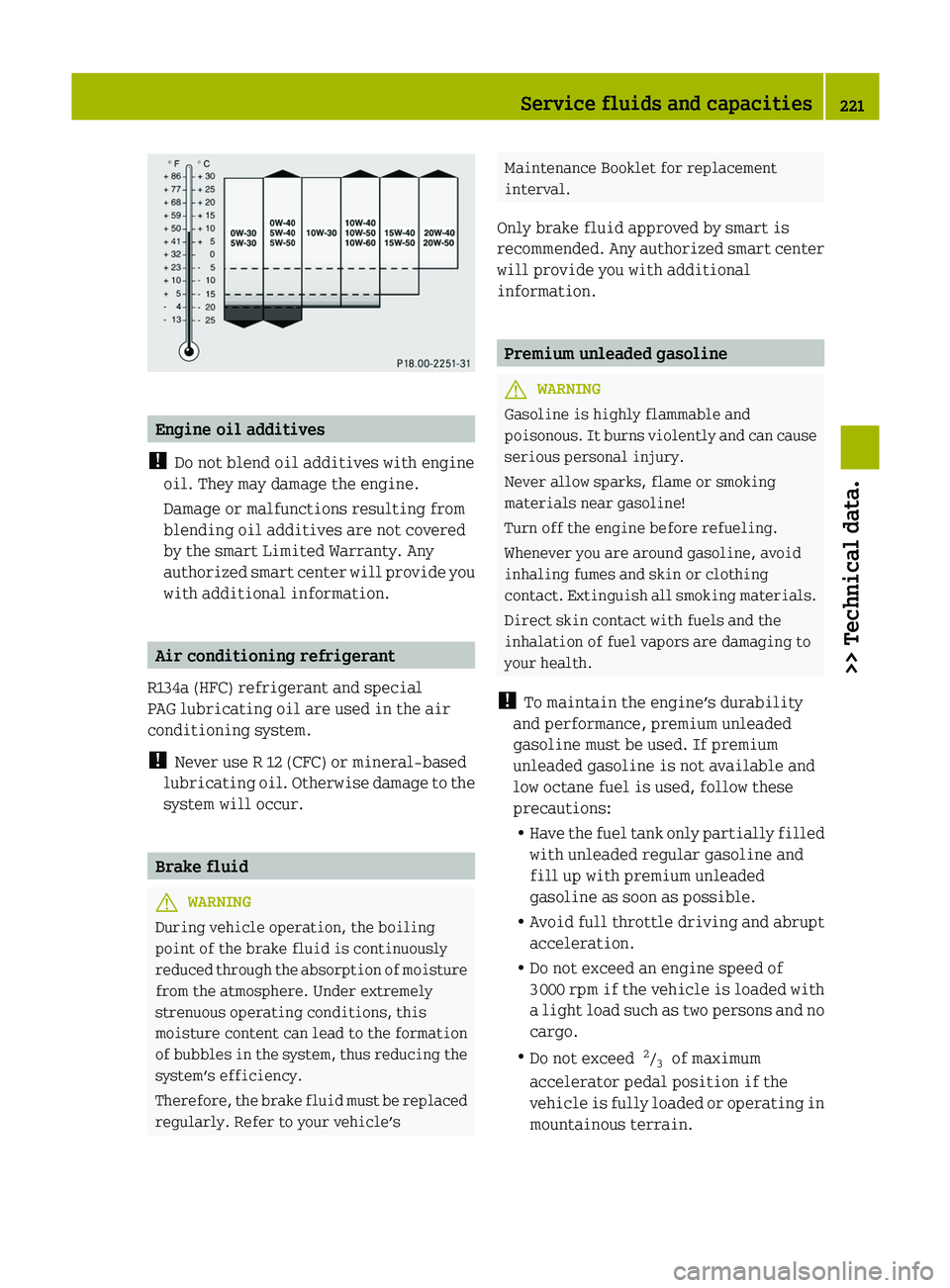
Viscosity grades for engine oils Using the chart below, select oil viscosity
according to the lowest air temperature
expected before the next oil change.
27 Use a windshield washer concentrate labeled for summer and water for temperatures above freezing
point
or a windshield washer concentrate labeled for winter and water for temperatures below freezing
point. 220
Service fluids and capacities
>> Technical data.
* optional
Page 223 of 228
Engine oil additives
! Do not blend oil additives with engine
oil. They may damage the engine.
Damage or malfunctions resulting from
blending oil additives are not covered
by the smart Limited Warranty. Any
authorized
smart center will provide you
with additional information. Air conditioning refrigerant
R134a (HFC) refrigerant and special
PAG lubricating oil are used in the air
conditioning system.
! Never use R 12 (CFC) or mineral-based
lubricating
oil. Otherwise damage to the
system will occur. Brake fluid
G
WARNING
During vehicle operation, the boiling
point of the brake fluid is continuously
reduced
through the absorption of moisture
from the atmosphere. Under extremely
strenuous operating conditions, this
moisture content can lead to the formation
of bubbles in the system, thus reducing the
system’s efficiency.
Therefore, the brake fluid must be replaced
regularly. Refer to your vehicle’s Maintenance Booklet for replacement
interval.
Only brake fluid approved by smart is
recommended.
Any authorized smart center
will provide you with additional
information. Premium unleaded gasoline
G
WARNING
Gasoline is highly flammable and
poisonous.
It burns violently and can cause
serious personal injury.
Never allow sparks, flame or smoking
materials near gasoline!
Turn off the engine before refueling.
Whenever you are around gasoline, avoid
inhaling fumes and skin or clothing
contact. Extinguish all smoking materials.
Direct skin contact with fuels and the
inhalation of fuel vapors are damaging to
your health.
! To maintain the engine’s durability
and performance, premium unleaded
gasoline must be used. If premium
unleaded gasoline is not available and
low octane fuel is used, follow these
precautions:
R Have the fuel tank only partially filled
with unleaded regular gasoline and
fill up with premium unleaded
gasoline as soon as possible.
R Avoid full throttle driving and abrupt
acceleration.
R Do not exceed an engine speed of
3 000 rpm if the vehicle is loaded with
a light load such as two persons and no
cargo.
R Do not exceed 2
/ 3 of maximum
accelerator pedal position if the
vehicle is fully loaded or operating in
mountainous terrain. Service fluids and capacities
221
>> Technical data. Z
Page 224 of 228
Fuel requirements
Only use premium unleaded fuel. The octane
number (posted at the pump) must be 91 min.
It is an average of both the Research Octane
Number (RON) and the Motor Octane Number
(MON): (RON+MON)/2. This is also known as
the ANTI‑KNOCK INDEX.
Unleaded gasoline containing oxygenates
such as ethanol, IPA, IBA and TBA can be
used provided the ratio of any one of these
oxygenates to gasoline does not exceed
10%; MTBE must not exceed 15%.
The ratio of methanol to gasoline must not
exceed 3% plus additional cosolvents.
Using mixtures of ethanol and methanol is
not allowed. Gasohol, which contains 10%
ethanol and 90% unleaded gasoline, can be
used.
These blends must also meet all other fuel
requirements, such as resistance to spark
knock, boiling range, vapor pressure, etc. Gasoline additives
A major concern among engine
manufacturers is carbon build-up caused
by
gasoline. smart recommends only the use
of quality gasoline containing additives
that prevent the build-up of carbon
deposits.
After an extended period of using fuels
without such additives carbon deposits can
build up, especially on the intake valves
and in the combustion area, leading to
engine performance problems such as:
R Warm-up hesitation
R Unstable idle
R Knocking/pinging
R Misfire
R Power loss
In areas where carbon deposits may be
encountered due to lack of availability of
gasolines which contain these additives, the use of smart approved additives is
recommended.
Contact an authorized smart
center for a listing of approved products.
Follow directions on the product label.
Do not blend other fuel additives with fuel.
This only results in unnecessary costs and
may be harmful to the engine operation.
! Damage or malfunction resulting from
poor fuel quality or from blending
additional fuel additives other than
those tested and approved by us for use
on smart vehicles are not covered by the
smart Limited Warranty. Windshield/rear window washer system
During all seasons:
X Use a windshield washer concentrate
labeled for summer and water for
temperatures above freezing point.
X Use a windshield washer concentrate
labeled for winter and water for
temperatures below freezing point.
X Premix the windshield washer fluid in a
suitable container depending on the
outside temperature and in accordance
with the manufacturer’s instructions 28
.
Washer fluid mixing ratio R
Temperature above 32 ¦ (0¥):
1 part windshield washer concentrate
labeled for summer to 100 parts water
R Temperature of 14 ¦ (-10¥):
1 part windshield washer concentrate
labeled for winter to 2 parts water
R Temperature of -4¦ (-20¥):
1 part windshield washer concentrate
labeled for winter to 1 part water G
WARNING
Windshield washer concentrate is highly
flammable.
Fire, naked flames and smoking
28 Refer to the notes for use on the container.222
Service fluids and capacities
>> Technical data.
Page 225 of 228
are prohibited when windshield washer
concentrate is being handled.
Coolants
The engine coolant is a mixture of water
and anticorrosion/antifreeze, which
provides:
R Corrosion protection
R Freeze protection
R Boiling protection (by increasing the
boiling point)
The
cooling system was filled at the factory
with a coolant providing freeze protection
to approximately -35¦ (-37 ¥) and
corrosion protection.
! Add premixed coolant solution only.
Adding water and MB 325.0
Anticorrosion/Antifreeze separately
from each other, could cause engine
damage not covered by the smart Limited
Warranty.
If the antifreeze mixture is effective to
-35¦ (-37 ¥), the boiling point of the
coolant in the pressurized cooling system
is reached at approximately 266 ¦
(130¥ ).
The coolant solution must be used year
round, even in countries which have high
temperatures to provide the necessary
corrosion protection and increase
boil‑over protection. Refer to
Maintenance/ Service Booklet for
replacement interval.
Coolant system design and coolant used
determine the replacement interval. The
replacement interval published in the
Maintenance booklet is only applicable if
MB 325.0 Anticorrosion/Antifreeze
solution or other smart approved products
of equal specification are used to renew
the coolant concentration or bring it back
up to the proper level. For information on other smart approved
products
of equal specification, contact an
authorized smart center.
To provide important corrosion
protection, the solution must be at least
50% anticorrosion/antifreeze (equivalent
to freeze protection to approximately
-35¦ [-37 ¥]).
If you use a solution that is more than 55%
anticorrosion/antifreeze (freeze
protection to approximately -49¦
[(-45 ¥]), the engine temperature will
increase due to the lower heat transfer
capability of the solution. Therefore, do
not use more than this amount of
anticorrosion/antifreeze.
If the coolant level is low, water and
MB 325.0 Anticorrosion/Antifreeze should
be used to bring it up to the proper level
(have cooling system checked for signs of
leakage). Please make sure the mixture is
in accordance with label instructions.
Always use anticorrosion/antifreeze that
has been approved by smart. For
information contact an authorized smart
center.
The water in the cooling system must meet
minimum requirements, which are usually
satisfied by normal drinking water.
If you are not sure about the water quality,
consult an authorized smart center.
Anticorrosion/antifreeze Your vehicle contains a number of
aluminum parts. The use of aluminum
components in motor vehicle engines
necessitates that anticorrosion/
antifreeze
coolant used in such engines be
specifically formulated to protect the
aluminum parts.
Failure to use such anticorrosion/
antifreeze coolant will result in a
significantly shortened service life.
Therefore, the following product is
strongly recommended for use in your Service fluids and capacities
223
>> Technical data. Z