transmission SMART FORTWO COUPE 2012 Owner's Manual
[x] Cancel search | Manufacturer: SMART, Model Year: 2012, Model line: FORTWO COUPE, Model: SMART FORTWO COUPE 2012Pages: 228, PDF Size: 12.76 MB
Page 162 of 228
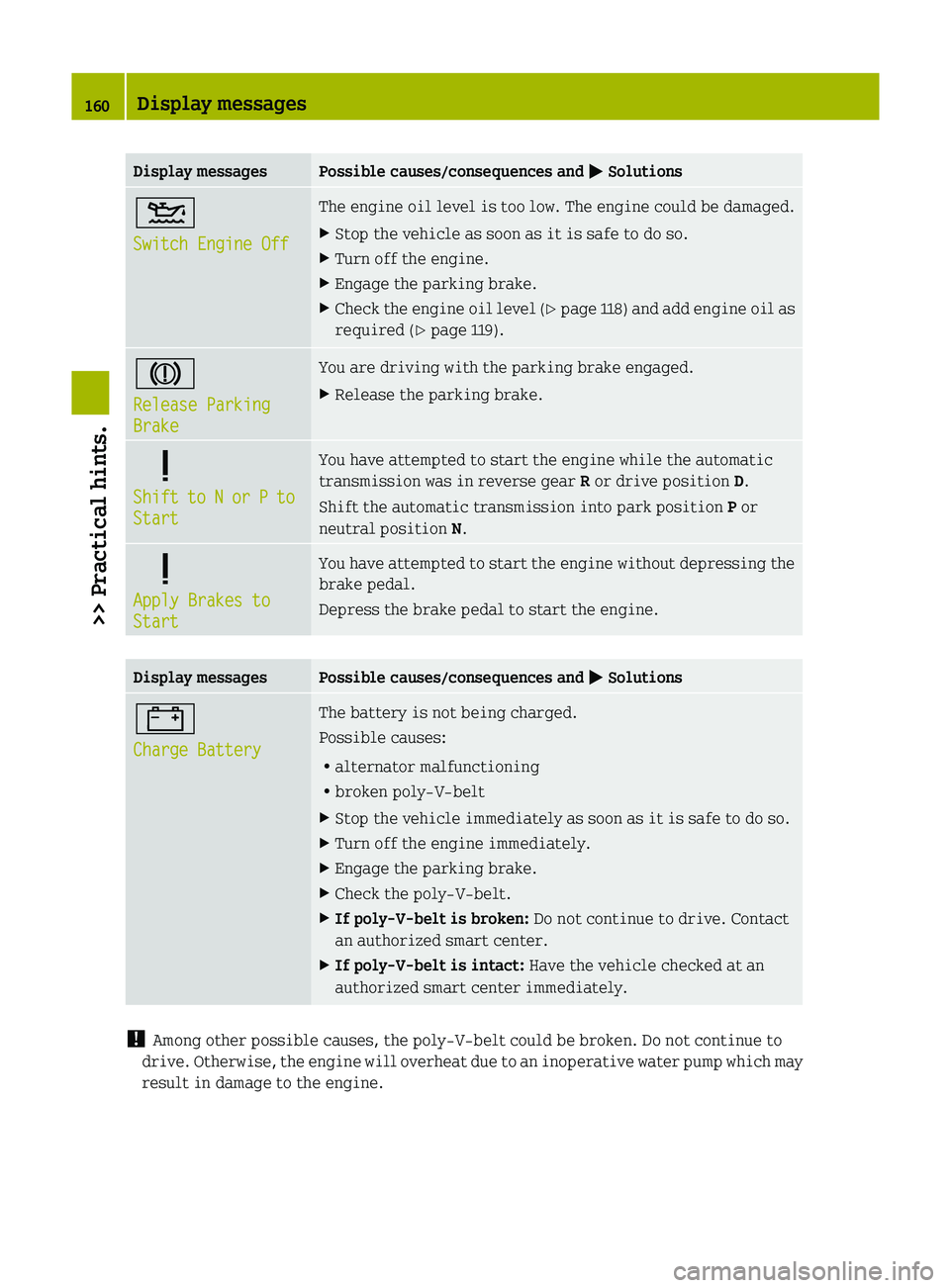
Display messages Possible causes/consequences and
M Solutions4
Switch Engine Off The engine oil level is too low. The engine could be damaged.
X
Stop the vehicle as soon as it is safe to do so.
X Turn off the engine.
X Engage the parking brake.
X Check the engine oil level (Y page 118) and add engine oil as
required (Y page 119). J
Release Parking
Brake You are driving with the parking brake engaged.
X
Release the parking brake. 5
Shift
to N or P to
Start You have attempted to start the engine while the automatic
transmission was in reverse gear
R or drive position D.
Shift the automatic transmission into park position P or
neutral position N.5
Apply Brakes to
Start You have attempted to start the engine without depressing the
brake pedal.
Depress the brake pedal to start the engine.
Display messages Possible causes/consequences and
M Solutions#
Charge Battery The battery is not being charged.
Possible causes:
R
alternator malfunctioning
R broken poly-V-belt
X Stop the vehicle immediately as soon as it is safe to do so.
X Turn off the engine immediately.
X Engage the parking brake.
X Check the poly-V-belt.
X If poly-V-belt is broken: Do not continue to drive. Contact
an authorized smart center.
X If poly-V-belt is intact: Have the vehicle checked at an
authorized smart center immediately. !
Among other possible causes, the poly-V-belt could be broken. Do not continue to
drive.
Otherwise, the engine will overheat due to an inoperative water pump which may
result in damage to the engine. 160
Display messages
>> Practical hints.
Page 176 of 228
G
WARNING
If the 4 0 indicator lamp does not illuminate or remains out with the weight of
a typical 12‑month‑old child in a standard child restraint or less on the passenger seat, do
not transport a child on the passenger seat until the system has been repaired. Engine
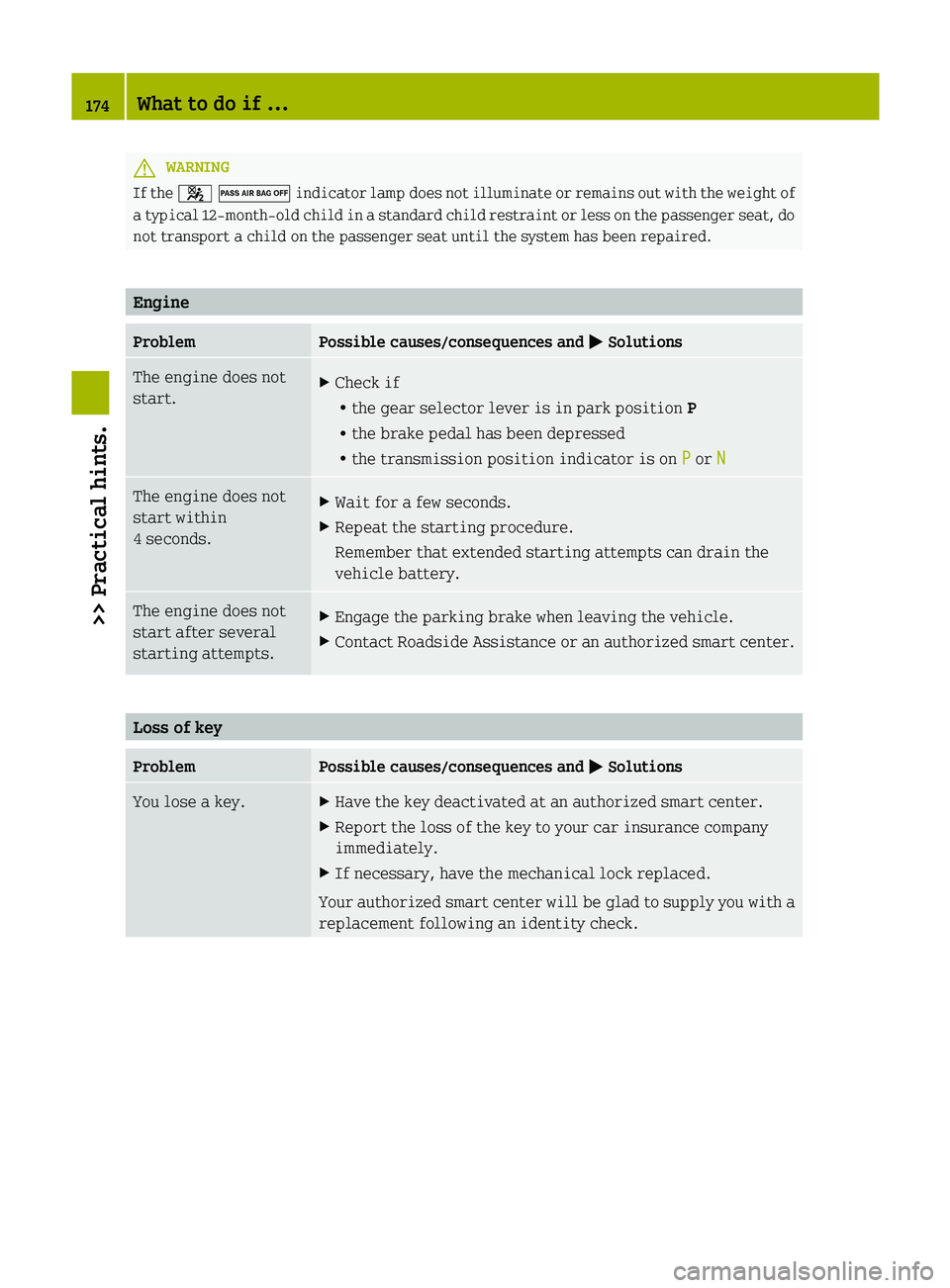
Problem Possible causes/consequences and
M SolutionsThe engine does not
start.
X
Check if
R
the gear selector lever is in park position P
R the brake pedal has been depressed
R the transmission position indicator is on P or NThe engine does not
start within
4 seconds.
X
Wait for a few seconds.
X Repeat the starting procedure.
Remember that extended starting attempts can drain the
vehicle battery. The engine does not
start after several
starting attempts.
X
Engage the parking brake when leaving the vehicle.
X Contact Roadside Assistance or an authorized smart center. Loss of key
Problem Possible causes/consequences and
M SolutionsYou lose a key. X
Have the key deactivated at an authorized smart center.
X Report the loss of the key to your car insurance company
immediately.
X If necessary, have the mechanical lock replaced.
Your authorized smart center will be glad to supply you with a
replacement following an identity check. 174
What to do if ...
>> Practical hints.
Page 200 of 228
key is in the starter switch. Otherwise
the alternator and other electronic
components could be severely damaged.
Have the battery checked regularly at an
authorized smart center.
Refer to Maintenance Booklet for
maintenance intervals or contact an
authorized smart center for further
information.
! Never invert the terminal connections! Disconnecting, removing, charging,
reinstalling and reconnecting the
battery
Disconnecting the battery i
If the battery is disconnected or
discharged
R the key will not turn in the starter
switch
R the automatic transmission will
remain in park position P
For more information see “Jump
starting” ( Y page 199).
X Engage the parking brake.
X Move the gear selector lever to park
position P.
X Turn off all electrical accessories.
X Turn off the engine.
X Open the passenger door.
X Move the passenger seat to the rear as far
as possible.
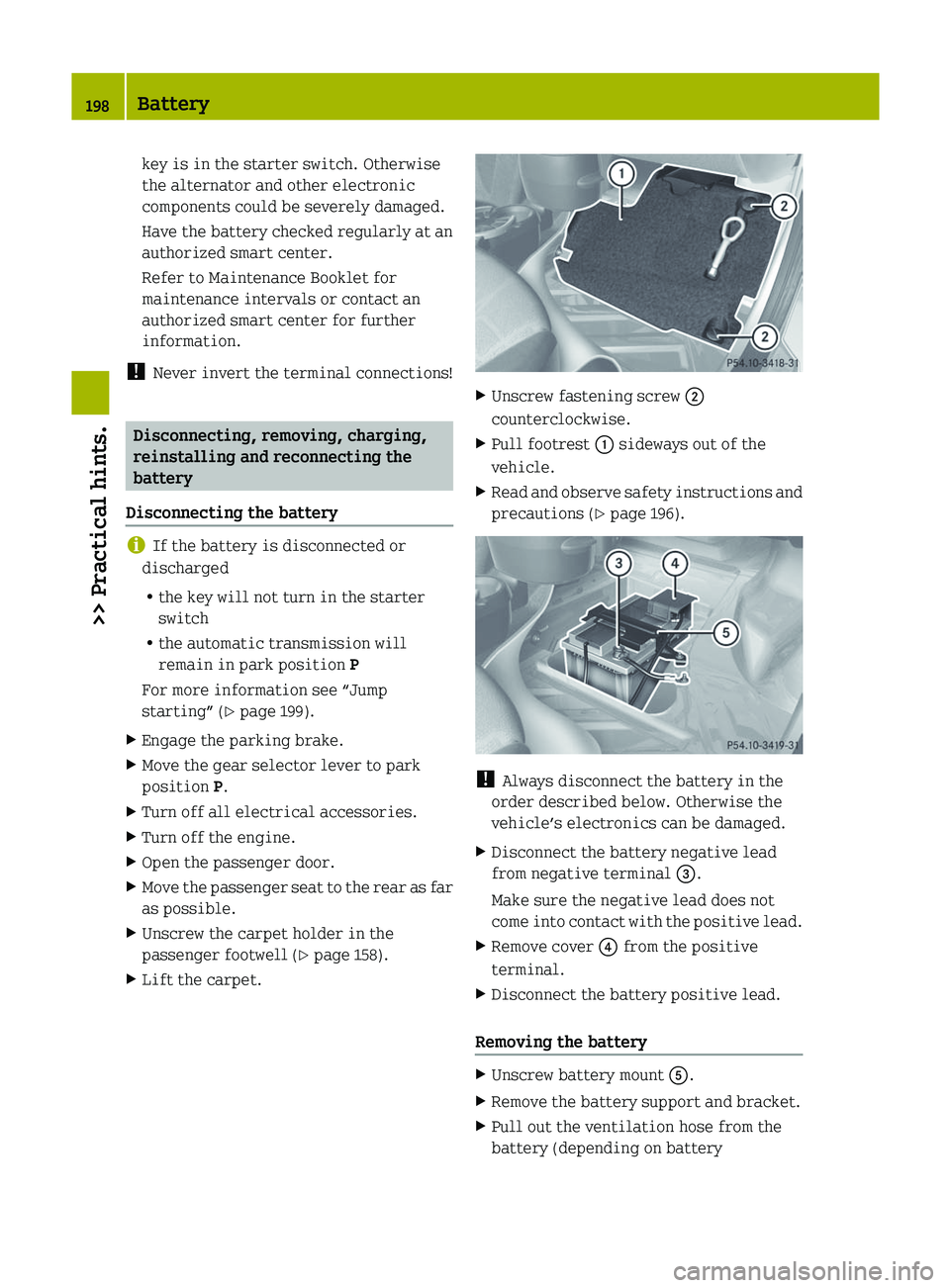
X Unscrew the carpet holder in the
passenger footwell (Y page 158).
X Lift the carpet. X
Unscrew fastening screw ;
counterclockwise.
X Pull footrest : sideways out of the
vehicle.
X Read and observe safety instructions and
precautions (Y page 196). !
Always disconnect the battery in the
order described below. Otherwise the
vehicle’s electronics can be damaged.
X Disconnect the battery negative lead
from negative terminal =.
Make sure the negative lead does not
come
into contact with the positive lead.
X Remove cover ? from the positive
terminal.
X Disconnect the battery positive lead.
Removing the battery X
Unscrew battery mount A.
X Remove the battery support and bracket.
X Pull out the ventilation hose from the
battery (depending on battery198
Battery
>> Practical hints.
Page 202 of 228
immediately flush affected area with
water, and seek medical help if necessary.
A battery will also produce hydrogen gas,
which is flammable and very explosive.
Keep flames or sparks away from battery,
avoid improper connection of jumper
cables, smoking, etc.
Attempting to jump start a frozen battery
can result in it exploding, causing
personal injury.
Read all instructions before proceeding.
! Do not tow‑start vehicle. You could
otherwise seriously damage the
transmission
which is not covered by the
smart Limited Warranty.
! Avoid repeated and lengthy starting
attempts.
Do not attempt to start the engine using
a battery quick charge unit.
If the engine does not run after several
unsuccessful starting attempts, have it
checked at the nearest authorized smart
center.
Excessive unburned fuel generated by
repeated failed starting attempts may
damage the catalytic converter and may
present a fire risk.
Make sure the jumper cables do not have
loose or missing insulation.
Make sure the cable clamps do not touch
any other metal part while the other end
is still attached to a battery.
If the battery is discharged, the engine can
be started with jumper cables and the fully
charged battery of another vehicle or an
equivalent starter pack. Observe the
following:
R Access to the battery is not possible on
all vehicles. If you cannot access the
battery in your vehicle provide jump start power by an external battery or
starter pack.
R Jump starting should only be performed
when the engine and catalytic converter
are cold.
R Do not start the engine if the battery is
frozen. Let the battery thaw out first.
R Only jump start from batteries with the
same
voltage rating (12 V). Jump starting
with a more powerful battery could
damage the vehicle’s electrical system.
Such damage will not be covered by the
smart Limited Warranty.
R Only use jumper cables with sufficient
cross-section and insulated terminal
clamps.
R Always make sure the jumper cables are
not on or near pulleys, fans or other parts
that move when an engine is started or
running.
R Should the battery be drained
completely, let the donating power
source charge the vehicle for several
minutes before reattempting the
starting process. G
WARNING
Keep flames or sparks away from battery. Do
not smoke.
Observe all safety instructions and
precautions when handling automotive
batteries. 200
Jump starting
>> Practical hints.
Page 205 of 228
cause damage to the radiator and other
supports if towing on a bumpy road.
R Towing
the vehicle should only be done
using the properly installed towing
eye bolt. Never attach a tow cable, tow
rope, or tow rod to the vehicle chassis,
frame, or suspension parts.
! Make sure the ignition is switched off
while towing the vehicle. Doing
otherwise may result in
R the ESP ®
being activated. Active
braking action through the ESP ®
may
seriously damage the brake system
which is not covered by the smart
Limited Warranty.
R a discharged battery.
! Make sure the gear selector lever is in
neutral position N while towing the
vehicle. Doing otherwise may result in
significant transmission damage.
! Towing the vehicle with a luggage
rack* mounted is not permissible. The
vehicle must not be towed by the luggage
rack*.
i If the battery is disconnected or
discharged, the gear selector lever will
remain locked in park position P.
Contact an authorized smart center for
assistance or call Roadside Assistance.
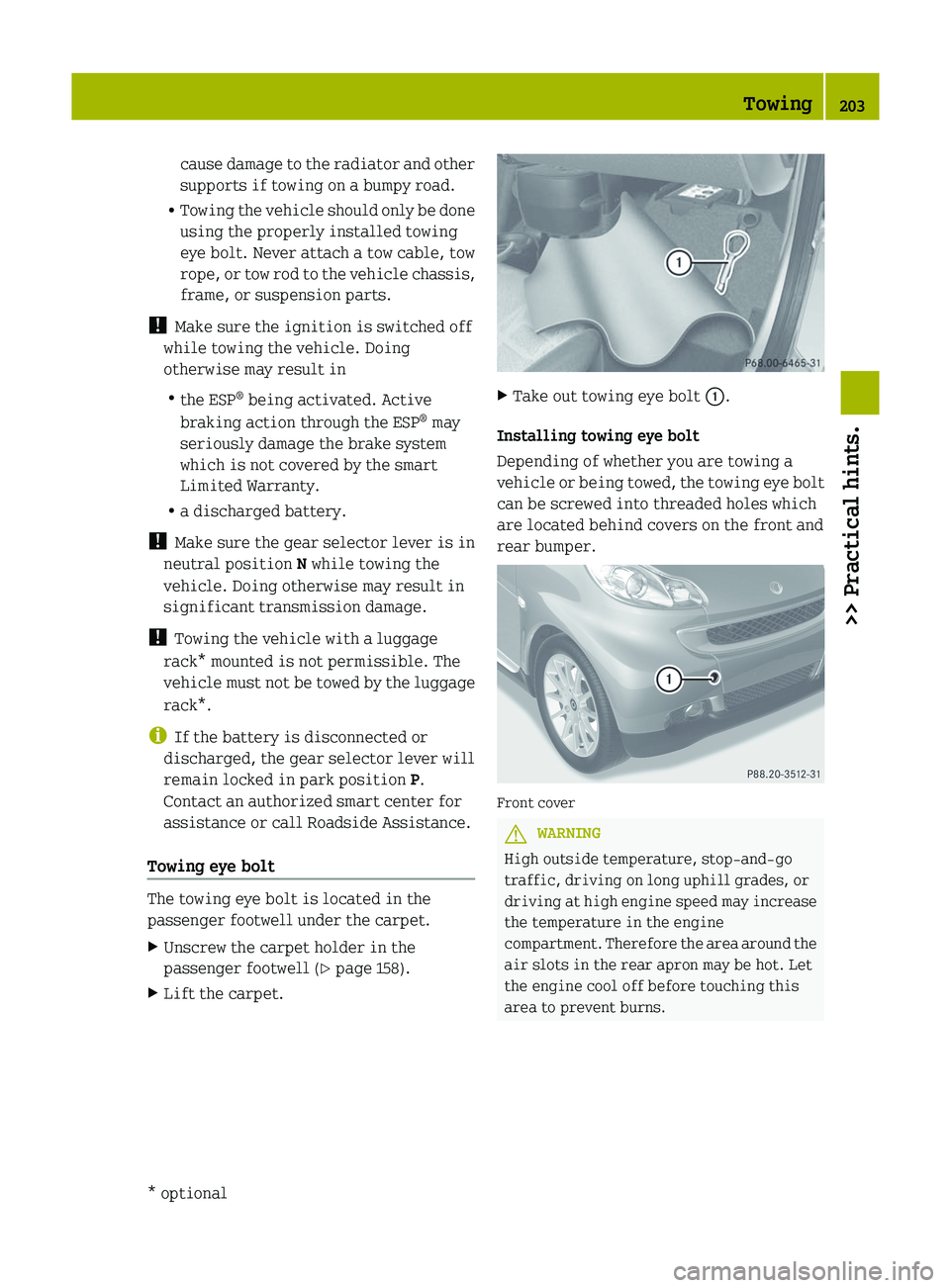
Towing eye bolt The towing eye bolt is located in the
passenger footwell under the carpet.
X
Unscrew the carpet holder in the
passenger footwell (Y page 158).
X Lift the carpet. X
Take out towing eye bolt :.
Installing towing eye bolt
Depending of whether you are towing a
vehicle
or being towed, the towing eye bolt
can be screwed into threaded holes which
are located behind covers on the front and
rear bumper. Front cover
G
WARNING
High outside temperature, stop-and-go
traffic, driving on long uphill grades, or
driving
at high engine speed may increase
the temperature in the engine
compartment. Therefore the area around the
air slots in the rear apron may be hot. Let
the engine cool off before touching this
area to prevent burns. Towing
203
>> Practical hints.
* optional Z
Page 207 of 228
X
Turn the battery on using the previously
installed battery switch.
X Move the gear selector lever to park
position P.
X Remove the key from the starter switch.
X Lock the doors.
! Do not flat tow the vehicle with the front
axle raised. Doing so may cause serious
damage to the brake system which is not
covered by the smart Limited Warranty.
! Failure to follow the recommendations
for flat towing can cause damage to your
vehicle:
R Not following the battery disconnect
procedure in the proper sequence may
result in data loss in the vehicle’s
control units.
R Not disconnecting the battery and
leaving the key in starter switch
position 1 (ignition on) may result in
-the vehicle locking. The vehicle will
lock if the wheels are turning at
vehicle speeds of approximately
8 mph (14 km/h) or more.
- the ESP ®
being activated. Active
braking action through the ESP ®
may
seriously damage the brake system
which is not covered by the smart
Limited Warranty.
R Not moving the gear selector lever to
neutral position N may result in
significant transmission damage.
R in a discharged battery. Fuses
The electrical fuses in your vehicle serve
to switch off malfunctioning power
circuits.
If a fuse is blown, the components and
systems secured by that fuse will stop
operating. G
WARNING
Only use fuses approved by smart with the
specified amperage for the system in
question and do not attempt to repair or
bridge a blown fuse this may cause an
overload leading to a fire, and/or cause
damage to electrical components and/or
systems. Contact a smart center if you
encounter any electrical problems.
! A blown fuse must be replaced by an
appropriate
spare fuse (recognizable by
its color or the fuse rating given on the
fuse) of the amperage recommended in
the fuse chart. Any smart center will be
glad to advise you on this subject.
If a newly inserted fuse blows again, have
the cause determined and rectified at an
authorized smart center.
Before replacing fuses:
R Engage the parking brake.
R Make sure the gear selector lever is in
park position P.
R Turn off all electrical accessories.
R Turn off the engine.
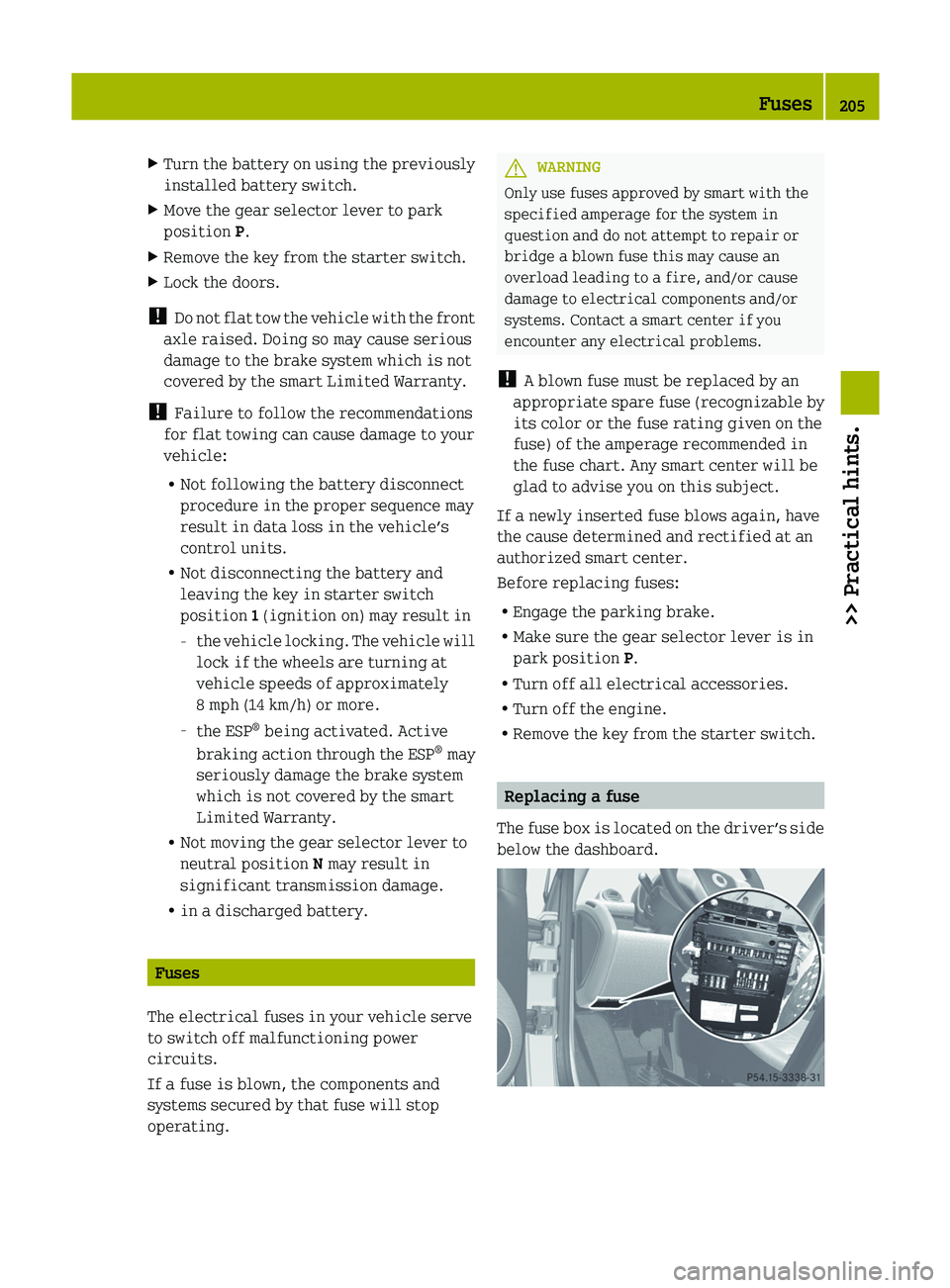
R Remove the key from the starter switch. Replacing a fuse
The
fuse box is located on the driver’s side
below the dashboard. Fuses
205
>> Practical hints. Z
Page 211 of 228
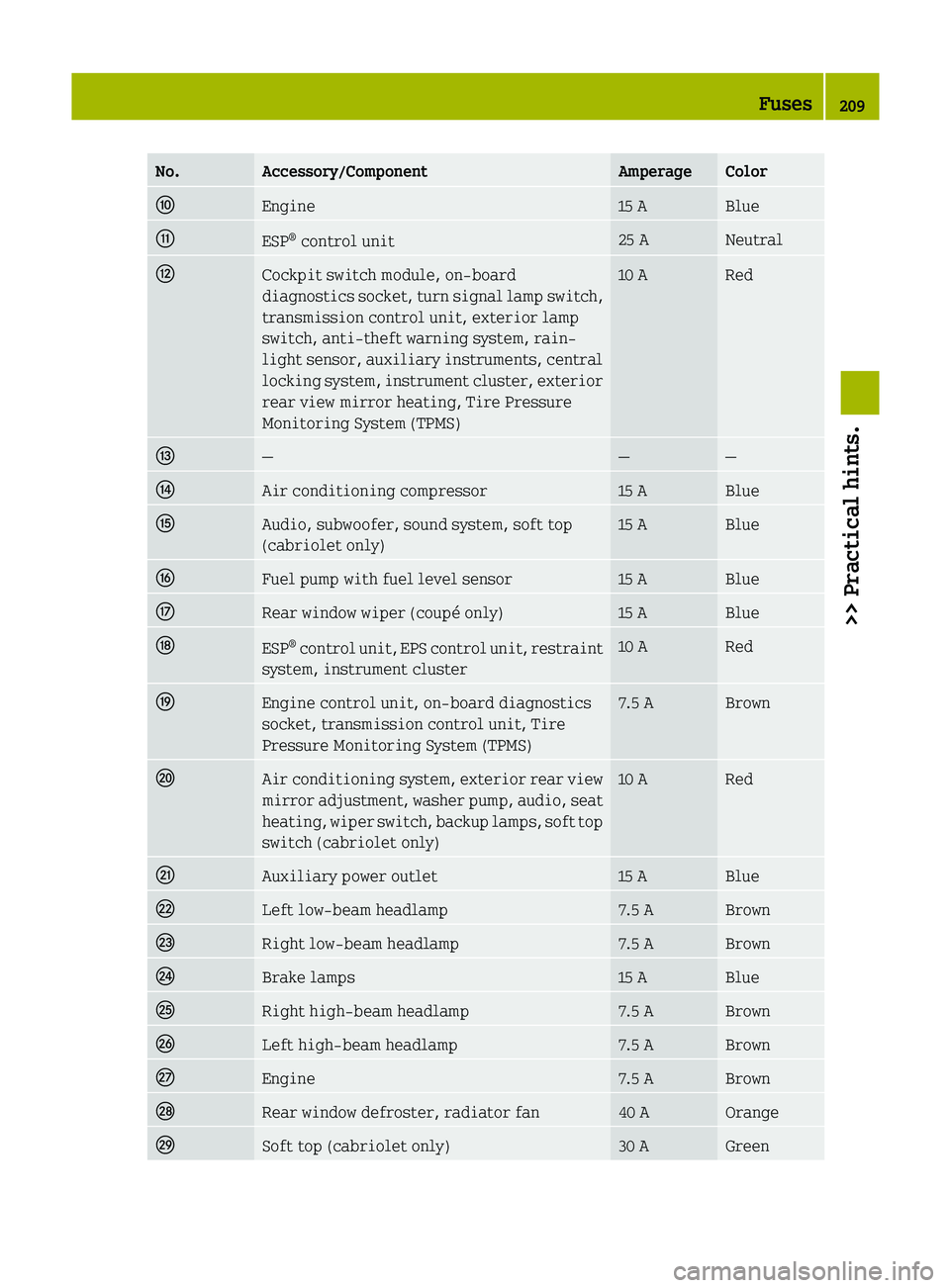
No. Accessory/Component Amperage Color
F
Engine 15 A Blue
G
ESP
®
control unit 25 A Neutral
H
Cockpit switch module, on-board
diagnostics
socket, turn signal lamp switch,
transmission control unit, exterior lamp
switch, anti-theft warning system, rain-
light sensor, auxiliary instruments, central
locking system, instrument cluster, exterior
rear view mirror heating, Tire Pressure
Monitoring System (TPMS) 10 A Red
I
— — —
J
Air conditioning compressor 15 A Blue
K
Audio, subwoofer, sound system, soft top
(cabriolet only) 15 A Blue
L
Fuel pump with fuel level sensor 15 A Blue
M
Rear window wiper (coupé only) 15 A Blue
N
ESP
®
control unit, EPS control unit, restraint
system, instrument cluster 10 A Red
O
Engine control unit, on-board diagnostics
socket, transmission control unit, Tire
Pressure Monitoring System (TPMS) 7.5 A Brown
P
Air conditioning system, exterior rear view
mirror
adjustment, washer pump, audio, seat
heating, wiper switch, backup lamps, soft top
switch (cabriolet only) 10 A Red
Q
Auxiliary power outlet 15 A Blue
R
Left low‑beam headlamp 7.5 A Brown
S
Right low‑beam headlamp 7.5 A Brown
T
Brake lamps 15 A Blue
U
Right high‑beam headlamp 7.5 A Brown
V
Left high‑beam headlamp 7.5 A Brown
W
Engine 7.5 A Brown
X
Rear window defroster, radiator fan 40 A Orange
Y
Soft top (cabriolet only) 30 A Green Fuses
209
>> Practical hints. Z
Page 212 of 228
 50 A Red
a
ESP
®
control unit 40 A")
No. Accessory/Component Amperage Color
Z
Transmission control unit 40 A Orange
\
Horn, central locking system 20 A Yellow
^
— — —
_
Starter switch (ignition) 50 A Red
a
ESP
®
control unit 40 A Orange
©
EPS control unit 30 A Green
y
Exterior rear view mirror heating 7.5 A Brown
z
Brake lamps 7.5 A Brown
|
LED daytime running lamps 5 A Light brown
~
— — —
¡
— — —
¢
— — —
£
Interior lighting 5 A Light brown
¤
Surround sound system 20 A Yellow
¥
Seat heating control unit 25 A Neutral210
Fuses>> Practical hints.