battery check SMART FORTWO COUPE 2012 Owners Manual
[x] Cancel search | Manufacturer: SMART, Model Year: 2012, Model line: FORTWO COUPE, Model: SMART FORTWO COUPE 2012Pages: 228, PDF Size: 12.76 MB
Page 6 of 228
A
ABS (Antilock Brake System) .............46
Indicator lamp ........................ 163
Accessory weight .......................... 139
Accidents Air bags .................................. 33
Additives
Engine oil .............................. 221
Gasoline ................................ 222
Address change .............................. 15
Air bags ....................................... 33
Children ..................................
33
Front, driver and passenger ......... 36
Front, passenger ....................... 36
Head-thorax ............................. 37
Knee bag .................................. 37
Passenger front air bag off
indicator lamp ..................... 28, 41
Safety guidelines ...................... 35
SRS indicator lamp ...................166
Thorax-pelvis .......................... 38
Window curtain ......................... 38
Air conditioning
see HVAC ................................ 102
Air conditioning refrigerant ..........221
Air pressure see Tire inflation pressure
Air pressure (tires) ....................... 140
Air vents ..................................... 104
Alarm system see Anti-theft systems
Ambient lighting ........................... 70
Anticorrosion/antifreeze ............... 223
Antiglare, Interior rear view
mirror ......................................... 62
Antilock Brake System see ABS
Anti-theft systems ......................... 48
Anti-theft warning system ........... 48
Electronic immobilizer .............. 48
Interior motion sensor ...............49
Tow-away alarm ......................... 49
Aquaplaning
see Hydroplaning
Armrest ........................................ 59
Aspect ratio (tires) ....................... 140Audio system
................................. 98
Basic ...................................... 99
Navigation/multimedia ..............99
Automatic headlamp mode ................65
Automatic locking .......................... 53
Automatic transmission ..................82
Display message .......................
159
Driving tips ............................. 84
Emergency operation (limp-
home mode) ............................... 86
Gear selector lever .................... 82
Gear selector lever positions ...... 83
Gearshift pattern ...................... 82
Hill-start assist system .............. 84
Manual gearshifting .................. 84
Shifting procedure .................... 83
Auxiliary instruments
Cockpit clock ........................... 92
Tachometer .............................. 92
AUX socket .................................... 99 B
Backrest see Seats
Backup lamp ................................. 180
Bar (air pressure unit) ................... 140
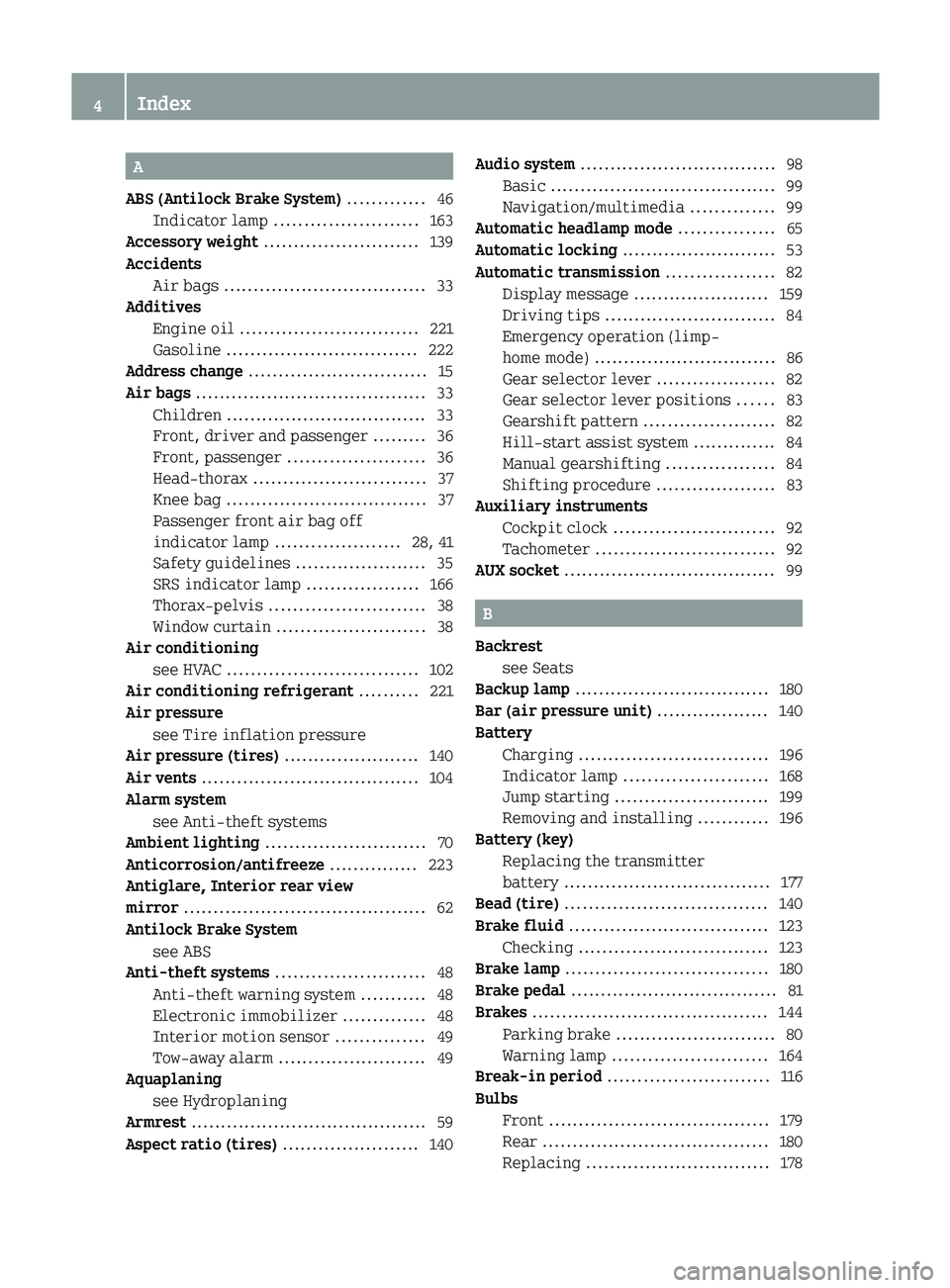
Battery Charging ................................ 196
Indicator lamp ........................ 168
Jump starting .......................... 199
Removing and installing ............196
Battery (key)
Replacing the transmitter
battery ................................... 177
Bead (tire) .................................. 140
Brake fluid .................................. 123
Checking ................................ 123
Brake lamp .................................. 180
Brake pedal ................................... 81
Brakes ........................................ 144
Parking brake ........................... 80
Warning lamp .......................... 164
Break-in period ........................... 116
Bulbs Front ..................................... 179
Rear ...................................... 180
Replacing ............................... 1784
Index
Page 11 of 228
Children in the vehicle
..............42
Infant and child restraint
systems ................................... 43
Introduction ............................ 30
OCS (Occupant Classification
System) ................................... 39
Passenger front air bag off
indicator lamp ......................... 39
Seat belts ............................ 31, 35
SRS indicator lamp, malfunction .
166
OCS (Occupant Classification
System) ........................................ 39
Self-test ................................. 42
Oil
see Engine oil
Oil level
see Engine oil, Checking level
On-board Diagnostics Socket (OBD) ...213
Operating safety ............................ 15
Outside temperature display ............89
Overhead control panel ...................28P
Paintwork care ............................. 154
Panic alarm .................................. 45
Parcel nets ............................. 107, 111
Parking ........................................
80
Parking brake ............................... 80
Parking lamps .............................. 179
Parts service ............................... 212
PASS AIR BAG OFF indicator lamp see Passenger front air bag off
indicator lamp
Passenger front air bag ...................36
Passenger front air bag off
indicator lamp .................... 28, 36, 173
Passenger safety see Occupant safety
Passenger seat ............................... 60
Pedals ........................................ 143
Power assistance .......................... 143
Power outlet ................................. 114
Power washer ............................... 153
Practical hints Battery .................................. 196
Display messages ..................... 158Flat tire .................................
186
Fuses ..................................... 205
Jump starting .......................... 199
Replacing bulbs ....................... 178
Replacing transmitter battery
....177
Replacing wiper blades ............. 184
Towing ................................... 202
Unlocking/locking manually ....... 176
Warning and indicator
lamps ............................... 162, 173
What to do if ............................ 162
Where will I find...? ................. 158
Premium unleaded gasoline ............222
Problems with your vehicle ..............16
Product information .......................13
Production options weight ..............141
PSI (air pressure unit) ...................141 R
Radio .......................................... 98
Radio transmitters ........................ 149
Rain-light sensor ...........................
71
Rear lamps Overview ................................ 180
Rear window defroster ...................106
Rear window wiper/washer ............... 72
Replacing wiper blade .............. 184
Recommended tire inflation
pressure ................................ 125, 141
Refrigerant, air conditioning .........221
Refueling .................................... 116
Remote control see Key
Replacing bulbs ............................ 178
Reporting safety defects ..................16
Research Octane Number see RON
Reserve fuel indicator ....................91
Restraint systems see Occupant safety
Rims ..................................... 141, 217
Roadside Assistance .......................14
RON (Research Octane Number) .........222
Roof see Soft top system Index
9
Page 54 of 228
Opening and closing
Key
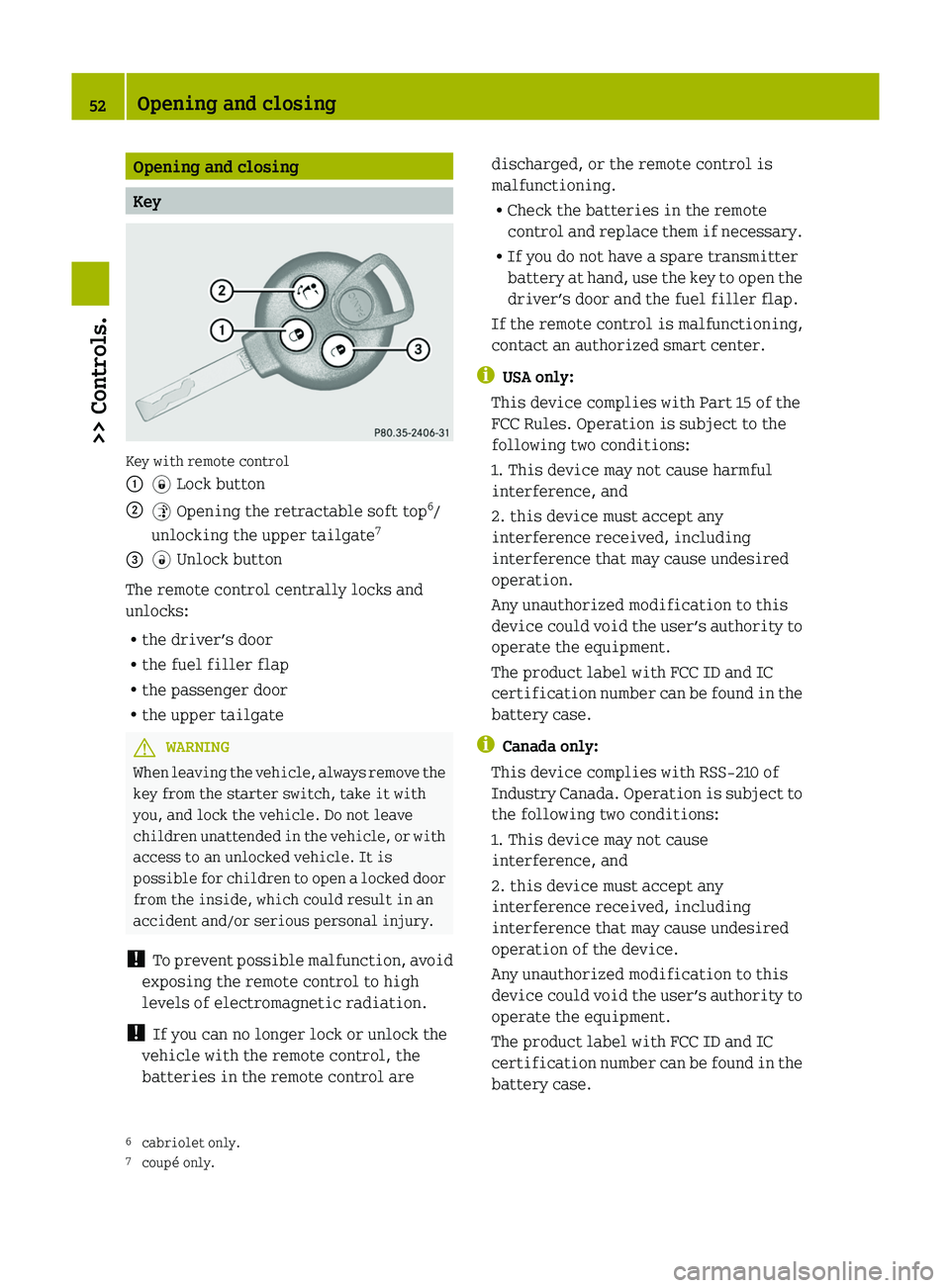
Key with remote control
:
* Lock button
; $ Opening the retractable soft top 6
/
unlocking the upper tailgate 7
= # Unlock button
The remote control centrally locks and
unlocks:
R the driver’s door
R the fuel filler flap
R the passenger door
R the upper tailgate G
WARNING
When leaving the vehicle, always remove the
key from the starter switch, take it with
you, and lock the vehicle. Do not leave
children
unattended in the vehicle, or with
access to an unlocked vehicle. It is
possible for children to open a locked door
from the inside, which could result in an
accident and/or serious personal injury.
! To prevent possible malfunction, avoid
exposing the remote control to high
levels of electromagnetic radiation.
! If you can no longer lock or unlock the
vehicle with the remote control, the
batteries in the remote control are discharged, or the remote control is
malfunctioning.
R
Check the batteries in the remote
control
and replace them if necessary.
R If you do not have a spare transmitter
battery at hand, use the key to open the
driver’s door and the fuel filler flap.
If the remote control is malfunctioning,
contact an authorized smart center.
i USA only:
This device complies with Part 15 of the
FCC Rules. Operation is subject to the
following two conditions:
1. This device may not cause harmful
interference, and
2. this device must accept any
interference received, including
interference that may cause undesired
operation.
Any unauthorized modification to this
device could void the user’s authority to
operate the equipment.
The product label with FCC ID and IC
certification number can be found in the
battery case.
i Canada only:
This device complies with RSS‑210 of
Industry Canada. Operation is subject to
the following two conditions:
1. This device may not cause
interference, and
2. this device must accept any
interference received, including
interference that may cause undesired
operation of the device.
Any unauthorized modification to this
device could void the user’s authority to
operate the equipment.
The product label with FCC ID and IC
certification number can be found in the
battery case.
6 cabriolet only.
7 coupé only. 52
Opening and closing
>> Controls.
Page 144 of 228
Treadwear indicators
Narrow bands, sometimes called “wear
bars” that show across the tread of a tire
when
only 1
/ 16 in (1.6 mm) of tread remains.
Uniform Tire Quality Grading Standards A tire information system that provides
consumers with ratings for a tire’s
traction, temperature and treadwear.
Ratings are determined by tire
manufacturers using U.S. government
testing
procedures. The ratings are molded
into the sidewall of the tire.
Vehicle maximum load on the tire Load on an individual tire that is
determined by distributing to each axle
its share of the maximum loaded vehicle
weight and dividing it by two.
Winter driving
Before the onset of winter, have your
vehicle winterized at an authorized smart
center.
This service includes:
R Check of anticorrosion and antifreeze
concentration.
R Addition of washer concentrate to the
water of the windshield/rear window.
Use a windshield washer concentrate
labeled for winter which is formulated
for temperatures below freezing point
(Y page 222).
R Battery
test. Battery capacity drops with
decreasing ambient temperature. A well
charged battery helps to make sure the
engine can be started, even at low
ambient temperatures.
R Tire change. Winter tires
G
WARNING
Winter tires with a tread depth of less
than 1
/ 6 in (4 mm) must be replaced. They
are no longer suitable for winter
operation.
Always use winter tires at temperatures
below 45 ¦ (7¥) and whenever wintry road
conditions
prevail. Not all M+S rated tires
provide special winter performance. Make
sure the tires you use show the mountain/
snowflake marking i on the tire
sidewall. These tires meet specific snow
traction performance requirements of the
Rubber Manufacturers Association (RMA)
and the Rubber Association of Canada (RAC)
and have been designed specifically for
use in snow conditions. Use of winter tires
is the only way to achieve the maximum
effectiveness of the ABS and ESP ®
in winter
operation.
For safe handling, make sure all mounted
winter tires are of the same make and have
the same tread design.
For information on winter tires for your
vehicle model, see the "Technical data"
section (Y page 217).
Always observe the speed rating of the
winter tires installed on your vehicle. If
the maximum speed for which your tires are
rated is below the speed rating of your
vehicle, you must place a notice to this
effect where it will be seen by the driver.
Such notices are available at your tire
dealer or any authorized smart center. Snow chains*
! Remember
that snow chains must always
be compatible with the tire sizes of a
vehicle. Snow chains that are approved
by smart are only permitted for the
following tire size:
175/55 R15 on the rear axle. 142
Winter driving
>> Operation.
* optional
Page 162 of 228
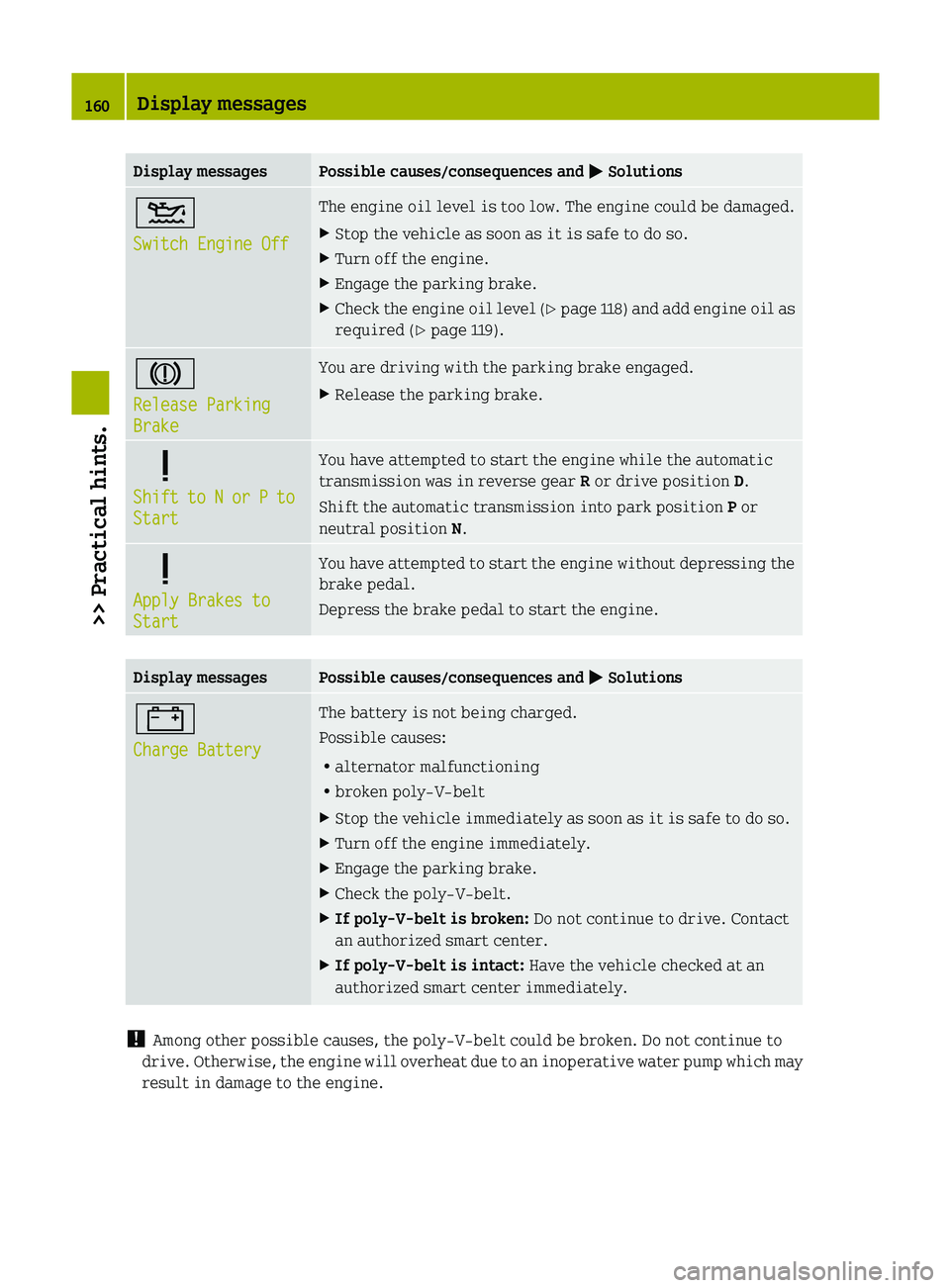
Display messages Possible causes/consequences and
M Solutions4
Switch Engine Off The engine oil level is too low. The engine could be damaged.
X
Stop the vehicle as soon as it is safe to do so.
X Turn off the engine.
X Engage the parking brake.
X Check the engine oil level (Y page 118) and add engine oil as
required (Y page 119). J
Release Parking
Brake You are driving with the parking brake engaged.
X
Release the parking brake. 5
Shift
to N or P to
Start You have attempted to start the engine while the automatic
transmission was in reverse gear
R or drive position D.
Shift the automatic transmission into park position P or
neutral position N.5
Apply Brakes to
Start You have attempted to start the engine without depressing the
brake pedal.
Depress the brake pedal to start the engine.
Display messages Possible causes/consequences and
M Solutions#
Charge Battery The battery is not being charged.
Possible causes:
R
alternator malfunctioning
R broken poly-V-belt
X Stop the vehicle immediately as soon as it is safe to do so.
X Turn off the engine immediately.
X Engage the parking brake.
X Check the poly-V-belt.
X If poly-V-belt is broken: Do not continue to drive. Contact
an authorized smart center.
X If poly-V-belt is intact: Have the vehicle checked at an
authorized smart center immediately. !
Among other possible causes, the poly-V-belt could be broken. Do not continue to
drive.
Otherwise, the engine will overheat due to an inoperative water pump which may
result in damage to the engine. 160
Display messages
>> Practical hints.
Page 176 of 228
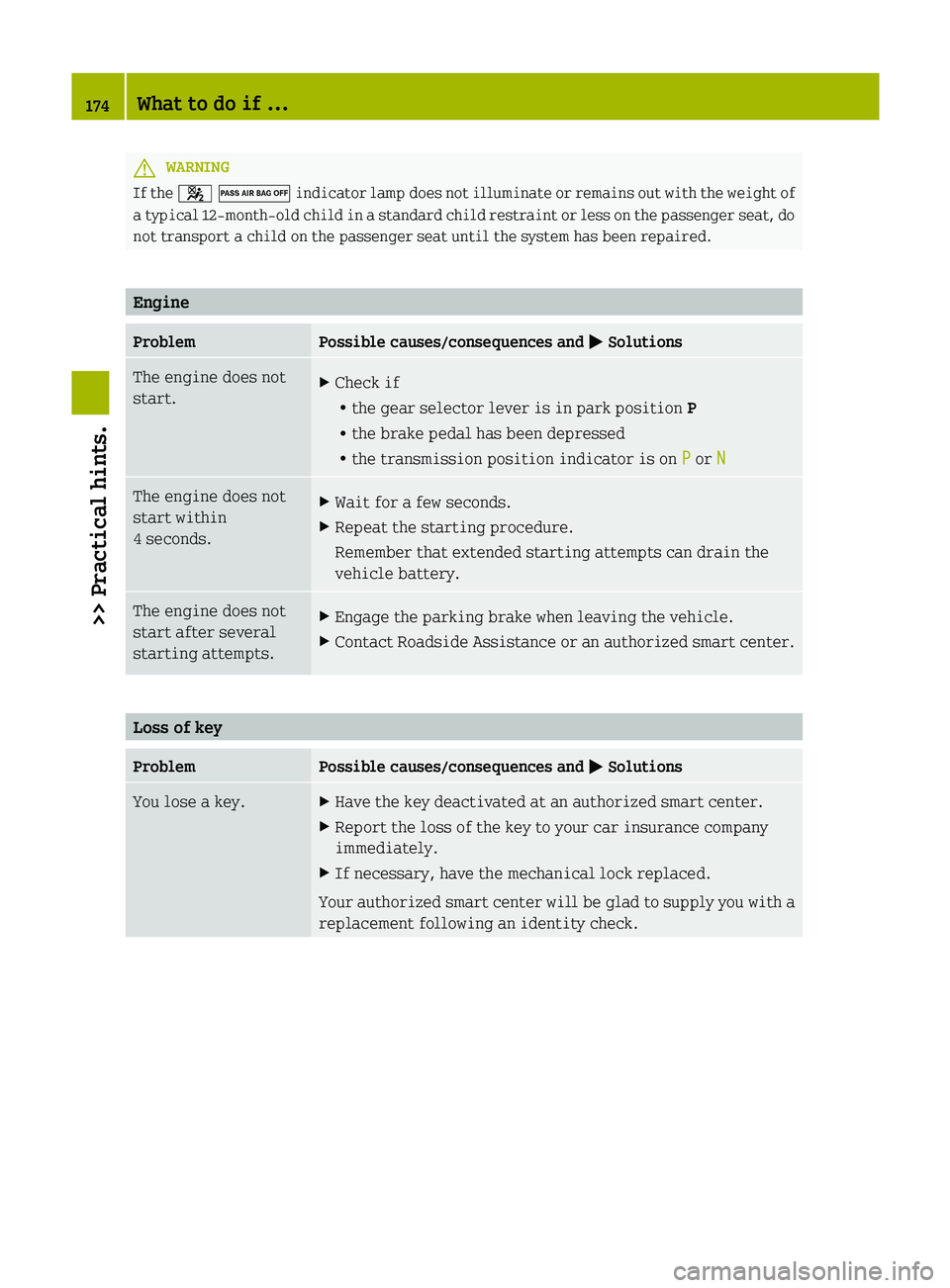
G
WARNING
If the 4 0 indicator lamp does not illuminate or remains out with the weight of
a typical 12‑month‑old child in a standard child restraint or less on the passenger seat, do
not transport a child on the passenger seat until the system has been repaired. Engine
Problem Possible causes/consequences and
M SolutionsThe engine does not
start.
X
Check if
R
the gear selector lever is in park position P
R the brake pedal has been depressed
R the transmission position indicator is on P or NThe engine does not
start within
4 seconds.
X
Wait for a few seconds.
X Repeat the starting procedure.
Remember that extended starting attempts can drain the
vehicle battery. The engine does not
start after several
starting attempts.
X
Engage the parking brake when leaving the vehicle.
X Contact Roadside Assistance or an authorized smart center. Loss of key
Problem Possible causes/consequences and
M SolutionsYou lose a key. X
Have the key deactivated at an authorized smart center.
X Report the loss of the key to your car insurance company
immediately.
X If necessary, have the mechanical lock replaced.
Your authorized smart center will be glad to supply you with a
replacement following an identity check. 174
What to do if ...
>> Practical hints.
Page 178 of 228
Problem Possible causes/consequences and
M SolutionsA warning signal
sounds when parking. You have not engaged the parking brake before releasing the
brake pedal, turning off the engine, and switching off the
ignition.
X
Switch on the ignition to deactivate the acoustic warning.
X Engage the parking brake.
X Make sure the gear selector lever is in park position P.
X Turn the key to starter switch position 0.
X Remove the key from the starter switch.
For safety, it is important that you perform the parking
procedure as described (Y page 80). You can hear a
continuous
noise from
the front axle when
braking. The vehicle is equipped with a mechanical/acoustic brake pad
indicator.
X
Have the brake pads checked at an authorized smart center. Unlocking/locking manually
Unlocking the vehicle
You can unlock the driver’s door and the
fuel filler flap by unlocking the driver’s
door using the key. The lock cylinder is
fitted with a cap.
X Press button # on the key.
The anti-theft warning system* is
disarmed.
i If the transmitter battery in the key is
discharged, the anti-theft warning
system* can no longer be disarmed with
button # on the key.
For replacing the transmitter battery
(Y page 177).
Unlocking the vehicle with the key and
opening a door or the tailgate will
trigger the anti-theft warning system*
(Y page 48).
To cancel the alarm:
X Insert the key in the starter switch.
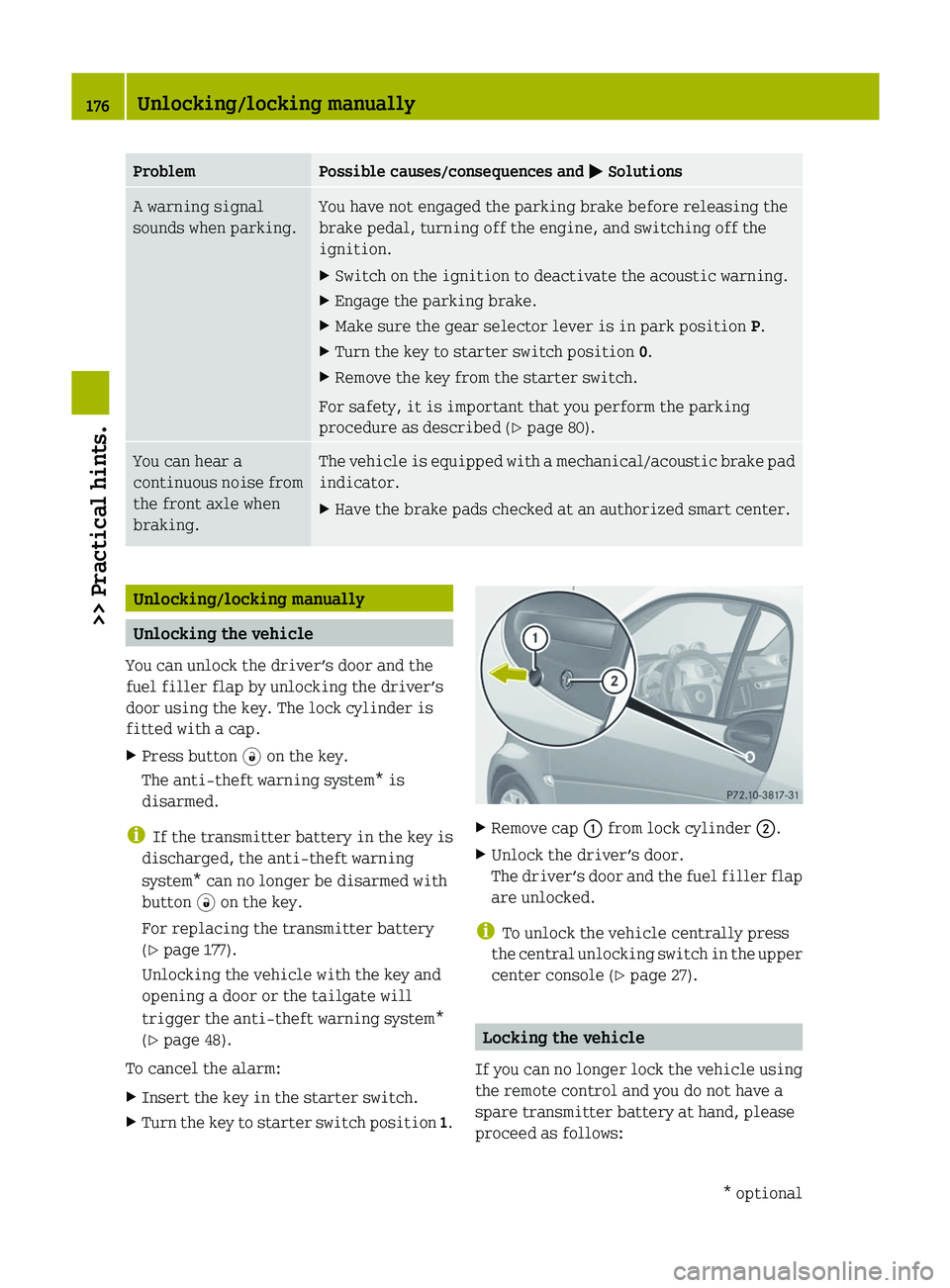
X Turn the key to starter switch position 1. X
Remove cap : from lock cylinder ;.
X Unlock the driver’s door.
The
driver’s door and the fuel filler flap
are unlocked.
i To unlock the vehicle centrally press
the
central unlocking switch in the upper
center console ( Y page 27). Locking the vehicle
If
you can no longer lock the vehicle using
the remote control and you do not have a
spare transmitter battery at hand, please
proceed as follows: 176
Unlocking/locking manually
>> Practical hints.
* optional
Page 179 of 228
X
Open the driver’s door.
X Press the central locking switch
(Y page 54).
The indicator lamp on the central
locking
switch comes on, when the starter
switch is in position 1.
The indicator lamp on the central
locking switch flashes, when the starter
switch is in position 0.
X Remove the key from the starter switch,
take it with you, and close all doors.
The vehicle is now locked and the anti-
theft warning system* is armed. Closing the rear soft top
If the rear soft top does not lock properly
after being closed, proceed as follows:
X Stop the vehicle in a safe location.
X Engage the parking brake.
X Make sure the key is in starter switch
position 1.
X Fold up the rear soft top completely.
The rear soft top stops in the unlocked
position.
X Within one minute, press and hold symbol
G on the retractable soft top switch
for 15 seconds twice.
The rear soft top closes the locking
hooks.
X Close the retractable soft top
completely.
X Have the rear soft top checked at an
authorized smart center. Replacing transmitter battery
Notes
The
remote control’s transmitter battery is
almost spent when the turn signals flash
rapidly nine times in a row when locking
the vehicle. i
If you do not replace the transmitter
battery, after about 100 more times you
will no longer be able to lock or unlock
the vehicle using the remote control.
X Replace the transmitter battery.
or
X Have the transmitter battery replaced at
an authorized smart center. G
WARNING
Batteries contain poisonous and corrosive
substances. Therefore keep the batteries
out of reach of children.
If
a battery is swallowed, seek medical help
immediately.
Batteries contain materials that can harm
the environment if disposed of improperly.
Recycling of batteries is the preferred
method of disposal. Many states/provinces
require sellers of batteries to accept old
batteries for recycling. Replacing battery
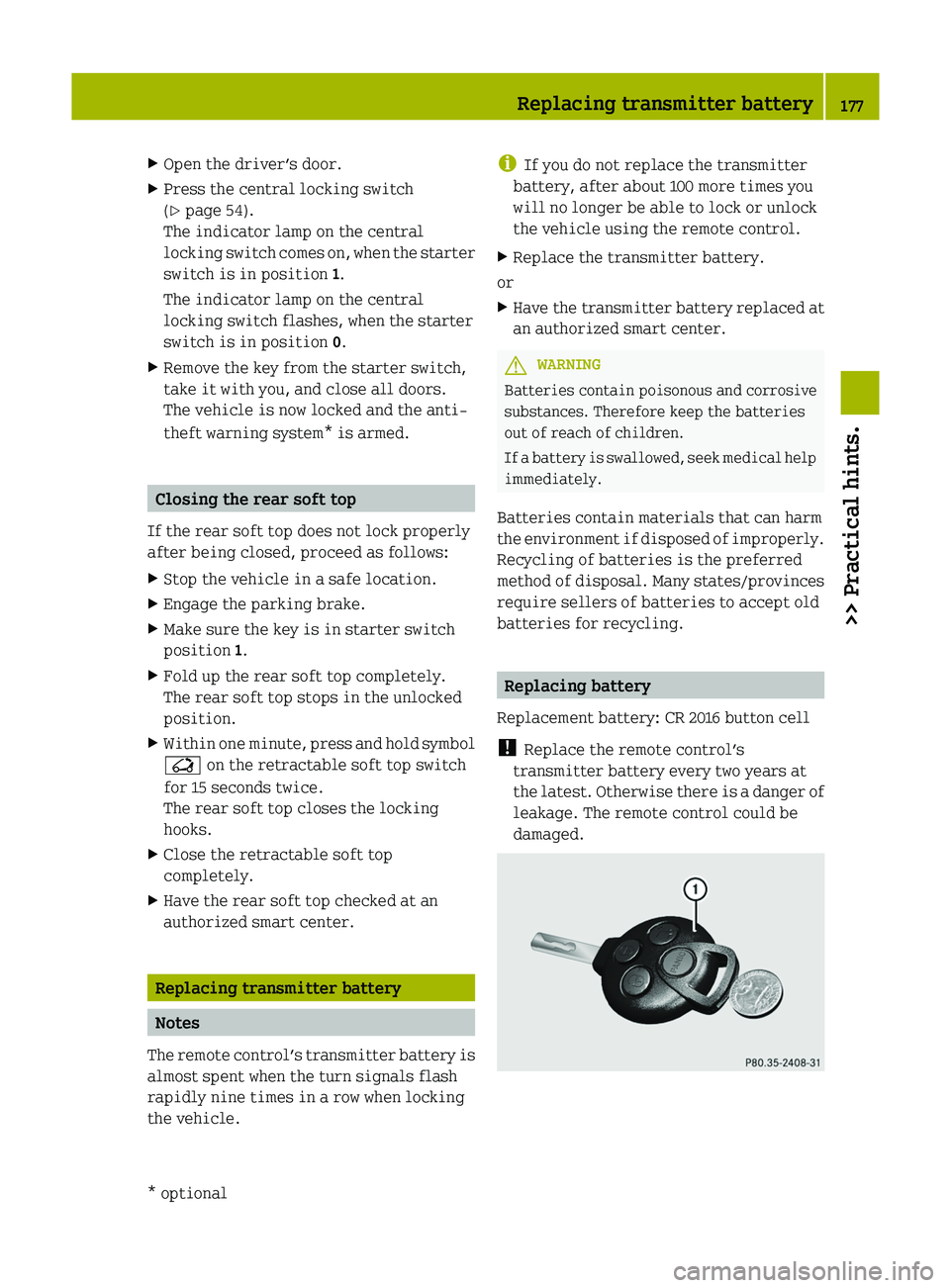
Replacement battery: CR 2016 button cell
! Replace the remote control’s
transmitter battery every two years at
the
latest. Otherwise there is a danger of
leakage. The remote control could be
damaged. Replacing transmitter battery
177
>> Practical hints.
* optional Z
Page 180 of 228
X
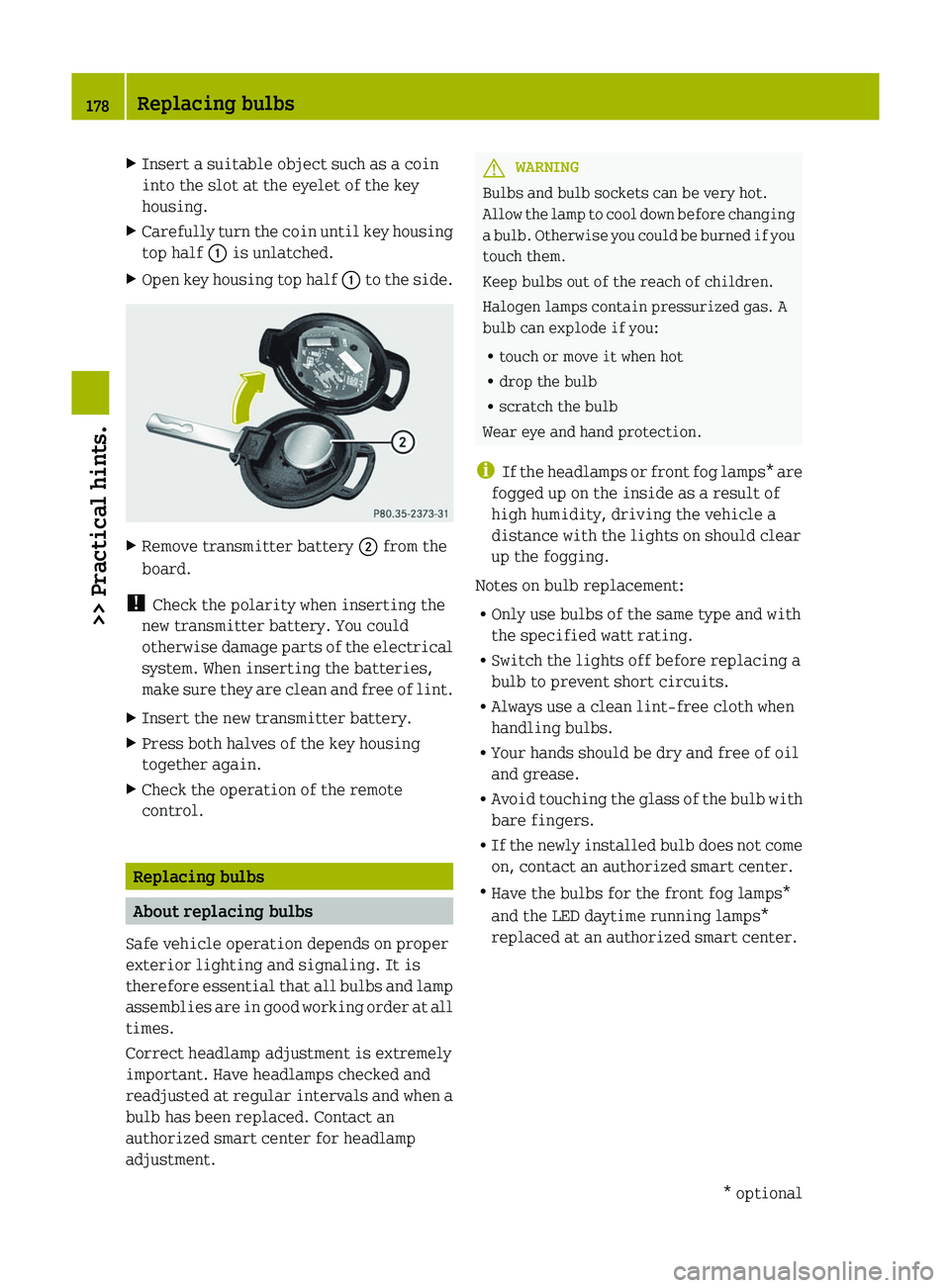
Insert a suitable object such as a coin
into the slot at the eyelet of the key
housing.
X Carefully turn the coin until key housing
top half : is unlatched.
X Open key housing top half : to the side.X
Remove transmitter battery ; from the
board.
! Check the polarity when inserting the
new transmitter battery. You could
otherwise
damage parts of the electrical
system. When inserting the batteries,
make sure they are clean and free of lint.
X Insert the new transmitter battery.
X Press both halves of the key housing
together again.
X Check the operation of the remote
control. Replacing bulbs
About replacing bulbs
Safe vehicle operation depends on proper
exterior lighting and signaling. It is
therefore
essential that all bulbs and lamp
assemblies are in good working order at all
times.
Correct headlamp adjustment is extremely
important. Have headlamps checked and
readjusted at regular intervals and when a
bulb has been replaced. Contact an
authorized smart center for headlamp
adjustment. G
WARNING
Bulbs and bulb sockets can be very hot.
Allow
the lamp to cool down before changing
a bulb. Otherwise you could be burned if you
touch them.
Keep bulbs out of the reach of children.
Halogen lamps contain pressurized gas. A
bulb can explode if you:
R touch or move it when hot
R drop the bulb
R scratch the bulb
Wear eye and hand protection.
i If the headlamps or front fog lamps* are
fogged up on the inside as a result of
high humidity, driving the vehicle a
distance with the lights on should clear
up the fogging.
Notes on bulb replacement:
R Only use bulbs of the same type and with
the specified watt rating.
R Switch the lights off before replacing a
bulb to prevent short circuits.
R Always use a clean lint-free cloth when
handling bulbs.
R Your hands should be dry and free of oil
and grease.
R Avoid touching the glass of the bulb with
bare fingers.
R If the newly installed bulb does not come
on, contact an authorized smart center.
R Have the bulbs for the front fog lamps*
and the LED daytime running lamps*
replaced at an authorized smart center.178
Replacing bulbs
>> Practical hints.
* optional
Page 198 of 228
to come off. This could cause an accident.
Be sure to use the correct wheel bolts.
G
WARNING
Only use genuine smart wheel bolts. Other
wheel bolts may come loose.
Do not tighten the wheel bolts when the
vehicle is raised. Otherwise the vehicle
could fall off the jack.
X Clean contact surfaces of wheel and wheel
hub.
! To avoid paint damage, place wheel flat
against hub and hold it there while
installing first wheel bolt. X
Guide the wheel onto the wheel hub and
push it on.
X Insert two wheel bolts and tighten them
slightly.
X Vehicles with wheel trim cap on steel
rim: Attach the wheel trim cap so that it
is held by the two wheel bolts.
X Install last wheel bolt and tighten it
slightly.
X Lower the vehicle until the vehicle is
resting fully on its own weight.
X Remove the jack.
X Tighten the wheel bolts. Observe a
tightening torque of 80 lb-ft (110 Nm)
.G
WARNING
Have the tightening torque checked after
changing a wheel. The wheels could come loose if they are not tightened to a torque
of 80 lb-ft (110 Nm).
Steel rim with wheel cover
X
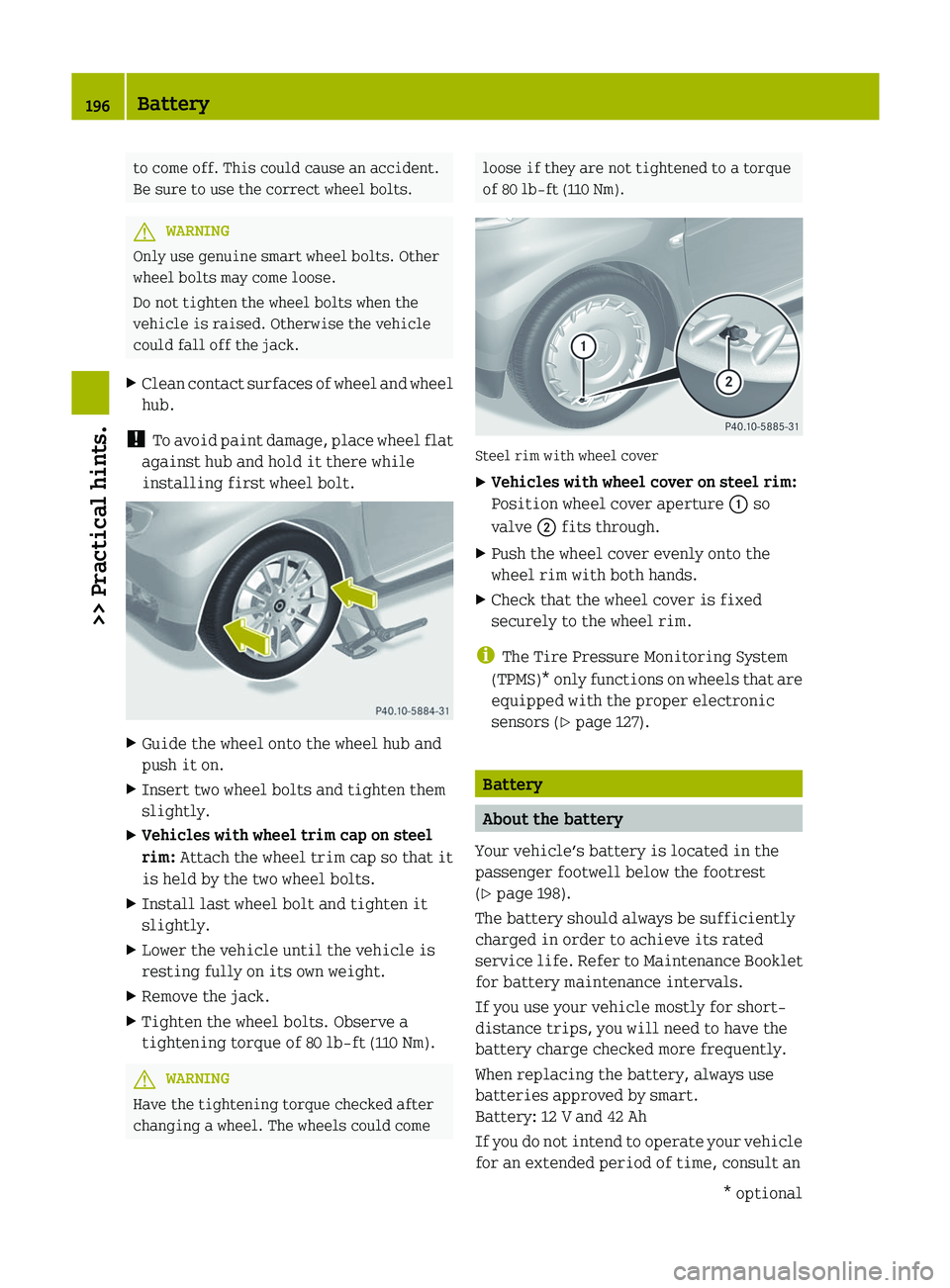
Vehicles with wheel cover on steel rim:
Position wheel cover aperture : so
valve ; fits through.
X Push the wheel cover evenly onto the
wheel rim with both hands.
X Check that the wheel cover is fixed
securely to the wheel rim.
i The Tire Pressure Monitoring System
(TPMS)*
only functions on wheels that are
equipped with the proper electronic
sensors (Y page 127). Battery
About the battery
Your vehicle’s battery is located in the
passenger footwell below the footrest
(Y page 198).
The battery should always be sufficiently
charged in order to achieve its rated
service
life. Refer to Maintenance Booklet
for battery maintenance intervals.
If you use your vehicle mostly for short-
distance trips, you will need to have the
battery charge checked more frequently.
When replacing the battery, always use
batteries approved by smart.
Battery: 12 V and 42 Ah
If you do not intend to operate your vehicle
for an extended period of time, consult an 196
Battery
>> Practical hints.
* optional