brake light SMART FORTWO COUPE 2012 Owners Manual
[x] Cancel search | Manufacturer: SMART, Model Year: 2012, Model line: FORTWO COUPE, Model: SMART FORTWO COUPE 2012Pages: 228, PDF Size: 12.76 MB
Page 6 of 228
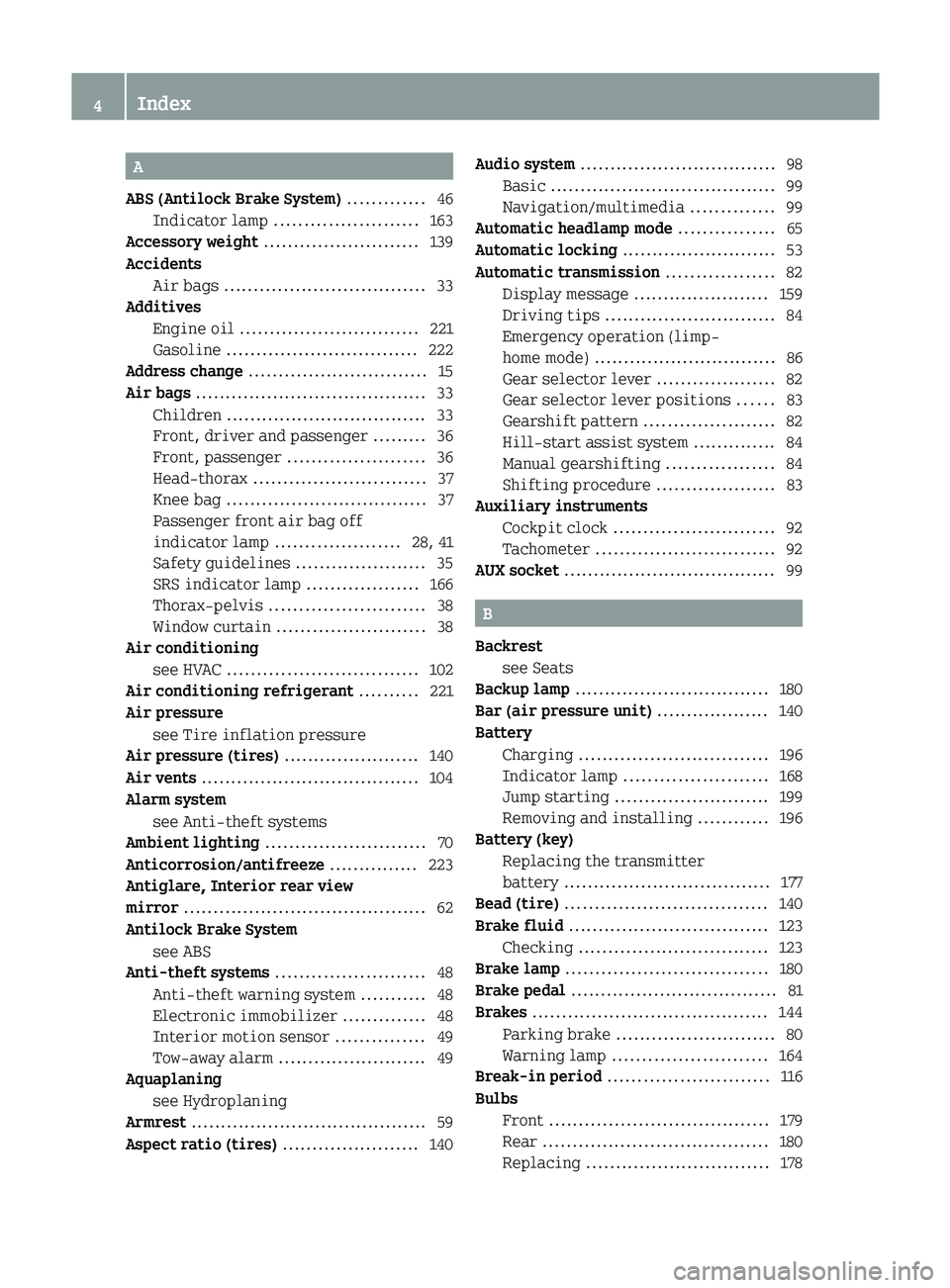
A
ABS (Antilock Brake System) .............46
Indicator lamp ........................ 163
Accessory weight .......................... 139
Accidents Air bags .................................. 33
Additives
Engine oil .............................. 221
Gasoline ................................ 222
Address change .............................. 15
Air bags ....................................... 33
Children ..................................
33
Front, driver and passenger ......... 36
Front, passenger ....................... 36
Head-thorax ............................. 37
Knee bag .................................. 37
Passenger front air bag off
indicator lamp ..................... 28, 41
Safety guidelines ...................... 35
SRS indicator lamp ...................166
Thorax-pelvis .......................... 38
Window curtain ......................... 38
Air conditioning
see HVAC ................................ 102
Air conditioning refrigerant ..........221
Air pressure see Tire inflation pressure
Air pressure (tires) ....................... 140
Air vents ..................................... 104
Alarm system see Anti-theft systems
Ambient lighting ........................... 70
Anticorrosion/antifreeze ............... 223
Antiglare, Interior rear view
mirror ......................................... 62
Antilock Brake System see ABS
Anti-theft systems ......................... 48
Anti-theft warning system ........... 48
Electronic immobilizer .............. 48
Interior motion sensor ...............49
Tow-away alarm ......................... 49
Aquaplaning
see Hydroplaning
Armrest ........................................ 59
Aspect ratio (tires) ....................... 140Audio system
................................. 98
Basic ...................................... 99
Navigation/multimedia ..............99
Automatic headlamp mode ................65
Automatic locking .......................... 53
Automatic transmission ..................82
Display message .......................
159
Driving tips ............................. 84
Emergency operation (limp-
home mode) ............................... 86
Gear selector lever .................... 82
Gear selector lever positions ...... 83
Gearshift pattern ...................... 82
Hill-start assist system .............. 84
Manual gearshifting .................. 84
Shifting procedure .................... 83
Auxiliary instruments
Cockpit clock ........................... 92
Tachometer .............................. 92
AUX socket .................................... 99 B
Backrest see Seats
Backup lamp ................................. 180
Bar (air pressure unit) ................... 140
Battery Charging ................................ 196
Indicator lamp ........................ 168
Jump starting .......................... 199
Removing and installing ............196
Battery (key)
Replacing the transmitter
battery ................................... 177
Bead (tire) .................................. 140
Brake fluid .................................. 123
Checking ................................ 123
Brake lamp .................................. 180
Brake pedal ................................... 81
Brakes ........................................ 144
Parking brake ........................... 80
Warning lamp .......................... 164
Break-in period ........................... 116
Bulbs Front ..................................... 179
Rear ...................................... 180
Replacing ............................... 1784
Index
Page 8 of 228
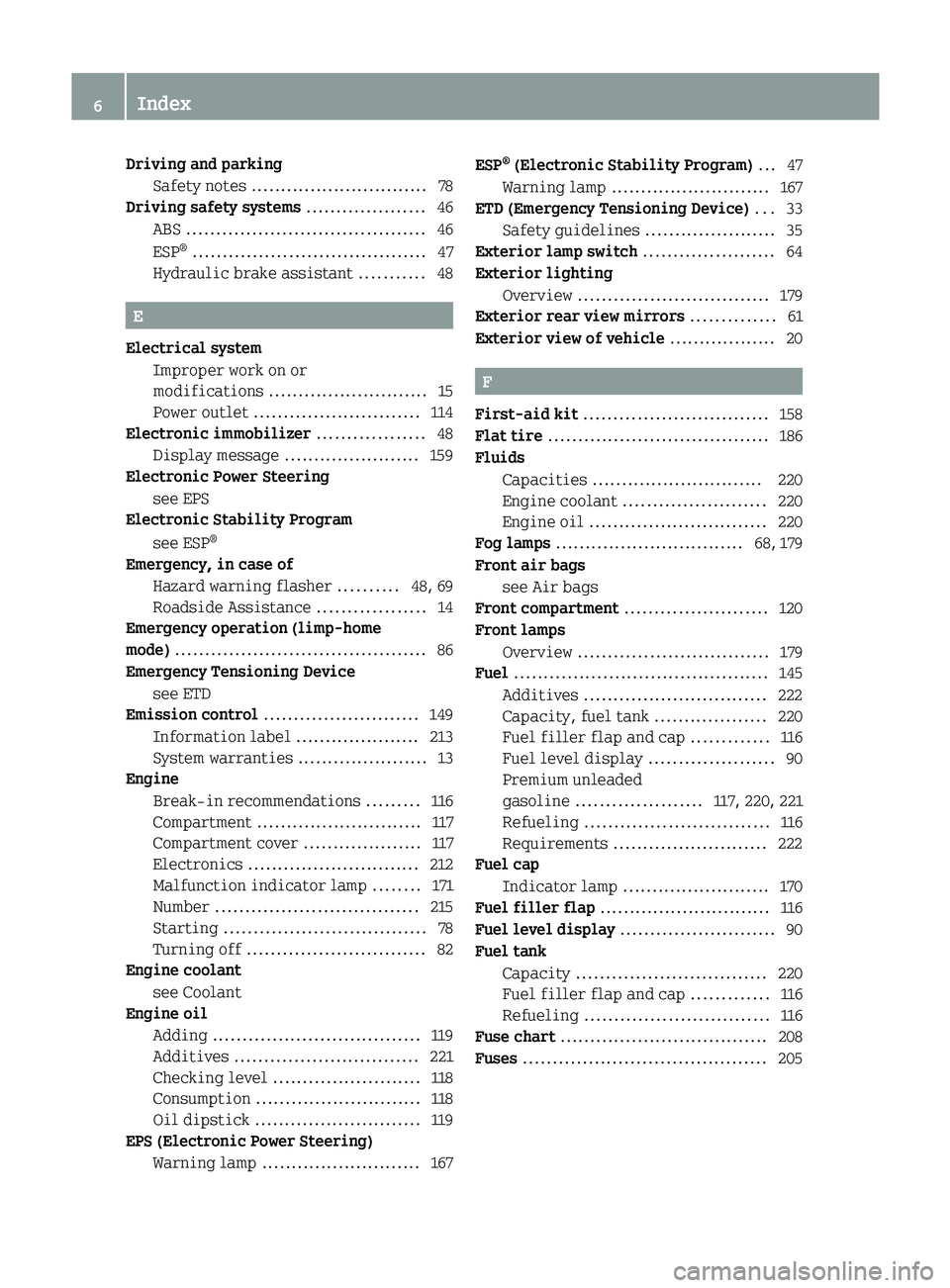
Driving and parking
Safety notes .............................. 78
Driving safety systems ....................46
ABS ........................................ 46
ESP ®
....................................... 47
Hydraulic brake assistant ...........48E
Electrical system Improper work on or
modifications ........................... 15
Power outlet ............................ 114
Electronic immobilizer ..................48
Display message .......................
159
Electronic Power Steering
see EPS
Electronic Stability Program
see ESP ®
Emergency, in case of
Hazard warning flasher .......... 48, 69
Roadside Assistance .................. 14
Emergency operation (limp-home
mode) .......................................... 86
Emergency Tensioning Device see ETD
Emission control .......................... 149
Information label ..................... 213
System warranties ...................... 13
Engine
Break-in recommendations ......... 116
Compartment ............................ 117
Compartment cover ....................117
Electronics ............................. 212
Malfunction indicator lamp ........171
Number .................................. 215
Starting .................................. 78
Turning off .............................. 82
Engine coolant
see Coolant
Engine oil
Adding ................................... 119
Additives ............................... 221
Checking level ......................... 118
Consumption ............................ 118
Oil dipstick ............................ 119
EPS (Electronic Power Steering)
Warning lamp ........................... 167 ESP
®
(Electronic Stability Program) ...47
Warning lamp ...........................
167
ETD (Emergency Tensioning Device) ...33
Safety guidelines ...................... 35
Exterior lamp switch ......................64
Exterior lighting Overview ................................ 179
Exterior rear view mirrors ..............61
Exterior view of vehicle .................. 20 F
First-aid kit ............................... 158
Flat tire ..................................... 186
Fluids Capacities .............................
220
Engine coolant ........................ 220
Engine oil .............................. 220
Fog lamps ................................ 68, 179
Front air bags see Air bags
Front compartment ........................ 120
Front lamps Overview ................................ 179
Fuel ........................................... 145
Additives ............................... 222
Capacity, fuel tank ................... 220
Fuel filler flap and cap ............. 116
Fuel level display ..................... 90
Premium unleaded
gasoline ..................... 117, 220, 221
Refueling ............................... 116
Requirements .......................... 222
Fuel cap
Indicator lamp ......................... 170
Fuel filler flap ............................. 116
Fuel level display .......................... 90
Fuel tank Capacity ................................ 220
Fuel filler flap and cap ............. 116
Refueling ............................... 116
Fuse chart ................................... 208
Fuses ......................................... 2056
Index
Page 10 of 228
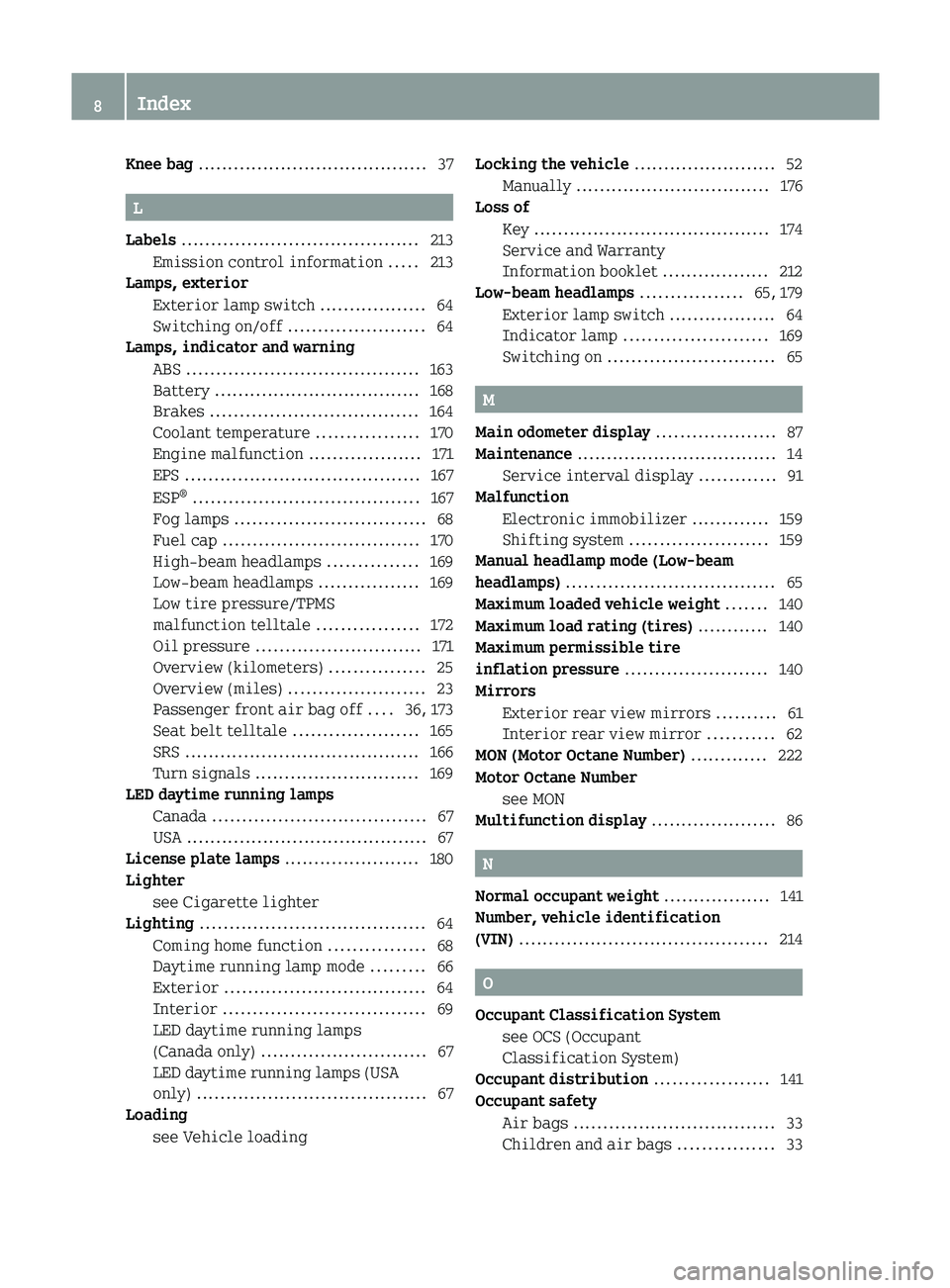
Knee bag .......................................
37L
Labels ........................................ 213
Emission control information .....213
Lamps, exterior
Exterior lamp switch
..................64
Switching on/off ....................... 64
Lamps, indicator and warning
ABS ....................................... 163
Battery ................................... 168
Brakes ................................... 164
Coolant temperature .................170
Engine malfunction ...................171
EPS ........................................ 167
ESP ®
...................................... 167
Fog lamps ................................ 68
Fuel cap ................................. 170
High-beam headlamps ............... 169
Low-beam headlamps ................. 169
Low tire pressure/TPMS
malfunction telltale ................. 172
Oil pressure ............................ 171
Overview (kilometers) ................ 25
Overview (miles) ....................... 23
Passenger front air bag off ....36, 173
Seat belt telltale .....................165
SRS ........................................ 166
Turn signals ............................ 169
LED daytime running lamps
Canada .................................... 67
USA ......................................... 67
License plate lamps ....................... 180
Lighter see Cigarette lighter
Lighting ...................................... 64
Coming home function ................ 68
Daytime running lamp mode .........66
Exterior .................................. 64
Interior .................................. 69
LED daytime running lamps
(Canada only) ............................ 67
LED daytime running lamps (USA
only) ....................................... 67
Loading
see Vehicle loading Locking the vehicle
........................ 52
Manually .................................
176
Loss of
Key ........................................ 174
Service and Warranty
Information booklet .................. 212
Low-beam headlamps .................65, 179
Exterior lamp switch .................. 64
Indicator lamp ........................ 169
Switching on ............................ 65 M
Main odometer display ....................87
Maintenance ..................................
14
Service interval display ............. 91
Malfunction
Electronic immobilizer ............. 159
Shifting system ....................... 159
Manual headlamp mode (Low-beam
headlamps) ................................... 65
Maximum loaded vehicle weight .......140
Maximum load rating (tires) ............ 140
Maximum permissible tire
inflation pressure ........................ 140
Mirrors Exterior rear view mirrors ..........61
Interior rear view mirror ........... 62
MON (Motor Octane Number) .............222
Motor Octane Number see MON
Multifunction display .....................86 N
Normal occupant weight ..................141
Number, vehicle identification
(VIN) .......................................... 214 O
Occupant Classification System see OCS (Occupant
Classification System)
Occupant distribution ...................141
Occupant safety Air bags .................................. 33
Children and air bags ................ 338
Index
Page 11 of 228
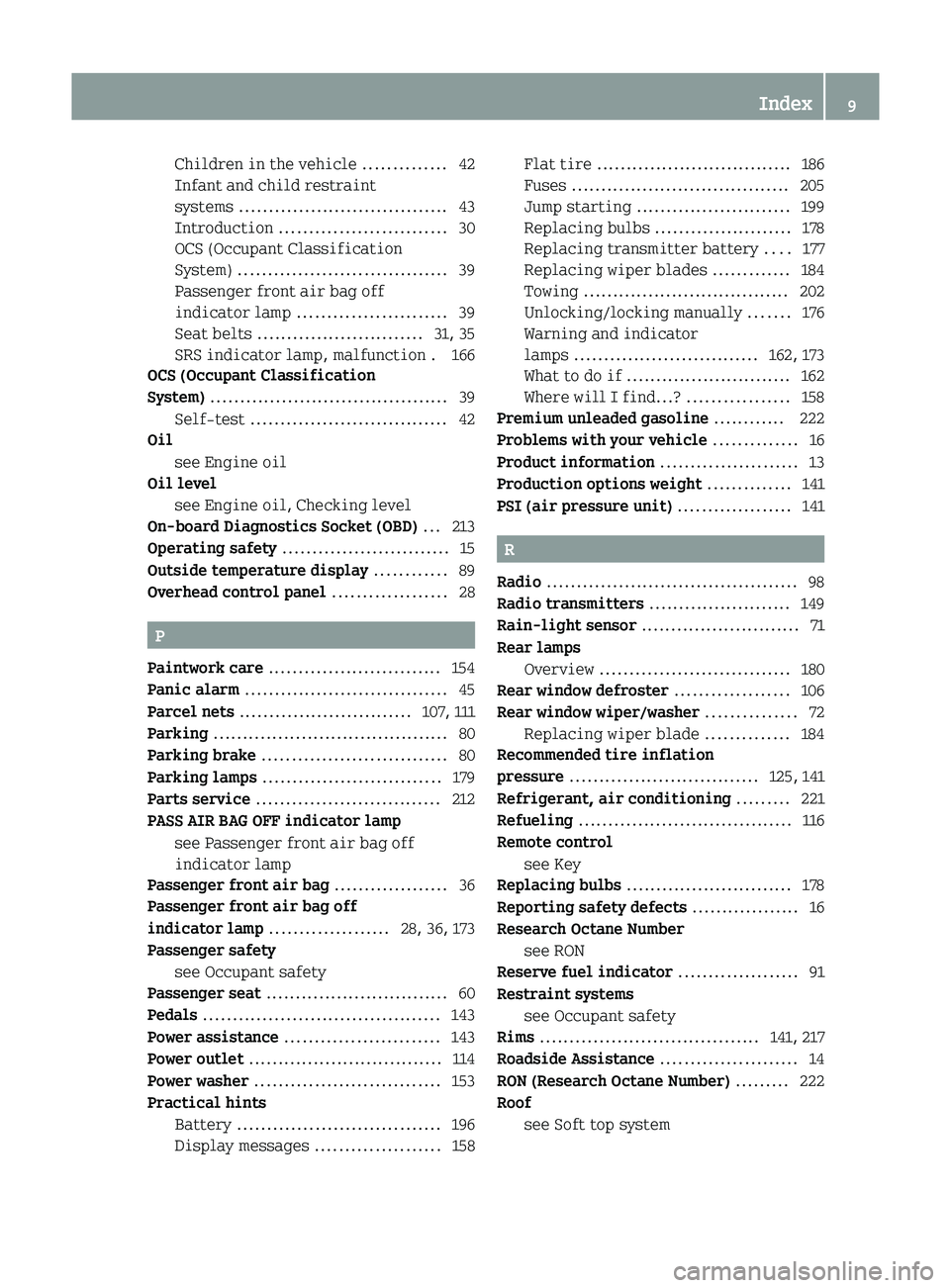
Children in the vehicle
..............42
Infant and child restraint
systems ................................... 43
Introduction ............................ 30
OCS (Occupant Classification
System) ................................... 39
Passenger front air bag off
indicator lamp ......................... 39
Seat belts ............................ 31, 35
SRS indicator lamp, malfunction .
166
OCS (Occupant Classification
System) ........................................ 39
Self-test ................................. 42
Oil
see Engine oil
Oil level
see Engine oil, Checking level
On-board Diagnostics Socket (OBD) ...213
Operating safety ............................ 15
Outside temperature display ............89
Overhead control panel ...................28P
Paintwork care ............................. 154
Panic alarm .................................. 45
Parcel nets ............................. 107, 111
Parking ........................................
80
Parking brake ............................... 80
Parking lamps .............................. 179
Parts service ............................... 212
PASS AIR BAG OFF indicator lamp see Passenger front air bag off
indicator lamp
Passenger front air bag ...................36
Passenger front air bag off
indicator lamp .................... 28, 36, 173
Passenger safety see Occupant safety
Passenger seat ............................... 60
Pedals ........................................ 143
Power assistance .......................... 143
Power outlet ................................. 114
Power washer ............................... 153
Practical hints Battery .................................. 196
Display messages ..................... 158Flat tire .................................
186
Fuses ..................................... 205
Jump starting .......................... 199
Replacing bulbs ....................... 178
Replacing transmitter battery
....177
Replacing wiper blades ............. 184
Towing ................................... 202
Unlocking/locking manually ....... 176
Warning and indicator
lamps ............................... 162, 173
What to do if ............................ 162
Where will I find...? ................. 158
Premium unleaded gasoline ............222
Problems with your vehicle ..............16
Product information .......................13
Production options weight ..............141
PSI (air pressure unit) ...................141 R
Radio .......................................... 98
Radio transmitters ........................ 149
Rain-light sensor ...........................
71
Rear lamps Overview ................................ 180
Rear window defroster ...................106
Rear window wiper/washer ............... 72
Replacing wiper blade .............. 184
Recommended tire inflation
pressure ................................ 125, 141
Refrigerant, air conditioning .........221
Refueling .................................... 116
Remote control see Key
Replacing bulbs ............................ 178
Reporting safety defects ..................16
Research Octane Number see RON
Reserve fuel indicator ....................91
Restraint systems see Occupant safety
Rims ..................................... 141, 217
Roadside Assistance .......................14
RON (Research Octane Number) .........222
Roof see Soft top system Index
9
Page 14 of 228
Turn signal lamps
......................... 179
Turn signals ................................. 68
Indicator lamps ....................... 169U
Uniform Tire Quality Grading
Standards .............................. 134, 142
Unleaded gasoline, premium ........... 221
Unlocking the vehicle ..................... 52
Manually .................................
176
USB socket .................................... 99V
Vehicle Bulbs ..................................... 178
Care ...................................... 150
Identification Number (VIN) .......214
Locking/unlocking
....................52
Modifications and alterations,
Operating safety ....................... 15
Towing ................................... 202
Unlocking/locking manually ....... 176
Vehicle dimensions
see Vehicle specification
Vehicle Identification Number
(VIN) .......................................... 214
Vehicle lighting ............................ 64
Vehicle loading Instructions ............................ 112
Load limit .............................. 131
Roof rack ................................ 112
Terminology ............................ 139
Vehicle maximum load on the tire ....142
Vehicle specification Model BRABUS .......................... 216
Model passion ......................... 215
Model pure .............................. 215
Vehicle washing
see Vehicle care
Vehicle weights
see Vehicle specification
Ventilation
see HVAC ................................ 102 W
Warning signals Anti-theft warning system .......... 175
Brake pads .............................. 176
Door ...................................... 175
Parking .................................. 176
Seat belt reminder system
....165, 175
Warranty coverage ......................... 212
Warranty information ......................13
Washer fluid Mixing ratio ........................... 222
Refilling ............................... 122
Wiping .................................... 71
Washer jet nozzles ......................... 186
Washing the vehicle ......................150
Weights (vehicle) see Vehicle specification
Wheel change ............................... 194
Wheel cover ................................. 194
Wheels, sizes ............................... 217
Wheels, Tires and .......................... 124
Where will I find...? First-aid kit ........................... 158
Tire repair kit ........................ 158
Window curtain air bags ..................38
Windshield Washer fluid ....................... 71, 222
Wipers .................................... 70
Windshield wipers .......................... 70
Adjusting washer jet nozzles ...... 186
Rain-light sensor ...................... 71
Replacing wiper blades ............. 184
Winter driving
Driving instructions ................148
Snow chains ............................ 142
Tires ..................................... 142
Winter tires ........................... 142, 21712
Index
Page 48 of 228
The product label with FCC ID and IC
certification
number can be found in the
battery case.
i Canada only:
This device complies with RSS‑210 of
Industry Canada. Operation is subject to
the following two conditions:
1. This device may not cause
interference, and
2. this device must accept any
interference received, including
interference that may cause undesired
operation of the device.
Any unauthorized modification to this
device could void the user’s authority to
operate the equipment.
The product label with FCC ID and IC
certification number can be found in the
battery case. Driving safety systems
Introduction
G
WARNING
The following factors increase the risk of
accidents:
R Excessive speed, especially in turns
R Wet and slippery road surfaces
R Following another vehicle too closely
The driving safety systems described in
this section cannot reduce these risks or
prevent the natural laws of physics from
acting on the vehicle.
Always adapt your driving style to the
prevailing road and weather and traffic
conditions and keep a safe distance to
other road users and objects on the street.
i In winter operation, the maximum
effectiveness of the ABS, the hydraulic
brake assistant, and the ESP ®
is only
achieved with winter tires ( Y page 142)
or snow chains* as required. Antilock Brake System (ABS)
G
WARNING
Do not pump the brake pedal. Use firm,
steady brake pedal pressure instead.
Pumping the brake pedal defeats the
purpose of the ABS and significantly
reduces braking effectiveness.
The Antilock Brake System (ABS) regulates
the
brake pressure so that the wheels do not
lock during braking. This allows you to
maintain the ability to steer your vehicle.
On slippery road surfaces, the ABS will
respond even to light brake pressure.
The ABS indicator lamp in the instrument
cluster (Y page 22) comes on when you
switch on the ignition. It goes out when the
engine is running.
Braking At the instant one of the wheels is about to
lock up, a slight pulsation can be felt in
the
brake pedal, indicating that the ABS is
regulating the brake pressure.
X Keep firm and steady pressure on the
brake pedal while experiencing the
pulsation.
Continuous, steady brake pedal pressure
yields
the advantages provided by the ABS,
namely braking power and the ability to
steer the vehicle.
A pulsating brake pedal can be an
indication of hazardous road conditions
and functions as a reminder to take extra
care while driving.
Emergency brake maneuver X
Keep continuous full pressure on the
brake pedal. G
WARNING
When the ABS is malfunctioning, the
hydraulic brake assistant and the ESP ®
are
also switched off. 46
Driving safety systems
>> Safety.
* optional
Page 60 of 228
g
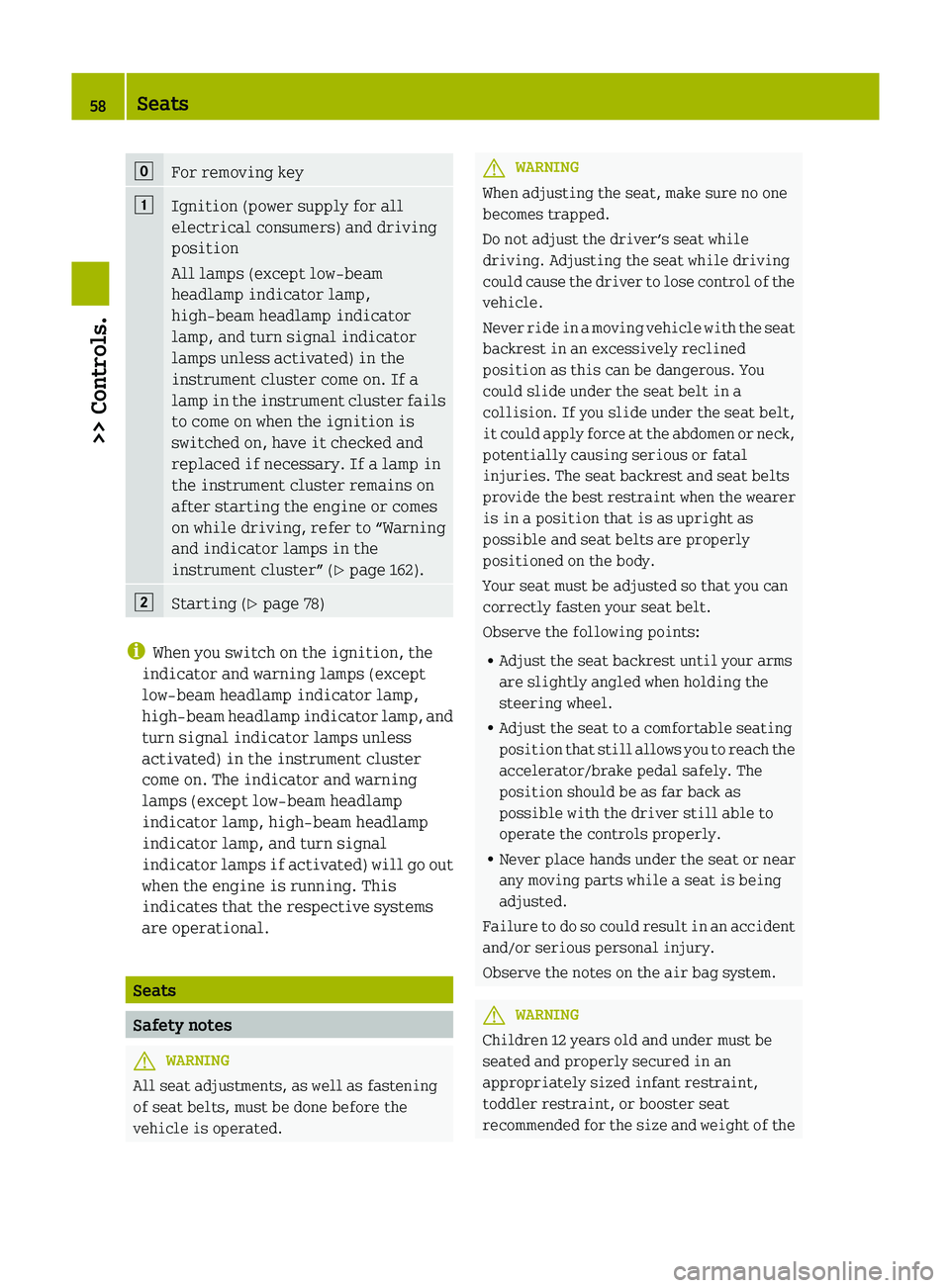
For removing key
1
Ignition (power supply for all
electrical consumers) and driving
position
All lamps (except low‑beam
headlamp indicator lamp,
high‑beam headlamp indicator
lamp, and turn signal indicator
lamps unless activated) in the
instrument cluster come on. If a
lamp
in the instrument cluster fails
to come on when the ignition is
switched on, have it checked and
replaced if necessary. If a lamp in
the instrument cluster remains on
after starting the engine or comes
on while driving, refer to “Warning
and indicator lamps in the
instrument cluster” ( Y page 162).2
Starting (
Y page 78)i
When you switch on the ignition, the
indicator and warning lamps (except
low‑beam headlamp indicator lamp,
high‑beam
headlamp indicator lamp, and
turn signal indicator lamps unless
activated) in the instrument cluster
come on. The indicator and warning
lamps (except low‑beam headlamp
indicator lamp, high‑beam headlamp
indicator lamp, and turn signal
indicator lamps if activated) will go out
when the engine is running. This
indicates that the respective systems
are operational. Seats
Safety notes
G
WARNING
All seat adjustments, as well as fastening
of seat belts, must be done before the
vehicle is operated. G
WARNING
When adjusting the seat, make sure no one
becomes trapped.
Do not adjust the driver’s seat while
driving. Adjusting the seat while driving
could
cause the driver to lose control of the
vehicle.
Never ride in a moving vehicle with the seat
backrest in an excessively reclined
position as this can be dangerous. You
could slide under the seat belt in a
collision. If you slide under the seat belt,
it could apply force at the abdomen or neck,
potentially causing serious or fatal
injuries. The seat backrest and seat belts
provide the best restraint when the wearer
is in a position that is as upright as
possible and seat belts are properly
positioned on the body.
Your seat must be adjusted so that you can
correctly fasten your seat belt.
Observe the following points:
R Adjust the seat backrest until your arms
are slightly angled when holding the
steering wheel.
R Adjust the seat to a comfortable seating
position that still allows you to reach the
accelerator/brake pedal safely. The
position should be as far back as
possible with the driver still able to
operate the controls properly.
R Never place hands under the seat or near
any moving parts while a seat is being
adjusted.
Failure to do so could result in an accident
and/or serious personal injury.
Observe the notes on the air bag system. G
WARNING
Children 12 years old and under must be
seated and properly secured in an
appropriately sized infant restraint,
toddler restraint, or booster seat
recommended
for the size and weight of the58
Seats
>> Controls.
Page 61 of 228
child. For additional information, see
“Children in the vehicle”.
A child’s risk of serious or fatal injuries
is significantly increased if the child
restraints are not properly secured in the
vehicle and/or the child is not properly
secured in the child restraint.
G
WARNING
Contact an authorized smart center if the
seats have become damaged.
The
seat is an integral part of the vehicle’s
safety system in the same way as seat belts
and air bags. Damage to the seats may
reduce their ability to protect the
occupants in an accident. Seat adjustment
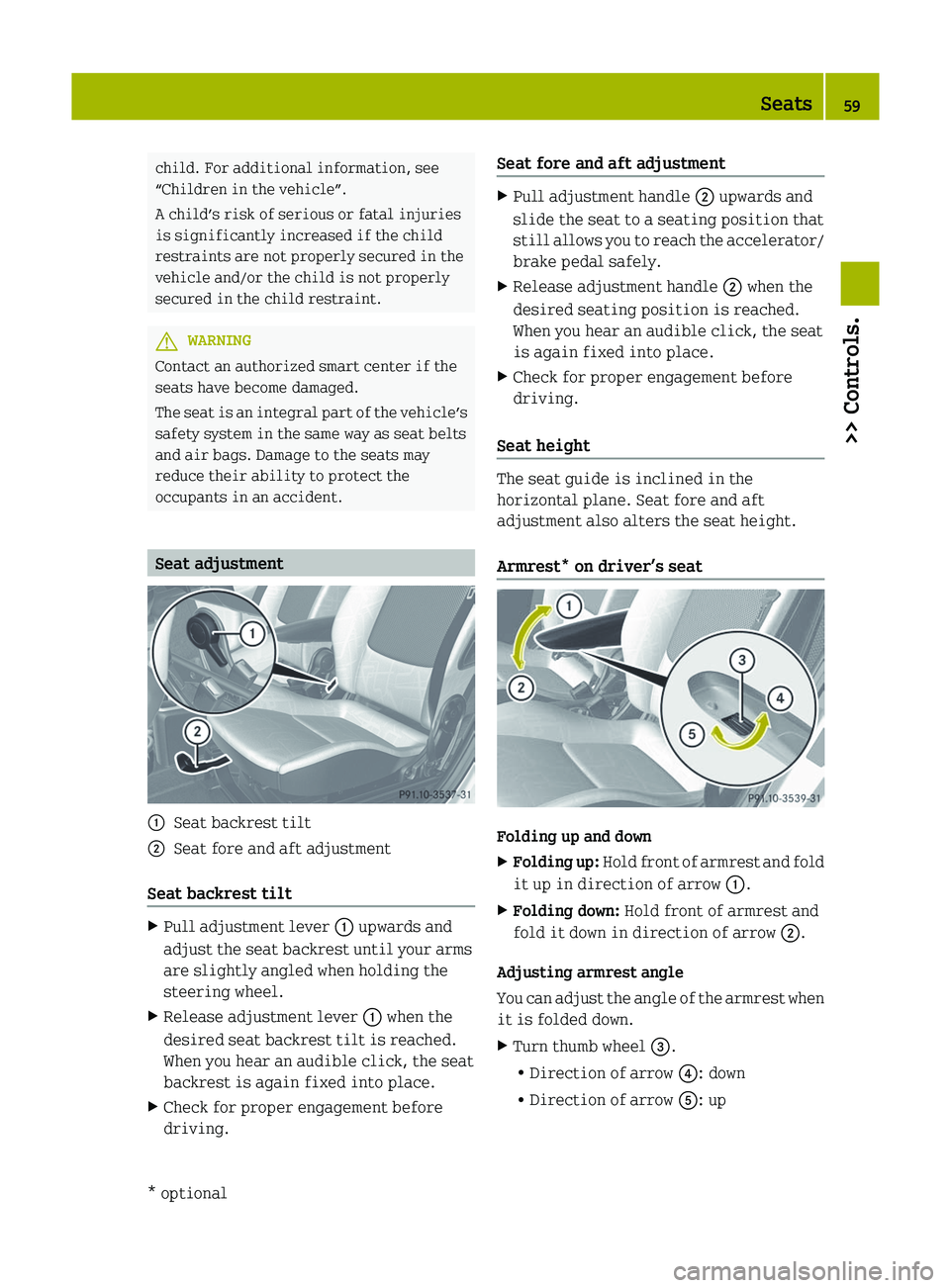
:
Seat backrest tilt
; Seat fore and aft adjustment
Seat backrest tilt X
Pull adjustment lever : upwards and
adjust the seat backrest until your arms
are slightly angled when holding the
steering wheel.
X Release adjustment lever : when the
desired seat backrest tilt is reached.
When you hear an audible click, the seat
backrest is again fixed into place.
X Check for proper engagement before
driving. Seat fore and aft adjustment X
Pull adjustment handle ; upwards and
slide the seat to a seating position that
still
allows you to reach the accelerator/
brake pedal safely.
X Release adjustment handle ; when the
desired seating position is reached.
When you hear an audible click, the seat
is again fixed into place.
X Check for proper engagement before
driving.
Seat height The seat guide is inclined in the
horizontal plane. Seat fore and aft
adjustment also alters the seat height.
Armrest* on driver’s seat
Folding up and down
X
Folding up:
Hold front of armrest and fold
it up in direction of arrow :.
X Folding down: Hold front of armrest and
fold it down in direction of arrow ;.
Adjusting armrest angle
You
can adjust the angle of the armrest when
it is folded down.
X Turn thumb wheel =.
R
Direction of arrow ?: down
R Direction of arrow A: up Seats
59
>> Controls.
* optional Z
Page 66 of 228
not touch the neck). Never pass the
shoulder portion of the seat belt under
your arm.
R Position the lap belt as low as possible
on your hips (over hip joint) and not
across the abdomen.
R Place
the seat backrest in a position that
is as upright as possible.
R Never use a seat belt for more than one
person at a time.
R Do not fasten a seat belt around a person
and another object at the same time. When
using a seat belt to secure infant or
toddler restraints or children in booster
seats, always follow the child seat
manufacturer’s instructions.
R Check your seat belt during travel to
make sure it is properly positioned.
R Make sure the seat belt is always fitted
snugly. Take special care to maintain a
snug fit when wearing loose clothing. G
WARNING
Do not pass seat belts over sharp edges.
They could tear.
Do not allow the seat belt to get caught in
the door or in the seat adjustment
mechanism. This could damage the seat
belt.
Never attempt to make modifications to
seat belts. This could impair the
effectiveness of the seat belts.
Do not bleach or dye seat belts as this may
severely weaken them. In a crash they may
not
be able to provide adequate protection.
Damaged seat belts or seat belts that were
highly stressed in an accident must be
replaced. Contact an authorized smart
center. Correct driver seat adjustment
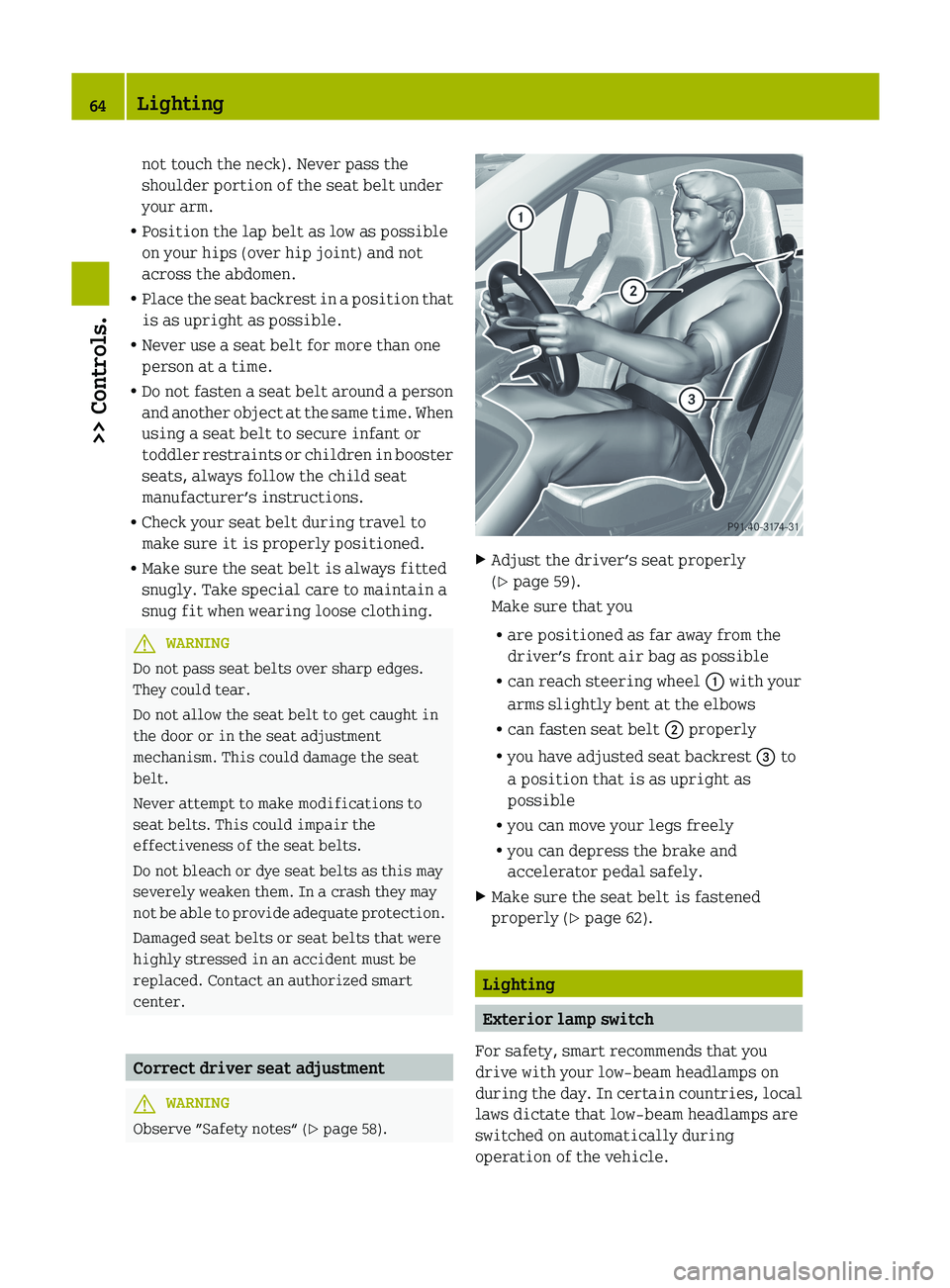
G
WARNING
Observe ”Safety notes“ ( Y page 58). X
Adjust the driver’s seat properly
(Y page 59).
Make sure that you
R are positioned as far away from the
driver’s front air bag as possible
R can reach steering wheel : with your
arms slightly bent at the elbows
R can fasten seat belt ; properly
R you have adjusted seat backrest = to
a position that is as upright as
possible
R you can move your legs freely
R you can depress the brake and
accelerator pedal safely.
X Make sure the seat belt is fastened
properly (Y page 62). Lighting
Exterior lamp switch
For safety, smart recommends that you
drive with your low‑beam headlamps on
during
the day. In certain countries, local
laws dictate that low‑beam headlamps are
switched on automatically during
operation of the vehicle. 64
Lighting
>> Controls.
Page 73 of 228
For safety reasons, stop the vehicle in a
safe location and
R
-
remove the key from the starter
switch
- engage the parking brake
before attempting to remove any
blockage.
R Remove blockage.
R Turn the windshield wipers on again.
X Switching off: Turn the wiper switch to
position g. Intermittent wiping
Only switch on intermittent wiping under
wet weather conditions or in the presence
of precipitation.
Vehicles
with rain-light sensor*: When you
select intermittent wiping, the sensor is
activated. The sensor automatically sets a
suitable wiping interval depending on the
wetness of the sensor surface.
! Vehicles with rain-light sensor*:
Do not leave windshield wipers in
intermittent setting when the vehicle is
taken to an automatic car wash or during
windshield cleaning. Windshield wipers
will operate in the presence of water
sprayed on the windshield, and
windshield wipers may be damaged as a
result.
! Vehicles with rain-light sensor*:
If you have set intermittent wiping, dirt
on the surface of the sensor or optical
effects may cause the windshield wipers
to wipe in an undesired fashion. This
could then damage the windshield wiper
blades or scratch the windshield. You
should therefore switch off the
windshield wipers when weather
conditions are dry. X
Make sure the key is in starter switch
position 1.
X Activating intermittent wiping:
Turn the
wiper switch to position 1.
After the initial wipe, pauses between
wipes are automatically controlled
depending on the vehicle speed and by the
rain-light sensor*.
X Deactivating intermittent wiping: Turn
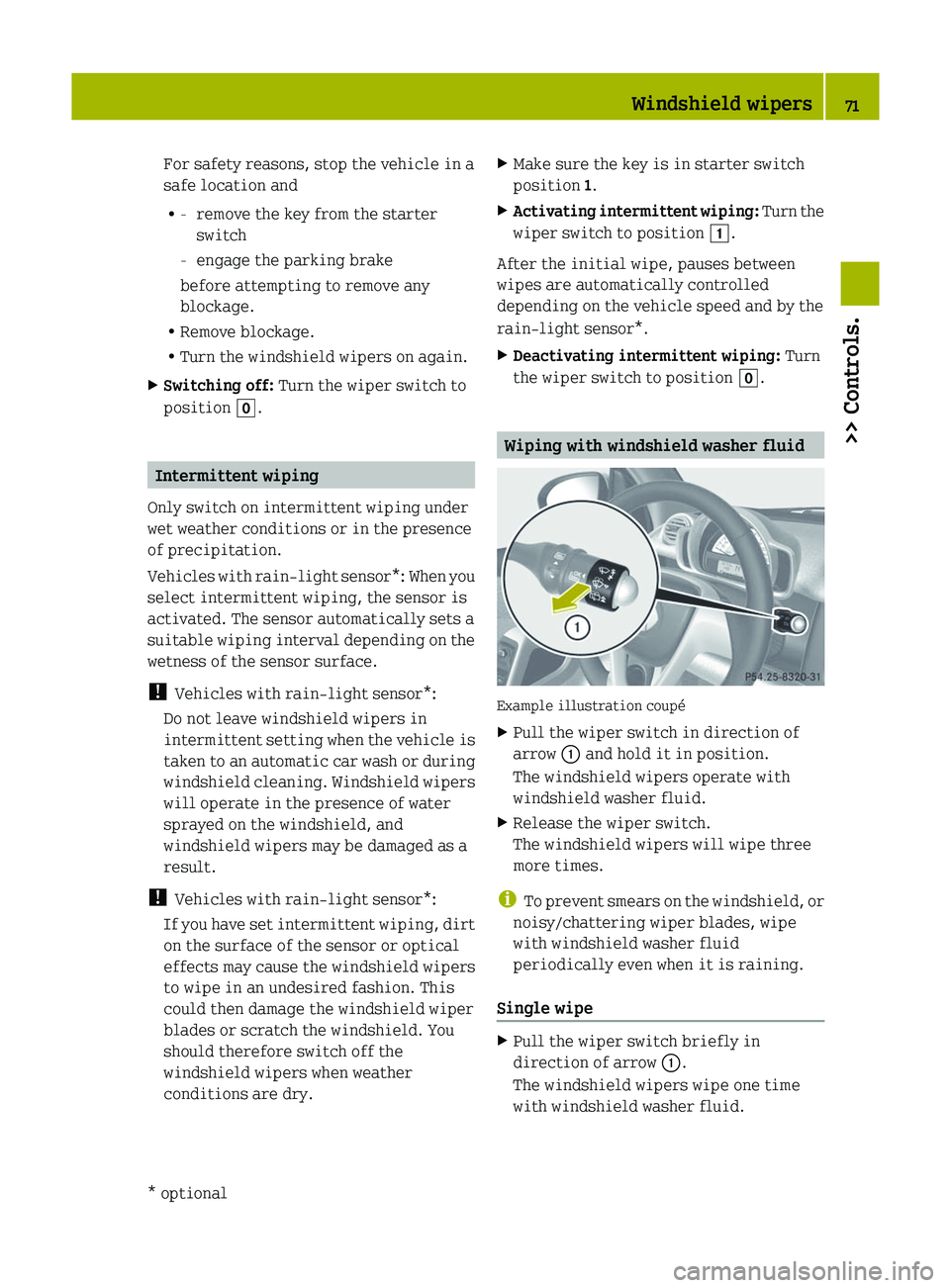
the wiper switch to position g. Wiping with windshield washer fluid
Example illustration coupé
X
Pull the wiper switch in direction of
arrow : and hold it in position.
The windshield wipers operate with
windshield washer fluid.
X Release the wiper switch.
The windshield wipers will wipe three
more times.
i To
prevent smears on the windshield, or
noisy/chattering wiper blades, wipe
with windshield washer fluid
periodically even when it is raining.
Single wipe X
Pull the wiper switch briefly in
direction of arrow :.
The windshield wipers wipe one time
with windshield washer fluid. Windshield wipers
71
>> Controls.
* optional Z