engine overheat SMART FORTWO COUPE 2012 Owners Manual
[x] Cancel search | Manufacturer: SMART, Model Year: 2012, Model line: FORTWO COUPE, Model: SMART FORTWO COUPE 2012Pages: 228, PDF Size: 12.76 MB
Page 120 of 228

X
Engage the parking brake.
X Move the gear selector lever to park
position P.
X Switch off the ignition.
X Open the tailgate. G
WARNING
Exercise extreme caution if you see flames
or smoke coming from the engine
compartment. Move away from the vehicle
and call the fire department.
If the coolant temperature warning lamp
indicates
that the engine is overheated, do
not attempt to open the engine compartment
cover. Move away from the vehicle and wait
until the engine has cooled before opening
the engine compartment. G
WARNING
To help prevent personal injury, stay clear
of moving parts when the engine
compartment cover is open and the engine
is running. G
WARNING
The engine is equipped with a
transistorized ignition system that
utilizes high voltage. Do not touch any
components (ignition coils, spark plug
sockets,
diagnostic socket) of the ignition
system
R while the engine is running
R while starting the engine
R if ignition is “on” and the engine is
turned manually X
Opening: Grasp the strap on cargo
compartment floor ;.
X Lift cargo compartment floor ;
with the
strap.
X Engage hook ? into top mounting = of
cargo compartment cover blind A.
X Remove fastening screw :.
X Remove engine compartment cover A.
X Closing:
Slide engine compartment cover
A forward into the tabs provided.
X Tighten fastening screw :.
X Disengage hook ? from top mounting
=.
X Fold cargo compartment floor ; back
down.
X Push the right hand and left hand cargo
compartment
floor edges under the edges
of the side panels.
X Close the tailgate. Engine oil
The amount of oil your engine needs will
depend on a number of factors, including
driving style. Increased oil consumption
can occur when the vehicle is new or the
vehicle is driven at higher engine speeds
frequently.
Engine
oil consumption checks should only
be made after the vehicle break-in period.
! Do not use any special lubricant
additives, as these may increase wear
and damage the drive assemblies. Using
special additives not approved by smart
may cause damage not covered by the
smart Limited Warranty. More
information on this subject is available
at any smart center.
Checking engine oil level !
Check the engine oil level at regular
intervals. 118
Engine compartment
>> Operation.
Page 124 of 228
Coolant
G
WARNING
In order to avoid potentially serious burns:
R Use extreme caution when opening the
service flap if there are any signs of
steam or coolant leaking from the
cooling system, or if the coolant
temperature warning lamp ? in the
instrument cluster indicates that the
coolant is overheated.
R Do
not remove the pressure cap on coolant
reservoir if coolant temperature is
above 158¦ (70¥). Allow engine to cool
down before removing cap. The coolant
reservoir contains hot fluid and is under
pressure.
R Using a rag, slowly turn the cap
approximately 1
/ 2 turn to relieve excess
pressure. If opened immediately,
scalding hot fluid and steam will be
blown out under pressure.
The engine coolant is a mixture of water
and anticorrosion/antifreeze. To check the
coolant level the vehicle must be parked on
level ground and the engine must have
cooled down. For more information, see
“Coolants” (Y page 223).
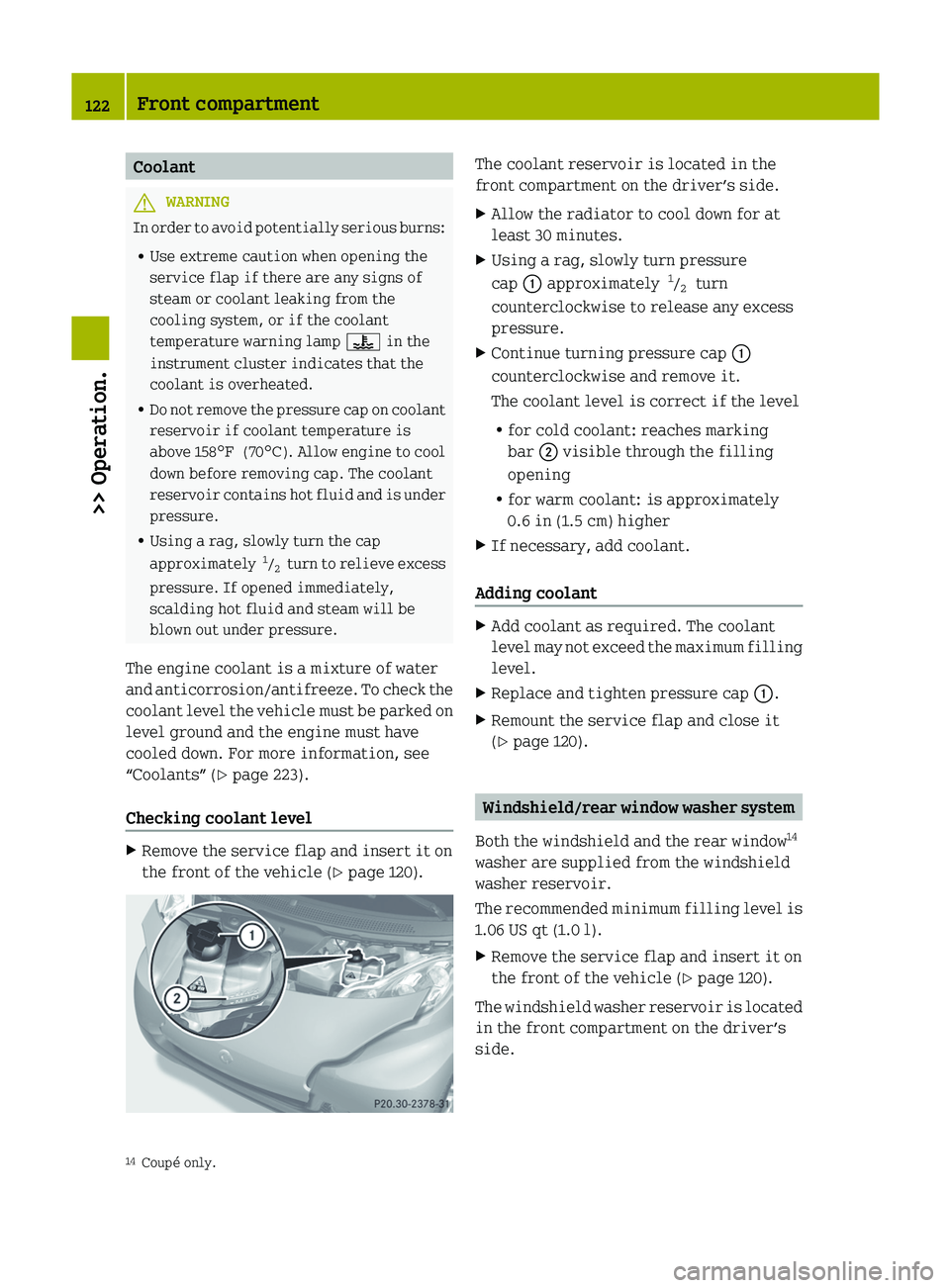
Checking coolant level X
Remove the service flap and insert it on
the front of the vehicle ( Y page 120). The coolant reservoir is located in the
front compartment on the driver’s side.
X
Allow the radiator to cool down for at
least 30 minutes.
X Using a rag, slowly turn pressure
cap : approximately 1
/ 2 turn
counterclockwise to release any excess
pressure.
X Continue turning pressure cap :
counterclockwise and remove it.
The coolant level is correct if the level
R
for cold coolant: reaches marking
bar ; visible through the filling
opening
R for warm coolant: is approximately
0.6 in (1.5 cm) higher
X If necessary, add coolant.
Adding coolant X
Add coolant as required. The coolant
level
may not exceed the maximum filling
level.
X Replace and tighten pressure cap :.
X Remount the service flap and close it
(Y page 120). Windshield/rear window washer system
Both the windshield and the rear window 14
washer are supplied from the windshield
washer reservoir.
The
recommended minimum filling level is
1.06 US qt (1.0 l).
X Remove the service flap and insert it on
the front of the vehicle ( Y page 120).
The windshield washer reservoir is located
in the front compartment on the driver’s
side.
14 Coupé only.122
Front compartment
>> Operation.
Page 146 of 228
important to keep in mind that a
considerably higher degree of effort is
necessary to brake and steer the vehicle.
Adapt your driving accordingly.
Brakes
G
WARNING
Make sure not to endanger any other road
users when carrying out braking
maneuvers.
Refer to the description of the hydraulic
brake assistant
(Y page 48).
! Because the ESP ®
operates
automatically, the engine must be turned
off (ignition switched off) when the
parking brake is being tested on a brake
test dynamometer. Active braking action
through the ESP ®
may otherwise seriously
damage the brake system which is not
covered by the smart Limited Warranty.
Brake pad wear or a leak in the brake system
may be the reason for low brake fluid level
in the brake fluid reservoir.
The brake fluid level in the brake fluid
reservoir may be too low if the brake
warning lamp in the instrument cluster
comes on (Y page 22) although the parking
brake is released.
Have the brake system inspected
immediately. Contact an authorized smart
center.
All checks and service work on the brake
system should be carried out by qualified
technicians only. Contact an authorized
smart center.
Only install brake pads and use brake fluid
recommended by smart.
Inclines !
When driving down long and steep
grades,
relieve the load on the brakes by
shifting into a lower gear to use the engine’s braking power. This helps
prevent overheating of the brakes and
reduces brake pad wear.
When
using the engine’s braking power, a
drive wheel may not spin for an extended
period of time, e.g. on slippery road
surfaces. This may cause serious damage
to the drive- train which is not covered
by the smart Limited Warranty.
High and low stresses G
WARNING
Resting your foot on the brake pedal will
cause excessive and premature wear of the
brake pads.
It can also result in the brakes
overheating, thereby significantly
reducing their effectiveness and your
ability to stop the vehicle in sufficient
time to avoid an accident.
After
hard braking, it is advisable to drive
on for some time, rather than immediately
park, so that the air stream will cool down
the brakes faster.
If your brake system is normally only
subjected to moderate loads, you should
occasionally test the effectiveness of the
brakes by applying above-normal braking
pressure at higher speeds. This will also
enhance the grip of the brake pads. G
WARNING
Make sure not to endanger any other road
users when carrying out these braking
maneuvers.
Wet road surface G
WARNING
After driving in heavy rain for some time
without applying the brakes or through
water
deep enough to wet brake components,
the first braking action may be somewhat
reduced and increased pedal pressure may
be necessary to obtain expected braking 144
Driving instructions
>> Operation.
Page 148 of 228
Catalytic converter
Your smart is equipped with monolithic-
type catalytic converter, an important
element in conjunction with the oxygen
sensors to achieve substantial control of
the pollutants in the exhaust emissions.
Keep your vehicle in proper operating
condition by following our recommended
maintenance instructions as outlined in
your Maintenance Booklet. G
WARNING
The catalytic converter can become very
hot. Coming into contact with the catalytic
converter could result in burns.
Note the following:
R Do not remove the protective heat guards.
R Do not apply any underseal.
R As with any vehicle, do not idle, park, or
operate this vehicle in areas where
combustible materials such as grass,
hay, or leaves can come into contact with
the hot exhaust system, as these
materials could be ignited and cause a
vehicle fire.
! To prevent damage to the catalytic
converter, only use premium unleaded
gasoline in this vehicle.
Any noticeable irregularities in engine
operation should be repaired promptly.
Otherwise, excessive unburned fuel may
reach the catalytic converter, causing it
to overheat and potentially start a fire.
It is essential to observe the following
points, as there is otherwise a danger of
overheating and the catalytic converter
may be damaged.
R Fill up only with premium unleaded
gasoline. Even small quantities of
leaded gasoline can damage the catalytic
converter.
R Make sure you adhere to the prescribed
service intervals.
R Never run the fuel tank empty. R
If
the engine starts to misfire, bring the
vehicle to an immediate standstill
without endangering traffic.
R If the engine fails to start the first time,
you should not try to start it any more
than three times in succession.
R Do not try to start for more than four
seconds at a time. Tires
G
WARNING
If you feel a sudden significant vibration
or ride disturbance, or you suspect that
possible damage to your vehicle has
occurred, you should turn on the hazard
warning flashers, carefully slow down, and
drive
with caution to an area which is a safe
distance from the road.
Inspect the tires and the vehicle underbody
for possible damage. If the vehicle or tires
appear unsafe, have the vehicle towed to the
nearest smart center or tire dealer for
repairs.
Treadwear indicators (TWI) are required by
law. These indicators are located in six
places on the tread circumference and
become visible at a tread depth of
approximately 1
/ 16 in (1.6 mm), at which
point the tire is considered worn and
should be replaced.
The treadwear indicator appears as a solid
band across the tread. G
WARNING
Although the applicable federal motor
vehicle safety laws consider a tire to be
worn when the treadwear indicators (TWI)
become visible at approximately
1
/ 16 in
(1.6 mm), we recommend that you do not allow
your tires to wear down to that level. As
tread depth approaches 1
/ 8 in (3 mm), the
adhesion properties on a wet road are
sharply reduced. 146
Driving instructions
>> Operation.
Page 152 of 228
Coolant temperature
During severe operating conditions and
stop-and-go city traffic, the coolant
temperature may rise.
! Excessive coolant temperature causes
the red coolant temperature warning
lamp ? in the instrument cluster to
come on.
The engine should not be operated with
the red coolant temperature warning
lamp ? illuminated. Doing so may
cause serious engine damage which is
not covered by the smart Limited
Warranty.
For more information on coolant
temperature warning lamp ( Y page 170).G
WARNING
Driving when your engine is overheated can
cause some fluids which may have leaked
into the engine compartment to catch fire.
You could be seriously burned.
Steam
from an overheated engine can cause
serious burns which can occur just by
opening the engine hood. Stay away from the
engine if you see or hear steam coming from
it.
Stop the vehicle in a safe location away
from other traffic. Turn off the engine, get
out of the vehicle and do not stand near the
vehicle until the engine has cooled down. Driving abroad
Abroad,
there is an extensive smart service
network at your disposal. If you plan to
drive into areas which are not listed in the
index of your smart center directory, you
should request pertinent information from
an authorized smart center. Symmetrical low beams
i If you drive in countries where
vehicles drive on the other side of the
road than the country in which the
vehicle is registered, you must have the
headlamps
modified for symmetrical low
beams. Relevant information can be
obtained at any authorized smart center. Vehicle care
Care tips
Regular and proper care will help to
maintain the value of your vehicle. The
best way to protect your vehicle from
harmful environmental influences is to
wash it and use protective treatments
regularly.
smart recommends that you care for the
paintwork
at least twice a year (e.g. in the
spring and autumn). G
WARNING
Many cleaning products can be hazardous.
Some are poisonous, others are flammable.
Always follow the instructions on the
particular container. Always open your
vehicle’s doors or windows when cleaning
the inside.
Never use fluids or solvents that are not
designed for cleaning your vehicle.
Always lock away cleaning products and
keep them out of reach of children.
! Follow
the care tips. Wash your vehicle
preferably by hand.
While in operation or even while parked,
your vehicle is subjected to varying
external influences, which left unchecked
can attack the paint as well as the vehicle
underbody and lead to permanent damage. 150
Vehicle care
>> Operation.
Page 161 of 228
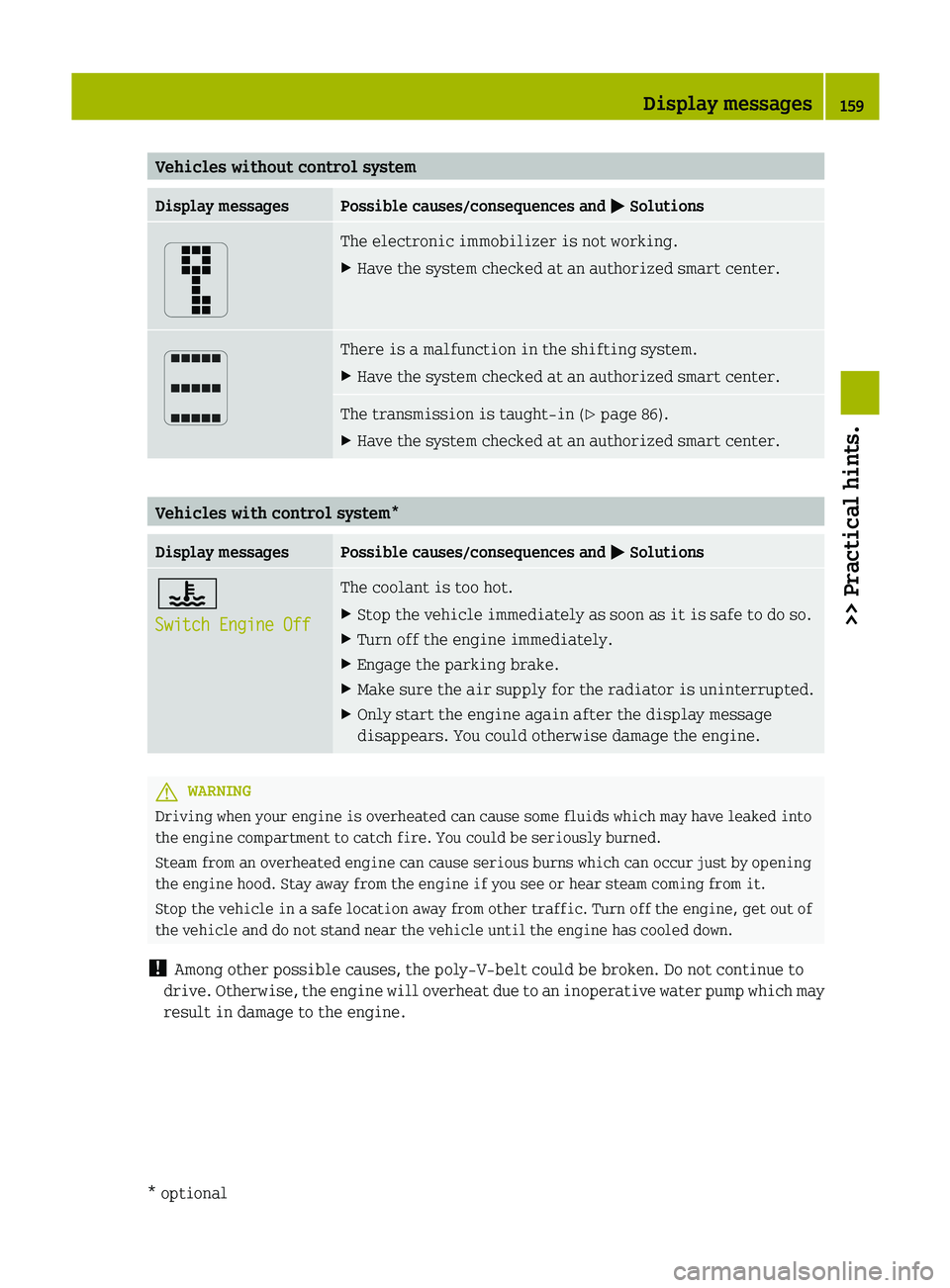
Vehicles without control system
Display messages Possible causes/consequences and
M Solutions The electronic immobilizer is not working.
X
Have the system checked at an authorized smart center. There is a malfunction in the shifting system.
X
Have the system checked at an authorized smart center. The transmission is taught-in (
Y page 86).
X Have the system checked at an authorized smart center. Vehicles with control system*
Display messages Possible causes/consequences and
M Solutions?
Switch Engine Off The coolant is too hot.
X
Stop the vehicle immediately as soon as it is safe to do so.
X Turn off the engine immediately.
X Engage the parking brake.
X Make sure the air supply for the radiator is uninterrupted.
X Only start the engine again after the display message
disappears. You could otherwise damage the engine. G
WARNING
Driving when your engine is overheated can cause some fluids which may have leaked into
the engine compartment to catch fire. You could be seriously burned.
Steam from an overheated engine can cause serious burns which can occur just by opening
the engine hood. Stay away from the engine if you see or hear steam coming from it.
Stop the vehicle in a safe location away from other traffic. Turn off the engine, get out of
the vehicle and do not stand near the vehicle until the engine has cooled down.
! Among other possible causes, the poly-V-belt could be broken. Do not continue to
drive.
Otherwise, the engine will overheat due to an inoperative water pump which may
result in damage to the engine. Display messages
159
>> Practical hints.
* optional Z
Page 162 of 228
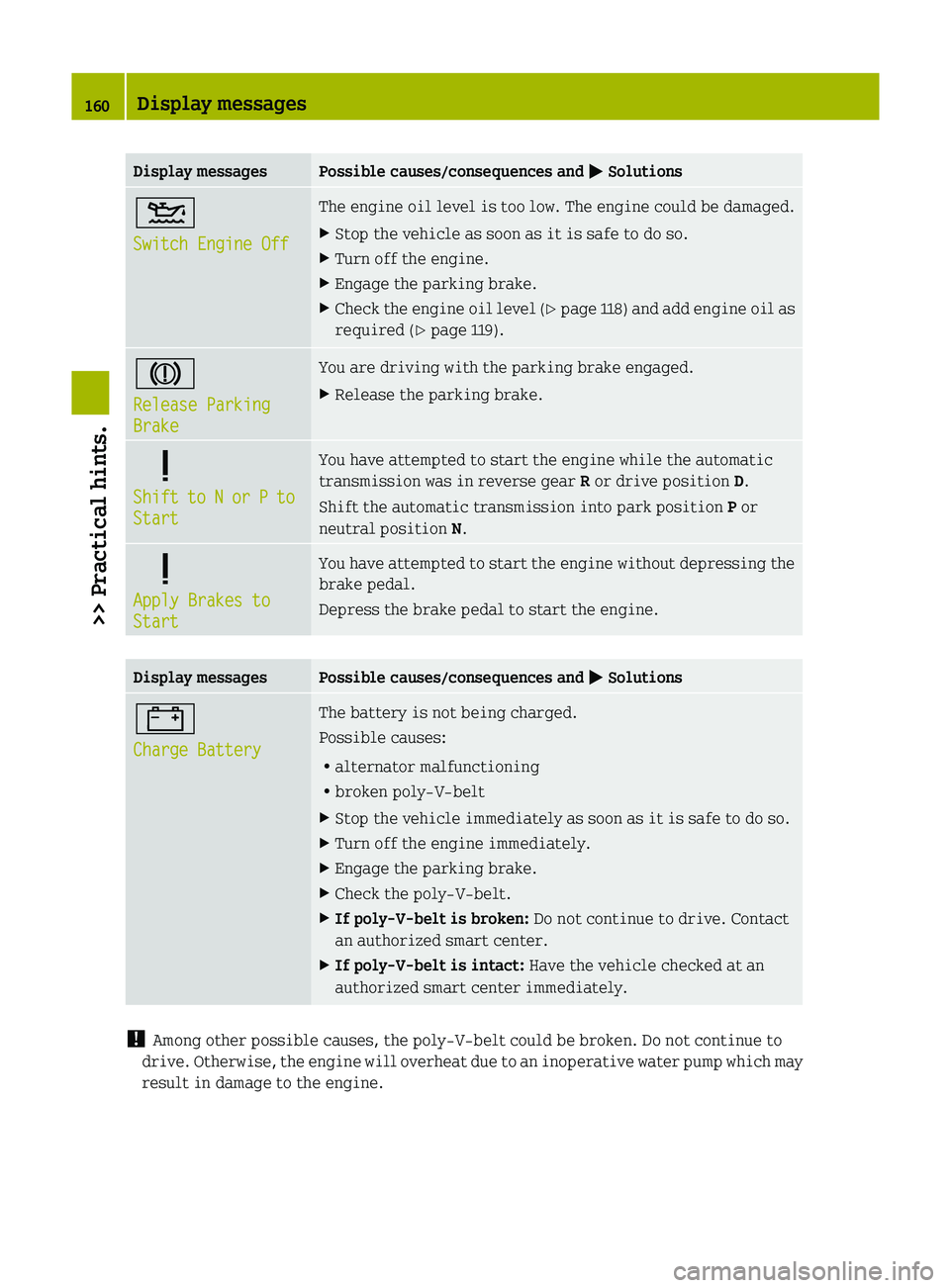
Display messages Possible causes/consequences and
M Solutions4
Switch Engine Off The engine oil level is too low. The engine could be damaged.
X
Stop the vehicle as soon as it is safe to do so.
X Turn off the engine.
X Engage the parking brake.
X Check the engine oil level (Y page 118) and add engine oil as
required (Y page 119). J
Release Parking
Brake You are driving with the parking brake engaged.
X
Release the parking brake. 5
Shift
to N or P to
Start You have attempted to start the engine while the automatic
transmission was in reverse gear
R or drive position D.
Shift the automatic transmission into park position P or
neutral position N.5
Apply Brakes to
Start You have attempted to start the engine without depressing the
brake pedal.
Depress the brake pedal to start the engine.
Display messages Possible causes/consequences and
M Solutions#
Charge Battery The battery is not being charged.
Possible causes:
R
alternator malfunctioning
R broken poly-V-belt
X Stop the vehicle immediately as soon as it is safe to do so.
X Turn off the engine immediately.
X Engage the parking brake.
X Check the poly-V-belt.
X If poly-V-belt is broken: Do not continue to drive. Contact
an authorized smart center.
X If poly-V-belt is intact: Have the vehicle checked at an
authorized smart center immediately. !
Among other possible causes, the poly-V-belt could be broken. Do not continue to
drive.
Otherwise, the engine will overheat due to an inoperative water pump which may
result in damage to the engine. 160
Display messages
>> Practical hints.
Page 170 of 228
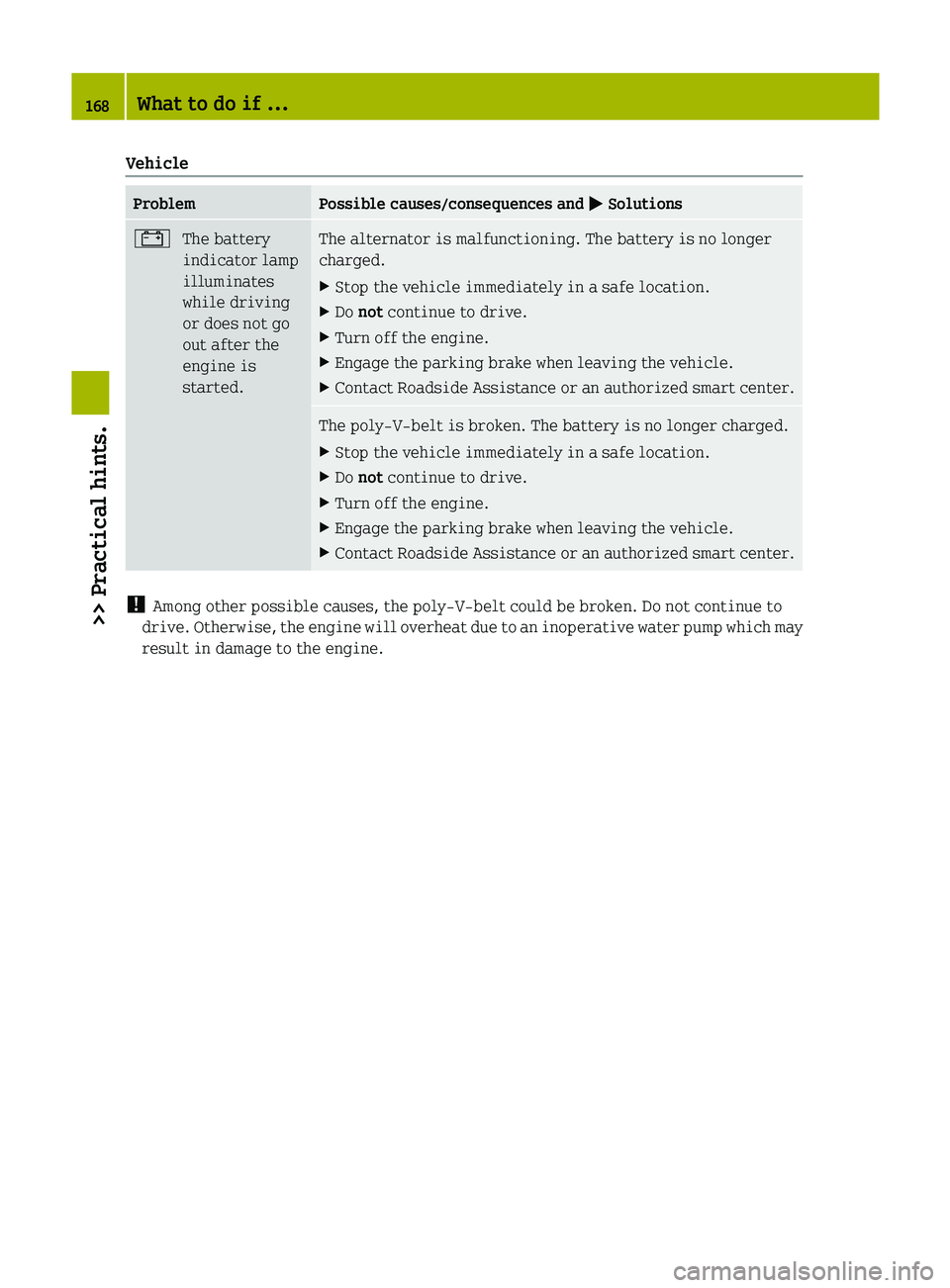
Vehicle
Problem Possible causes/consequences and
M Solutions#
The battery
indicator lamp
illuminates
while driving
or does not go
out after the
engine is
started. The alternator is malfunctioning. The battery is no longer
charged.
X
Stop the vehicle immediately in a safe location.
X Do not continue to drive.
X Turn off the engine.
X Engage the parking brake when leaving the vehicle.
X Contact Roadside Assistance or an authorized smart center. The poly-V-belt is broken. The battery is no longer charged.
X
Stop the vehicle immediately in a safe location.
X Do not continue to drive.
X Turn off the engine.
X Engage the parking brake when leaving the vehicle.
X Contact Roadside Assistance or an authorized smart center. !
Among other possible causes, the poly-V-belt could be broken. Do not continue to
drive.
Otherwise, the engine will overheat due to an inoperative water pump which may
result in damage to the engine. 168
What to do if ...>> Practical hints.
Page 172 of 228
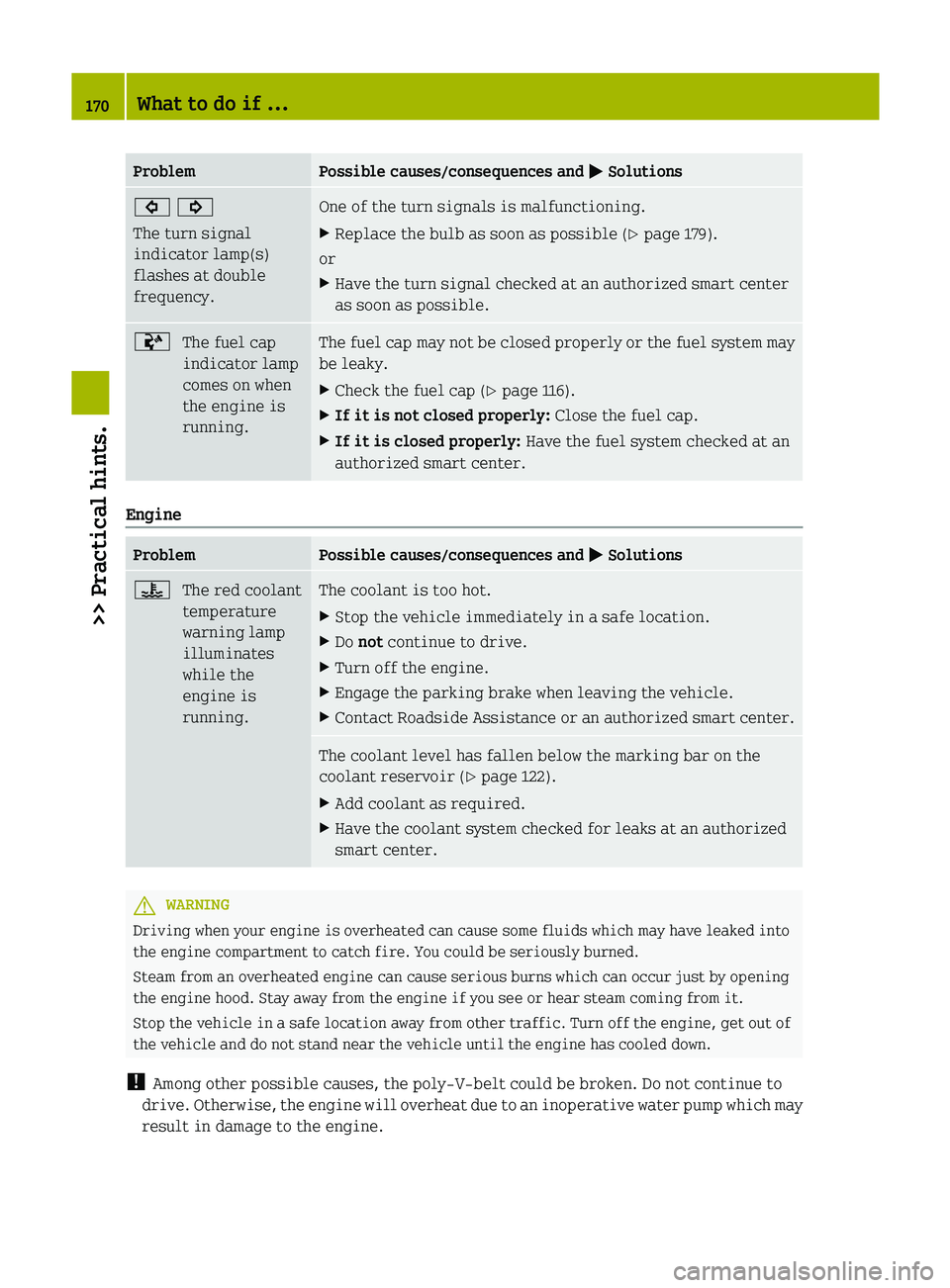
Problem Possible causes/consequences and
M Solutions# !
The turn signal
indicator lamp(s)
flashes at double
frequency. One of the turn signals is malfunctioning.
X
Replace the bulb as soon as possible ( Y page 179).
or
X Have the turn signal checked at an authorized smart center
as soon as possible. ®
The fuel cap
indicator lamp
comes on when
the engine is
running. The fuel cap may not be closed properly or the fuel system may
be leaky.
X
Check the fuel cap ( Y page 116).
X If it is not closed properly: Close the fuel cap.
X If it is closed properly: Have the fuel system checked at an
authorized smart center. Engine
Problem Possible causes/consequences and
M Solutions?
The red coolant
temperature
warning lamp
illuminates
while the
engine is
running. The coolant is too hot.
X
Stop the vehicle immediately in a safe location.
X Do not continue to drive.
X Turn off the engine.
X Engage the parking brake when leaving the vehicle.
X Contact Roadside Assistance or an authorized smart center. The coolant level has fallen below the marking bar on the
coolant reservoir (Y page 122).
X
Add coolant as required.
X Have the coolant system checked for leaks at an authorized
smart center. G
WARNING
Driving when your engine is overheated can cause some fluids which may have leaked into
the engine compartment to catch fire. You could be seriously burned.
Steam from an overheated engine can cause serious burns which can occur just by opening
the engine hood. Stay away from the engine if you see or hear steam coming from it.
Stop the vehicle in a safe location away from other traffic. Turn off the engine, get out of
the vehicle and do not stand near the vehicle until the engine has cooled down.
! Among other possible causes, the poly-V-belt could be broken. Do not continue to
drive.
Otherwise, the engine will overheat due to an inoperative water pump which may
result in damage to the engine. 170
What to do if ...
>> Practical hints.
Page 191 of 228
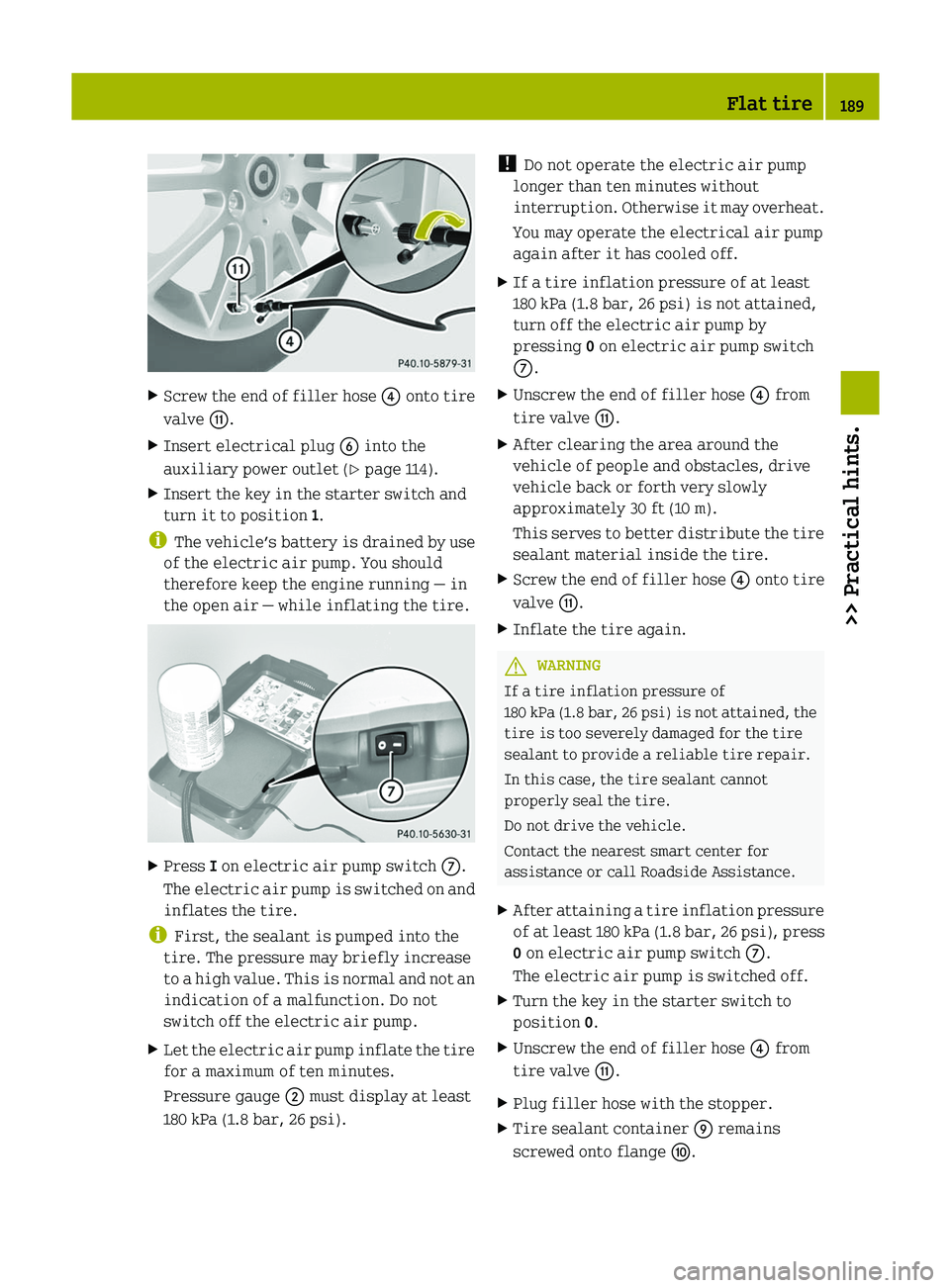
X
Screw the end of filler hose ? onto tire
valve G.
X Insert electrical plug B into the
auxiliary power outlet
(Y page 114).
X Insert the key in the starter switch and
turn it to position 1.
i The
vehicle’s battery is drained by use
of the electric air pump. You should
therefore keep the engine running — in
the open air — while inflating the tire. X
Press I on electric air pump switch C.
The
electric air pump is switched on and
inflates the tire.
i First, the sealant is pumped into the
tire. The pressure may briefly increase
to
a high value. This is normal and not an
indication of a malfunction. Do not
switch off the electric air pump.
X Let the electric air pump inflate the tire
for a maximum of ten minutes.
Pressure gauge ; must display at least
180 kPa (1.8 bar, 26 psi)
.!
Do not operate the electric air pump
longer than ten minutes without
interruption.
Otherwise it may overheat.
You may operate the electrical air pump
again after it has cooled off.
X If a tire inflation pressure of at least
180 kPa (1.8 bar, 26 psi)
is not attained,
turn off the electric air pump by
pressing 0 on electric air pump switch
C.
X Unscrew the end of filler hose ? from
tire valve G.
X After clearing the area around the
vehicle of people and obstacles, drive
vehicle back or forth very slowly
approximately 30 ft (10 m).
This
serves to better distribute the tire
sealant material inside the tire.
X Screw the end of filler hose ? onto tire
valve G.
X Inflate the tire again. G
WARNING
If a tire inflation pressure of
180
kPa (1.8 bar, 26 psi) is not attained, the
tire is too severely damaged for the tire
sealant to provide a reliable tire repair.
In this case, the tire sealant cannot
properly seal the tire.
Do not drive the vehicle.
Contact the nearest smart center for
assistance or call Roadside Assistance.
X After attaining a tire inflation pressure
of
at least 180 kPa (1.8 bar, 26 psi), press
0 on electric air pump switch C.
The electric air pump is switched off.
X Turn the key in the starter switch to
position 0.
X Unscrew the end of filler hose ? from
tire valve G.
X Plug filler hose with the stopper.
X Tire sealant container E remains
screwed onto flange F. Flat tire
189
>> Practical hints. Z