instrument cluster SMART FORTWO COUPE 2012 Owners Manual
[x] Cancel search | Manufacturer: SMART, Model Year: 2012, Model line: FORTWO COUPE, Model: SMART FORTWO COUPE 2012Pages: 228, PDF Size: 12.76 MB
Page 7 of 228
C
CAC (Customer Assistance Center) ......16
California retail buyers and
lessees, important notice for ...........14
Can holder see Cup holder
Cargo compartment cover blind ........107
Catalytic converter ....................... 146
CD player ..................................... 98
Center console ............................... 27
Central locking Automatic ................................ 53
Locking/unlocking from inside ....54
Certification label ....................... 214
Children in the vehicle ................... 42
Air bags .................................. 33
Indicator lamp, passenger front
air bag off .......................... 41, 173
Infant and child restraint
systems ................................... 43
OCS (Occupant Classification
System) ................................... 39
Safety notes ............................. 42
Tether anchorage points ............. 44
Child safety
see Children in the vehicle
Cigarette lighter .......................... 114
Climate control see HVAC ................................ 102
Clock ........................................... 88
Cockpit ........................................ 21
Coin holder ................................. 110
Cold tire inflation pressure ...........140
Combination switch ........................ 67
Control system Consumption menu ..................... 95
Control lever ............................ 93
Introduction ............................ 93
Menus and submenus ................... 94
Messages menu .......................... 96
Multifunction display ................ 93
Odometer menu .......................... 94
Reset menu ............................... 95
Settings menu ........................... 96
Start menu ............................... 95
Time menu ................................ 97Coolant
Anticorrosion/antifreeze .......... 223
Capacities .............................
220
Checking level ......................... 122
Temperature warning lamp .........170
Coolant temperature ......................150
Cruise control ............................. 100
Cup holder ................................... 107
Curb weight ................................. 140
Customer Assistance Center (CAC) ......16 D
Dashboard see Instrument cluster
Data recording ............................... 17
Daytime running lamp mode ..............66
Deep water see Standing water
Defroster
Rear window ............................ 106
Windshield ............................. 106
Department of Transportation
see DOT
Dimensions (vehicle)
see Vehicle specification
Direction of rotation (tires) ...........133
Display messages Automatic transmission .............159
Electronic immobilizer ............. 159
Door control panel ......................... 28
Door handles ................................. 28
Doors Locking/unlocking from outside ...53
Opening from inside .................. 54
DOT (Department of
Transportation) ...................... 138, 140
Drinking and driving ..................... 143
Driving Abroad ................................... 150
Coolant temperature .................150
Hydroplaning .......................... 147
Instructions ....................... 78, 143
In winter ................................ 148
Safety systems .......................... 46
Through standing water ............. 148
Tips, automatic transmission ...... 84 Index
5
Page 9 of 228
G
Gasoline see Fuel
GAWR (Gross Axle Weight Rating) ...... 140
Gear selector lever ........................ 82
Transmission positions .............. 83
Global locking/unlocking ................53
Glove box .................................... 110
Gross Axle Weight Rating see GAWR
Gross Vehicle Weight
see GVW
Gross Vehicle Weight Rating
see GVWR
GVW (Gross Vehicle Weight) .............140
GVWR (Gross Vehicle Weight Rating) ..140 H
Halogen headlamps see Headlamps
Hazard warning flasher ................... 69
Headlamps Automatic headlamp mode ............65
Daytime running lamp mode .........66
High-beam flasher ..................... 67
High-beam headlamps ................. 67
LED daytime running lamps
(Canada only) ............................ 67
LED daytime running lamps (USA
only) ....................................... 67
Low-beam headlamps .................. 65
Switch ..................................... 64
Head-thorax air bags ......................37
Heated exterior rear view mirrors .....62
Heated seats .................................. 60
Heating see HVAC ................................ 102
Height adjustment
Seats ...................................... 59
High-beam flasher .......................... 67
High-beam headlamps ................67, 179
Indicator lamp ........................ 169
High-mounted brake lamp ...............180
Hill-start assist system ..................84HVAC (Heating, Ventilation, Air
Conditioning) ..............................
102
Air distribution ...................... 105
Air recirculation .....................107
Air vents ................................ 104
Air volume .............................. 106
Defrosting .............................. 106
Rear window defroster ............... 106
Temperature ............................
104
Hydraulic brake assistant ................48
Hydroplaning ............................... 147 I
Identification labels ....................213
Identification number, vehicle
(VIN) .......................................... 214
Infant and child restraint systems see Children in the vehicle
Inflation pressure
see Tires, Inflation pressure
Inside door handle ......................... 54
Instrument cluster .....................22, 24
Illumination ............................ 92
Lamps, indicator and warning ..... 162
Instrument panel
see Instrument cluster
Instruments and controls
see Cockpit
Interior motion sensor .................... 49
Interior rear view mirror ................62
Interior storage spaces see Storage compartments
Intermittent wiping
Rear window wiper ..................... 72
Windshield wipers ..................... 71 J
Jump-starting .............................. 199 K
Key ............................................. 52
Loss of ................................... 174
Replacing the transmitter
battery ................................... 177
Kilopascal (air pressure unit) .........140 Index
7
Page 21 of 228
>> At a glance.Exterior view
................................... 20
Cockpit ........................................... 21
Instrument cluster (miles) ..................22
Instrument cluster (kilometers) ...........24
Steering wheel gearshift control .......... 26
Center console .................................. 27
Overhead control panel ...................... 28
Door control panel ............................ 28
Page 23 of 228
Cockpit
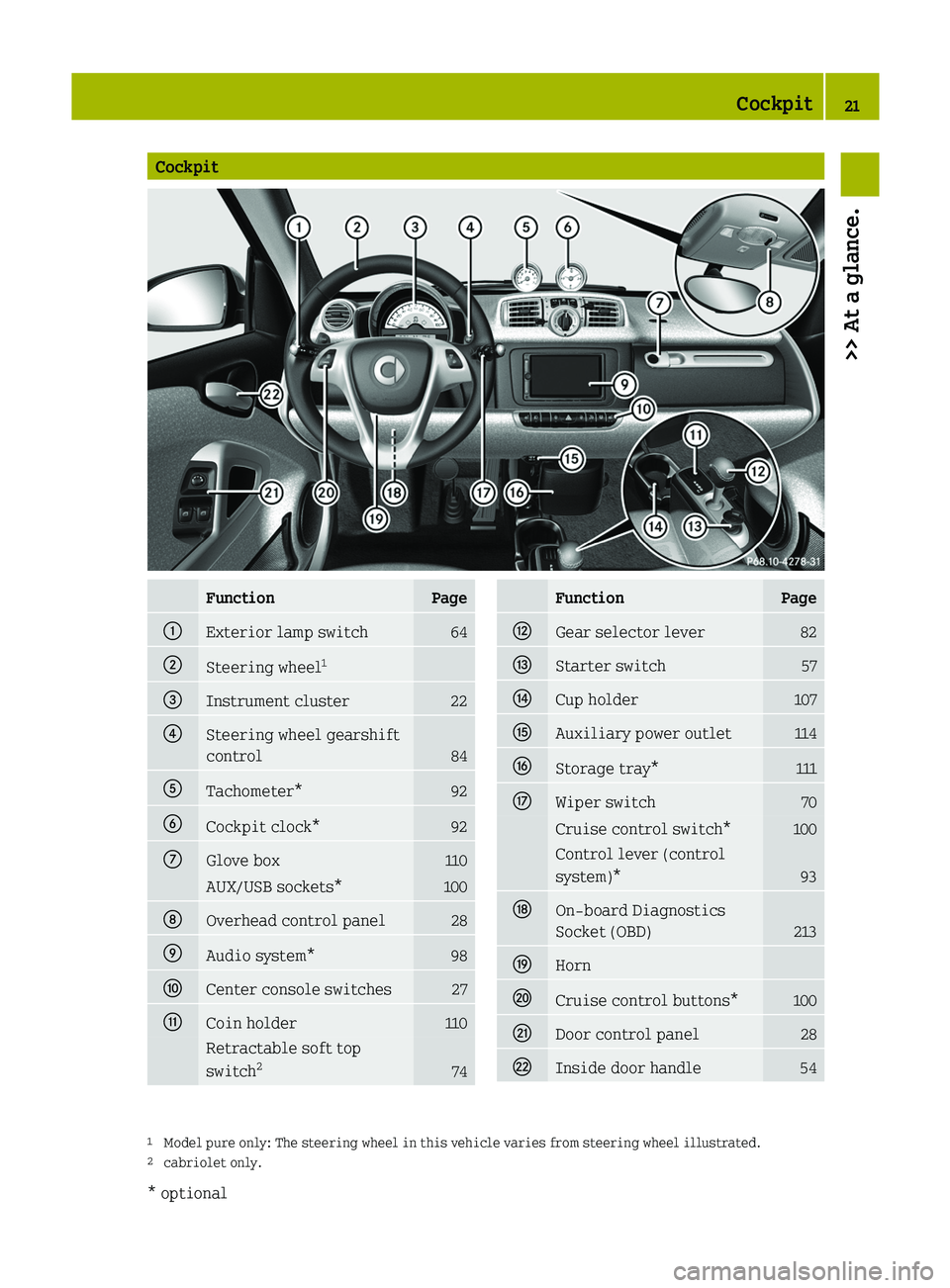
Function Page
:
Exterior lamp switch 64
;
Steering wheel
1=
Instrument cluster 22
?
Steering wheel gearshift
control
84
A
Tachometer* 92
B
Cockpit clock* 92
C
Glove box 110
AUX/USB sockets* 100
D
Overhead control panel 28
E
Audio system* 98
F
Center console switches 27
G
Coin holder 110
Retractable soft top
switch
2 74 Function Page
H
Gear selector lever 82
I
Starter switch 57
J
Cup holder 107
K
Auxiliary power outlet 114
L
Storage tray* 111
M
Wiper switch 70
Cruise control switch* 100
Control lever (control
system)*
93
N
On-board Diagnostics
Socket (OBD)
213
O
Horn
P
Cruise control buttons* 100
Q
Door control panel 28
R
Inside door handle 54
1
Model pure only: The steering wheel in this vehicle varies from steering wheel illustrated.
2 cabriolet only. Cockpit
21>> At a glance.
* optional
Page 24 of 228
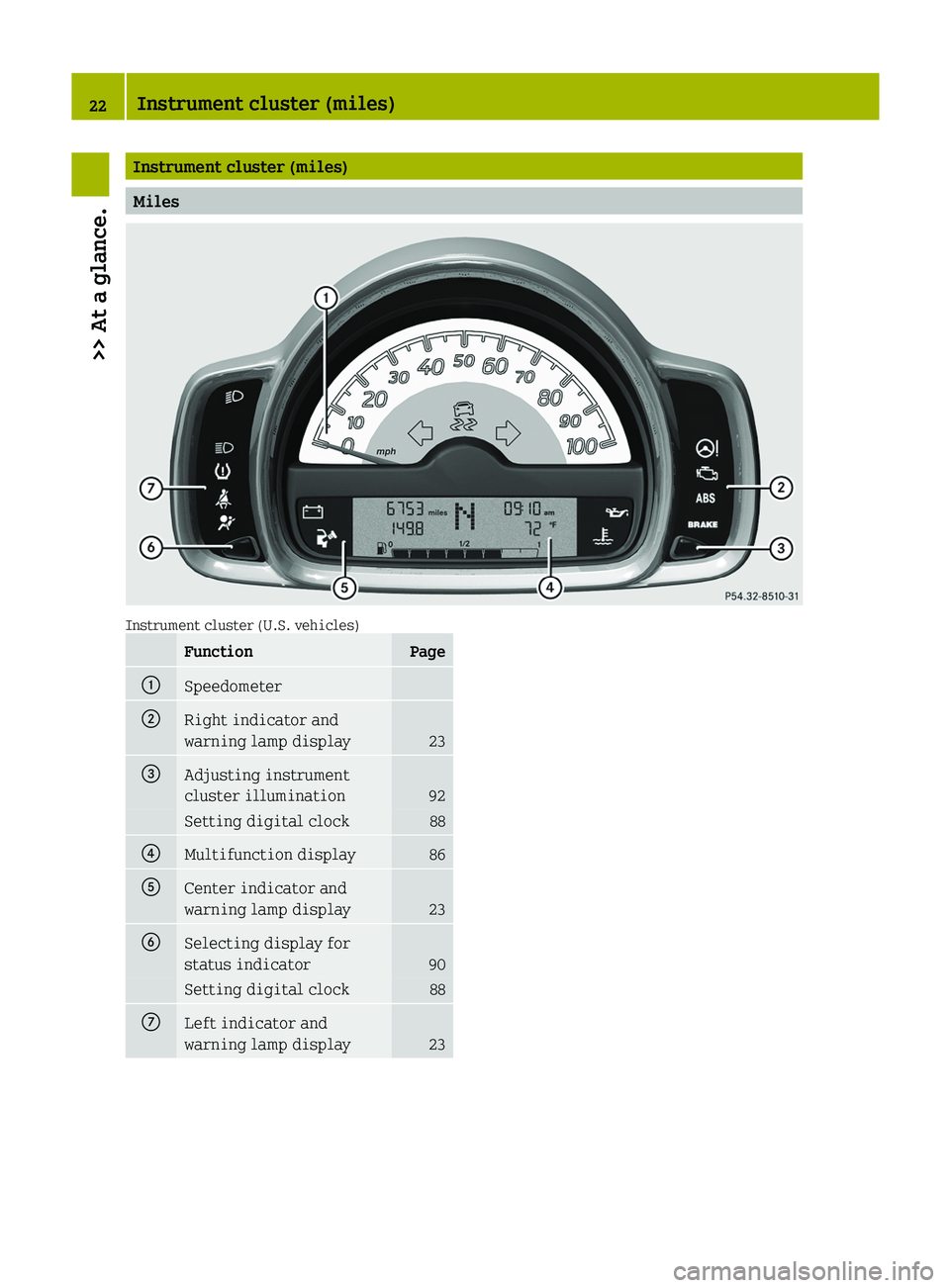
Instrument cluster (miles)
Miles
Instrument cluster (U.S. vehicles)
Function Page
:
Speedometer
;
Right indicator and
warning lamp display
23
=
Adjusting instrument
cluster illumination
92
Setting digital clock 88
?
Multifunction display 86
A
Center indicator and
warning lamp display
23
B
Selecting display for
status indicator
90
Setting digital clock 88
C
Left indicator and
warning lamp display
2322
Instrument cluster (miles)>> At a glance.
Page 25 of 228
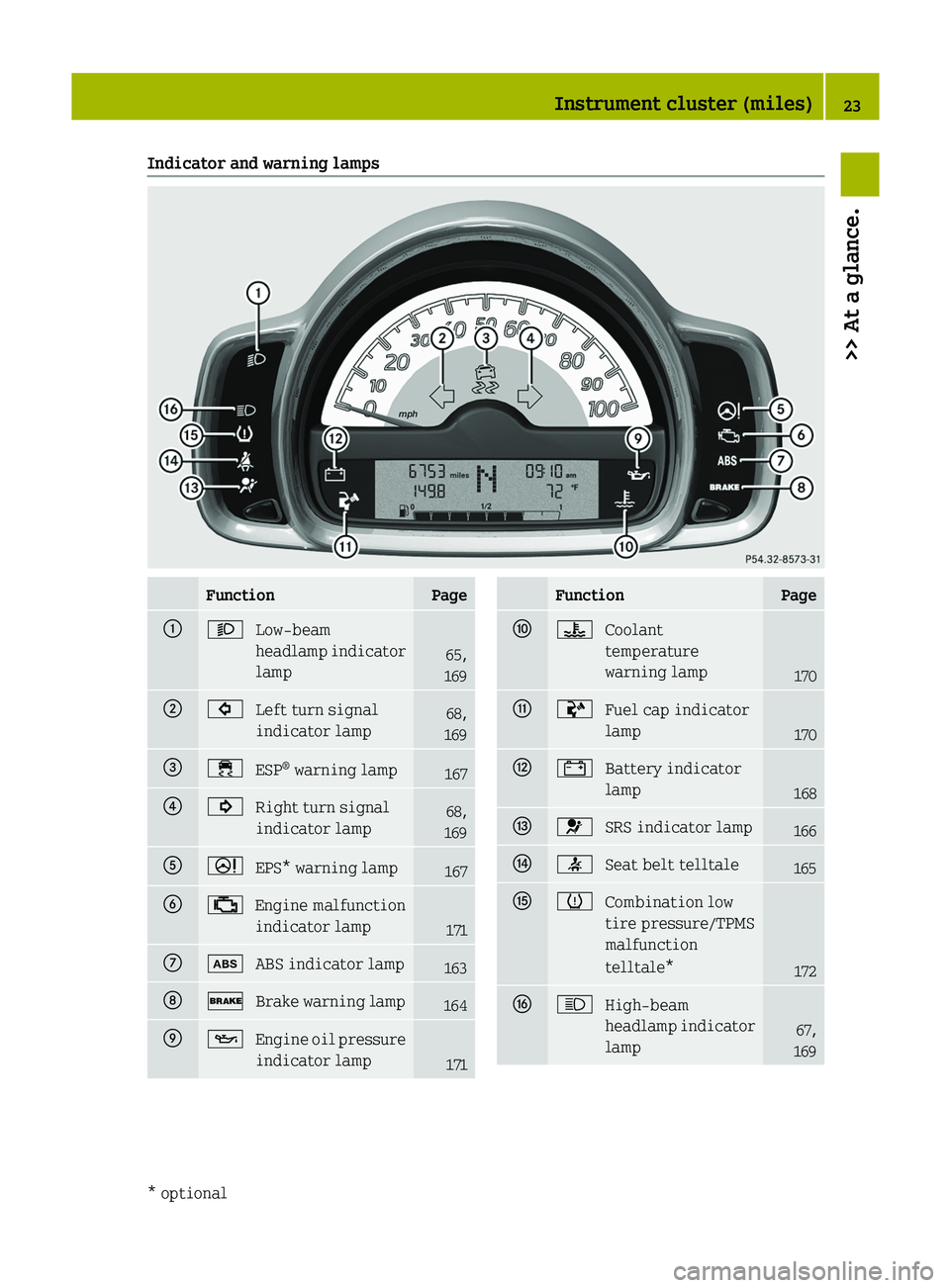
Indicator and warning lamps
Function Page
:
M
Low‑beam
headlamp
indicator
lamp 65,
169 ;
#
Left turn signal
indicator lamp 68,
169 =
÷
ESP®
warning lamp 167
?
!
Right turn signal
indicator lamp 68,
169 A
D
EPS* warning lamp 167
B
;
Engine malfunction
indicator lamp 171
C
ò
ABS indicator lamp 163
D
$
Brake warning lamp 164
E
5
Engine oil pressure
indicator lamp 171 Function Page
F
?
Coolant
temperature
warning lamp 170
G
®
Fuel cap indicator
lamp 170
H
#
Battery indicator
lamp 168
I
6
SRS indicator lamp 166
J
7
Seat belt telltale 165
K
h
Combination low
tire pressure/TPMS
malfunction
telltale* 172
L
K
High‑beam
headlamp
indicator
lamp 67,
169 Instrument cluster (miles)
23
>> At a glance.
* optional
Page 26 of 228
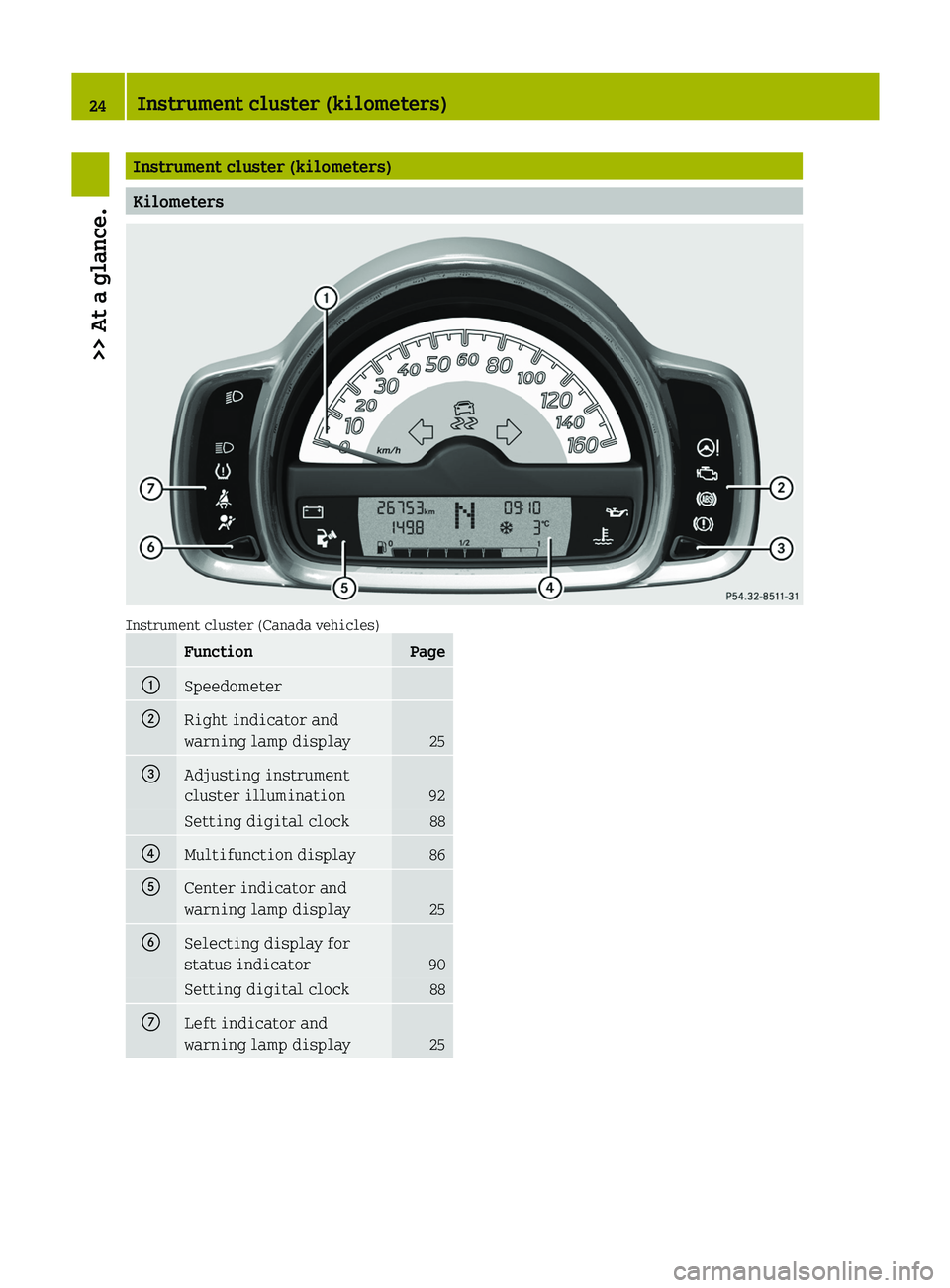
Instrument cluster (kilometers)
Kilometers
Instrument cluster (Canada vehicles)
Function Page
:
Speedometer
;
Right indicator and
warning lamp display
25
=
Adjusting instrument
cluster illumination
92
Setting digital clock 88
?
Multifunction display 86
A
Center indicator and
warning lamp display
25
B
Selecting display for
status indicator
90
Setting digital clock 88
C
Left indicator and
warning lamp display
2524
Instrument cluster (kilometers)>> At a glance.
Page 27 of 228
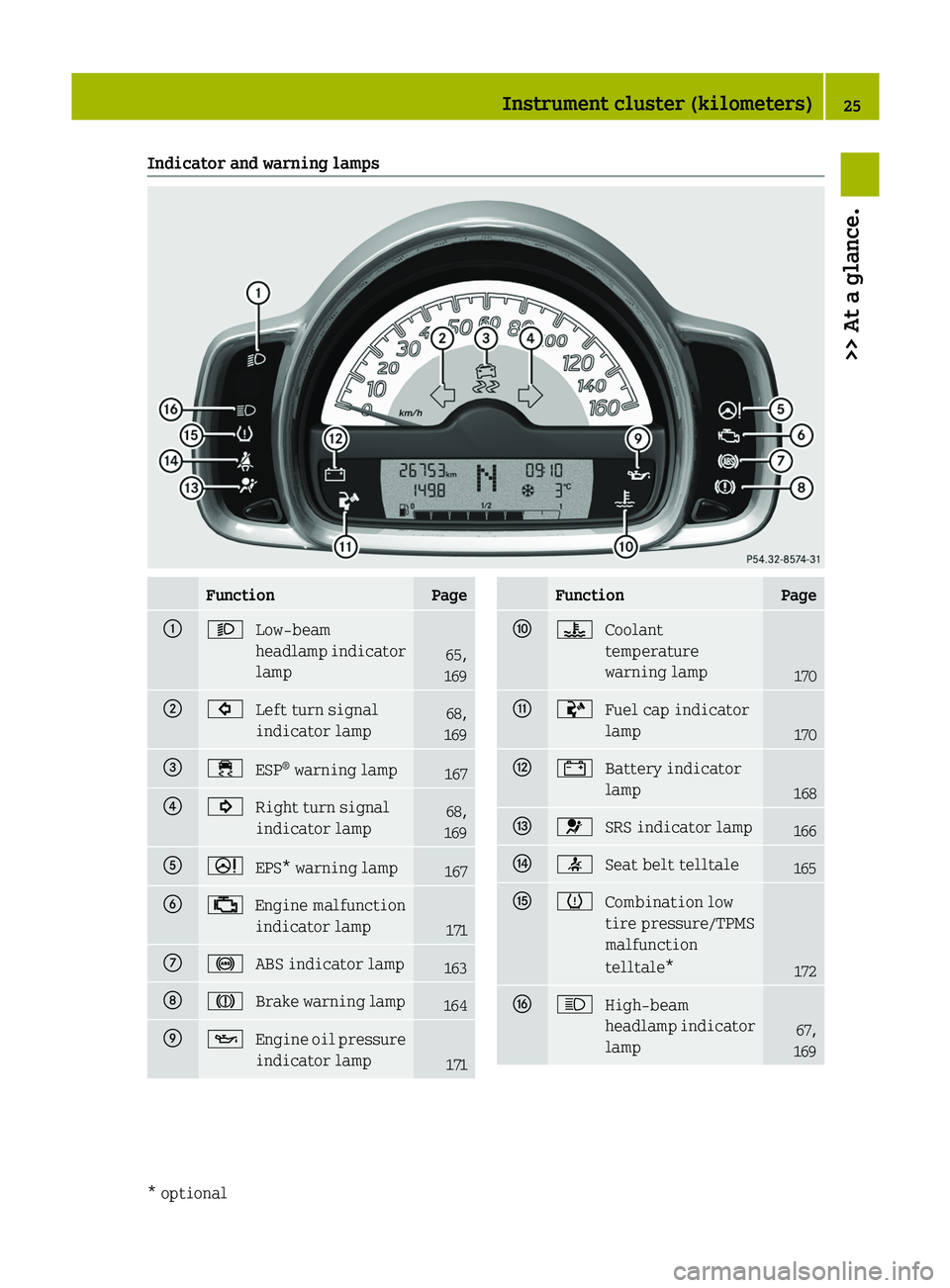
Indicator and warning lamps
Function Page
:
M
Low‑beam
headlamp
indicator
lamp 65,
169 ;
#
Left turn signal
indicator lamp 68,
169 =
÷
ESP®
warning lamp 167
?
!
Right turn signal
indicator lamp 68,
169 A
D
EPS* warning lamp 167
B
;
Engine malfunction
indicator lamp 171
C
!
ABS indicator lamp 163
D
J
Brake warning lamp 164
E
5
Engine oil pressure
indicator lamp 171 Function Page
F
?
Coolant
temperature
warning lamp 170
G
®
Fuel cap indicator
lamp 170
H
#
Battery indicator
lamp 168
I
6
SRS indicator lamp 166
J
7
Seat belt telltale 165
K
h
Combination low
tire pressure/TPMS
malfunction
telltale* 172
L
K
High‑beam
headlamp
indicator
lamp 67,
169 Instrument cluster (kilometers)
25
>> At a glance.
* optional
Page 32 of 228
Occupant safety
Introduction
The smart vehicle is equipped with seat
belts
and dual stage air bags to protect you
in a crash. However, children can be killed
or seriously injured by an inflating air
bag. Indeed, there is a stronger risk of
serious death or bodily injury when an air
bag deploys on a child positioned in a
rear-facing child seat in the passenger
seat. Because this vehicle has only two
front seats and no backseat, it is limited
as are other two-seat vehicles, in the
extent to which it may restrain children
traveling in the passenger front seat. Many
states have laws against placing children
of certain ages in the front seat of a
vehicle that has both front and back seats.
Those laws make exceptions to permit
children to be restrained in the front seat
of two seat vehicles. Special instructions
and warnings are provided below about
when and if you may restrain a child in the
passenger seat of the smart vehicle. Under
certain circumstances, it is appropriate
for the passenger air bag not to operate
when a child is restrained in a car seat in
the passenger seat, and this vehicle is
equipped with technology to accomplish
this. Please pay very close attention to the
instructions and warnings below,
particularly as they relate to children.
In this section you will learn the most
important facts about the restraint system
components of the vehicle.
The restraint systems are:
R Seat belts ( Y page 31)
R Child restraints ( Y page 43) Additional protection potential is
provided by:
R
Supplemental Restraint System (SRS)
with
- Air bags (Y page 33)
- Air bag control unit (with crash
sensors)
- Emergency Tensioning Devices and
seat belt force limiters
(Y page 33)
R Air bag system components with
-Passenger front air bag off indicator
lamp (Y page 41)
- Passenger seat with Occupant
Classification System (OCS)
(Y page 39)
Although independent systems, their
protective functions work in conjunction
with each other.
i For information on infants and
children traveling with you in the
vehicle and restraint systems for infants
and children, see “Children in the
vehicle” ( Y page 42).
The SRS system conducts a self-test when
the ignition is switched on and in regular
intervals while the engine is running. This
facilitates detection of malfunctions. The
SRS indicator lamp 6 in the instrument
cluster comes on when the ignition is
switched on and goes out after
approximately four seconds.
The SRS components are in operational
readiness if the SRS indicator lamp 6
is not lit when the engine is running.
A malfunction in the system has been
detected if the SRS indicator lamp 6
R fails to go out after approximately 4
seconds after the ignition was switched
on
R does not come on at all
R comes on after the engine was started or
while driving 30
Occupant safety
>> Safety.
Page 35 of 228
should be positioned as low as possible
on the hips to avoid any possible
pressure on the abdomen.
R Never place your feet on the instrument
panel, dashboard or on the seat. Always
keep
both feet on the floor in front of the
seat.
R When using a seat belt to secure infant or
toddler restraints or children in booster
seats, always follow the child seat
manufacturer’s instructions. Emergency Tensioning Devices (ETDs)
and seat belt force limiters
The seat belts are equipped with
Emergency Tensioning Devices and seat
belt force limiters.
Emergency Tensioning Devices are
designed to activate in the following
cases:
R in frontal or rear-end impacts
exceeding the system deployment
threshold
R if the restraint systems are operational
and functioning correctly
R in collisions with high vehicle
deceleration/acceleration in the
longitudinal direction, e.g. a head-on
collision
R on passenger side when the seat is
occupied and the seat belt is fastened
R independently of the front air bags
When activated, Emergency Tensioning
Devices
remove slack from the seat belts in
such a way that the seat belts fit more
snugly against the body. Seat belt force
limiters, when activated, reduce the force
exerted by the seat belts on occupants
during a crash.
When the emergency tensioning device is
triggered, the SRS indicator lamp 6 in
the instrument cluster illuminates, see
“SRS indicator lamp” ( Y page 166). G
WARNING
Once they have been triggered, Emergency
Tensioning
Devices will no longer function
properly and must be replaced. smart
recommends that you visit a qualified
workshop to have this done. In particular,
work relevant to safety or on safety-related
systems must be carried out at a qualified
specialist workshop.
Comply with safety regulations when
disposing of Emergency Tensioning
Devices. These regulations are available at
any smart center.
The belt force limiter is designed to
operate in unison with the front air bag,
which absorbs a portion of the seat belt’s
decelerating forces, distributing the load
over a larger area.
In the event of a head-on or rear-end
collision, the emergency tensioning
device is activated if the vehicle is
decelerated or accelerated sufficiently in
the longitudinal direction at the start of
impact with the ignition switched on. Air bags
Air bags can reduce the severity of
injuries in serious collisions, e.g. in a
head-on collision or a side impact. G
WARNING
Air bags are designed to reduce the
potential of injury in certain frontal
impacts (front air bags and knee bags), or
side impacts (head-thorax air bags,
window
curtain air bags and thorax-pelvis
air bags) which may cause significant
injuries. However, no system available
today can completely eliminate injuries
and fatalities.
The deployment of the air bags temporarily
releases a small amount of dust from the air
bags. This dust is neither injurious to your
health, nor does it indicate a fire in the
vehicle. The dust might cause some Occupant safety
33
>> Safety.
Z