ECU SMART FORTWO COUPE 2013 User Guide
[x] Cancel search | Manufacturer: SMART, Model Year: 2013, Model line: FORTWO COUPE, Model: SMART FORTWO COUPE 2013Pages: 218, PDF Size: 2.69 MB
Page 63 of 218
X
Push latch plate 002Binto seat belt
buckle 002Auntil it clicks.
X If necessary, tighten the lap portion of
the seat belt to a snug fit by pulling
shoulder portion up.
X Unfastening the seat belt: Press release
button 0028.
X Allow the retractor to completely rewind
the seat belt by guiding latch plate 002B.
Proper use of seat belts R
Do not twist the seat belt when fastening.
R Adjust the seat belt so that the shoulder
portion is located as close as possible
to the middle of the shoulder (it should
not touch the neck). Never pass the
shoulder portion of the seat belt under
your arm.
R Position the lap belt as low as possible
on your hips (over hip joint) and not
across the abdomen.
R Place the seat backrest in a position that
is as upright as possible.
R Never use a seat belt for more than one
person at a time.
R Do not fasten a seat belt aroun daperson
and another object at the same time. When
using a seat belt to secure infant or
toddler restraints or children in booster
seats, always follow the child seat
manufacturer’s instructions.
R Check your seat belt during travel to
make sure it is properly positioned.
R Make sure the seat belt is always fitted
snugly. Take special care to maintain a
snug fit when wearing loose clothing. G
WARNING
Do not pass seat belts over sharp edges.
They could tear.
Do not allow the seat belt to get caught in
the door or in the seat adjustment
mechanism. This could damage the seat
belt. Never attempt to make modifications to
seat belts. This could impair the
effectiveness of the seat belts.
Do not bleach or dye seat belts as this may
severely weaken them. In a crash they may
not be able to provide adequate protection.
Damaged seat belts or seat belts that were
highly stressed in an accident must be
replaced. Contact an authorized electric
drive smart center. Correct driver seat adjustment
G
WARNING
Observe ”Safety notes“ (Y page 56). X
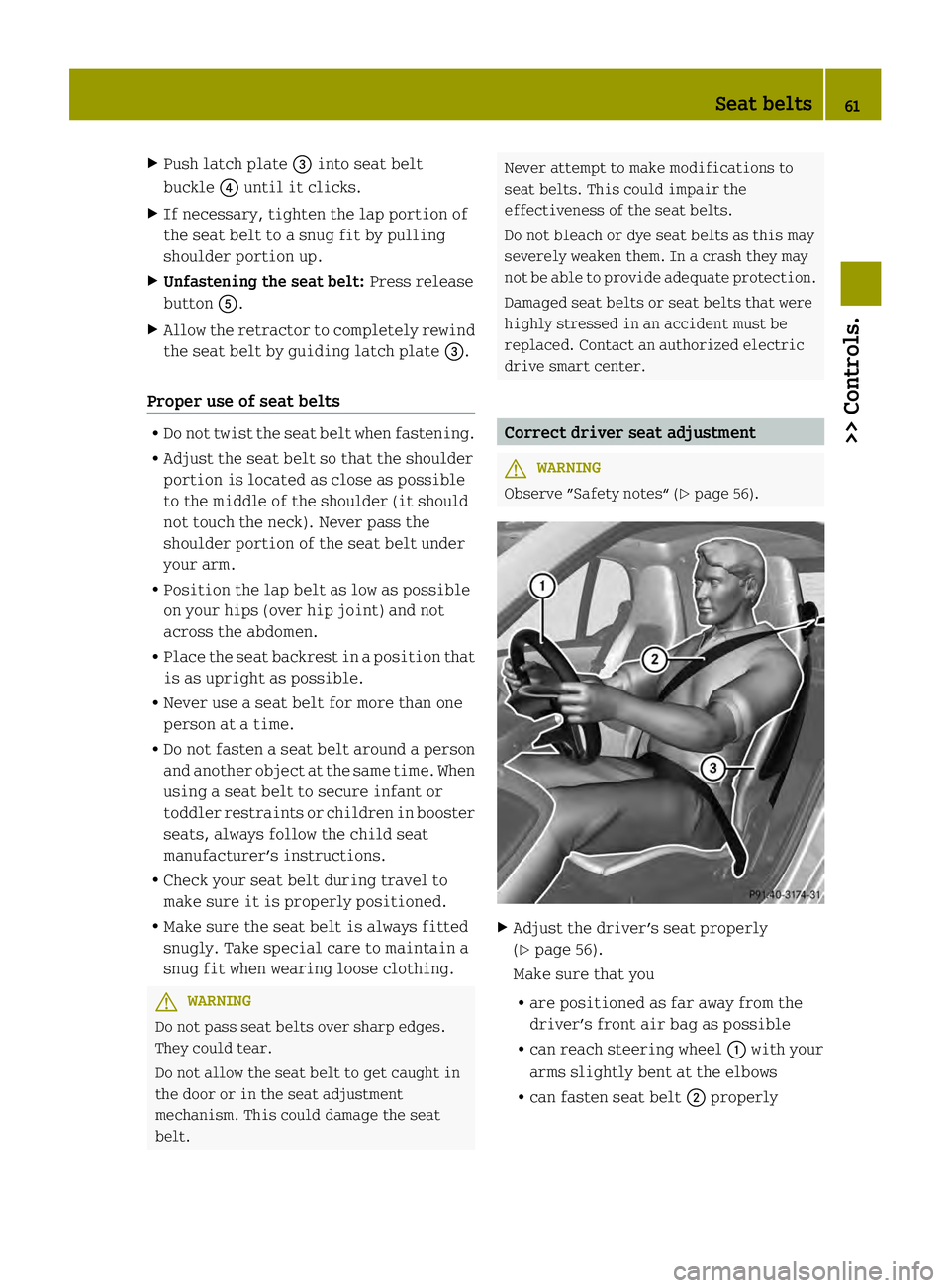
Adjust the driver’s seat properly
(Y page 56).
Make sure that you
R are positioned as far away from the
driver’s front air bag as possible
R can reach steering wheel 0002with your
arms slightly bent at the elbows
R can fasten seat belt 0003properly Seat belts
61>> Controls. Z
Page 73 of 218

X
Make sure the key is in starter switch
position 1. Retractable soft top switch
0002
Closing
0003 Opening
Opening the rear soft top X
Press symbol 0003on the retractable soft
top switch or button 0005on the key until
the retractable soft top has opened
completely.
X Release retractable soft top switch 0003or
button 0005on the key.
X Press symbol 0003on the retractable soft
top switch once more until the rear soft
top has folded down completely.
Closing the rear soft top X
Press symbol 0002on the retractable soft
top switch until the rear soft top has
folded up completely.
X Release retractable soft top switch 0002.
i If you release the retractable soft top
switch while driving before the rear soft
top has closed completely, the rear soft
top will fold down again. Removing the side rails
X Open the retractable soft top
(Y page 53).
X Open the rear soft top (Y page 70).X
Open the driver’s and passenger door
when conditions are safe to do so.
X Open the tailgate (Y page 54). X
Pull handle 0002on the inside of the
tailgate backward.
X Lift up the storage compartment cover. X
Push release lever 002Bof side rail 0003
backward.
Side rail 0003can be lifted at the rear end,
but remains secured.
X Push release lever 002Bbackward again. Soft top system (cabriolet only)
71>> Controls. Z
Page 77 of 218

Driving
i The vehicle has acrawler function. The
vehicle moves forward when the brake
pedal is released.
X Depress the brake pedal.
X Move the gear selector lever to drive
position D.
D appears in the transmission position
indicator.
X Release the brake pedal.
The vehicle moves forward.
X Depress the accelerator pedal smoothly.
The vehicle accelerates. Reversing the vehicle
! Shift the transmission into reverse
gear Ronly when the vehicle is stopped
in order to avoid damaging the
transmission.
You can drive in reverse gear at a speed
of up to 9 mph (15 km/h).
i Das Fahrzeug verfügt über eine
Kriechfunktion. Bei Lösen des
Bremspedals fährt das Fahrzeug an.
X Depress the brake pedal.
X Move the gear selector lever to reverse
gear R.
R appears in the transmission position
indicator.
X Release the brake pedal.
Das Fahrzeug fährt an.
X Gleichmäßig Gas geben.
Das Fahrzeug beschleunigt. Parking
G
WARNING
With the drive system inactive, there is no
power assistance for the brake and steering
systems. In this case, it is important to
keep in mind that a considerably higher
degree of effort is necessary to brake and steer the vehicle
.Adapt your driving
accordingly. G
WARNING
Vehicle movement can cause serious
personal injury. Therefore, always do the
following before exiting and leaving the
vehicle:
R Keep right foot on the brake pedal.
R Engage the parking brake.
R Move the gear selector lever to park
position P.
R Slowly release the brake pedal.
R When parked on an incline, always turn
the front wheels towards the curb.
R Turn the key to starter switch position 0
and remove the key from the starter
switch.
R Take the key with you and lock the vehicle
when leaving.
X Properly stop and park the vehicle.
X Depress the brake pedal.
X Engage the parking brake (Y page 75).
When the ignition is switched on, the
brake warning lamp 0002(USA only) or
0001 (Canada only) in the instrument
cluster comes on.
X Release the brake pedal.
Parking brake The parking brake serves to secure the
vehicle against rolling away when it is
stationary or parked.
G
WARNING
Engaging the parking brake while the
vehicle is in motion can cause the rear
wheels to lock up. You could lose control of
the vehicle and cause an accident. In
addition, the vehicle’s brake lights do not
light up when the parking brake is engaged. Driving and parking
75>> Controls. Z
Page 79 of 218

If a brake circuit has failed (Y
page 160),
you must depress brake pedal 0002further
down to achieve the same effect and the
braking distance is increased.
i The brake servo will only function with
the ignition switched on. Switching off the drive system
G
WARNING
Do not turn off the drive system before the
vehicle has come to a complete stop. With
the drive system not running, there is no
power assistance for the brake and steering
systems. In this case, it is important to
keep in mind that a considerably higher
degree of effort is necessary to brake and
steer the vehicle.
X Depress the brake pedal.
X Move the gear selector lever to park
position P.
The transmission position indicator
should be on P !
Always engage the parking brake in
addition to shifting to park position P.
X Release the brake pedal.
X Turn the key to starter switch position
0.
X Remove the key from the starter switch.
The electronic immobilizer is
activated. Transmission
Shifting procedure
Gearshift pattern for transmission
0010
Park position
0009
Reverse gear
000B
Neutral position
000F
Drive position
Select a gear:
X
Switch on the ignition.
X Depress the brake pedal.
X Move the gear selector lever to the
desired position. Steering wheel paddle shifters (for
recuperation)*
G
WARNING
The operating condition of the high-
voltage battery (e.g. not yet at normal
operating temperature or fully charged)
influences the braking effect of the
electric motor.
In overrun or braking mode, the motor's
braking effect may therefore be reduced or
may not be present at all.
As a result of the reduced engine braking
effect, you may cause an accident and
injure yourself or others. Transmission
77>> Controls.
* optional Z
Page 80 of 218

Compensate for the reduced engine braking
effect by pressing the brake pedal
accordingly, as required.
Using the steering wheel paddle shifters,
you can increase or decrease the
recuperation in overrun phases.
Recuperation means that energy is
recovered while driving - the electric
motor functions as a generator. The kinetic
energy of the vehicle is converted into
electric power and stored in the high-
voltage battery. The more the recuperation
increases, the more the vehicle will be
decelerated.
In overrun phases, there are three levels of
recuperation:
R no recuperation (level 0, coasting)
R mid-level recuperation (level 1)
R high-level recuperation (level 2)
The amount of recuperation in overrun
mode is displayed in the power gauge
(Y page 79).
When you switch on the ignition, level 1 is
automatically preset. X
Decrease recuperation: Pull left
steering wheel paddle shifter 0002.
X Increase recuperation: Pull right
steering wheel paddle shifter 0003.Use the different levels 0 to 2 for
conditions as described below: Level 0 Driving without frequent
breaking. No sharp bends on
the road ahead.
Maximum kinetic energy
remains for the vehicle.
Level 1 Normal driving, standard
setting.
Level 2 Sporty driving.
The break pedal has to be
depressed less often, as the
deceleration due to
recuperation is higher than
in level 1.
The energy efficiency is
substantially higher than if
the vehicle is decelerated by
depressing the brake pedal.
At levels
1and 2the vehicle can be
steplessly decelerated by depressing the
brake pedal.
i Under certain circumstances, in
overrun phases recuperation does not
work as described above. This may be e. g
the case if the high-voltage battery is
already fully charged or has not reached
operating temperature. Driving tips
Driving on uphill grades G
WARNING
The hill-start assist system is not
designed to function as a parking brake and
does not prevent the vehicle from moving
when parked on an incline.
Always engage the parking brake in
addition to shifting to park position P.78
Transmission>> Controls.
Page 84 of 218

Display Function
N
Neutral
D
Drive
N (flashes)
There is a parking lock
malfunction.
X
Move the gear selector
leve rslowly from
position Pto position R
and back to position P.
If Nremains flashing in
the multifunctio ndisplay:
X Move the gear selector
lever to position P. When
leaving the vehicle,
apply the parking brake
to secure the vehicle
from rolling away.
X Contact an authorized
electric drive smart
center. 0 X
Move the gear selector
lever to park position P
or neutral position N.
X Turn the key to starter
switch position 2
(Y page 55) and hold it in
position until READY appears in the
multifunction display
(Y
page 82). READY indicator
READY appears for two seconds in the
multifunction display, if: R
the key is turned to starter switch
position 2
R there is no malfunction in the drive
system
The vehicle is ready to drive. Maximum available power
G
WARNING
When the indicator for the maximum
available power is not at its maximal
range, the power output is reduced
noticeably. Adapt your speed and driving
accordingly. Otherwise, you could cause an
accident. Exercise particular care when
passing or accelerating. The indicator for the maximum available
power of the drive system contains three
segments
0002. The number of dark segments
indicates power that is currently
available.
R Three segments: maximum power is
available.
R Two segments: Less than 66 % amount of
power is available.
R One segment: Less than 33 % amount of
power is available.
Under normal operating conditions the
indicator for the maximum power is at the
maximum range 0002.
The available amount of power can vary
from the the maximum range due to:
R very high or low outside temperatures
R very high power demand over along time
period
R very low charge level of the high-voltage
battery 82
Control system>> Controls.
Page 102 of 218

from the outside (e.g. before driving
through a tunnel). This setting cuts off the
intake of outside air and recirculates the
air in the passenger compartment.
G
WARNING
When the air recirculation mode is
switched on, windows can fog on the inside
immediately. Fogged windows impair
visibility, endangering you and others. If
the windows begin to fog on the inside,
switching off the air recirculation mode
immediately should clear interior window
fogging. If interior window fogging
persists,m ake sure the air conditionin gis
switched on, turn air distribution control
0029 to position 0006and increase the air
volume using air volume control 0002.
Control panel (Y page 97).
X Switching on: Press air recirculation
switch 002A.
The indicator lamp in air recirculation
switch 002Acomes on.
X Switching off: Press air recirculation
switch 002Aonce more.
The indicator lamp in air recirculation
switch 002Agoes out. Loading and storing
Cargo compartment cover blind with
parcel net bag
G
WARNING
The cargo compartment cover blind is not
intended to secure heavy objects in the
event of an accident. For this reason, heavy
objects must be tied down.
Vehicle occupants could be injured by
objects being thrown around in the vehicle
in the event of
R hard braking
R a change of direction
R an accident G
WARNING
Do not place any objects on the mounted
cargo compartment cover blind.
Vehicle occupants could be injured by
objects being thrown around in the vehicle
in the event of
R hard braking
R a change of direction
R an accident G
WARNING
Only place light loads in the parcel net
bag. Do not transport heavy ,sharp-edged or
fragile objects in the parcel net bag. The
parcel net bag cannot sufficiently secure
loads in an accident.
Vehicle occupants could be injured by
objects being thrown around in the vehicle
in the event of
R hard braking
R a change of direction
R an accident
Observe the loading guidelines.
The cargo compartment cover blind
R serves to protect objects that are stored
in the vehicle’s cargo compartment from
prying eyes
R prevents smaller objects from
penetrating into the passenger
compartment from the cargo
compartment; however, it is not intended
to act as a load restraining device
The parcel net bag
R is for storing small, lightweight objects
R prevents small objects from sliding
around inside the passenger
compartment
! If objects are placed on the cargo
compartment cover blind when mounted,
the cover may be damaged. 100
Loading and storing>> Controls.
Page 103 of 218

Fitting
If you wish to use cargo compartment cover
blind 0002as normal, assemble it in top
mountings 0003. If you do not need the cargo
compartment cover blind, insert in bottom
mountings 002B.
X Open the tailgate.
X Secure cargo compartment cover
blind 0002at the front of the cargo
compartment with the parcel net bag.
X Insert cargo compartment cover
blind 0002on the right-hand side in top
mounting 0003or in bottom mounting 002B.X
Push handle 002Ato the right in the
direction of the arrow.
X Insert cargo compartment cover
blind 0002in top mounting 0003or bottom
mounting 002Bin the left-hand side
paneling and release handle 002A.
X Cargo compartment cover blind 0002
engages. X
Pull parcel net bag 0028down slightly and
secure with the hook and loop fastener.
X Remove in reverse order.
Controls X
Closing: Take hold of cargo compartment
cover blind 0002in the middle and pull
backwards.
X Guide cargo compartment cover
blind 0002into the rear right and left
mountings 0003.
X Opening: Take hold of cargo compartment
cover blind 0002in the middle, pull
backwards, and remove from rear
mountings 0003.
X Guide cargo compartment cover
blind 0002into position. Coat hooks
The coat hooks are located at the rear roof
rail on the driver’s and passenger side. Loading and storing
101>> Controls. Z
Page 106 of 218

X
Opening: Press on the center of
drawer 0002.
The drawer opens slightly.
X Pull drawer0002 to open completely.
X Closing: Press on drawer 0002until it
engages.
Storage compartment in the tailgate
(coupé only) If possible, you can stow the charging cable
in the storage compartment of the tailgate
(Y
page 112).
! Do not place the charging cable in the
compartment for the roof bars of the roof
system. If the charging cable is placed
there, the roof bars can be damaged when
the storage compartment is closed. For
this reason, please make sure that the
charging cable is only stowed in the
intended location. X
Opening: Open the tailgates.
X Pull handle 0002on the inside of the
tailgate backward.
X Lift up the storage compartment cover.
X Closing: Close storage compartment
cover 0002.
X Press on the “PRESS” marking in the
middle of storage compartment cover 0002
until it engages audibly.
X Close the tailgates (Y page 53). Loading instructions
G
WARNING
Transport heavy or hard objects in the
cargo compartment, not in the passenger
compartment.
Always fasten items being carried as
securely as possible using fastening
materials appropriate for the weight and
size of the load.
In an accident, during hard braking or
sudden maneuvers, loose items may be
thrown around inside the vehicle, causing
injury to vehicle occupants. G
WARNING
To help avoid personal injury during a
collision or sudden maneuver, exercise
care when storing objects in the vehicle.
Put luggage or cargo in the cargo
compartment if possible. Do not pile
luggage or cargo higher than the seat
backrests.
Keep compartment lids closed. This will
help to prevent stored objects from being
thrown about and injuring vehicle
occupants during
R braking
R vehicle maneuvers
R an accident G
WARNING
No racks or loads may be secured to the roof
of the vehicle, as
R the panorama roof* may be damaged, thus
injuring persons
R this can have a substantial adverse
effect on the driving dynamics of the
vehicle, thus causing accidents
R the rack and/or the load could detach and
through this cause an accident or other
people could be injured by the load and/
or rack that has fallen off 104
Loading and storing>> Controls.
* optional
Page 107 of 218

G
WARNING
Do not store any flammable substances
inside the vehicle that could ignite and
start a fire. G
WARNING
The manufacturer has not approved your
vehicle for towing a trailer. A trailer can
permanently impair driving safety.
The gross vehicle weight which is the
weight of the vehicle including tools,
installed accessories, passengers, and
luggage/cargo must never exceed the load
limit and the Gross Vehicle Weight Rating
(GVWR) for your vehicle as specified on the
placard located on the driver’s door
B‑pillar (Y page 208). In addition, the
load must be distributed in such a way so
that the weight on each axle never exceeds
the Gross Axle Weight Rating (GAWR) for the
front and rear axle. The GVWR and GAWR for
your vehicle are indicated on the
certification label which can be found on
the driver’s door B‑pillar.
For more information, see “Loading the
vehicle” (Y page 127).
The handling characteristics of a fully
loaded vehicle depend greatly on the load
distribution. It is therefore recommended
to load the vehicle with the heaviest items
being placed towards the front of the
vehicle.
Please pay attention to and comply with the
following instructions when loading the
vehicle and transporting cargo:
R Always place items being carried
against seat backrests, and fasten them
as securely as possible.
R The heaviest portio nofthe cargo should
always be kept as low as possible against
seat backrests.
R Do not stack loads higher than the top
edge of the head restraints.
R Make sure no luggage/cargo items can get
above or next to the driver’s and/or passenger seat into the passenger
compartment.
R Make sure luggage/cargo is properly
secured.
R Always use, if so equipped, cargo net*
when transporting cargo.
Do not carry any unnecessary weight in the
vehicle. This increases vehicle weight,
which results in increased energy
consumption. Useful features
Sun visors
The sun visors protect you from sun glare
while driving. Glare through the windshield
X
Swing sun visor 0002down.
Glare through a side window X
Swing sun visor 0002down.
X Disengage sun visor 0002from
mounting 0003.
X Pivot sun visor 0002to the side. Sun screen*
The sun screen provides protection from
sun rays and from heat generated by the
panorama roof*. Useful features
105>> Controls.
* optional Z