battery SMART FORTWO COUPE 2013 User Guide
[x] Cancel search | Manufacturer: SMART, Model Year: 2013, Model line: FORTWO COUPE, Model: SMART FORTWO COUPE 2013Pages: 218, PDF Size: 2.69 MB
Page 52 of 218

Opening and closing
Key
Key with remote control
0002
0004Lock button
0003 0005Opening the retractable soft top 3
/
unlocking the upper tailgate 4
002B 0006Unlock button
The remote control centrally locks and
unlocks:
R the driver’s door
R the charge socket flap
R the passenger door
R the upper tailgate G
WARNING
When leaving the vehicle, always remove the
key from the starter switch, take it with
you, and lock the vehicle. Do not leave
children unattended in the vehicle, or with
access to an unlocked vehicle. It is
possible for children to open a locked door
from the inside, which could result in an
accident and/or serious personal injury.
! To prevent possible malfunction, avoid
exposing the remote control to high
levels of electromagnetic radiation.
If you can no longer lock or unlock the
vehicle with the remote control, the
batteries in the remote control are discharged, or the remote control is
malfunctioning.
X
Check the batteries in the remote control
and replace them if necessary.
X If you do not have a spare transmitter
battery at hand, use the key to open the
driver’s door and the charge socket flap
(Y page 170).
i USA only:
This device complies with Part 15 of the
FCC Rules. Operation is subject to the
following two conditions:
1. This device may not cause harmful
interference, and
2. this device must accept any
interference received, including
interference that may cause undesired
operation.
Any unauthorized modification to this
device could void the user’s authority to
operate the equipment.
The product label with FCC ID and IC
certification number can be found in the
battery case.
i Canada only:
This device complies with RSS‑210 of
Industry Canada. Operation is subject to
the following two conditions:
1. This device may not cause
interference, and
2. this device must accept any
interference received, including
interference that may cause undesired
operation of the device.
Any unauthorized modification to this
device could void the user’s authority to
operate the equipment.
The product label with FCC ID and IC
certification number can be found in the
battery case.
3 cabriolet only.
4 coupé only. 50
Opening and closing>> Controls.
Page 60 of 218

X
Hold the backrest with one hand back.
X Pull adjustment lever 0003upwards and
unlock the seat backrest.
X Fold the seat backrest forward.
Folding back X
Pull adjustment lever 0003upwards and
unlock the seat backrest.
X Fold the seat backrest backward.
When you hear an audible click, the seat
backrest is again fixed into place.
X Check for proper engagement before
driving.
X Place the seat belt back in seat belt
guide 0002. G
WARNING
When folding the passenger seat backrest
back to its upright position, please make
sure
R nobody becomes trapped
R no obstacles are jammed in the lock
R the adjustment lever has audibly locked
into position
A properly engaged passenger seat
backrest will help to prevent stored
objects in the cargo compartment from
being thrown about and injuring vehicle
occupants during
R braking
R vehicle maneuvers
R an accident Seat heating*
The seat heating allows you to heat the
driver’s and passenger seat electrically. The seat heating has two levels.
The indicator lamps on seat heating
switch
0002come on to show which heating
level you have selected. Level Indicator lamps on the switch
off
No indicator lamp on
1
One indicator lamp on
2
Two indicator lamps on
X
Make sure the key is in starter switch
position 1.
X Switching on: Press seat heating
switch 0002repeatedly until the desired
seat heating level is reached.
X Switching off: Press seat heating
switch 0002repeatedly until all indicator
lamps go out.
i Switch on the seat heating and, at the
sam etime, reduce the temperature in the
vehicle interior. The high‑voltage
battery then consumes less energy.
! If the seat heating is malfunctioning,
the indicator lamp(s) on the switch
come(s) on briefly when you press the
switch and then go(es) out again. Contact
an authorized smart center. Mirrors
Adjust the interior and exterior rear view
mirrors before driving so that you have a 58
Mirrors>> Controls.
* optional
Page 68 of 218

X
Make sure the parking lamps or the
low‑beam headlamps are switched on.
X Switching on: Press switch0002.
The front fog lamps come on.
The indicator lamp in the switch comes
on.
X Switching off: Press switch0002once
more.
The front fog lamps go out.
The indicator lamp in the switch goes
out. Hazard warning flasher
The hazard warning flasher can be switched
on at all times, even with the key removed
from the starter switch. X
Switching on: Press hazard warning
flasher switch 0002.
All turn signal lamps are flashing.
X Switching off: Press hazard warning
flasher switch 0002once more. Interior lighting
The interior lamp comes on for a period of
time when you open the doors, or lock or
unlock the vehicle with the key.
It goes out
R immediately after switching off the
ignition with all doors closed
R after 30 seconds if the doors are not
opened R
after 15 seconds if all doors are closed
R after 10 minutes if at least one door is
open
The rocker switch can be set to three
different positions. 0002
Interior lamp
0003 Off
002B Switching on the automatic control
002A Continuous operation
Automatic control X
Set the rocker switch to position 002B.
The interior lamp comes on for a period
of time.
Switching off X
Set the rocker switch to position 0003.
The interior lamp is permanently
switched off.
Continuous operation X
Set the rocker switch to position 002A.
The interior lamp is permanently
switched on.
! When leaving the vehicle, make sure the
interior lamp is not set to continuous
operation and none of the doors is left
open for a long period of time.
Doing otherwise could result in a
discharged battery. 66
Lighting>> Controls.
Page 71 of 218
When loading, make sure no sharp objects
come into contact with the soft top or the
rear window.
Do not place any evenly distributed loads
with a weight of more than 165 lbs (75 kg)
on the rear soft top when folded down.
Make sure the high-mounted brake lamp
is not concealed.
! Do not block the soft top system’s
locking apertures.
Only place the side rails in the
designated storage space of the tailgate.
! Do not sit on the folded-down rear soft
top.
Do not fold down the rear soft top at
temperatures below 14¦ (-10¥).
Do not place any pointed, sharp-edged,
hot (above 176 ¦[80¥]), incandescent or
burning objects on the soft top’s lining.
Do not apply wax to the soft top fabric and
select only wax-free washing products
when using an automatic car wash.
Only drive with the retaining clips
closed, as exhaust fumes could otherwise
reach the vehicle’s interior.
! Please keep in mind that weather
conditions can sometimes change
rapidly. Make sure to close the
retractable soft top and the rear soft top
when leaving the vehicle. If water enters
the vehicle interior, vehicle
electronics could be damaged which is
not covered by the smart Limited
Warranty. Opening and closing the retractable
soft top
You can open and close the retractable soft
top when the vehicle is either stationary
or in motion. G
WARNING
Never operate the retractable soft top if
there is the possibility of anyone being
harmed by the opening or closing
procedure. G
WARNING
The retractable soft top is made out of
fabric. In the event of an accident, the
fabric may tear. This may result in an
opening in the roof.
In a vehicle rollover, occupants not
wearing their seat belts or not wearing
them properly may be thrown out of the
opening. Such an opening also presents a
potentia lfor injury for occupants wearing
their seat belts properly as entire body
parts or portions of them may protrude from
the passenger compartment. G
WARNING
When leaving the vehicle, always remove the
key from the starter switch, take it with
you, and lock the vehicle. Do not leave
children unattended in the vehicle, or with
access to an unlocked vehicle. A child’s
unsupervised access to a vehicle could
result in an accident and/or serious
personal injury.
! To avoid damaging the seals, do not
transport any objects with sharp edges
which can stick out of the retractable
soft top.
Do not open the retractable soft top if
there is snow or ice on the roof, as this
could result in malfunctions.
If you cannot open or close the
retractable soft top due to a malfunction
contact Roadside Assistance or an
authorized electric drive smart center.
i To avoid draining the battery, leave the
drive system running when opening and
closing the retractable soft top. Soft top system (cabriolet only)
69>> Controls. Z
Page 79 of 218

If a brake circuit has failed (Y
page 160),
you must depress brake pedal 0002further
down to achieve the same effect and the
braking distance is increased.
i The brake servo will only function with
the ignition switched on. Switching off the drive system
G
WARNING
Do not turn off the drive system before the
vehicle has come to a complete stop. With
the drive system not running, there is no
power assistance for the brake and steering
systems. In this case, it is important to
keep in mind that a considerably higher
degree of effort is necessary to brake and
steer the vehicle.
X Depress the brake pedal.
X Move the gear selector lever to park
position P.
The transmission position indicator
should be on P !
Always engage the parking brake in
addition to shifting to park position P.
X Release the brake pedal.
X Turn the key to starter switch position
0.
X Remove the key from the starter switch.
The electronic immobilizer is
activated. Transmission
Shifting procedure
Gearshift pattern for transmission
0010
Park position
0009
Reverse gear
000B
Neutral position
000F
Drive position
Select a gear:
X
Switch on the ignition.
X Depress the brake pedal.
X Move the gear selector lever to the
desired position. Steering wheel paddle shifters (for
recuperation)*
G
WARNING
The operating condition of the high-
voltage battery (e.g. not yet at normal
operating temperature or fully charged)
influences the braking effect of the
electric motor.
In overrun or braking mode, the motor's
braking effect may therefore be reduced or
may not be present at all.
As a result of the reduced engine braking
effect, you may cause an accident and
injure yourself or others. Transmission
77>> Controls.
* optional Z
Page 80 of 218

Compensate for the reduced engine braking
effect by pressing the brake pedal
accordingly, as required.
Using the steering wheel paddle shifters,
you can increase or decrease the
recuperation in overrun phases.
Recuperation means that energy is
recovered while driving - the electric
motor functions as a generator. The kinetic
energy of the vehicle is converted into
electric power and stored in the high-
voltage battery. The more the recuperation
increases, the more the vehicle will be
decelerated.
In overrun phases, there are three levels of
recuperation:
R no recuperation (level 0, coasting)
R mid-level recuperation (level 1)
R high-level recuperation (level 2)
The amount of recuperation in overrun
mode is displayed in the power gauge
(Y page 79).
When you switch on the ignition, level 1 is
automatically preset. X
Decrease recuperation: Pull left
steering wheel paddle shifter 0002.
X Increase recuperation: Pull right
steering wheel paddle shifter 0003.Use the different levels 0 to 2 for
conditions as described below: Level 0 Driving without frequent
breaking. No sharp bends on
the road ahead.
Maximum kinetic energy
remains for the vehicle.
Level 1 Normal driving, standard
setting.
Level 2 Sporty driving.
The break pedal has to be
depressed less often, as the
deceleration due to
recuperation is higher than
in level 1.
The energy efficiency is
substantially higher than if
the vehicle is decelerated by
depressing the brake pedal.
At levels
1and 2the vehicle can be
steplessly decelerated by depressing the
brake pedal.
i Under certain circumstances, in
overrun phases recuperation does not
work as described above. This may be e. g
the case if the high-voltage battery is
already fully charged or has not reached
operating temperature. Driving tips
Driving on uphill grades G
WARNING
The hill-start assist system is not
designed to function as a parking brake and
does not prevent the vehicle from moving
when parked on an incline.
Always engage the parking brake in
addition to shifting to park position P.78
Transmission>> Controls.
Page 81 of 218

!
When the hill‑start assist system stops
braking the vehicle, it can roll
backwards.
If you open the driver’s door, the
hill‑start assist system is deactivated
and a warning signal sounds.
Your vehicle has a hill‑start assist system.
On uphill grades the hill‑start assist
system maintains the pressure in the brake
system for approximately one second after
you have released the brake pedal.
Therefore, you can start off smoothly
without the vehicle moving immediately
after releasing the brake pedal.
X Release the brake pedal.
X Apply sufficient pressure to the
accelerator pedal to drive off.
On uphill grades with higher inclination,
the hill-start assist system will release
the pressure in the brake system after
approximately two seconds. A warning
signal sounds and the transmission
position indicator shows a flashing N in
order to warn you of the vehicle rolling
backwards.
X Press the brake pedal.
X Release the brake pedal.
X Apply sufficient pressure to the
accelerator pedal to drive off.
i The hill‑start assist system is inactive
if you start off with the parking brake
engaged. Instrument cluster
Charge level and power gauges
0002
Charge level gauge
0003 Power gauge
The gauges can be turned by approximately
90°.
The illumination for both gauges comes on
when you switch on the ignition and the
exterior lighting.
Charge level gauge !
Do not hang any objects on the charge
level gauge.
This could cause the charge level gauge
to be torn from its mountings and be
damaged.
The charge level gauge 0002displays charge
status of the high-voltage battery as a
percentage.
When the High-voltage Battery at Reserve Level message appears in the
multifunction display while the drive
system is in operation, the high-voltage
battery has reached the reserve level.
i If the charge level of the high-voltage
battery has dropped below 20 %, recharge
it at:
R an AC power socket (Y page 112)
R a private wall box (Y page 112)
R a public charging station
(Y page 114) Instrument cluster
79>> Controls. Z
Page 82 of 218

Power gauge
G
WARNING
The operating condition of the high-
voltage battery (e.g. not yet at normal
operating temperature or fully charged)
influences the braking effect of the
electric motor.
In overrun or braking mode, the motor's
braking effect may therefore be reduced or
may not be present at all.
As a result of the reduced engine braking
effect, you may cause an accident and
injure yourself or others.
Compensate for the reduced engine braking
effect by pressing the brake pedal
accordingly, as required.
! Do not hang any objects on the power
gauge.
This could cause the power gauge to be
torn from its mountings and be damaged.
Power gauge 0003contains two segments:
R Section right of 0
Power gauge 0003indicates the current
power that the drive system delivers to
the rear wheels. 100 % correspond to
55 kW peak power.
R Section left of 0
When you release the accelerator pedal
or when you depress the brake pedal, the
electric motor operates as a generator.
Electric current is produced and stored
in the high-voltage battery. As long as
the high-voltage battery is being
charged, the electric motor simulates an
engine brake.
When the pointer of power gauge 0003is in
the "OFF “position, the vehicle is not ready
to drive, because:
R the drive system has not been started
R the gear selector lever has not been
moved to position Nor Pwhen starting
the drive system R
the charging cable is connected to the
vehicle
R there is not enough power from the high-
voltage battery
R a problem occured in the high-voltage
system
After the drive system has been started, the
pointer of power gauge 0003moves to
position 0.READY appears in the
multifunction display (Y page 82). The
vehicle is ready to drive. Adjusting instrument cluster
illumination
You can adjust the illumination of
R the switches and dials in the instrument
cluster
R the radio
R the climate control panel
R the charge level and power gauges
Five illumination levels are available. X
Make sure the key is in starter switch
position 1.
X Switch on the parking lamps.
X To brighten or dim illumination: Press
button 0002on the instrument cluster
repeatedly until the desired setting is
reached.
The current setting is stored. 80
Instrument cluster>> Controls.
Page 84 of 218

Display Function
N
Neutral
D
Drive
N (flashes)
There is a parking lock
malfunction.
X
Move the gear selector
leve rslowly from
position Pto position R
and back to position P.
If Nremains flashing in
the multifunctio ndisplay:
X Move the gear selector
lever to position P. When
leaving the vehicle,
apply the parking brake
to secure the vehicle
from rolling away.
X Contact an authorized
electric drive smart
center. 0 X
Move the gear selector
lever to park position P
or neutral position N.
X Turn the key to starter
switch position 2
(Y page 55) and hold it in
position until READY appears in the
multifunction display
(Y
page 82). READY indicator
READY appears for two seconds in the
multifunction display, if: R
the key is turned to starter switch
position 2
R there is no malfunction in the drive
system
The vehicle is ready to drive. Maximum available power
G
WARNING
When the indicator for the maximum
available power is not at its maximal
range, the power output is reduced
noticeably. Adapt your speed and driving
accordingly. Otherwise, you could cause an
accident. Exercise particular care when
passing or accelerating. The indicator for the maximum available
power of the drive system contains three
segments
0002. The number of dark segments
indicates power that is currently
available.
R Three segments: maximum power is
available.
R Two segments: Less than 66 % amount of
power is available.
R One segment: Less than 33 % amount of
power is available.
Under normal operating conditions the
indicator for the maximum power is at the
maximum range 0002.
The available amount of power can vary
from the the maximum range due to:
R very high or low outside temperatures
R very high power demand over along time
period
R very low charge level of the high-voltage
battery 82
Control system>> Controls.
Page 85 of 218
By charging the high-voltage battery, the
reduced availability of power can be
improved (Y page 112). ECO indicator
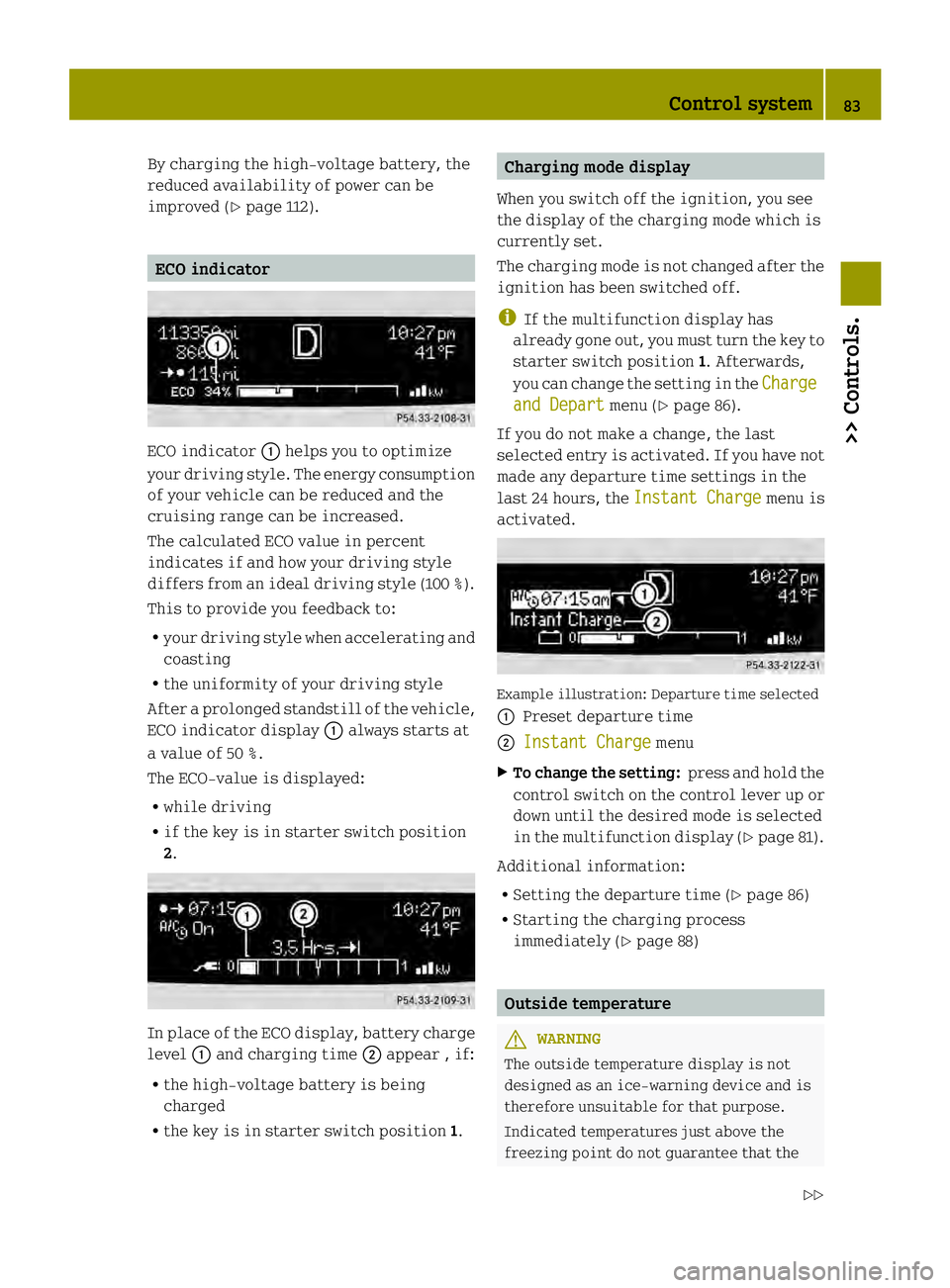
ECO indicator
0002helps you to optimize
your driving style. The energy consumption
of your vehicle can be reduced and the
cruising range can be increased.
The calculated ECO value in percent
indicates if and how your driving style
differs from an ideal driving style (100 %).
This to provide you feedback to:
R your driving style when accelerating and
coasting
R the uniformity of your driving style
After aprolonged standstill of the vehicle,
ECO indicator display 0002always starts at
a value of 50 %.
The ECO-value is displayed:
R while driving
R if the key is in starter switch position
2. In place of the ECO display, battery charge
level 0002and charging time 0003appear , if:
R the high‑voltage battery is being
charged
R the key is in starter switch position 1. Charging mode display
When you switch off the ignition, you see
the display of the charging mode which is
currently set.
The charging mode is not changed after the
ignition has been switched off.
i If the multifunction display has
already gone out, you must turn the key to
starter switch position 1. Afterwards,
you can change the setting in the Charge and Depart menu (Y
page 86).
If you do not make a change, the last
selected entry is activated. If you have not
made any departure time settings in the
last 24 hours, the Instant Charge menu is
activated. Example illustration: Departure time selected
0002
Preset departure time
0003 Instant Charge menu
X To change the setting: press and hold the
control switch on the control lever up or
down until the desired mode is selected
in the multifunction display (Y page 81).
Additional information:
R Setting the departure time (Y page 86)
R Starting the charging process
immediately (Y page 88) Outside temperature
G
WARNING
The outside temperature display is not
designed as an ice-warning device and is
therefore unsuitable for that purpose.
Indicated temperatures just above the
freezing point do not guarantee that the Control system
83>> Controls.
Z