light SMART FORTWO COUPE 2013 User Guide
[x] Cancel search | Manufacturer: SMART, Model Year: 2013, Model line: FORTWO COUPE, Model: SMART FORTWO COUPE 2013Pages: 218, PDF Size: 2.69 MB
Page 28 of 218
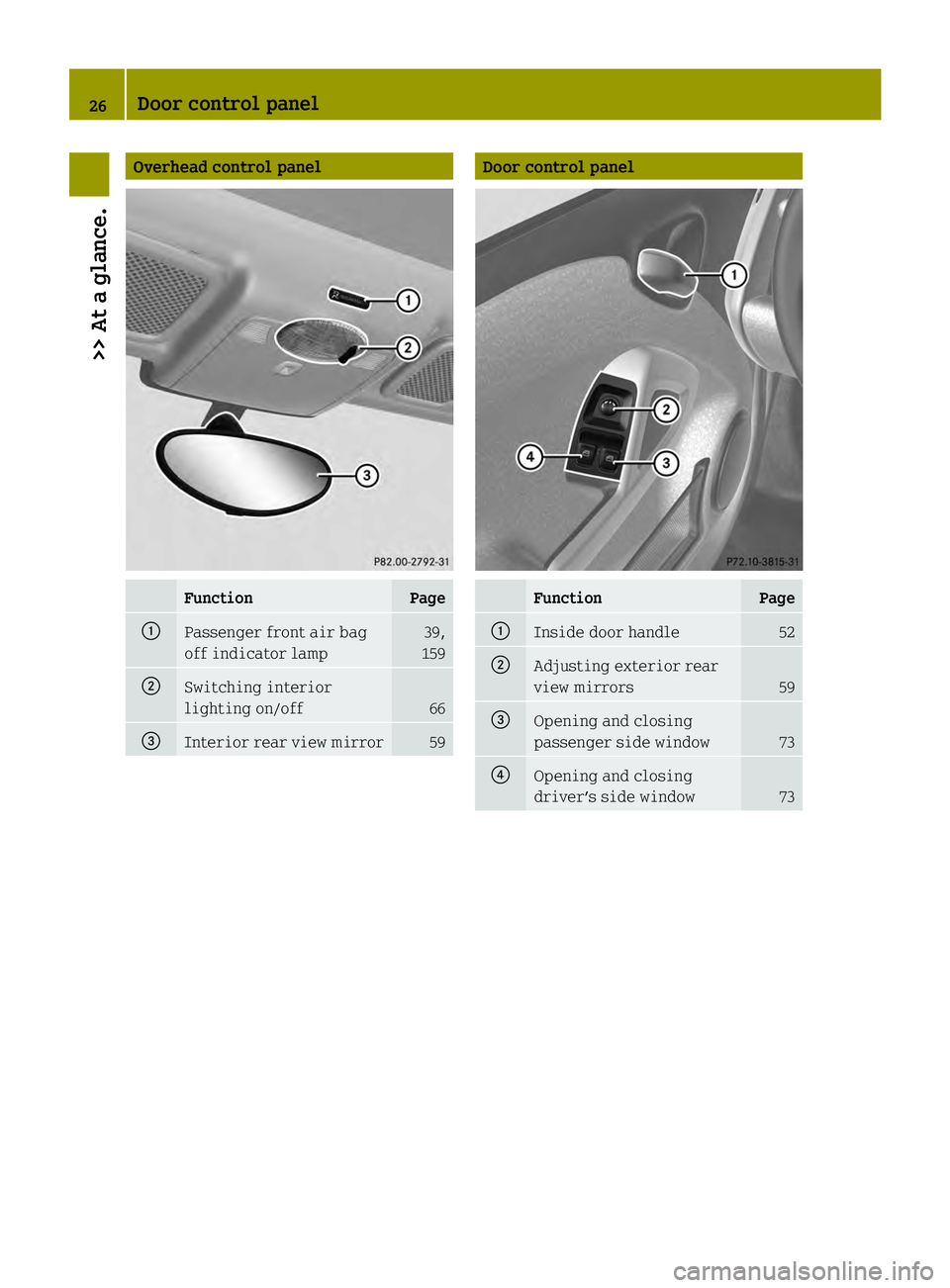
Overhead control panel
Function Page
0002
Passenger front air bag
off indicator lamp 39,
159 0003
Switching interior
lighting on/off
66
002B
Interior rear view mirror 59 Door control panel
Function Page
0002
Inside door handle 52
0003
Adjusting exterior rear
view mirrors
59
002B
Opening and closing
passenger side window
73
002A
Opening and closing
driver’s side window
7326
Door control panel>> At a glance.
Page 36 of 218

any authorized electric drive smart
center.
How an air bag operates An air bag is inflated in a matter of
milliseconds. If an air bag is triggered,
the SRS indicator lamp
000Ain the
instrument cluster illuminates.
! If the air bags are activated, you will
hear a loud noise and some dust may be
generated. The explosion fundamentally
represents no risk to your hearing.
An inflated air bag slows down and reduces
the movement of the occupant. When the
occupant makes contact with a front air bag
or head-thorax air bag (cabriolet only),
hot gas flows out of the inflated front air
bags and head-thorax air bags (cabriolet
only). This reduces the load on the
occupant’s head and upper body. These air
bags are consequently deflated after the
accident.
Driver front air bag/passenger front air
bag The front air bags are designed to reduce
the potential of injury in certain frontal
impacts.
Driver front air bag and passenger front
air bag are deployed
R
at the start of an accident with high
vehicle deceleration in the longitudinal
direction
R independently of other air bags in the
vehicle being deployed
R never in the event of arollover, unless
high vehicle deceleration in the
longitudinal direction is detected
i The front air bags in this vehicle have
been designed to inflate in two stages.
This allows the air bag to have different
rates of inflation that are based on the
rate of relevant vehicle deceleration and a fastened or unfastened seat belt as
assessed by the air bag control unit.
On the passenger side, the front air bag
deployment is additionally influenced
by the passenger’s weight category as
identified by the Occupant
Classification System (OCS)
(Y
page 37).
The lighter the passenger side occupant,
the higher the vehicle deceleration rate
required for the second stage inflation
of the air bag.
The air bags will not deploy in impacts
which do not exceed the system’s
deployment thresholds. In such instances,
the seat belts are designed to protect you.
The passenger air bag will only be
deployed if
R the system, based on OCS weight sensor
readings, senses that the passenger seat
is occupied and the 00090007
indicator lamp is not lit (Y page 39)
R the impact exceeds a preset deployment
threshold
The driver front air bag is located in the
steering wheel housing, the passenger
front air bag above the glove box. 0002
Driver front air bag
0003 Passenger front air bag 34
Occupant safety>> Safety.
Page 42 of 218
Contact an authorized electric drive
smart center.
R Sit properly belted in a position that is
as upright as possible with your back
against the seat backrest.
R Do not lean on the armrests or lift
yoursel ffrom the seat by using the handle
over the door as this may cause the OCS to
be unable to correctly approximate the
occupant weight category.
R Only have the seat repaired or replaced
by an authorized electric drive smart
center.
R Read and observe all warnings in this
chapter.
Self-test Occupant Classification
System After turning the key in the starter switch
to position 1or 2, the 00090007
indicator lamp located in the center
console illuminates. If an adult occupant
is properly sitting on the passenger seat
and the system senses the occupant as being
an adult, the 00090007indicator
lamp will illuminate and go out after
approximately 4 seconds.
If the seat is not occupied and the system
senses the passenger seat as being empty,
the 00090007indicator lamp will
illuminate and not go out. G
WARNING
If the 00090007indicator lamp does
not illuminate immediately after
switching on the drive system, the system
is not functioning. You must contact an
authorized electric drive smart center
before seating any child on the passenger
seat.
More information can be found in the
“Practical hints” section (Y page 168). G
WARNING
Never place anything between seat cushion
and child seat (e.g. pillow), since it
reduces the effectiveness of the Occupant
Classification System. The bottom of the
child seat must make full contact with the
passenger seat cushion. An incorrectly
mounted child seat could cause injuries to
the child in case of an accident, instead of
increasing protection for the child.
Follow the manufacturer’s instructions for
installation of child seats. Children in the vehicle
If an infant or child is traveling with you
in the vehicle:
X Secure the child using an infant or child
restraint appropriate to the age and size
of the child.
X Make sure the infant or child is properly
secured at all times while the vehicle is
in motion. G
WARNING
Do not leave children unattended in the
vehicle, even if they are secured in achild
restraint system. The children could
R injure themselves on parts of the vehicle
R be seriously or fatally injured through
excessive exposure to extreme heat or
cold
Do not expose the child restraint system to
direct sunlight. The child restraint
system’s metal parts, for example, could
become very hot, and the child could be
burned on these parts.
If children open a door, they could
R injure other persons
R get out of the vehicle and injure
themselves or be injured by following
traffic 40
Occupant safety>> Safety.
Page 46 of 218

2. this device must accept any
interference received, including
interference that may cause undesired
operation.
Any unauthorized modification to this
device could void the user’s authority to
operate the equipment.
The product label with FCC ID and IC
certification number can be foun
dinthe
battery case.
i Canada only:
This device complies with RSS‑210 of
Industr yCanada. Operation is subject to
the following two conditions:
1. This device may not cause
interference, and
2. this device must accept any
interference received, including
interference that may cause undesired
operation of the device.
Any unauthorized modification to this
device could void the user’s authority to
operate the equipment.
The product label with FCC ID and IC
certification number can be found in the
battery case. Driving safety systems
Introduction
G
WARNING
The following factors increase the risk of
accidents:
R Excessive speed, especially in turns
R Wet and slippery road surfaces
R Following another vehicle too closely
The driving safety systems described in
this section cannot reduce these risks or
prevent the natural laws of physics from
acting on the vehicle.
Always adapt your driving style to the
prevailing road and weather and traffic conditions and keep a safe distance to
other road users and objects on the street.
i In winter operation, the maximum
effectiveness of the ABS, the hydraulic
brake assistant, and the ESP ®
is only
achieved with winter tires (Y page 140)
or snow chains* as required. Antilock Brake System (ABS)
G
WARNING
Do not pump the brake pedal. Use firm,
steady brake pedal pressure instead.
Pumping the brake pedal defeats the
purpose of the ABS and significantly
reduces braking effectiveness.
The Antilock BrakeSystem (ABS) regulates
the brake pressure so that the wheels do not
lock during braking. This allows you to
maintain the ability to steer your vehicle.
On slippery road surfaces, the ABS will
respond even to light brake pressure.
The ABS indicator lamp in the instrument
cluster (Y page 22) comes on when you
switch on the ignition. It goes out when the
drive system is active.
Braking At the instant one of the wheels is about to
lock up, a slight pulsation can be felt in
the brake pedal, indicating that the ABS is
regulating the brake pressure.
X
Keep firm and steady pressure on the
brake pedal while experiencing the
pulsation.
Continuous, steady brake pedal pressure
yields the advantages provided by the ABS,
namely braking power and the ability to
steer the vehicle.
A pulsating brake pedal can be an
indication of hazardous road conditions
and functions as a reminder to take extra
care while driving. 44
Driving safety systems>> Safety.
* optional
Page 51 of 218

>> Controls.Openin
gand closing .......................... 50
Starter switch positions .....................55
Seats .............................................. 56
Mirrors ........................................... 58
Seat belts ........................................ 60
Lighting ......................................... 62
Windshield wipers ............................. 67
Soft top system (cabriolet only) ...........68
Side windows .................................... 73
Driving and parking .......................... 74
Transmission ................................... 77
Instrument cluster ............................. 79
Control system .................................. 81
Audio system* ................................... 91
Driving systems ................................ 93
Air conditioning with climate control ..95
Loading and storing ......................... 100
Useful feature s................................ 105
Page 58 of 218

Seats
Safety notes
G
WARNING
All seat adjustments, as well as fastening
of seat belts, must be done before the
vehicle is operated. G
WARNING
When adjusting the seat, make sure no one
becomes trapped.
Do not adjust the driver’s seat while
driving. Adjusting the seat while driving
could cause the driver to lose control of the
vehicle.
Never ride in amoving vehicle with the seat
backrest in an excessively reclined
position as this can be dangerous. You
could slide under the seat belt in a
collision. If you slide under the seat belt,
it could apply force at the abdomen or neck,
potentially causing serious or fatal
injuries. The seat backrest and seat belts
provide the best restraint when the wearer
is in a position that is as upright as
possible and seat belts are properly
positioned on the body.
Your seat must be adjusted so that you can
correctly fasten your seat belt.
Observe the following points:
R Adjust the seat backrest until your arms
are slightly angled when holding the
steering wheel.
R Adjust the seat to a comfortable seating
position that still allows you to reach the
accelerator/brake pedal safely. The
position should be as far back as
possible with the driver still able to
operate the controls properly.
R Never place hands under the seat or near
any moving parts while a seat is being
adjusted.
Failure to do so could result in an accident
and/or serious personal injury.
Observe the notes on the air bag system. G
WARNING
Children 12 years old and under must be
seated and properly secured in an
appropriately sized infant restraint,
toddler restraint, or booster seat
recommended for the size and weight of the
child. For additional information, see
“Children in the vehicle”.
A child’s risk of serious or fatal injuries
is significantly increased if the child
restraints are not properly secured in the
vehicle and/or the child is not properly
secured in the child restraint. G
WARNING
Contact an authorized electric drive smart
center if the seats have become damaged.
The seat is an integral part of the vehicle’s
safety system in the same way as seat belts
and air bags. Damage to the seats may
reduce their ability to protect the
occupants in an accident. Seat adjustment
0002
Seat backrest tilt
0003 Seat fore and aft adjustment
Seat backrest tilt X
Pull adjustment lever 0002upwards and
adjust the seat backrest until your arms 56
Seats>> Controls.
Page 59 of 218

are slightly angled when holding the
steering wheel.
X Release adjustment lever 0002when the
desired seat backrest tilt is reached.
When you hear an audible click, the seat
backrest is again fixed into place.
X Check for proper engagement before
driving.
Seat fore and aft adjustment X
Pull adjustment handle 0003upwards and
slide the seat to a seating position that
still allows you to reach the accelerator/
brake pedal safely.
X Release adjustment handle 0003when the
desired seating position is reached.
When you hear an audible click, the seat
is again fixed into place.
X Check for proper engagement before
driving.
Seat height The seat guide is inclined in the
horizontal plane. Seat fore and aft
adjustment also alters the seat height.
Armrest* on driver’s seat
Folding up and down
X
Folding up: Hold front of armrest and fold
it up in direction of arrow 0002.
X Folding down: Hold front of armrest and
fold it down in direction of arrow 0003.Adjusting armrest angle
You can adjust the angle of the armrest when
it is folded down.
X
Turn thumb wheel 002B.
R Direction of arrow 002A: down
R Direction of arrow 0028: up Passenger seat
You can expand the cargo compartment by
folding down the passenger seat.
Observe the loading instructions
(Y page 104).
Folding down X
Remove the seat belt from seat belt
guide 0002.
X Move the passenger seat backward as far
as it will go. Seats
57>> Controls.
* optional Z
Page 63 of 218
X
Push latch plate 002Binto seat belt
buckle 002Auntil it clicks.
X If necessary, tighten the lap portion of
the seat belt to a snug fit by pulling
shoulder portion up.
X Unfastening the seat belt: Press release
button 0028.
X Allow the retractor to completely rewind
the seat belt by guiding latch plate 002B.
Proper use of seat belts R
Do not twist the seat belt when fastening.
R Adjust the seat belt so that the shoulder
portion is located as close as possible
to the middle of the shoulder (it should
not touch the neck). Never pass the
shoulder portion of the seat belt under
your arm.
R Position the lap belt as low as possible
on your hips (over hip joint) and not
across the abdomen.
R Place the seat backrest in a position that
is as upright as possible.
R Never use a seat belt for more than one
person at a time.
R Do not fasten a seat belt aroun daperson
and another object at the same time. When
using a seat belt to secure infant or
toddler restraints or children in booster
seats, always follow the child seat
manufacturer’s instructions.
R Check your seat belt during travel to
make sure it is properly positioned.
R Make sure the seat belt is always fitted
snugly. Take special care to maintain a
snug fit when wearing loose clothing. G
WARNING
Do not pass seat belts over sharp edges.
They could tear.
Do not allow the seat belt to get caught in
the door or in the seat adjustment
mechanism. This could damage the seat
belt. Never attempt to make modifications to
seat belts. This could impair the
effectiveness of the seat belts.
Do not bleach or dye seat belts as this may
severely weaken them. In a crash they may
not be able to provide adequate protection.
Damaged seat belts or seat belts that were
highly stressed in an accident must be
replaced. Contact an authorized electric
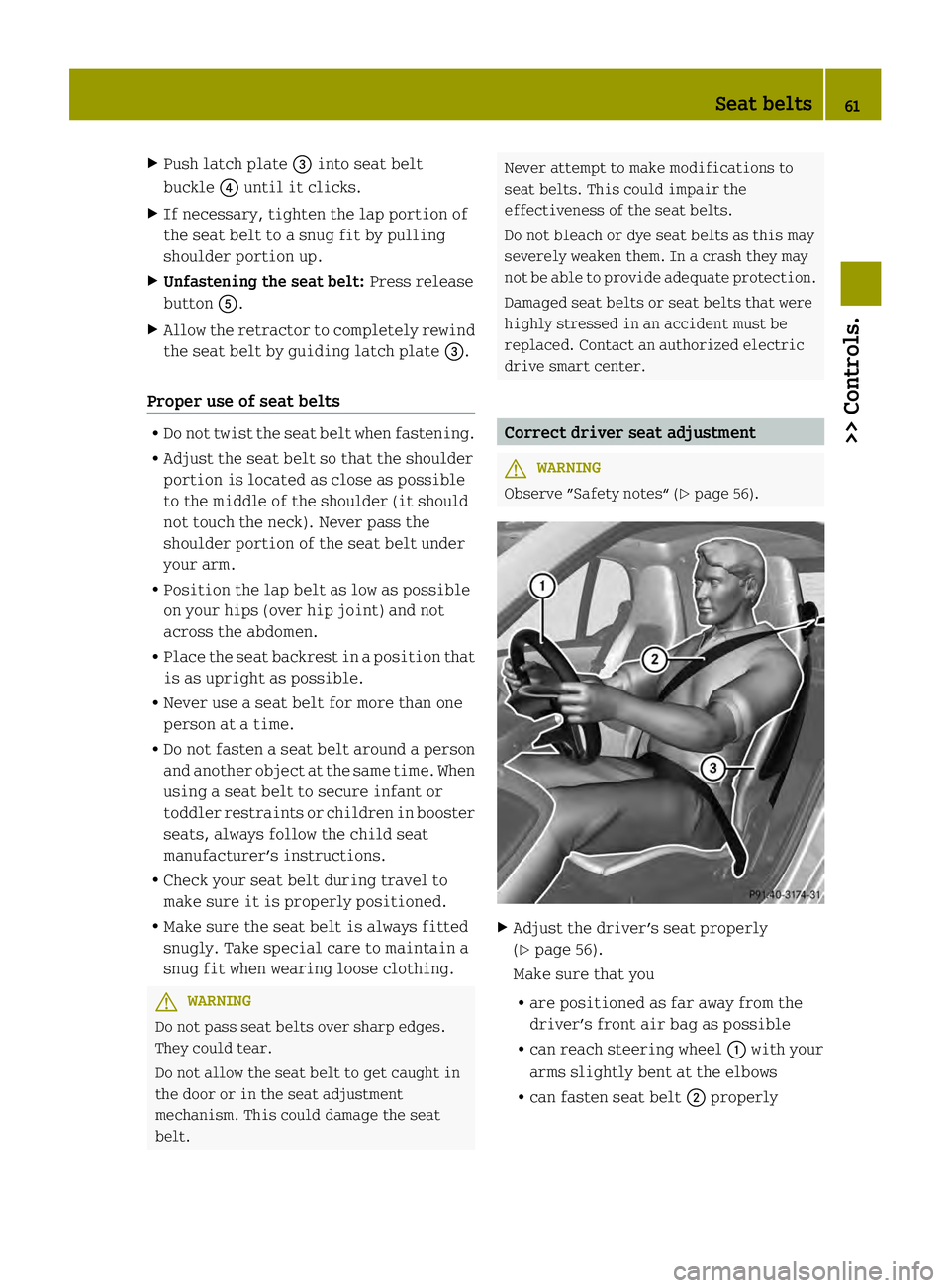
drive smart center. Correct driver seat adjustment
G
WARNING
Observe ”Safety notes“ (Y page 56). X
Adjust the driver’s seat properly
(Y page 56).
Make sure that you
R are positioned as far away from the
driver’s front air bag as possible
R can reach steering wheel 0002with your
arms slightly bent at the elbows
R can fasten seat belt 0003properly Seat belts
61>> Controls. Z
Page 64 of 218

R
you have adjusted seat backrest 002Bto
a position that is as upright as
possible
R you can move your legs freely
R you can depress the brake and
accelerator pedal safely.
X Make sure the seat belt is fastened
properly (Y page 60). Lighting
Exterior lamp switch
For safety, smart recommends that you
drive with your low‑beam headlamps on
during the day. In certain countries, local
laws dictate that low‑beam headlamps are
switched on automatically during
operation of the vehicle.
i If you drive in countries where
vehicles drive on the other side of the
road than the country in which the
vehicle is registered, you must have the
headlamps modified for symmetrical low
beams. Relevant information can be
obtained at any authorized electric
drive smart center. Exterior lamp switch
0004
Lamps off
Daytime running lamp mode*
0006 Parking lamps
0002 Low‑beam headlamps or high‑beam
headlamps
0002 Automatic headlamp mode* Parking lamps You can switch on and off the parking lamps
with the exterior lamp switch using the
manual headlamp mode.
X
Switching on: Turn the exterior lamp
switch to position 0006.
The parking lamps come on.
The following lamps also come on:
R Tail lamps
R License plate lamps
R Side marker lamps
Low‑beam headlamps You can switch on and off the low‑beam
headlamps with the exterior lamp switch
using the manual headlamp mode.
X Switching on: Turn the exterior lamp
switch to position 0002.
The low‑beam headlamps come on.
The low‑beam headlamp indicator lamp
0003 in the instrument cluster comes on.
The following lamps also come on:
R Tail and parking lamps
R License plate lamps
R Side marker lamps
Automatic headlamp mode* This feature is only available on vehicles
with rain-light sensor*.
The following lamps come on and go out
automatically depending on the brightness
of the ambient light:
R Low‑beam headlamps
R Tail and parking lamps
R License plate lamps
R Side marker lamps G
WARNING
If the exterior lamp switch is set to
position 0002, the headlamps will not be
automatically switched on under foggy
conditions. 62
Lighting>> Controls.
* optional
Page 65 of 218

To minimize risk to you and to others,
activate headlamps by turning exterior
lamp switch to position 0002when driving
or when traffic and/or ambient lighting
conditions require you to do so.
In low ambient lighting conditions, only
switch from position 0002to0002 with the
vehicle at a standstill in a safe location.
Switching from position 0002to0002 will
briefly switch off the headlamps. Doing so
while driving in low ambient lighting
conditions may result in an accident.
The automatic headlamp feature is only an
aid to the driver. The driver is responsible
for the operation of the vehicle’s lights at
all times.
X Turn the exterior lamp switch to position
0002.
With the key in starter switch position
1, the tail and parking lamps, the license
plate lamps, and the side marker lamps
will come on and go out automatically
depending on the brightness of the
ambient light.
With the engine running, the low‑beam
headlamps, the tail and parking lamps,
the license plate lamps and the side
marker lamps will come on and go out
automatically depending on the
brightness of the ambient light.
Daytime running lamp mode* In USA, the daytime running lamp mode can
be deactivated.
In Canada, the daytime running lamp mode
is mandatory and therefore in a constant
mode.
Depending on the vehicle equipment, your
vehicle comes either with low-beam
daytime running lamps or with LED daytime
running lamps. Switching on:
X
Start the drive system.
The daytime running lamps are switched
on.
On vehicles with low beam daytime
running lamps the parking lamps also
come on.
Switching off - vehicles without rain-
light sensor*:
X Switch on the parking lamps 0006or the
low‑beam headlamps 0003.
The daytime running lamps are switched
off.
Switching off - vehicles with rain-light
sensor*:
X Switch on the parking lamps 0006or the
low‑beam headlamps 0003.
The daytime running lamps are switched
off.
or
X Turn the exterior lamp switch to position
0002.
With the engine running, the low‑beam
headlamps, the tail and parking lamps,
the license plate lamps and the side
marker lamps will come on and go out
automatically depending on the
brightness of the ambient light.
Deactivating (USA only):
X Switch off the ignition.
X Remove the key from the starter switch.
X Switch on the high-beam flasher and
press button 0006on the key
simultaneously.
An acoustic signal sounds.
The daytime running lamp mode is
deactivated. Lighting
63>> Controls.
* optional Z