ECU SMART FORTWO COUPE 2014 User Guide
[x] Cancel search | Manufacturer: SMART, Model Year: 2014, Model line: FORTWO COUPE, Model: SMART FORTWO COUPE 2014Pages: 222, PDF Size: 16.17 MB
Page 60 of 222

Seats
Safety notes
G
WARNING
All seat adjustments, as well as fastening
of seat belts, must be done before the vehi-
cle is operated. G
WARNING
When adjusting the seat, make sure no one
becomes trapped.
Do not adjust the driver’s seat while driv-
ing. Adjusting the seat while driving could
cause the driver to lose control of the vehi-
cle.
Never ride in a moving vehicle with the seat
backrest in an excessively reclined posi-
tion as this can be dangerous. You could
slide under the seat belt in a collision. If
you slide under the seat belt, it could apply
force at the abdomen or neck, potentially
causing serious or fatal injuries. The seat
backrest and seat belts provide the best
restraint when the wearer is in a position
that is as upright as possible and seat belts
are properly positioned on the body.
Your seat must be adjusted so that you can
correctly fasten your seat belt.
Observe the following points:
R Adjust the seat backrest until your arms
are slightly angled when holding the
steering wheel.
R Adjust the seat to a comfortable seating
position that still allows you to reach the
accelerator/brake pedal safely. The
position should be as far back as possi-
ble with the driver still able to operate
the controls properly.
R Never place hands under the seat or near
any moving parts while a seat is being
adjusted.
Failure to do so could result in an accident
and/or serious personal injury.
Observe the notes on the air bag system. G
WARNING
Children 12 years old and under must be
seated and properly secured in an appro-
priately sized infant restraint, toddler
restraint, or booster seat recommended for
the size and weight of the child. For addi-
tional information, see “Children in the
vehicle”.
A child’s risk of serious or fatal injuries
is significantly increased if the child
restraints are not properly secured in the
vehicle and/or the child is not properly
secured in the child restraint. G
WARNING
Contact an authorized electric drive smart
center if the seats have become damaged.
The seat is an integral part of the vehicle’s
safety system in the same way as seat belts
and air bags. Damage to the seats may
reduce their ability to protect the occu-
pants in an accident. Seat adjustment
0043
Seat backrest tilt
0044 Seat fore and aft adjustment
Seat backrest tilt X
Adjusting: Sit down on the front seat.
X Pull adjustment lever 0043upwards and
adjust the seat backrest until your arms
are slightly angled when holding the
steering wheel. 58
Seats>> Controls.
Page 64 of 222

Seat belts
Fastening the seat belts
G
WARNING
Always fasten your seat belt before driving.
Always make sure all of your passengers are
properly restrained.
Failure to wear and properly fasten and
position your seat belt greatly increases
your risk of injuries and their likely
severity in an accident. You and your
passenger should always wear seat belts.
If you are ever in an accident, your injuries
can be considerably more severe without
your seat belt properly buckled.
Without your seat belt buckled, you are
much more likely to hit the interior of the
vehicle or be ejected from it. You can be
seriously injured or killed.
In the same crash, the possibility of injury
or death is lessened if you are properly
wearing your seat belt. Air bags can only
protect you if you are properly wearing
your seat belt. G
WARNING
Children 12 years old and under must be
seated and properly secured in an appro-
priately sized infant restraint, toddler
restraint, or booster seat recommended for
the size and weight of the child. For addi-
tional information, see “Children in the
vehicle”.
A child’s risk of serious or fatal injuries
is significantly increased if the child
restraints are not properly secured in the
vehicle and/or the child is not properly
secured in the child restraint. G
WARNING
Never let more people ride in the vehicle
than there are seat belts available. Make
sure everyone riding in the vehicle is cor-
rectly restrained with a separate seat belt.
Never use a seat belt for more than one per-
son at a time. G
WARNING
Never ride in a moving vehicle with the seat
backrest in an excessively reclined posi-
tion as this can be dangerous. You could
slide under the seat belt in a collision. If
you slide under it, the belt would apply
force at the abdomen or neck, causing ser-
ious or even fatal injuries. The seat back-
rest and seat belt provide the best
restraint when the wearer is in a position
that is as upright as possible and the belt
is properly positioned on the body. G
WARNING
Observe ”Safety notes“ (Y page 35). 0043
Seat belt outlet
0044 Seat belt guide
0087 Latch plate
0085 Seat belt buckle
0083 Release button
X Fastening the seat belt: With a smooth
motion, pull the seat belt out of seat belt
outlet 0043.
X Place the shoulder portion of the seat
belt across the top of your shoulder and
the lap portion across your hips. 62
Seat belts>> Controls.
Page 65 of 222

X
Push latch plate 0087into seat belt
buckle 0085until it clicks.
X If necessary, tighten the lap portion of
the seat belt to a snug fit by pulling
shoulder portion up.
X Unfastening the seat belt: Press release
button 0083.
X Allow the retractor to completely rewind
the seat belt by guiding latch plate 0087.
Proper use of seat belts R
Do not twist the seat belt when fastening.
R Adjust the seat belt so that the shoulder
portion is located as close as possible
to the middle of the shoulder (it should
not touch the neck). Never pass the
shoulder portion of the seat belt under
your arm.
R Position the lap belt as low as possible
on your hips (over hip joint) and not
across the abdomen.
R Place the seat backrest in a position that
is as upright as possible.
R Never use a seat belt for more than one
person at a time.
R Do not fasten a seat belt around a person
and another object at the same time. When
using a seat belt to secure infant or tod-
dler restraints or children in booster
seats, always follow the child seat man-
ufacturer’s instructions.
R Check your seat belt during travel to
make sure it is properly positioned.
R Make sure the seat belt is always fitted
snugly. Take special care to maintain a
snug fit when wearing loose clothing. G
WARNING
Do not pass seat belts over sharp edges.
They could tear.
Do not allow the seat belt to get caught in
the door or in the seat adjustment mecha-
nism. This could damage the seat belt. Never attempt to make modifications to
seat belts. This could impair the effec-
tiveness of the seat belts.
Do not bleach or dye seat belts as this may
severely weaken them. In a crash they may
not be able to provide adequate protection.
Damaged seat belts or seat belts that were
highly stressed in an accident must be
replaced. Contact an authorized electric
drive smart center. Correct driver seat adjustment
G
WARNING
Observe ”Safety notes“ (Y page 58). X
Adjust the driver’s seat properly
(Y page 58).
Make sure that you
R are positioned as far away from the
driver’s front air bag as possible
R can reach steering wheel 0043with your
arms slightly bent at the elbows
R can fasten seat belt 0044properly Seat belts
63>> Controls. Z
Page 75 of 222
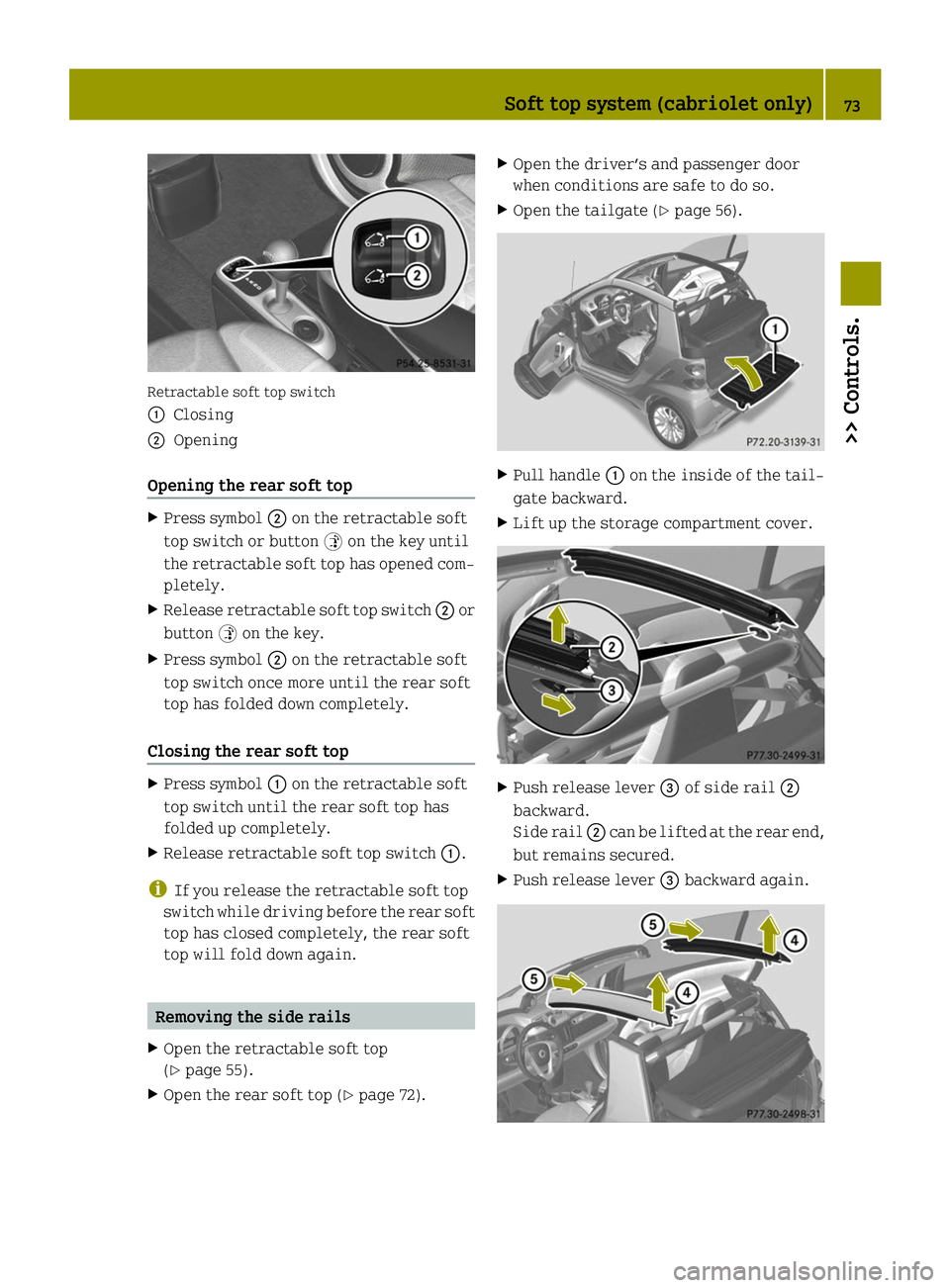
Retractable soft top switch
0043
Closing
0044 Opening
Opening the rear soft top X
Press symbol 0044on the retractable soft
top switch or button 0035on the key until
the retractable soft top has opened com-
pletely.
X Release retractable soft top switch 0044or
button 0035on the key.
X Press symbol 0044on the retractable soft
top switch once more until the rear soft
top has folded down completely.
Closing the rear soft top X
Press symbol 0043on the retractable soft
top switch until the rear soft top has
folded up completely.
X Release retractable soft top switch 0043.
i If you release the retractable soft top
switch while driving before the rear soft
top has closed completely, the rear soft
top will fold down again. Removing the side rails
X Open the retractable soft top
(Y page 55).
X Open the rear soft top (Y page 72).X
Open the driver’s and passenger door
when conditions are safe to do so.
X Open the tailgate (Y page 56). X
Pull handle 0043on the inside of the tail-
gate backward.
X Lift up the storage compartment cover. X
Push release lever 0087of side rail 0044
backward.
Side rail 0044can be lifted at the rear end,
but remains secured.
X Push release lever 0087backward again. Soft top system (cabriolet only)
73>> Controls. Z
Page 79 of 222
appears in the multifunction display
(Y
page 87).
The pointer of the power gauge moves
from "OFF“ to "0“ (Y page 81).Driving
i The vehicle has a crawler function. The
vehicle moves forward when the brake
pedal is released.
X Depress the brake pedal.
X Move the gear selector lever to drive
position D.
D D appears in the transmission position
indicator.
X Release the brake pedal.
The vehicle moves forward.
X Depress the accelerator pedal smoothly.
The vehicle accelerates. Reversing the vehicle
! Shift the transmission into reverse
gear Ronly when the vehicle is stopped
in order to avoid damaging the trans-
mission.
You can drive in reverse gear at a speed
of up to 9 mph (15 km/h).
i The vehicle has a crawler function.
Thevehicle moves forward when the
brakepedal is released.
X Depress the brake pedal.
X Move the gear selector lever to reverse
gear R.
R R appears in the transmission position
indicator.
X Release the brake pedal.
The vehicle moves forward.
X Depress the accelerator pedal smoothly.
The vehicle accelerates. Parking
G
WARNING
With the drive system inactive, there is no
power assistance for the brake and steering
systems. In this case, it is important to
keep in mind that a considerably higher
degree of effort is necessary to brake and
steer the vehicle. Adapt your driving
accordingly. G
WARNING
Vehicle movement can cause serious per-
sonal injury. Therefore, always do the fol-
lowing before exiting and leaving the
vehicle:
R Keep right foot on the brake pedal.
R Engage the parking brake.
R Move the gear selector lever to park
position P.
R Slowly release the brake pedal.
R When parked on an incline, always turn
the front wheels towards the curb.
R Turn the key to starter switch position 0
and remove the key from the starter
switch.
R Take the key with you and lock the vehicle
when leaving.
X Properly stop and park the vehicle.
X Depress the brake pedal.
X Engage the parking brake (Y page 77).
When the ignition is switched on, the
brake warning lamp 0027(USA only) or
004D (Canada only) in the instrument
cluster comes on.
X Release the brake pedal.
Parking brake The parking brake serves to secure the
vehicle against rolling away when it is
stationary or parked. Driving and parking
77>> Controls. Z
Page 81 of 222

Make sure the drive system is active when-
ever the vehicle is rolling. Have the brake
system repaired at an authorized electric
drive smart center, if there is a fault in the
brake system. If a brake circuit has failed (Y
page 167),
you must depress brake pedal 0043further
down to achieve the same effect and the
braking distance is increased.
i The brake servo will only function with
the ignition switched on. Switching off the drive system
G
WARNING
Do not turn off the drive system before the
vehicle has come to a complete stop. With
the drive system not running, there is no
power assistance for the brake and steering
systems. In this case, it is important to
keep in mind that a considerably higher
degree of effort is necessary to brake and
steer the vehicle.
X Depress the brake pedal.
X Move the gear selector lever to park
position P.
The transmission position indicator
should be on P P
! Always engage the parking brake in
addition to shifting to park position P.X
Release the brake pedal.
X Turn the key to starter switch position
0.
X Remove the key from the starter switch.
The electronic immobilizer is acti-
vated. Transmission
Shifting procedure
Gearshift pattern for transmission
005D
Park position
005E
Reverse gear
005C
Neutral position
005B
Drive position
Select a gear:
X
Switch on the ignition.
X Depress the brake pedal.
X Move the gear selector lever to the
desired position. Steering wheel paddle shifters* (for
recuperation)
G
WARNING
The operating condition of the high-volt-
age battery (e.g. not yet at normal operat-
ing temperature or fully charged) influen- Transmission
79>> Controls.
* optional Z
Page 82 of 222

ces the braking effect of the electric
motor.
In overrun or braking mode, the motor's
braking effect may therefore be reduced or
may not be present at all.
As a result of the reduced engine braking
effect, you may cause an accident and
injure yourself or others.
Compensate for the reduced engine braking
effect by pressing the brake pedal accord-
ingly, as required.
Using the steering wheel paddle shifters *,
you can increase or decrease the recuper-
ation in overrun phases. Recuperation
takes place when you release the acceler-
ator pedal. The electric motor will then be
used as a generator and energy will be
regained while driving. The regained
energy is stored in the high-voltage bat-
tery. High recuperation decelerates your
vehicle stronger.
In overrun phases, there are three levels of
recuperation:
R no recuperation (level 0, coasting)
R moderate recuperation (level 1)
R high-level recuperation (level 2)
The amount of recuperation in overrun
mode is displayed in the power gauge
(Y page 81).
The set mode for recuperation is shown in
the recuperation display (Y page 84).
When you switch on the ignition, level 1 is
automatically preset. 0043
Left steering wheel paddle shifter
(minus)
0044 Right steering wheel paddle shifter
(plus)
X Decrease recuperation: Pull left steer-
ing wheel paddle shifter 0043.
X Increase recuperation: Pull right steer-
ing wheel paddle shifter 0044.
Use the different levels 0 to 2 for condi-
tions as described below: Level 0 Driving without frequent
breaking. No sharp bends on
the road ahead.
Maximum kinetic energy
remains for the vehicle.
Level 1 Normal driving, standard set-
ting.
Level 2 Sporty driving.
The break pedal has to be
depressed less often, as the
deceleration due to recuper-
ation is higher than in
level 1.
The energy efficiency is sub-
stantially higher than if the
vehicle is decelerated by
depressing the brake pedal.
At levels 1 and 2 the vehicle can be step-
lessly decelerated by depressing the brake
pedal.80
Transmission>> Controls.
* optional
Page 83 of 222

i
Under certain circumstances, in over-
run phases recuperation does not work as
described above. This may be e. g the
case if the high-voltage battery is
already fully charged or has not reached
operating temperature. Driving tips
Driving on uphill grades G
WARNING
The hill-start assist system is not
designed to function as a parking brake and
does not prevent the vehicle from moving
when parked on an incline.
Always engage the parking brake in addi-
tion to shifting to park position P.
! When the hill‑start assist system stops
braking the vehicle, it can roll back-
wards.
If you open the driver’s door, the
hill‑start assist system is deactivated
and a warning signal sounds.
Your vehicle has a hill‑start assist system.
On uphill grades the hill‑start assist sys-
tem maintains the pressure in the brake
system for approximately one second after
you have released the brake pedal. There-
fore, you can start off smoothly without the
vehicle moving immediately after releas-
ing the brake pedal.
X Release the brake pedal.
X Apply sufficient pressure to the accel-
erator pedal to drive off.
On uphill grades with higher inclination,
the hill-start assist system will release
the pressure in the brake system after
approximately two seconds. A warning sig-
nal sounds and the transmission position
indicator shows a flashing N
N in order to
warn you of the vehicle rolling backwards. X
Press the brake pedal.
X Release the brake pedal.
X Apply sufficient pressure to the accel-
erator pedal to drive off.
i The hill‑start assist system is inactive
if you start off with the parking brake
engaged.
Recuperation If the high-voltage battery is fully
charged or too cold, only limited recuper-
ation power will be available.
The vehicle can not be decelerated or lim-
ited in being decelerated by using the
accelerator pedal, if
R
the gearshift selector lever is in posi-
tion Dand the vehicle is rolling back-
wards
R the gearshift selector lever is in posi-
tion Rand the vehicle is rolling for-
wards.
On uphill grades, the vehicle could possi-
bly be not or only restricted being held
from the crawler function. Instrument cluster
Charge level and power gauges
0043
Charge level gauge
0044 Power gauge
The gauges can be turned by approximately
90°. Instrument cluster
81>> Controls. Z
Page 86 of 222

message
Back
Backappears in the multifunc-
tion display.
X Press the OK button on the control lever
briefly. Transmission position indicator
The transmission position indicator
0043
displays the current gear selector lever
position. Display Function
P
Park position
R
Reverse gear
N
Neutral
D
Drive Display Function
N (flashes)
There is a parking lock
malfunction.
X
Move the gear selector
lever slowly from posi-
tion Pto position Rand
back to position P.
If Nremains flashing in
the multifunction display:
X Move the gear selector
lever to position P. When
leaving the vehicle,
apply the parking brake
to secure the vehicle
from rolling away.
X Contact an authorized
electric drive smart
center. 0 X
Move the gear selector
lever to park position P
or neutral position N.
X Turn the key to starter
switch position 2
(Y page 57) and hold it in
position until READY READY
appears in the multi-
function display
(Y page 87). Recuperation display*
The recuperation display shows you the
current set recuperation level. You can set
the recuperation level by using the steer-
ing wheel paddle shifters* (Y page 79).
The following levels are available:
R no recuperation (level 0)
R moderate recuperation (level 1)
R high recuperation (level 2) 84
Control system>> Controls.
* optional
Page 87 of 222

No recuperation (level 0)
0043
Symbol for no recuperation
When this mode is set, there is no recuper-
ation. When you release the accelerator
pedal, the vehicle rolls on unbraked.
Use this mode in situations when driving
without frequent braking, for example on
highways.
Moderate recuperation (level 1) Moderate recuperation occurs when this
mode is set. When you release the acceler-
ator pedal, the vehicle is slightly braked.
Gained kinetic energy is converted into
electrical energy by the electric motor.
This energy is stored in the high-voltage
battery.
This mode is set as standard when starting
the drive system.
Use this mode in situations of well-bal-
anced relationship between accelerating
and braking, for example on cross-country
rides. High recuperation (level 2) 0043
Symbol for high recuperation
High recuperation occurs when this mode
is set. When you release the accelerator
pedal, the vehicle is deeply braked. Energy
conversion of kinetic energy to electrical
energy is most effective in this mode.
Use this mode in situations in which you
need to brake frequently, for example while
driving stop-and-go in city traffic. Maximum available power
G
WARNING
When the indicator for the maximum avail-
able power is not at its maximal range, the
power output is reduced noticeably. Adapt
your speed and driving accordingly. Oth-
erwise, you could cause an accident. Exer-
cise particular care when passing or accel-
erating. The indicator for the maximum available
power of the drive system contains three
segments
0043. The number of dark segments
indicates power that is currently availa-
ble. Control system
85>> Controls. Z