ECU SMART FORTWO COUPE 2014 Owner's Guide
[x] Cancel search | Manufacturer: SMART, Model Year: 2014, Model line: FORTWO COUPE, Model: SMART FORTWO COUPE 2014Pages: 222, PDF Size: 16.17 MB
Page 193 of 222

X
Place the tire repair kit securely in the
vehicle.
X Drive off immediately.
The tire sealant will distribute itself
evenly inside the tire. G
WARNING
Do not exceed vehicle speed of 50 mph
(80 km/h). A tire sealant repair is not
designed to operate at higher speeds.
The sticker must be attached on the instru-
ment cluster where it will be easily seen by
the driver.
Vehicle handling characteristics of a tire
sealant repaired tire may change. Adapt
your driving accordingly.
X After driving for about 1.8 miles (3 km)
or ten minutes, stop and exit the vehicle
taking all of the appropriate safety pre-
cautions.
X Take the tire repair kit from the vehicle.
X Screw the end of filler hose 0085onto tire
valve 006F.
X Check the tire inflation pressure using
pressure gauge 0044. G
WARNING
If tire inflation pressure has fallen below
130 kPa (1.3 bar, 19 psi) do not continue to
drive the vehicle.
Park your vehicle safely away from the
roadway and contact the nearest authorized
electric drive smart center or call Road-
side Assistance.
Have the damaged tire replaced.
X If the tire inflation pressure is at least
130 kPa (1.3 bar, 19 psi), inflate or deflate
the tire to correct tire inflation pres-
sure (see Tire and Loading Information
placard located on the driver’s door
B‑pillar). R
To increase the tire inflation pres-
sure: Switch on the electric air pump.
R To decrease the tire inflation pres-
sure: Open vent screw 0087. Recheck the
tire inflation pressure with the elec-
tric air pump’s pressure gauge.
X After checking the tire inflation pres-
sure, unscrew the end of filler hose 0085
from tire valve 006F.
X Screw the valve cap onto the tire valve.
X Plug filler hose with the stopper.
X Place the tire repair kit securely in the
vehicle.
! The manufacturer is unable to guaran-
tee that all tire punctures can be
repaired with the tire repair kit, in par-
ticular cuts or perforations larger than
approximately 0.16 in (4 mm) or away from
the tire’s tread. The manufacturer is not
liable for damage sustained through
improper use of the tire repair kit. G
WARNING
Follow recommended tire inflation pres-
sures.
Do not underinflate tires. Underinflated
tires wear excessively and/or unevenly,
adversely affect handling and energy con-
sumption of the vehicle, and are more
likely to fail from being overheated.
Do not overinflate tires. Overinflated
tires can adversely affect handling and
ride comfort, wear unevenly, increase
stopping distance, and result in sudden
deflation (blowout) because they are more
likely to become punctured or damaged by
road debris, potholes etc.
Do not overload the tires by exceeding the
specified load limit as indicated on the
Tire and Loading Information placard on
the driver’s door B‑pillar. Overloading the
tires can overheat them, possibly causing
a blowout. Overloading the tires can also
result in handling or steering problems, or
brake failure. Flat tire
191>> Practical hints. Z
Page 195 of 222

You may operate the electrical air pump
again after it has cooled off.
X If a tire inflation pressure of at least
200 kpa (2.0 bar, 29 psi) is not attained,
turn off the electric air pump by press-
ing OFF on electric air pump switch 0085.
X Unscrew the end of filler hose 0085from
tire valve 006B.
X After clearing the area around the vehi-
cle of people and obstacles, drive vehi-
cle back or forth very slowly approx-
imately 30 ft (10 m).
This serves to better distribute the tire
sealant material inside the tire.
X Screw the end of filler hose 0085onto tire
valve 006B.
X Inflate the tire again. G
WARNING
If a tire inflation pressure of
200 kPa (2.0 bar, 29 psi) is not attained, the
tire is too severely damaged for the tire
sealant to provide a reliable tire repair.
In this case, the tire sealant cannot prop-
erly seal the tire.
Do not drive the vehicle.
Contact the nearest authorized electric
drive smart center for assistance or call
Roadside Assistance.
X After attaining a tire inflation pressure
of at least 200 kPa (2.0 bar, 29 psi), press
OFF on electric air pump switch 0085.
The electric air pump is switched off.
X Turn the key in the starter switch to
position 0.
X Unscrew the end of filler hose 0085from
tire valve 006B.
X Place the tire repair kit securely in the
vehicle.
X Drive off immediately.
The tire sealant will distribute itself
evenly inside the tire. G
WARNING
Do not exceed vehicle speed of 50 mph
(80 km/h). A tire sealant repair is not
designed to operate at higher speeds.
The sticker must be attached on the instru-
ment cluster where it will be easily seen by
the driver.
Vehicle handling characteristics of a tire
sealant repaired tire may change. Adapt
your driving accordingly.
X After driving for about 1.8 miles (3 km)
or ten minutes, stop and exit the vehicle
taking all of the appropriate safety pre-
cautions.
X Take the tire repair kit from the vehicle.
X Screw the end of filler hose 0085onto tire
valve 006B. X
Check the tire inflation pressure using
pressure gauge 006D. G
WARNING
If tire inflation pressure has fallen below
130 kPa (1.3 bar, 19 psi) do not continue to
drive the vehicle.
Park your vehicle safely away from the
roadway and contact the nearest authorized
electric drive smart center or call Road-
side Assistance.
Have the damaged tire replaced.
X If the tire inflation pressure is at least
130 kPa (1.3 bar, 19 psi), inflate or deflate
the tire to correct tire inflation pres-
sure (see Tire and Loading Information Flat tire
193>> Practical hints. Z
Page 196 of 222

placard located on the driver’s door
B‑pillar).
R
To increase the tire inflation pres-
sure: Switch on the electric air pump.
R To decrease the tire inflation pres-
sure: Press deflate button 006C. Recheck
the tire inflation pressure with the
electric air pump’s pressure gauge
006D.
X When the tire inflation pressure is cor-
rect, unscrew the end of filler hose 0085
from tire valve 006B.
X Screw the valve cap onto the tire valve. X
To detach tire sealant container 0043from
the electric air pump, press both
latches.
X Pull tire sealant container 0043out of fix-
ture 0044.
Filler hose 0085remains on tire sealant
container 0043.
X Place the tire repair kit securely in the
vehicle.
! The manufacturer is unable to guaran-
tee that all tire punctures can be
repaired with the tire repair kit, in par-
ticular cuts or perforations larger than
approximately 0.16 in (4 mm) or away from
the tire’s tread. The manufacturer is not
liable for damage sustained through
improper use of the tire repair kit. G
WARNING
Follow recommended tire inflation pres-
sures.
Do not underinflate tires. Underinflated
tires wear excessively and/or unevenly,
adversely affect handling and energy con-
sumption of the vehicle, and are more
likely to fail from being overheated.
Do not overinflate tires. Overinflated
tires can adversely affect handling and
ride comfort, wear unevenly, increase
stopping distance, and result in sudden
deflation (blowout) because they are more
likely to become punctured or damaged by
road debris, potholes etc.
Do not overload the tires by exceeding the
specified load limit as indicated on the
Tire and Loading Information placard on
the driver’s door B‑pillar. Overloading the
tires can overheat them, possibly causing
a blowout. Overloading the tires can also
result in handling or steering problems, or
brake failure.
X Drive to the nearest authorized electric
drive smart center, to have the damaged
tire replaced.
X Contact an authorized electric drive
smart center as soon as possible to
obtain a new filler hose and a new tire
sealant container.
X Bring used tire sealant materials to an
authorized electric drive smart center
for proper disposal.
X Replace your tire sealant container
every 4 years. Replacement containers
are available at any authorized electric
drive smart center. G
WARNING
After changing a tire, contact an author-
ized electric drive smart center to make
sure the bolts holding the wheel to the car
are tight enough. Otherwise, the wheels
could come off. Each bolt should be tight-
ened to a torque of 81 lb‑ft (110 Nm). 194
Flat tire>> Practical hints.
Page 202 of 222
ther gas is being discharged by the bat-
teries.
Only charge the battery in a well ventilated
area.
There is a risk of acid burns during the
charging procedure due to the gases which
escape from the battery. Do not lean over
the battery when it is being charged. G
WARNING
Never charge a battery while still installed
in the vehicle. Gases may escape during
charging and cause explosions that may
result in paint damage, corrosion or per-
sonal injury.
X Charge battery in accordance with the
instructions of the battery charger man-
ufacturer.
! Only use chargers of a correct and suit-
able voltage.
! Never attempt to recharge a frozen bat-
tery. Have the battery checked at a smart
center. The battery housing could be
damaged.
Reinstalling the 12-volt battery X
Reinstall the charged battery. Follow the
previously described steps in reverse
order.
! The battery, its filler caps and the ven-
tilation hose must always be securely
installed when the vehicle is in opera-
tion.
Reconnecting the 12-volt battery !
Always connect the battery in the order
described below. Otherwise the vehi-
cle’s electronics can be damaged.
X Turn off all electrical accessories.
X Remove the key from the starter switch.
! Never invert the terminal connections! X
Connect the battery positive lead and
fasten cover 0085(Ypage 199).
X Connect battery negative lead 0087
(Y page 199).
i After battery power (e.g. due to recon-
nection) was interrupted, you will have
to set the clock (Y page 94).
i Have the battery’s charge status and
acid level checked at the start of the cold
season at a an authorized electric drive
smart center. Jump starting
Notes
G
WARNING
Failure to follow these directions will
cause damage to the electronic components,
and can lead to a battery explosion and
severe injury or death.
Never lean over batteries while connecting
or jump starting, you might get injured.
Battery fluid contains sulfuric acid. Do not
allow this fluid to come in contact with
eyes, skin or clothing. In case it does,
immediately flush affected area with
water, and seek medical help if necessary.
A battery will also produce hydrogen gas,
which is flammable and very explosive.
Keep flames or sparks away from battery,
avoid improper connection of jumper
cables, smoking, etc.
Attempting to jump start a frozen battery
can result in it exploding, causing per-
sonal injury.
Read all instructions before proceeding.
! Do not tow‑start vehicle. It is not pos-
sible to tow-start the vehicle. Attempt-
ing to do so may seriously damage the
drivetrain which would not be covered by
the smart Limited Warranty.
If the 12-volt battery is discharged, the
drive system cannot be started, regardless 200
Jump starting>> Practical hints.
Page 207 of 222
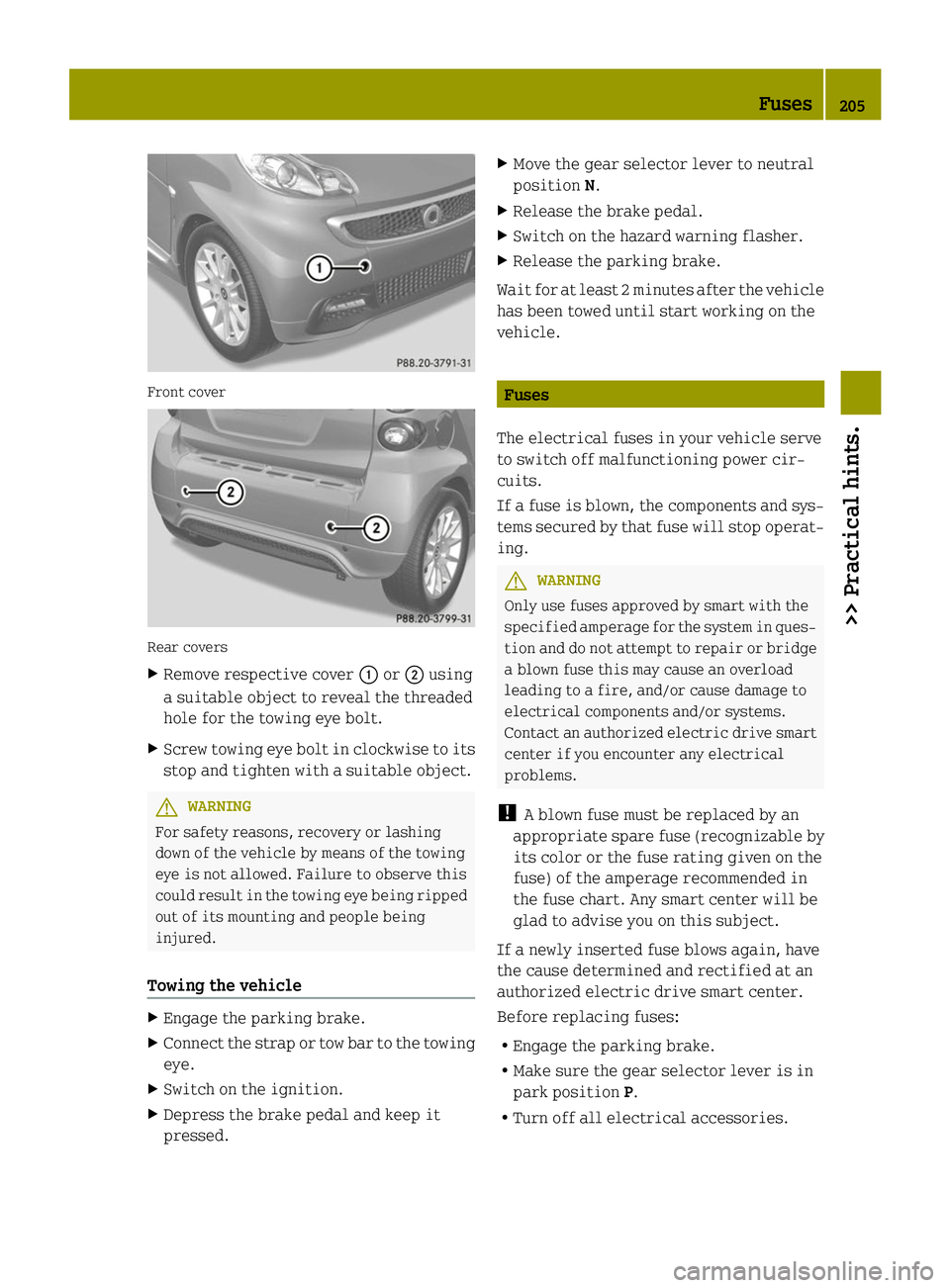
Front cover
Rear covers
X
Remove respective cover 0043or0044 using
a suitable object to reveal the threaded
hole for the towing eye bolt.
X Screw towing eye bolt in clockwise to its
stop and tighten with a suitable object. G
WARNING
For safety reasons, recovery or lashing
down of the vehicle by means of the towing
eye is not allowed. Failure to observe this
could result in the towing eye being ripped
out of its mounting and people being
injured.
Towing the vehicle X
Engage the parking brake.
X Connect the strap or tow bar to the towing
eye.
X Switch on the ignition.
X Depress the brake pedal and keep it
pressed. X
Move the gear selector lever to neutral
position N.
X Release the brake pedal.
X Switch on the hazard warning flasher.
X Release the parking brake.
Wait for at least 2 minutes after the vehicle
has been towed until start working on the
vehicle. Fuses
The electrical fuses in your vehicle serve
to switch off malfunctioning power cir-
cuits.
If a fuse is blown, the components and sys-
tems secured by that fuse will stop operat-
ing. G
WARNING
Only use fuses approved by smart with the
specified amperage for the system in ques-
tion and do not attempt to repair or bridge
a blown fuse this may cause an overload
leading to a fire, and/or cause damage to
electrical components and/or systems.
Contact an authorized electric drive smart
center if you encounter any electrical
problems.
! A blown fuse must be replaced by an
appropriate spare fuse (recognizable by
its color or the fuse rating given on the
fuse) of the amperage recommended in
the fuse chart. Any smart center will be
glad to advise you on this subject.
If a newly inserted fuse blows again, have
the cause determined and rectified at an
authorized electric drive smart center.
Before replacing fuses:
R Engage the parking brake.
R Make sure the gear selector lever is in
park position P.
R Turn off all electrical accessories. Fuses
205>> Practical hints. Z
Page 217 of 222

Example certification label (Canada vehicles)
0044 Vehicle Identification Number (VIN)
0087 Paintwork code Vehicle Identification Number (VIN)
The Vehicle Identification Number (VIN)
can be found in the following locations:
R on the certification label on the driver’s
door B‑pillar (Y page 214)
R on the rear right on the cargo compart-
ment floor (Y page 215)
R in the lower edge of the windshield
(Y page 214)
X Open the cargo compartment.
X Fold back the carpet. 0043
VIN (on the cargo compartment floor) Vehicle specification
The quoted data apply only to the standard
vehicle. Contact an authorized electric
drive smart center for the corresponding
data of all special bodies and special
equipment. Main dimensions
Overall vehicle
length
107.4 in (2 727 mm)
Overall vehicle
width
11 69.0 in (1 752 mm)
Overall vehicle
height
62.1 in (1 555 mm)
Wheelbase
73.5 in (1 867 mm)
Turning circle
28.7 ft (8.75 m)
Weights
Cargo compart-
ment load
max. 110 lb (50 kg)
Roof load
None
This vehicle is not intended to carry items
on its roof. Thus roof rails and any roof-
mounted devices must not be used.
G
WARNING
No racks or loads may be secured to the roof
of the vehicle, as
R the panorama roof* may be damaged, thus
injuring persons
R this can have a substantial adverse
effect on the driving dynamics of the
vehicle, thus causing accidents
R the rack and/or the load could detach and
through this cause an accident or other
people could be injured by the load and/
or rack that has fallen off
11 Exterior rear view mirrors folded out. Vehicle specification
215>> Technical data.
* optional Z