steering wheel SMART FORTWO COUPE 2014 Owner's Manual
[x] Cancel search | Manufacturer: SMART, Model Year: 2014, Model line: FORTWO COUPE, Model: SMART FORTWO COUPE 2014Pages: 222, PDF Size: 16.17 MB
Page 143 of 222

tire failure may result and cause an acci-
dent and/or serious personal injury to you
or others.
Always replace rims and tires with the same
designation, manufacturer and type as
shown on the original part. G
WARNING
Do not overload the tires by exceeding the
specified load limit as indicated on the
Tire and Loading Information placard on
the driver’s door B‑pillar. Overloading the
tires can overheat them, possibly causing
a blowout. Overloading the tires can also
result in handling or steering problems, or
brake failure.
Tire load rating 0083is a numerical code
associated with the maximum load a tire
can support.
For example, a load rating of 91 corre-
sponds to a maximum load of 1356 lbs
(615 kg) the tire is designed to support.
See also “Maximum tire load” (Y page 136)
where the maximum load associated with
the load index is indicated in kilograms
and lbs.
For additional information on tire load
rating, see “Load identification”
(Y page 142).
Tire speed rating G
WARNING
Even when permitted by law, never operate
a vehicle at speeds greater than the maxi-
mum speed rating of the tires.
Exceeding the maximum speed for which
tires are rated can lead to sudden tire fail-
ure, causing loss of vehicle control and
possibly resulting in an accident and/or
personal injury and possible death, for you
and for others.
Regardless of the tire speed rating, local
speed limits should be obeyed. Use prudent
driving speeds appropriate to prevailing
conditions. Tire speed rating
0084indicates the
approved maximum speed for the tire.
Summer tires Index Speed rating
Q up to 100 mph (160 km/h)
R up to 106 mph (170 km/h)
S up to 112 mph (180 km/h)
T up to 118 mph (190 km/h)
H up to 130 mph (210 km/h)
V up to 149 mph (240 km/h)
W up to 168 mph (270 km/h)
Y up to 186 mph (300 km/h)
ZR...Y above 186 mph (300 km/h)
ZR...(Y) above 186 mph (300 km/h)
ZR above 149 mph (240 km/h)
R
At the tire manufacturer’s option, any
tire with a speed capability above
149 mph (240 km/h) can include a “ZR” in
the size designation (for example:
245/40 ZR18). To determine the maximum
speed capability of the tire, the service
description for the tire must be referred
to.
The service description is comprised of
tire load rating 0083and tire speed rating
0084.
If your tire includes “ZR” in the size
designation and no service description
is given, the tire manufacturer must be
consulted for the maximum speed capa-
bility.
If a service description is given, the
speed capability is limited by the speed
symbol in the service description.
Example: 245/40 ZR18 97Y.
In this example, “97Y” is the service
description. The letter “Y” designates
the speed rating and the speed capabil- Tires and wheels
141>> Operation. Z
Page 145 of 222

The TIN is a unique identifier which facil-
itates efforts by tire manufactures to
notify purchasers in recall situations or
other safety matters concerning tires and
gives purchasers the means to easily iden-
tify such tires.
The TIN is comprised of “Manufacturer’s
identification mark” 0044, “Tire size”0087,
“Tire type code” 0085, and “Date of manufac-
ture” 0083.
i For illustration purposes only. Actual
data on tires are specific to each vehicle
and may vary from data shown in above
illustration.
DOT (Department of Transportation) Tire branding symbol
0043which denotes the
tire meets requirements of the U.S. Depart-
ment of Transportation.
Manufacturer’s identification mark Manufacturer’s identification mark
0044
denotes the tire manufacturer.
New tires have a mark with two symbols.
Retreaded tires have a mark with four sym-
bols. For more information on retreaded
tires (Y page 127).
Tire size Code
0087indicates the tire size. Tire type code Tire type code
0085may, at the option of the
manufacturer, be used as a descriptive
code for identifying significant charac-
teristics of the tire.
Date of manufacture Date of manufacture
0083identifies the week
and year of manufacture.
The first two figures identify the week,
starting with “01” to represent the first
full week of the calendar year. The second
two figures represent the year.
For example, “3202” represents the 32nd
week of 2002. Tire ply material
i
For illustration purposes only. Actual
data on tires are specific to each vehicle
and may vary from data shown in above
illustration.
This marking tells you about the type of
cord and number of plies in the side-
wall 0043and under the tread 0044. Tire and loading terminology
Accessory weight The combined weight (in excess of those
standard items which may be replaced) of
transmission, power steering, power
brakes, power windows, power seats, radio, Tires and wheels
143>> Operation. Z
Page 149 of 222

175/55 R15 on the rear axle.
For safety reasons, smart recommends
that you only use snow chains that have
been approved by smart.
Information on this is available from any
smart center.
Please refer to the separate operating
instructions for detailed information on
mounting the snow chains.
Snow chains should only be driven on
snow-covered roads at speeds not to
exceed 30 mph (50 km/h). Remove chains
as soon as possible when driving on roads
without snow.
Please observe the following guidelines
when using snow chains:
R Using snow chains is not permissible
with all wheel/tire combinations
(Y page 216).
R Use snow chains in pairs and on rear
wheels only. Follow the manufacturer’s
mounting instructions.
R Use of snow chains may be prohibited
depending on location. Always check
local and state laws before mounting
snow chains. G
WARNING
When mounting or removing snow chains,
always park your vehicle on level ground,
engage the parking brake, and switch off
the drive system. The vehicle could other-
wise move and injure yourself or other road
users. G
WARNING
When mounting and removing snow chains,
ensure that you and your vehicle are at a
safe distance from moving traffic. Not
doing so could endanger other road users or
even lead to you being injured by the vehi-
cles behind you. G
WARNING
The vehicle’s handling changes when driv-
ing with snow chains on any kind of road surface. This means that you should always
adapt your driving style to suit the current
road and weather conditions.
! If snow chains that do not meet require-
ments are mounted, they may scrape
against the body or axle components when
the vehicle is in motion. This could
result in damage to the rim/tire or vehi-
cle. Driving instructions
Drinking and driving
G
WARNING
Do not drink alcohol or take drugs and drive
or allow anyone to drive who has been
drinking alcohol or taking drugs. Even a
small amount of alcohol or drugs can affect
your reflexes, perceptions and judgment.
The possibility of a serious or even fatal
accident are greatly increased when you
drink or take drugs and drive. Pedals
G
WARNING
Make sure absolutely no objects are
obstructing the pedals’ range of motion.
Keep the driver’s footwell clear of all
obstacles. If there are any floormats* or
carpets in the footwell, make sure the ped-
als still have sufficient clearance.
During sudden acceleration or braking
maneuvers, the objects could get caught
between or beneath the pedals and restrict
your ability to brake or accelerate. This
could lead to accidents and/or injury. Power assistance
G
WARNING
With the drive system inactive, there is no
power assistance for the brake and steering Driving instructions
147>> Operation.
* optional Z
Page 153 of 222

approximately
1
/ 6 in (4 mm) on all four
wheels for the winter season to ensure nor-
mal balanced handling characteristics. On
packed snow, they can reduce your stopping
distance compared to summer tires.
Stopping distance, however, is still con-
siderably greater than when the road is not
covered with snow or ice. Exercise appro-
priate caution.
! Avoid spinning of a drive wheel for an
extended period when driving off on
slippery road surfaces. Otherwise, the
drivetrain could be damaged, which is
not covered by the smart Limited War-
ranty. Tire speed rating
Regardless of the tire speed rating, local
speed limits should be obeyed. Use prudent
driving speeds appropriate to prevailing
conditions. G
WARNING
Even when permitted by law, never operate
a vehicle at speeds greater than the maxi-
mum speed rating of the tires.
Exceeding the maximum speed for which
tires are rated can lead to sudden tire fail-
ure, causing loss of vehicle control and
possibly resulting in an accident and/or
personal injury and possible death, for you
and for others.
Make sure your tires have the required tire
speed rating as specified for your vehicle
in the “Technical data section”
(Y page 216), for example when purchasing
new tires.
For information on how to identify the tire
speed rating on a tire’s sidewall, see “Tire
size designation, load and speed rating”
(Y page 140).
If you are uncertain about the correct read-
ing of the information given on a tire’s sidewall, any authorized electric drive
smart center will be glad to assist you.
i
For information on speed ratings for
winter tires, see “All-season and winter
tires” (Y page 141). Winter driving instructions
The most important rule for slippery or icy
roads is to drive sensibly and to avoid
abrupt acceleration, braking and steering
maneuvers.
For information on driving with snow
chains*, see “Snow chains*” (Y page 146).
Road salts and chemicals can adversely
affect braking efficiency. Increased pedal
force may become necessary to produce the
normal braking effect.
Depressing the brake pedal periodically
when traveling at length on salt-strewn
roads can bring road-salt-impaired brak-
ing efficiency back to normal.
If the vehicle is parked after being driven
on salt-treated roads, the braking effi-
ciency should be tested as soon as possible
after driving is resumed. G
WARNING
Make sure not to endanger any other road
users when carrying out these braking
maneuvers. G
WARNING
The outside temperature display is not
designed to serve as an ice-warning device
and is therefore unsuitable for that pur-
pose. Indicated temperatures just above
the freezing point do not guarantee that the
road surface is free of ice.
For more information, see “Winter driving”
(Y page 146). Driving instructions
151>> Operation.
* optional Z
Page 169 of 222
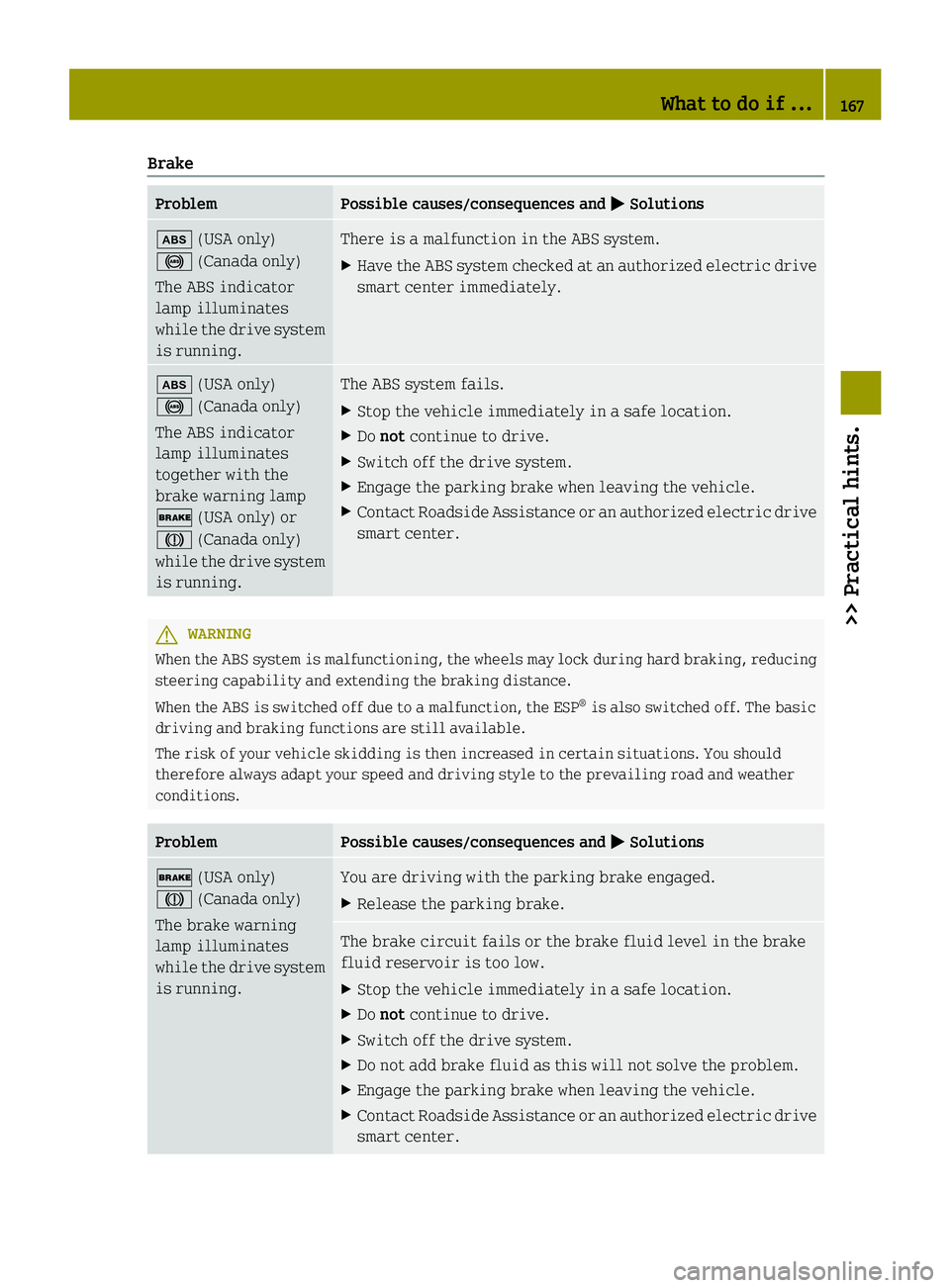
Brake
Problem Possible causes/consequences and
0050
0050Solutions 00DF
(USA only)
0025 (Canada only)
The ABS indicator
lamp illuminates
while the drive system
is running. There is a malfunction in the ABS system.
X
Have the ABS system checked at an authorized electric drive
smart center immediately. 00DF
(USA only)
0025 (Canada only)
The ABS indicator
lamp illuminates
together with the
brake warning lamp
0027 (USA only) or
004D (Canada only)
while the drive system
is running. The ABS system fails.
X
Stop the vehicle immediately in a safe location.
X Do not continue to drive.
X Switch off the drive system.
X Engage the parking brake when leaving the vehicle.
X Contact Roadside Assistance or an authorized electric drive
smart center. G
WARNING
When the ABS system is malfunctioning, the wheels may lock during hard braking, reducing
steering capability and extending the braking distance.
When the ABS is switched off due to a malfunction, the ESP ®
is also switched off. The basic
driving and braking functions are still available.
The risk of your vehicle skidding is then increased in certain situations. You should
therefore always adapt your speed and driving style to the prevailing road and weather
conditions. Problem Possible causes/consequences and
0050 0050Solutions 0027
(USA only)
004D (Canada only)
The brake warning
lamp illuminates
while the drive system
is running. You are driving with the parking brake engaged.
X
Release the parking brake. The brake circuit fails or the brake fluid level in the brake
fluid reservoir is too low.
X
Stop the vehicle immediately in a safe location.
X Do not continue to drive.
X Switch off the drive system.
X Do not add brake fluid as this will not solve the problem.
X Engage the parking brake when leaving the vehicle.
X Contact Roadside Assistance or an authorized electric drive
smart center. What to do if ...
167>> Practical hints. Z
Page 189 of 222

X
Removing: Fold the wiper arm away from
the rear window until you feel it engage.
X Fold wiper blade 0043away from the wiper
arm in direction of arrow 0044until it
disengages from its mounting.
X Detach wiper blade 0043.
X Installing: Push the new wiper blade onto
the wiper arm until you feel it engage.
X Fold the wiper blade into a position par-
allel to the wiper arm.
X Fold the wiper arm backward to rest on
the rear window.
Make sure to hold on to the wiper when
folding the wiper arm back.
! Make sure the wiper blade is properly
installed. An improperly installed
wiper blade may cause rear window dam-
age. Adjusting the washer jet nozzles
0043
Front washer jet nozzles
0044 Rear washer jet nozzles
X Adjusting: Use a needle to move washer
jet nozzles 0043or0044 left, right, up, or
down.
i Check the setting of the washer jet noz-
zles at regular intervals. The washer jet
nozzles are correctly set when the water
jet hits the windshield or the rear win-
dow approximately in the center. Flat tire
Preparing the vehicle
Upon experiencing any type of problem
with the vehicle’s tires, switch on the haz-
ard warning flasher, carefully slow down
and exit the roadway in a cautious manner.
X Park the vehicle at a safe distance from
moving traffic on a hard, flat surface
when possible.
X Make sure the tire valve of the damaged
tire is located below the horizontal axle
of the wheel hub.
X Engage the parking brake.
X Turn the steering wheel so that the front
wheels are in a straight ahead position.
X Move the gear selector lever to park
position P.
X Switch off the drive system.
X Remove the key from the starter switch
and take the key with you.
i Open door only when conditions are safe
to do so.
X Have any passenger exit the vehicle at a
safe distance from the roadway. Using the tire repair kit
! Depending on the type of damage on the
tire, the tire sealant could damage the
sensor of the Tire Pressure Monitoring
System (TPMS)*. Such damage is not cov-
ered by the smart Limited Warranty.
When having the damaged tire replaced,
also have the TPMS sensors* checked for
proper function. When the sensor is dam-
aged, the TPMS* will not function prop-
erly. The sensor must then be replaced at
an authorized electric drive smart
center as soon as possible.
i Depending on production date of your
vehicle, it will be equipped with version
1 or version 2 of the tire repair kit.
Please make sure to refer to the descrip- Flat tire
187>> Practical hints.
* optional Z
Page 196 of 222

placard located on the driver’s door
B‑pillar).
R
To increase the tire inflation pres-
sure: Switch on the electric air pump.
R To decrease the tire inflation pres-
sure: Press deflate button 006C. Recheck
the tire inflation pressure with the
electric air pump’s pressure gauge
006D.
X When the tire inflation pressure is cor-
rect, unscrew the end of filler hose 0085
from tire valve 006B.
X Screw the valve cap onto the tire valve. X
To detach tire sealant container 0043from
the electric air pump, press both
latches.
X Pull tire sealant container 0043out of fix-
ture 0044.
Filler hose 0085remains on tire sealant
container 0043.
X Place the tire repair kit securely in the
vehicle.
! The manufacturer is unable to guaran-
tee that all tire punctures can be
repaired with the tire repair kit, in par-
ticular cuts or perforations larger than
approximately 0.16 in (4 mm) or away from
the tire’s tread. The manufacturer is not
liable for damage sustained through
improper use of the tire repair kit. G
WARNING
Follow recommended tire inflation pres-
sures.
Do not underinflate tires. Underinflated
tires wear excessively and/or unevenly,
adversely affect handling and energy con-
sumption of the vehicle, and are more
likely to fail from being overheated.
Do not overinflate tires. Overinflated
tires can adversely affect handling and
ride comfort, wear unevenly, increase
stopping distance, and result in sudden
deflation (blowout) because they are more
likely to become punctured or damaged by
road debris, potholes etc.
Do not overload the tires by exceeding the
specified load limit as indicated on the
Tire and Loading Information placard on
the driver’s door B‑pillar. Overloading the
tires can overheat them, possibly causing
a blowout. Overloading the tires can also
result in handling or steering problems, or
brake failure.
X Drive to the nearest authorized electric
drive smart center, to have the damaged
tire replaced.
X Contact an authorized electric drive
smart center as soon as possible to
obtain a new filler hose and a new tire
sealant container.
X Bring used tire sealant materials to an
authorized electric drive smart center
for proper disposal.
X Replace your tire sealant container
every 4 years. Replacement containers
are available at any authorized electric
drive smart center. G
WARNING
After changing a tire, contact an author-
ized electric drive smart center to make
sure the bolts holding the wheel to the car
are tight enough. Otherwise, the wheels
could come off. Each bolt should be tight-
ened to a torque of 81 lb‑ft (110 Nm). 194
Flat tire>> Practical hints.
Page 197 of 222

Wheel change
Preparing the vehicle
X Park the vehicle on a hard, flat surface
when possible.
X Turn on the hazard warning flasher.
X Turn the steering wheel so that the front
wheels are in a straight-ahead position.
X Engage the parking brake.
X Move the gear selector lever to park
position P.
X Switch off the drive system.
X Have any passenger exit the vehicle at a
safe distance from the roadway. Removing the wheel
G
WARNING
When jacking up the vehicle, only use a
suitable jack. Observe the manufacturer’s
safety instructions.
The jack must be designed for jacking up
this vehicle at the jack take-up brackets
built into both sides of the vehicle.
The jack is intended only for lifting the
vehicle briefly for wheel changes. It is not
suited for performing maintenance work
under the vehicle. To help avoid personal
injury, use the jack only to lift the vehicle
during a wheel change.
Never get beneath the vehicle while it is
supported by the jack. Keep hands and feet
away from the area under the lifted vehicle.
Always lower the vehicle onto sufficient
capacity jackstands before working under
the vehicle.
Always firmly engage the parking brake and
block the wheels with wheel chocks or other
sizeable objects before raising the vehi-
cle with the jack. Do not release the parking
brake while the vehicle is raised.
Make sure the ground on which the vehicle
is standing and where you place the jack is solid, level and not slippery. If necessary,
use a large underlay. On slippery surfaces,
such as tiled floors, you should use a non-
slip underlay, for example a rubber mat.
Do not use wooden blocks or similar objects
to support the jack. Otherwise the jack may
not be able to achieve its load-bearing
capacity if it is not at its full height.
The jack must always be vertical when in
use. Always try to use the jack on level sur-
face. If you do not position the jack cor-
rectly, the vehicle can fall off the jack and
seriously or fatally injure you or others.
Never switch on the drive system when the
vehicle is raised.
Also observe the notes on the jack.
X Make sure to have a suitable jack 10
, wheel
wrench 10
and wheel chock 10
.
Contact an authorized electric drive
smart center for information on which
jack and wheel wrench are required.
X Prepare the vehicle as described
(Y page 195).
X Make sure the surface is level.
Prevent the vehicle from rolling away by
blocking wheels with wheel chocks or other
sizeable objects:
X Place one wheel chock or other sizeable
object in front of and another wheel
chock or other sizeable object behind
the wheel that is diagonally opposite to
the wheel being changed.
X On wheel to be changed, loosen but do not
yet remove the wheel bolts (approx-
imately one full turn with wheel wrench).
! Only position the jack on the desig-
nated take-up brackets.
You must not position the jack under the
high-voltage battery. Otherwise, the
high-voltage battery could be damaged.
10 Not included and not available as factory equipment. Wheel change
195>> Practical hints. Z
Page 205 of 222

X
Remove the jumper cables from negative terminals 0087and 0085first.
X Remove the jumper cables from positive terminals 0043and 0044.
You can now switch on the headlamps.
X Remount the positive terminal cover.
X Have the 12-volt battery checked at the nearest authorized electric drive smart center.
i Please keep in mind that it will take quite some time to charge the 12-volt battery.
When you switch off the drive system after driving a short distance, you may not be able
to start it again.
Charge the 12-volt battery completely as soon as possible. Towing
About towing
This section offers information on towing
methods for breakdown situations and
emergency towing. Recommended towing method - Break-
down situation
! To prevent damage during transport, do
not tie down the vehicle by its chassis or
suspension parts — use only wheel straps
to position and hold down the vehicle.
Improper tie down on a flatbed carrier
truck or trailer can damage suspension
parts and body panels.
smart recommends that the vehicle be
transported with all wheels off the ground
using a flatbed carrier truck or appropri-
ate wheel lift/dolly equipment.
Always have your vehicle transported:
R when the 0075warning lamp for the high-
voltage system lights up in the instru-
ment cluster
R when the Do not tow (away)
Do not tow (away) message
appears in the instrument cluster
R when the multifunction display is inop-
erative R
when one or several of the following
warning lamps light up:
-00ED Drive diagnostics (red)
- 003D 12‑Volt battery
0052 Power steering
R if the brake pedal already starts to pul-
sate just after towing begins
R if you have to transport the vehicle over
long distances
X Switch off the tow‑away protection* and
interior motion sensor* (Y page 50). Emergency towing
When circumstances do not permit the rec-
ommended towing method, the vehicle may
be towed with all wheels on the ground
using a strap or tow bar connected to
another vehicle. Only tow the vehicle as far
as necessary to have the vehicle moved to a
safe location where the recommended tow-
ing method can be employed. G
WARNING
If circumstances require towing the vehi-
cle with all wheels on the ground, always tow
with a tow bar if:
R the drive system will not run
R there is a malfunction in the brake sys-
tem
R there is a malfunction in the power sup-
ply or in the vehicle’s electrical system Towing
203>> Practical hints.
* optional Z
Page 206 of 222
A tow bar is necessary to adequately control
the towed vehicle.
Prior to towing the vehicle with all wheels
on the ground, make sure the gear selector
lever is in neutral position Nand the igni-
tion is switched on. G
WARNING
With the drive system inactive, there is no
power assistance for the brake and steering
systems. In this case, it is important to
keep in mind that a considerably higher
degree of effort is necessary to brake and
steer the vehicle. Adapt your driving
accordingly.
! The vehicle may be towed only for dis-
tances up to 30 miles (50 km) and at a
speed not to exceed 30 mph (50 km/h).
Otherwise, the electric drive or the
high-voltage system could be damaged.
! Do not tow other vehicles.
Otherwise, the drive system or compo-
nents of the high-voltage system could be
damaged.
! Do not tow the vehicle with the front
axle raised. Doing so may cause serious
damage to the brake system which is not
covered by the smart Limited Warranty.
! Before towing the vehicle observe the
following instructions:
R Do not tow with sling-type equipment
attached to suspension parts. This may
cause damage to the supports if towing
on a bumpy road.
R Towing the vehicle should only be done
using the properly installed towing
eye bolt. Never attach a tow cable, tow
rope, or tow rod to the vehicle chassis,
frame, or suspension parts.
! Make sure the gear selector lever is in
neutral position Nwhile towing the
vehicle. Doing otherwise may result in
significant drive train damage. !
Towing the vehicle with a luggage
rack* mounted is not permissible. The
vehicle must not be towed by the luggage
rack*.
i If the 12-volt battery is disconnected
or discharged, the gear selector lever
will remain locked in park position P.
Contact an authorized electric drive
smart center for assistance or call Road-
side Assistance.
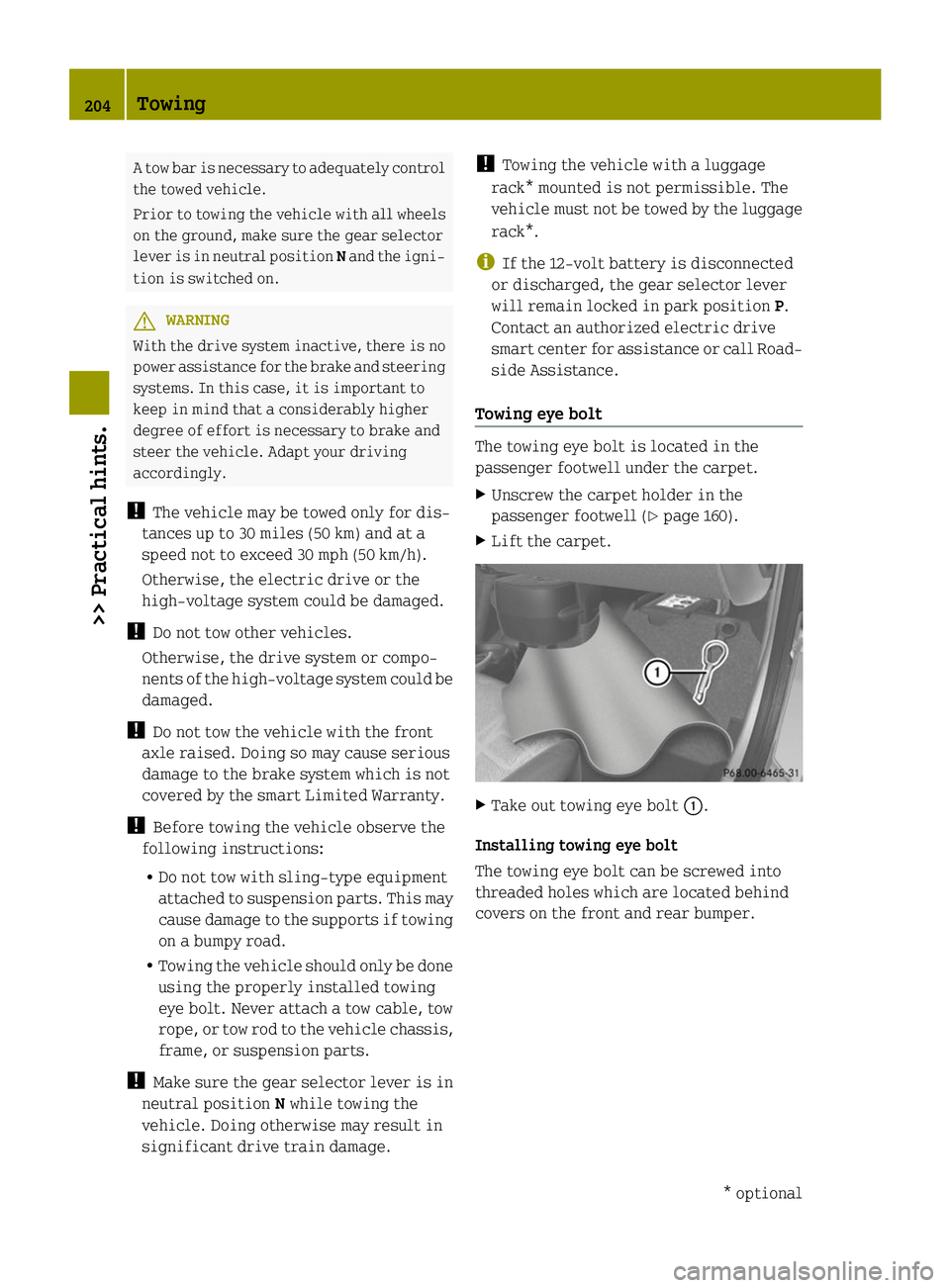
Towing eye bolt The towing eye bolt is located in the
passenger footwell under the carpet.
X
Unscrew the carpet holder in the
passenger footwell (Y page 160).
X Lift the carpet. X
Take out towing eye bolt 0043.
Installing towing eye bolt
The towing eye bolt can be screwed into
threaded holes which are located behind
covers on the front and rear bumper. 204
Towing>> Practical hints.
* optional