wheel SMART FORTWO COUPE 2014 Owner's Manual
[x] Cancel search | Manufacturer: SMART, Model Year: 2014, Model line: FORTWO COUPE, Model: SMART FORTWO COUPE 2014Pages: 222, PDF Size: 16.17 MB
Page 80 of 222
G
WARNING
Engaging the parking brake while the vehi-
cle is in motion can cause the rear wheels
to lock up. You could lose control of the
vehicle and cause an accident. In addition,
the vehicle’s brake lights do not light up
when the parking brake is engaged. X
Releasing: Depress the brake pedal.
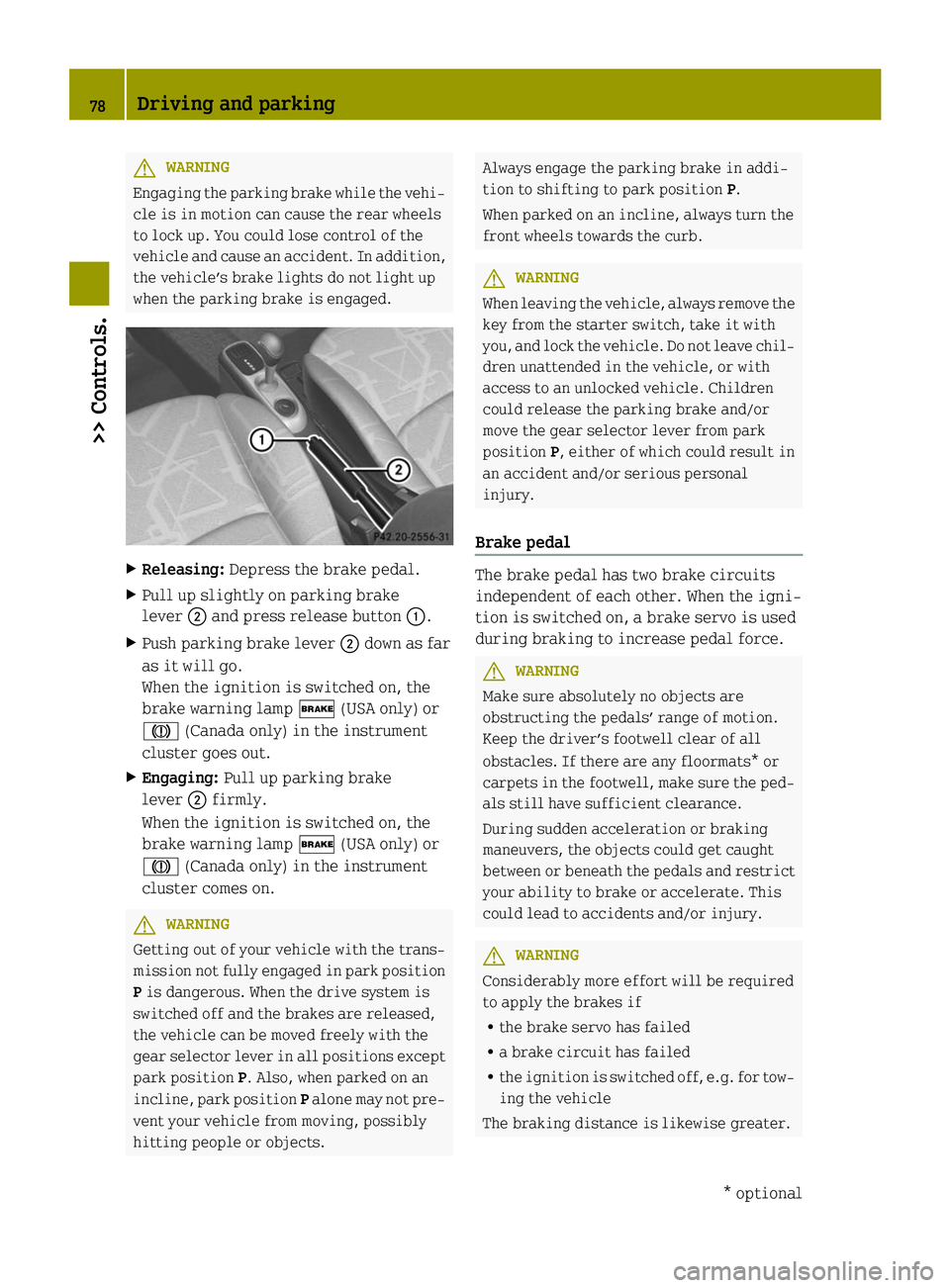
X Pull up slightly on parking brake
lever 0044and press release button 0043.
X Push parking brake lever 0044down as far
as it will go.
When the ignition is switched on, the
brake warning lamp 0027(USA only) or
004D (Canada only) in the instrument
cluster goes out.
X Engaging: Pull up parking brake
lever 0044firmly.
When the ignition is switched on, the
brake warning lamp 0027(USA only) or
004D (Canada only) in the instrument
cluster comes on. G
WARNING
Getting out of your vehicle with the trans-
mission not fully engaged in park position
P is dangerous. When the drive system is
switched off and the brakes are released,
the vehicle can be moved freely with the
gear selector lever in all positions except
park position P. Also, when parked on an
incline, park position Palone may not pre-
vent your vehicle from moving, possibly
hitting people or objects. Always engage the parking brake in addi-
tion to shifting to park position
P.
When parked on an incline, always turn the
front wheels towards the curb. G
WARNING
When leaving the vehicle, always remove the
key from the starter switch, take it with
you, and lock the vehicle. Do not leave chil-
dren unattended in the vehicle, or with
access to an unlocked vehicle. Children
could release the parking brake and/or
move the gear selector lever from park
position P, either of which could result in
an accident and/or serious personal
injury.
Brake pedal The brake pedal has two brake circuits
independent of each other. When the igni-
tion is switched on, a brake servo is used
during braking to increase pedal force.
G
WARNING
Make sure absolutely no objects are
obstructing the pedals’ range of motion.
Keep the driver’s footwell clear of all
obstacles. If there are any floormats* or
carpets in the footwell, make sure the ped-
als still have sufficient clearance.
During sudden acceleration or braking
maneuvers, the objects could get caught
between or beneath the pedals and restrict
your ability to brake or accelerate. This
could lead to accidents and/or injury. G
WARNING
Considerably more effort will be required
to apply the brakes if
R the brake servo has failed
R a brake circuit has failed
R the ignition is switched off, e.g. for tow-
ing the vehicle
The braking distance is likewise greater. 78
Driving and parking>> Controls.
* optional
Page 81 of 222

Make sure the drive system is active when-
ever the vehicle is rolling. Have the brake
system repaired at an authorized electric
drive smart center, if there is a fault in the
brake system. If a brake circuit has failed (Y
page 167),
you must depress brake pedal 0043further
down to achieve the same effect and the
braking distance is increased.
i The brake servo will only function with
the ignition switched on. Switching off the drive system
G
WARNING
Do not turn off the drive system before the
vehicle has come to a complete stop. With
the drive system not running, there is no
power assistance for the brake and steering
systems. In this case, it is important to
keep in mind that a considerably higher
degree of effort is necessary to brake and
steer the vehicle.
X Depress the brake pedal.
X Move the gear selector lever to park
position P.
The transmission position indicator
should be on P P
! Always engage the parking brake in
addition to shifting to park position P.X
Release the brake pedal.
X Turn the key to starter switch position
0.
X Remove the key from the starter switch.
The electronic immobilizer is acti-
vated. Transmission
Shifting procedure
Gearshift pattern for transmission
005D
Park position
005E
Reverse gear
005C
Neutral position
005B
Drive position
Select a gear:
X
Switch on the ignition.
X Depress the brake pedal.
X Move the gear selector lever to the
desired position. Steering wheel paddle shifters* (for
recuperation)
G
WARNING
The operating condition of the high-volt-
age battery (e.g. not yet at normal operat-
ing temperature or fully charged) influen- Transmission
79>> Controls.
* optional Z
Page 82 of 222

ces the braking effect of the electric
motor.
In overrun or braking mode, the motor's
braking effect may therefore be reduced or
may not be present at all.
As a result of the reduced engine braking
effect, you may cause an accident and
injure yourself or others.
Compensate for the reduced engine braking
effect by pressing the brake pedal accord-
ingly, as required.
Using the steering wheel paddle shifters *,
you can increase or decrease the recuper-
ation in overrun phases. Recuperation
takes place when you release the acceler-
ator pedal. The electric motor will then be
used as a generator and energy will be
regained while driving. The regained
energy is stored in the high-voltage bat-
tery. High recuperation decelerates your
vehicle stronger.
In overrun phases, there are three levels of
recuperation:
R no recuperation (level 0, coasting)
R moderate recuperation (level 1)
R high-level recuperation (level 2)
The amount of recuperation in overrun
mode is displayed in the power gauge
(Y page 81).
The set mode for recuperation is shown in
the recuperation display (Y page 84).
When you switch on the ignition, level 1 is
automatically preset. 0043
Left steering wheel paddle shifter
(minus)
0044 Right steering wheel paddle shifter
(plus)
X Decrease recuperation: Pull left steer-
ing wheel paddle shifter 0043.
X Increase recuperation: Pull right steer-
ing wheel paddle shifter 0044.
Use the different levels 0 to 2 for condi-
tions as described below: Level 0 Driving without frequent
breaking. No sharp bends on
the road ahead.
Maximum kinetic energy
remains for the vehicle.
Level 1 Normal driving, standard set-
ting.
Level 2 Sporty driving.
The break pedal has to be
depressed less often, as the
deceleration due to recuper-
ation is higher than in
level 1.
The energy efficiency is sub-
stantially higher than if the
vehicle is decelerated by
depressing the brake pedal.
At levels 1 and 2 the vehicle can be step-
lessly decelerated by depressing the brake
pedal.80
Transmission>> Controls.
* optional
Page 84 of 222

The illumination for both gauges comes on
when you switch on the ignition and the
exterior lighting.
Charge level gauge !
Do not hang any objects on the charge
level gauge.
This could cause the charge level gauge
to be torn from its mountings and be dam-
aged.
The charge level gauge 0043displays charge
status of the high-voltage battery as a per-
centage.
When the High-voltage Battery at
High-voltage Battery at
Reserve Level
Reserve Level message appears in the
multifunction display while the drive sys-
tem is in operation, the high-voltage bat-
tery has reached the reserve level.
i If the charge level of the high-voltage
battery has dropped below 20 %, recharge
it at:
R an AC power socket (Y page 114)
R a private wall box (Y page 115)
R a public charging station
(Y page 117)
Power gauge G
WARNING
The operating condition of the high-volt-
age battery (e.g. not yet at normal operat-
ing temperature or fully charged) influen-
ces the braking effect of the electric
motor.
In overrun or braking mode, the motor's
braking effect may therefore be reduced or
may not be present at all.
As a result of the reduced engine braking
effect, you may cause an accident and
injure yourself or others.
Compensate for the reduced engine braking
effect by pressing the brake pedal accord-
ingly, as required. !
Do not hang any objects on the power
gauge.
This could cause the power gauge to be
torn from its mountings and be damaged.
Power gauge 0044contains two segments:
R Section right of 0
Power gauge 0044indicates the current
power that the drive system delivers to
the rear wheels. 100 % correspond to
55 kW peak power.
R Section left of 0
When you release the accelerator pedal
or when you depress the brake pedal, the
electric motor operates as a generator.
Electric current is produced and stored
in the high-voltage battery. As long as
the high-voltage battery is being
charged, the electric motor simulates an
engine brake.
When the pointer of power gauge 0044is in
the "OFF“ position, the vehicle is not ready
to drive, because:
R the drive system has not been started
R the gear selector lever has not been
moved to position Nor Pwhen starting
the drive system
R the charging cable is connected to the
vehicle
R there is not enough power from the high-
voltage battery
R a problem occured in the high-voltage
system
After the drive system has been started, the
pointer of power gauge 0044moves to posi-
tion 0.READY
READY appears in the multifunction
display (Y page 87). The vehicle is ready
to drive. 82
Instrument cluster>> Controls.
Page 86 of 222

message
Back
Backappears in the multifunc-
tion display.
X Press the OK button on the control lever
briefly. Transmission position indicator
The transmission position indicator
0043
displays the current gear selector lever
position. Display Function
P
Park position
R
Reverse gear
N
Neutral
D
Drive Display Function
N (flashes)
There is a parking lock
malfunction.
X
Move the gear selector
lever slowly from posi-
tion Pto position Rand
back to position P.
If Nremains flashing in
the multifunction display:
X Move the gear selector
lever to position P. When
leaving the vehicle,
apply the parking brake
to secure the vehicle
from rolling away.
X Contact an authorized
electric drive smart
center. 0 X
Move the gear selector
lever to park position P
or neutral position N.
X Turn the key to starter
switch position 2
(Y page 57) and hold it in
position until READY READY
appears in the multi-
function display
(Y page 87). Recuperation display*
The recuperation display shows you the
current set recuperation level. You can set
the recuperation level by using the steer-
ing wheel paddle shifters* (Y page 79).
The following levels are available:
R no recuperation (level 0)
R moderate recuperation (level 1)
R high recuperation (level 2) 84
Control system>> Controls.
* optional
Page 99 of 222

0043
USB socket
0044 AUX socket smart surround sound system*
The smart surround sound system supple-
ments the existing speakers with more
powerful and additional speakers (includ-
ing a digital amplifier in the passenger
footwell and a passive subwoofer). Driving systems
Cruise control*
The cruise control maintains the speed you
set for your vehicle automatically. On
downhill grades, the cruise control does
not brake the vehicle via the brake system.
The cruise control can only use the braking
power of the engine. You must apply the
brakes yourself in order to reduce the
vehicle speed. The cruise control will then
be canceled. G
WARNING
The cruise control is a convenience system
designed to assist the driver during vehi-
cle operation. The cruise control cannot
take road, traffic, and weather conditions
into account. The driver is and must always
remain responsible for the vehicle’s speed
and for safe brake operation. Do not use the cruise control
R
if the road, traffic, and weather condi-
tions do not make it advisable to travel
at a constant speed
R on slippery roads
Rapid changes in tire traction can result
in wheel spin and loss of control.
R when driving in fog
The use of the cruise control is recom-
mended for driving at a constant speed for
extended periods of time.
With the cruise control is activated and a
speed set, the following message appears
in the multifunction display: U.S. vehicles
0043
Cruise control activated
0044 Set speed Canada vehicles
0043
Cruise control activated
0044 Set speed
The cruise control is operated via buttons
on the steering wheel. Driving systems
97>> Controls.
* optional Z
Page 108 of 222

Storage compartments
G
WARNING
To help avoid personal injury during a col-
lision or sudden maneuver, exercise care
when storing objects in the vehicle. Put
luggage or cargo in the cargo compartment
if possible. Do not pile luggage or cargo
higher than the seat backrests.
Keep compartment lids closed. This will
help to prevent stored objects from being
thrown about and injuring vehicle occu-
pants during
R hard braking
R a change of direction
R an accident
Do not store objects under the driver’s seat.
Objects stored under the driver’s seat can
slide forward into driver’s foot well during
braking and get caught between or beneath
the pedals. This could restrict your ability
to brake or accelerate and could lead to
accidents and injury.
Coin holder The coin holder is located in front of the
gear selector lever. Example illustration (coupé)
0043 Coin holder
Door pockets The door pockets are located in the driver’s
and passenger door. 0043
Door pocket
Storage trays next to the steering wheel The storage trays are located to the left and
right of the steering wheel. 0043
Storage tray
Glove box i
A clamp rail for slips of paper is
located on the outside of the glove box
lid. 106
Loading and storing>> Controls.
Page 113 of 222
>> Operation.High-voltage battery
........................112
Front compartment ........................... 123
Tires and wheels .............................. 127
Winter driving ................................ 146
Driving instructions ........................147
Driving abroad ................................ 153
Vehicle care ................................... 153
Page 129 of 222
X
Use a windshield washer concentrate
labeled for summer and water for tem-
peratures above freezing point.
X Use a windshield washer concentrate
labeled for winter and water for temper-
atures below freezing point.
! Always use a windshield washer concen-
trate labeled for winter where tempera-
tures may fall below freezing point.
Failure to do so could result in damage
to the washer system/reservoir.
X Premix the windshield washer fluid in a
suitable container.
Observe mixing ratios depending on the
outside temperature (Y page 218).
X Use the tab to pull cap 0043upwards.
X Refill the windshield washer reservoir.
X Push cap 0043onto the windshield washer
reservoir.
X Remount the service flap and close it
(Y page 123). Brake fluid
G
WARNING
During vehicle operation, the boiling
point of the brake fluid is continuously
reduced through the absorption of moisture
from the atmosphere. Under extremely
strenuous operating conditions, this mois-
ture content can lead to the formation of
bubbles in the system, thus reducing the
system’s efficiency.
Therefore, the brake fluid must be replaced
regularly. Refer to your vehicle’s Mainte-
nance Booklet for replacement interval.
The brake fluid level in the brake fluid
reservoir may be too low if the brake warn-
ing lamp in the instrument cluster comes
on (Y page 23) although the parking brake
is released.
! If you find that the brake fluid in the
brake fluid reservoir has fallen to the minimum mark or below, have the brake
system checked for brake pad thickness
and leaks immediately. Contact an
authorized electric drive smart center
immediately. Do not add brake fluid as
this will not solve the problem.
X Remove the service flap and insert it on
the front of the vehicle (Y page 123).
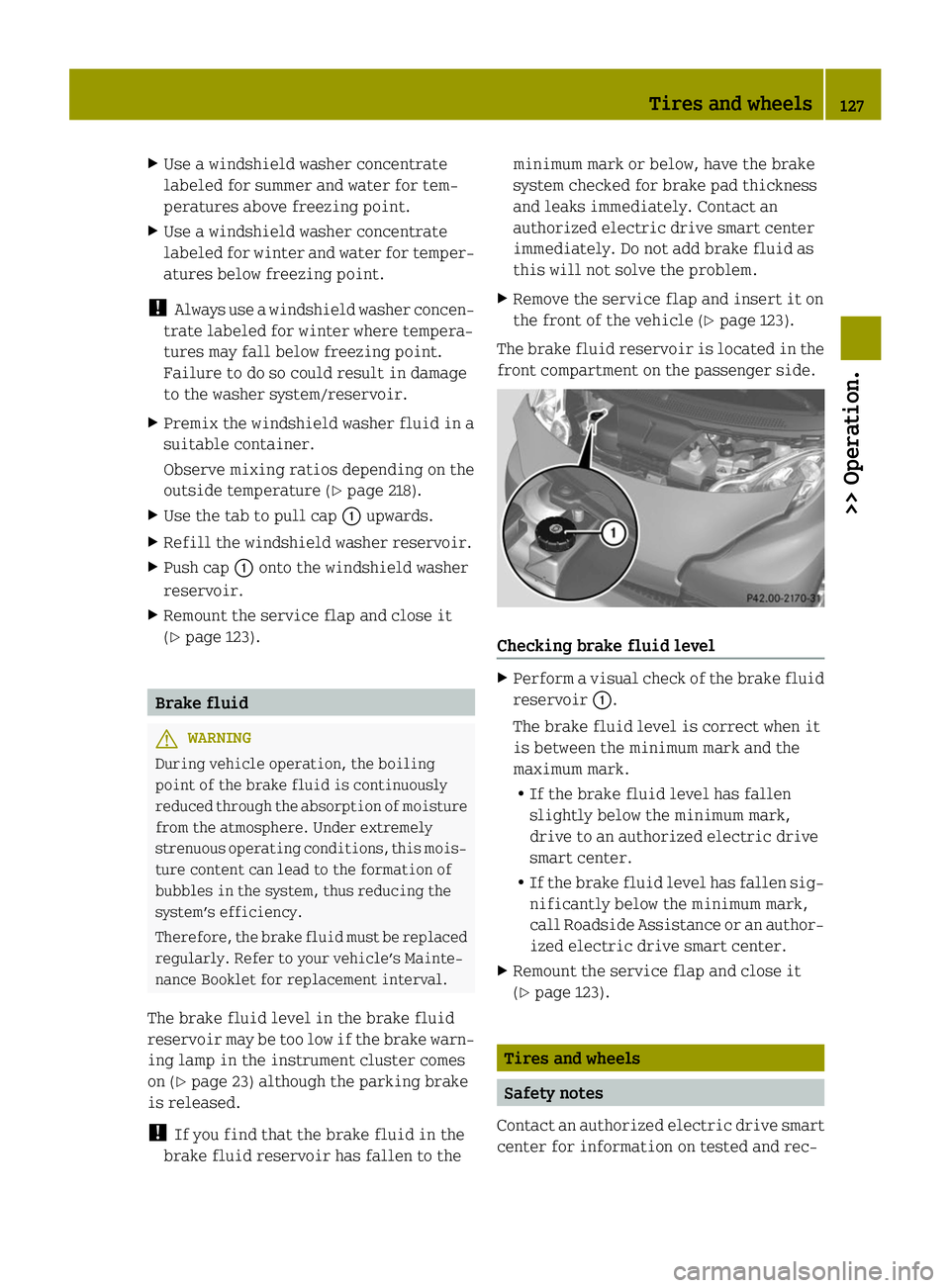
The brake fluid reservoir is located in the
front compartment on the passenger side. Checking brake fluid level
X
Perform a visual check of the brake fluid
reservoir 0043.
The brake fluid level is correct when it
is between the minimum mark and the
maximum mark.
R If the brake fluid level has fallen
slightly below the minimum mark,
drive to an authorized electric drive
smart center.
R If the brake fluid level has fallen sig-
nificantly below the minimum mark,
call Roadside Assistance or an author-
ized electric drive smart center.
X Remount the service flap and close it
(Y page 123). Tires and wheels
Safety notes
Contact an authorized electric drive smart
center for information on tested and rec- Tires and wheels
127>> Operation. Z
Page 130 of 222
ommended rims and tires for summer and
winter operation. They can also offer
advice concerning tire service and pur-
chase. G
WARNING
Replace rims or tires with the same desig-
nation, manufacturer and type as shown on
the original part. For further information
contact an authorized electric drive smart
center. If incorrectly sized rims and tires
are mounted, the wheel brakes or suspen-
sion components can be damaged. Also, the
operating clearance of the wheels and the
tires may no longer be correct. G
WARNING
Worn, old tires can cause accidents. If the
tire tread is worn to minimum tread depth,
or if the tires have sustained damage,
replace them.
When replacing rims, only use genuine
smart wheel bolts specified for the partic-
ular rim type. Failure to do so can result in
the bolts loosening and possibly an acci-
dent.
Retreaded tires are not tested or recom-
mended by smart, since previous damage
cannot always be recognized on retreads.
The operating safety of the vehicle cannot
be assured when such tires are used. G
WARNING
If you feel a sudden significant vibration
or ride disturbance, or you suspect that
possible damage to your vehicle has occur-
red, you should turn on the hazard warning
flashers, carefully slow down, and drive
with caution to an area which is a safe dis-
tance from the road.
Inspect the tires and the vehicle underbody
for possible damage. If the vehicle or tires
appear unsafe, have the vehicle towed to the
nearest authorized electric drive smart
center or tire dealer for repairs. G
WARNING
Do not drive with a flat tire. A flat tire
affects the ability to steer or brake the
vehicle. You could lose control of the vehi-
cle. Continued driving with a flat tire or
driving at high speed with a flat tire will
cause excessive heat build-up and possibly
a fire.
Modifications to the brake system and
wheels and the use of brake dust rings are
not permissible. Important guidelines
R Only use sets of tires and rims of the same
type and make.
R Tires must be of the correct size for the
rim.
R Break in new tires for approximately
60 miles (100 km) at moderate speeds.
R Regularly check the tires and rims for
damage. Dented or bent rims can cause
tire pressure loss and damage to the tire
beads.
R If vehicle is heavily loaded, check tire
inflation pressure and correct as
required.
R Do not allow your tires to wear down too
far. Adhesion properties on wet roads are
sharply reduced at tread depths of less
than 1
/ 8 in (3 mm). Recommended tire inflation pressure
G
WARNING
Follow recommended tire inflation pres-
sures.
Do not underinflate tires. Underinflated
tires wear excessively and/or unevenly,
adversely affect handling and energy con-
sumption of the vehicle, and are more
likely to fail from being overheated.
Do not overinflate tires. Overinflated
tires can adversely affect handling and 128
Tires and wheels>> Operation.