wheel SMART FORTWO COUPE 2014 Workshop Manual
[x] Cancel search | Manufacturer: SMART, Model Year: 2014, Model line: FORTWO COUPE, Model: SMART FORTWO COUPE 2014Pages: 222, PDF Size: 16.17 MB
Page 158 of 222
Exterior Special considera-
tions Lightly soiled
Hand-/Automatic
car washes Heavily soiled
Hand-/Automatic
car washes
Wheels and wheel
covers Two-layer metallic
paint (high-gloss) Car shampoo con-
centrate, rim care Car shampoo con-
centrate, rim care
Retractable soft top PAC fabric Car shampoo con-
centrate, soft top
cleaner, impregna-
tion spray Car shampoo con-
centrate, soft top
cleaner, impregna-
tion spray
Removing insects
Remove insect remains before you start to
wash the vehicle.
X
Spray insect remover on.
X Allow insect remover to work in briefly.
X Rub in gently with a soft cloth or sponge.
X Rinse with plenty of water.
X Treat the cleaned surface with hard wax.
Removing tar Remove any tar marks before washing the
vehicle.
X
Apply tar remover with a soft cloth.
X Allow tar remover to work in briefly.
X Rub in gently.
X Rinse with plenty of water.
X Treat the cleaned surface with hard wax.
Vehicle washing In the winter, thoroughly remove all traces
of road salt as soon as possible.
When washing the vehicle underbody, do not
forget to clean the inner sides of the
wheels.
Washing your vehicle by hand
X
Wash the vehicle using car shampoo con-
centrate and a sponge.
X Rinse with clean water.
X Towel dry the vehicle. !
Do not wash the vehicle in direct sun-
light. The body panel surfaces and paint
finish may be damaged.
Washing your vehicle in an automatic car
wash
i When running your vehicle through an
automatic car wash, water droplets can
run down the inside of the side windows.
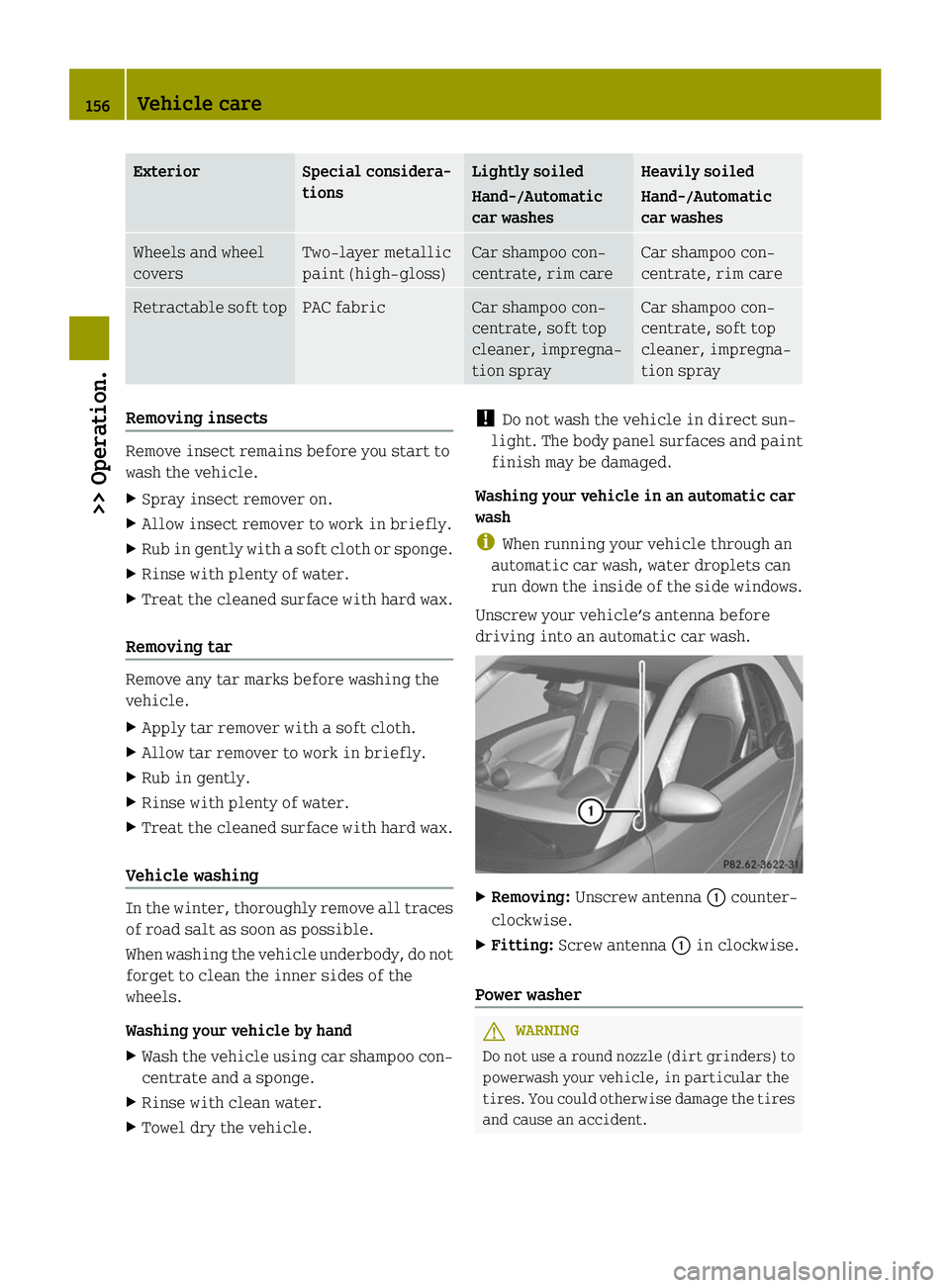
Unscrew your vehicle’s antenna before
driving into an automatic car wash. X
Removing: Unscrew antenna 0043counter-
clockwise.
X Fitting: Screw antenna 0043in clockwise.
Power washer G
WARNING
Do not use a round nozzle (dirt grinders) to
powerwash your vehicle, in particular the
tires. You could otherwise damage the tires
and cause an accident. 156
Vehicle care>> Operation.
Page 161 of 222
>> Practical hints.Where will I find ...
.......................... 160
Display messages ............................. 161
What to do if ... ............................... 166
Unlocking/locking manually ...............177
Replacing transmitter battery ............178
Replacing bulbs .............................. .179
Replacing wiper blades .....................185
Flat tire ........................................ 187
Wheel change .................................. 195
Batteries ....................................... 197
Jump starting ................................. 200
Towing .......................................... 203
Fuses ............................................ 205
Page 165 of 222
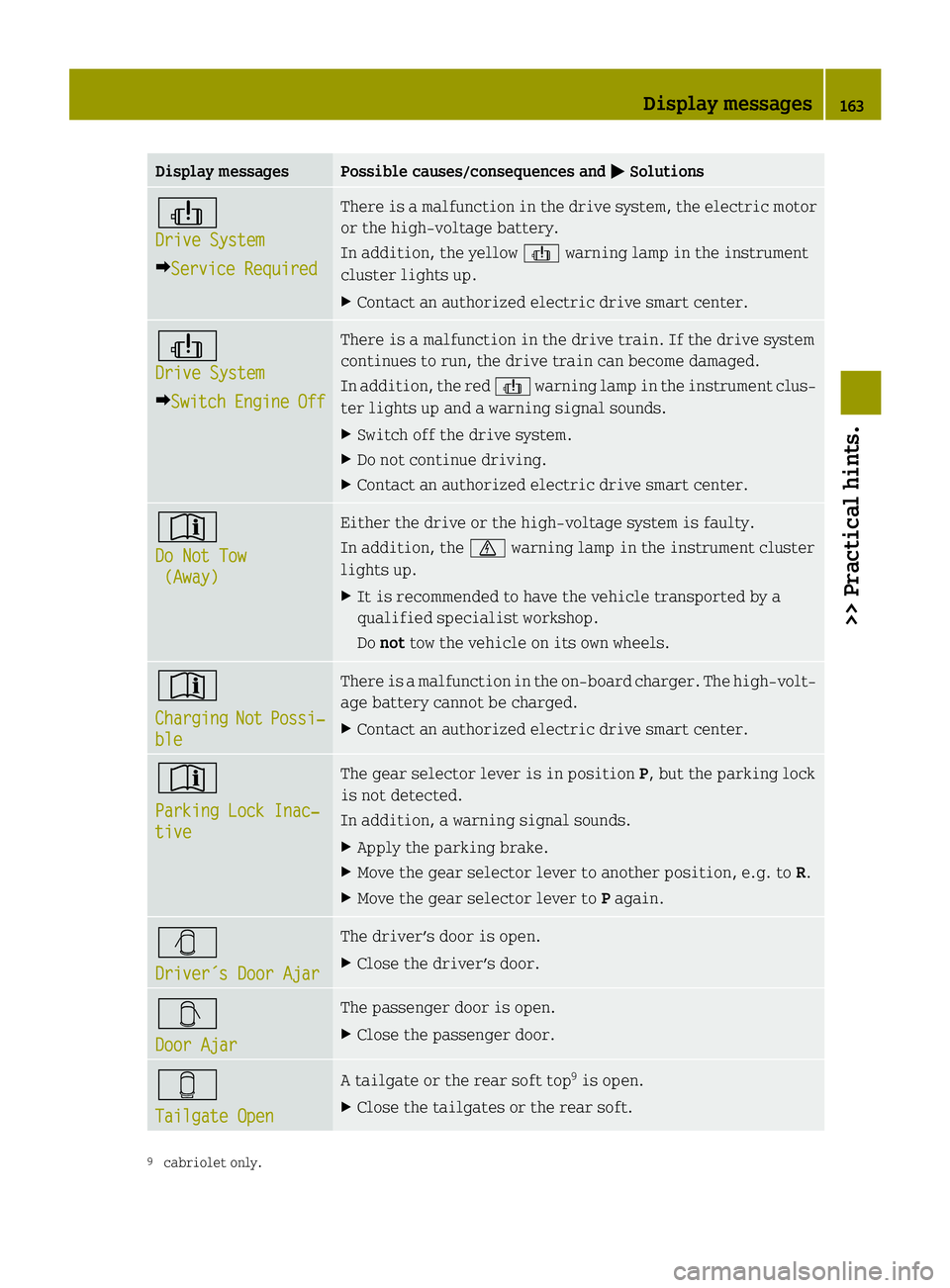
Display messages Possible causes/consequences and
0050
0050Solutions 00ED
Drive System Drive System
0096Service Required
Service Required There is a malfunction in the drive system, the electric motor
or the high‑voltage battery.
In addition, the yellow
00EDwarning lamp in the instrument
cluster lights up.
X Contact an authorized electric drive smart center. 00ED
Drive System Drive System
0096Switch
Switch Engine EngineOff
Off There is a malfunction in the drive train. If the drive system
continues to run, the drive train can become damaged.
In addition, the red
00EDwarning lamp in the instrument clus-
ter lights up and a warning signal sounds.
X Switch off the drive system.
X Do not continue driving.
X Contact an authorized electric drive smart center. 0051
Do Not Tow Do Not Tow
(Away)
(Away) Either the drive or the high‑voltage system is faulty.
In addition, the
0075warning lamp in the instrument cluster
lights up.
X It is recommended to have the vehicle transported by a
qualified specialist workshop.
Do not tow the vehicle on its own wheels. 0051
Charging Charging
Not
NotPossi‐
Possi‐
ble
ble There is a malfunction in the on-board charger. The high‑volt-
age battery cannot be charged.
X
Contact an authorized electric drive smart center. 0051
Parking Lock Inac‐ Parking Lock Inac‐
tive tive The gear selector lever is in position
P, but the parking lock
is not detected.
In addition, a warning signal sounds.
X Apply the parking brake.
X Move the gear selector lever to another position, e.g. to R.
X Move the gear selector lever to Pagain. 00DA
Driver´s Door Ajar Driver´s Door Ajar The driver’s door is open.
X
Close the driver’s door. 00DB
Door Ajar Door Ajar The passenger door is open.
X
Close the passenger door. 00D9
Tailgate Open Tailgate Open A tailgate or the rear soft top
9
is open.
X Close the tailgates or the rear soft. 9
cabriolet only. Display messages
163>> Practical hints. Z
Page 166 of 222
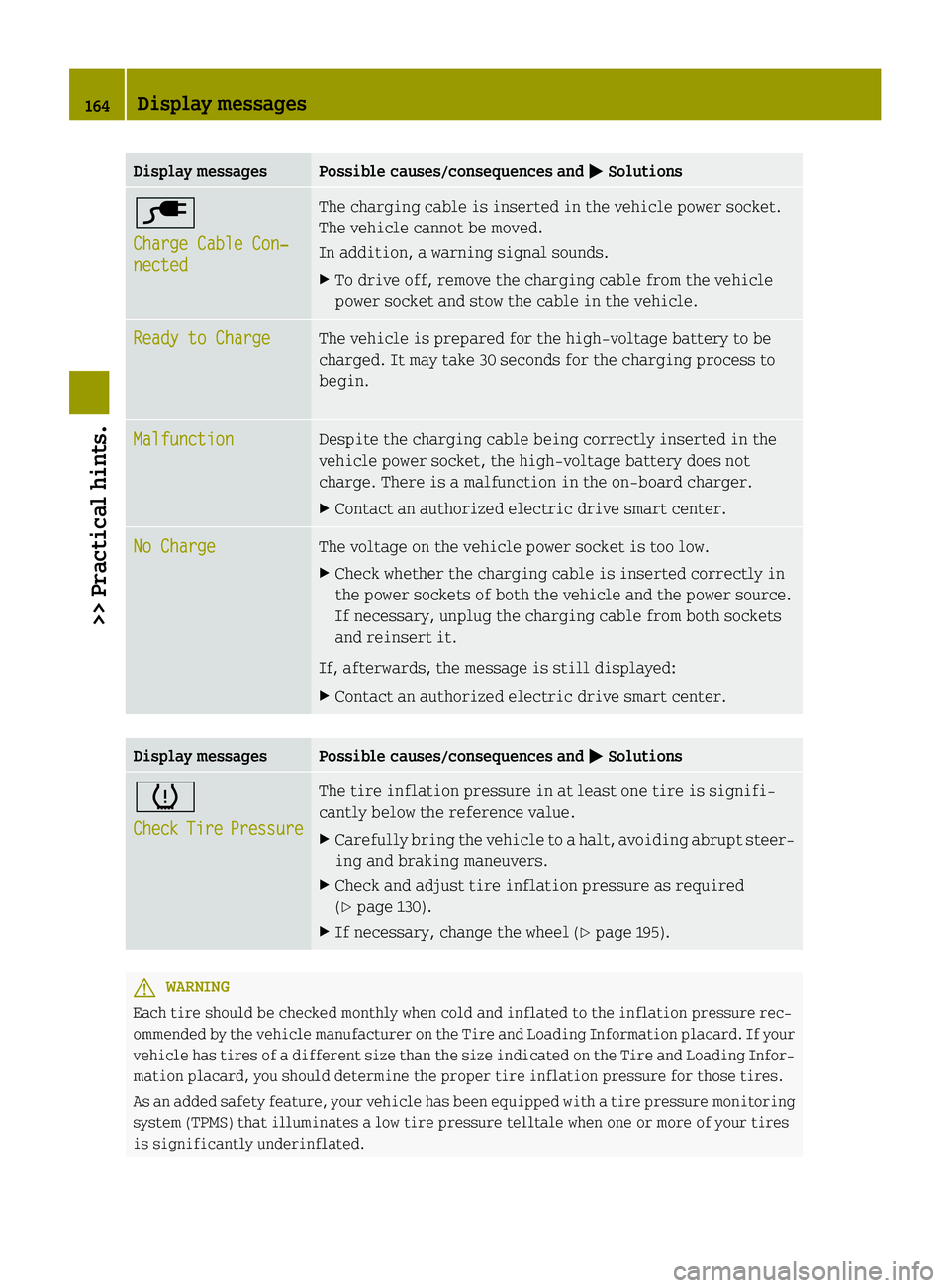
Display messages Possible causes/consequences and
0050
0050Solutions 00E5
Charge Cable Con‐ Charge Cable Con‐
nected nected The charging cable is inserted in the vehicle power socket.
The vehicle cannot be moved.
In addition, a warning signal sounds.
X
To drive off, remove the charging cable from the vehicle
power socket and stow the cable in the vehicle. Ready to Charge Ready to Charge The vehicle is prepared for the high‑voltage battery to be
charged. It may take 30 seconds for the charging process to
begin.
Malfunction Malfunction Despite the charging cable being correctly inserted in the
vehicle power socket, the high‑voltage battery does not
charge. There is a malfunction in the on-board charger.
X
Contact an authorized electric drive smart center. No Charge No Charge The voltage on the vehicle power socket is too low.
X
Check whether the charging cable is inserted correctly in
the power sockets of both the vehicle and the power source.
If necessary, unplug the charging cable from both sockets
and reinsert it.
If, afterwards, the message is still displayed:
X Contact an authorized electric drive smart center. Display messages Possible causes/consequences and
0050 0050Solutions 0077
Check Check
Tire
TirePressure
Pressure The tire inflation pressure in at least one tire is signifi-
cantly below the reference value.
X
Carefully bring the vehicle to a halt, avoiding abrupt steer-
ing and braking maneuvers.
X Check and adjust tire inflation pressure as required
(Y page 130).
X If necessary, change the wheel (Y page 195).G
WARNING
Each tire should be checked monthly when cold and inflated to the inflation pressure rec-
ommended by the vehicle manufacturer on the Tire and Loading Information placard. If your
vehicle has tires of a different size than the size indicated on the Tire and Loading Infor-
mation placard, you should determine the proper tire inflation pressure for those tires.
As an added safety feature, your vehicle has been equipped with a tire pressure monitoring
system (TPMS) that illuminates a low tire pressure telltale when one or more of your tires
is significantly underinflated. 164
Display messages>> Practical hints.
Page 167 of 222

Accordingly, when the low tire pressure telltale illuminates, you should stop and check your
tires as soon as possible, and inflate them to the proper pressure. Driving on a significantly
underinflated tire causes the tire to overheat and can lead to tire failure.
Underinflation also reduces fuel efficiency and tire tread life, and may affect the vehicle’s
handling and stopping ability. Please note that the TPMS is not a substitute for proper tire
maintenance, and it is the driver’s responsibility to maintain correct tire pressure, even
if underinflation has not reached the level to trigger illumination of the TPMS low tire
pressure telltale.
Your vehicle has also been equipped with a TPMS malfunction indicator to indicate when
the system is not operating properly. The TPMS malfunction indicator is combined with the
low tire pressure telltale. When the system detects a malfunction, the telltale will flash for
approximately 1 minute and then remain continuously illuminated.
This sequence will continue upon subsequent vehicle start-ups as long as the malfunction
exists. When the malfunction indicator is illuminated, the system may not be able to detect
or signal low tire pressure as intended.
TPMS malfunctions may occur for a variety of reasons, including the installation of incom-
patible replacement or alternate tires or wheels on the vehicle that prevent the TPMS from
functioning properly. Always check the TPMS malfunction telltale after replacing one or
more tires or wheels on your vehicle to ensure that the replacement or alternate tires and
wheels allow the TPMS to continue to function properly. Display messages Possible causes/consequences and
0050 0050Solutions 0046
Danger: Ice Danger: Ice
(Canada only) The outside temperature is below 3
¥. The road may be icy.
X Adjust your driving style to the prevailing road and weather
conditions.
X Confirming message: Press the OK button on the control lever
briefly (Y page 83). G
WARNING
The display message Danger: Danger:Ice
Iceis not designed as an ice-warning device and is therefore
unsuitable for that purpose.
Indicated temperatures just above the freezing point do not guarantee that the road surface
is free of ice. The road may still be icy, especially in wooded areas or on bridges. Your
vehicle could start to skid if you do not adjust your driving style accordingly.
Therefore, always adjust your driving style to the prevailing road and weather conditions. Display messages
165>> Practical hints. Z
Page 169 of 222
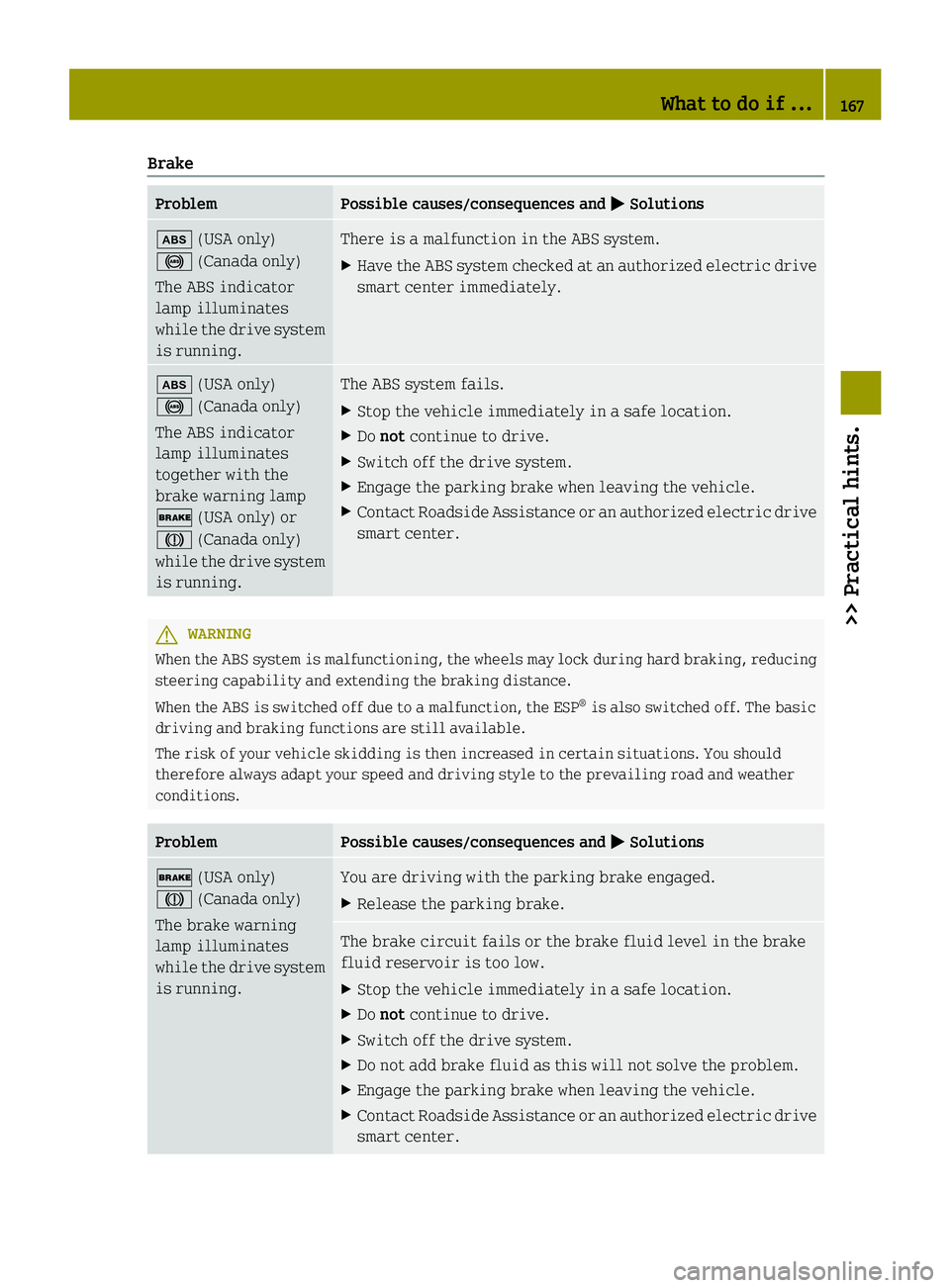
Brake
Problem Possible causes/consequences and
0050
0050Solutions 00DF
(USA only)
0025 (Canada only)
The ABS indicator
lamp illuminates
while the drive system
is running. There is a malfunction in the ABS system.
X
Have the ABS system checked at an authorized electric drive
smart center immediately. 00DF
(USA only)
0025 (Canada only)
The ABS indicator
lamp illuminates
together with the
brake warning lamp
0027 (USA only) or
004D (Canada only)
while the drive system
is running. The ABS system fails.
X
Stop the vehicle immediately in a safe location.
X Do not continue to drive.
X Switch off the drive system.
X Engage the parking brake when leaving the vehicle.
X Contact Roadside Assistance or an authorized electric drive
smart center. G
WARNING
When the ABS system is malfunctioning, the wheels may lock during hard braking, reducing
steering capability and extending the braking distance.
When the ABS is switched off due to a malfunction, the ESP ®
is also switched off. The basic
driving and braking functions are still available.
The risk of your vehicle skidding is then increased in certain situations. You should
therefore always adapt your speed and driving style to the prevailing road and weather
conditions. Problem Possible causes/consequences and
0050 0050Solutions 0027
(USA only)
004D (Canada only)
The brake warning
lamp illuminates
while the drive system
is running. You are driving with the parking brake engaged.
X
Release the parking brake. The brake circuit fails or the brake fluid level in the brake
fluid reservoir is too low.
X
Stop the vehicle immediately in a safe location.
X Do not continue to drive.
X Switch off the drive system.
X Do not add brake fluid as this will not solve the problem.
X Engage the parking brake when leaving the vehicle.
X Contact Roadside Assistance or an authorized electric drive
smart center. What to do if ...
167>> Practical hints. Z
Page 176 of 222

As an added safety feature, your vehicle has been equipped with a tire pressure monitoring
system (TPMS) that illuminates a low tire pressure telltale when one or more of your tires
is significantly underinflated.
Accordingly, when the low tire pressure telltale illuminates, you should stop and check your
tires as soon as possible, and inflate them to the proper pressure. Driving on a significantly
underinflated tire causes the tire to overheat and can lead to tire failure.
Underinflation also increases energy consumption, reduces tire tread life, and may affect
the vehicle’s handling and stopping ability. Please note that the TPMS is not a substitute
for proper tire maintenance, and it is the driver’s responsibility to maintain correct tire
pressure, even if underinflation has not reached the level to trigger illumination of the
TPMS low tire pressure telltale.
Your vehicle has also been equipped with a TPMS malfunction indicator to indicate when
the system is not operating properly. The TPMS malfunction indicator is combined with the
low tire pressure telltale. When the system detects a malfunction, the telltale will flash for
approximately 1 minute and then remain continuously illuminated.
This sequence will continue upon subsequent vehicle start-ups as long as the malfunction
exists. When the malfunction indicator is illuminated, the system may not be able to detect
or signal low tire pressure as intended.
TPMS malfunctions may occur for a variety of reasons, including the installation of incom-
patible replacement or alternate tires or wheels on the vehicle that prevent the TPMS from
functioning properly. Always check the TPMS malfunction telltale after replacing one or
more tires or wheels on your vehicle to ensure that the replacement or alternate tires and
wheels allow the TPMS to continue to function properly. 174
What to do if ...>> Practical hints.
Page 189 of 222

X
Removing: Fold the wiper arm away from
the rear window until you feel it engage.
X Fold wiper blade 0043away from the wiper
arm in direction of arrow 0044until it
disengages from its mounting.
X Detach wiper blade 0043.
X Installing: Push the new wiper blade onto
the wiper arm until you feel it engage.
X Fold the wiper blade into a position par-
allel to the wiper arm.
X Fold the wiper arm backward to rest on
the rear window.
Make sure to hold on to the wiper when
folding the wiper arm back.
! Make sure the wiper blade is properly
installed. An improperly installed
wiper blade may cause rear window dam-
age. Adjusting the washer jet nozzles
0043
Front washer jet nozzles
0044 Rear washer jet nozzles
X Adjusting: Use a needle to move washer
jet nozzles 0043or0044 left, right, up, or
down.
i Check the setting of the washer jet noz-
zles at regular intervals. The washer jet
nozzles are correctly set when the water
jet hits the windshield or the rear win-
dow approximately in the center. Flat tire
Preparing the vehicle
Upon experiencing any type of problem
with the vehicle’s tires, switch on the haz-
ard warning flasher, carefully slow down
and exit the roadway in a cautious manner.
X Park the vehicle at a safe distance from
moving traffic on a hard, flat surface
when possible.
X Make sure the tire valve of the damaged
tire is located below the horizontal axle
of the wheel hub.
X Engage the parking brake.
X Turn the steering wheel so that the front
wheels are in a straight ahead position.
X Move the gear selector lever to park
position P.
X Switch off the drive system.
X Remove the key from the starter switch
and take the key with you.
i Open door only when conditions are safe
to do so.
X Have any passenger exit the vehicle at a
safe distance from the roadway. Using the tire repair kit
! Depending on the type of damage on the
tire, the tire sealant could damage the
sensor of the Tire Pressure Monitoring
System (TPMS)*. Such damage is not cov-
ered by the smart Limited Warranty.
When having the damaged tire replaced,
also have the TPMS sensors* checked for
proper function. When the sensor is dam-
aged, the TPMS* will not function prop-
erly. The sensor must then be replaced at
an authorized electric drive smart
center as soon as possible.
i Depending on production date of your
vehicle, it will be equipped with version
1 or version 2 of the tire repair kit.
Please make sure to refer to the descrip- Flat tire
187>> Practical hints.
* optional Z
Page 190 of 222
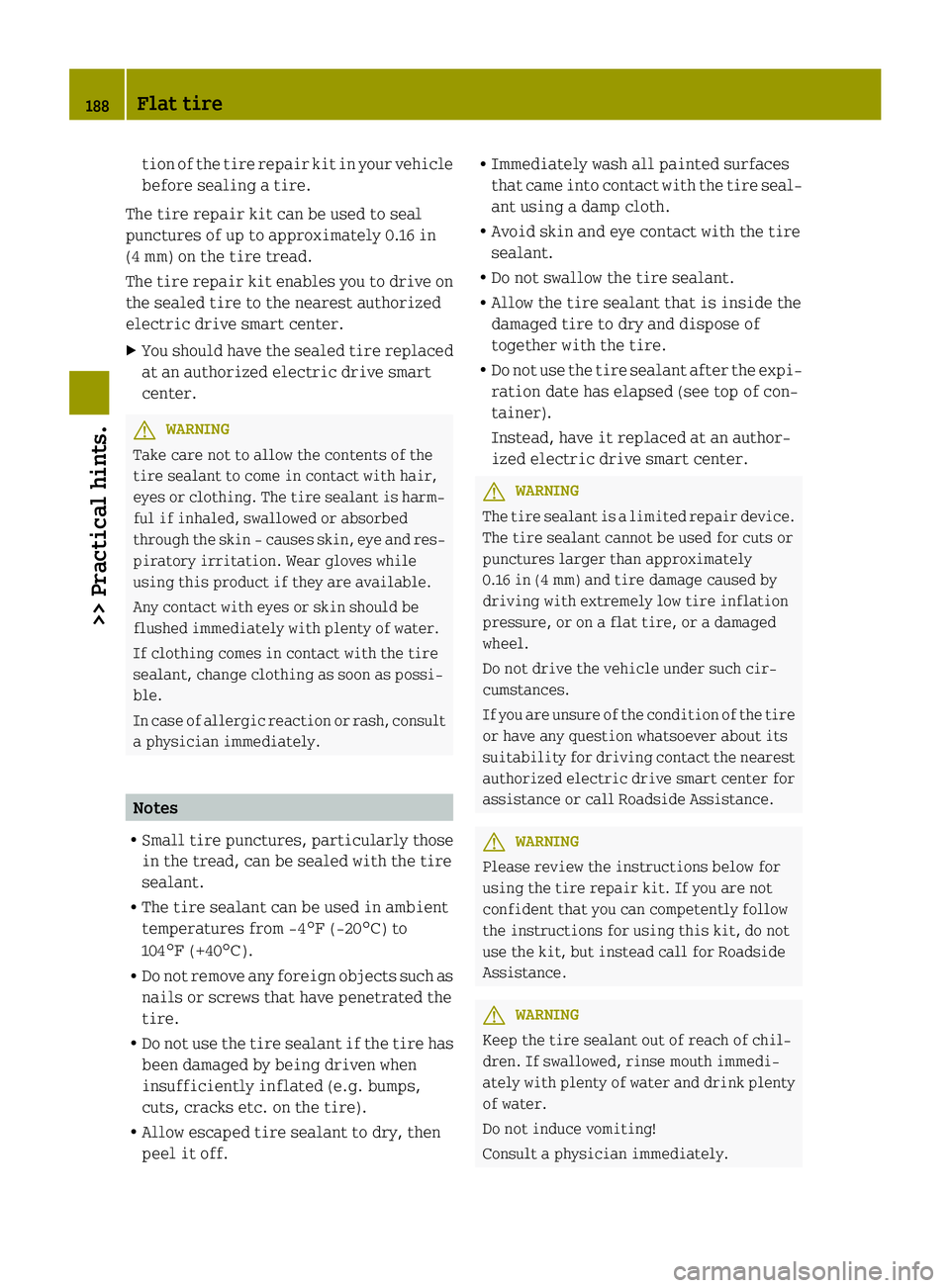
tion of the tire repair kit in your vehicle
before sealing a tire.
The tire repair kit can be used to seal
punctures of up to approximately 0.16 in
(4 mm) on the tire tread.
The tire repair kit enables you to drive on
the sealed tire to the nearest authorized
electric drive smart center.
X You should have the sealed tire replaced
at an authorized electric drive smart
center. G
WARNING
Take care not to allow the contents of the
tire sealant to come in contact with hair,
eyes or clothing. The tire sealant is harm-
ful if inhaled, swallowed or absorbed
through the skin - causes skin, eye and res-
piratory irritation. Wear gloves while
using this product if they are available.
Any contact with eyes or skin should be
flushed immediately with plenty of water.
If clothing comes in contact with the tire
sealant, change clothing as soon as possi-
ble.
In case of allergic reaction or rash, consult
a physician immediately. Notes
R Small tire punctures, particularly those
in the tread, can be sealed with the tire
sealant.
R The tire sealant can be used in ambient
temperatures from ‑4 ¦(‑20¥) to
104¦ (+40¥).
R Do not remove any foreign objects such as
nails or screws that have penetrated the
tire.
R Do not use the tire sealant if the tire has
been damaged by being driven when
insufficiently inflated (e.g. bumps,
cuts, cracks etc. on the tire).
R Allow escaped tire sealant to dry, then
peel it off. R
Immediately wash all painted surfaces
that came into contact with the tire seal-
ant using a damp cloth.
R Avoid skin and eye contact with the tire
sealant.
R Do not swallow the tire sealant.
R Allow the tire sealant that is inside the
damaged tire to dry and dispose of
together with the tire.
R Do not use the tire sealant after the expi-
ration date has elapsed (see top of con-
tainer).
Instead, have it replaced at an author-
ized electric drive smart center. G
WARNING
The tire sealant is a limited repair device.
The tire sealant cannot be used for cuts or
punctures larger than approximately
0.16 in (4 mm) and tire damage caused by
driving with extremely low tire inflation
pressure, or on a flat tire, or a damaged
wheel.
Do not drive the vehicle under such cir-
cumstances.
If you are unsure of the condition of the tire
or have any question whatsoever about its
suitability for driving contact the nearest
authorized electric drive smart center for
assistance or call Roadside Assistance. G
WARNING
Please review the instructions below for
using the tire repair kit. If you are not
confident that you can competently follow
the instructions for using this kit, do not
use the kit, but instead call for Roadside
Assistance. G
WARNING
Keep the tire sealant out of reach of chil-
dren. If swallowed, rinse mouth immedi-
ately with plenty of water and drink plenty
of water.
Do not induce vomiting!
Consult a physician immediately. 188
Flat tire>> Practical hints.
Page 194 of 222

X
Drive to the nearest authorized electric
drive smart center, to have the damaged
tire replaced.
X Contact an authorized electric drive
smart center as soon as possible to
obtain a new filler hose and a new tire
sealant container.
X Bring used tire sealant materials to an
authorized electric drive smart center
for proper disposal.
X Replace your tire sealant container
every 4 years. Replacement containers
are available at any authorized electric
drive smart center. G
WARNING
After changing a tire, contact an author-
ized electric drive smart center to make
sure the bolts holding the wheel to the car
are tight enough. Otherwise, the wheels
could come off. Each bolt should be tight-
ened to a torque of 81 lb‑ft (110 Nm). Sealing a tire (Version 2)
X Take the tire repair kit from the
passenger footwell (Y page 160).X
Take electrical plug 0087and filler hose
0084 from the bottom of the electric air
pump housing.
X Engage the yellow plug of filler hose 0084
in the opening in yellow closure cap 0083.X
With the O-ring seals towards the elec-
tric air pump housing, insert yellow clo-
sure cap 0083into fixture 0044.
X Push tire sealant container 0043into fix-
ture 0044until both hooks of yellow closure
cap 0083engage. X
Unscrew the valve cap from tire valve
006B of the damaged tire.
X Screw the end of filler hose 0084onto tire
valve 006B.
X Insert electrical plug 0087into the aux-
iliary power outlet ( Ypage 110).
X Insert the key in the starter switch and
turn it to position 1.
i The vehicle’s 12‑volt battery is drained
by use of the electric air pump. You
should therefore keep the drive system
running while inflating the tire.
X Press ONon electric air pump switch 0085.
The electric air pump is switched on and
inflates the tire.
i First, the sealant is pumped into the
tire. The pressure may briefly increase
to a high value. This is normal and not an
indication of a malfunction. Do not
switch off the electric air pump.
X Let the electric air pump inflate the tire
for a maximum of ten minutes.
The pressure gauge must display at least
200 kpa (2.0 bar, 29 psi).
! Do not operate the electric air pump
longer than ten minutes without inter-
ruption. Otherwise it may overheat. 192
Flat tire>> Practical hints.