warning SMART FORTWO COUPE ELECTRIC DRIVE 2013 User Guide
[x] Cancel search | Manufacturer: SMART, Model Year: 2013, Model line: FORTWO COUPE ELECTRIC DRIVE, Model: SMART FORTWO COUPE ELECTRIC DRIVE 2013Pages: 218, PDF Size: 2.69 MB
Page 19 of 218
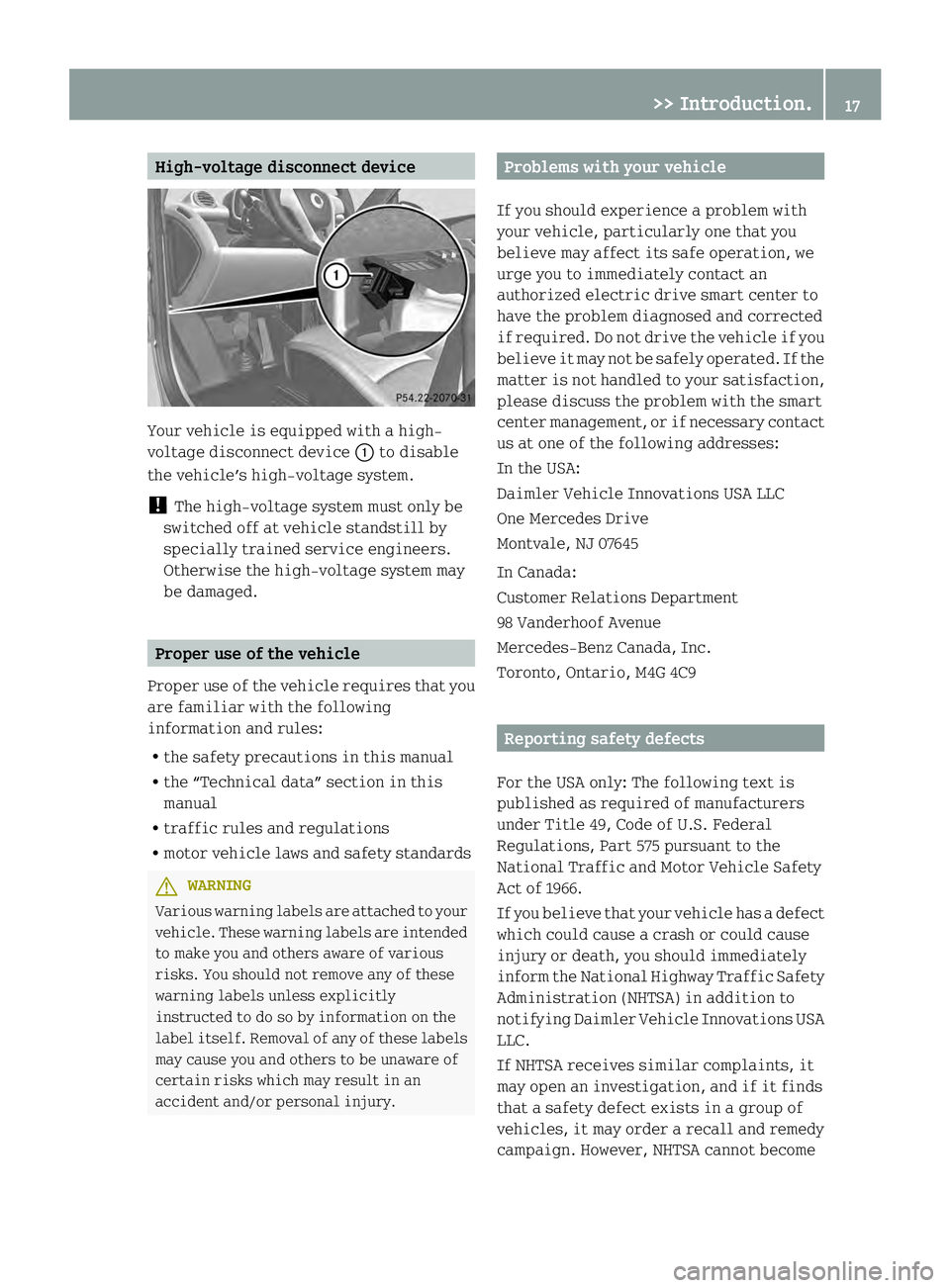
High-voltage disconnect device
Your vehicle is equipped with a high-
voltage disconnect device 0002to disable
the vehicle’s high-voltage system.
! The high-voltage system must only be
switched off at vehicle standstill by
specially trained service engineers.
Otherwise the high-voltage system may
be damaged. Proper use of the vehicle
Proper use of the vehicl erequires that you
are familiar with the following
information and rules:
R the safety precautions in this manual
R the “Technical data” section in this
manual
R traffic rules and regulations
R motor vehicle laws and safety standards G
WARNING
Various warning labels are attached to your
vehicle. These warning labels are intended
to make you and others aware of various
risks. You should not remove any of these
warning labels unless explicitly
instructed to do so by information on the
label itself. Removal of any of these labels
may cause you and others to be unaware of
certain risks which may result in an
accident and/or personal injury. Problems with your vehicle
If you should experience a problem with
your vehicle, particularly one that you
believe may affect its safe operation, we
urge you to immediately contact an
authorized electric drive smart center to
have the problem diagnosed and corrected
if required. Do not drive the vehicle if you
believe it may not be safely operated. If the
matter is not handled to your satisfaction,
please discuss the problem with the smart
center management, or if necessary contact
us at one of the following addresses:
In the USA:
Daimler Vehicle Innovations USA LLC
One Mercedes Drive
Montvale, NJ 07645
In Canada:
Customer Relations Department
98 Vanderhoof Avenue
Mercedes-Benz Canada, Inc.
Toronto, Ontario, M4G 4C9 Reporting safety defects
For the USA only: The following text is
published as required of manufacturers
under Title 49, Code of U.S. Federal
Regulations, Part 575 pursuant to the
National Traffic and Motor Vehicle Safety
Act of 1966.
If you believe that your vehicle has adefect
which could cause a crash or could cause
injury or death, you should immediately
inform the National Highway Traffic Safety
Administration (NHTSA) in addition to
notifying Daimler Vehicle Innovations USA
LLC.
If NHTSA receives similar complaints, it
may open an investigation, and if it finds
that a safety defect exists in a group of
vehicles, it may order a recall and remedy
campaign. However, NHTSA cannot become >> Introduction.
17 Z
Page 23 of 218
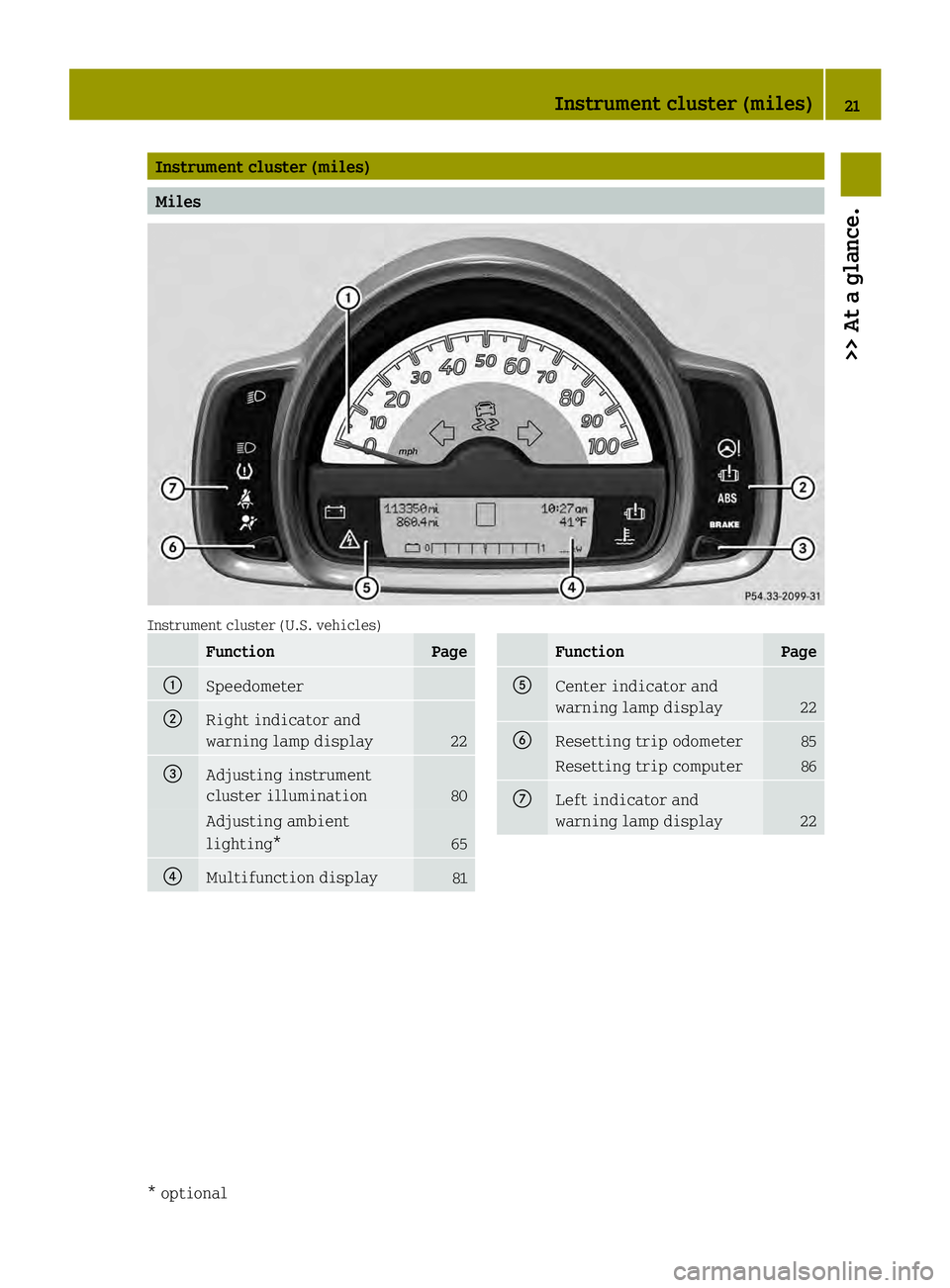
Instrument cluster (miles)
Miles
Instrument cluster (U.S. vehicles)
Function Page
0002
Speedometer
0003
Right indicator and
warning lamp display
22
002B
Adjusting instrument
cluster illumination
80
Adjusting ambient
lighting*
65
002A
Multifunction display
81 Function Page
0028
Center indicator and
warning lamp display
22
0029
Resetting trip odometer 85
Resetting trip computer 86
0018
Left indicator and
warning lamp display
22Instrument cluster (miles)
21>> At a glance.
* optional
Page 24 of 218
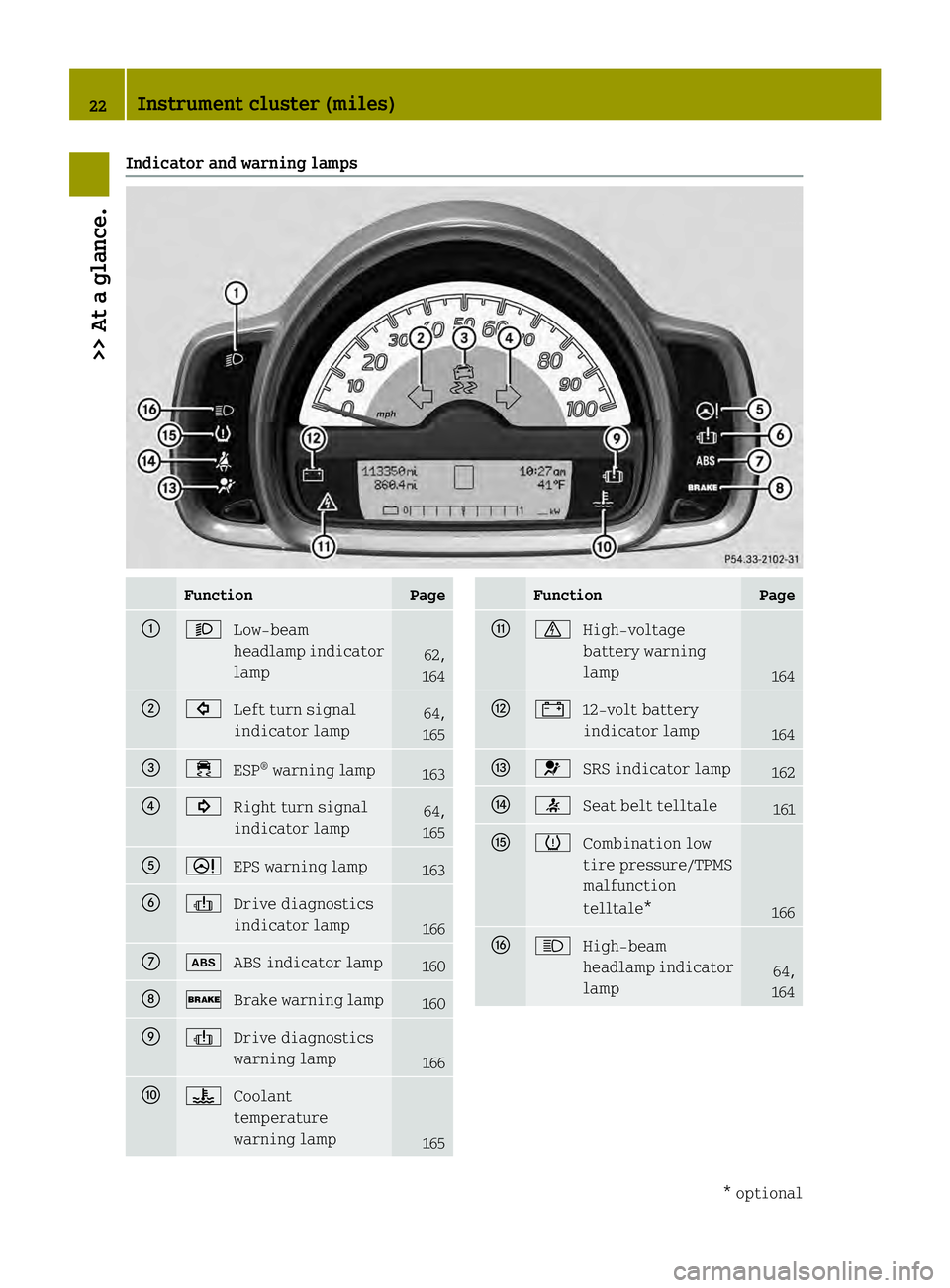
Indicator and warning lamps
Function Page
0002
0003
Low‑beam
headlamp indicator
lamp 62,
164 0003
0003
Left turn signal
indicator lamp 64,
165 002B
0004
ESP®
warning lamp 163
002A
0002
Right turn signal
indicator lamp 64,
165 0028
0002
EPS warning lamp 163
0029
0001
Drive diagnostics
indicator lamp 166
0018
0005
ABS indicator lamp 160
0019
0002
Brake warning lamp 160
001A
0001
Drive diagnostics
warning lamp 166
001B
0005
Coolant
temperature
warning lamp 165 Function Page
001D
0002
High-voltage
battery warning
lamp 164
001E
0004
12-volt battery
indicator lamp 164
0020
000A
SRS indicator lamp 162
0021
000B
Seat belt telltale 161
0022
0008
Combination low
tire pressure/TPMS
malfunction
telltale* 166
0023
0001
High‑beam
headlamp indicator
lamp 64,
164 22
Instrument cluster (miles)>> At a glance.
* optional
Page 25 of 218
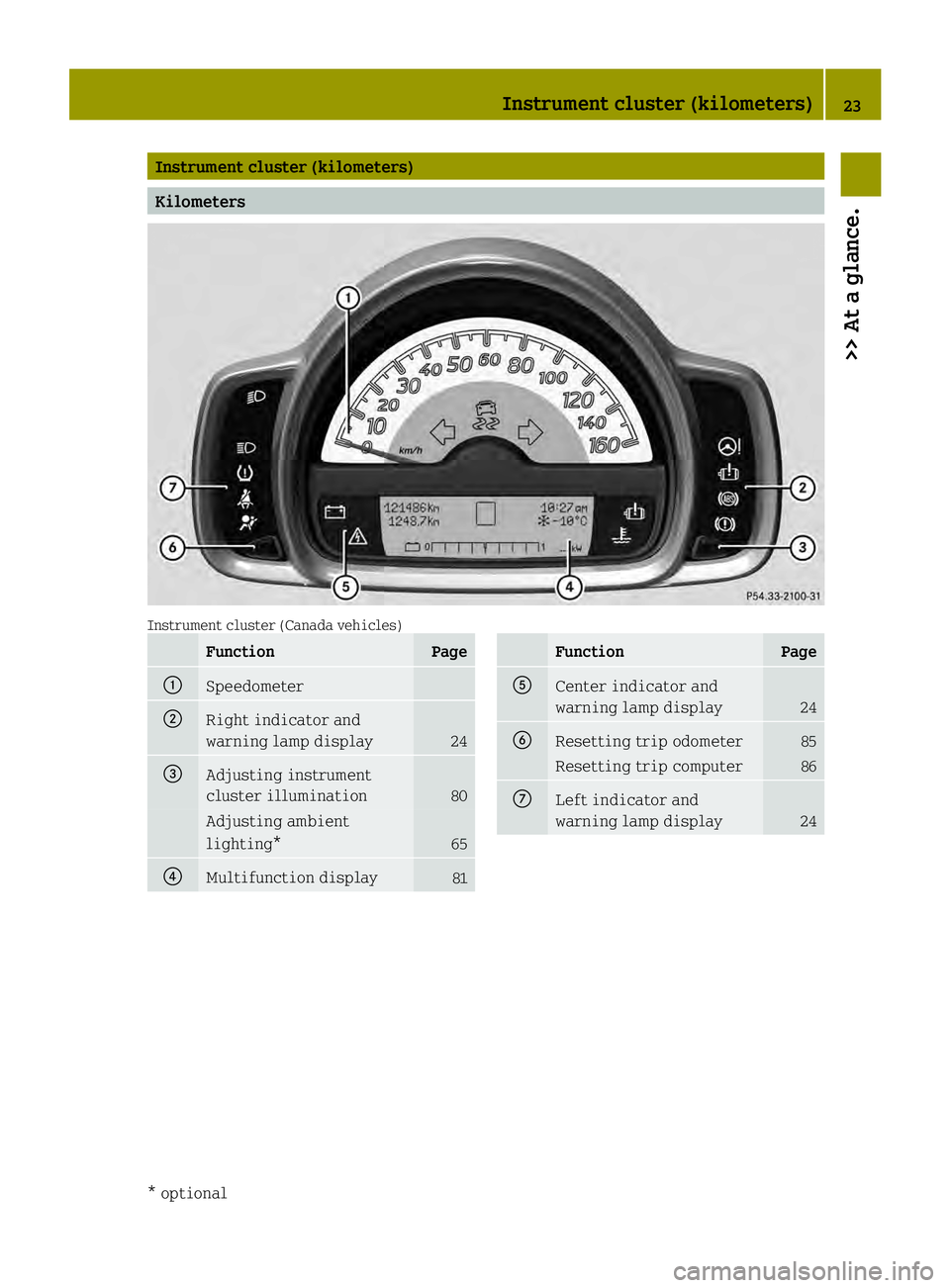
Instrument cluster (kilometers)
Kilometers
Instrument cluster (Canada vehicles)
Function Page
0002
Speedometer
0003
Right indicator and
warning lamp display
24
002B
Adjusting instrument
cluster illumination
80
Adjusting ambient
lighting*
65
002A
Multifunction display
81 Function Page
0028
Center indicator and
warning lamp display
24
0029
Resetting trip odometer 85
Resetting trip computer 86
0018
Left indicator and
warning lamp display
24Instrument cluster (kilometers)
23>> At a glance.
* optional
Page 26 of 218
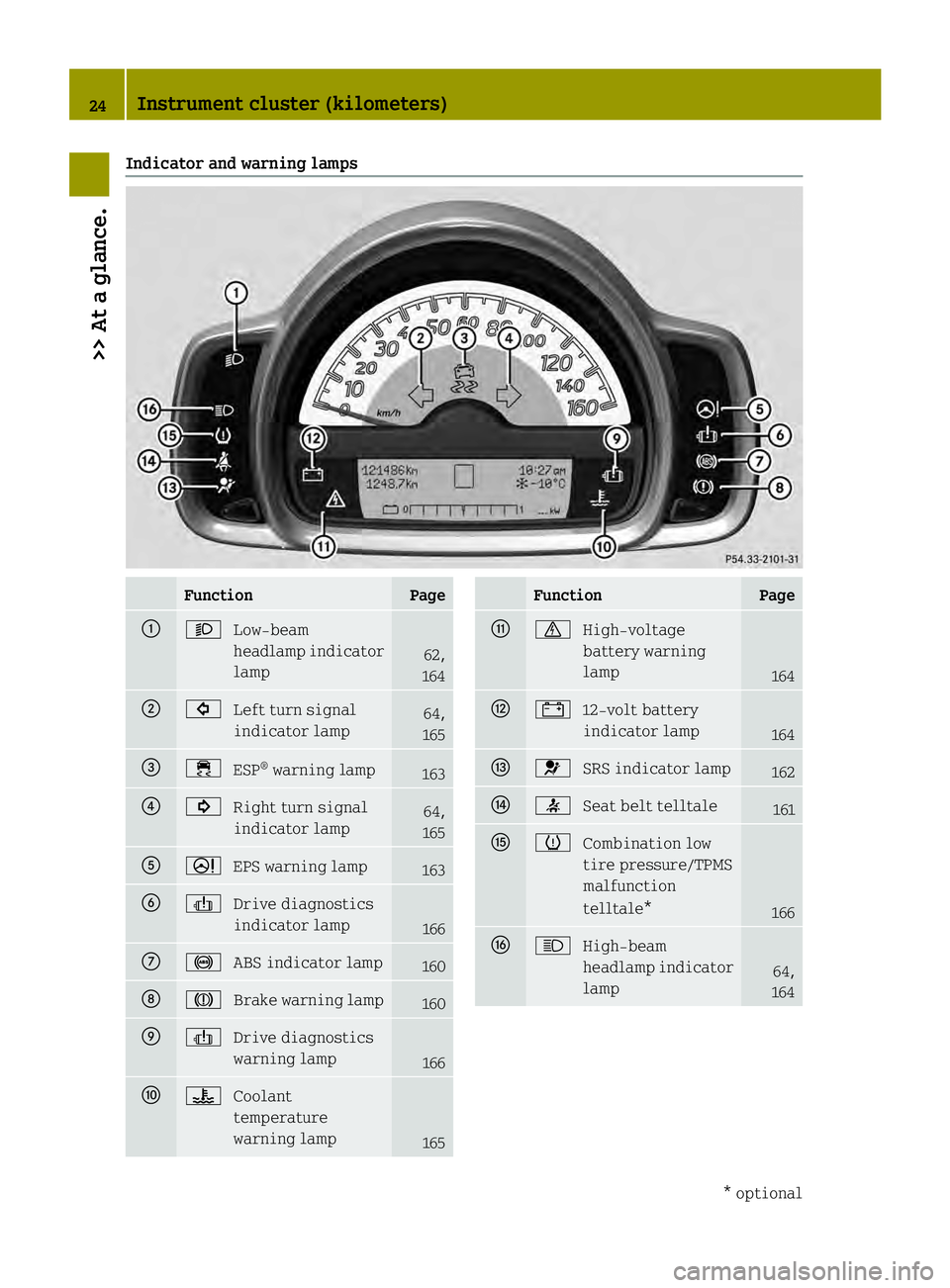
Indicator and warning lamps
Function Page
0002
0003
Low‑beam
headlamp indicator
lamp 62,
164 0003
0003
Left turn signal
indicator lamp 64,
165 002B
0004
ESP®
warning lamp 163
002A
0002
Right turn signal
indicator lamp 64,
165 0028
0002
EPS warning lamp 163
0029
0001
Drive diagnostics
indicator lamp 166
0018
0008
ABS indicator lamp 160
0019
0001
Brake warning lamp 160
001A
0001
Drive diagnostics
warning lamp 166
001B
0005
Coolant
temperature
warning lamp 165 Function Page
001D
0002
High-voltage
battery warning
lamp 164
001E
0004
12-volt battery
indicator lamp 164
0020
000A
SRS indicator lamp 162
0021
000B
Seat belt telltale 161
0022
0008
Combination low
tire pressure/TPMS
malfunction
telltale* 166
0023
0001
High‑beam
headlamp indicator
lamp 64,
164 24
Instrument cluster (kilometers)>> At a glance.
* optional
Page 27 of 218
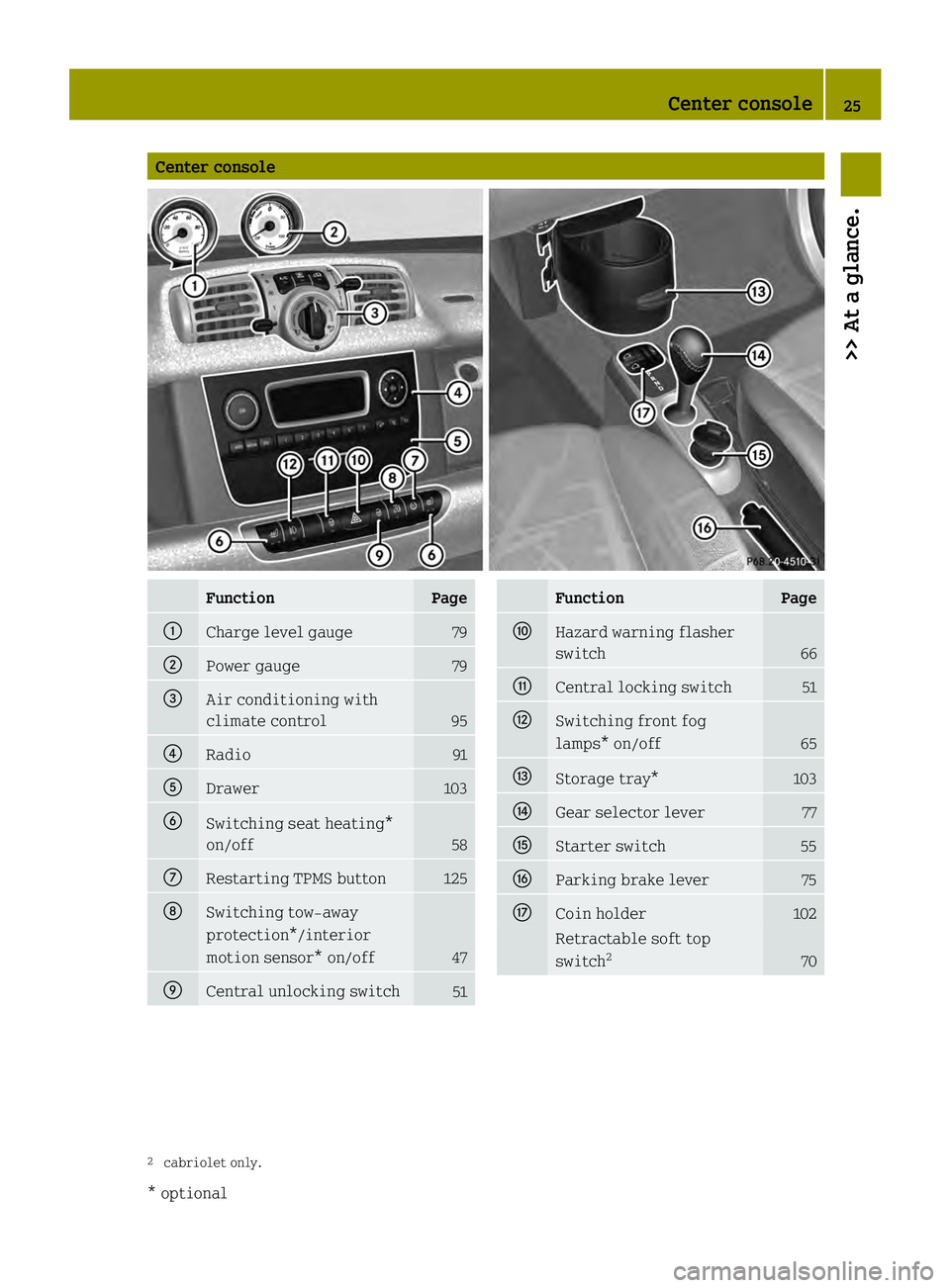
Center console
Function Page
0002
Charge level gauge 79
0003
Power gauge 79
002B
Air conditioning with
climate control
95
002A
Radio 91
0028
Drawer 103
0029
Switching seat heating*
on/off
58
0018
Restarting TPMS button 125
0019
Switching tow-away
protection*/interior
motion sensor* on/off
47
001A
Central unlocking switch
51 Function Page
001B
Hazard warning flasher
switch
66
001D
Central locking switch 51
001E
Switching front fog
lamps* on/off
65
0020
Storage tray* 103
0021
Gear selecto
rlever 77
0022
Starter switch 55
0023
Parking brake lever 75
0024
Coin holder 102
Retractable soft top
switch
2 70
2
cabriolet only. Center console
25>> At a glance.
* optional
Page 30 of 218
Occupant safety
Introduction
The smart vehicle is equipped with seat
belts and dual stage air bags to protect you
in acrash. However, children can be killed
or seriously injured by an inflating air
bag. Indeed, there is a stronger risk of
serious death or bodily injury when an air
bag deploys on a child positioned in a
rear-facing child seat in the passenger
seat. Because this vehicle has only two
front seats and no backseat, it is limited
as are other two-seat vehicles, in the
extent to which it may restrain children
traveling in the passenger front seat. Many
states have laws against placing children
of certain ages in the front seat of a
vehicle that has both front and back seats.
Those laws make exceptions to permit
childre nto be restrained in the front seat
of two seat vehicles. Special instructions
and warnings are provided below about
when and if you may restrain a child in the
passenger seat of the smart vehicle. Under
certain circumstances, it is appropriate
for the passenger air bag not to operate
when a child is restrained in a car seat in
the passenger seat, and this vehicle is
equipped with technology to accomplish
this. Please pay very close attention to the
instructions and warnings below,
particularly as they relate to children.
In this section you will learn the most
important facts about the restraint system
components of the vehicle.
The restraint systems are:
R Seat belts (Y page 29)
R Child restraints (Y page 41) Additional protection potential is
provided by:
R
Supplemental RestraintSystem (SRS)
with
- Air bags (Y page 31)
- Air bag control unit (with crash
sensors)
- Emergency Tensioning Devices and
seat belt force limiters (Y page 31)
R Air bag system components with
-Passenger front air bag off indicator
lamp (Y page 39)
- Passenger seat with Occupant
Classification System (OCS)
(Y page 37)
Although independents ystems, their
protective functions work in conjunction
with each other.
i For information on infants and
children traveling with you in the
vehicle and restraint systems for infants
and children, see “Children in the
vehicle” (Y page 40).
The SRS system conducts a self-test when
the ignition is switched on and in regular
intervals while the engine is running. This
facilitates detection of malfunctions. The
SRS indicator lamp 000Ain the instrument
cluster comes on when the ignition is
switched on and goes out after
approximately four seconds.
The SRS components are in operational
readiness if the SRS indicator lamp 000A
is not lit when the engine is running.
A malfunction in the system has been
detected if the SRS indicator lamp 000A
R fails to go out after approximately 4
seconds after the ignition was switched
on
R does not come on at all
R comes on after the engine was started or
while driving 28
Occupant safety>> Safety.
Page 31 of 218
G
WARNING
Modifications to or work improperly
conducted on restraint systems (such as
seat belts and anchors, Emergency
Tensioning Devices, seat belt force
limiters or air bags) or their wiring, as
well as tampering with interconnected
electronic systems, can lead to the
restraint systems no longer functioning as
intended. Air bags or Emergency
Tensioning Devices, for example, could
deploy inadvertently or fail to deploy in
accidents in which they otherwise should
deploy (although the deceleration
threshold for air bag deployment is
exceeded). Therefore, never modify the
restraint systems. Do not tamper with
electronic components or their software. G
WARNING
In the event that the SRS indicator lamp
000A comes on while driving or does not
come on at all, the SRS self-check has
detected a malfunction. For your safety, we
strongly recommend that you immediately
but safely pull the vehicle off of the
roadway and stop driving. Contact an
authorized electric drive smart center
immediately to have the system checked;
otherwise the SRS may not deploy when
needed in an accident, which could result
in serious or fatal injury, or it might
deploy unexpectedly and unnecessarily
which could also result in injury.
In addition, improper repair work on the
SRS creates a risk of rendering the SRS
inoperative or causing unintended air bag
deployment. Work on the SRS must therefore
only be performed by qualified
technicians. Contact an authorized
electric drive smart center. If it is
necessary to modify an air bag system to
accommodate a person with disabilities,
contact your local authorized electric
drive smart center. Seat belts
The use of seat belts and infant and child
restraint systems is require dbylaw in all
50 states, the District of Columbia, the U.S.
territories and all Canadian provinces and
territories.
Even where this is not the case, all vehicle
occupants should have their seat belts
fastened whenever the vehicle is being
operated.
For more information, see “Fastening the
seat belts” (Y page 60).
i For information on infants and
children traveling with you in the
vehicle and restraint systems for infants
and children, see “Children in the
vehicle” (Y page 40). G
WARNING
Always fasten your seat belt before driving.
Always make sure all of your passengers are
properly restrained.
Failure to wear and properly fasten and
position your seat belt greatly increases
your risk of injuries and their likely
severity in an accident. You and your
passenger should always wear seat belts.
If you are ever in an accident, your injuries
can be considerably more severe without
your seat belt properly buckled.
Without your seat belt buckled, you are
much more likely to hit the interior of the
vehicle or be ejected from it. You can be
seriously injured or killed.
In the same crash, the possibility of injury
or death is lessened if you are properly
wearing your seat belt. Air bags can only
protect you if you are properly wearing
your seat belt. G
WARNING
Never ride in amoving vehicle with the seat
backrest in an excessively reclined
position as this can be dangerous. You
could slide under the seat belt in a Occupant safety
29>> Safety.
Z
Page 32 of 218
collision. If you slide under it, the belt
would apply force at the abdomen or neck,
causing serious or even fatal injuries. The
seat backrest and seat belt provide the best
restraint when the wearer is in a position
that is as upright as possible and the belt
is properly positioned on the body.
G
WARNING
Never let more people ride in the vehicle
than there are seat belts available. Make
sure everyone riding in the vehicle is
correctly restrained with a separate seat
belt. Never use a seat belt for more than one
person at a time. G
WARNING
Seat belts of a vehicle involved in an
accident must be inspected by smart. Only
then is it possible to determine whether
the seat belts were damaged or stressed in
the accident. Damaged or stressed seat
belts may not properly protect you in a
subsequent accident.
Only use seat belts which have been
approved by smart.
Do not make any modifications to the seat
belts. This can lead to unintended
activation of the Emergency Tensioning
Devices (ETDs) or to their failure to
activate when necessary.
Do not bleach or dye seat belts as this may
severely weaken them. In a crash, they may
not be able to provide adequate protection.
Have all work carried out only by qualified
technicians. Contact an authorized
electric drive smart center. G
WARNING
USE SEAT BELTS PROPERLY
R Seat belts can only work when used
properly. Never wear seat belts in any
other way than as described in this section, as that could result in serious
injuries in case of an accident.
R Each occupant should wear their seat belt
at all times, because seat belts help
reduce the likelihood of and potential
severity of injuries in accidents,
including rollovers. The integrated
restraint system includes SRS (driver
front air bag, passenger front air bag,
head-thorax air bags) and Emergency
Tensioning Devices (ETDs) with seat belt
force limiters.
The system is designed to enhance the
protection provided by secured seat
belts in certain frontal and side
impacts.
R Never wear the shoulder belt under your
arm, against your neck or off your
shoulder. Doing so may cause your body to
move too far forward in a frontal crash,
which would increase the chance of head
and neck injuries. The seat belt would
also apply too much force to the ribs or
abdomen, which could severely injure
internal organs such as your liver or
spleen.
R Never wear seat belts over rigid or
breakable objects in or on your clothing,
such as eyeglasses, pens, keys, etc., as
these might cause injuries.
R Position the lap belt as low as possible
on your hips and not across the abdomen.
If the lap seat belt is positioned across
your abdomen, it could cause serious
injuries in a crash.
R Never use a seat belt for more than one
person at a time. Do not fasten a seat belt
around a person and another person or
other objects at the same time.
R Seat belts should not be worn twisted. In
a crash, you would not have the full width
of the seat belt to manage impact forces.
The twisted seat belt against your body
could cause injuries.
R Pregnant women should also always use a
lap-shoulder belt. The lap belt portion 30
Occupant safety>> Safety.
Page 33 of 218
should be positioned as low as possible
on the hips to avoid any possible
pressure on the abdomen.
R Never place your feet on the instrument
panel, dashboard or on the seat. Always
keep both feet on the floor in front of the
seat.
R When using a seat belt to secure infan tor
toddler restraints or children in booster
seats, always follow the child seat
manufacturer’s instructions. Emergency Tensioning Devices (ETDs)
and seat belt force limiters
The seat belts are equipped with
Emergency Tensioning Devices and seat
belt force limiters.
Emergency Tensioning Devices are
designed to activate in the following
cases:
R in frontal or rear-end impacts
exceeding the system deployment
threshold
R if the restraint systems are operational
and functioning correctly
R in collisions with high vehicle
deceleration/acceleration in the
longitudinal direction, e.g. ahead-on
collision
R on passenger side when the seat is
occupied and the seat belt is fastened
R independently of the front air bags
When activated, Emergency Tensioning
Devices remove slack from the seat belts in
such a way that the seat belts fit more
snugly against the body. Seat belt force
limiters, when activated, reduce the force
exerted by the seat belts on occupants
during a crash.
When the emergency tensioning device is
triggered, the SRS indicator lamp 000Ain
the instrument cluster illuminates, see
“SRS indicator lamp” (Y page 162). G
WARNING
Once they have been triggered, Emergency
Tensioning Devices will no longer function
properly and must be replaced. smart
recommends that you visit a qualified
workshop to have this done. In particular,
work relevant to safety or on safety-related
systems must be carried out at a qualified
specialist workshop.
Comply with safety regulations when
disposing of Emergency Tensioning
Devices. These regulations are available at
any smart center.
The belt force limiter is designed to
operate in unison with the front air bag,
which absorbs a portion of the seat belt’s
decelerating forces, distributing the load
over a larger area.
In the event of a head-on or rear-end
collision, the emergency tensioning
device is activated if the vehicle is
decelerated or accelerated sufficiently in
the longitudinal direction at the start of
impact with the ignition switched on. Air bags
Air bags can reduce the severity of
injuries in serious collisions, e.g. in a
head-on collision or a side impact. G
WARNING
Air bags are designed to reduce the
potential of injury in certain frontal
impacts (front air bags and knee bags), or
side impacts (head-thorax air bags,
window curtain air bags and thorax-pelvis
air bags) which may cause significant
injuries. However, no system available
today can completely eliminate injuries
and fatalities.
The deployment of the air bags temporarily
releases a small amount of dust from the air
bags. This dust is neither injurious to your
health, nor does it indicate a fire in the
vehicle. The dust might cause some Occupant safety
31>> Safety.
Z