ESP SMART FORTWO COUPE ELECTRIC DRIVE 2014 User Guide
[x] Cancel search | Manufacturer: SMART, Model Year: 2014, Model line: FORTWO COUPE ELECTRIC DRIVE, Model: SMART FORTWO COUPE ELECTRIC DRIVE 2014Pages: 222, PDF Size: 16.17 MB
Page 28 of 222
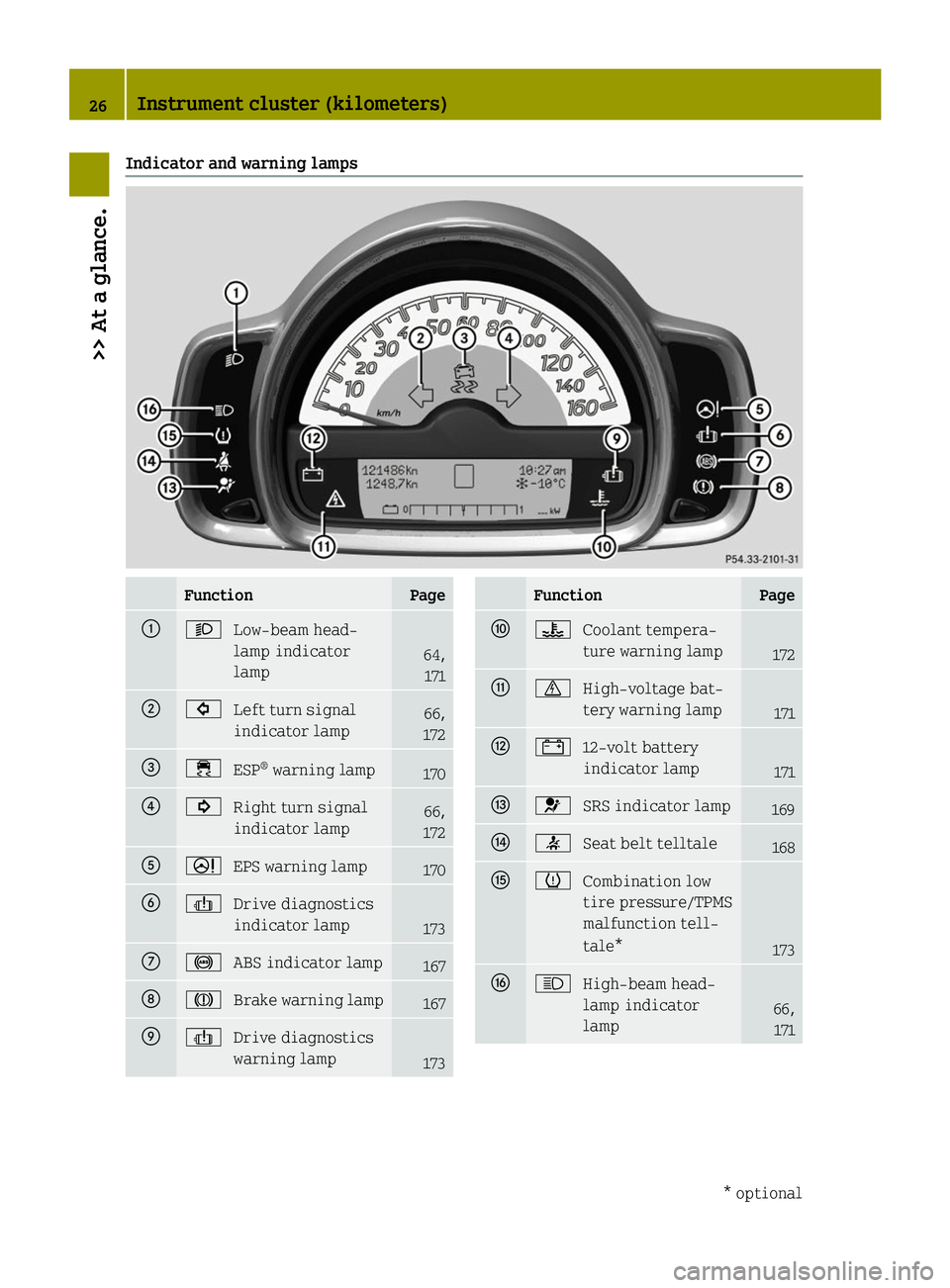
Indicator and warning lamps
Function Page
0043
0059
Low‑beam head-
lamp indicator
lamp 64,
171 0044
003E
Left turn signal
indicator lamp 66,
172 0087
00E5
ESP®
warning lamp 170
0085
003D
Right turn signal
indicator lamp 66,
172 0083
0052
EPS warning lamp 170
0084
00ED
Drive diagnostics
indicator lamp 173
006B
0025
ABS indicator lamp 167
006C
004D
Brake warning lamp 167
006D
00ED
Drive diagnostics
warning lamp 173 Function Page
006E
00AC
Coolant tempera-
ture warning lamp 172
006F
0075
High-voltage bat-
tery warning lamp 171
0070
003D
12-volt battery
indicator lamp 171
0071
0075
SRS indicator lamp 169
0072
0076
Seat belt telltale 168
0073
0077
Combination low
tire pressure/TPMS
malfunction tell-
tale* 173
0074
0057
High‑beam head-
lamp indicator
lamp 66,
171 26
Instrument cluster (kilometers)>> At a glance.
* optional
Page 36 of 222
G
WARNING
To reduce the risk of injury when the front
air bags inflate, it is very important for
the driver and passenger to always be in a
properly seated position and to wear their
respective seat belt.
For maximum protection in the event of a
collision always be in normal seated posi-
tion with your back against the backrest.
Fasten your seat belt and ensure it is prop-
erly positioned on your body.
Since the air bag inflates with considera-
ble speed and force, a proper seating and
hands on steering wheel position will help
to keep you at a safe distance from the air
bag.
Occupants who are unbelted, out of position
or too close to the air bag can be seriously
injured or killed by an air bag as it
inflates extremely quickly and with great
force:
R Sit properly belted in a position that is
as upright as possible with your back
against the seat backrest.
R Adjust the driver’s seat as far as possible
rearward, still permitting proper oper-
ation of vehicle controls. The distance
from the center of the driver’s breast-
bone to the center of the air bag cover on
the steering wheel must be at least
10 inches (25 cm) or more. You should be
able to accomplish this by adjustments to
the seat. If you have any problems, please
contact an authorized electric drive
smart center.
R Do not lean your head or chest close to the
steering wheel or dashboard.
R Keep hands on the outside of the steering
wheel rim. Placing hands and arms inside
the rim can increase the risk and poten-
tial severity of hand/arm injury when the
driver’s front air bag inflates. R
Adjust the passenger seat as far as pos-
sible rearward from the dashboard when
the seat is occupied.
R Occupants, especially children, should
never place their bodies or lean their
heads in the area of the door where the
head-thorax air bag (cabriolet) or
thorax-pelvis side air bag (coupé)
inflates. This could result in serious
injuries or death should the head-thorax
air bag (cabriolet) or thorax-pelvis side
air bag (coupé) be deployed. Always sit
as upright as possible, wear the seat belt
properly and use an appropriately sized
infant restraint, toddler restraint, or
booster seat recommended for the size
and weight of the child.
Failure to follow these instructions can
result in severe injuries to you or other
occupants.
If you sell your vehicle, it is important that
you make the buyer aware of this safety
information. Be sure to give the buyer this
Operator’s Manual.
i Air bags are designed to deploy only in
certain frontal impacts (front air bags
and knee bags), or side impacts (head-
thorax air bags, window curtain air bags
and thorax-pelvis air bags) which
exceed preset thresholds. Only during
these events will they provide their sup-
plemental protection.
The driver and passenger should always
wear their seat belts. Otherwise it is not
possible for air bags to provide their
supplemental protection.
In case of other types of impacts and
impacts below air bag deployment
thresholds, air bags will not deploy. The
driver and passenger will then be pro-
tected to the extent possible by a prop-
erly fastened seat belt. A properly fas-
tened seat belt is also needed to provide
the best possible protection in a roll-
over. 34
Occupant safety>> Safety.
Page 39 of 222
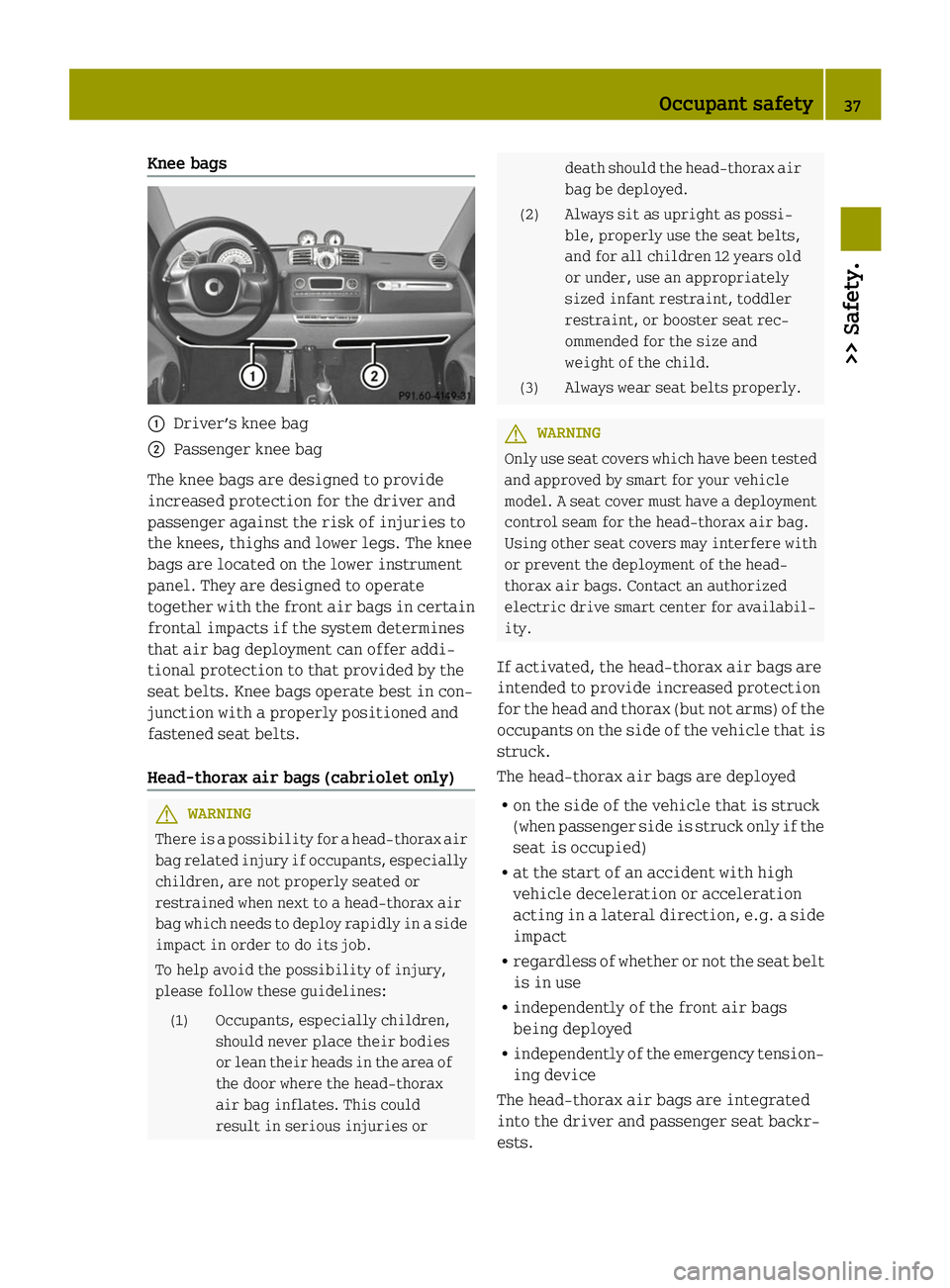
Knee bags
0043
Driver’s knee bag
0044 Passenger knee bag
The knee bags are designed to provide
increased protection for the driver and
passenger against the risk of injuries to
the knees, thighs and lower legs. The knee
bags are located on the lower instrument
panel. They are designed to operate
together with the front air bags in certain
frontal impacts if the system determines
that air bag deployment can offer addi-
tional protection to that provided by the
seat belts. Knee bags operate best in con-
junction with a properly positioned and
fastened seat belts.
Head-thorax air bags (cabriolet only) G
WARNING
There is a possibility for a head-thorax air
bag related injury if occupants, especially
children, are not properly seated or
restrained when next to a head-thorax air
bag which needs to deploy rapidly in a side
impact in order to do its job.
To help avoid the possibility of injury,
please follow these guidelines:
(1) Occupants, especially children, should never place their bodies
or lean their heads in the area of
the door where the head-thorax
air bag inflates. This could
result in serious injuries or death should the head-thorax air
bag be deployed.
(2) Always sit as upright as possi- ble, properly use the seat belts,
and for all children 12 years old
or under, use an appropriately
sized infant restraint, toddler
restraint, or booster seat rec-
ommended for the size and
weight of the child.
(3) Always wear seat belts properly. G
WARNING
Only use seat covers which have been tested
and approved by smart for your vehicle
model. A seat cover must have a deployment
control seam for the head-thorax air bag.
Using other seat covers may interfere with
or prevent the deployment of the head-
thorax air bags. Contact an authorized
electric drive smart center for availabil-
ity.
If activated, the head-thorax air bags are
intended to provide increased protection
for the head and thorax (but not arms) of the
occupants on the side of the vehicle that is
struck.
The head-thorax air bags are deployed
R on the side of the vehicle that is struck
(when passenger side is struck only if the
seat is occupied)
R at the start of an accident with high
vehicle deceleration or acceleration
acting in a lateral direction, e.g. a side
impact
R regardless of whether or not the seat belt
is in use
R independently of the front air bags
being deployed
R independently of the emergency tension-
ing device
The head-thorax air bags are integrated
into the driver and passenger seat backr-
ests. Occupant safety
37>> Safety. Z
Page 40 of 222
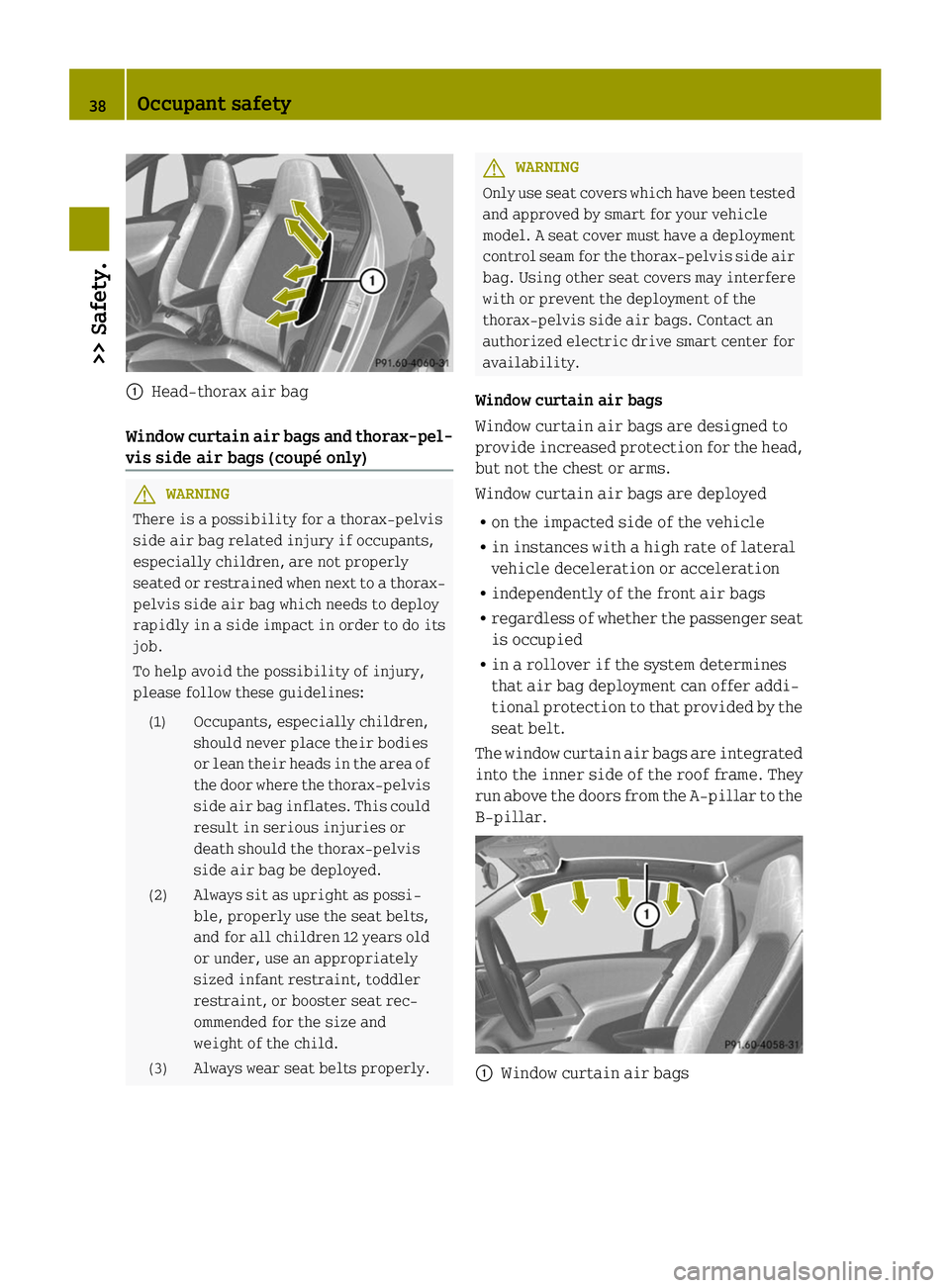
0043
Head-thorax air bag
Window curtain air bags and thorax-pel-
vis side air bags (coupé only) G
WARNING
There is a possibility for a thorax-pelvis
side air bag related injury if occupants,
especially children, are not properly
seated or restrained when next to a thorax-
pelvis side air bag which needs to deploy
rapidly in a side impact in order to do its
job.
To help avoid the possibility of injury,
please follow these guidelines:
(1) Occupants, especially children, should never place their bodies
or lean their heads in the area of
the door where the thorax-pelvis
side air bag inflates. This could
result in serious injuries or
death should the thorax-pelvis
side air bag be deployed.
(2) Always sit as upright as possi- ble, properly use the seat belts,
and for all children 12 years old
or under, use an appropriately
sized infant restraint, toddler
restraint, or booster seat rec-
ommended for the size and
weight of the child.
(3) Always wear seat belts properly. G
WARNING
Only use seat covers which have been tested
and approved by smart for your vehicle
model. A seat cover must have a deployment
control seam for the thorax-pelvis side air
bag. Using other seat covers may interfere
with or prevent the deployment of the
thorax-pelvis side air bags. Contact an
authorized electric drive smart center for
availability.
Window curtain air bags
Window curtain air bags are designed to
provide increased protection for the head,
but not the chest or arms.
Window curtain air bags are deployed
R on the impacted side of the vehicle
R in instances with a high rate of lateral
vehicle deceleration or acceleration
R independently of the front air bags
R regardless of whether the passenger seat
is occupied
R in a rollover if the system determines
that air bag deployment can offer addi-
tional protection to that provided by the
seat belt.
The window curtain air bags are integrated
into the inner side of the roof frame. They
run above the doors from the A-pillar to the
B-pillar. 0043
Window curtain air bags 38
Occupant safety>> Safety.
Page 45 of 222
Unsecured or improperly positioned cargo
increases a child’s risk of injury in the
event of
R strong braking maneuvers
R sudden changes of direction
R an accident
Infant and child restraint system We recommend all infants and children be
properly restrained at all times while the
vehicle is in operation.
The passenger lap-shoulder belt has a spe-
cial seat belt retractor for secure fasten-
ing of child restraints.
To fasten a child restraint, follow all
mounting instructions provided by the
child restraint manufacturer. Then pull the
shoulder seat belt out completely and let it
retract. During seat belt retraction, a
ratcheting sound can be heard to indicate
that the special seat belt retractor is acti-
vated. The seat belt is now locked. Push
down on child restraint to take up any
slack.
To deactivate, release seat belt buckle and
let seat belt retract completely. To deac-
tivate the special seat belt retractor for
the passenger seat, the passenger seat must
be in the most backward position. The seat
belt can again be used in the usual manner. G
WARNING
Never release the seat belt buckle while the
vehicle is in motion, since the special seat
belt retractor will be deactivated.
The use of infant or child restraints is
required by law in all 50 states, the Dis-
trict of Columbia, the U.S. territories, and
all Canadian provinces and territories.
Infants and small children should be seated
in an appropriate infant or child restraint
system properly secured in accordance
with the manufacturer’s instructions for
the child restraint, that complies with U.S.
Federal Motor Vehicle Safety Standards 213 and 225 and Canadian Motor Vehicle Safety
Standards 213, 213.1 and 213.2.
A statement by the child restraint manu-
facturer of compliance with these stand-
ards can be found on the instruction label
on the restraint and in the instruction
manual provided with the restraint.
When using any infant restraint, toddler
restraint, or booster seat be sure to care-
fully read and follow all manufacturer’s
instructions for installation and use.
Please read and observe warning labels
affixed to the inside of the vehicle and to
infant or child restraints.
G
WARNING
Children 12 years old and under must be
seated and properly secured in an appro-
priately sized infant restraint, toddler
restraint, or booster seat recommended for
the size and weight of the child.
The infant or child restraint must be prop-
erly secured with the vehicle’s seat belt
fully in accordance with the child seat
manufacturer’s instructions.
Occupants, especially children, should
never place their bodies or lean their
heads in the area of the door where the
head-thorax air bags (cabriolet), window
curtain air bags (coupé) and thorax-pelvis
air bags (coupé) inflates. This could result
in serious injuries or death should the
head-thorax air bags (cabriolet), window
curtain air bags (coupé) and thorax-pelvis
air bags (coupé) be triggered. Always sit as
upright as possible, properly use the seat
belt and use an appropriately sized infant
restraint, toddler restraint, or booster
seat recommended for the size and weight
of the child.
Children can be killed or seriously injured
by an inflating air bag. Note the following
important information when circumstances
require you to place a child in the
passenger seat: Occupant safety
43>> Safety.
Z
Page 48 of 222
i
Canada only:
This device complies with RSS‑210 of
Industry Canada. Operation is subject to
the following two conditions:
1. This device may not cause interfer-
ence, and
2. this device must accept any interfer-
ence received, including interference
that may cause undesired operation of
the device.
Any unauthorized modification to this
device could void the user’s authority to
operate the equipment.
The product label with FCC ID and IC cer-
tification number can be found in the
battery case. Driving safety systems
Introduction
G
WARNING
The following factors increase the risk of
accidents:
R Excessive speed, especially in turns
R Wet and slippery road surfaces
R Following another vehicle too closely
The driving safety systems described in
this section cannot reduce these risks or
prevent the natural laws of physics from
acting on the vehicle.
Always adapt your driving style to the pre-
vailing road and weather and traffic con-
ditions and keep a safe distance to other
road users and objects on the street.
i In winter operation, the maximum
effectiveness of the ABS, the hydraulic
brake assistant, and the ESP ®
is only ach-
ieved with winter tires (Y page 146) or
snow chains* as required. Antilock Brake System (ABS)
G
WARNING
Do not pump the brake pedal. Use firm,
steady brake pedal pressure instead. Pump-
ing the brake pedal defeats the purpose of
the ABS and significantly reduces braking
effectiveness.
The Antilock BrakeSystem (ABS) regulates
the brake pressure so that the wheels do not
lock during braking. This allows you to
maintain the ability to steer your vehicle.
On slippery road surfaces, the ABS will
respond even to light brake pressure.
The ABS indicator lamp in the instrument
cluster (Y page 24) comes on when you
switch on the ignition. It goes out when the
drive system is active.
Braking At the instant one of the wheels is about to
lock up, a slight pulsation can be felt in
the brake pedal, indicating that the ABS is
regulating the brake pressure.
X
Keep firm and steady pressure on the
brake pedal while experiencing the pul-
sation.
Continuous, steady brake pedal pressure
yields the advantages provided by the ABS,
namely braking power and the ability to
steer the vehicle.
A pulsating brake pedal can be an indica-
tion of hazardous road conditions and
functions as a reminder to take extra care
while driving.
Emergency brake maneuver X
Keep continuous full pressure on the
brake pedal. G
WARNING
When the ABS is malfunctioning, the
hydraulic brake assistant and the ESP ®
are
also switched off. 46
Driving safety systems>> Safety.
* optional
Page 49 of 222
When the ABS is malfunctioning, the wheels
may lock during hard braking, reducing
steering capability and extending the
braking distance. G
WARNING
The ABS cannot prevent the natural laws of
physics from acting on the vehicle, nor can
it increase braking or steering efficiency
beyond that afforded by the condition of the
vehicle brakes and tires or the traction
afforded. The ABS cannot prevent acci-
dents, including those resulting from
excessive speed in turns, following
another vehicle too closely, or hydroplan-
ing. Only a safe, attentive, and skillful
driver can prevent accidents. The capabil-
ities of an ABS equipped vehicle must never
be exploited in a reckless or dangerous
manner which could jeopardize the user’s
safety or the safety of others. Electronic Stability Program (ESP
®
)
Your vehicle is equipped with the Elec-
tronic Stability Program (ESP ®
). The ESP ®
is operational as soon as the drive system
is switched on and it monitors the vehicle’s
traction (force of adhesive friction
between the tires and the road surface) and
handling.
The ESP ®
recognizes when a wheel is spin-
ning or if the vehicle starts to skid. By
applying brakes to the appropriate wheel
and by limiting the power output, the ESP ®
works to stabilize the vehicle. The ESP ®
is
especially useful while driving off and on
wet or slippery road surfaces. The ESP ®
also
stabilizes the vehicle during braking and
steering maneuvers.
The ESP ®
warning lamp 00E5in the instru-
ment cluster flashes when the ESP ®
is
engaged.
The ESP ®
warning lamp 00E5in the instru-
ment cluster comes on when you switch on the ignition. It goes out when the drive
system is active.
Depending on the driving situation, the
ESP ®
R reduces the speed
R selectively brakes individual wheels
R equalizes the speed of the driven wheels
R stabilizes the vehicle when braking
R assists you in evasive maneuvers on all
roads G
WARNING
If the ESP ®
warning lamp 00E5in the
instrument cluster flashes, proceed as fol-
lows:
R While driving off, apply as little throt-
tle as possible.
R While driving, ease up on the accelerator
pedal.
R Adapt your speed and driving style to the
prevailing road conditions.
Failure to observe these guidelines could
cause the vehicle to skid.
The ESP ®
cannot prevent accidents result-
ing from excessive speed. G
WARNING
The ESP ®
cannot prevent the natural laws of
physics from acting on the vehicle, nor can
it increase the traction afforded. The
ESP ®
cannot prevent accidents, including
those resulting from excessive speed in
turns, or hydroplaning. Only a safe, atten-
tive, and skillful driver can prevent acci-
dents. The capabilities of an ESP ®
equip-
ped vehicle must never be exploited in a
reckless or dangerous manner which could
jeopardize the user’s safety or the safety of
others.
! Because the ESP ®
operates automati-
cally, the ignition must be switched off
when the parking brake is being tested
on a brake test dynamometer. Active
braking action through the ESP ®
may oth- Driving safety systems
47>> Safety. Z
Page 50 of 222
erwise seriously damage the brake sys-
tem which is not covered by the smart
Limited Warranty.
i The ESP ®
will only function properly if
you use wheels of the recommended tire
size (Y page 216). Hydraulic brake assistant
The hydraulic brake assistant operates in
emergency situations. If you apply the
brakes very quickly, the hydraulic brake
assistant automatically provides full
brake boost, thereby potentially reducing
the braking distance.
X Apply continuous full braking pressure
until the emergency braking situation is
over.
The ABS will prevent the wheels from
locking.
When you release the brake pedal, the
brakes function again as normal. The
hydraulic brake assistant is then deacti-
vated. G
WARNING
When the hydraulic brake assistant is mal-
functioning, the brake system is still func-
tioning normally, but without the addi-
tional brake boost that would normally be
provided during an emergency braking
maneuver. Therefore, the braking distance
may increase. G
WARNING
The hydraulic brake assistant cannot pre-
vent the natural laws of physics from acting
on the vehicle, nor can it increase braking
efficiency beyond that afforded by the con-
dition of the vehicle brakes and tires or the
traction afforded. The hydraulic brake
assistant cannot prevent accidents,
including those resulting from excessive
speed in turns, following another vehicle
too closely, or hydroplaning. Only a safe,
attentive, and skillful driver can prevent accidents. The capabilities of a hydraulic
brake assistant equipped vehicle must
never be exploited in a reckless or dan-
gerous manner which could jeopardize the
user’s safety or the safety of others.
Activating the hazard warning flasher
after an emergency braking maneuver
If you bring the vehicle to a complete stop
by strongly braking at a speed of more than
43 mph (70 km/h), the hazard warning
flasher comes on automatically as soon as
the vehicle is at a standstill. The hazard
warning flasher will remain on until it is
switched off using the hazard warning
flasher switch (Y page 68) or until the
speed of the vehicle has exceeded 6 mph
(10 km/h). Acoustic Vehicle Indication*
Vehicles with electric motors develop con-
siderably lower driving noises than vehi-
cles with combustion engines. Therefore
your vehicle in traffic might not be acous-
tically noticed by other road users in cer-
tain situations.
In order to avoid this, a built-in sound
generator emits a certain noise (Acoustic
Vehicle Indication) within a speed range
between 0 to 20 mph (30 km/h). Thus, other
road users, especially pedestrians and
bicycle riders can notice your vehicle bet-
ter. Acoustic Vehicle Indication can also
be heard inside of the vehicle.
The volume of Acoustic Vehicle Indication
depends on the current engine speed (rpm).
The stronger you accelerate, the louder the
noise. At speed of more than 20 mph
30 km/h the noise is switched off. From this
speed on the natural noises of the vehicle
are sufficient so that other road users can
notice the vehicle on time. 48
Driving safety systems>> Safety.
* optional
Page 57 of 222
X
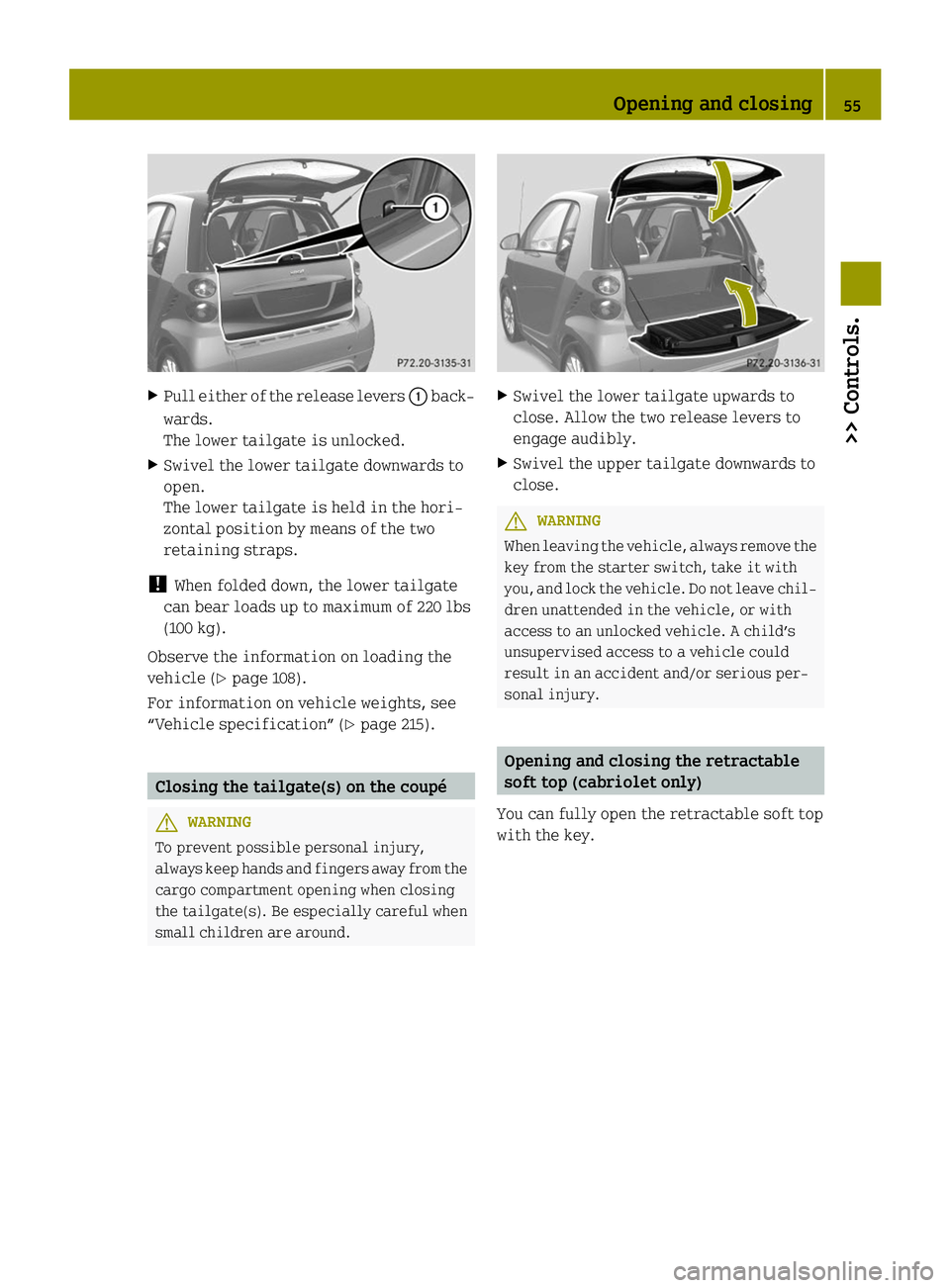
Pull either of the release levers 0043back-
wards.
The lower tailgate is unlocked.
X Swivel the lower tailgate downwards to
open.
The lower tailgate is held in the hori-
zontal position by means of the two
retaining straps.
! When folded down, the lower tailgate
can bear loads up to maximum of 220 lbs
(100 kg).
Observe the information on loading the
vehicle (Y page 108).
For information on vehicle weights, see
“Vehicle specification” (Y page 215).Closing the tailgate(s) on the coupé
G
WARNING
To prevent possible personal injury,
always keep hands and fingers away from the
cargo compartment opening when closing
the tailgate(s). Be especially careful when
small children are around. X
Swivel the lower tailgate upwards to
close. Allow the two release levers to
engage audibly.
X Swivel the upper tailgate downwards to
close. G
WARNING
When leaving the vehicle, always remove the
key from the starter switch, take it with
you, and lock the vehicle. Do not leave chil-
dren unattended in the vehicle, or with
access to an unlocked vehicle. A child’s
unsupervised access to a vehicle could
result in an accident and/or serious per-
sonal injury. Opening and closing the retractable
soft top (cabriolet only)
You can fully open the retractable soft top
with the key. Opening and closing
55>> Controls. Z
Page 58 of 222
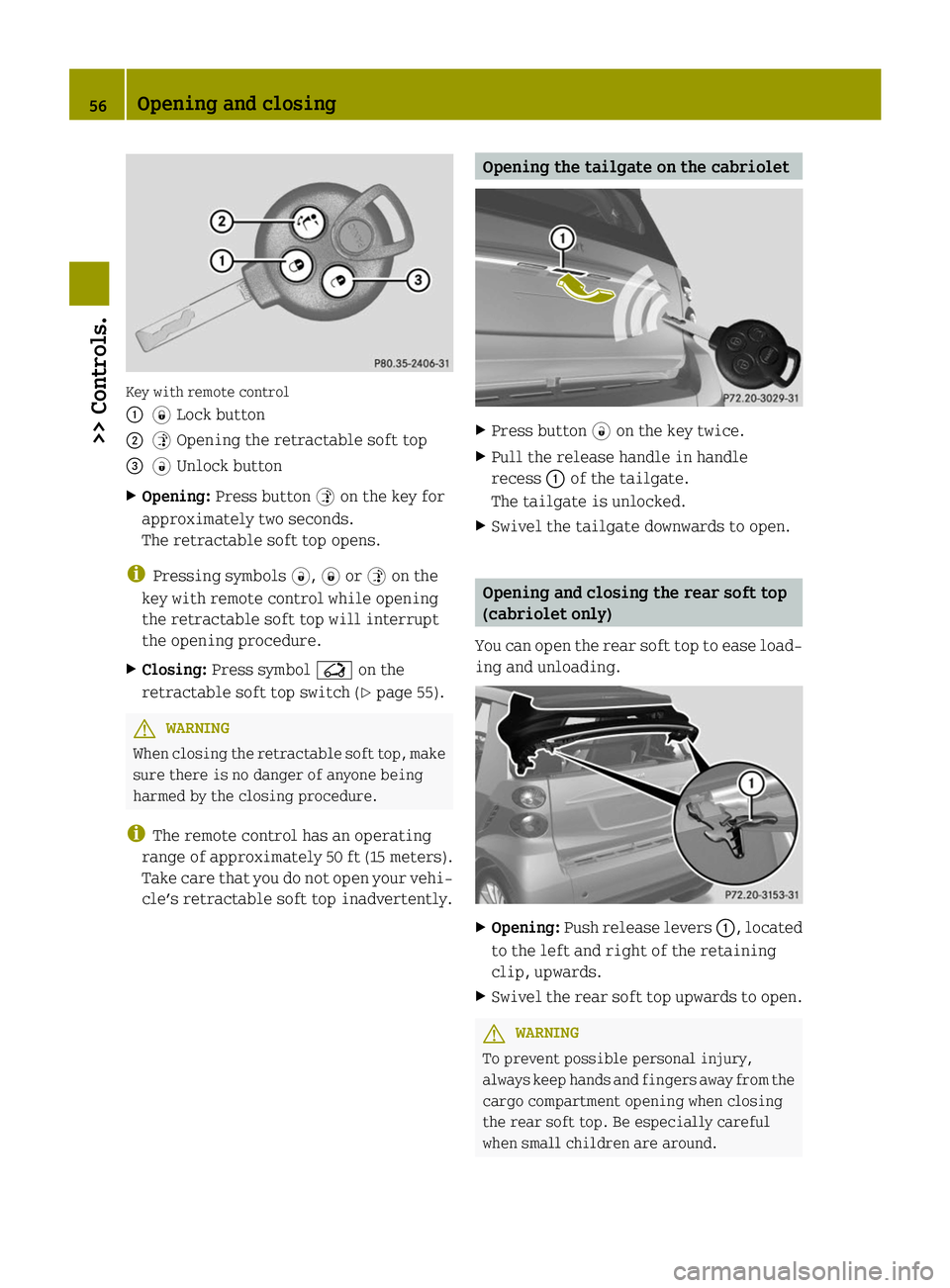
Key with remote control
0043
0038Lock button
0044 0035Opening the retractable soft top
0087 0034Unlock button
X Opening: Press button 0035on the key for
approximately two seconds.
The retractable soft top opens.
i Pressing symbols 0034,0038or0035 on the
key with remote control while opening
the retractable soft top will interrupt
the opening procedure.
X Closing: Press symbol 0055on the
retractable soft top switch (Y page 55).G
WARNING
When closing the retractable soft top, make
sure there is no danger of anyone being
harmed by the closing procedure.
i The remote control has an operating
range of approximately 50 ft (15 meters).
Take care that you do not open your vehi-
cle’s retractable soft top inadvertently. Opening the tailgate on the cabriolet
X
Press button 0034on the key twice.
X Pull the release handle in handle
recess 0043of the tailgate.
The tailgate is unlocked.
X Swivel the tailgate downwards to open. Opening and closing the rear soft top
(cabriolet only)
You can open the rear soft top to ease load-
ing and unloading. X
Opening: Push release levers 0043, located
to the left and right of the retaining
clip, upwards.
X Swivel the rear soft top upwards to open. G
WARNING
To prevent possible personal injury,
always keep hands and fingers away from the
cargo compartment opening when closing
the rear soft top. Be especially careful
when small children are around. 56
Opening and closing>> Controls.